Electrostatics (CBSE 12)
Cheatsheet Content
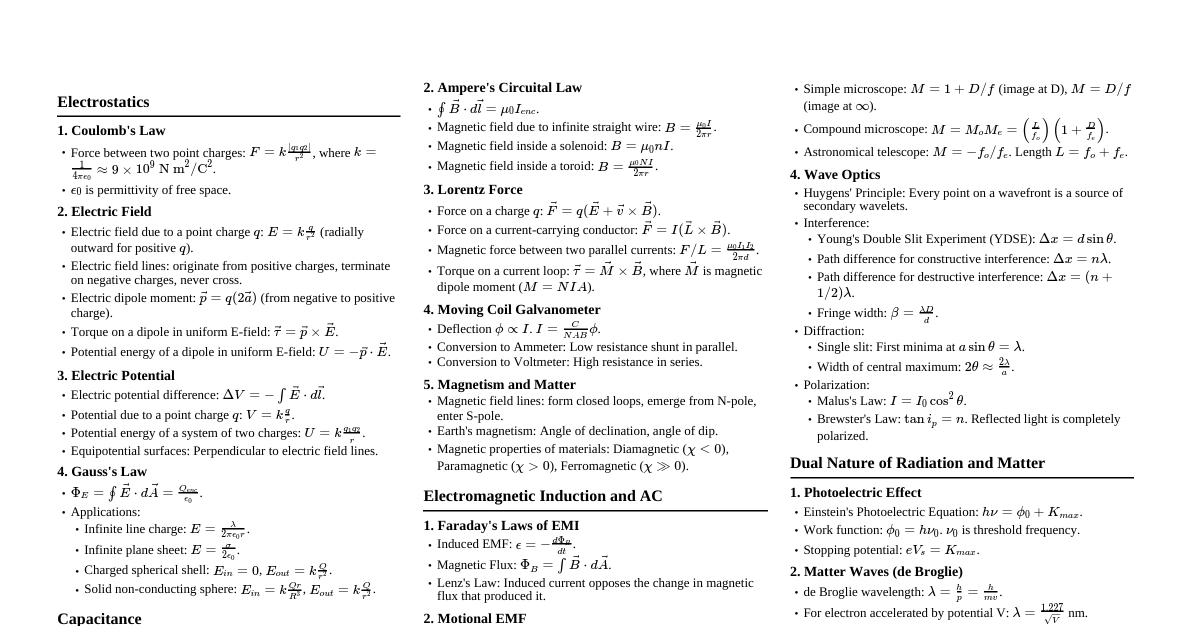
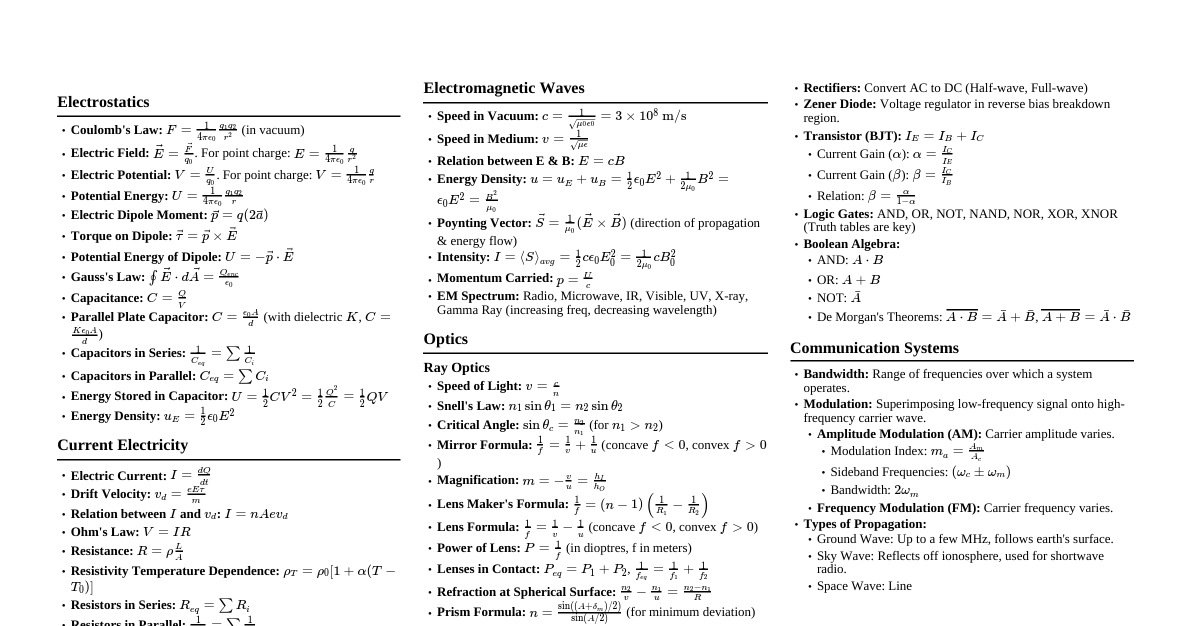
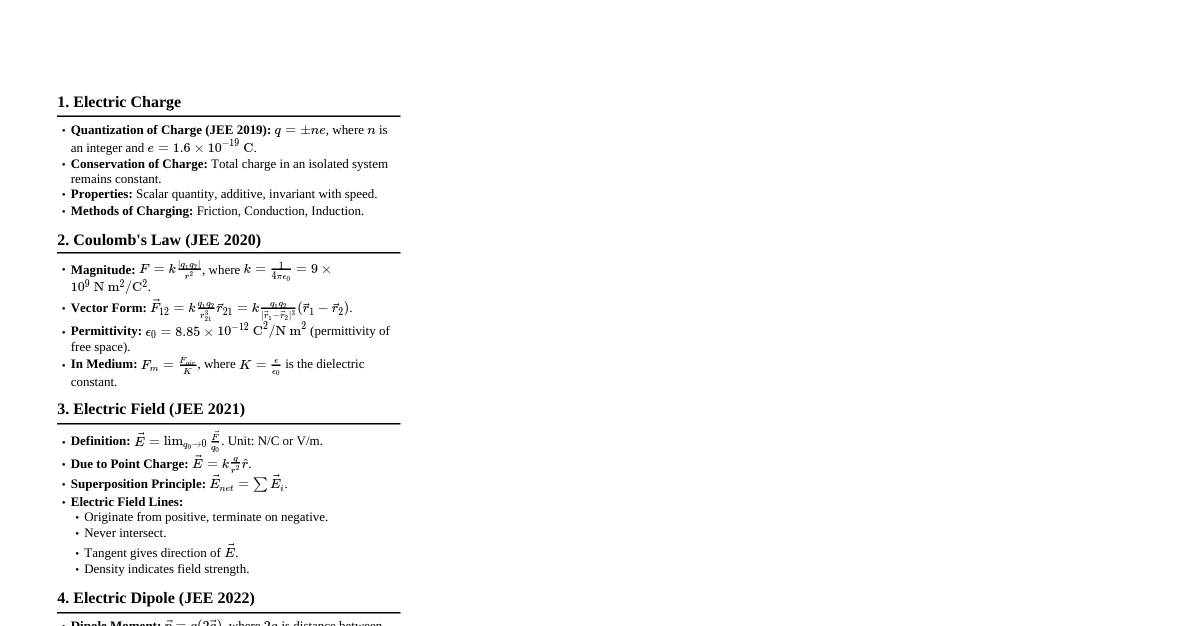
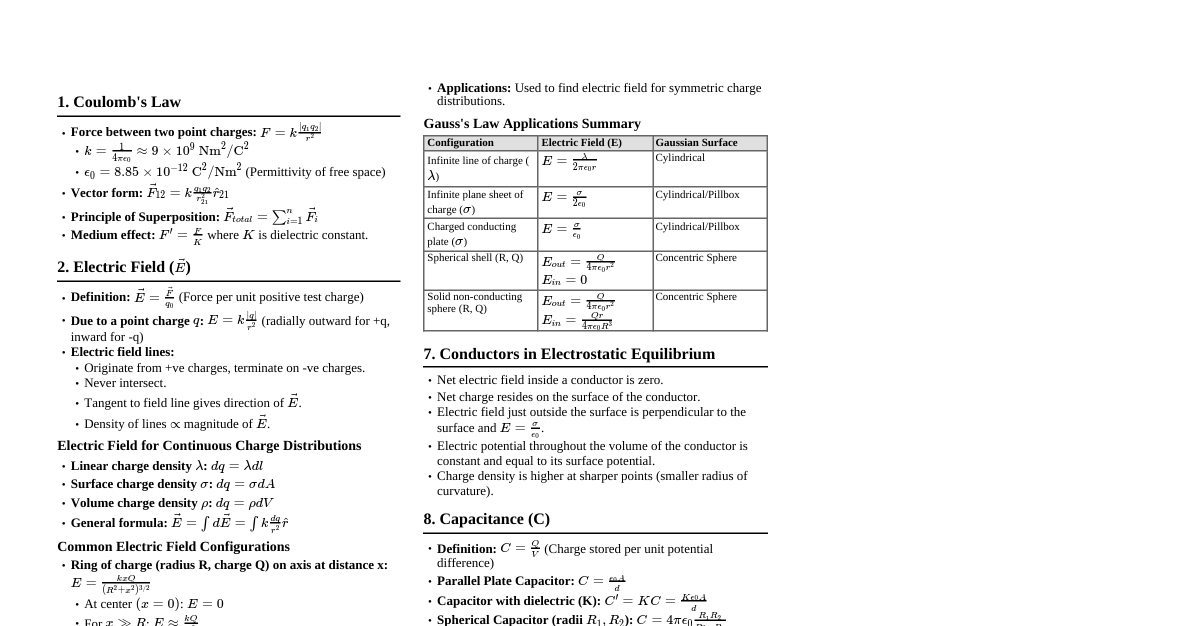
### Coulomb's Law - **Formula:** $F = k \frac{|q_1 q_2|}{r^2}$, where $k = \frac{1}{4\pi\epsilon_0} = 9 \times 10^9 \text{ Nm}^2/\text{C}^2$ - **Vector Form:** $\vec{F}_{12} = k \frac{q_1 q_2}{r^3} \vec{r}_{12}$ - **Permittivity:** $\epsilon_0$ is permittivity of free space. $\epsilon = \epsilon_0 \epsilon_r$ for a medium. - **Superposition Principle:** Total force on a charge is the vector sum of forces due to all other charges. ### Electric Field - **Definition:** $\vec{E} = \frac{\vec{F}}{q_0}$ (force per unit positive test charge) - **Due to Point Charge:** $E = k \frac{|q|}{r^2}$ - **Due to Electric Dipole:** - **Axial Line:** $E_{axial} = \frac{2kp}{r^3}$ (for $r \gg a$) - **Equatorial Line:** $E_{equatorial} = \frac{kp}{r^3}$ (for $r \gg a$) - **Electric Dipole Moment:** $\vec{p} = q(2\vec{a})$, where $2\vec{a}$ is vector from $-q$ to $+q$. - **Torque on Dipole in Uniform Field:** $\vec{\tau} = \vec{p} \times \vec{E}$ - **Potential Energy of Dipole:** $U = -\vec{p} \cdot \vec{E} = -pE\cos\theta$ ### Electric Potential & Potential Energy - **Electric Potential (V):** Work done per unit positive test charge ($V = \frac{W}{q_0}$) - **Potential Difference:** $V_B - V_A = -\int_A^B \vec{E} \cdot d\vec{l}$ - **Due to Point Charge:** $V = k \frac{q}{r}$ - **Due to Electric Dipole:** - **Axial Line:** $V = \frac{kp\cos\theta}{r^2}$ ($V = \frac{kp}{r^2}$ on axis, $V=0$ on equator) - **Electric Potential Energy (U):** - **Two Point Charges:** $U = k \frac{q_1 q_2}{r}$ - **In External Field:** $U = qV$ - **Dipole in External Field:** $U = -\vec{p} \cdot \vec{E}$ - **Relation between E and V:** $E = -\frac{dV}{dr}$ (for 1D) or $\vec{E} = -\nabla V$ ### Gauss's Law & Applications - **Electric Flux ($\Phi_E$):** $\Phi_E = \int \vec{E} \cdot d\vec{A} = E A \cos\theta$ - **Gauss's Law:** $\Phi_E = \frac{q_{enc}}{\epsilon_0}$ - **Applications:** - **Infinitely Long Straight Wire:** $E = \frac{\lambda}{2\pi\epsilon_0 r}$ - **Uniformly Charged Infinite Plane Sheet:** $E = \frac{\sigma}{2\epsilon_0}$ - **Uniformly Charged Thin Spherical Shell:** - Outside ($r \ge R$): $E = \frac{Q}{4\pi\epsilon_0 r^2}$, $V = \frac{Q}{4\pi\epsilon_0 r}$ - Inside ($r ### Capacitors & Capacitance - **Capacitance (C):** $C = \frac{Q}{V}$ - **Parallel Plate Capacitor:** $C = \frac{\epsilon_0 A}{d}$ - **With Dielectric:** $C_m = K C_0 = \frac{K\epsilon_0 A}{d}$ - **Series Combination:** $\frac{1}{C_{eq}} = \frac{1}{C_1} + \frac{1}{C_2} + ...$ - **Parallel Combination:** $C_{eq} = C_1 + C_2 + ...$ - **Energy Stored:** $U = \frac{1}{2}CV^2 = \frac{1}{2}\frac{Q^2}{C} = \frac{1}{2}QV$ - **Energy Density:** $u = \frac{1}{2}\epsilon_0 E^2$ ### Dielectrics & Polarization - **Dielectric Constant (K or $\epsilon_r$):** $K = \frac{E_0}{E}$ (ratio of field in vacuum to field in dielectric) - **Polarization (P):** Dipole moment per unit volume. $\vec{P} = \chi_e \epsilon_0 \vec{E}$, where $\chi_e$ is electric susceptibility. - **Relation:** $K = 1 + \chi_e$