Indian History (1919-1947)
Cheatsheet Content
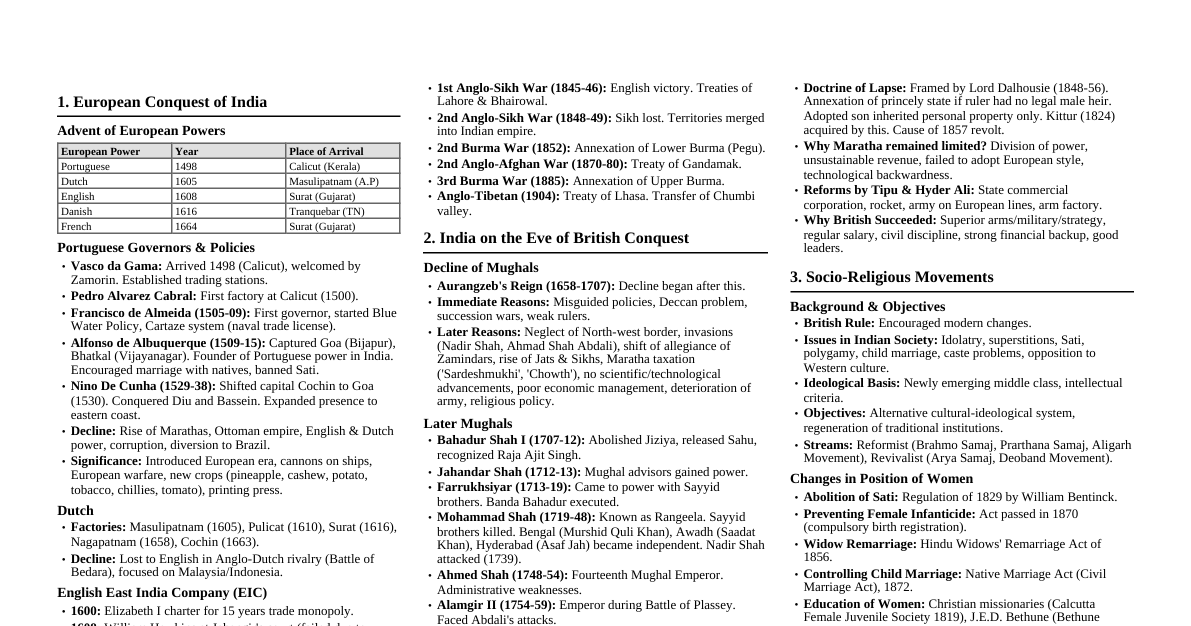
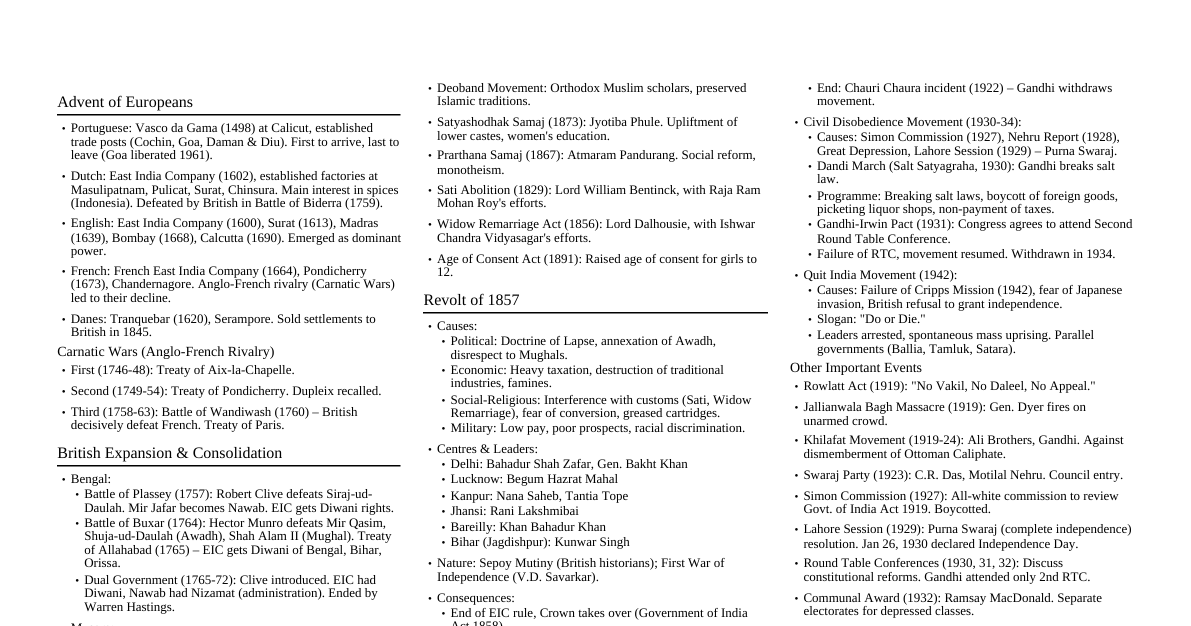
### Gandhian Mass Movements (1919-1942) - **Nature:** Transformed Indian nationalism from an elite-driven movement to a mass-based struggle, involving diverse sections of society including peasants, workers, women, and students. Emphasized moral authority and non-violent resistance. - **Methods:** - **Ahimsa (Non-violence):** The core principle, applied rigorously in all actions. - **Satyagraha:** "Truth-force" or "soul-force," a method of non-violent resistance through civil disobedience and non-cooperation. - **Non-Cooperation:** Boycott of British institutions (schools, courts, legislative councils), foreign goods, and renunciation of titles. - **Civil Disobedience:** Deliberate and non-violent breach of unjust laws and government decrees. - **Constructive Programme:** Promotion of Khadi (hand-spun cloth), Hindu-Muslim unity, removal of untouchability, village industries, and basic education, aiming for social reform and self-reliance. - **Key Movements:** - **Non-Cooperation Movement (1920-1922):** Boycott of legislature elections, government schools, courts, and foreign clothes. Unified Hindus and Muslims (Khilafat Movement). - **Civil Disobedience Movement (1930-1934):** Initiated with the Dandi March (Salt Satyagraha), challenging the British salt monopoly. Included boycotts, non-payment of taxes, and forest satyagrahas. - **Quit India Movement (1942):** "Do or Die" call for immediate British withdrawal during WWII. Led to widespread spontaneous protests, sabotage, and formation of parallel governments in some areas, despite leadership arrests. - **Impact on Indian Nationalism:** - **Mass Mobilization:** Brought millions into the freedom struggle, making it a truly national movement. - **Psychological Empowerment:** Instilled fearlessness and self-respect among Indians, eroding the aura of British invincibility. - **Ethical Foundation:** Provided a moral high ground against colonial rule, gaining international sympathy. - **Political Awareness:** Raised political consciousness among the masses. - **Weakened British Authority:** Made governance increasingly difficult and unsustainable for the British. ### Constitutional Developments Leading to Indian Independence - **Cripps Mission (1942):** - **Context:** Sent by Britain during WWII to secure full Indian cooperation. - **Proposals:** Offered Dominion Status after the war, a constitution-making body, and the right for provinces to opt out of the Indian Union. - **Rejection:** Failed as the Indian National Congress (INC) demanded immediate full independence and a truly representative national government, while the Muslim League rejected it for not guaranteeing Pakistan. - **Wavell Plan (1945):** - **Context:** Proposed by Viceroy Lord Wavell after the war, aiming to break the political deadlock. - **Proposals:** Envisaged a new Executive Council where all members, except the Viceroy and Commander-in-Chief, would be Indians, with equal representation for caste Hindus and Muslims. - **Rejection:** Failed at the Simla Conference due to Jinnah's insistence that only the Muslim League could nominate Muslim members, which the INC rejected. - **Cabinet Mission Plan (1946):** - **Context:** Sent by the British Labour government to negotiate a peaceful transfer of power. - **Proposals:** Rejected the idea of a separate Pakistan, proposing a three-tier federal structure for India: 1. A Union Centre dealing only with Defence, Foreign Affairs, and Communications. 2. Provinces grouped into three sections (A, B, C) with regional autonomy, allowing for Muslim-majority provinces to form separate groups. 3. A Constituent Assembly to draft the new constitution. - **Outcome:** Initially accepted by both INC and Muslim League, but differing interpretations and Jinnah's call for "Direct Action Day" eventually led to its failure and increased communal violence. - **Mountbatten Plan (June 3, 1947):** - **Context:** Proposed by the last Viceroy, Lord Mountbatten, amidst escalating communal violence. - **Proposals:** Outlined the partition of British India into two independent Dominions: India and Pakistan. Provided for: - Partition of Punjab and Bengal. - Referendum in NWFP and Sylhet (Assam) to decide their fate. - Princely states to accede to either India or Pakistan. - Transfer of power by August 15, 1947. - **Outcome:** Accepted by all major parties (INC, Muslim League, Sikh representatives) as the only viable option to prevent further bloodshed, leading to the Indian Independence Act of 1947. ### Partition: Causes and Impact on Indian Society and Culture - **Causes:** - **British "Divide and Rule" Policy:** Fostering communal divisions through policies like separate electorates. - **Rise of Communalism:** Growth of religious nationalism (Hindu Mahasabha, Muslim League) and the "Two-Nation Theory" advocated by Jinnah. - **Lahore Resolution (1940):** Formal demand by the Muslim League for separate Muslim states. - **Failure of Negotiations:** Inability of Cripps and Cabinet Missions to find a mutually acceptable solution for a united India. - **Escalating Communal Violence:** Widespread riots (e.g., Calcutta Killings 1946) made the idea of a united India seem impractical. - **Congress's Acceptance:** As a painful last resort to achieve independence and avert civil war, given the deteriorating law and order situation. - **Impact on Indian Society and Culture:** - **Mass Migration:** An estimated 14-18 million people (Hindus/Sikhs to India, Muslims to Pakistan) were forcibly displaced, one of the largest migrations in history. - **Unprecedented Violence:** Widespread communal riots, massacres, abduction, and rape, leading to an estimated 1-2 million deaths. - **Refugee Crisis:** Massive humanitarian challenge of housing, feeding, and rehabilitating millions of refugees. - **Economic Dislocation:** Division of assets, disruption of trade, and loss of livelihoods. - **Social Trauma:** Deep psychological scars, intergenerational trauma, and persistent memories of loss and brutality. - **Cultural Loss & Redefinition:** Division of shared cultural heritage, languages, and traditions, leading to new cultural identities and narratives in both nations. - **Geo-political Legacy:** Created enduring animosity and conflict between India and Pakistan, shaping regional politics. ### Critically Evaluate Challenges of Communalism in Late Colonial India - **Definition:** Communalism is an ideology that promotes the interests of one religious community over others, often leading to social, economic, and political conflict. It asserts that religious identity is the primary basis for political action and nationhood. - **Challenges Posed:** - **Fragmented National Unity:** Undermined the idea of a composite Indian nationalism, replacing it with religious fault lines. - **Political Exploitation:** British policies (e.g., separate electorates from 1909) institutionalized communal divisions, allowing political leaders to mobilize support along religious lines. - **Rise of Communal Organizations:** Emergence and growth of organizations like the All-India Muslim League and Hindu Mahasabha, which articulated distinct religious identities and demands. - **Escalation of Violence:** Frequent and increasingly severe communal riots, particularly in the 1920s and 1940s, created an atmosphere of fear and distrust. - **Obstruction to Constitutional Reforms:** Communal demands often stalled constitutional negotiations, making it difficult to reach a consensus on India's future. - **Special Reference to the Pakistan Resolution (1940):** - **Watershed Moment:** The Lahore Resolution, passed by the Muslim League, formally articulated the demand for separate "independent states" for Muslim-majority areas in the North-Western and Eastern parts of India. - **Two-Nation Theory:** This resolution was a direct outcome and reinforcement of the "Two-Nation Theory" (that Hindus and Muslims were two distinct nations) propagated by Jinnah and the League. - **Irreconcilable Demands:** It made the demands of the Muslim League seemingly irreconcilable with the Congress's vision of a united, secular India, thus pushing the country towards partition. - **Intensified Communal Divide:** The resolution galvanized Muslim support for a separate homeland but simultaneously deepened the chasm between Hindu and Muslim political aspirations, making compromise increasingly difficult and contributing significantly to the eventual partition of India. ### Significance of the Non-Cooperation Movement (1920-1922) - **Mass Mobilization:** It was the first truly mass-based movement under Gandhi's leadership, drawing millions from various social strata into the freedom struggle. - **Shift in Leadership:** Transformed the Indian National Congress from an elite body into a people's organization with a broader base. - **Introduction of New Methods:** Popularized the Gandhian methods of non-violent non-cooperation and civil disobedience (Satyagraha) as effective tools against colonial rule. - **Hindu-Muslim Unity:** Launched in conjunction with the Khilafat Movement, it fostered unprecedented Hindu-Muslim unity against the British, albeit temporarily. - **Economic Impact:** Boycott of foreign goods boosted Indian industries and the use of Khadi, promoting self-reliance. - **Psychological Impact:** Instilled courage and self-confidence among the Indian populace, eroding the fear of British authority. - **Paved the Way:** Laid the groundwork and provided a blueprint for future large-scale movements like the Civil Disobedience and Quit India Movements. Though it did not achieve Swaraj, it fundamentally altered the nature and trajectory of the Indian freedom struggle. ### Role of Subhas Chandra Bose and the Indian National Army (INA) in India’s Freedom Struggle - **Subhas Chandra Bose:** A radical nationalist leader who believed in more aggressive means to achieve independence. Disagreed with Gandhi's non-violent approach and sought external assistance. - Escaped from British detention in 1941 and traveled to Germany and then Southeast Asia. - Reorganized and led the Indian National Army (INA) from 1943, becoming its "Netaji." - Formed the Provisional Government of Free India (Azad Hind Government) in Singapore. - **Indian National Army (INA):** - Composed primarily of Indian prisoners of war captured by Japan in Southeast Asia (Malaya, Singapore). - Fought alongside Japanese forces against the British in regions like Burma and Northeast India (e.g., Battle of Imphal-Kohima). - Its motto was "Unity, Faith, Sacrifice." - **Impact and Significance:** - **Symbol of Resistance:** Inspired immense patriotic fervor within India and abroad, demonstrating that Indians were willing to fight for freedom. - **Challenge to British Authority:** The INA's existence and actions, particularly the loyalty of Indian soldiers to the INA rather than the British, profoundly disturbed the colonial power. - **INA Trials (1945-46):** The British decision to try INA officers for treason sparked widespread public outrage and protests across India, uniting various political factions. - **Catalyst for Mutinies:** The trials and the public's support for the INA significantly contributed to the disillusionment within the Indian armed forces, culminating in the Royal Indian Navy Mutiny of 1946. - **Accelerated Independence:** The British realized they could no longer rely on the loyalty of the Indian army, a critical pillar of their rule, thereby accelerating their decision to withdraw from India. ### Royal Indian Navy (RIN) Mutiny of 1946 and its Importance - **Causes:** - **Poor Conditions:** Substandard food, racial discrimination, and abusive treatment by British officers. - **Nationalist Sentiment:** Growing desire for independence, inspired by the INA trials and the general anti-British mood. - **Post-War Discontent:** Demobilization of soldiers after WWII and uncertain futures. - **Events:** - Started on February 18, 1946, by ratings on HMS Talwar in Bombay, protesting food and discrimination. - Quickly spread to other naval establishments, including Karachi and Calcutta, involving thousands of sailors. - Mutineers hoisted the flags of the Indian National Congress, Muslim League, and the Communist Party, demanding the release of INA prisoners and "Quit India." - Sympathetic strikes and protests erupted in cities like Bombay. - **Importance:** - **Last Nail in the Coffin:** Demonstrated the complete erosion of loyalty within a crucial segment of the British Indian armed forces, which was vital for maintaining colonial rule. - **Hindu-Muslim Unity:** The mutiny showed remarkable unity among ratings across religious lines, a fact that deeply worried the British. - **Accelerated British Withdrawal:** Convinced the British government that maintaining control over India was no longer feasible, directly influencing their decision to expedite the transfer of power. - **Warning to Indian Leaders:** Highlighted the potential for widespread unrest and anarchy if independence was delayed, prompting them to accept partition as a quicker route to power. ### Evolution of Parliamentary Democracy in India After Independence - **Foundational Principles:** India adopted a parliamentary democratic system based on the Westminster model, with a President as the ceremonial head of state and a Prime Minister as the head of government, responsible to the Lok Sabha (Lower House of Parliament). - **Constituent Assembly (1946-1949):** Drafted the Indian Constitution, establishing a sovereign, socialist, secular, and democratic republic. - **Universal Adult Franchise:** A revolutionary step, granting voting rights to all citizens aged 21 (later lowered to 18) from the very first general election (1951-52), irrespective of caste, creed, gender, or economic status. - **Regular Elections:** Free and fair elections have been held consistently, enabling peaceful transfers of power and reinforcing democratic norms. - **Multi-Party System:** Despite initial dominance by the Indian National Congress, a vibrant multi-party system emerged, reflecting India's vast diversity and regional aspirations. - **Independent Institutions:** Establishment of robust democratic institutions like the Election Commission, Supreme Court, Comptroller and Auditor General, and Public Service Commissions to ensure checks and balances and uphold the rule of law. - **Constitutional Amendments:** The Constitution has been amended numerous times (over 100) to adapt to changing social, economic, and political realities, demonstrating its flexibility and resilience (e.g., Panchayati Raj Institutions for local self-governance). - **Challenges and Resilience:** Faced challenges like regionalism, communalism, casteism, corruption, and emergency rule (1975-77), but the democratic framework has consistently proven its resilience, making India the world's largest functioning democracy. ### Impact of Partition on Refugees and Rehabilitation - **Immediate Impact:** - **Mass Exodus:** Millions of people (Hindus and Sikhs from West Pakistan, Muslims from East Punjab and other parts of India) were forced to abandon their homes and migrate across newly drawn borders. - **Unspeakable Violence:** The migration was accompanied by horrific communal violence, massacres, sexual violence, and destruction of property, creating deep trauma. - **Loss of Life:** Estimates suggest up to 1-2 million lives were lost during the Partition violence. - **Refugee Crisis:** - **Humanitarian Catastrophe:** Millions arrived as destitute refugees, requiring immediate relief, shelter, and food. - **Refugee Camps:** Massive temporary camps were set up, often in dire conditions, to accommodate the displaced. - **Rehabilitation Efforts (India):** - **Ministry of Relief and Rehabilitation:** Established to manage the crisis. - **Resettlement:** Provision of land for farmers, housing for urban refugees (e.g., construction of new townships like Lajpat Nagar in Delhi). - **Economic Integration:** Loans, grants, and vocational training were provided to help refugees start new businesses or find employment. - **Educational Support:** Schools and educational facilities were established to ensure children's education. - **Psychological Support:** Though rudimentary by modern standards, efforts were made to help people cope with trauma. - **Long-term Impact:** - **Demographic Shift:** Significant changes in the population composition of affected regions. - **Economic Strain:** Placed immense pressure on the nascent Indian economy. - **Social and Cultural Adaptation:** Refugees faced challenges integrating into new societies, often struggling with identity and cultural loss. - **Political Legacy:** Created a significant refugee vote bank and influenced policies, particularly in states like Punjab and West Bengal. - **Enduring Trauma:** The memories and experiences of Partition continue to affect generations, influencing social narratives and collective memory in both India and Pakistan. ### Basic Principles of India’s Foreign Policy During the Nehruvian Era (1947-1964) - **Non-Alignment (NAM):** - **Core Principle:** India's refusal to join either the US-led (capitalist) or USSR-led (communist) military blocs during the Cold War. - **Objective:** To maintain independence in foreign policy decision-making, judge international issues on their merits, and promote world peace. - **Role:** Jawaharlal Nehru was a co-founder of the Non-Aligned Movement, emphasizing a "third path" for newly independent nations. - **Anti-Colonialism and Anti-Imperialism:** - Strong advocacy for the liberation of all colonized nations in Asia and Africa. - Active support for self-determination movements globally. - **Panchsheel (Five Principles of Peaceful Coexistence):** - Formulated with China in 1954, these principles guided India's approach to international relations: 1. Mutual respect for each other's territorial integrity and sovereignty. 2. Mutual non-aggression. 3. Mutual non-interference in each other's internal affairs. 4. Equality and mutual benefit. 5. Peaceful coexistence. - **Promotion of World Peace and Disarmament:** - India actively championed nuclear disarmament and peaceful resolution of international disputes through the United Nations. - Advocated for a more equitable global order. - **Afro-Asian Solidarity:** - Played a leading role in fostering unity among newly independent nations of Asia and Africa (e.g., Bandung Conference 1955). - Aimed to create a collective voice for the Global South on the world stage. - **Economic Self-Reliance:** - Focused on developing domestic industries and reducing economic dependence on former colonial powers or major blocs. - **Challenges:** The Sino-Indian War of 1962 severely tested the principles of Panchsheel and Non-Alignment, leading to a re-evaluation of India's defense and foreign policy strategies. ### What was the Pakistan Resolution (1940)? The Pakistan Resolution, also known as the Lahore Resolution, was passed by the All-India Muslim League on March 23, 1940. It formally demanded that "the areas in which the Muslims are numerically a majority as in the North-Western and Eastern zones of India should be grouped to constitute 'Independent States' in which the constituent units shall be autonomous and sovereign." This resolution marked the Muslim League's clear demand for a separate Muslim homeland, fundamentally altering the political landscape and setting the stage for the partition of India. ### Mention two features of the Quit India Movement. 1. **"Do or Die" Call:** Mahatma Gandhi issued the famous "Do or Die" call, urging Indians to make supreme sacrifices for immediate independence, signifying a more assertive and radical phase of the freedom struggle. 2. **Leaderless Mass Uprising:** Following the swift arrest of all major Congress leaders, the movement became largely spontaneous and leaderless, characterized by mass protests, strikes, sabotage of government property, and the establishment of parallel governments in some areas, demonstrating the deep-seated anti-British sentiment among the populace. ### Who was Subhas Chandra Bose? Mention one contribution of his. Subhas Chandra Bose was a prominent Indian nationalist leader, known for his radical and militant approach to achieving India's independence. He was a former President of the Indian National Congress who disagreed with Mahatma Gandhi's non-violent methods. One significant contribution of his was **reorganizing and leading the Indian National Army (INA)**, which fought against the British in Southeast Asia during World War II, aiming to liberate India through armed struggle and inspiring immense patriotic fervor. ### What do you understand by communalism? Communalism, particularly in the context of late colonial India, refers to an ideology that emphasizes loyalty to one's own religious community over the broader national identity. It asserts that political, economic, and social interests of members of one religion are distinct from and often antagonistic to those of another religion. This ideology was exploited by colonial powers and political leaders, leading to divisions, distrust, and ultimately, violent conflict between religious groups, culminating in the partition of India. ### What is meant by Non-Alignment? Non-Alignment refers to a foreign policy stance adopted by many newly independent nations, prominently India under Jawaharlal Nehru, during the Cold War era. It meant deliberately refusing to formally align with either of the two dominant power blocs (the United States or the Soviet Union) and instead maintaining an independent foreign policy. The goal was to judge international issues on their own merits, preserve national sovereignty, and promote world peace and disarmament, without being drawn into superpower rivalries. ### Write a short note on the Cabinet Mission Plan. The Cabinet Mission Plan was a British initiative in March 1946 aimed at facilitating India's independence while attempting to preserve its unity. It rejected the idea of Pakistan and proposed a three-tier federal structure: a weak central government handling only defense, foreign affairs, and communications; provinces grouped into three sections (A, B, C) with significant autonomy; and a Constituent Assembly to draft a new constitution. Although initially accepted by both the Congress and the Muslim League, disagreements over its interpretation and the Muslim League's subsequent withdrawal and call for "Direct Action" ultimately led to its failure, paving the way for partition.