Class 10 Science CBSE (25-26)
Cheatsheet Content
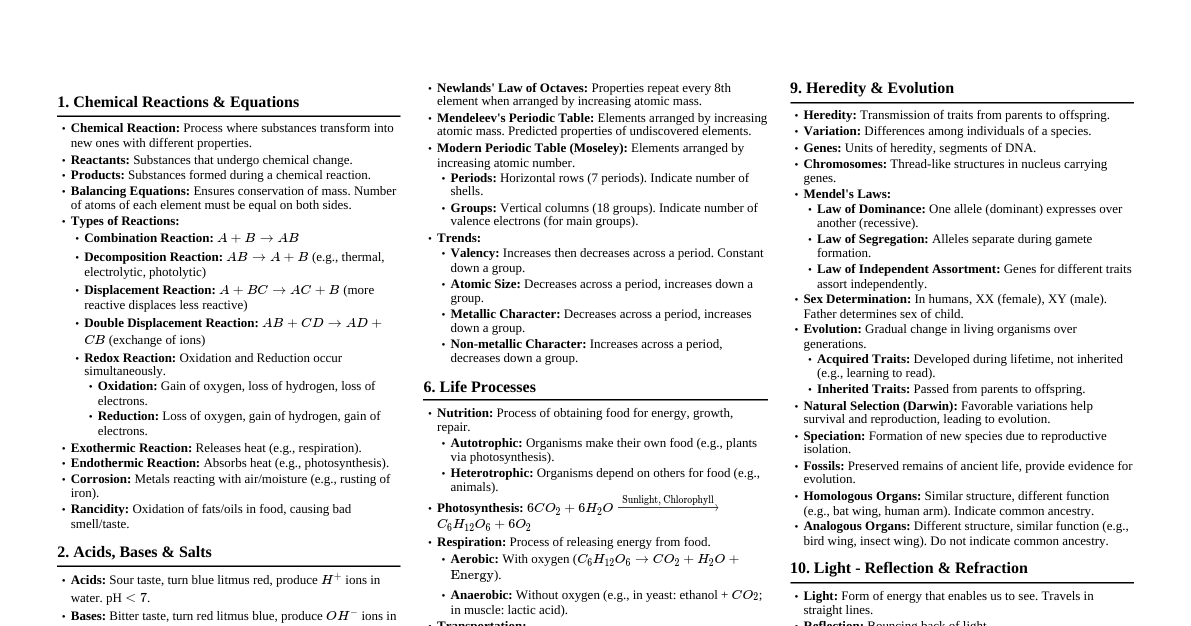
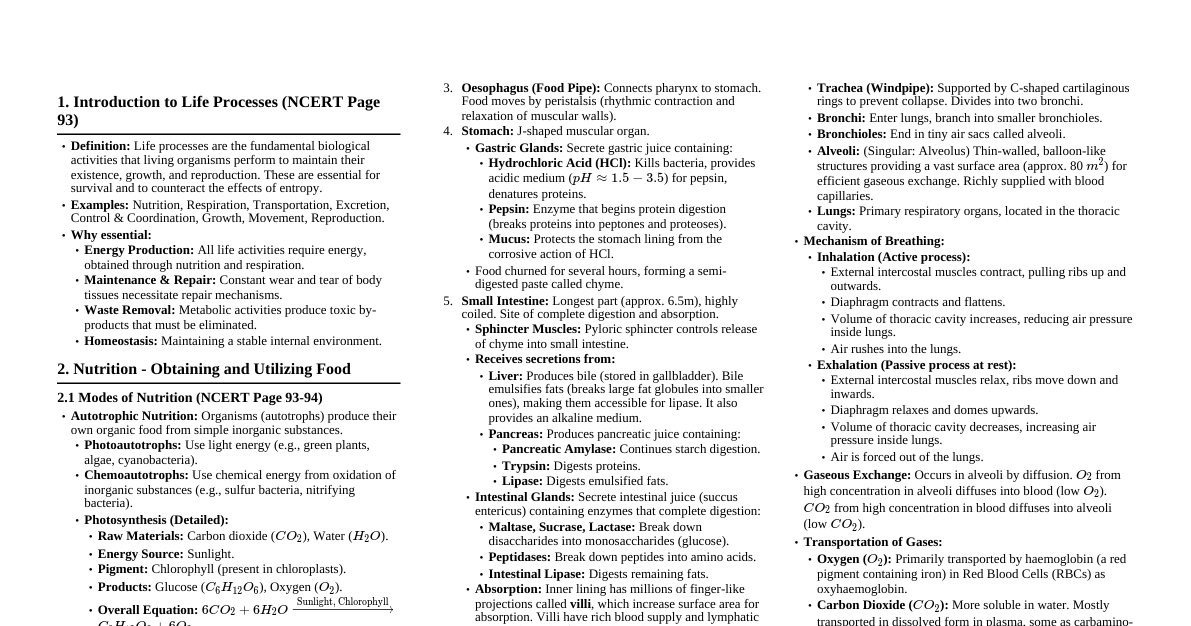
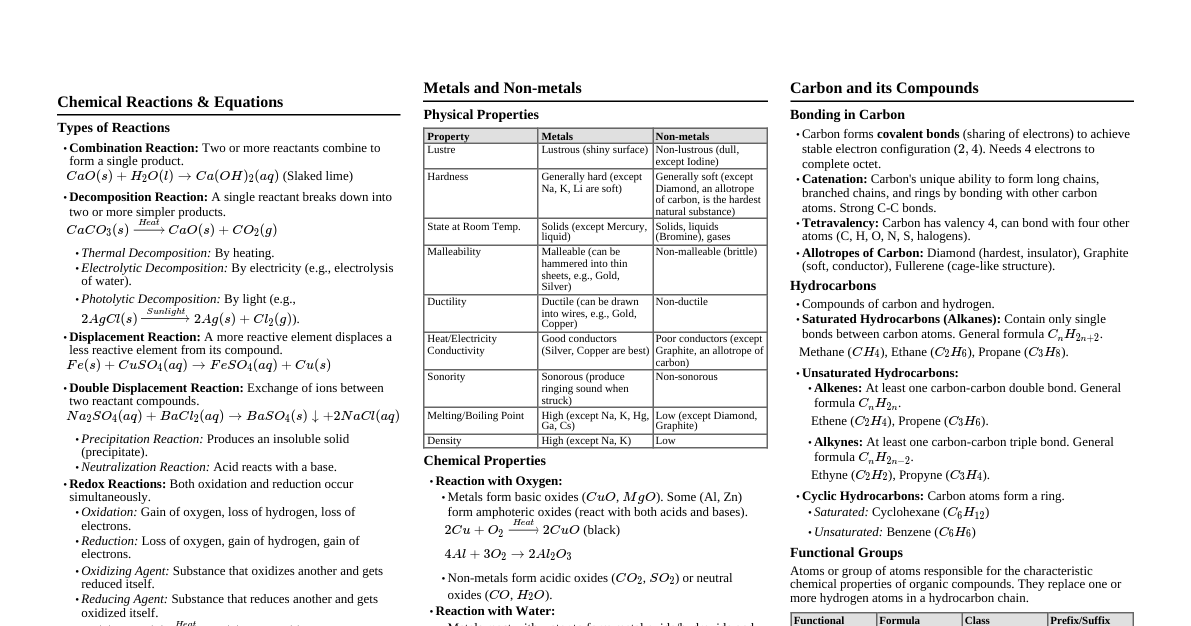
1. Chemical Reactions & Equations Chemical Reaction: Process where reactants transform into products. Example: $2Mg + O_2 \to 2MgO$ Types of Reactions: Combination: $A + B \to AB$ Decomposition: $AB \to A + B$ (Thermal, Electrolytic, Photolytic) Displacement: $A + BC \to AC + B$ (more reactive displaces less reactive) Double Displacement: $AB + CD \to AD + CB$ (exchange of ions) Redox: Oxidation (gain of $O_2$, loss of $H_2$, loss of $e^-$), Reduction (loss of $O_2$, gain of $H_2$, gain of $e^-$) Effects of Oxidation: Corrosion, Rancidity 2. Acids, Bases & Salts Acids: Sour taste, turn blue litmus red, produce $H^+$ ions in water. Examples: $HCl$, $H_2SO_4$, $HNO_3$ Bases: Bitter taste, turn red litmus blue, produce $OH^-$ ions in water. Examples: $NaOH$, $KOH$, $Ca(OH)_2$ pH Scale: Measures $H^+$ ion concentration. $pH 7$ (basic). Salts: Formed by reaction of acid and base (Neutralization). Examples: $NaCl$, $Na_2CO_3 \cdot 10H_2O$ (Washing Soda), $CaSO_4 \cdot \frac{1}{2}H_2O$ (Plaster of Paris) 3. Metals & Non-metals Metals: Lustrous, malleable, ductile, good conductors of heat & electricity, generally solid. Examples: Iron, Copper, Gold, Sodium Non-metals: Dull, brittle, poor conductors (except graphite), can be solid, liquid, or gas. Examples: Carbon, Oxygen, Sulfur, Chlorine Reactivity Series: Arranges metals in decreasing order of reactivity. Extraction of Metals: Ore $\to$ Concentration $\to$ Reduction $\to$ Refining. Corrosion: Deterioration of metal due to reaction with air, moisture, chemicals. Prevention: Painting, oiling, galvanizing, anodizing. 4. Carbon & Its Compounds Covalent Bonding: Sharing of electrons between atoms. Carbon forms covalent bonds. Allotropes of Carbon: Diamond, Graphite, Fullerenes (different forms, same element). Hydrocarbons: Compounds of Carbon and Hydrogen. Saturated: Alkanes (single bonds, -ane suffix) Unsaturated: Alkenes (double bonds, -ene suffix), Alkynes (triple bonds, -yne suffix) Functional Groups: Atoms/groups that determine chemical properties (e.g., -OH (alcohol), -COOH (carboxylic acid)). Ethanol ($C_2H_5OH$): Alcohol, good solvent. Ethanoic Acid ($CH_3COOH$): Carboxylic acid, vinegar. Soaps & Detergents: Soaps are Na/K salts of long-chain fatty acids. Detergents are synthetic. Micelle formation for cleaning. 5. Life Processes Nutrition: Autotrophic: Plants (photosynthesis: $6CO_2 + 6H_2O \xrightarrow{Sunlight} C_6H_{12}O_6 + 6O_2$) Heterotrophic: Animals (holophytic, saprophytic, parasitic) Respiration: Aerobic: Glucose $\to$ Pyruvate $\to$ $CO_2 + H_2O + Energy$ (in mitochondria) Anaerobic: Glucose $\to$ Pyruvate $\to$ Lactic Acid/Ethanol + $CO_2 + Energy$ (in cytoplasm) Transportation: Plants: Xylem (water), Phloem (food) Humans: Blood (RBC, WBC, platelets, plasma), Heart (double circulation), Blood Vessels (arteries, veins, capillaries) Excretion: Removal of metabolic waste. Humans: Kidneys (nephrons filter blood), Ureters, Bladder, Urethra. 6. Control & Coordination Nervous System: Neurons: Structural & functional unit. Dendrite $\to$ Cell body $\to$ Axon $\to$ Nerve ending. Reflex Arc: Sensory neuron $\to$ Spinal cord (relay neuron) $\to$ Motor neuron $\to$ Effector. Brain: Forebrain (cerebrum - thought, memory), Midbrain, Hindbrain (cerebellum - balance, medulla - involuntary actions). Endocrine System: Hormones (chemical messengers). Pituitary (master gland), Thyroid (thyroxine), Pancreas (insulin, glucagon), Adrenal (adrenaline), Gonads (testosterone, estrogen). Coordination in Plants: Phytohormones: Auxins (growth), Gibberellins (stem elongation), Cytokinins (cell division), Abscisic acid (growth inhibitor), Ethylene (fruit ripening). Tropisms: Phototropism, Geotropism, Hydrotropism, Chemotropism, Thigmotropism. 7. How Do Organisms Reproduce? Asexual Reproduction: Single parent, no gamete fusion. Fission (amoeba), Budding (hydra), Fragmentation (spirogyra), Regeneration (planaria), Spore formation (rhizopus), Vegetative propagation (plants). Sexual Reproduction: Two parents, gamete fusion. Flowering Plants: Flower (sepals, petals, stamens, pistil). Pollination (self, cross), Fertilization (double fertilization). Humans: Male reproductive system (testes, vas deferens, urethra), Female reproductive system (ovaries, fallopian tubes, uterus, vagina). Fertilization, Pregnancy. Reproductive Health: STDs, Contraception (barrier, oral pills, IUDs, surgical methods). 8. Heredity & Evolution Heredity: Transmission of traits from parents to offspring. Variations: Differences among individuals of a species. Important for survival. Mendel's Laws: Law of Segregation: Alleles separate during gamete formation. Law of Independent Assortment: Genes for different traits assort independently. Sex Determination: In humans, XX (female), XY (male). Father determines sex of child. Evolution: Gradual change in living organisms over generations. Evidence: Homologous organs, Analogous organs, Fossils. Speciation: Formation of new species. 9. Light - Reflection & Refraction Reflection: Bouncing back of light. Laws: Angle of incidence = Angle of reflection. Incident ray, reflected ray, normal lie in same plane. Mirrors: Plane, Concave, Convex. Mirror Formula: $\frac{1}{v} + \frac{1}{u} = \frac{1}{f}$. Magnification: $m = -\frac{v}{u}$. Refraction: Bending of light as it passes from one medium to another. Laws: Incident ray, refracted ray, normal lie in same plane. Snell's Law: $\frac{\sin i}{\sin r} = n$ (refractive index). Lenses: Concave, Convex. Lens Formula: $\frac{1}{v} - \frac{1}{u} = \frac{1}{f}$. Magnification: $m = \frac{v}{u}$. Power of Lens: $P = \frac{1}{f}$ (in dioptres). 10. Human Eye & Colourful World Human Eye: Cornea, Iris, Pupil, Ciliary muscles, Lens, Retina, Optic nerve. Accommodation: Ability of eye lens to adjust focal length. Defects: Myopia (nearsightedness - concave lens), Hypermetropia (farsightedness - convex lens), Presbyopia, Astigmatism. Dispersion: Splitting of white light into constituent colours (VIBGYOR) by a prism. Atmospheric Refraction: Twinkling of stars, Advanced sunrise, Delayed sunset. Scattering of Light: Tyndall effect, Blue colour of sky, Reddish sunrise/sunset. 11. Electricity Electric Current ($I$): Rate of flow of charge. $I = \frac{Q}{t}$ (unit: Ampere, A). Electric Potential Difference ($V$): Work done per unit charge. $V = \frac{W}{Q}$ (unit: Volt, V). Ohm's Law: $V = IR$ (Resistance $R$ unit: Ohm, $\Omega$). Resistance: $R = \rho \frac{L}{A}$ ($\rho$ is resistivity). Resistors in Series: $R_{eq} = R_1 + R_2 + ...$ Resistors in Parallel: $\frac{1}{R_{eq}} = \frac{1}{R_1} + \frac{1}{R_2} + ...$ Heating Effect of Current: Joule's Law of Heating: $H = I^2Rt = VIt = \frac{V^2}{R}t$. Electric Power ($P$): Rate of doing work. $P = VI = I^2R = \frac{V^2}{R}$ (unit: Watt, W). 12. Magnetic Effects of Electric Current Magnetic Field: Region around a magnet where its force is experienced. Magnetic Field Lines: Originate from N-pole, terminate at S-pole (outside magnet). Do not intersect. Current-carrying conductor: Produces magnetic field. Straight conductor: Concentric circles (Right-Hand Thumb Rule). Solenoid: Behaves like a bar magnet. Force on Current-carrying Conductor: Fleming's Left-Hand Rule. $F = BIL\sin\theta$. Electric Motor: Converts electrical energy to mechanical energy (based on force on conductor). Electromagnetic Induction: Production of induced current by changing magnetic field. (Faraday's Law, Fleming's Right-Hand Rule). Electric Generator: Converts mechanical energy to electrical energy (based on EMI). Domestic Electric Circuits: Live wire (red), Neutral wire (black), Earth wire (green). Short circuiting, Overloading. 13. Our Environment Ecosystem: Biotic (living) and Abiotic (non-living) components interacting. Food Chain: Energy flow: Producer $\to$ Primary Consumer $\to$ Secondary Consumer $\to$ Tertiary Consumer. Food Web: Interconnected food chains. Trophic Levels: Position an organism occupies in a food chain. 10% Law: Only 10% of energy is transferred to the next trophic level. Biomagnification: Increase in concentration of toxic substances at successive trophic levels. Ozone Layer: Protects from UV radiation. Depletion by CFCs. Waste Management: Biodegradable vs. Non-biodegradable. Reduce, Reuse, Recycle. 14. Management of Natural Resources Natural Resources: Resources from nature (forests, wildlife, water, coal, petroleum). Sustainable Management: Using resources wisely for present and future generations. Forests & Wildlife: Conservation efforts (e.g., Chipko Andolan). Stakeholders. Water Resources: Rainwater harvesting, Dams (pros & cons). Coal & Petroleum: Fossil fuels, non-renewable. Judicious use is crucial. "3 Rs" for Conservation: Reduce, Reuse, Recycle.