JEE Essentials Cheatsheet
Cheatsheet Content
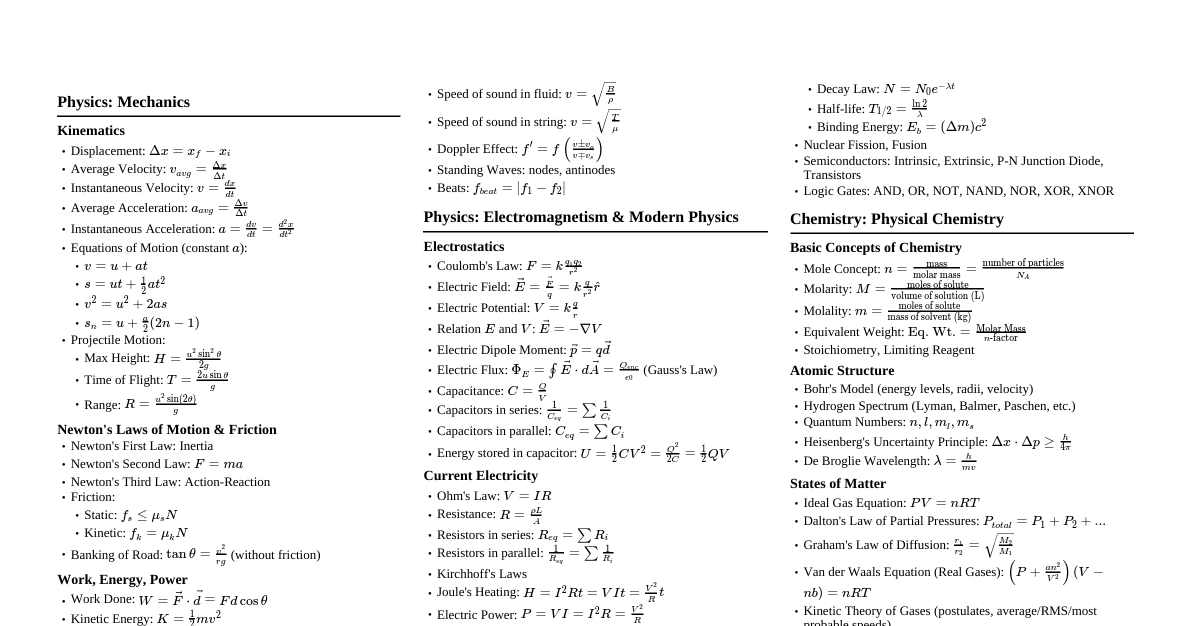
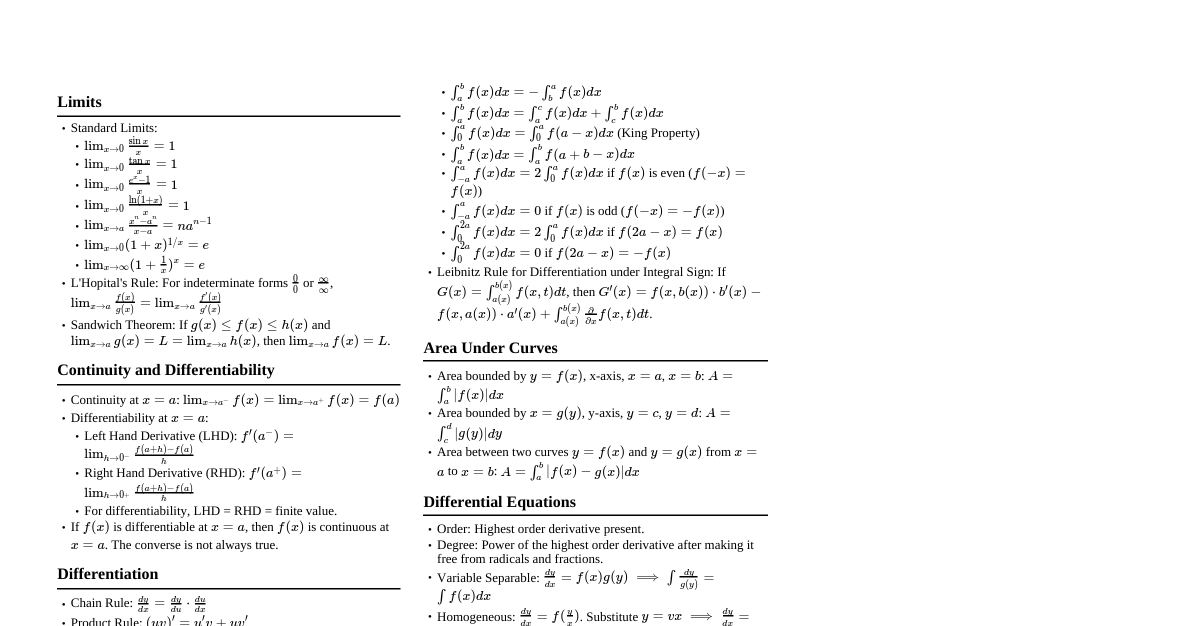
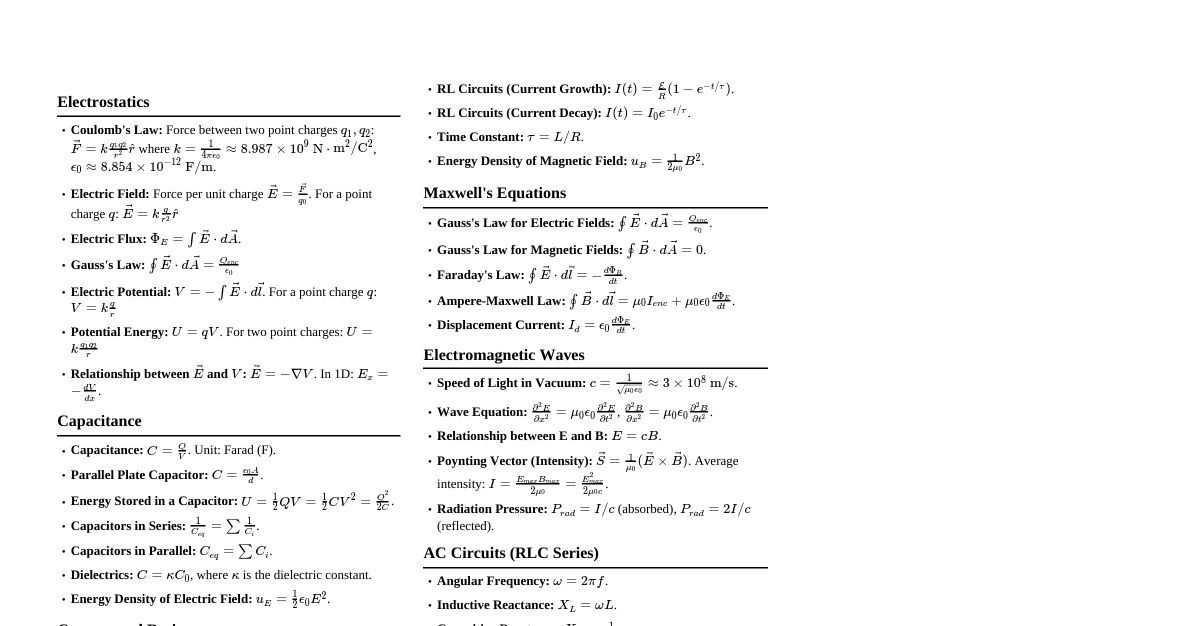
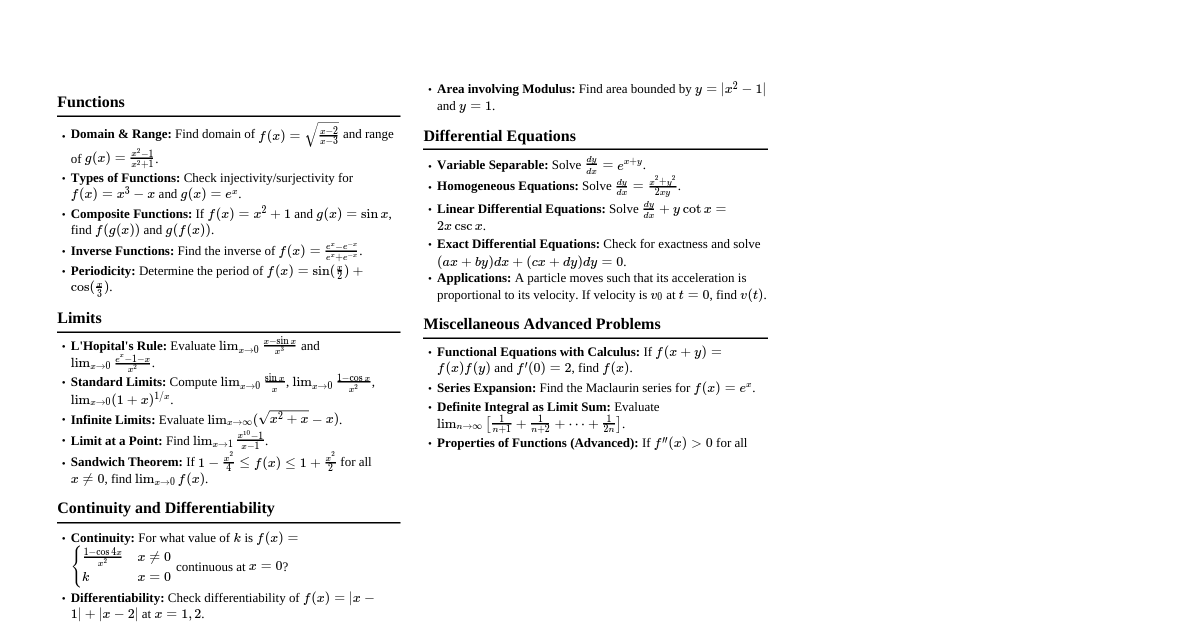
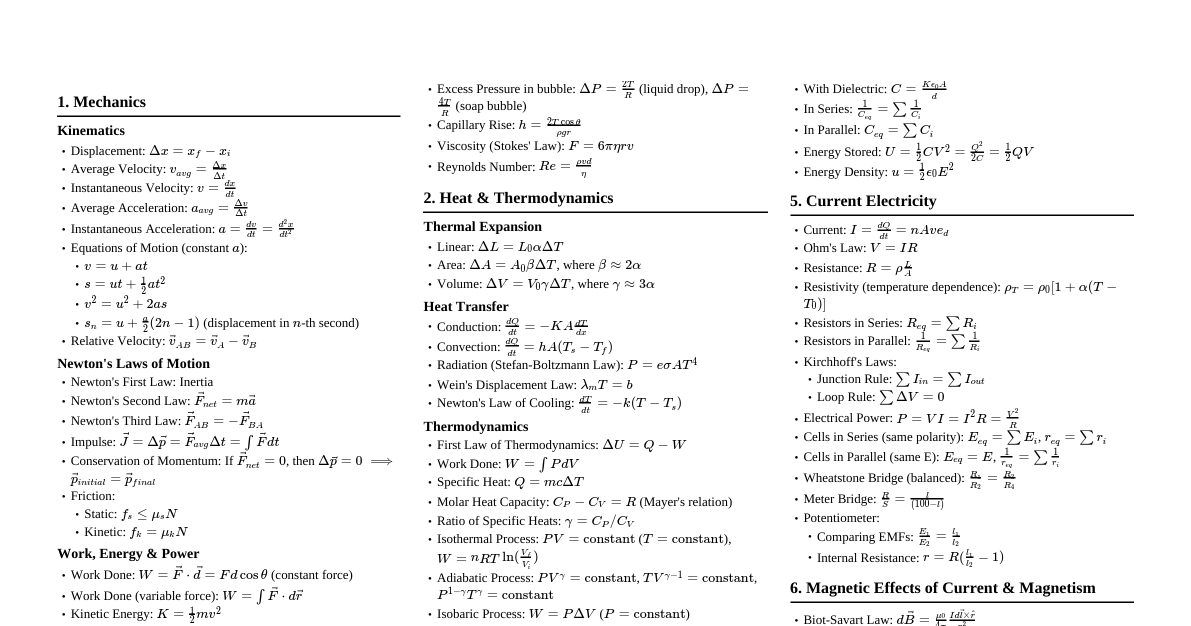
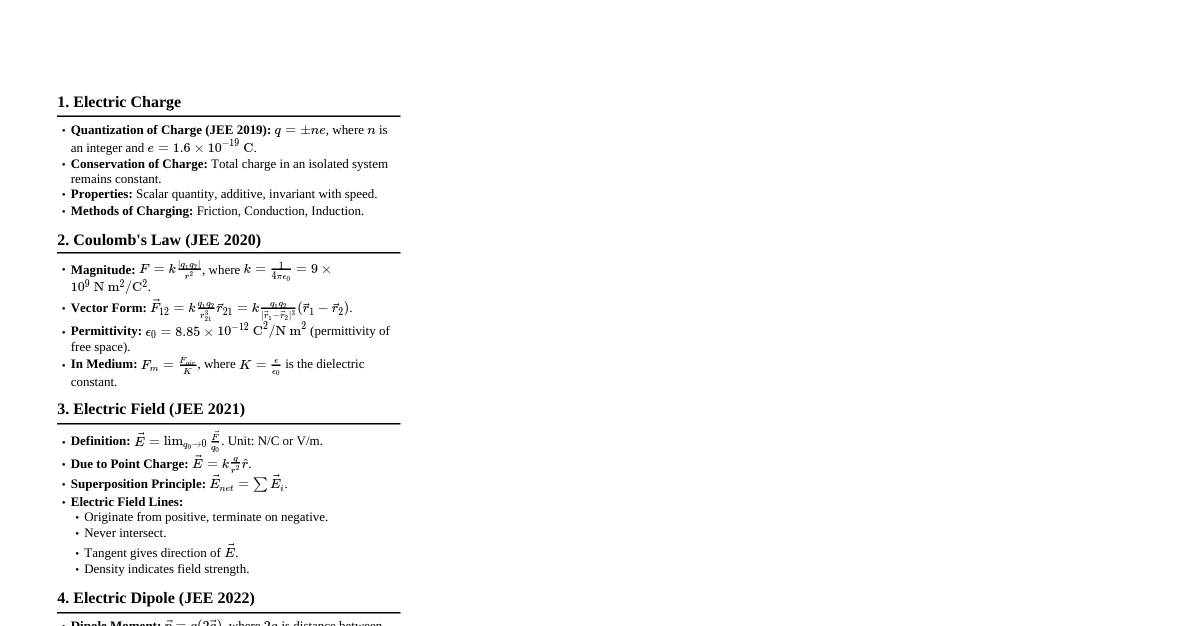
Mathematics: Algebra Quadratic Equation: $ax^2 + bx + c = 0 \implies x = \frac{-b \pm \sqrt{b^2 - 4ac}}{2a}$ Discriminant: $D = b^2 - 4ac$. For real roots, $D \ge 0$. Arithmetic Progression (AP): $a_n = a + (n-1)d$, $S_n = \frac{n}{2}(2a + (n-1)d)$ Geometric Progression (GP): $a_n = ar^{n-1}$, $S_n = \frac{a(r^n-1)}{r-1}$ ($r \ne 1$), $S_\infty = \frac{a}{1-r}$ ($|r| Binomial Theorem: $(a+b)^n = \sum_{k=0}^n \binom{n}{k} a^{n-k} b^k$ Permutations: $P(n,r) = \frac{n!}{(n-r)!}$ Combinations: $C(n,r) = \frac{n!}{r!(n-r)!}$ Complex Numbers: $z = x+iy = r(\cos\theta + i\sin\theta)$, $|z| = \sqrt{x^2+y^2}$, $\arg(z) = \theta$ De Moivre's Theorem: $(\cos\theta + i\sin\theta)^n = \cos(n\theta) + i\sin(n\theta)$ Probability: $P(A \cup B) = P(A) + P(B) - P(A \cap B)$ Mathematics: Calculus Limits: $\lim_{x \to 0} \frac{\sin x}{x} = 1$, $\lim_{x \to 0} \frac{e^x-1}{x} = 1$, $\lim_{x \to 0} (1+x)^{1/x} = e$ Derivatives: $\frac{d}{dx}(x^n) = nx^{n-1}$ $\frac{d}{dx}(\sin x) = \cos x$ $\frac{d}{dx}(\cos x) = -\sin x$ $\frac{d}{dx}(e^x) = e^x$ $\frac{d}{dx}(\ln x) = \frac{1}{x}$ Product Rule: $(uv)' = u'v + uv'$ Quotient Rule: $(\frac{u}{v})' = \frac{u'v - uv'}{v^2}$ Integrals: $\int x^n dx = \frac{x^{n+1}}{n+1} + C$ ($n \ne -1$) $\int \frac{1}{x} dx = \ln|x| + C$ $\int \sin x dx = -\cos x + C$ $\int \cos x dx = \sin x + C$ $\int e^x dx = e^x + C$ Integration by Parts: $\int u dv = uv - \int v du$ Area under curve: $A = \int_a^b y dx$ Differential Equations: Variable Separable, Linear (Integrating Factor $e^{\int P(x)dx}$) Mathematics: Coordinate Geometry & Vectors Distance Formula: $\sqrt{(x_2-x_1)^2 + (y_2-y_1)^2}$ Section Formula: $P(\frac{mx_2+nx_1}{m+n}, \frac{my_2+ny_1}{m+n})$ Equation of Line: $y-y_1 = m(x-x_1)$, $Ax+By+C=0$ Angle between lines: $\tan\theta = |\frac{m_1-m_2}{1+m_1m_2}|$ Circle: $(x-h)^2 + (y-k)^2 = r^2$ Parabola: $y^2 = 4ax$ (or variations) Ellipse: $\frac{x^2}{a^2} + \frac{y^2}{b^2} = 1$, eccentricity $e = \sqrt{1 - b^2/a^2}$ Hyperbola: $\frac{x^2}{a^2} - \frac{y^2}{b^2} = 1$, eccentricity $e = \sqrt{1 + b^2/a^2}$ Dot Product: $\vec{a} \cdot \vec{b} = |\vec{a}| |\vec{b}| \cos\theta = a_xb_x + a_yb_y + a_zb_z$ Cross Product: $\vec{a} \times \vec{b} = (a_yb_z - a_zb_y)\hat{i} + ...$, magnitude $|\vec{a}| |\vec{b}| \sin\theta$ Scalar Triple Product: $[\vec{a} \vec{b} \vec{c}] = \vec{a} \cdot (\vec{b} \times \vec{c})$ (volume of parallelepiped) Physics: Mechanics Kinematics: $v = u+at$, $s = ut + \frac{1}{2}at^2$, $v^2 = u^2 + 2as$ Newton's Laws: $F=ma$, $p=mv$, Impulse $J = \Delta p = F\Delta t$ Work-Energy Theorem: $W = \Delta KE$, $KE = \frac{1}{2}mv^2$, $PE_g = mgh$, $PE_s = \frac{1}{2}kx^2$ Power: $P = \frac{dW}{dt} = F \cdot v$ Rotational Motion: $\tau = I\alpha$, $L = I\omega$, $KE_{rot} = \frac{1}{2}I\omega^2$ Moment of Inertia (common shapes): Ring (about center): $MR^2$ Disc (about center): $\frac{1}{2}MR^2$ Sphere: $\frac{2}{5}MR^2$ Rod (center): $\frac{1}{12}ML^2$ Gravitation: $F = \frac{Gm_1m_2}{r^2}$, $PE = -\frac{Gm_1m_2}{r}$, Escape velocity $v_e = \sqrt{\frac{2GM}{R}}$ Simple Harmonic Motion (SHM): $x = A\sin(\omega t + \phi)$, $T = 2\pi\sqrt{\frac{m}{k}}$ (spring), $T = 2\pi\sqrt{\frac{L}{g}}$ (pendulum) Fluid Mechanics: Bernoulli's Principle $P + \frac{1}{2}\rho v^2 + \rho gh = \text{constant}$ Physics: Electromagnetism & Optics Coulomb's Law: $F = \frac{1}{4\pi\epsilon_0} \frac{q_1q_2}{r^2}$ Electric Field: $E = \frac{F}{q} = \frac{1}{4\pi\epsilon_0} \frac{q}{r^2}$ Electric Potential: $V = \frac{1}{4\pi\epsilon_0} \frac{q}{r}$, $E = -\nabla V$ Capacitance: $C = \frac{Q}{V}$, Parallel Plate $C = \frac{\epsilon_0 A}{d}$, Energy $U = \frac{1}{2}CV^2$ Ohm's Law: $V = IR$, Resistance $R = \frac{\rho L}{A}$ Resistors in Series: $R_{eq} = R_1 + R_2 + ...$ Resistors in Parallel: $\frac{1}{R_{eq}} = \frac{1}{R_1} + \frac{1}{R_2} + ...$ Magnetic Force: $\vec{F} = q(\vec{v} \times \vec{B})$, $\vec{F} = I(\vec{L} \times \vec{B})$ Biot-Savart Law: $d\vec{B} = \frac{\mu_0}{4\pi} \frac{I d\vec{l} \times \hat{r}}{r^2}$ Ampere's Law: $\oint \vec{B} \cdot d\vec{l} = \mu_0 I_{enc}$ Faraday's Law: $\mathcal{E} = -\frac{d\Phi_B}{dt}$ Lenz's Law: Induced current opposes change in flux. Optics: Mirror/Lens Formula $\frac{1}{f} = \frac{1}{v} + \frac{1}{u}$, Magnification $m = -\frac{v}{u}$ Refractive Index: $n = \frac{c}{v}$, Snell's Law $n_1\sin\theta_1 = n_2\sin\theta_2$ Young's Double Slit: Fringe width $\beta = \frac{\lambda D}{d}$ Physics: Modern Physics & Thermodynamics Photoelectric Effect: $KE_{max} = h\nu - \Phi$, $\Phi = h\nu_0$ Photon Energy: $E = h\nu = \frac{hc}{\lambda}$ De Broglie Wavelength: $\lambda = \frac{h}{p} = \frac{h}{mv}$ Bohr Model: $E_n = -\frac{13.6 Z^2}{n^2}$ eV, $r_n = 0.529 \frac{n^2}{Z}$ Å Radioactivity: $N = N_0 e^{-\lambda t}$, Half-life $T_{1/2} = \frac{\ln 2}{\lambda}$ First Law of Thermodynamics: $\Delta U = Q - W$ Work done by gas: $W = \int P dV$ Ideal Gas Law: $PV = nRT$ Kinetic Theory: $KE_{avg} = \frac{3}{2}kT$, $v_{rms} = \sqrt{\frac{3RT}{M}}$ Specific Heat at constant volume/pressure: $C_v = \frac{f}{2}R$, $C_p = (\frac{f}{2}+1)R$ Chemistry: Physical Chemistry Mole Concept: 1 mole = $6.022 \times 10^{23}$ particles (Avogadro No.) Molarity: Moles of solute / Volume of solution (L) Molality: Moles of solute / Mass of solvent (kg) Raoult's Law: $P_A = x_A P_A^\circ$, $\Delta P = x_B P_A^\circ$ Elevation in Boiling Point: $\Delta T_b = i K_b m$ Depression in Freezing Point: $\Delta T_f = i K_f m$ Osmotic Pressure: $\Pi = i CRT$ First Order Reaction: $k = \frac{2.303}{t} \log \frac{[A]_0}{[A]_t}$, $t_{1/2} = \frac{0.693}{k}$ Arrhenius Equation: $k = A e^{-E_a/RT}$ Nernst Equation: $E_{cell} = E_{cell}^\circ - \frac{0.0591}{n} \log Q$ (at $298K$) Gibbs Free Energy: $\Delta G = \Delta H - T\Delta S$, $\Delta G^\circ = -RT \ln K_{eq}$ Equilibrium Constant: $K_c = \frac{[Products]}{[Reactants]}$, $K_p = K_c(RT)^{\Delta n_g}$ pH: $pH = -\log[H^+]$, $pH + pOH = 14$ Solubility Product: $K_{sp}$ Chemistry: Inorganic Chemistry Periodic Trends: Atomic radius, ionization enthalpy, electron gain enthalpy, electronegativity (general trends) Hybridization: $sp, sp^2, sp^3, dsp^2, sp^3d, sp^3d^2$ (predict geometry based on lone pairs/bond pairs) VSEPR Theory: Shape of molecules (e.g., linear, trigonal planar, tetrahedral, trigonal bipyramidal, octahedral) Coordination Compounds: Ligands, Coordination number, Werner's theory, Valence bond theory (VBT - magnetic properties, geometry), Crystal field theory (CFT - splitting, color) Common Reagents/Reactions: Oxidation States: Transition metals, p-block elements Qualitative Analysis: Group reagents for cations/anions Metallurgy: Roasting, Calcination, Reduction (e.g., Hall-Heroult for Al, Blast furnace for Fe) Hydrogen Bonding: Intermolecular, intramolecular Bond Order: (No. of bonding electrons - No. of antibonding electrons) / 2 Chemistry: Organic Chemistry Nomenclature: IUPAC rules for alkanes, alkenes, alkynes, functional groups Isomerism: Structural (chain, position, functional), Stereoisomerism (geometrical/cis-trans, optical/enantiomers, diastereomers) Reaction Intermediates: Carbocations, Carbanions, Free Radicals (stability) Reaction Mechanisms: Nucleophilic Substitution: $S_N1, S_N2$ (factors affecting rate, stereochemistry) Elimination: $E1, E2$ (Saytzeff's rule) Electrophilic Addition: Alkenes/Alkynes (Markovnikov's rule) Electrophilic Substitution: Benzene and derivatives (ortho/para, meta directing groups) Nucleophilic Addition: Aldehydes/Ketones Important Reactions & Reagents: Alkanes: Halogenation (free radical) Alkenes: Hydrogenation, Halogenation, Hydrohalogenation, Hydration, Ozonolysis, Baeyer's reagent Alkynes: Similar to alkenes, including Lindlar's catalyst, Na/liq. NH$_3$ Alkyl Halides: Wurtz, Finkelstein, Swarts, Grignard reagent Alcohols: Oxidation, Dehydration, Esterification, Lucas test Aldehydes/Ketones: Tollen's, Fehling's, Cannizzaro, Aldol, Clemmensen, Wolff-Kishner, Wittig Carboxylic Acids: Esterification, HVZ reaction, Decarboxylation Amines: Hoffmann bromamide, Carbylamine, Diazotization, Hinsberg test Polymers: Addition (PE, PVC), Condensation (Nylon, Polyester), natural rubber Biomolecules: Carbohydrates (glucose, fructose), Proteins (amino acids, peptide bond), DNA/RNA (nucleic acids)