GSEB Class 12 PCM & English
Cheatsheet Content
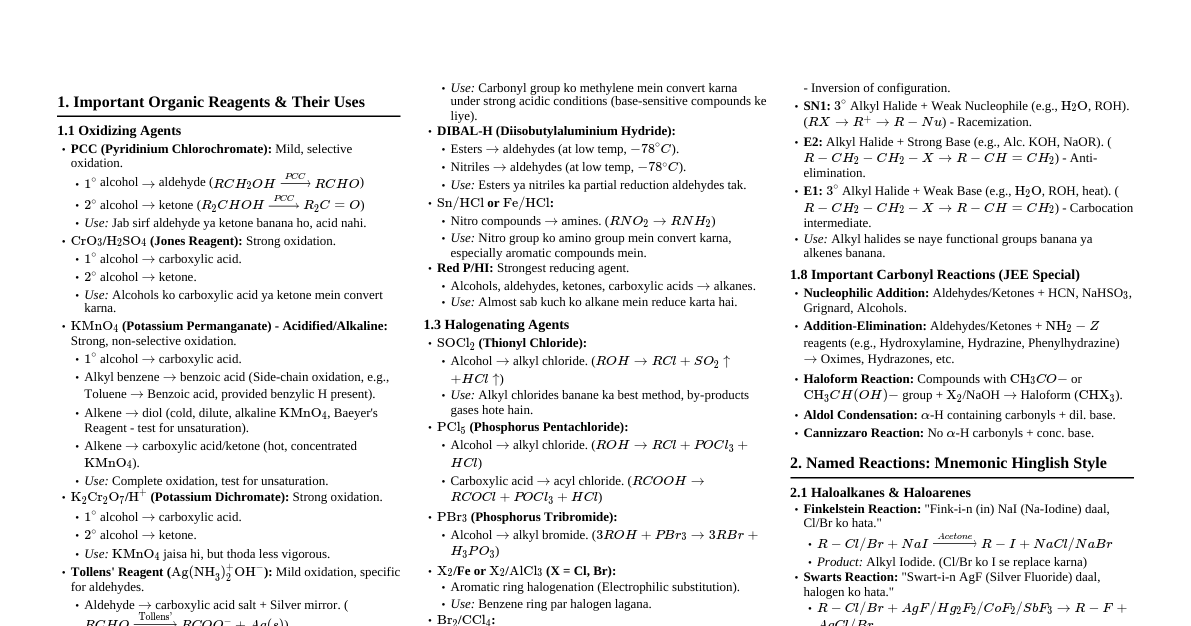
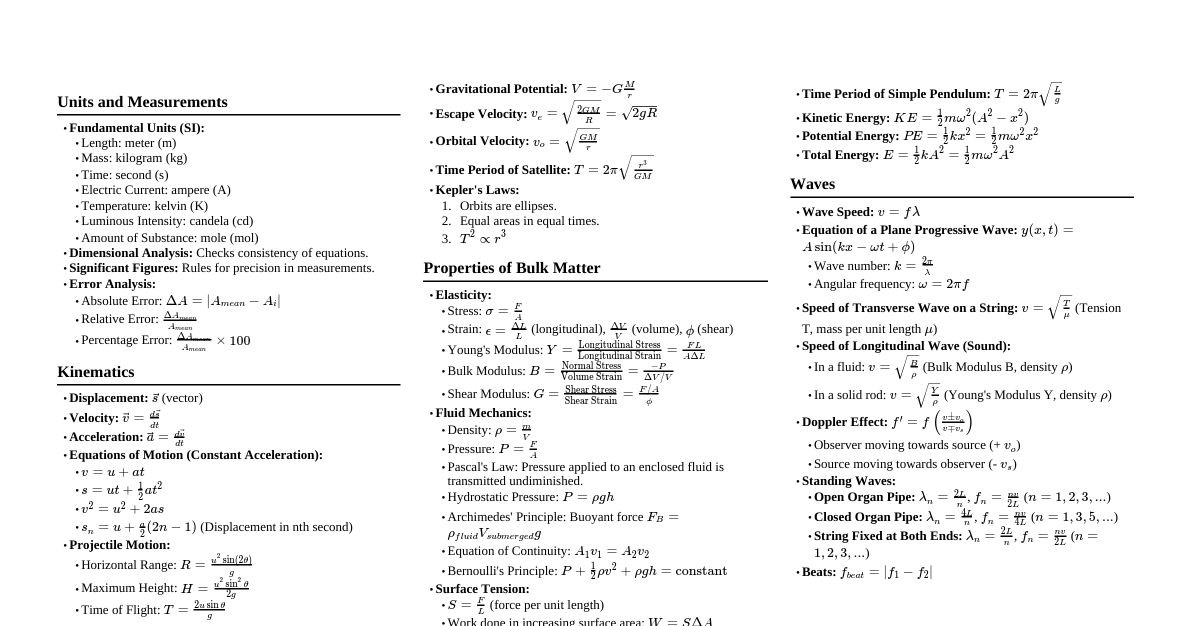
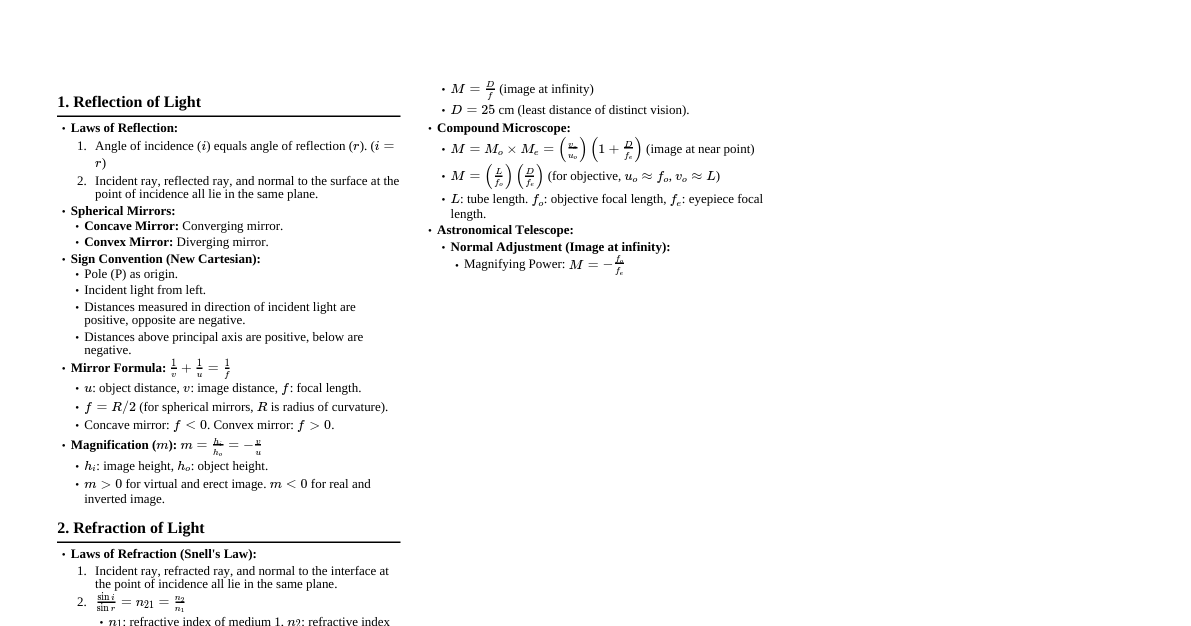
### How to Use This Cheatsheet This cheatsheet is designed for GSEB Class 12 students covering Physics, Chemistry, Mathematics, and English. It aims to provide a concise overview of key concepts, formulas, and exam-oriented tips. #### Structure - Each subject is divided into major topics. - Key definitions, formulas, and concepts are highlighted. - Special sections for MCQs and shortcuts are included where applicable. #### Tips for GSEB Exams - Focus on understanding fundamental principles. - Practice derivations and problem-solving regularly. - Memorize key formulas, constants, and reaction types. - For English, practice comprehension, writing skills, and literary analysis. ### Physics #### 1. Electrostatics - **Coulomb's Law:** Force between two point charges $F = k \frac{|q_1 q_2|}{r^2}$ - **Electric Field:** $\vec{E} = \frac{\vec{F}}{q_0}$ - **Electric Potential:** $V = \frac{W}{q_0}$ - **Capacitance:** $C = \frac{Q}{V}$ - **Energy Stored in Capacitor:** $U = \frac{1}{2}CV^2 = \frac{1}{2}\frac{Q^2}{C} = \frac{1}{2}QV$ #### 2. Current Electricity - **Ohm's Law:** $V = IR$ - **Resistance:** $R = \rho \frac{L}{A}$ - **Resistors in Series:** $R_{eq} = R_1 + R_2 + ...$ - **Resistors in Parallel:** $\frac{1}{R_{eq}} = \frac{1}{R_1} + \frac{1}{R_2} + ...$ - **Kirchhoff's Laws:** - Junction Rule: $\sum I = 0$ - Loop Rule: $\sum \Delta V = 0$ #### 3. Magnetic Effects of Current & Magnetism - **Biot-Savart Law:** $d\vec{B} = \frac{\mu_0}{4\pi} \frac{I d\vec{l} \times \hat{r}}{r^2}$ - **Ampere's Circuital Law:** $\oint \vec{B} \cdot d\vec{l} = \mu_0 I_{enc}$ - **Lorentz Force:** $\vec{F} = q(\vec{E} + \vec{v} \times \vec{B})$ - **Magnetic Dipole Moment:** $\vec{M} = NI\vec{A}$ #### 4. Electromagnetic Induction & AC - **Faraday's Law:** $\mathcal{E} = -N \frac{d\Phi_B}{dt}$ - **Lenz's Law:** Induced current opposes the change in magnetic flux. - **RMS Value (AC):** $V_{rms} = \frac{V_0}{\sqrt{2}}$, $I_{rms} = \frac{I_0}{\sqrt{2}}$ - **Power in AC Circuit:** $P = V_{rms} I_{rms} \cos\phi$ #### 5. Electromagnetic Waves - **Wave Speed:** $c = \frac{1}{\sqrt{\mu_0 \epsilon_0}}$ - **Properties:** Transverse waves, do not require a medium. #### 6. Optics - **Mirror Formula:** $\frac{1}{f} = \frac{1}{v} + \frac{1}{u}$ (for spherical mirrors) - **Lens Formula:** $\frac{1}{f} = \frac{1}{v} - \frac{1}{u}$ (for thin lenses) - **Refractive Index:** $n = \frac{c}{v}$ - **Snell's Law:** $n_1 \sin\theta_1 = n_2 \sin\theta_2$ - **Total Internal Reflection:** $\sin\theta_c = \frac{n_2}{n_1}$ ($n_1 > n_2$) - **Young's Double Slit Experiment:** Fringe width $\beta = \frac{\lambda D}{d}$ #### 7. Dual Nature of Radiation & Matter - **Planck's Quantum Theory:** $E = h\nu$ - **Photoelectric Effect:** $K_{max} = h\nu - \phi_0$ - **De Broglie Wavelength:** $\lambda = \frac{h}{p} = \frac{h}{mv}$ #### 8. Atoms & Nuclei - **Bohr's Model:** Quantized orbits, angular momentum $L = n\frac{h}{2\pi}$ - **Rutherford's Model:** Nucleus at center, electrons orbit. - **Radioactive Decay Law:** $N = N_0 e^{-\lambda t}$ - **Half-Life:** $T_{1/2} = \frac{0.693}{\lambda}$ #### 9. Semiconductor Electronics - **P-N Junction Diode:** Forward and reverse bias characteristics. - **Transistor:** NPN and PNP, amplifier action. - **Logic Gates:** AND, OR, NOT, NAND, NOR, XOR, XNOR (Truth tables). #### Physics MCQs & Shortcuts - **Units & Dimensions:** Always check units in options to eliminate incorrect answers. - **Graphs:** Understand the slope and area under the curve for various physical quantities. - **Approximations:** For complex calculations, look for opportunities to approximate (e.g., small angle approximation). - **Symmetry:** Utilize symmetry in problems involving charge distributions or magnetic fields. ### Chemistry #### 1. Solid State - **Types of Solids:** Crystalline vs. Amorphous. - **Unit Cells:** Simple Cubic, FCC, BCC. - **Packing Efficiency:** SC (52.4%), BCC (68%), FCC (74%). - **Density:** $\rho = \frac{Z \cdot M}{a^3 \cdot N_A}$ - **Defects:** Stoichiometric (Vacancy, Interstitial), Non-stoichiometric. #### 2. Solutions - **Concentration Terms:** Molarity, Molality, Mole Fraction, Mass %. - **Raoult's Law:** $P_A = P_A^0 x_A$ - **Colligative Properties:** - Relative Lowering of Vapor Pressure - Elevation in Boiling Point: $\Delta T_b = K_b m$ - Depression in Freezing Point: $\Delta T_f = K_f m$ - Osmotic Pressure: $\Pi = iCRT$ - **Van't Hoff Factor ($i$):** Accounts for dissociation/association. #### 3. Electrochemistry - **Electrochemical Cells:** Galvanic (voltaic) cells, Electrolytic cells. - **Nernst Equation:** $E_{cell} = E_{cell}^0 - \frac{0.0592}{n} \log Q$ (at 298K) - **Faraday's Laws of Electrolysis:** - 1st Law: $W = ZIt$ - 2nd Law: $\frac{W_1}{W_2} = \frac{E_1}{E_2}$ - **Conductivity:** $\kappa = \frac{1}{R} \frac{l}{A}$ - **Molar Conductivity:** $\Lambda_m = \frac{\kappa \times 1000}{M}$ #### 4. Chemical Kinetics - **Rate of Reaction:** $-\frac{d[R]}{dt} = k[R]^n$ - **Order of Reaction:** Sum of powers of concentration terms in rate law. - **Integrated Rate Laws:** (0th, 1st, 2nd order) - 1st Order: $k = \frac{2.303}{t} \log \frac{[A]_0}{[A]}$ - **Half-Life:** $T_{1/2}$ for 1st order: $\frac{0.693}{k}$ - **Arrhenius Equation:** $k = A e^{-E_a/RT}$ #### 5. Surface Chemistry - **Adsorption:** Physisorption vs. Chemisorption. - **Catalysis:** Homogeneous, Heterogeneous, Enzyme catalysis. - **Colloids:** Lyophilic, Lyophobic, Multimolecular, Macromolecular, Associated Colloids. - **Tyndall Effect, Brownian Movement, Electrophoresis.** #### 6. General Principles of Isolation of Elements - **Metallurgy:** Crushing, Concentration (Gravity Separation, Froth Flotation, Leaching), Calcination, Roasting, Reduction, Refining. - **Thermodynamics of Metallurgy:** Ellingham Diagram. #### 7. p-Block Elements - **Group 15 (Nitrogen Family):** Ammonia, Nitric Acid, Phosphorus Allotropes. - **Group 16 (Oxygen Family):** Sulphuric Acid, Oxides of Sulphur. - **Group 17 (Halogens):** Halogen Acids, Interhalogen Compounds. - **Group 18 (Noble Gases):** Xenon Compounds. #### 8. d- and f-Block Elements - **Transition Elements (d-block):** Electronic configuration, Oxidation states, Color, Magnetic properties, Catalytic properties. - **Lanthanoids & Actinoids (f-block):** Electronic configuration, Lanthanoid Contraction. - **KMnO$_4$ and K$_2$Cr$_2$O$_7$:** Preparation and oxidizing properties. #### 9. Coordination Compounds - **Ligands:** Monodentate, Polydentate. - **Nomenclature:** IUPAC naming rules. - **Isomerism:** Structural (Ionization, Hydrate, Linkage), Stereoisomerism (Geometrical, Optical). - **Bonding Theories:** VBT, CFT (Crystal Field Splitting). #### 10. Haloalkanes and Haloarenes - **Nomenclature:** IUPAC rules. - **Preparation Methods:** From alcohols, alkanes, alkenes. - **Reactions:** Nucleophilic Substitution (SN1, SN2), Elimination (E1, E2), Wurtz reaction, Fittig reaction. #### 11. Alcohols, Phenols, and Ethers - **Nomenclature:** IUPAC rules. - **Preparation Methods:** From Grignard reagents, aldehydes/ketones. - **Reactions:** Oxidation, Dehydration, Esterification. - **Phenols:** Acidity, Electrophilic substitution. - **Ethers:** Williamson synthesis, Cleavage with HI/HBr. #### 12. Aldehydes, Ketones, and Carboxylic Acids - **Nomenclature:** IUPAC rules. - **Preparation Methods:** Oxidation of alcohols, ozonolysis. - **Reactions of Aldehydes/Ketones:** Nucleophilic addition, Aldol condensation, Cannizzaro reaction, Haloform reaction. - **Carboxylic Acids:** Acidity, Esterification, Decarboxylation. #### 13. Amines - **Nomenclature:** IUPAC rules. - **Preparation Methods:** Reduction of nitro compounds, Hoffmann bromamide degradation. - **Basicity:** Primary > Secondary > Tertiary (in gaseous phase), Aqueous phase order. - **Reactions:** Carbylamine reaction, Diazotization. #### 14. Biomolecules - **Carbohydrates:** Monosaccharides (Glucose, Fructose), Disaccharides (Sucrose, Lactose, Maltose), Polysaccharides (Starch, Cellulose, Glycogen). - **Proteins:** Amino acids, Peptide bond, Primary, Secondary, Tertiary, Quaternary structure, Denaturation. - **Nucleic Acids:** DNA, RNA, Nucleotides, Nucleosides, Double helix structure. - **Vitamins:** Types and deficiencies. #### 15. Polymers - **Classification:** Natural, Synthetic, Addition, Condensation. - **Examples:** Polyethylene, PVC, Nylon-6,6, Buna-S, Teflon. #### 16. Chemistry in Everyday Life - **Drugs:** Analgesics, Antiseptics, Antibiotics, Antacids, Tranquilizers. - **Food Preservatives, Artificial Sweeteners, Soaps and Detergents.** #### Chemistry MCQs & Shortcuts - **Organic Reactions:** Identify reaction type (SN1, SN2, E1, E2, electrophilic addition, nucleophilic addition, etc.) and predict major products. - **Name Reactions:** Memorize key name reactions and their reagents/conditions. - **Acidity/Basicity:** Relate to inductive effect, resonance effect, and steric hindrance. - **Inorganic Chemistry:** Focus on trends in periodic table, exceptions, and color changes in reactions. - **Balancing Redox Reactions:** Practice balancing using oxidation number method or half-reaction method. ### Mathematics #### 1. Relations and Functions - **Types of Relations:** Reflexive, Symmetric, Transitive, Equivalence. - **Types of Functions:** One-to-one (Injective), Onto (Surjective), Bijective. - **Composition of Functions:** $(f \circ g)(x) = f(g(x))$. - **Inverse of a Function:** $f^{-1}(y) = x$ if $f(x) = y$. #### 2. Inverse Trigonometric Functions - **Principal Value Branches:** Understand the domain and range for $\sin^{-1}x$, $\cos^{-1}x$, $\tan^{-1}x$, etc. - **Properties/Formulas:** - $\sin^{-1}x + \cos^{-1}x = \frac{\pi}{2}$ - $\tan^{-1}x + \tan^{-1}y = \tan^{-1}\left(\frac{x+y}{1-xy}\right)$ - $2\tan^{-1}x = \tan^{-1}\left(\frac{2x}{1-x^2}\right) = \sin^{-1}\left(\frac{2x}{1+x^2}\right) = \cos^{-1}\left(\frac{1-x^2}{1+x^2}\right)$ #### 3. Matrices - **Types of Matrices:** Square, Diagonal, Scalar, Identity, Symmetric, Skew-symmetric. - **Operations:** Addition, Subtraction, Multiplication. - **Transpose:** $(A^T)^T = A$, $(AB)^T = B^T A^T$. - **Adjoint of a Matrix:** $\text{adj}(A) = (C_{ij})^T$. - **Inverse of a Matrix:** $A^{-1} = \frac{1}{\det(A)} \text{adj}(A)$. - **Solving Linear Equations:** $AX=B \implies X = A^{-1}B$. #### 4. Determinants - **Determinant of a Matrix:** For $2 \times 2$: $\begin{vmatrix} a & b \\ c & d \end{vmatrix} = ad-bc$. - **Properties of Determinants:** Effect of row/column operations, $\det(AB) = \det(A)\det(B)$. - **Area of a Triangle:** $\frac{1}{2} \begin{vmatrix} x_1 & y_1 & 1 \\ x_2 & y_2 & 1 \\ x_3 & y_3 & 1 \end{vmatrix}$. - **Cofactors and Minors:** Used for calculating determinants and adjoints. #### 5. Continuity and Differentiability - **Continuity:** A function $f(x)$ is continuous at $x=c$ if $\lim_{x \to c^-} f(x) = \lim_{x \to c^+} f(x) = f(c)$. - **Differentiability:** A function is differentiable if its derivative exists (left-hand derivative = right-hand derivative). - **Derivatives of Standard Functions:** $\frac{d}{dx}(x^n) = nx^{n-1}$, $\frac{d}{dx}(\sin x) = \cos x$, $\frac{d}{dx}(e^x) = e^x$, etc. - **Chain Rule:** $\frac{dy}{dx} = \frac{dy}{du} \frac{du}{dx}$. - **Implicit Differentiation, Logarithmic Differentiation.** - **Mean Value Theorems:** Rolle's Theorem, Lagrange's Mean Value Theorem. #### 6. Applications of Derivatives - **Rate of Change:** $\frac{dy}{dx}$. - **Increasing/Decreasing Functions:** $f'(x) > 0$ (increasing), $f'(x) ### English (Flamingo & Vistas) #### Flamingo (Prose) ##### 1. The Last Lesson (Alphonse Daudet) - **Theme:** Language identity, patriotism, regret, impact of war. - **Characters:** Franz (narrator), M. Hamel (teacher). - **Key Message:** Importance of one's native language and culture. ##### 2. Lost Spring (Anees Jung) - **Theme:** Child labor, poverty, exploitation, lost childhood. - **Characters:** Saheb-e-Alam (ragpicker), Mukesh (bangle maker). - **Key Message:** The vicious cycle of poverty and the inability to escape it. ##### 3. Deep Water (William Douglas) - **Theme:** Conquering fear, determination, psychological victory. - **Characters:** William Douglas (narrator). - **Key Message:** "All we have to fear is fear itself." ##### 4. The Rattrap (Selma Lagerlöf) - **Theme:** Human goodness, redemption, impact of kindness. - **Characters:** Peddler (rattrap seller), ironmaster, Edla Willmansson. - **Key Message:** Love and understanding can transform a person. ##### 5. Indigo (Louis Fischer) - **Theme:** Peasant exploitation, civil disobedience, leadership of Gandhi. - **Characters:** Mahatma Gandhi, Rajkumar Shukla. - **Key Message:** The power of non-violent protest and fighting for justice. ##### 6. Poets and Pancakes (Asokamitran) - **Theme:** Life in a film studio, satirical take on glamour, literary figures. - **Characters:** Office boy, Kothamangalam Subbu, Stephen Spender. - **Key Message:** The mundane reality behind the glittering film world. ##### 7. The Interview (Christopher Silvester) - **Theme:** Impact and purpose of interviews, different perspectives. - **Characters:** Umberto Eco, Christopher Silvester. - **Key Message:** The interview as a medium and its varied reception. ##### 8. Going Places (A.R. Barton) - **Theme:** Adolescent fantasies, escapism, reality vs. dreams. - **Characters:** Sophie, Jansie, Geoff, Danny Casey. - **Key Message:** The dangers of living in a dream world and ignoring reality. #### Flamingo (Poetry) ##### 1. My Mother at Sixty-Six (Kamala Das) - **Theme:** Aging, fear of loss, filial love. - **Literary Devices:** Simile ("ashen like a corpse"), repetition. ##### 2. An Elementary School Classroom in a Slum (Stephen Spender) - **Theme:** Social injustice, inequality, poverty, hope for change. - **Imagery:** "slag heap," "foggy slum." ##### 3. Keeping Quiet (Pablo Neruda) - **Theme:** Introspection, peace, self-analysis, universal brotherhood. - **Key Message:** The importance of silence and stillness. ##### 4. A Thing of Beauty (John Keats) - **Theme:** Lasting joy from beautiful things, nature's solace. - **Key Message:** Beauty is eternal and provides inspiration. ##### 5. A Roadside Stand (Robert Frost) - **Theme:** Rural poverty, neglect by urban elite, unfulfilled dreams. - **Tone:** Sympathetic, melancholic. ##### 6. Aunt Jennifer's Tigers (Adrienne Rich) - **Theme:** Oppression of women, desire for freedom, artistic expression. - **Symbolism:** Tigers (fearless), Aunt Jennifer (subdued). #### Vistas (Supplementary Reader) ##### 1. The Third Level (Jack Finney) - **Theme:** Escapism, fantasy vs. reality, modern anxieties. - **Characters:** Charley, Louisa, Sam. - **Key Message:** The human desire to escape the harsh realities of life. ##### 2. The Tiger King (Kalki) - **Theme:** Irony, human arrogance, fate. - **Characters:** Maharaja of Pratibandapuram. - **Key Message:** The futility of trying to defy destiny. ##### 3. Journey to the End of the Earth (Tishani Doshi) - **Theme:** Climate change, environmental awareness, geological history. - **Setting:** Antarctica. - **Key Message:** The fragility of the planet and human impact. ##### 4. The Enemy (Pearl S. Buck) - **Theme:** Humanity vs. nationalism, moral dilemma, compassion. - **Characters:** Dr. Sadao, Hana, Tom (American POW). - **Key Message:** The conflict between duty and human kindness. ##### 5. Should Wizard Hit Mommy? (John Updike) - **Theme:** Parental authority, childhood innocence, differing perspectives. - **Characters:** Jack, Jo, Roger Skunk, Wizard, Mommy. - **Key Message:** The clash between a child's imaginative world and an adult's practical one. ##### 6. On the Face of It (Susan Hill) - **Theme:** Loneliness, isolation, overcoming disability, friendship. - **Characters:** Derry, Mr. Lamb. - **Key Message:** The importance of positive attitude and self-acceptance. ##### 7. Evans Tries an O-Level (Colin Dexter) - **Theme:** Cunning, escape, cat-and-mouse game. - **Characters:** Evans, Governor, Mr. Jackson, Mr. Stephens. - **Key Message:** The intelligence and resourcefulness of a criminal. ##### 8. Memories of Childhood (Zitkala-Sa & Bama) - **Theme:** Racial discrimination, caste discrimination, resilience. - **Part 1: The Cutting of My Long Hair (Zitkala-Sa):** Cultural insensitivity, loss of identity. - **Part 2: We Too Are Human Beings (Bama):** Experience of untouchability, dignity. #### English MCQs & Exam Strategy - **Reading Comprehension:** Practice reading passages and identifying main ideas, inferences, and vocabulary. - **Literary Devices:** Be able to identify and explain various literary devices (simile, metaphor, irony, personification, etc.) in poetry and prose. - **Themes & Messages:** Understand the core message and thematic concerns of each chapter and poem. - **Character Analysis:** Know the key traits and roles of main characters. - **Vocabulary:** Pay attention to new words encountered in the texts. - **Writing Section (if applicable for MCQs):** For questions on notice, letter, report writing, etc., understand the format and key components. - **Direct Questions:** Many MCQs will be direct questions testing your knowledge of plot details and character actions. - **Inferential Questions:** Some will require you to infer meaning or draw conclusions from the text. ### Computer Studies #### 1. HTML & Web Design - **HTML Structure:** ` `, ` `, ` `. - **Tags:** Headings (` ` to ` `), Paragraphs (` `), Links (` `), Images (` `), Lists (` `, ` `, ` `), Tables (` `, ` `, ` `, ` `). - **Attributes:** `href`, `src`, `alt`, `width`, `height`, `border`, `align`. - **Forms:** ` `, ` ` (text, password, radio, checkbox, submit), ` `, ` `, ` `. - **CSS (Basic Concepts):** Inline, Internal, External CSS. Selectors (element, class, ID). Properties (color, background-color, font-size, text-align). #### 2. Networking Concepts - **Types of Networks:** LAN, WAN, MAN. - **Network Topologies:** Bus, Star, Ring, Mesh. - **Network Devices:** Hub, Switch, Router, Modem, Gateway. - **Protocols:** TCP/IP, HTTP, HTTPS, FTP, SMTP, POP3. - **Internet:** WWW, Web Browsers, Search Engines. - **Cybersecurity Basics:** Malware, Phishing, Firewall, Antivirus. #### 3. Database Management Systems (DBMS) - **Concepts:** Data, Information, Database, DBMS. - **Database Models:** Relational Model (Tables, Records, Fields). - **Keys:** Primary Key, Candidate Key, Foreign Key. - **SQL (Structured Query Language):** - **DDL (Data Definition Language):** `CREATE TABLE`, `ALTER TABLE`, `DROP TABLE`. - **DML (Data Manipulation Language):** `INSERT INTO`, `SELECT`, `UPDATE`, `DELETE`. - **Basic `SELECT` queries:** `WHERE`, `ORDER BY`, `GROUP BY`, `HAVING`, `JOIN`. #### 4. Object-Oriented Programming (OOP) Concepts (e.g., C++ or Java) - **Classes and Objects:** Blueprint and instance. - **Encapsulation:** Binding data and methods into a single unit. - **Inheritance:** Reusability, `extends` keyword. - **Polymorphism:** Method Overloading, Method Overriding. - **Abstraction:** Hiding implementation details. #### 5. Data Structures - **Arrays:** Fixed-size, sequential storage. - **Linked Lists:** Dynamic, nodes with data and pointer. - **Stacks:** LIFO (Last In, First Out). Push, Pop. - **Queues:** FIFO (First In, First Out). Enqueue, Dequeue. - **Trees (Basic):** Root, Node, Leaf. Binary Tree. #### Computer Studies MCQs & Shortcuts - **Terminology:** Many MCQs test direct knowledge of definitions and terms (e.g., what is a primary key? what does HTTP stand for?). - **SQL Queries:** Practice identifying correct syntax for `SELECT`, `INSERT`, `UPDATE`, `DELETE` operations. Understand the output of given queries. - **HTML Tags/Attributes:** Match the tag/attribute to its function. - **Networking:** Differentiate between network devices and topologies. - **OOP:** Understand the core principles and their application. - **Output Prediction:** For programming questions, trace the code logic to predict the output. - **Logic Gates (if covered):** Understand truth tables and basic gate operations.