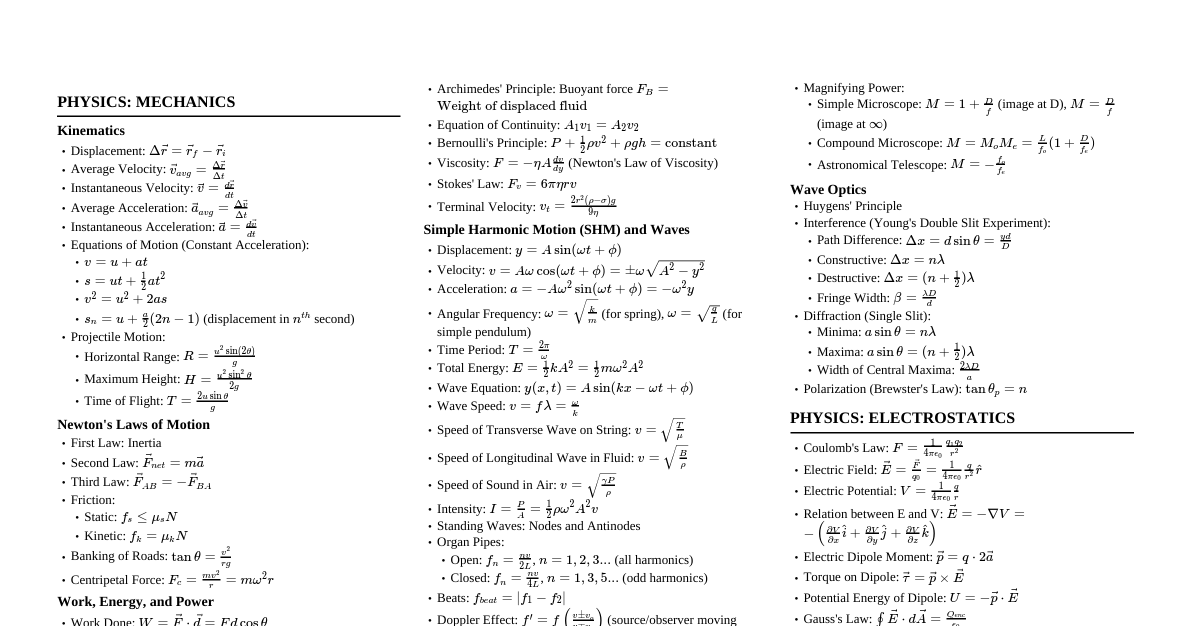
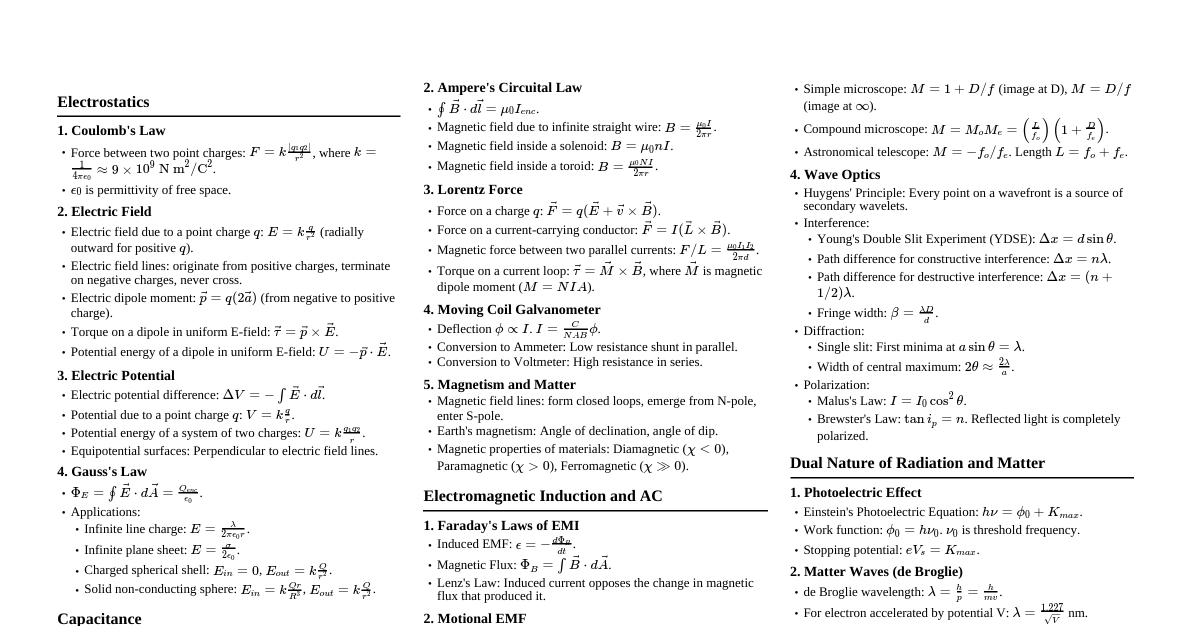
JEE Mains Physics PYQ Cheatshe
Cheatsheet Content
### Kinematics #### Core Theory Motion described by displacement, velocity, and acceleration. Uniform motion: $v = \text{constant}$, $a=0$. Uniformly accelerated motion: $a = \text{constant}$. Non-uniform motion involves variable acceleration. #### Formula Block $v = u + at$ $s = ut + \frac{1}{2}at^2$ $v^2 = u^2 + 2as$ $s_n = u + \frac{a}{2}(2n-1)$ Relative velocity: $\vec{v}_{AB} = \vec{v}_A - \vec{v}_B$ Projectile motion: $R = \frac{u^2 \sin(2\theta)}{g}$, $H = \frac{u^2 \sin^2\theta}{2g}$, $T = \frac{2u \sin\theta}{g}$ #### PYQ Example Set 1. **Question:** A particle starts from rest and accelerates at $2 \text{ m/s}^2$ for $10 \text{ s}$. Then it moves at constant velocity for $30 \text{ s}$ and finally decelerates at $4 \text{ m/s}^2$ until it stops. Find the total distance covered. (JEE Mains 2023) - **Examiner is testing:** Multi-stage motion analysis using kinematic equations. - **Solution:** - Stage 1: $u=0, a=2, t=10 \Rightarrow v_1 = 20 \text{ m/s}, s_1 = \frac{1}{2}(2)(10^2) = 100 \text{ m}$. - Stage 2: $v=20, t=30 \Rightarrow s_2 = 20 \times 30 = 600 \text{ m}$. - Stage 3: $u=20, v=0, a=-4 \Rightarrow 0^2 = 20^2 + 2(-4)s_3 \Rightarrow s_3 = 50 \text{ m}$. - Total distance = $100 + 600 + 50 = 750 \text{ m}$. - **Shortcut:** Sketch v-t graph and find area. - **Trap:** Incorrectly applying equations across stages or sign errors for deceleration. - **Trend:** Frequent multi-stage problems, often involving calculation of distance or time. 2. **Question:** A ball is thrown vertically upwards with a speed of $20 \text{ m/s}$ from the top of a tower of height $25 \text{ m}$. Find the time taken to reach the ground. (JEE Mains 2022) - **Examiner is testing:** Vertical motion under gravity, sign conventions for displacement. - **Solution:** Take upward as positive. $s = -25 \text{ m}$, $u = 20 \text{ m/s}$, $a = -10 \text{ m/s}^2$. - Using $s = ut + \frac{1}{2}at^2$: $-25 = 20t + \frac{1}{2}(-10)t^2$ - $-25 = 20t - 5t^2 \Rightarrow 5t^2 - 20t - 25 = 0 \Rightarrow t^2 - 4t - 5 = 0$ - $(t-5)(t+1) = 0 \Rightarrow t = 5 \text{ s}$ (since $t>0$). - **Shortcut:** Use quadratic equation solver, or consider time to max height, then time to fall from max height. - **Trap:** Confusing displacement with distance, or incorrect sign convention for gravity. - **Trend:** Direct application of kinematic equations, often involving falling from a height or projectile motion. 3. **Question:** A car moving at $10 \text{ m/s}$ accelerates uniformly at $2 \text{ m/s}^2$. What is its speed after it has covered a distance of $24 \text{ m}$? (JEE Mains 2021) - **Examiner is testing:** Application of $v^2 = u^2 + 2as$. - **Solution:** $u=10, a=2, s=24$. - $v^2 = 10^2 + 2(2)(24) = 100 + 96 = 196$. - $v = \sqrt{196} = 14 \text{ m/s}$. - **Shortcut:** Recognize the direct formula application. - **Trap:** Calculation errors or using the wrong kinematic equation. - **Trend:** Straightforward one-step problems are common to check basic formula recall. 4. **Question:** Two cars A and B are moving in the same direction with speeds $v_A = 30 \text{ m/s}$ and $v_B = 20 \text{ m/s}$. Car A is $100 \text{ m}$ behind car B. How long will it take for car A to overtake car B? (JEE Mains 2020) - **Examiner is testing:** Relative velocity concept. - **Solution:** Relative speed of A with respect to B: $v_{AB} = v_A - v_B = 30 - 20 = 10 \text{ m/s}$. - Distance to cover = $100 \text{ m}$. - Time = $\frac{\text{Distance}}{\text{Relative Speed}} = \frac{100}{10} = 10 \text{ s}$. - **Shortcut:** Direct application of $t = \frac{d}{v_{rel}}$. - **Trap:** Incorrectly calculating relative velocity (e.g., adding speeds). - **Trend:** Relative motion problems, especially involving overtaking or crossing, are standard. 5. **Question:** A projectile is fired at an angle of $45^\circ$ with the horizontal. The horizontal range is $R$. What is the maximum height achieved? (JEE Mains 2023) - **Examiner is testing:** Relationship between range and height in projectile motion. - **Solution:** $R = \frac{u^2 \sin(2\theta)}{g}$, $H = \frac{u^2 \sin^2\theta}{2g}$. - For $\theta = 45^\circ$, $\sin(2\theta) = \sin(90^\circ) = 1$. So $R = \frac{u^2}{g}$. - For $\theta = 45^\circ$, $\sin^2\theta = (\frac{1}{\sqrt{2}})^2 = \frac{1}{2}$. So $H = \frac{u^2 (1/2)}{2g} = \frac{u^2}{4g}$. - Since $R = \frac{u^2}{g}$, we have $H = \frac{R}{4}$. - **Shortcut:** For $\theta = 45^\circ$, $H = R/4$. - **Trap:** Incorrect trigonometric values or misremembering formulas. - **Trend:** Projectile motion with specific angles ($45^\circ, 30^\circ, 60^\circ$) and relationships between parameters are common. ### NLM & Friction #### Core Theory Newton's Laws define motion and forces. First law: inertia. Second law: $F=ma$. Third law: action-reaction pairs. Friction opposes relative motion: static friction prevents motion, kinetic friction acts during motion. #### Formula Block Newton's Second Law: $\vec{F}_{net} = m\vec{a}$ Static Friction: $f_s \le \mu_s N$ Kinetic Friction: $f_k = \mu_k N$ Apparent weight in a lift: $N = m(g \pm a)$ Conservation of momentum: $m_1u_1 + m_2u_2 = m_1v_1 + m_2v_2$ #### PYQ Example Set 1. **Question:** A block of mass $M$ is pulled by a force $F$ on a rough horizontal surface with coefficient of kinetic friction $\mu_k$. Find the acceleration of the block. (JEE Mains 2023) - **Examiner is testing:** Application of Newton's second law with kinetic friction. - **Solution:** - Normal force $N = Mg$. - Kinetic friction $f_k = \mu_k N = \mu_k Mg$. - Net force $F_{net} = F - f_k = F - \mu_k Mg$. - By Newton's second law, $F_{net} = Ma$. - So, $a = \frac{F - \mu_k Mg}{M}$. - **Shortcut:** $a = \frac{\text{Applied Force} - \text{Friction Force}}{\text{Mass}}$. - **Trap:** Using static friction instead of kinetic friction when motion occurs, or incorrect direction of friction. - **Trend:** Block-on-surface problems with friction are high-frequency, often involving inclined planes or multiple blocks. 2. **Question:** Two blocks of masses $m_1$ and $m_2$ are connected by a massless string passing over a frictionless pulley. Find the acceleration of the system. (JEE Mains 2022 - Atwood machine variant) - **Examiner is testing:** System dynamics, tension, and Newton's laws for connected bodies. - **Solution:** - Assume $m_1 > m_2$. $m_1$ moves down, $m_2$ moves up. - For $m_1$: $m_1g - T = m_1a$ - For $m_2$: $T - m_2g = m_2a$ - Adding the two equations: $(m_1g - T) + (T - m_2g) = m_1a + m_2a$ - $(m_1 - m_2)g = (m_1 + m_2)a$ - $a = \frac{(m_1 - m_2)g}{m_1 + m_2}$. - **Shortcut:** $a = \frac{\text{Net Pulling Force}}{\text{Total Mass}}$. - **Trap:** Incorrectly setting up force equations or sign errors for acceleration/tension. - **Trend:** Atwood machine and pulley-block systems are standard NLM questions. 3. **Question:** A block of mass $m$ is placed on an inclined plane with angle $\theta$. If the coefficient of static friction is $\mu_s$, what is the maximum angle $\theta$ for which the block remains at rest? (JEE Mains 2021) - **Examiner is testing:** Equilibrium on an inclined plane with static friction. - **Solution:** - Forces along the incline: $mg \sin\theta$ (down) and $f_s$ (up). - Forces perpendicular to incline: $N = mg \cos\theta$. - For equilibrium, $f_s = mg \sin\theta$. - Maximum static friction $f_{s,max} = \mu_s N = \mu_s mg \cos\theta$. - For the block to remain at rest, $mg \sin\theta \le \mu_s mg \cos\theta$. - $\tan\theta \le \mu_s$. So, $\theta_{max} = \arctan(\mu_s)$. - **Shortcut:** Angle of repose $\theta = \arctan(\mu_s)$. - **Trap:** Confusing static and kinetic friction, or incorrect resolution of forces. - **Trend:** Inclined plane problems with friction are very common, testing both equilibrium and motion. 4. **Question:** A $5 \text{ kg}$ block is at rest on a horizontal surface. A horizontal force of $20 \text{ N}$ is applied. If $\mu_s = 0.5$ and $\mu_k = 0.4$, what is the acceleration of the block? ($g=10 \text{ m/s}^2$) (JEE Mains 2020) - **Examiner is testing:** Distinguishing between static and kinetic friction and conditions for motion. - **Solution:** - Normal force $N = mg = 5 \times 10 = 50 \text{ N}$. - Maximum static friction $f_{s,max} = \mu_s N = 0.5 \times 50 = 25 \text{ N}$. - Applied force $F = 20 \text{ N}$. Since $F f_{s,max}$ first. - **Trap:** Blindly applying kinetic friction formula without checking if motion starts. - **Trend:** Problems requiring a check for initial motion are crucial to differentiate $\mu_s$ and $\mu_k$. 5. **Question:** A $10 \text{ kg}$ mass is suspended from a spring balance in a lift. If the lift is accelerating upwards at $2 \text{ m/s}^2$, what is the reading of the spring balance? ($g=10 \text{ m/s}^2$) (JEE Mains 2024) - **Examiner is testing:** Apparent weight in an accelerating frame. - **Solution:** - Apparent weight $N = m(g+a)$ for upward acceleration. - $N = 10(10+2) = 10 \times 12 = 120 \text{ N}$. - The spring balance reads the normal force/tension, which is the apparent weight. - **Shortcut:** $W_{app} = m(g \pm a)$. - **Trap:** Forgetting the sign convention for acceleration (up/down). - **Trend:** Lift problems are a common application of pseudo forces/accelerating frames. ### Work, Energy & Power #### Core Theory Work done by a force: $W = \vec{F} \cdot \vec{d}$. Kinetic energy: $KE = \frac{1}{2}mv^2$. Potential energy for gravity: $PE = mgh$. Work-Energy Theorem: $W_{net} = \Delta KE$. Conservation of Mechanical Energy: $KE_i + PE_i = KE_f + PE_f$ (for conservative forces). Power: $P = \frac{dW}{dt} = \vec{F} \cdot \vec{v}$. #### Formula Block Work: $W = Fd \cos\theta$ Kinetic Energy: $KE = \frac{1}{2}mv^2$ Gravitational Potential Energy: $PE_g = mgh$ Spring Potential Energy: $PE_s = \frac{1}{2}kx^2$ Work-Energy Theorem: $W_{net} = \Delta KE$ Power: $P = \frac{W}{t} = \vec{F} \cdot \vec{v}$ Conservation of Mechanical Energy: $E_i = E_f$ (if $W_{non-cons} = 0$) #### PYQ Example Set 1. **Question:** A block of mass $m$ is pulled along a horizontal surface by a force $F$ at an angle $\theta$ above the horizontal. If the coefficient of kinetic friction is $\mu_k$, calculate the work done by friction when the block moves a distance $d$. (JEE Mains 2023) - **Examiner is testing:** Work done by friction, normal force calculation with angled applied force. - **Solution:** - Vertical equilibrium: $N + F \sin\theta = mg \Rightarrow N = mg - F \sin\theta$. - Kinetic friction $f_k = \mu_k N = \mu_k (mg - F \sin\theta)$. - Work done by friction $W_f = -f_k d = -\mu_k (mg - F \sin\theta) d$. (Negative sign as friction opposes motion) - **Shortcut:** Correctly find normal force, then $W_f = -f_k d$. - **Trap:** Forgetting to consider the vertical component of the applied force when calculating normal force. - **Trend:** Work done by various forces, especially friction, on horizontal or inclined surfaces is common. 2. **Question:** A particle of mass $2 \text{ kg}$ moves such that its position vector is given by $\vec{r} = (t^3 \hat{i} + 2t^2 \hat{j}) \text{ m}$. Find the work done by the net force on the particle in the first $1 \text{ s}$. (JEE Mains 2022) - **Examiner is testing:** Work-Energy Theorem, calculating velocity from position, derivative application. - **Solution:** - Velocity $\vec{v} = \frac{d\vec{r}}{dt} = (3t^2 \hat{i} + 4t \hat{j}) \text{ m/s}$. - At $t=0$: $\vec{v}_i = (0 \hat{i} + 0 \hat{j}) \text{ m/s} \Rightarrow KE_i = 0$. - At $t=1 \text{ s}$: $\vec{v}_f = (3 \hat{i} + 4 \hat{j}) \text{ m/s}$. - Speed $v_f = |\vec{v}_f| = \sqrt{3^2 + 4^2} = \sqrt{9+16} = \sqrt{25} = 5 \text{ m/s}$. - $KE_f = \frac{1}{2}mv_f^2 = \frac{1}{2}(2)(5^2) = 25 \text{ J}$. - Work done $W_{net} = \Delta KE = KE_f - KE_i = 25 - 0 = 25 \text{ J}$. - **Shortcut:** Directly apply Work-Energy Theorem. - **Trap:** Calculation errors in derivatives or magnitude of velocity. - **Trend:** Work-Energy Theorem is a staple, often in combination with calculus-based kinematics. 3. **Question:** A block of mass $m$ starts from rest and slides down a frictionless inclined plane of length $L$ and inclination $\theta$. What is its speed at the bottom? (JEE Mains 2021) - **Examiner is testing:** Conservation of mechanical energy. - **Solution:** - Initial height $h = L \sin\theta$. - Initial mechanical energy $E_i = KE_i + PE_i = 0 + mgh = mgL \sin\theta$. - Final mechanical energy $E_f = KE_f + PE_f = \frac{1}{2}mv^2 + 0$. - By conservation of energy: $mgL \sin\theta = \frac{1}{2}mv^2$. - $v^2 = 2gL \sin\theta \Rightarrow v = \sqrt{2gL \sin\theta}$. - **Shortcut:** Potential energy converted to kinetic energy. - **Trap:** Forgetting to account for the height $h$ in terms of $L$ and $\theta$. - **Trend:** Conservation of energy on inclined planes (frictionless and with friction) is very frequent. 4. **Question:** A pump lifts $100 \text{ kg}$ of water to a height of $10 \text{ m}$ in $5 \text{ s}$. Calculate the power of the pump. ($g=10 \text{ m/s}^2$) (JEE Mains 2020) - **Examiner is testing:** Definition of power and work done against gravity. - **Solution:** - Work done by pump $W = mgh = 100 \times 10 \times 10 = 10000 \text{ J}$. - Power $P = \frac{W}{t} = \frac{10000}{5} = 2000 \text{ W}$. - **Shortcut:** $P = \frac{mgh}{t}$. - **Trap:** Units conversion or simple calculation errors. - **Trend:** Power calculation for lifting masses or in various mechanical scenarios is a recurring theme. 5. **Question:** A body of mass $1 \text{ kg}$ is thrown upwards with a velocity of $20 \text{ m/s}$. It reaches a maximum height of $18 \text{ m}$. Calculate the energy lost due to air friction. ($g=10 \text{ m/s}^2$) (JEE Mains 2024) - **Examiner is testing:** Work-Energy Theorem with non-conservative forces. - **Solution:** - Initial KE = $\frac{1}{2}mv^2 = \frac{1}{2}(1)(20^2) = 200 \text{ J}$. - At max height, KE = 0. Potential energy $PE = mgh = 1 \times 10 \times 18 = 180 \text{ J}$. - By Work-Energy Theorem (generalized): $W_{non-cons} = \Delta E_{mech} = (KE_f + PE_f) - (KE_i + PE_i)$. - $W_{air-friction} = (0 + 180) - (200 + 0) = 180 - 200 = -20 \text{ J}$. - Energy lost due to air friction = $20 \text{ J}$. - **Shortcut:** Initial ME - Final ME = Energy lost. - **Trap:** Incorrectly applying conservation of mechanical energy when non-conservative forces are present. - **Trend:** Energy loss due to friction/air resistance is a common scenario for applying generalized W.E.T. ### Centre of Mass #### Core Theory Centre of mass (CM) is the point where the entire mass of the system is assumed to be concentrated. For a system of particles, $\vec{R}_{CM} = \frac{\sum m_i \vec{r}_i}{\sum m_i}$. For continuous bodies, $\vec{R}_{CM} = \frac{\int \vec{r} dm}{\int dm}$. If no external force acts, the CM velocity remains constant. #### Formula Block Position of CM: $\vec{R}_{CM} = \frac{m_1\vec{r}_1 + m_2\vec{r}_2 + ...}{m_1 + m_2 + ...}$ Velocity of CM: $\vec{V}_{CM} = \frac{m_1\vec{v}_1 + m_2\vec{v}_2 + ...}{m_1 + m_2 + ...}$ Acceleration of CM: $\vec{A}_{CM} = \frac{m_1\vec{a}_1 + m_2\vec{a}_2 + ...}{m_1 + m_2 + ...}$ External Force: $\vec{F}_{ext} = M_{total}\vec{A}_{CM}$ Momentum of system: $\vec{P}_{sys} = M_{total}\vec{V}_{CM}$ #### PYQ Example Set 1. **Question:** Two particles of masses $1 \text{ kg}$ and $3 \text{ kg}$ are located at $(1,2,3)$ and $(3,-2,1)$ respectively. Find the coordinates of the center of mass. (JEE Mains 2023) - **Examiner is testing:** Basic formula for CM of discrete particles. - **Solution:** - $x_{CM} = \frac{m_1x_1 + m_2x_2}{m_1+m_2} = \frac{1(1) + 3(3)}{1+3} = \frac{1+9}{4} = \frac{10}{4} = 2.5$. - $y_{CM} = \frac{m_1y_1 + m_2y_2}{m_1+m_2} = \frac{1(2) + 3(-2)}{1+3} = \frac{2-6}{4} = \frac{-4}{4} = -1$. - $z_{CM} = \frac{m_1z_1 + m_2z_2}{m_1+m_2} = \frac{1(3) + 3(1)}{1+3} = \frac{3+3}{4} = \frac{6}{4} = 1.5$. - CM coordinates: $(2.5, -1, 1.5)$. - **Shortcut:** Direct application of the weighted average formula. - **Trap:** Simple arithmetic errors or mixing up coordinates. - **Trend:** Direct calculation of CM for 2-3 particles is common. 2. **Question:** A uniform circular disc of radius $R$ has a circular hole of radius $R/2$ cut out from its edge such that the edge of the hole passes through the center of the disc. Find the center of mass of the remaining portion. (JEE Mains 2022) - **Examiner is testing:** CM of a system with a cut-out part, using negative mass concept. - **Solution:** - Assume total disc (mass $M$, radius $R$) has CM at origin $(0,0)$. Area $A = \pi R^2$. - Cut-out disc (mass $M'$, radius $R/2$) has CM at $(R/2, 0)$. Area $A' = \pi (R/2)^2 = \pi R^2/4$. - Mass $M' = \frac{A'}{A} M = \frac{\pi R^2/4}{\pi R^2} M = M/4$. - Treat the system as original disc + (negative mass) cut-out disc. - $x_{CM} = \frac{M(0) + (-M/4)(R/2)}{M + (-M/4)} = \frac{-MR/8}{3M/4} = -\frac{R}{6}$. - $y_{CM} = 0$. - CM of remaining part is $(-\frac{R}{6}, 0)$. - **Shortcut:** Use negative mass approach for cut-out sections. - **Trap:** Incorrectly assigning mass or CM position for the cut-out part. - **Trend:** CM of composite bodies, especially those with holes, is a classic and frequently asked problem. 3. **Question:** A bomb at rest explodes into two pieces of masses $m_1$ and $m_2$. If $m_1$ moves with velocity $\vec{v}_1$, find the velocity of $m_2$. (JEE Mains 2021) - **Examiner is testing:** Conservation of momentum and CM velocity for an explosion. - **Solution:** - Initial momentum of the system (bomb at rest) is $P_i = 0$. - Since explosion is an internal process, no external force, so momentum is conserved. - Final momentum $P_f = m_1\vec{v}_1 + m_2\vec{v}_2$. - $P_i = P_f \Rightarrow 0 = m_1\vec{v}_1 + m_2\vec{v}_2$. - $\vec{v}_2 = -\frac{m_1}{m_2}\vec{v}_1$. - **Shortcut:** Direct application of momentum conservation for explosions. - **Trap:** Forgetting the vector nature of velocity or the negative sign. - **Trend:** Explosions and collisions are primary applications of momentum conservation, often linked to CM. 4. **Question:** A system of two particles has masses $m_1$ and $m_2$ and velocities $v_1$ and $v_2$. If $m_1 = 2 \text{ kg}$, $m_2 = 3 \text{ kg}$, $\vec{v}_1 = (2\hat{i} - \hat{j}) \text{ m/s}$ and $\vec{v}_2 = (-\hat{i} + 3\hat{j}) \text{ m/s}$. Find the velocity of the center of mass. (JEE Mains 2020) - **Examiner is testing:** Vectorial calculation of CM velocity. - **Solution:** - $\vec{V}_{CM} = \frac{m_1\vec{v}_1 + m_2\vec{v}_2}{m_1 + m_2}$ - $\vec{V}_{CM} = \frac{2(2\hat{i} - \hat{j}) + 3(-\hat{i} + 3\hat{j})}{2+3}$ - $\vec{V}_{CM} = \frac{(4\hat{i} - 2\hat{j}) + (-3\hat{i} + 9\hat{j})}{5}$ - $\vec{V}_{CM} = \frac{(4-3)\hat{i} + (-2+9)\hat{j}}{5} = \frac{1\hat{i} + 7\hat{j}}{5} = (0.2\hat{i} + 1.4\hat{j}) \text{ m/s}$. - **Shortcut:** Apply formula component-wise. - **Trap:** Vector addition errors. - **Trend:** Vector algebra in CM calculations is common. 5. **Question:** A uniform rod of length $L$ and mass $M$ is bent into a semicircle. Find the distance of its center of mass from the center of curvature. (JEE Mains 2024) - **Examiner is testing:** CM of a continuous body with specific geometry. - **Solution:** - For a uniform semicircular wire/arc of radius $R$, the CM is at a distance $\frac{2R}{\pi}$ from the center of curvature along the axis of symmetry. - The length of the rod $L = \pi R$. So, $R = L/\pi$. - Distance of CM from center = $\frac{2(L/\pi)}{\pi} = \frac{2L}{\pi^2}$. - **Shortcut:** Memorize standard CM positions for common shapes (semicircle, cone, etc.). - **Trap:** Confusing CM of a semicircular arc with a semicircular disc (which is $\frac{4R}{3\pi}$). - **Trend:** CM of continuous bodies, especially standard geometric shapes, is tested. ### Rotational Mechanics #### Core Theory Rotational motion analogous to linear motion: angular displacement ($\theta$), velocity ($\omega$), acceleration ($\alpha$). Torque ($\vec{\tau} = \vec{r} \times \vec{F}$) causes angular acceleration ($\tau = I\alpha$). Moment of inertia ($I = \sum m_i r_i^2$ or $\int r^2 dm$) is rotational inertia. Angular momentum ($\vec{L} = \vec{r} \times \vec{p} = I\vec{\omega}$). Conservation of angular momentum if net external torque is zero. Rotational KE: $\frac{1}{2}I\omega^2$. #### Formula Block Angular displacement: $\theta$ Angular velocity: $\omega = \frac{d\theta}{dt}$ Angular acceleration: $\alpha = \frac{d\omega}{dt}$ Kinematic equations: $\omega = \omega_0 + \alpha t$, $\theta = \omega_0 t + \frac{1}{2}\alpha t^2$, $\omega^2 = \omega_0^2 + 2\alpha\theta$ Torque: $\vec{\tau} = \vec{r} \times \vec{F}$, $\tau = I\alpha$ Moment of Inertia: $I = \sum m_i r_i^2$, $I_{parallel} = I_{CM} + Md^2$, $I_{perpendicular} = I_x + I_y$ Angular Momentum: $\vec{L} = \vec{r} \times \vec{p} = I\vec{\omega}$ Rotational KE: $KE_{rot} = \frac{1}{2}I\omega^2$ Rolling without slipping: $v = R\omega$, $a = R\alpha$ #### PYQ Example Set 1. **Question:** A solid cylinder of mass $M$ and radius $R$ rolls without slipping down an inclined plane of height $h$. Find its speed at the bottom. (JEE Mains 2023) - **Examiner is testing:** Conservation of energy for rolling motion (translation + rotation). - **Solution:** - Initial Energy $E_i = Mgh$. - Final Energy $E_f = KE_{trans} + KE_{rot} = \frac{1}{2}Mv^2 + \frac{1}{2}I\omega^2$. - For solid cylinder, $I = \frac{1}{2}MR^2$. For rolling without slipping, $v = R\omega \Rightarrow \omega = v/R$. - $E_f = \frac{1}{2}Mv^2 + \frac{1}{2}(\frac{1}{2}MR^2)(\frac{v}{R})^2 = \frac{1}{2}Mv^2 + \frac{1}{4}Mv^2 = \frac{3}{4}Mv^2$. - By conservation of energy: $Mgh = \frac{3}{4}Mv^2 \Rightarrow v = \sqrt{\frac{4gh}{3}}$. - **Shortcut:** $v = \sqrt{\frac{2gh}{1 + k^2/R^2}}$ where $I = Mk^2$. For solid cylinder $k^2/R^2 = 1/2$. - **Trap:** Forgetting the rotational kinetic energy component or incorrect moment of inertia. - **Trend:** Rolling motion on inclined planes is a highly favored topic, often comparing different shapes. 2. **Question:** A uniform rod of length $L$ and mass $M$ is pivoted at one end. It is released from rest in a horizontal position. Find the angular velocity when it reaches the vertical position. (JEE Mains 2022) - **Examiner is testing:** Conservation of mechanical energy involving rotational motion. - **Solution:** - Moment of inertia of rod about one end $I = \frac{1}{3}ML^2$. - Initial PE (CM is at $L/2$): $PE_i = Mg(L/2)$. Initial KE = 0. - Final PE (CM is at $0$ relative to pivot): $PE_f = 0$. Final KE = $\frac{1}{2}I\omega^2$. - By conservation of energy: $Mg(L/2) = \frac{1}{2}(\frac{1}{3}ML^2)\omega^2$. - $MgL/2 = \frac{1}{6}ML^2\omega^2 \Rightarrow g = \frac{1}{3}L\omega^2 \Rightarrow \omega = \sqrt{\frac{3g}{L}}$. - **Shortcut:** Apply energy conservation directly. - **Trap:** Incorrect moment of inertia or incorrect change in potential energy. - **Trend:** Problems involving objects pivoting and falling, using energy conservation. 3. **Question:** A solid sphere and a hollow sphere of the same mass and radius roll down the same inclined plane from rest. Which one reaches the bottom first? (JEE Mains 2021) - **Examiner is testing:** Comparison of rolling motion based on moment of inertia. - **Solution:** - Speed at bottom $v = \sqrt{\frac{2gh}{1 + k^2/R^2}}$. - For solid sphere, $I = \frac{2}{5}MR^2 \Rightarrow k^2/R^2 = 2/5$. So $v_{solid} = \sqrt{\frac{2gh}{1+2/5}} = \sqrt{\frac{10gh}{7}}$. - For hollow sphere, $I = \frac{2}{3}MR^2 \Rightarrow k^2/R^2 = 2/3$. So $v_{hollow} = \sqrt{\frac{2gh}{1+2/3}} = \sqrt{\frac{6gh}{5}}$. - Since $\frac{10}{7} > \frac{6}{5}$ (1.428 > 1.2), $v_{solid} > v_{hollow}$. - Higher velocity means less time. So, the solid sphere reaches the bottom first. - **Shortcut:** Object with smaller $k^2/R^2$ (or smaller moment of inertia for given mass/radius) rolls faster. - **Trap:** Confusing moment of inertia values or incorrect comparison. - **Trend:** Comparative questions for rolling objects are very common. 4. **Question:** A particle of mass $m$ is projected with velocity $v$ at an angle $\theta$ with the horizontal. Find its angular momentum about the point of projection when it is at its maximum height. (JEE Mains 2020) - **Examiner is testing:** Angular momentum calculation for projectile motion. - **Solution:** - At max height $H$, the velocity is purely horizontal: $v_x = v \cos\theta$. - The height is $H = \frac{v^2 \sin^2\theta}{2g}$. - Angular momentum $\vec{L} = \vec{r} \times \vec{p}$. Here, $\vec{r}$ is vertical (height $H$) and $\vec{p}$ is horizontal ($mv_x$). - The magnitude $L = r p \sin(90^\circ) = H (mv_x)$. - $L = (\frac{v^2 \sin^2\theta}{2g}) (m v \cos\theta) = \frac{mv^3 \sin^2\theta \cos\theta}{2g}$. - Direction is into the page (for projection in xy-plane). - **Shortcut:** $L = (m v \cos\theta) \times H$. - **Trap:** Incorrect velocity component or height, or direction of angular momentum. - **Trend:** Angular momentum of projectile motion is a frequent theoretical and calculation-based problem. 5. **Question:** A uniform disc of mass $M$ and radius $R$ is rotating with angular velocity $\omega$. A second disc of the same mass but radius $R/2$ is gently placed concentrically on the first disc. What is the final angular velocity of the system? (JEE Mains 2024) - **Examiner is testing:** Conservation of angular momentum for a system of rotating bodies. - **Solution:** - Initial angular momentum $L_i = I_1 \omega_1$. - For first disc, $I_1 = \frac{1}{2}MR^2$. So $L_i = \frac{1}{2}MR^2 \omega$. - Final angular momentum $L_f = (I_1 + I_2)\omega_f$. - For second disc, $I_2 = \frac{1}{2}M(R/2)^2 = \frac{1}{2}M \frac{R^2}{4} = \frac{1}{8}MR^2$. - $L_f = (\frac{1}{2}MR^2 + \frac{1}{8}MR^2)\omega_f = (\frac{4+1}{8}MR^2)\omega_f = \frac{5}{8}MR^2 \omega_f$. - By conservation of angular momentum: $L_i = L_f$. - $\frac{1}{2}MR^2 \omega = \frac{5}{8}MR^2 \omega_f \Rightarrow \omega_f = \frac{4}{5}\omega$. - **Shortcut:** $I_{initial}\omega_{initial} = I_{final}\omega_{final}$. - **Trap:** Incorrect moment of inertia for the second disc or algebraic errors. - **Trend:** Problems involving changing moment of inertia and conservation of angular momentum are very important. ### Gravitation #### Core Theory Newton's Law of Gravitation: $F = \frac{Gm_1m_2}{r^2}$. Gravitational field intensity: $\vec{E} = \vec{F}/m$. Gravitational potential: $V = -GM/r$. Gravitational potential energy: $U = -Gm_1m_2/r$. Kepler's Laws for planetary motion. Orbital velocity, escape velocity. #### Formula Block Gravitational Force: $F = \frac{Gm_1m_2}{r^2}$ Gravitational Field: $E = \frac{GM}{r^2}$ (outside), $E = \frac{GMr}{R^3}$ (inside uniform sphere) Gravitational Potential: $V = -\frac{GM}{r}$ Gravitational Potential Energy: $U = -\frac{Gm_1m_2}{r}$ Acceleration due to gravity: $g = \frac{GM}{R^2}$ Variation of $g$: $g' = g(1 - \frac{2h}{R})$ (for $h \ll R$), $g' = g(1 - \frac{d}{R})$ (depth $d$), $g' = g - R\omega^2 \cos^2\lambda$ (rotation) Orbital velocity: $v_o = \sqrt{\frac{GM}{r}}$ Escape velocity: $v_e = \sqrt{\frac{2GM}{R}}$ Kepler's Third Law: $T^2 \propto r^3$ #### PYQ Example Set 1. **Question:** If the radius of Earth shrinks by $1\%$ keeping its mass constant, what is the percentage change in acceleration due to gravity on its surface? (JEE Mains 2023) - **Examiner is testing:** Dependence of $g$ on radius, percentage change calculation. - **Solution:** - $g = \frac{GM}{R^2}$. If $R$ changes to $R' = R - 0.01R = 0.99R$. - $g' = \frac{GM}{(0.99R)^2} = \frac{GM}{0.9801R^2} \approx \frac{1}{0.98} \frac{GM}{R^2} \approx (1+0.02)g$. - $g' \approx 1.02g$. - Percentage change in $g = \frac{g' - g}{g} \times 100\% = \frac{1.02g - g}{g} \times 100\% = 0.02 \times 100\% = 2\%$. (Increase) - Alternatively, using differential method: $\ln g = \ln(GM) - 2 \ln R$. - $\frac{\Delta g}{g} = -2 \frac{\Delta R}{R}$. - If $\Delta R/R = -0.01$, then $\Delta g/g = -2(-0.01) = +0.02$. So $2\%$ increase. - **Shortcut:** For small changes, $\frac{\Delta g}{g} = -2\frac{\Delta R}{R}$. - **Trap:** Incorrect sign for percentage change (increase vs decrease) or calculation errors. - **Trend:** Variation of $g$ with height, depth, radius, and rotation are frequently tested. 2. **Question:** An artificial satellite is moving in a circular orbit around the Earth with speed $v$. If it suddenly stops, what will be its speed when it hits the Earth's surface? (Assume $R_E$ is Earth's radius and $r$ is orbital radius). (JEE Mains 2022) - **Examiner is testing:** Conservation of mechanical energy for a falling satellite. - **Solution:** - Initial Mechanical Energy $E_i = U_i + KE_i = -\frac{GMm}{r} + 0$ (since it stops). - Final Mechanical Energy $E_f = U_f + KE_f = -\frac{GMm}{R_E} + \frac{1}{2}mv^2_{impact}$. - By conservation of energy: $-\frac{GMm}{r} = -\frac{GMm}{R_E} + \frac{1}{2}mv^2_{impact}$. - $\frac{1}{2}v^2_{impact} = GM(\frac{1}{R_E} - \frac{1}{r})$. - $v_{impact} = \sqrt{2GM(\frac{1}{R_E} - \frac{1}{r})}$. - **Shortcut:** Apply energy conservation between orbital position and Earth's surface. - **Trap:** Forgetting that $GM = gR_E^2$ or using orbital velocity $v_o$ instead of zero initial KE. - **Trend:** Energy conservation for satellites and objects falling under gravity is an important concept. 3. **Question:** What is the ratio of escape velocity from Earth to the orbital velocity of a satellite very close to Earth's surface? (JEE Mains 2021) - **Examiner is testing:** Relationship between escape velocity and orbital velocity. - **Solution:** - Escape velocity $v_e = \sqrt{\frac{2GM}{R_E}}$. - Orbital velocity close to surface $v_o = \sqrt{\frac{GM}{R_E}}$. - Ratio $\frac{v_e}{v_o} = \frac{\sqrt{2GM/R_E}}{\sqrt{GM/R_E}} = \sqrt{2}$. - **Shortcut:** $v_e = \sqrt{2} v_o$. - **Trap:** Misremembering formulas or calculation errors. - **Trend:** Direct formula-based questions and relationships between velocities are common. 4. **Question:** A planet has mass $M/2$ and radius $R/2$, where $M$ and $R$ are the mass and radius of Earth. If the escape velocity from Earth is $v_e$, what is the escape velocity from the planet? (JEE Mains 2020) - **Examiner is testing:** Dependence of escape velocity on mass and radius. - **Solution:** - Escape velocity from Earth $v_e = \sqrt{\frac{2GM}{R}}$. - For the planet, mass $M' = M/2$, radius $R' = R/2$. - Escape velocity from planet $v_e' = \sqrt{\frac{2GM'}{R'}} = \sqrt{\frac{2G(M/2)}{R/2}} = \sqrt{\frac{2GM}{R}} = v_e$. - **Shortcut:** Notice the ratio $M/R$ remains constant. - **Trap:** Calculation errors with fractions. - **Trend:** Scaling problems involving gravitational parameters (mass, radius) are popular. 5. **Question:** Two satellites A and B revolve around a planet in circular orbits of radii $R$ and $4R$ respectively. If the time period of A is $T$, what is the time period of B? (JEE Mains 2024) - **Examiner is testing:** Kepler's Third Law. - **Solution:** - According to Kepler's Third Law, $T^2 \propto r^3$. - So, $\frac{T_B^2}{T_A^2} = \frac{r_B^3}{r_A^3}$. - $\frac{T_B^2}{T^2} = \frac{(4R)^3}{R^3} = \frac{64R^3}{R^3} = 64$. - $T_B^2 = 64T^2 \Rightarrow T_B = 8T$. - **Shortcut:** Directly apply $T \propto r^{3/2}$. - **Trap:** Using $T \propto r$ or $T \propto r^2$. - **Trend:** Kepler's laws, especially the third law, are frequently tested. ### Thermodynamics #### Core Theory Temperature, heat, work, internal energy. First Law of Thermodynamics: $\Delta U = Q - W$. Specific heat capacities $C_p, C_v$. Isothermal, adiabatic, isobaric, isochoric processes. Carnot engine efficiency. #### Formula Block First Law of Thermodynamics: $\Delta U = Q - W$ (or $\Delta U = Q + W$ if $W$ is work done on system) Work done by gas: $W = \int P dV$ For ideal gas: $PV = nRT$, $U = \frac{f}{2}nRT$ Specific heat: $C_p - C_v = R$, $\gamma = C_p/C_v$ Molar specific heat: $C_v = \frac{f}{2}R$, $C_p = (\frac{f}{2}+1)R$ Isothermal process: $PV = \text{constant}$, $W = nRT \ln(V_f/V_i)$ Adiabatic process: $PV^\gamma = \text{constant}$, $TV^{\gamma-1} = \text{constant}$, $P^{1-\gamma}T^\gamma = \text{constant}$ Efficiency of Carnot engine: $\eta = 1 - \frac{T_C}{T_H}$ Coefficient of Performance (COP) of refrigerator: $COP = \frac{Q_C}{W} = \frac{T_C}{T_H - T_C}$ #### PYQ Example Set 1. **Question:** An ideal gas expands from volume $V$ to $2V$ at constant temperature $T$. Calculate the work done by the gas. (JEE Mains 2023) - **Examiner is testing:** Work done during an isothermal process. - **Solution:** - For an isothermal process, the temperature $T$ is constant. - Work done by an ideal gas during isothermal expansion: $W = nRT \ln(\frac{V_f}{V_i})$. - Given $V_i = V$, $V_f = 2V$. - $W = nRT \ln(\frac{2V}{V}) = nRT \ln(2)$. - **Shortcut:** Directly use the formula for isothermal work. - **Trap:** Using $P\Delta V$ which is only for isobaric, or incorrect logarithmic base. - **Trend:** Work done in various thermodynamic processes, especially isothermal and adiabatic, is frequently tested. 2. **Question:** A Carnot engine operates between $300 \text{ K}$ and $400 \text{ K}$. If it absorbs $1200 \text{ J}$ of heat from the source, how much heat is rejected to the sink? (JEE Mains 2022) - **Examiner is testing:** Carnot engine efficiency and relation between heat absorbed/rejected. - **Solution:** - Efficiency $\eta = 1 - \frac{T_C}{T_H} = 1 - \frac{300}{400} = 1 - \frac{3}{4} = \frac{1}{4}$. - Also, $\eta = \frac{W}{Q_H} = \frac{Q_H - Q_C}{Q_H} = 1 - \frac{Q_C}{Q_H}$. - So, $1 - \frac{Q_C}{Q_H} = 1 - \frac{T_C}{T_H} \Rightarrow \frac{Q_C}{Q_H} = \frac{T_C}{T_H}$. - $Q_C = Q_H \frac{T_C}{T_H} = 1200 \text{ J} \times \frac{300 \text{ K}}{400 \text{ K}} = 1200 \times \frac{3}{4} = 900 \text{ J}$. - **Shortcut:** $\frac{Q_C}{T_C} = \frac{Q_H}{T_H}$. - **Trap:** Confusing source and sink temperatures or incorrect formula for efficiency. - **Trend:** Carnot engine/refrigerator problems are a staple, often involving calculation of efficiency or heat transfer. 3. **Question:** $1 \text{ mole}$ of a monoatomic ideal gas undergoes an adiabatic process. Its temperature changes from $400 \text{ K}$ to $300 \text{ K}$. Calculate the work done by the gas. ($R = 8.3 \text{ J/mol K}$) (JEE Mains 2021) - **Examiner is testing:** Work done in an adiabatic process, internal energy change. - **Solution:** - For an adiabatic process, $Q=0$. - From First Law of Thermodynamics: $\Delta U = Q - W \Rightarrow \Delta U = -W$. - So, $W = -\Delta U$. - For monoatomic gas, $f=3$. $\Delta U = n C_v \Delta T = n (\frac{3}{2}R) (T_f - T_i)$. - $\Delta U = 1 \times (\frac{3}{2} \times 8.3) \times (300 - 400) = \frac{3}{2} \times 8.3 \times (-100) = -1.5 \times 830 = -1245 \text{ J}$. - Work done by gas $W = -(-1245 \text{ J}) = 1245 \text{ J}$. - **Shortcut:** $W = \frac{nR(T_i - T_f)}{\gamma - 1}$. For monoatomic $\gamma = 5/3$. $W = \frac{1 \times 8.3 \times (400 - 300)}{5/3 - 1} = \frac{8.3 \times 100}{2/3} = 8.3 \times 150 = 1245 \text{ J}$. - **Trap:** Incorrect value of $\gamma$ for monoatomic gas or sign error in work/internal energy. - **Trend:** Adiabatic processes, especially work done and temperature-volume relations, are frequently tested. 4. **Question:** For a gas, the ratio of two specific heats is $1.4$. If the gas is heated at constant pressure, what fraction of the heat supplied is used to increase the internal energy? (JEE Mains 2020) - **Examiner is testing:** Relation between $C_p, C_v, \gamma$ and First Law of Thermodynamics for isobaric process. - **Solution:** - Given $\gamma = C_p/C_v = 1.4$. - Heat supplied at constant pressure $Q_p = nC_p \Delta T$. - Change in internal energy $\Delta U = nC_v \Delta T$. - Fraction of heat used for internal energy = $\frac{\Delta U}{Q_p} = \frac{nC_v \Delta T}{nC_p \Delta T} = \frac{C_v}{C_p} = \frac{1}{\gamma}$. - Fraction = $\frac{1}{1.4} = \frac{10}{14} = \frac{5}{7}$. - **Shortcut:** For isobaric process, $\frac{\Delta U}{Q} = \frac{1}{\gamma}$. - **Trap:** Confusing $C_p$ and $C_v$ or misinterpreting the question. - **Trend:** Relationship between specific heats and their application in various processes. 5. **Question:** A gas performs work $W$ when it expands isothermally. What is the change in its internal energy? (JEE Mains 2024) - **Examiner is testing:** First Law of Thermodynamics for an isothermal process. - **Solution:** - For an ideal gas, internal energy $U$ depends only on temperature $T$. - In an isothermal process, $T = \text{constant}$. - Therefore, the change in internal energy $\Delta U = 0$. - From First Law: $\Delta U = Q - W$. Since $\Delta U = 0$, $Q = W$. - **Shortcut:** For ideal gas, isothermal process implies $\Delta U = 0$. - **Trap:** Assuming $\Delta U$ is always non-zero or confusing it with heat/work. - **Trend:** Conceptual questions about the First Law and properties of ideal gases are common. ### Kinetic Theory #### Core Theory Ideal gas assumptions. Pressure exerted by gas. Average kinetic energy of a molecule $\frac{3}{2}kT$. Degrees of freedom $f$. Law of equipartition of energy. Root mean square speed $v_{rms}$. #### Formula Block Pressure: $P = \frac{1}{3}\frac{nm}{V}v_{rms}^2 = \frac{1}{3}\rho v_{rms}^2$ Average KE per molecule: $\langle KE \rangle = \frac{3}{2}kT$ Internal Energy of ideal gas: $U = \frac{f}{2}nRT = \frac{f}{2}NkT$ RMS speed: $v_{rms} = \sqrt{\frac{3RT}{M_0}} = \sqrt{\frac{3kT}{m}}$ Mean free path: $\lambda = \frac{1}{\sqrt{2}n\pi d^2}$ Degrees of freedom: Monoatomic $f=3$, Diatomic $f=5$ (at moderate T), Polyatomic $f=6$ #### PYQ Example Set 1. **Question:** For a gas, if $v_{rms}$ is the root mean square speed and $v_p$ is the most probable speed, what is the ratio $v_{rms}/v_p$? (JEE Mains 2023) - **Examiner is testing:** Understanding of different molecular speeds. - **Solution:** - $v_{rms} = \sqrt{\frac{3RT}{M_0}}$. - $v_p = \sqrt{\frac{2RT}{M_0}}$. - Ratio $\frac{v_{rms}}{v_p} = \frac{\sqrt{3RT/M_0}}{\sqrt{2RT/M_0}} = \sqrt{\frac{3}{2}}$. - **Shortcut:** Memorize the ratios $v_p : v_{avg} : v_{rms} = \sqrt{2} : \sqrt{8/\pi} : \sqrt{3}$. - **Trap:** Confusing the formulas for different speeds. - **Trend:** Comparison and calculation of different molecular speeds are common. 2. **Question:** The internal energy of $1 \text{ mole}$ of an ideal monoatomic gas at temperature $T$ is $U_0$. What is the internal energy of $1 \text{ mole}$ of an ideal diatomic gas at temperature $2T$? (JEE Mains 2022) - **Examiner is testing:** Dependence of internal energy on degrees of freedom and temperature. - **Solution:** - For monoatomic gas, degrees of freedom $f_m = 3$. - Internal energy $U_{mono} = \frac{f_m}{2}nRT = \frac{3}{2}nRT$. - Given $U_0 = \frac{3}{2}nRT$. (Assuming $n=1$) - For diatomic gas, degrees of freedom $f_d = 5$ (at moderate temperatures, translational + rotational). - Internal energy $U_{di} = \frac{f_d}{2}nRT' = \frac{5}{2}nRT'$. - Given new temperature $T' = 2T$. - $U_{di} = \frac{5}{2}n R (2T) = 5nRT$. - To relate to $U_0$: $nRT = \frac{2}{3}U_0$. - $U_{di} = 5 (\frac{2}{3}U_0) = \frac{10}{3}U_0$. - **Shortcut:** $U \propto fT$. Ratio of $U_2/U_1 = (f_2 T_2)/(f_1 T_1)$. - **Trap:** Incorrect degrees of freedom for different gases or calculation errors. - **Trend:** Internal energy, degrees of freedom, and their relation to temperature are frequently tested. 3. **Question:** At what temperature will the root mean square speed of hydrogen molecules be equal to that of oxygen molecules at $300 \text{ K}$? (Molecular weight of $H_2 = 2 \text{ g/mol}$, $O_2 = 32 \text{ g/mol}$) (JEE Mains 2021) - **Examiner is testing:** Dependence of $v_{rms}$ on temperature and molar mass. - **Solution:** - $v_{rms} = \sqrt{\frac{3RT}{M_0}}$. - We want $(v_{rms})_{H_2} = (v_{rms})_{O_2}$. - $\sqrt{\frac{3RT_{H_2}}{M_{H_2}}} = \sqrt{\frac{3RT_{O_2}}{M_{O_2}}}$. - $\frac{T_{H_2}}{M_{H_2}} = \frac{T_{O_2}}{M_{O_2}}$. - $T_{H_2} = T_{O_2} \frac{M_{H_2}}{M_{O_2}} = 300 \text{ K} \times \frac{2 \text{ g/mol}}{32 \text{ g/mol}} = 300 \times \frac{1}{16} = 18.75 \text{ K}$. - **Shortcut:** $T_1/M_1 = T_2/M_2$ for equal $v_{rms}$. - **Trap:** Incorrect molar masses or inverse relation. - **Trend:** Comparing $v_{rms}$ of different gases at different temperatures is a classic KTG problem. 4. **Question:** A gas at $27^\circ \text{C}$ has a volume $V$. If its pressure is doubled and temperature is raised to $127^\circ \text{C}$, what is the new volume? (JEE Mains 2020) - **Examiner is testing:** Ideal gas law ($PV=nRT$). - **Solution:** - Initial state: $P_1, V_1=V, T_1 = 27^\circ \text{C} = 300 \text{ K}$. - Final state: $P_2=2P_1, V_2, T_2 = 127^\circ \text{C} = 400 \text{ K}$. - Using $\frac{P_1V_1}{T_1} = \frac{P_2V_2}{T_2}$. - $\frac{P_1V}{300} = \frac{2P_1V_2}{400}$. - $\frac{V}{300} = \frac{2V_2}{400} \Rightarrow \frac{V}{3} = \frac{2V_2}{4} \Rightarrow \frac{V}{3} = \frac{V_2}{2}$. - $V_2 = \frac{2V}{3}$. - **Shortcut:** Convert temperatures to Kelvin immediately. - **Trap:** Forgetting to convert temperature to Kelvin, or simple algebraic error. - **Trend:** Ideal gas law and its applications are foundational and frequently tested. 5. **Question:** In a mixture of two gases, the ratio of their molar masses is $M_1/M_2 = 1/4$ and the ratio of their temperatures is $T_1/T_2 = 2$. What is the ratio of their RMS speeds, $(v_{rms})_1/(v_{rms})_2$? (JEE Mains 2024) - **Examiner is testing:** Dependence of $v_{rms}$ on temperature and molar mass. - **Solution:** - $v_{rms} = \sqrt{\frac{3RT}{M_{molar}}}$. - $\frac{(v_{rms})_1}{(v_{rms})_2} = \sqrt{\frac{3RT_1/M_1}{3RT_2/M_2}} = \sqrt{\frac{T_1 M_2}{T_2 M_1}}$. - Given $T_1/T_2 = 2$ and $M_1/M_2 = 1/4 \Rightarrow M_2/M_1 = 4$. - $\frac{(v_{rms})_1}{(v_{rms})_2} = \sqrt{(2)(4)} = \sqrt{8} = 2\sqrt{2}$. - **Shortcut:** Directly substitute ratios into the $v_{rms}$ formula. - **Trap:** Incorrectly inverting the molar mass ratio. - **Trend:** Ratio problems involving $v_{rms}$ are common, testing careful substitution. ### Oscillations & Waves #### Core Theory Simple Harmonic Motion (SHM): $a = -\omega^2 x$. Energy in SHM. Damped and forced oscillations. Wave equation: $y(x,t) = A \sin(kx - \omega t + \phi)$. Wave speed: $v = f\lambda = \omega/k$. Superposition, interference, diffraction. Standing waves, beats, Doppler effect. #### Formula Block SHM displacement: $x(t) = A \sin(\omega t + \phi)$ Velocity in SHM: $v = A\omega \cos(\omega t + \phi) = \pm \omega \sqrt{A^2 - x^2}$ Acceleration in SHM: $a = -A\omega^2 \sin(\omega t + \phi) = -\omega^2 x$ Time period of spring-mass: $T = 2\pi\sqrt{m/k}$ Time period of simple pendulum: $T = 2\pi\sqrt{L/g}$ Total energy in SHM: $E = \frac{1}{2}kA^2 = \frac{1}{2}m\omega^2 A^2$ Wave speed on string: $v = \sqrt{T/\mu}$ Wave equation: $y(x,t) = A \sin(kx - \omega t + \phi)$ Angular wave number: $k = 2\pi/\lambda$ Angular frequency: $\omega = 2\pi f$ Beat frequency: $f_{beat} = |f_1 - f_2|$ Doppler Effect: $f' = f \frac{v \pm v_o}{v \mp v_s}$ (upper signs for approaching, lower for receding) Stationary waves: nodes at fixed ends, antinodes at free ends. Open organ pipe: $f_n = \frac{nv}{2L}$, Closed organ pipe: $f_n = \frac{nv}{4L}$ ($n=1,3,5...$) #### PYQ Example Set 1. **Question:** A particle executes SHM with amplitude $A$ and angular frequency $\omega$. What is the ratio of its maximum kinetic energy to its maximum potential energy? (JEE Mains 2023) - **Examiner is testing:** Energy conservation in SHM. - **Solution:** - Maximum kinetic energy $KE_{max} = \frac{1}{2}mv_{max}^2 = \frac{1}{2}m(A\omega)^2 = \frac{1}{2}m A^2 \omega^2$. - Maximum potential energy $PE_{max} = \frac{1}{2}kA^2$. - For SHM, $k = m\omega^2$. - So, $PE_{max} = \frac{1}{2}(m\omega^2)A^2 = \frac{1}{2}m A^2 \omega^2$. - The ratio $KE_{max} / PE_{max} = 1$. (Total energy is constant and equals $KE_{max}$ or $PE_{max}$) - **Shortcut:** In SHM, total energy is constant and equals $KE_{max}$ (at mean position) or $PE_{max}$ (at extreme positions). - **Trap:** Incorrectly calculating $k$ or confusing maximum values with instantaneous values. - **Trend:** Energy in SHM and its conservation is a fundamental and frequently asked concept. 2. **Question:** A string fixed at both ends vibrates in its third harmonic. If the length of the string is $L$, what is the wavelength of the wave? (JEE Mains 2022) - **Examiner is testing:** Understanding of harmonics and standing waves in strings. - **Solution:** - For a string fixed at both ends, the wavelength of the $n$-th harmonic is $\lambda_n = \frac{2L}{n}$. - For the third harmonic, $n=3$. - So, $\lambda_3 = \frac{2L}{3}$. - **Shortcut:** Directly apply the formula $\lambda_n = 2L/n$. - **Trap:** Confusing $n$ for third harmonic (number of loops is 3, so $n=3$) or using formula for open/closed pipes. - **Trend:** Standing waves in strings and organ pipes are very common, testing wavelength and frequency relations. 3. **Question:** A source of sound of frequency $f$ moves towards a stationary observer with speed $v_s$. If the speed of sound is $v$, what is the apparent frequency heard by the observer? (JEE Mains 2021) - **Examiner is testing:** Doppler effect for sound. - **Solution:** - Doppler effect formula: $f' = f \frac{v \pm v_o}{v \mp v_s}$. - Here, observer is stationary ($v_o = 0$). Source is approaching ($v_s$ in denominator with minus sign). - So, $f' = f \frac{v}{v - v_s}$. - **Shortcut:** Remember the sign convention: "towards" implies decrease in denominator (for source) or increase in numerator (for observer). - **Trap:** Incorrect sign convention in the Doppler formula. - **Trend:** Doppler effect problems, usually direct application, are very frequent. 4. **Question:** Two waves represented by $y_1 = 5 \sin(2\pi t - \pi x)$ and $y_2 = 10 \sin(2\pi t - \pi x + \pi/3)$ interfere. What is the ratio of their intensities? (JEE Mains 2020) - **Examiner is testing:** Relation between amplitude and intensity for waves. - **Solution:** - Intensity $I \propto A^2$. - For $y_1$, amplitude $A_1 = 5$. For $y_2$, amplitude $A_2 = 10$. - Ratio of intensities $\frac{I_1}{I_2} = \frac{A_1^2}{A_2^2} = \frac{5^2}{10^2} = \frac{25}{100} = \frac{1}{4}$. - **Shortcut:** $I \propto A^2$. - **Trap:** Calculating resultant amplitude (which is not asked) or simply taking ratio of amplitudes. - **Trend:** Intensity and amplitude relations, and interference of waves are common. 5. **Question:** A block of mass $m$ is attached to a spring with spring constant $k$. If it oscillates with amplitude $A$, what is its speed when it is at $x = A/2$ from the equilibrium position? (JEE Mains 2024) - **Examiner is testing:** Velocity in SHM at an arbitrary position. - **Solution:** - Velocity in SHM: $v = \omega \sqrt{A^2 - x^2}$. - Here, $x = A/2$. - $v = \omega \sqrt{A^2 - (A/2)^2} = \omega \sqrt{A^2 - A^2/4} = \omega \sqrt{\frac{3A^2}{4}} = \omega \frac{\sqrt{3}A}{2}$. - Since $\omega = \sqrt{k/m}$, $v = \sqrt{\frac{k}{m}} \frac{\sqrt{3}A}{2}$. - **Shortcut:** Direct formula application $v = \omega \sqrt{A^2 - x^2}$. - **Trap:** Calculation errors with squares and square roots. - **Trend:** Kinematics of SHM (position, velocity, acceleration) are fundamental and regularly asked. ### Electrostatics #### Core Theory Coulomb's Law: $F = \frac{1}{4\pi\epsilon_0} \frac{q_1q_2}{r^2}$. Electric field: $\vec{E} = \vec{F}/q_0$. Electric potential: $V = W/q_0$. Gauss's Law: $\oint \vec{E} \cdot d\vec{A} = Q_{enc}/\epsilon_0$. Dipole moment: $\vec{p} = q\vec{d}$. #### Formula Block Coulomb's Law: $\vec{F} = \frac{1}{4\pi\epsilon_0} \frac{q_1q_2}{r^2} \hat{r}$ Electric Field: $E = \frac{1}{4\pi\epsilon_0} \frac{q}{r^2}$ (point charge) Electric Potential: $V = \frac{1}{4\pi\epsilon_0} \frac{q}{r}$ (point charge) Potential Energy: $U = \frac{1}{4\pi\epsilon_0} \frac{q_1q_2}{r}$ Electric Dipole Moment: $\vec{p} = q(2\vec{a})$ Torque on dipole: $\vec{\tau} = \vec{p} \times \vec{E}$ Potential energy of dipole: $U = -\vec{p} \cdot \vec{E}$ Gauss's Law: $\oint \vec{E} \cdot d\vec{A} = Q_{enc}/\epsilon_0$ Field of infinite line charge: $E = \frac{\lambda}{2\pi\epsilon_0 r}$ Field of infinite plane sheet: $E = \frac{\sigma}{2\epsilon_0}$ Field of charged conducting sphere: $E=0$ (inside), $E=\frac{1}{4\pi\epsilon_0}\frac{Q}{r^2}$ (outside) #### PYQ Example Set 1. **Question:** Two point charges $+q$ and $+4q$ are placed at a distance $r$ from each other. At what point on the line joining them is the electric field zero? (JEE Mains 2023) - **Examiner is testing:** Superposition of electric fields, finding null point. - **Solution:** - Let the point be at distance $x$ from $+q$. Then its distance from $+4q$ is $(r-x)$. - For electric field to be zero, $\vec{E}_1 + \vec{E}_2 = 0 \Rightarrow |\vec{E}_1| = |\vec{E}_2|$. - $\frac{1}{4\pi\epsilon_0} \frac{q}{x^2} = \frac{1}{4\pi\epsilon_0} \frac{4q}{(r-x)^2}$. - $\frac{1}{x^2} = \frac{4}{(r-x)^2} \Rightarrow (\frac{r-x}{x})^2 = 4 \Rightarrow \frac{r-x}{x} = \pm 2$. - Since the point is between charges, $r-x$ and $x$ are positive. So $\frac{r-x}{x} = 2$. - $r-x = 2x \Rightarrow r = 3x \Rightarrow x = r/3$. - **Shortcut:** For charges $q_1, q_2$ distance $d$, null point from $q_1$ is $x = \frac{d}{1+\sqrt{q_2/q_1}}$. - **Trap:** Taking square root with only positive value, or incorrectly setting up distances. - **Trend:** Null points for electric field/potential are common problems. 2. **Question:** A hollow conducting sphere of radius $R$ is given a charge $Q$. What is the electric potential at its center? (JEE Mains 2022) - **Examiner is testing:** Properties of conductors in electrostatics, potential inside a charged sphere. - **Solution:** - For a charged conducting sphere, the electric field inside is zero. - Since $E = -\frac{dV}{dr}$, if $E=0$ inside, then $V$ is constant inside. - The potential on the surface of the sphere is $V_{surface} = \frac{1}{4\pi\epsilon_0} \frac{Q}{R}$. - Therefore, the potential at the center is the same as the potential on the surface. - $V_{center} = \frac{1}{4\pi\epsilon_0} \frac{Q}{R}$. - **Shortcut:** Potential is constant inside a conductor, equal to its surface potential. - **Trap:** Confusing electric field (zero inside) with electric potential (constant inside). - **Trend:** Properties of conductors and potential/field inside/outside charged spheres are frequently tested. 3. **Question:** An electric dipole of length $2a$ has charge $\pm q$. It is placed in a uniform electric field $E$. What is the maximum torque experienced by the dipole? (JEE Mains 2021) - **Examiner is testing:** Torque on an electric dipole in a uniform electric field. - **Solution:** - Dipole moment $p = q(2a)$. - Torque $\vec{\tau} = \vec{p} \times \vec{E}$. - Magnitude $\tau = pE \sin\theta$. - Maximum torque occurs when $\theta = 90^\circ$ (dipole perpendicular to field), so $\sin\theta = 1$. - $\tau_{max} = pE = q(2a)E$. - **Shortcut:** $\tau_{max} = pE$. - **Trap:** Incorrect formula for dipole moment or maximum torque. - **Trend:** Torque and potential energy of a dipole in an electric field are standard questions. 4. **Question:** A point charge $q$ is placed at the center of a cube of side $L$. What is the electric flux passing through one face of the cube? (JEE Mains 2020) - **Examiner is testing:** Gauss's Law and symmetry. - **Solution:** - According to Gauss's Law, the total electric flux through a closed surface enclosing charge $q$ is $\Phi_{total} = \frac{q}{\epsilon_0}$. - For a charge at the center of a cube, the flux is symmetrically distributed among its 6 faces. - Flux through one face $\Phi_{face} = \frac{1}{6} \Phi_{total} = \frac{q}{6\epsilon_0}$. - **Shortcut:** Apply Gauss's law and use symmetry. - **Trap:** Giving total flux instead of flux through one face. - **Trend:** Gauss's law for various symmetric charge distributions is a key concept. 5. **Question:** Three charges $+q, +q, -q$ are placed at the vertices of an equilateral triangle of side $a$. What is the potential energy of the system? (JEE Mains 2024) - **Examiner is testing:** Potential energy of a system of point charges. - **Solution:** - Potential energy of a system of charges is the sum of potential energies of all unique pairs. - $U = U_{12} + U_{13} + U_{23}$. - $U = \frac{1}{4\pi\epsilon_0} \left( \frac{(+q)(+q)}{a} + \frac{(+q)(-q)}{a} + \frac{(+q)(-q)}{a} \right)$. - $U = \frac{1}{4\pi\epsilon_0} \left( \frac{q^2}{a} - \frac{q^2}{a} - \frac{q^2}{a} \right) = -\frac{1}{4\pi\epsilon_0} \frac{q^2}{a}$. - **Shortcut:** Sum of potential energies of all pairs. - **Trap:** Forgetting the negative signs for unlike charges or counting pairs incorrectly. - **Trend:** Potential energy of charge configurations is a common calculation. ### Capacitors #### Core Theory Capacitance: $C = Q/V$. Parallel plate capacitor: $C = \frac{\epsilon_0 A}{d}$. Energy stored: $U = \frac{1}{2}CV^2 = \frac{Q^2}{2C} = \frac{1}{2}QV$. Dielectric effect: $C_k = KC_0$. Series and parallel combinations. #### Formula Block Capacitance: $C = Q/V$ Parallel Plate Capacitor: $C = \frac{\epsilon_0 A}{d}$ Capacitor with Dielectric: $C_k = \frac{K\epsilon_0 A}{d}$ Energy Stored: $U = \frac{1}{2}CV^2 = \frac{Q^2}{2C} = \frac{1}{2}QV$ Energy Density: $u = \frac{1}{2}\epsilon_0 E^2$ Series Combination: $\frac{1}{C_{eq}} = \frac{1}{C_1} + \frac{1}{C_2} + ...$ (Charge same) Parallel Combination: $C_{eq} = C_1 + C_2 + ...$ (Voltage same) Force between plates: $F = \frac{Q^2}{2A\epsilon_0}$ Time constant in RC circuit: $\tau = RC$ Charging of capacitor: $Q(t) = Q_0(1 - e^{-t/RC})$, $V(t) = V_0(1 - e^{-t/RC})$ Discharging of capacitor: $Q(t) = Q_0 e^{-t/RC}$, $V(t) = V_0 e^{-t/RC}$ #### PYQ Example Set 1. **Question:** Three capacitors of capacitances $C_1, C_2, C_3$ are connected in series. What is their equivalent capacitance? (JEE Mains 2023) - **Examiner is testing:** Series combination of capacitors. - **Solution:** - For capacitors in series, the reciprocal of the equivalent capacitance is the sum of the reciprocals of individual capacitances. - $\frac{1}{C_{eq}} = \frac{1}{C_1} + \frac{1}{C_2} + \frac{1}{C_3}$. - **Shortcut:** Directly apply the series combination formula. - **Trap:** Confusing series and parallel formulas. - **Trend:** Combinations of capacitors are fundamental, often involving mixed series-parallel networks. 2. **Question:** A parallel plate capacitor has capacitance $C_0$. If a dielectric slab of dielectric constant $K$ and thickness $d/2$ is inserted between the plates (original plate separation $d$), what is the new capacitance? (JEE Mains 2022) - **Examiner is testing:** Capacitance with partial dielectric filling. - **Solution:** - The setup can be considered as two capacitors in series: one with dielectric of thickness $d/2$ and another with air of thickness $d/2$. - $C_1 = \frac{K\epsilon_0 A}{d/2} = \frac{2K\epsilon_0 A}{d}$. - $C_2 = \frac{\epsilon_0 A}{d/2} = \frac{2\epsilon_0 A}{d}$. - In series: $\frac{1}{C_{eq}} = \frac{1}{C_1} + \frac{1}{C_2} = \frac{d}{2K\epsilon_0 A} + \frac{d}{2\epsilon_0 A} = \frac{d}{2\epsilon_0 A} (\frac{1}{K} + 1) = \frac{d(K+1)}{2K\epsilon_0 A}$. - $C_{eq} = \frac{2K\epsilon_0 A}{d(K+1)}$. - Since $C_0 = \frac{\epsilon_0 A}{d}$, $C_{eq} = \frac{2K}{K+1} C_0$. - **Shortcut:** Treat as series combination of two capacitors. - **Trap:** Incorrectly treating it as parallel combination or errors in equivalent capacitance calculation. - **Trend:** Capacitance with dielectric materials, especially partial filling, is a common variant. 3. **Question:** A capacitor of $10 \mu F$ is charged to $100 \text{ V}$. What is the energy stored in it? (JEE Mains 2021) - **Examiner is testing:** Energy stored in a capacitor. - **Solution:** - $C = 10 \mu F = 10 \times 10^{-6} F$. - $V = 100 \text{ V}$. - Energy stored $U = \frac{1}{2}CV^2 = \frac{1}{2} (10 \times 10^{-6}) (100)^2$. - $U = \frac{1}{2} \times 10^{-5} \times 10^4 = \frac{1}{2} \times 10^{-1} = 0.05 \text{ J}$. - **Shortcut:** Direct application of $U = \frac{1}{2}CV^2$. - **Trap:** Unit conversion errors (microfarads to farads) or calculation mistakes. - **Trend:** Direct calculation of energy stored is fundamental. 4. **Question:** A $2 \mu F$ capacitor is charged up to $200 \text{ V}$ and then disconnected from the battery. It is then connected in parallel to an uncharged $8 \mu F$ capacitor. What is the common potential difference across the combination? (JEE Mains 2020) - **Examiner is testing:** Charge conservation and redistribution in parallel capacitors. - **Solution:** - Initial charge on $C_1$: $Q_1 = C_1V_1 = (2 \times 10^{-6} F) \times (200 \text{ V}) = 400 \times 10^{-6} \text{ C} = 400 \mu C$. - When connected in parallel, total charge $Q_{total} = Q_1 + Q_2 = 400 \mu C + 0 = 400 \mu C$. - Equivalent capacitance in parallel $C_{eq} = C_1 + C_2 = 2 \mu F + 8 \mu F = 10 \mu F$. - Common potential $V_{common} = \frac{Q_{total}}{C_{eq}} = \frac{400 \mu C}{10 \mu F} = 40 \text{ V}$. - **Shortcut:** $V_{common} = \frac{C_1V_1 + C_2V_2}{C_1 + C_2}$. - **Trap:** Forgetting charge conservation or incorrect combination formula. - **Trend:** Charge sharing and common potential in capacitor combinations are common. 5. **Question:** A parallel plate capacitor has plates of area $A$ and separation $d$. The space between the plates is filled with two dielectric slabs of dielectric constants $K_1$ and $K_2$. The first slab has thickness $d/2$ and the second has thickness $d/2$. Both slabs fill the entire area. What is the equivalent capacitance? (JEE Mains 2024) - **Examiner is testing:** Capacitance with multiple dielectrics in series. - **Solution:** - This arrangement is equivalent to two capacitors in series. - $C_1 = \frac{K_1\epsilon_0 A}{d/2} = \frac{2K_1\epsilon_0 A}{d}$. - $C_2 = \frac{K_2\epsilon_0 A}{d/2} = \frac{2K_2\epsilon_0 A}{d}$. - In series: $\frac{1}{C_{eq}} = \frac{1}{C_1} + \frac{1}{C_2} = \frac{d}{2K_1\epsilon_0 A} + \frac{d}{2K_2\epsilon_0 A} = \frac{d}{2\epsilon_0 A} (\frac{1}{K_1} + \frac{1}{K_2})$. - $\frac{1}{C_{eq}} = \frac{d}{2\epsilon_0 A} \frac{K_1+K_2}{K_1K_2}$. - $C_{eq} = \frac{2\epsilon_0 A}{d} \frac{K_1K_2}{K_1+K_2}$. - **Shortcut:** Recognize series combination, then apply formula. - **Trap:** Incorrectly treating as parallel combination. - **Trend:** Capacitors with multiple dielectrics, both in series and parallel configurations, are common. ### Current Electricity #### Core Theory Ohm's Law: $V=IR$. Resistance: $R = \rho L/A$. Resistivity ($\rho$). Temperature dependence of resistance. Kirchhoff's Laws (KCL, KVL). Series and parallel combinations of resistors. Heating effect of current: $H = I^2Rt = VIt = \frac{V^2}{R}t$. Cells in series and parallel. Wheatstone bridge, potentiometer. #### Formula Block Ohm's Law: $V = IR$ Resistance: $R = \rho \frac{L}{A}$ Resistivity temperature dependence: $\rho_T = \rho_0(1 + \alpha \Delta T)$ Series Resistors: $R_{eq} = R_1 + R_2 + ...$ Parallel Resistors: $\frac{1}{R_{eq}} = \frac{1}{R_1} + \frac{1}{R_2} + ...$ Power: $P = VI = I^2R = V^2/R$ Joule's Heating: $H = I^2Rt$ Terminal voltage of cell: $V = E - Ir$ Cells in series: $E_{eq} = E_1 + E_2 + ...$, $r_{eq} = r_1 + r_2 + ...$ Cells in parallel (identical): $E_{eq} = E$, $r_{eq} = r/n$ Wheatstone Bridge: $\frac{P}{Q} = \frac{R}{S}$ (for balance) Potentiometer: Compare EMFs $E_1/E_2 = L_1/L_2$, Internal resistance $r = R (\frac{L_1}{L_2} - 1)$ #### PYQ Example Set 1. **Question:** A wire of resistance $R$ is stretched to $n$ times its original length. Assuming volume remains constant, what is its new resistance? (JEE Mains 2023) - **Examiner is testing:** Dependence of resistance on length and area, volume conservation. - **Solution:** - Original resistance $R = \rho \frac{L}{A}$. - New length $L' = nL$. - Volume $V = AL = A'L'$. Since $V$ is constant, $AL = A'(nL) \Rightarrow A' = A/n$. - New resistance $R' = \rho \frac{L'}{A'} = \rho \frac{nL}{A/n} = \rho \frac{n^2L}{A} = n^2 R$. - **Shortcut:** If length is stretched $n$ times, resistance becomes $n^2$ times. If radius is changed $n$ times, resistance becomes $1/n^4$ times. - **Trap:** Not accounting for the change in area due to volume conservation. - **Trend:** Resistance variation with dimensions and temperature are common. 2. **Question:** Three resistors $R_1, R_2, R_3$ are connected in series to a battery. If $R_1=10\Omega, R_2=20\Omega, R_3=30\Omega$ and the battery voltage is $60 \text{ V}$, calculate the current flowing through $R_2$. (JEE Mains 2022) - **Examiner is testing:** Series combination of resistors, Ohm's law. - **Solution:** - In a series circuit, the equivalent resistance is $R_{eq} = R_1 + R_2 + R_3 = 10 + 20 + 30 = 60 \Omega$. - The total current from the battery is $I = \frac{V}{R_{eq}} = \frac{60 \text{ V}}{60 \Omega} = 1 \text{ A}$. - In a series circuit, the current is the same through all resistors. - So, current through $R_2$ is $1 \text{ A}$. - **Shortcut:** Calculate total current, which is the same for all series resistors. - **Trap:** Trying to apply voltage division without calculating total current first. - **Trend:** Simple series/parallel resistor combinations are foundational. 3. **Question:** A $12 \text{ V}$ battery with internal resistance $0.5 \Omega$ is connected to a resistor of $5.5 \Omega$. What is the terminal voltage of the battery? (JEE Mains 2021) - **Examiner is testing:** Terminal voltage of a real battery. - **Solution:** - Total resistance in the circuit $R_{total} = R_{ext} + r = 5.5 \Omega + 0.5 \Omega = 6.0 \Omega$. - Current flowing $I = \frac{E}{R_{total}} = \frac{12 \text{ V}}{6.0 \Omega} = 2 \text{ A}$. - Terminal voltage $V = E - Ir = 12 \text{ V} - (2 \text{ A})(0.5 \Omega) = 12 - 1 = 11 \text{ V}$. - Alternatively, $V = IR_{ext} = (2 \text{ A})(5.5 \Omega) = 11 \text{ V}$. - **Shortcut:** $V = IR_{ext}$. - **Trap:** Forgetting the internal resistance or calculation errors. - **Trend:** Terminal voltage and internal resistance of cells are standard. 4. **Question:** A wire of resistance $10 \Omega$ is heated by a current of $2 \text{ A}$ for $5 \text{ minutes}$. Calculate the heat produced. (JEE Mains 2020) - **Examiner is testing:** Joule's heating effect. - **Solution:** - Resistance $R = 10 \Omega$. Current $I = 2 \text{ A}$. - Time $t = 5 \text{ minutes} = 5 \times 60 = 300 \text{ s}$. - Heat produced $H = I^2Rt = (2)^2 \times 10 \times 300 = 4 \times 10 \times 300 = 12000 \text{ J}$. - **Shortcut:** Direct application of $H = I^2Rt$. - **Trap:** Forgetting to convert time to seconds. - **Trend:** Joule heating calculations are basic and frequent. 5. **Question:** In a Wheatstone bridge, the four arms have resistances $P=10\Omega, Q=20\Omega, R=X, S=40\Omega$. If the bridge is balanced, find $X$. (JEE Mains 2024) - **Examiner is testing:** Condition for balance in a Wheatstone bridge. - **Solution:** - For a balanced Wheatstone bridge, $\frac{P}{Q} = \frac{R}{S}$. - $\frac{10}{20} = \frac{X}{40}$. - $\frac{1}{2} = \frac{X}{40} \Rightarrow X = \frac{40}{2} = 20 \Omega$. - **Shortcut:** Apply balanced bridge condition. - **Trap:** Incorrectly setting up the ratio of resistances. - **Trend:** Wheatstone bridge (and meter bridge) problems are common applications of KCL/KVL. ### Magnetism #### Core Theory Biot-Savart Law: $d\vec{B} = \frac{\mu_0}{4\pi} \frac{Id\vec{l} \times \vec{r}}{r^3}$. Ampere's Circuital Law: $\oint \vec{B} \cdot d\vec{l} = \mu_0 I_{enc}$. Force on a moving charge: $\vec{F} = q(\vec{v} \times \vec{B})$. Force on a current-carrying wire: $\vec{F} = I(\vec{L} \times \vec{B})$. Torque on a current loop: $\vec{\tau} = \vec{M} \times \vec{B}$. Magnetic dipole moment: $\vec{M} = NI\vec{A}$. #### Formula Block Biot-Savart Law: $d\vec{B} = \frac{\mu_0}{4\pi} \frac{Id\vec{l} \times \vec{r}}{r^3}$ Magnetic field at center of current loop: $B = \frac{\mu_0 I}{2R}$ Magnetic field on axis of current loop: $B = \frac{\mu_0 IR^2}{2(R^2+x^2)^{3/2}}$ Magnetic field of long straight wire: $B = \frac{\mu_0 I}{2\pi r}$ Magnetic field inside solenoid: $B = \mu_0 nI$ Ampere's Circuital Law: $\oint \vec{B} \cdot d\vec{l} = \mu_0 I_{enc}$ Lorentz Force: $\vec{F} = q(\vec{E} + \vec{v} \times \vec{B})$ Force on current-carrying wire: $\vec{F} = I(\vec{L} \times \vec{B})$ Torque on current loop: $\vec{\tau} = \vec{M} \times \vec{B}$ Magnetic Dipole Moment: $\vec{M} = NI\vec{A}$ Magnetic potential energy of dipole: $U = -\vec{M} \cdot \vec{B}$ Cyclotron frequency: $f = \frac{qB}{2\pi m}$, $T = \frac{2\pi m}{qB}$ Radius of circular path: $r = \frac{mv}{qB}$ Hall Effect: $V_H = IBR/ntq$ #### PYQ Example Set 1. **Question:** A charged particle moves in a uniform magnetic field $\vec{B}$ with velocity $\vec{v}$. What is the angle between $\vec{v}$ and $\vec{B}$ for the path of the particle to be a helix with constant pitch? (JEE Mains 2023) - **Examiner is testing:** Motion of a charged particle in a magnetic field, helical path condition. - **Solution:** - For a helical path, the velocity vector $\vec{v}$ must have components both parallel and perpendicular to the magnetic field $\vec{B}$. - The component $v_\perp$ causes circular motion, and $v_\parallel$ causes linear motion along the field. - If the pitch is constant, both $v_\perp$ and $v_\parallel$ must be non-zero and constant. - This means the angle between $\vec{v}$ and $\vec{B}$ must be non-zero and non-$90^\circ$. So, $0^\circ ### EMI & AC #### Core Theory Faraday's Law of EMI: $\mathcal{E} = -N \frac{d\Phi_B}{dt}$. Lenz's Law. Motional EMF: $\mathcal{E} = Blv$. Self-inductance ($L$), Mutual inductance ($M$). AC circuits: RMS values, peak values, reactance ($X_L, X_C$), impedance ($Z$), phase angle ($\phi$), power factor ($\cos\phi$). LC oscillations, transformers. #### Formula Block Magnetic Flux: $\Phi_B = \vec{B} \cdot \vec{A}$ Faraday's Law: $\mathcal{E} = -N \frac{d\Phi_B}{dt}$ Motional EMF: $\mathcal{E} = Blv$ Self-inductance: $\Phi_B = LI$, Induced EMF: $\mathcal{E} = -L \frac{dI}{dt}$ Energy stored in inductor: $U_L = \frac{1}{2}LI^2$ Mutual inductance: $\Phi_{21} = MI_1$, Induced EMF: $\mathcal{E}_2 = -M \frac{dI_1}{dt}$ AC voltage: $V = V_0 \sin(\omega t)$, AC current: $I = I_0 \sin(\omega t + \phi)$ RMS values: $V_{rms} = V_0/\sqrt{2}$, $I_{rms} = I_0/\sqrt{2}$ Inductive Reactance: $X_L = \omega L$ Capacitive Reactance: $X_C = 1/\omega C$ Impedance (series RLC): $Z = \sqrt{R^2 + (X_L - X_C)^2}$ Phase angle: $\tan\phi = \frac{X_L - X_C}{R}$ Resonance frequency: $\omega_0 = 1/\sqrt{LC}$ Power in AC circuit: $P_{avg} = V_{rms}I_{rms}\cos\phi$ (Power factor $\cos\phi$) Transformer: $\frac{V_s}{V_p} = \frac{N_s}{N_p} = \frac{I_p}{I_s}$ #### PYQ Example Set 1. **Question:** A metallic rod of length $L$ is rotated with an angular velocity $\omega$ about an axis passing through its one end and perpendicular to its length. A uniform magnetic field $B$ is present parallel to the axis of rotation. Find the EMF induced across the ends of the rod. (JEE Mains 2023) - **Examiner is testing:** Motional EMF due to rotation. - **Solution:** - Consider a small element $dr$ at distance $r$ from the pivot. Its linear velocity is $v = r\omega$. - The EMF induced across this element is $d\mathcal{E} = Bv dr = B(r\omega) dr$. - Total EMF across the rod $\mathcal{E} = \int_0^L B\omega r dr = B\omega [\frac{r^2}{2}]_0^L = \frac{1}{2}B\omega L^2$. - **Shortcut:** Memorize the formula for rotating rod. - **Trap:** Incorrectly using $Blv$ directly without integration, or wrong limits of integration. - **Trend:** Motional EMF, especially for rotating conductors, is a common application of Faraday's Law. 2. **Question:** A series RLC circuit has $R=10\Omega$, $L=100 \text{ mH}$, $C=1 \mu F$. What is the resonance frequency of the circuit? (JEE Mains 2022) - **Examiner is testing:** Resonance frequency in an RLC circuit. - **Solution:** - $L = 100 \text{ mH} = 0.1 \text{ H}$. - $C = 1 \mu F = 1 \times 10^{-6} F$. - Resonance angular frequency $\omega_0 = \frac{1}{\sqrt{LC}}$. - $\omega_0 = \frac{1}{\sqrt{0.1 \times 1 \times 10^{-6}}} = \frac{1}{\sqrt{10^{-7}}} = \frac{1}{\sqrt{10 \times 10^{-8}}} = \frac{1}{10^{-4}\sqrt{10}} = \frac{10^4}{\sqrt{10}} \text{ rad/s}$. - Resonance frequency $f_0 = \frac{\omega_0}{2\pi} = \frac{10^4}{2\pi\sqrt{10}} \text{ Hz}$. - **Shortcut:** Directly apply the resonance frequency formula. - **Trap:** Unit conversion errors or calculation mistakes. - **Trend:** Resonance in RLC circuits, including frequency and impedance, is very common. 3. **Question:** An AC source is connected to a pure inductor. What is the phase difference between voltage and current? (JEE Mains 2021) - **Examiner is testing:** Phase relationship in AC circuits. - **Solution:** - In a pure inductive circuit, the current lags the voltage by $90^\circ$ or $\pi/2$ radians. - Voltage $V = V_0 \sin(\omega t)$. - Current $I = I_0 \sin(\omega t - \pi/2)$. - **Shortcut:** "ELI the ICE man" - EMF (Voltage) Lags Current in Inductor; Current Leads EMF (Voltage) in Capacitor. - **Trap:** Confusing leading/lagging or incorrect phase angle value. - **Trend:** Phase relations for R, L, C components in AC circuits are fundamental. 4. **Question:** A rectangular loop of area $A$ is placed in a uniform magnetic field $B$ such that its plane is perpendicular to the field. If the field changes at a rate $dB/dt$, what is the induced EMF in the loop? (JEE Mains 2020) - **Examiner is testing:** Faraday's Law of EMI for changing magnetic field. - **Solution:** - Magnetic flux through the loop $\Phi_B = \vec{B} \cdot \vec{A} = BA \cos\theta$. - Since the plane is perpendicular to the field, $\theta = 0^\circ$ (angle between $\vec{A}$ and $\vec{B}$). So $\Phi_B = BA$. - Induced EMF $\mathcal{E} = -\frac{d\Phi_B}{dt} = -\frac{d(BA)}{dt}$. - Since $A$ is constant, $\mathcal{E} = -A \frac{dB}{dt}$. (Magnitude is $A \frac{dB}{dt}$) - **Shortcut:** $\mathcal{E} = A \frac{dB}{dt}$ for perpendicular orientation. - **Trap:** Incorrectly using $\theta$ for flux or differentiating incorrectly. - **Trend:** Faraday's law for changing magnetic flux (due to changing B or changing A) is a core concept. 5. **Question:** In an RLC series circuit, the voltage across the resistor is $30 \text{ V}$, across the inductor is $40 \text{ V}$, and across the capacitor is $10 \text{ V}$. What is the total voltage of the source? (JEE Mains 2024) - **Examiner is testing:** Phasor addition of voltages in an RLC series circuit. - **Solution:** - The voltages across R, L, and C are not in phase. - $V_R = 30 \text{ V}$ (in phase with current). - $V_L = 40 \text{ V}$ (leads current by $90^\circ$). - $V_C = 10 \text{ V}$ (lags current by $90^\circ$). - The total voltage $V_{source} = \sqrt{V_R^2 + (V_L - V_C)^2}$. - $V_{source} = \sqrt{30^2 + (40 - 10)^2} = \sqrt{30^2 + 30^2} = \sqrt{900 + 900} = \sqrt{1800} = 30\sqrt{2} \text{ V}$. - **Shortcut:** Use phasor diagram or the formula $V = \sqrt{V_R^2 + (V_L - V_C)^2}$. - **Trap:** Simple arithmetic addition of voltages, ignoring phase differences. - **Trend:** Voltage and current relations in series RLC circuits are common, requiring phasor analysis. ### Ray Optics #### Core Theory Reflection (laws of reflection, plane mirrors, spherical mirrors), Refraction (Snell's Law, total internal reflection, lenses, prisms). Lensmaker's formula, mirror formula, lens formula. Magnification. #### Formula Block Mirror Formula: $\frac{1}{f} = \frac{1}{v} + \frac{1}{u}$ Lens Formula: $\frac{1}{f} = \frac{1}{v} - \frac{1}{u}$ Magnification: $m = -v/u = h_i/h_o$ (for mirrors and lenses) Refractive Index: $\mu = c/v = \sin i / \sin r$ Critical Angle: $\sin C = 1/\mu$ Lensmaker's Formula: $\frac{1}{f} = (\mu - 1)(\frac{1}{R_1} - \frac{1}{R_2})$ Power of lens: $P = 1/f$ (in meters) Combination of thin lenses: $P_{eq} = P_1 + P_2$, $\frac{1}{f_{eq}} = \frac{1}{f_1} + \frac{1}{f_2}$ Prism: $\delta = (i+e) - A$, $\mu = \frac{\sin((A+\delta_m)/2)}{\sin(A/2)}$ #### PYQ Example Set 1. **Question:** An object is placed $15 \text{ cm}$ from a concave mirror of focal length $10 \text{ cm}$. Find the position and nature of the image. (JEE Mains 2023) - **Examiner is testing:** Mirror formula and sign conventions for concave mirror. - **Solution:** - For concave mirror, $f = -10 \text{ cm}$. - Object distance $u = -15 \text{ cm}$. - Using mirror formula: $\frac{1}{f} = \frac{1}{v} + \frac{1}{u}$. - $\frac{1}{-10} = \frac{1}{v} + \frac{1}{-15}$. - $\frac{1}{v} = \frac{1}{15} - \frac{1}{10} = \frac{2-3}{30} = -\frac{1}{30}$. - $v = -30 \text{ cm}$. - Image is formed at $30 \text{ cm}$ in front of the mirror (real). - Magnification $m = -v/u = -(-30)/(-15) = -2$. Image is inverted and magnified. - **Shortcut:** Memorize image formation cases for spherical mirrors/lenses. - **Trap:** Incorrect sign conventions for $u, v, f$. - **Trend:** Direct application of mirror/lens formulas with proper sign conventions is very frequent. 2. **Question:** A ray of light passes from air to a medium such that the angle of incidence is $60^\circ$ and the angle of refraction is $30^\circ$. What is the refractive index of the medium? (JEE Mains 2022) - **Examiner is testing:** Snell's Law. - **Solution:** - According to Snell's Law: $\mu_1 \sin i = \mu_2 \sin r$. - For air, $\mu_1 = 1$. - $1 \times \sin(60^\circ) = \mu_2 \times \sin(30^\circ)$. - $\frac{\sqrt{3}}{2} = \mu_2 \times \frac{1}{2}$. - $\mu_2 = \sqrt{3} \approx 1.732$. - **Shortcut:** Directly apply Snell's Law. - **Trap:** Incorrect trigonometric values. - **Trend:** Snell's law and total internal reflection are fundamental. 3. **Question:** A convex lens of focal length $20 \text{ cm}$ is placed in contact with a concave lens of focal length $25 \text{ cm}$. What is the power of the combination? (JEE Mains 2021) - **Examiner is testing:** Combination of thin lenses, power calculation. - **Solution:** - For convex lens, $f_1 = +20 \text{ cm} = +0.2 \text{ m}$. Power $P_1 = 1/f_1 = 1/0.2 = +5 \text{ D}$. - For concave lens, $f_2 = -25 \text{ cm} = -0.25 \text{ m}$. Power $P_2 = 1/f_2 = 1/(-0.25) = -4 \text{ D}$. - Power of combination $P_{eq} = P_1 + P_2 = +5 \text{ D} + (-4 \text{ D}) = +1 \text{ D}$. - **Shortcut:** $P_{eq} = P_1 + P_2$. - **Trap:** Incorrect sign for focal length of concave lens or not converting to meters for power. - **Trend:** Combination of lenses and their power is a common topic. 4. **Question:** A ray of light enters a glass slab ($\mu=1.5$) from air. If the angle of incidence is $0^\circ$, what is the angle of refraction? (JEE Mains 2020) - **Examiner is testing:** Behavior of light when incident normally. - **Solution:** - If angle of incidence $i = 0^\circ$, the light ray is incident normally to the surface. - According to Snell's Law, $\mu_1 \sin i = \mu_2 \sin r$. - $1 \times \sin(0^\circ) = 1.5 \times \sin r$. - $0 = 1.5 \sin r \Rightarrow \sin r = 0 \Rightarrow r = 0^\circ$. - The ray passes undeviated. - **Shortcut:** Normal incidence means no refraction. - **Trap:** Overthinking a simple case, or misapplying Snell's law. - **Trend:** Basic understanding of refraction, especially edge cases like normal incidence. 5. **Question:** A convex lens forms a real image of an object. If the object is moved closer to the lens, how does the image position change? (JEE Mains 2024) - **Examiner is testing:** Image formation by a convex lens, conceptual understanding. - **Solution:** - For a convex lens, if a real image is formed, the object is placed beyond the focal point. - As the object is moved closer to the lens (but still beyond $F$), the image moves away from the lens. - If the object moves from $\infty$ to $2F$, image moves from $F$ to $2F$. - If the object moves from $2F$ to $F$, image moves from $2F$ to $\infty$. - So, if the object moves closer (towards $F$), the real image moves farther away (away from $F$). - **Shortcut:** Use ray diagrams or think about the lens formula. - **Trap:** Confusing with virtual image formation or concave lens behavior. - **Trend:** Conceptual questions about image formation and movement are important. ### Wave Optics #### Core Theory Huygens' Principle. Interference (Young's Double Slit Experiment - YDSE). Diffraction (single slit, grating). Polarization. #### Formula Block YDSE fringe width: $\beta = \frac{\lambda D}{d}$ Position of bright fringes: $y_n = \frac{n\lambda D}{d}$ Position of dark fringes: $y_n = \frac{(2n-1)\lambda D}{2d}$ Path difference for constructive interference: $\Delta x = n\lambda$ Path difference for destructive interference: $\Delta x = (n + \frac{1}{2})\lambda$ Intensity in interference: $I = I_1 + I_2 + 2\sqrt{I_1I_2}\cos\phi$ Single slit diffraction minima: $a \sin\theta = n\lambda$ Single slit diffraction maxima: $a \sin\theta = (n + \frac{1}{2})\lambda$ Brewster's Law: $\tan i_p = \mu$ Malus's Law: $I = I_0 \cos^2\theta$ #### PYQ Example Set 1. **Question:** In a Young's Double Slit Experiment, the fringe width is $0.2 \text{ mm}$. If the wavelength of light used is $600 \text{ nm}$ and the distance between the slits and screen is $1 \text{ m}$, what is the distance between the two slits? (JEE Mains 2023) - **Examiner is testing:** YDSE fringe width formula. - **Solution:** - Fringe width $\beta = 0.2 \text{ mm} = 0.2 \times 10^{-3} \text{ m}$. - Wavelength $\lambda = 600 \text{ nm} = 600 \times 10^{-9} \text{ m} = 6 \times 10^{-7} \text{ m}$. - Distance to screen $D = 1 \text{ m}$. - Formula: $\beta = \frac{\lambda D}{d} \Rightarrow d = \frac{\lambda D}{\beta}$. - $d = \frac{(6 \times 10^{-7} \text{ m}) \times (1 \text{ m})}{0.2 \times 10^{-3} \text{ m}} = \frac{6 \times 10^{-7}}{0.2 \times 10^{-3}} = 30 \times 10^{-4} \text{ m} = 3 \times 10^{-3} \text{ m} = 3 \text{ mm}$. - **Shortcut:** Direct formula application, ensuring unit consistency. - **Trap:** Unit conversion errors (nm to m, mm to m). - **Trend:** YDSE calculations (fringe width, position of fringes) are very frequent. 2. **Question:** The intensity at the central maximum in a Young's double-slit experiment is $I_0$. What is the intensity at a point where the path difference is $\lambda/3$? (JEE Mains 2022) - **Examiner is testing:** Intensity variation in interference, relation to path difference. - **Solution:** - For path difference $\Delta x$, phase difference $\phi = \frac{2\pi}{\lambda} \Delta x$. - Given $\Delta x = \lambda/3$. So $\phi = \frac{2\pi}{\lambda} (\frac{\lambda}{3}) = \frac{2\pi}{3}$. - Intensity $I = I_0 \cos^2(\phi/2)$. (Here $I_0$ is max intensity, assuming equal slit intensities) - $I = I_0 \cos^2(\frac{2\pi/3}{2}) = I_0 \cos^2(\pi/3)$. - $\cos(\pi/3) = 1/2$. So $I = I_0 (1/2)^2 = I_0/4$. - **Shortcut:** $\phi = (2\pi/\lambda)\Delta x$, then $I = I_{max}\cos^2(\phi/2)$. - **Trap:** Using $I = I_1 + I_2 + 2\sqrt{I_1I_2}\cos\phi$ directly without converting to $I_{max}$ form, or incorrect $\cos$ value. - **Trend:** Intensity distribution in interference patterns is a common, slightly more complex, problem. 3. **Question:** In a single slit diffraction experiment, if the width of the slit is doubled, how does the width of the central maximum change? (JEE Mains 2021) - **Examiner is testing:** Dependence of diffraction pattern on slit width. - **Solution:** - For single-slit diffraction, the angular width of the central maximum is given by $2\theta$, where $\sin\theta = \lambda/a$ (for first minimum). For small angles, $2\theta \approx 2\lambda/a$. - Linear width of central maximum $W = 2D\theta \approx \frac{2D\lambda}{a}$. - Width of central maximum is inversely proportional to slit width $a$. - If $a$ is doubled, the width of the central maximum becomes half. - **Shortcut:** Angular width $\propto 1/a$. - **Trap:** Confusing with YDSE fringe width (which is independent of slit width $a$, but dependent on separation $d$). - **Trend:** Single-slit diffraction patterns, particularly the central maximum, are common. 4. **Question:** Unpolarized light is incident on a plane glass surface. If the reflected and refracted rays are perpendicular to each other, what is the angle of incidence? (Given refractive index of glass is $\mu$). (JEE Mains 2020) - **Examiner is testing:** Brewster's Law and polarization by reflection. - **Solution:** - When reflected and refracted rays are perpendicular, the angle of incidence is the Brewster angle ($i_p$). - According to Brewster's Law, $\tan i_p = \mu$. - So, $i_p = \arctan(\mu)$. - **Shortcut:** Directly apply Brewster's Law. - **Trap:** Forgetting the condition for Brewster's angle, or confusing with critical angle. - **Trend:** Polarization by reflection (Brewster's Law) is a standard topic. 5. **Question:** Two coherent sources of intensity ratio $16:1$ interfere. What is the ratio of maximum to minimum intensity in the interference pattern? (JEE Mains 2024) - **Examiner is testing:** Intensity ratio in interference, relationship with amplitudes. - **Solution:** - Let $I_1 = 16I$ and $I_2 = I$. - Intensity $I \propto A^2$, so $A \propto \sqrt{I}$. - $\frac{A_1}{A_2} = \sqrt{\frac{I_1}{I_2}} = \sqrt{\frac{16}{1}} = 4$. So $A_1 = 4A_2$. - Maximum intensity $I_{max} = (A_1 + A_2)^2 = (4A_2 + A_2)^2 = (5A_2)^2 = 25A_2^2$. - Minimum intensity $I_{min} = (A_1 - A_2)^2 = (4A_2 - A_2)^2 = (3A_2)^2 = 9A_2^2$. - Ratio $\frac{I_{max}}{I_{min}} = \frac{25A_2^2}{9A_2^2} = \frac{25}{9}$. - **Shortcut:** $\frac{I_{max}}{I_{min}} = (\frac{\sqrt{I_1} + \sqrt{I_2}}{\sqrt{I_1} - \sqrt{I_2}})^2$. - **Trap:** Incorrectly relating intensities to amplitudes or calculation errors. - **Trend:** Calculation of maximum/minimum intensities from individual intensities is a common interference problem. ### Modern Physics #### Core Theory Photoelectric Effect (Einstein's equation: $KE_{max} = h\nu - \Phi_0$). De Broglie wavelength: $\lambda = h/p$. Bohr's model of hydrogen atom. X-rays. Radioactivity (decay law, half-life). Nuclear reactions, mass defect, binding energy. #### Formula Block Photoelectric Effect: $KE_{max} = h\nu - \Phi_0 = h\frac{c}{\lambda} - \Phi_0$ Threshold frequency: $\nu_0 = \Phi_0/h$ Stopping potential: $eV_s = KE_{max}$ De Broglie wavelength: $\lambda = h/p = h/mv = h/\sqrt{2mKE}$ Bohr's radius: $r_n = \frac{n^2\epsilon_0 h^2}{\pi m e^2 Z}$ Energy of $n$-th orbit: $E_n = -\frac{13.6 Z^2}{n^2} \text{ eV}$ Wavelength of emitted photon: $\frac{1}{\lambda} = RZ^2 (\frac{1}{n_1^2} - \frac{1}{n_2^2})$ (Rydberg formula) Radioactive decay law: $N = N_0 e^{-\lambda t}$ Half-life: $T_{1/2} = \frac{\ln 2}{\lambda} = \frac{0.693}{\lambda}$ Number of half-lives: $n = t/T_{1/2}$ Mass defect: $\Delta m = (Z m_p + (A-Z) m_n) - M_{nucleus}$ Binding Energy: $BE = \Delta m c^2$ Nuclear Fission/Fusion: Energy released from mass defect #### PYQ Example Set 1. **Question:** The work function of a metal is $3.3 \text{ eV}$. If light of wavelength $300 \text{ nm}$ is incident on it, what is the maximum kinetic energy of the emitted photoelectrons? ($h=4.14 \times 10^{-15} \text{ eV s}$, $c=3 \times 10^8 \text{ m/s}$) (JEE Mains 2023) - **Examiner is testing:** Einstein's photoelectric equation. - **Solution:** - Energy of incident photon $E = h\nu = h\frac{c}{\lambda}$. - $E = \frac{1240 \text{ eV nm}}{300 \text{ nm}} = \frac{1240}{300} \text{ eV} \approx 4.13 \text{ eV}$. (Using $hc \approx 1240 \text{ eV nm}$ for quick calculation) - Work function $\Phi_0 = 3.3 \text{ eV}$. - Maximum KE of photoelectrons $KE_{max} = E - \Phi_0 = 4.13 \text{ eV} - 3.3 \text{ eV} = 0.83 \text{ eV}$. - **Shortcut:** Use $hc = 1240 \text{ eV nm}$ for quick calculations. - **Trap:** Unit conversion errors (nm to m, eV to J) if not using the $1240$ trick. - **Trend:** Photoelectric effect, including work function, threshold frequency/wavelength, and stopping potential, is a core topic. 2. **Question:** What is the de Broglie wavelength of an electron accelerated through a potential difference of $100 \text{ V}$? (JEE Mains 2022) - **Examiner is testing:** De Broglie wavelength, relation to accelerating potential. - **Solution:** - Kinetic energy gained by electron $KE = eV$. - De Broglie wavelength $\lambda = \frac{h}{\sqrt{2mKE}} = \frac{h}{\sqrt{2mev}}$. - Substituting values ($h=6.626 \times 10^{-34} \text{ J s}$, $m_e=9.1 \times 10^{-31} \text{ kg}$, $e=1.6 \times 10^{-19} \text{ C}$): - $\lambda = \frac{1.227}{\sqrt{V}} \text{ nm}$. - For $V=100 \text{ V}$, $\lambda = \frac{1.227}{\sqrt{100}} = \frac{1.227}{10} = 0.1227 \text{ nm}$. - **Shortcut:** Memorize $\lambda = \frac{1.227}{\sqrt{V}} \text{ nm}$ for electrons. - **Trap:** Calculation errors or forgetting the factor of 2 in $\sqrt{2mKE}$. - **Trend:** De Broglie wavelength for electrons, protons, or alpha particles accelerated through potential differences is very common. 3. **Question:** An electron in a hydrogen atom jumps from $n=3$ to $n=1$ orbit. Calculate the wavelength of the emitted photon. (Rydberg constant $R=1.097 \times 10^7 \text{ m}^{-1}$) (JEE Mains 2021) - **Examiner is testing:** Bohr's model, Rydberg formula for spectral series. - **Solution:** - Using Rydberg formula for hydrogen ($Z=1$): $\frac{1}{\lambda} = RZ^2 (\frac{1}{n_1^2} - \frac{1}{n_2^2})$. - Here $n_1=1$, $n_2=3$. - $\frac{1}{\lambda} = R(1)^2 (\frac{1}{1^2} - \frac{1}{3^2}) = R (1 - \frac{1}{9}) = R (\frac{8}{9})$. - $\lambda = \frac{9}{8R} = \frac{9}{8 \times 1.097 \times 10^7} \text{ m} \approx 1.025 \times 10^{-7} \text{ m} = 102.5 \text{ nm}$. - This is in the ultraviolet region (Lyman series). - **Shortcut:** Direct application of Rydberg formula. - **Trap:** Incorrect $n_1, n_2$ values or calculation error. - **Trend:** Bohr's model, energy levels, and spectral series are pivotal. 4. **Question:** The half-life of a radioactive substance is $20 \text{ minutes}$. If initially there are $N_0$ nuclei, how much time will it take for $75\%$ of the substance to decay? (JEE Mains 2020) - **Examiner is testing:** Radioactive decay law, half-life concept. - **Solution:** - If $75\%$ decays, then $25\%$ or $N_0/4$ remains. - Number of half-lives $n = t/T_{1/2}$. - Remaining nuclei $N = N_0 (\frac{1}{2})^n$. - $\frac{N_0}{4} = N_0 (\frac{1}{2})^n \Rightarrow \frac{1}{4} = (\frac{1}{2})^n \Rightarrow (\frac{1}{2})^2 = (\frac{1}{2})^n \Rightarrow n=2$. - So, $t = n \times T_{1/2} = 2 \times 20 \text{ minutes} = 40 \text{ minutes}$. - **Shortcut:** $N_0 \xrightarrow{T_{1/2}} N_0/2 \xrightarrow{T_{1/2}} N_0/4$. Two half-lives for $75\%$ decay. - **Trap:** Confusing remaining percentage with decayed percentage. - **Trend:** Half-life, mean life, and decay rates are consistently asked. 5. **Question:** Calculate the binding energy per nucleon for an atom with mass number $A=4$ and atomic number $Z=2$ (Helium nucleus). Given mass of proton = $1.0078 \text{ u}$, mass of neutron = $1.0087 \text{ u}$, mass of Helium nucleus = $4.0026 \text{ u}$. ($1 \text{ u} = 931.5 \text{ MeV/c}^2$) (JEE Mains 2024) - **Examiner is testing:** Mass defect and binding energy calculation. - **Solution:** - Helium nucleus ($^4_2He$) has 2 protons and 2 neutrons. - Mass of 2 protons = $2 \times 1.0078 \text{ u} = 2.0156 \text{ u}$. - Mass of 2 neutrons = $2 \times 1.0087 \text{ u} = 2.0174 \text{ u}$. - Total mass of nucleons = $2.0156 + 2.0174 = 4.0330 \text{ u}$. - Mass defect $\Delta m = \text{Mass of nucleons} - \text{Mass of nucleus}$. - $\Delta m = 4.0330 \text{ u} - 4.0026 \text{ u} = 0.0304 \text{ u}$. - Binding Energy $BE = \Delta m c^2 = 0.0304 \times 931.5 \text{ MeV} \approx 28.32 \text{ MeV}$. - Binding Energy per nucleon = $\frac{BE}{A} = \frac{28.32 \text{ MeV}}{4} = 7.08 \text{ MeV/nucleon}$. - **Shortcut:** Consistent unit conversion for mass defect. - **Trap:** Incorrectly calculating mass defect or forgetting to divide by mass number for BE per nucleon. - **Trend:** Binding energy, mass defect, and nuclear stability are significant topics.