Laser Fundamentals
Cheatsheet Content
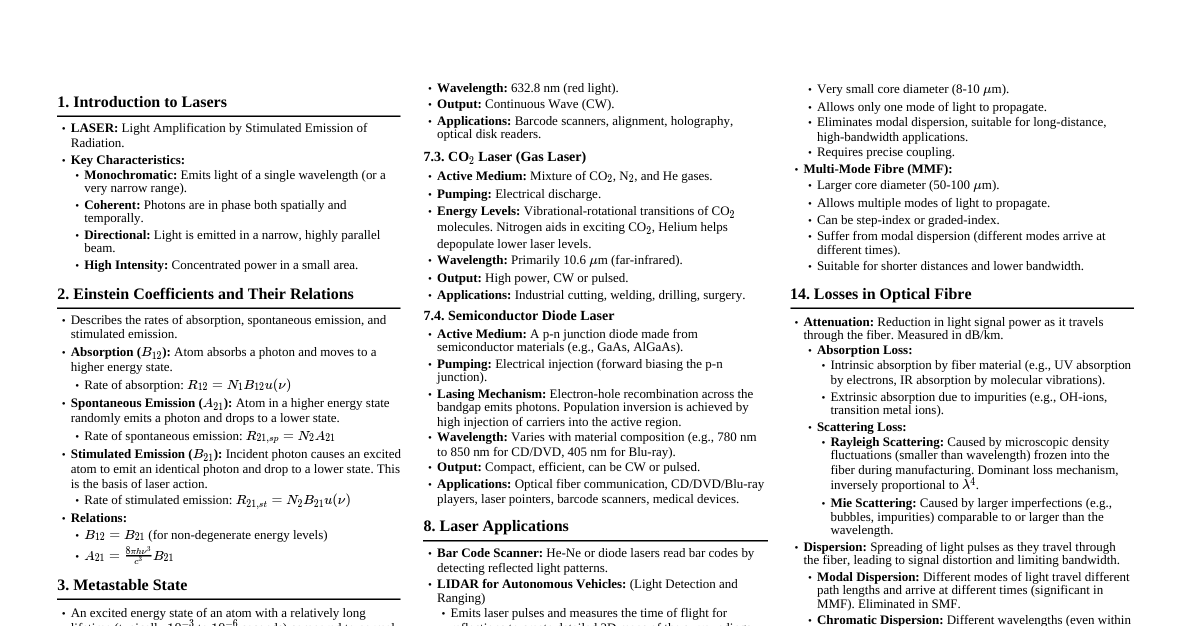
Spontaneous Emission Atom in excited state $E_2$ decays to ground state $E_1$ without external perturbation. Emits a photon of energy $h\nu = E_2 - E_1$. Photons are emitted randomly in direction, phase, and polarization. Governed by Einstein A coefficient: $A_{21}$. Lifetime of excited state $\tau_2 = 1/A_{21}$. Stimulated Emission Atom in excited state $E_2$ is perturbed by an incident photon of energy $h\nu = E_2 - E_1$. Atom decays to $E_1$ and emits a second photon. The emitted photon is identical to the incident photon in energy, phase, direction, and polarization. This is the fundamental process for light amplification in lasers. Governed by Einstein B coefficient: $B_{21}$. Absorption Atom in ground state $E_1$ absorbs an incident photon of energy $h\nu = E_2 - E_1$. Atom transitions to excited state $E_2$. Governed by Einstein B coefficient: $B_{12}$. For thermal equilibrium, $B_{12} = B_{21}$. Population Inversion For net stimulated emission (gain), the population of the upper energy level ($N_2$) must be greater than the population of the lower energy level ($N_1$). $N_2 > N_1$ is called population inversion. This is a non-equilibrium state, requiring external energy input (pumping). Without population inversion, absorption dominates over stimulated emission. Pumping Mechanisms Optical Pumping: Using light (flash lamps, other lasers) to excite atoms. Common in solid-state lasers (e.g., Nd:YAG). Electrical Pumping: Using an electrical discharge to excite atoms. Common in gas lasers (e.g., HeNe, Ar-ion, CO2) and semiconductor lasers (laser diodes). Chemical Pumping: Energy released from chemical reactions excites atoms. Laser Components Gain Medium: Material (solid, liquid, gas, semiconductor) where population inversion and stimulated emission occur. Pumping Source: Provides energy to achieve population inversion. Optical Resonator (Cavity): Two mirrors (one highly reflective, one partially reflective) that provide optical feedback, allowing photons to make multiple passes through the gain medium. Output Coupler: The partially reflective mirror that allows a portion of the generated light to exit the cavity as the laser beam. Laser Characteristics Monochromaticity: Emits light of a single, very narrow range of wavelengths. Coherence: Temporal Coherence: Photons have a well-defined phase relationship over time. Long coherence length. Spatial Coherence: Photons have a well-defined phase relationship across the beam's cross-section. Directionality: Emits light in a narrow, highly collimated beam with low divergence. Brightness: Extremely high power per unit area per unit solid angle. Types of Lasers Solid-State Lasers: Gain medium is a solid material (e.g., Nd:YAG, Ruby, Ti:Sapphire). Optically pumped. Often pulsed, high peak power. Gas Lasers: Gain medium is a gas or gas mixture (e.g., HeNe, Ar-ion, CO2). Electrically pumped. Often continuous wave (CW), good beam quality. Diode (Semiconductor) Lasers: Gain medium is a semiconductor junction. Electrically pumped (direct conversion of electrical to light energy). Compact, efficient, widely used (CD/DVD players, fiber optics). Dye Lasers: Gain medium is an organic dye dissolved in a solvent. Optically pumped. Tunable over a broad range of wavelengths. Excimer Lasers: Gain medium is an "excited dimer" molecule (e.g., ArF, KrF). Electrically pumped. Produce UV light, used in photolithography. Three-Level vs. Four-Level Laser Systems Three-Level System: Ground state $E_1$, excited state $E_2$, metastable state $E_m$. Pumping from $E_1$ to $E_2$. Fast non-radiative decay from $E_2$ to $E_m$. Lasing transition from $E_m$ to $E_1$. Requires very high pumping power because $N_1$ must be depleted significantly to achieve $N_m > N_1$. (e.g., Ruby laser). Four-Level System: Ground state $E_1$, pump band $E_3$, upper laser level $E_2$, lower laser level $E_1'$. Pumping from $E_1$ to $E_3$. Fast non-radiative decay from $E_3$ to $E_2$. Lasing transition from $E_2$ to $E_1'$. Fast non-radiative decay from $E_1'$ to $E_1$. Easier to achieve population inversion because $E_1'$ is often sparsely populated, so $N_2 > N_1'$ is achieved with less pumping power. (e.g., Nd:YAG, HeNe). Laser Applications Medicine: Surgery, ophthalmology (LASIK), dermatology, diagnostics. Industry: Cutting, welding, drilling, engraving, material processing, lidar. Communications: Fiber optic communication, free-space optical communication. Science & Research: Spectroscopy, interferometry, holography, fundamental physics research. Consumer Electronics: Barcode scanners, optical drives (CD/DVD/Blu-ray), laser pointers.