Physics & Chemistry (SSC-10)
Cheatsheet Content
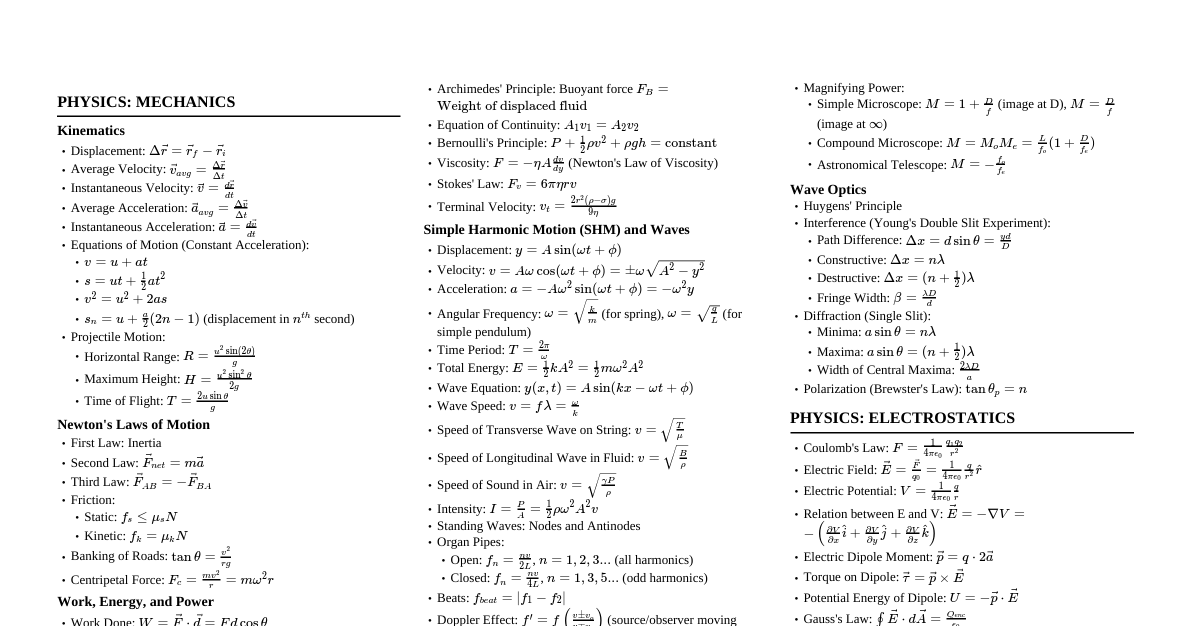
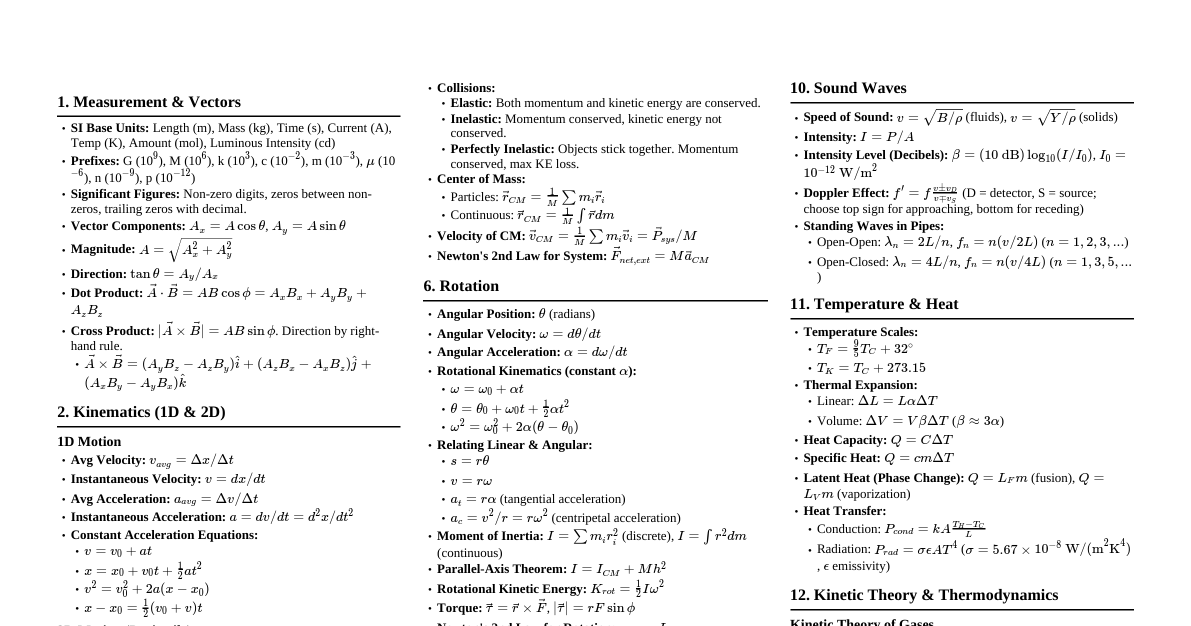
### Gravitation - **Newton's Law of Universal Gravitation:** $F = G \frac{m_1 m_2}{r^2}$ - $G$: Gravitational Constant ($6.67 \times 10^{-11} \text{ Nm}^2/\text{kg}^2$) - $m_1, m_2$: Masses of objects - $r$: Distance between their centers - **Acceleration due to gravity (g):** $g = G \frac{M}{R^2}$ - $M$: Mass of Earth, $R$: Radius of Earth - Value at Earth's surface: $9.8 \text{ m/s}^2$ - **Variation of g:** - **With height:** Decreases as altitude increases. - **With depth:** Decreases as depth increases (max at surface). - **With latitude:** Slightly increases from equator to poles (due to Earth's bulge and rotation). - **Free Fall:** Motion under gravity alone. - Initial velocity $u=0$. - Equations of motion: - $v = u + gt$ - $s = ut + \frac{1}{2}gt^2$ - $v^2 = u^2 + 2gs$ - **Escape Velocity:** Minimum velocity required for an object to escape Earth's gravitational field. - $v_{esc} = \sqrt{\frac{2GM}{R}}$ - For Earth, $v_{esc} \approx 11.2 \text{ km/s}$ - **Kepler's Laws of Planetary Motion:** 1. **Law of Orbits:** Planets move in elliptical orbits with the Sun at one focus. 2. **Law of Areas:** A line joining a planet and the Sun sweeps out equal areas in equal intervals of time. 3. **Law of Periods:** The square of the orbital period ($T$) of a planet is directly proportional to the cube of the semi-major axis ($r$) of its orbit. ($T^2 \propto r^3$) ### Heat - **Heat:** Form of energy transferred due to temperature difference. - **Temperature:** Measure of average kinetic energy of particles. - **Units:** Joule (J) for heat, Celsius (°C), Kelvin (K) for temperature. - **Specific Heat Capacity (c):** Amount of heat required to raise the temperature of 1 kg of a substance by 1 °C (or 1 K). - $Q = mc\Delta T$ - $Q$: Heat gained/lost, $m$: mass, $\Delta T$: change in temperature. - Unit: J/(kg°C) or J/(kg K) - **Latent Heat:** Heat absorbed or released during a phase change without change in temperature. - **Latent Heat of Fusion ($L_f$):** For melting/freezing. $Q = mL_f$ - **Latent Heat of Vaporization ($L_v$):** For boiling/condensation. $Q = mL_v$ - **Principle of Heat Exchange:** Heat lost by hot body = Heat gained by cold body (assuming no heat loss to surroundings). - **Anomalous Behavior of Water:** Water expands on cooling from 4°C to 0°C. Density is maximum at 4°C. - **Dew Point:** Temperature at which air becomes saturated with water vapor and condensation begins. - **Humidity:** Amount of water vapor present in the air. - **Absolute Humidity:** Mass of water vapor per unit volume of air. - **Relative Humidity:** Ratio of actual amount of water vapor in air to the maximum amount it can hold at that temperature. ### Optics (Light) - **Laws of Reflection:** 1. Angle of incidence = Angle of reflection ($\angle i = \angle r$). 2. Incident ray, reflected ray, and normal all lie in the same plane. - **Types of Mirrors:** - **Plane Mirror:** Forms virtual, erect, laterally inverted image of same size. - **Concave Mirror:** Converging mirror. - Used in headlights, shaving mirrors, solar furnaces. - Forms real & inverted images (mostly), virtual & erect (when object between F & P). - **Convex Mirror:** Diverging mirror. - Used in rear-view mirrors (wider field of view). - Always forms virtual, erect, diminished image. - **Mirror Formula:** $\frac{1}{f} = \frac{1}{v} + \frac{1}{u}$ - $f$: focal length, $v$: image distance, $u$: object distance - **Magnification (m):** $m = \frac{h_i}{h_o} = -\frac{v}{u}$ - $h_i$: image height, $h_o$: object height - **Refraction of Light:** Bending of light as it passes from one medium to another. - **Snell's Law:** $n_1 \sin i = n_2 \sin r$ - $n_1, n_2$: Refractive indices of medium 1 and 2. - **Refractive Index (n):** $n = \frac{\text{speed of light in vacuum}}{\text{speed of light in medium}} = \frac{c}{v}$ - **Total Internal Reflection (TIR):** Occurs when light travels from denser to rarer medium and angle of incidence > critical angle. - Critical Angle ($C$): $\sin C = \frac{n_2}{n_1}$ (for $n_1 > n_2$) - **Lenses:** - **Convex Lens:** Converging lens. Used in magnifying glasses, cameras, correcting hypermetropia. - **Concave Lens:** Diverging lens. Used in correcting myopia. - **Lens Formula:** $\frac{1}{f} = \frac{1}{v} - \frac{1}{u}$ - **Power of Lens (P):** $P = \frac{1}{f}$ (in dioptres, if $f$ in meters) - **Human Eye:** - **Myopia (Nearsightedness):** Distant objects blurred. Corrected by concave lens. - **Hypermetropia (Farsightedness):** Near objects blurred. Corrected by convex lens. - **Presbyopia:** Age-related loss of accommodation. Corrected by bifocal lens. - **Dispersion of Light:** Splitting of white light into its constituent colors (VIBGYOR) by a prism. ### Electricity - **Electric Current (I):** Rate of flow of charge. $I = \frac{Q}{t}$ - Unit: Ampere (A) - **Electric Potential Difference (V):** Work done per unit charge in moving a charge from one point to another. $V = \frac{W}{Q}$ - Unit: Volt (V) - **Ohm's Law:** $V = IR$ - $R$: Resistance, Unit: Ohm ($\Omega$) - **Resistance:** Opposition to the flow of current. - $R = \rho \frac{L}{A}$ - $\rho$: Resistivity, $L$: Length, $A$: Cross-sectional Area - **Resistors in Series:** $R_{eq} = R_1 + R_2 + R_3 + ...$ - Current is same, voltage divides. - **Resistors in Parallel:** $\frac{1}{R_{eq}} = \frac{1}{R_1} + \frac{1}{R_2} + \frac{1}{R_3} + ...$ - Voltage is same, current divides. - **Electric Power (P):** Rate at which electrical energy is consumed. - $P = VI = I^2R = \frac{V^2}{R}$ - Unit: Watt (W) - **Electrical Energy (E):** $E = Pt$ - Unit: Joule (J), Commercial Unit: kilowatt-hour (kWh) - **Heating Effect of Electric Current (Joule's Law):** $H = I^2Rt$ - Applications: Heaters, geysers, electric iron. ### Magnetism - **Magnetic Field:** Region around a magnet where its magnetic force can be detected. - **Magnetic Field Lines:** - Originate from North pole and end at South pole (outside magnet). - Form closed loops. - Never intersect each other. - Closer lines indicate stronger field. - **Electromagnetism:** Production of magnetism due to electric current. - **Oersted's Experiment:** Current-carrying conductor produces a magnetic field. - **Right-Hand Thumb Rule:** Direction of magnetic field around a current-carrying conductor. - **Magnetic Field due to Solenoid:** Behaves like a bar magnet. - **Fleming's Left-Hand Rule:** For force on a current-carrying conductor in a magnetic field. - Thumb: Direction of Force (Motion) - Forefinger: Direction of Magnetic Field - Middle Finger: Direction of Current - Used in electric motors. - **Electric Motor:** Converts electrical energy into mechanical energy. - **Electromagnetic Induction:** Production of induced current by changing magnetic field. - **Faraday's Laws of Induction:** 1. A change in magnetic flux through a coil induces an EMF. 2. Magnitude of induced EMF is proportional to the rate of change of magnetic flux. - **Lenz's Law:** Direction of induced current opposes the cause producing it. - **Fleming's Right-Hand Rule:** For direction of induced current. - Thumb: Direction of Motion - Forefinger: Direction of Magnetic Field - Middle Finger: Direction of Induced Current - Used in electric generators. - **Electric Generator:** Converts mechanical energy into electrical energy. ### Classification of Elements - **Döbereiner's Triads:** Elements arranged in groups of three with similar properties. Atomic mass of middle element was approx. average of other two. (e.g., Li, Na, K) - **Newlands' Law of Octaves:** Elements arranged in increasing order of atomic mass, every eighth element had properties similar to the first. (Like musical octaves) - **Mendeleev's Periodic Table:** - Elements arranged in increasing order of atomic mass. - Properties of elements are a periodic function of their atomic masses. - Left gaps for undiscovered elements (e.g., Eka-Aluminium, Eka-Silicon). - Anomalies: Position of isotopes, some elements placed out of order of atomic mass. - **Modern Periodic Table (Moseley):** - Elements arranged in increasing order of atomic number. - Properties of elements are a periodic function of their atomic numbers. - **Periods (Horizontal Rows):** 7 periods. Indicate number of electron shells. - **Groups (Vertical Columns):** 18 groups. Indicate number of valence electrons (for main group elements) and similar chemical properties. - **Blocks:** - **s-block:** Groups 1 & 2 (Alkali metals, Alkaline earth metals) - **p-block:** Groups 13 to 18 (Non-metals, metalloids, some metals) - **d-block:** Groups 3 to 12 (Transition metals) - **f-block:** Lanthanides & Actinides (Inner transition metals) - **Periodic Trends:** - **Valency:** First increases from 1 to 4, then decreases to 0 across a period. Remains same down a group. - **Atomic Size:** Decreases across a period (due to increased nuclear charge). Increases down a group (due to increased number of shells). - **Metallic Character:** Decreases across a period. Increases down a group. - **Non-metallic Character:** Increases across a period. Decreases down a group. - **Electronegativity:** Increases across a period. Decreases down a group. - **Ionization Enthalpy:** Increases across a period. Decreases down a group. - **Electron Gain Enthalpy:** Generally increases across a period (becomes more negative). Generally decreases down a group. ### Chemical Reactions & Equations - **Chemical Reaction:** Process where reactants are transformed into products. - **Chemical Equation:** Symbolic representation of a chemical reaction. - Reactants on Left, Products on Right. - Balanced equation follows Law of Conservation of Mass. - **Types of Chemical Reactions:** - **Combination Reaction:** A + B $\rightarrow$ AB (e.g., $2H_2 + O_2 \rightarrow 2H_2O$) - **Decomposition Reaction:** AB $\rightarrow$ A + B (e.g., $CaCO_3 \xrightarrow{\text{heat}} CaO + CO_2$) - Often requires heat, light, or electricity. - **Displacement Reaction:** A + BC $\rightarrow$ AC + B (More reactive element displaces less reactive one) (e.g., $Fe + CuSO_4 \rightarrow FeSO_4 + Cu$) - **Double Displacement Reaction:** AB + CD $\rightarrow$ AD + CB (Exchange of ions) (e.g., $AgNO_3 + NaCl \rightarrow AgCl \downarrow + NaNO_3$) - Often forms a precipitate (insoluble solid). - **Redox Reactions (Oxidation-Reduction):** - **Oxidation:** Gain of oxygen, loss of hydrogen, loss of electrons. - **Reduction:** Loss of oxygen, gain of hydrogen, gain of electrons. - Oxidizing agent gets reduced; Reducing agent gets oxidized. - **Exothermic Reaction:** Releases heat (e.g., burning of fuels). - **Endothermic Reaction:** Absorbs heat (e.g., photosynthesis). - **Corrosion:** Deterioration of metals by chemical reactions with environment (e.g., rusting of iron). - **Rancidity:** Oxidation of fats and oils in food, leading to unpleasant smell and taste. ### Acids, Bases, and Salts - **Acids:** - Sour taste. - Turn blue litmus red. - Produce $H^+$ ions in aqueous solution (Arrhenius). - Proton donors (Brønsted-Lowry). - Examples: HCl, $H_2SO_4$, $HNO_3$, $CH_3COOH$. - **Bases:** - Bitter taste, soapy feel. - Turn red litmus blue. - Produce $OH^-$ ions in aqueous solution (Arrhenius). - Proton acceptors (Brønsted-Lowry). - Examples: NaOH, KOH, $Ca(OH)_2$, $NH_4OH$. - **Salts:** Formed by the reaction of an acid and a base (neutralization reaction). - Acid + Base $\rightarrow$ Salt + Water - Example: $HCl + NaOH \rightarrow NaCl + H_2O$ - **pH Scale:** Measures acidity or alkalinity. - pH = 7: Neutral - pH 7: Basic (Alkaline) - pH = $-log[H^+]$ - **Important Salts & Their Uses:** - **Sodium Chloride (NaCl):** Common salt, food preservative. - **Sodium Hydroxide (NaOH):** Caustic soda, soap and paper manufacturing. - **Bleaching Powder ($CaOCl_2$):** Disinfectant, bleaching agent. - **Baking Soda ($NaHCO_3$):** Antacid, baking. - **Washing Soda ($Na_2CO_3 \cdot 10H_2O$):** Cleaning agent, water softening. - **Plaster of Paris ($CaSO_4 \cdot \frac{1}{2}H_2O$):** For fractures, making casts. ### Carbon Compounds - **Carbon:** Tetravalent element, forms strong covalent bonds. - **Allotropes of Carbon:** - **Diamond:** Hardest natural substance, insulator, tetrahedral structure. - **Graphite:** Soft, good conductor, layered hexagonal structure. - **Fullerenes:** Spherical molecules (e.g., $C_{60}$ Buckminsterfullerene). - **Covalent Bond:** Formed by sharing of electrons between atoms. - **Hydrocarbons:** Compounds of Carbon and Hydrogen. - **Saturated Hydrocarbons (Alkanes):** Single bonds ($C_n H_{2n+2}$) - Methane ($CH_4$), Ethane ($C_2H_6$), Propane ($C_3H_8$) - **Unsaturated Hydrocarbons:** - **Alkenes:** Contain at least one C=C double bond ($C_n H_{2n}$) - Ethene ($C_2H_4$) - **Alkynes:** Contain at least one C$\equiv$C triple bond ($C_n H_{2n-2}$) - Ethyne ($C_2H_2$) - **Functional Groups:** Atoms or groups of atoms that determine chemical properties. - **Alcohol:** -OH (e.g., Ethanol $CH_3CH_2OH$) - **Aldehyde:** -CHO (e.g., Ethanal $CH_3CHO$) - **Ketone:** >C=O (e.g., Propanone $CH_3COCH_3$) - **Carboxylic Acid:** -COOH (e.g., Ethanoic acid $CH_3COOH$) - **Homologous Series:** Series of organic compounds with similar chemical properties and general formula, differing by a $CH_2$ unit. - **Isomerism:** Compounds with same molecular formula but different structural formula. - **Ethanol ($C_2H_5OH$):** Alcohol, good solvent, fuel. - **Ethanoic Acid ($CH_3COOH$):** Acetic acid, component of vinegar. - **Soaps and Detergents:** - **Soaps:** Sodium or potassium salts of long-chain carboxylic acids. Work in soft water. - **Detergents:** Sulphonic acid salts of long chain hydrocarbons or ammonium salts with chloride/bromide ions. Work in hard and soft water. ### Metals and Non-metals - **Metals:** - **Physical Properties:** Lustrous, malleable, ductile, good conductors of heat and electricity, usually solid at room temp (except Hg). - **Chemical Properties:** - React with oxygen to form basic oxides. - React with water to form hydroxides and hydrogen gas. - React with acids to form salt and hydrogen gas. - Displace less reactive metals from their salt solutions. - Tend to lose electrons to form positive ions (cations). - **Reactivity Series:** K > Na > Ca > Mg > Al > Zn > Fe > Pb > H > Cu > Ag > Au - **Non-metals:** - **Physical Properties:** Dull, brittle, poor conductors of heat and electricity (except graphite), can be solid, liquid (Br), or gas. - **Chemical Properties:** - React with oxygen to form acidic or neutral oxides. - Tend to gain electrons to form negative ions (anions). - **Ionic Compounds:** Formed by transfer of electrons (metal + non-metal). - High melting and boiling points, soluble in water, conduct electricity in molten state or aqueous solution. - **Covalent Compounds:** Formed by sharing of electrons (non-metal + non-metal). - Low melting and boiling points, generally insoluble in water, do not conduct electricity. - **Extraction of Metals (Metallurgy):** - **Concentration of Ore:** Removing gangue (impurities). - **Reduction of Metal:** - Highly reactive metals (K, Na, Ca, Mg, Al): Electrolytic reduction. - Medium reactive metals (Zn, Fe, Pb, Cu): Reduction with carbon (roasting/calcination then smelting). - Less reactive metals (Hg, Ag): Heating alone. - **Refining of Metals:** Purification (e.g., electrolytic refining). ### Space Missions - **Artificial Satellites:** Man-made objects orbiting Earth or other celestial bodies. - **Uses:** Communication, weather forecasting, remote sensing, navigation (GPS), scientific research. - **Orbital Velocity:** Velocity required to keep a satellite in orbit. - **Geosynchronous Satellites:** Orbit Earth at same rate as Earth's rotation, appear stationary from Earth. Used for communication. - **Polar Satellites:** Orbit over Earth's poles, cover entire Earth surface over many orbits. Used for weather, spying, remote sensing. - **Space Shuttles:** Reusable spacecraft for transporting people and cargo to and from space. - **Indian Space Research Organisation (ISRO):** India's national space agency. - **Important Missions:** - **Chandrayaan-1, 2, 3:** Lunar exploration missions. - **Mangalyaan (Mars Orbiter Mission - MOM):** Mars exploration. - **GSLV, PSLV:** Launch vehicle families. - **Space Debris:** Non-functional man-made objects in space, a growing problem. - **Importance of Space Missions:** - Scientific knowledge about universe. - Technological advancement. - Benefits for communication, weather, agriculture, disaster management.