Straight Lines & Co-ordinates
Cheatsheet Content
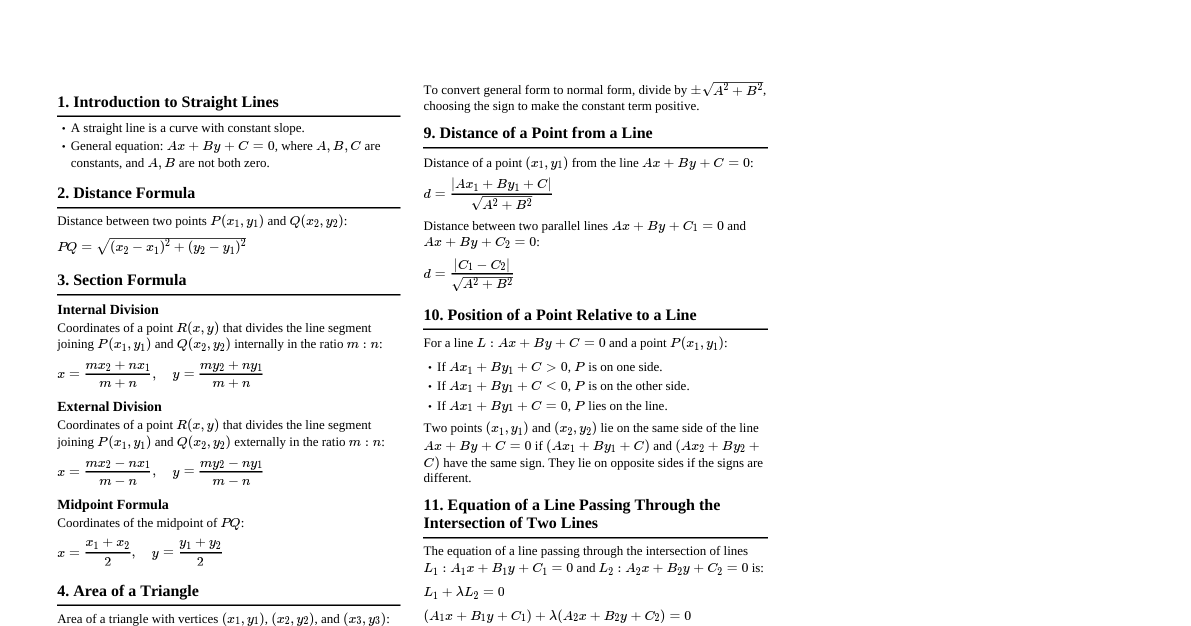
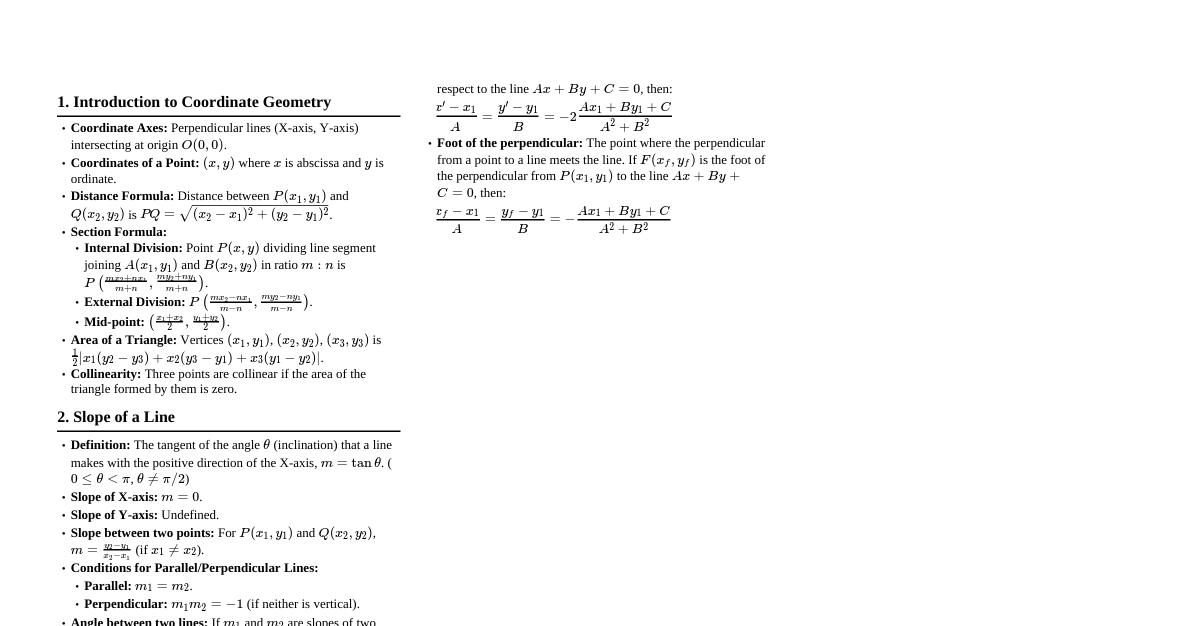
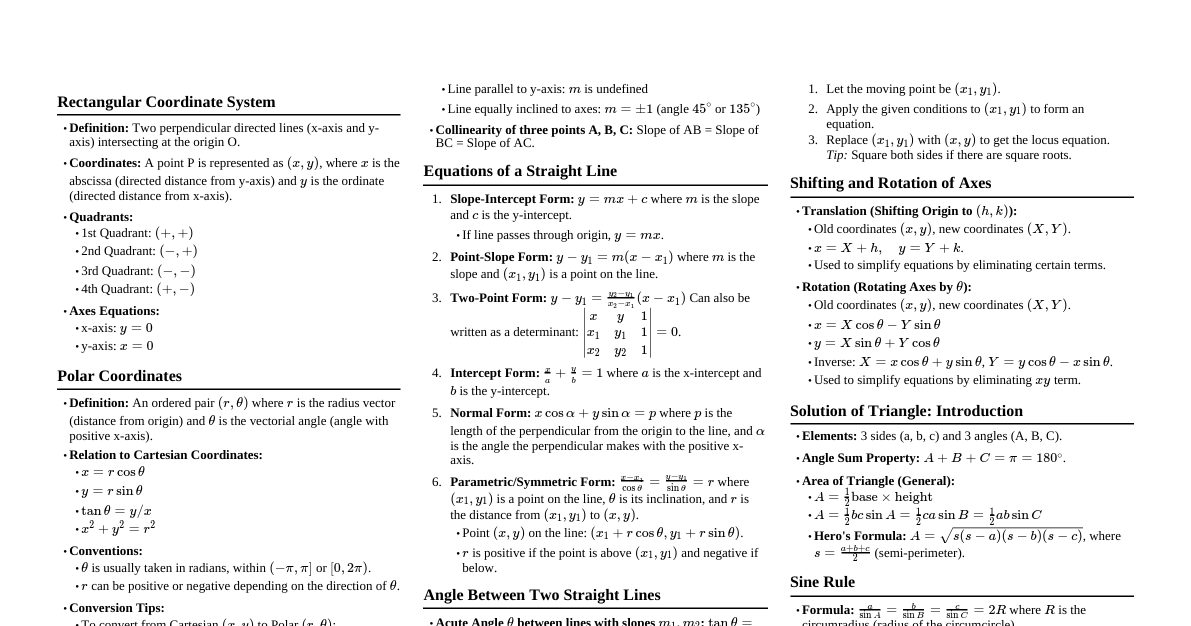
1. Rectangular Coordinate System Definition: Two mutually perpendicular lines (x-axis, y-axis) in a plane. Their intersection is the origin $O(0,0)$. Quadrants: The axes divide the plane into four regions, numbered counter-clockwise from the positive x-axis. Signs: Quadrant I: $(+,+)$ Quadrant II: $(-,+)$ Quadrant III: $(-,-)$ Quadrant IV: $(+,-)$ 2. Distance Formula Distance between two points $A(x_1, y_1)$ and $B(x_2, y_2)$: $$AB = \sqrt{(x_2-x_1)^2 + (y_2-y_1)^2}$$ or $$AB = \sqrt{(x_1-x_2)^2 + (y_1-y_2)^2}$$ Distance from origin $O(0,0)$ to a point $P(x,y)$: $$OP = \sqrt{x^2 + y^2}$$ 3. Properties of Geometric Figures (using Distance Formula) Rectangle: Opposite sides equal ($AB=CD$, $AD=BC$), diagonals equal ($AC=BD$). Parallelogram: Opposite sides equal ($AB=DC$, $AD=BC$), diagonals not necessarily equal ($AC \ne BD$). Square: All sides equal ($AD=AB=BC=CD$), diagonals equal ($AC=BD$). Rhombus: All sides equal ($AB=DC=AD=BC$), diagonals not necessarily equal ($AC \ne BD$). Isosceles Triangle: Any two sides are equal. Equilateral Triangle: All three sides are equal ($AB=BC=AC$). Right-angled Triangle: Satisfies Pythagoras' theorem ($AB^2 = BC^2 + AC^2$). Right-angled Isosceles Triangle: Isosceles and right-angled. 4. Collinear Points If three points $A, B, C$ are collinear (lie on a line), then the sum of the lengths of any two segments equals the length of the third segment (e.g., $AB + BC = AC$). 5. Section Formula Coordinates of a point $R(x,y)$ dividing the line segment joining $A(x_1, y_1)$ and $B(x_2, y_2)$ in the ratio $m:n$: Internally: $$R = \left(\frac{mx_2+nx_1}{m+n}, \frac{my_2+ny_1}{m+n}\right)$$ Externally: $$R = \left(\frac{mx_2-nx_1}{m-n}, \frac{my_2-ny_1}{m-n}\right)$$ Midpoint Formula: If $R(x,y)$ is the midpoint of $AB$ (ratio $1:1$), then $$R = \left(\frac{x_1+x_2}{2}, \frac{y_1+y_2}{2}\right)$$ 6. Area of a Triangle For a triangle with vertices $A(x_1, y_1)$, $B(x_2, y_2)$, and $C(x_3, y_3)$: $$Area(\triangle ABC) = \frac{1}{2} |x_1(y_2-y_3) + x_2(y_3-y_1) + x_3(y_1-y_2)|$$ Collinearity of 3 points: If $Area(\triangle ABC) = 0$, the points $A, B, C$ are collinear. 7. Area of a Quadrilateral For a quadrilateral $ABCD$ with vertices $A(x_1, y_1)$, $B(x_2, y_2)$, $C(x_3, y_3)$, $D(x_4, y_4)$: $$Area(ABCD) = Area(\triangle ABC) + Area(\triangle ADC)$$ (This involves dividing the quadrilateral into two triangles). 8. Centroid of a Triangle For a triangle with vertices $A(x_1, y_1)$, $B(x_2, y_2)$, and $C(x_3, y_3)$, the centroid $G$ is: $$G = \left(\frac{x_1+x_2+x_3}{3}, \frac{y_1+y_2+y_3}{3}\right)$$ Median: Line segment from a vertex to the midpoint of the opposite side. Centroid: Point of intersection of the medians. 9. Incentre of a Triangle For a triangle with vertices $A(x_1, y_1)$, $B(x_2, y_2)$, $C(x_3, y_3)$ and opposite sides of lengths $a, b, c$: $$I = \left(\frac{ax_1+bx_2+cx_3}{a+b+c}, \frac{ay_1+by_2+cy_3}{a+b+c}\right)$$ 10. Slope of a Line ($m$) If a line makes an angle $\theta$ with the positive x-axis: $$m = \tan \theta$$ Slope of the line passing through two points $A(x_1, y_1)$ and $B(x_2, y_2)$: $$m = \frac{y_2-y_1}{x_2-x_1} \quad \text{or} \quad m = \frac{y_1-y_2}{x_1-x_2}$$ Angles and Slopes: $m=0$ for horizontal line ($\theta = 0^\circ$). $m=\text{undefined}$ for vertical line ($\theta = 90^\circ$). Positive slope for acute $\theta$ ($0^\circ Negative slope for obtuse $\theta$ ($90^\circ Angle between two lines: If lines have slopes $m_1$ and $m_2$, the angle $\theta$ between them is given by: $$\tan \theta = \left|\frac{m_2-m_1}{1+m_1m_2}\right|$$ Parallel Lines: $m_1 = m_2$ Perpendicular Lines: $m_1m_2 = -1$ 11. Equations of a Straight Line x-axis: $y=0$ y-axis: $x=0$ Parallel to x-axis: $y=b$ Parallel to y-axis: $x=a$ Slope-intercept form: Given slope $m$ and y-intercept $c$: $$y = mx+c$$ Point-slope form: Given slope $m$ and a point $(x_1, y_1)$: $$y-y_1 = m(x-x_1)$$ Two-point form: Given two points $(x_1, y_1)$ and $(x_2, y_2)$: $$\frac{y-y_1}{y_2-y_1} = \frac{x-x_1}{x_2-x_1}$$ Intercept form: Given x-intercept $a$ and y-intercept $b$: $$\frac{x}{a} + \frac{y}{b} = 1$$ Normal form: Perpendicular distance $p$ from origin, and angle $\omega$ the normal makes with x-axis: $$x \cos \omega + y \sin \omega = p$$ General form: $$Ax+By+C=0$$ Slope $m = -\frac{A}{B}$ y-intercept $c = -\frac{C}{B}$ x-intercept $a = -\frac{C}{A}$ 12. Lines Related to $Ax+By+C=0$ Parallel line: $Ax+By+K=0$ (where $K$ is any constant) Perpendicular line: $Bx-Ay+K=0$ (where $K$ is any constant) Distance between parallel lines: $Ax+By+C_1=0$ and $Ax+By+C_2=0$: $$d = \frac{|C_2-C_1|}{\sqrt{A^2+B^2}}$$ Perpendicular distance from a point $(x_1, y_1)$ to a line $Ax+By+C=0$: $$d = \frac{|Ax_1+By_1+C|}{\sqrt{A^2+B^2}}$$ Point of intersection of two lines: Solve the system of equations $A_1x+B_1y+C_1=0$ and $A_2x+B_2y+C_2=0$. $$P(x,y) = \left(\frac{B_1C_2-B_2C_1}{A_1B_2-A_2B_1}, \frac{C_1A_2-C_2A_1}{A_1B_2-A_2B_1}\right)$$ Concurrent lines: Three or more lines are concurrent if they intersect at a single point. To check, find the intersection of two lines and substitute it into the third equation.