Plant Respiration Cheatsheet
Cheatsheet Content
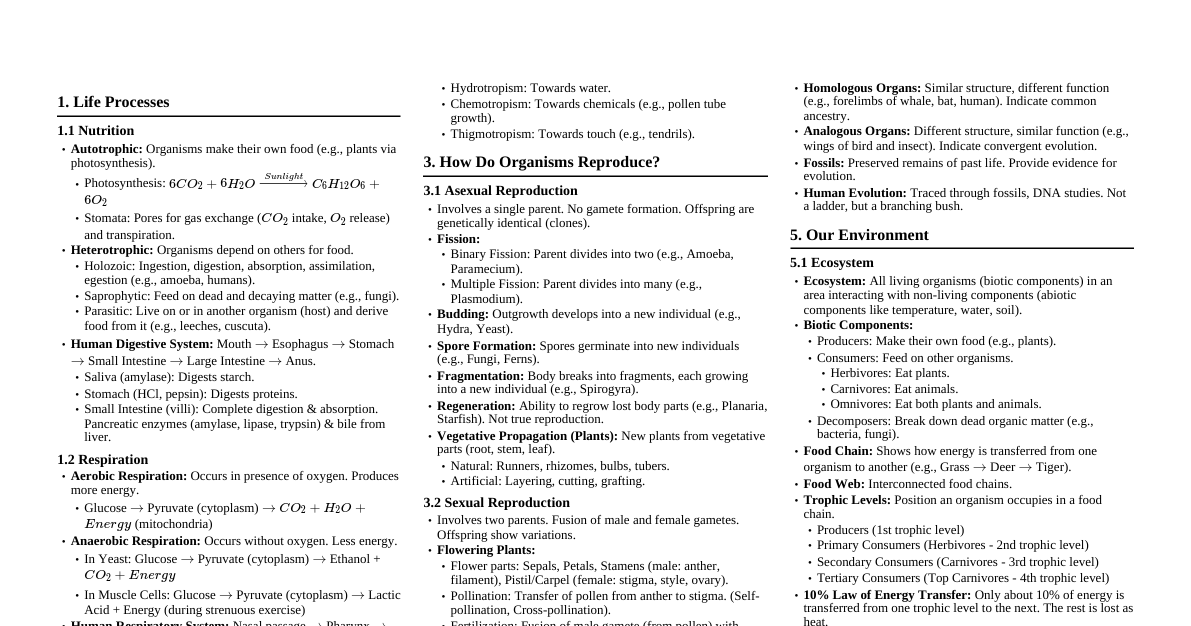
1. Introduction to Plant Respiration Definition: Metabolic process where plants release energy from organic compounds (sugars), producing ATP. Equation: $C_6H_{12}O_6 + 6O_2 \rightarrow 6CO_2 + 6H_2O + \text{Energy (ATP)}$ Contrast with Photosynthesis: Respiration: Catabolic, releases energy, occurs day and night, in mitochondria. Photosynthesis: Anabolic, stores energy, occurs in light, in chloroplasts. Importance: Provides energy for growth, maintenance, nutrient uptake, synthesis of macromolecules. 2. Stages of Aerobic Respiration 2.1. Glycolysis Location: Cytoplasm Input: 1 molecule of Glucose ($C_6H_{12}O_6$) Output: 2 Pyruvate, 2 ATP (net), 2 NADH Process: Energy Investment Phase: 2 ATP consumed to phosphorylate glucose. Energy Payoff Phase: 4 ATP produced (substrate-level phosphorylation), 2 NADH produced. Oxygen Requirement: Does not require oxygen (anaerobic). 2.2. Pyruvate Oxidation (Link Reaction) Location: Mitochondrial matrix Input: 2 Pyruvate Output: 2 Acetyl-CoA, 2 $CO_2$, 2 NADH Process: Pyruvate is decarboxylated and oxidized, then combined with Coenzyme A. 2.3. Krebs Cycle (Citric Acid Cycle) Location: Mitochondrial matrix Input: 2 Acetyl-CoA (for two turns of the cycle) Output (per glucose): 4 $CO_2$, 6 NADH, 2 $FADH_2$, 2 ATP (or GTP) Process: Acetyl-CoA combines with oxaloacetate to form citrate; a series of oxidation and decarboxylation reactions regenerates oxaloacetate. 2.4. Oxidative Phosphorylation Location: Inner mitochondrial membrane Components: Electron Transport Chain (ETC) and Chemiosmosis Input: NADH, $FADH_2$, $O_2$ Output: ~28-34 ATP, $H_2O$ Electron Transport Chain: Electrons from NADH and $FADH_2$ pass through protein complexes. Energy released pumps protons ($H^+$) from matrix to intermembrane space, creating a proton gradient. Oxygen is the final electron acceptor, forming water. Chemiosmosis: Protons flow back into the matrix through ATP synthase. ATP synthase uses the proton motive force to synthesize ATP from ADP and Pi. 3. Energy Yield Summary (Aerobic Respiration) Stage ATP (net) NADH $FADH_2$ $CO_2$ Glycolysis 2 2 0 0 Pyruvate Oxidation 0 2 0 2 Krebs Cycle 2 6 2 4 Total (Substrate-level) 4 10 2 6 Oxidative Phosphorylation ~28-34 (from 10 NADH) (from 2 $FADH_2$) 0 Overall Total (per Glucose) ~30-38 ATP - - 6 Note: ATP yield is variable due to shuttle systems for NADH from glycolysis. 4. Anaerobic Respiration (Fermentation) Occurs when: Oxygen is limited or absent. Purpose: Regenerate $NAD^+$ for glycolysis to continue producing ATP (2 net ATP per glucose). Stages: Glycolysis followed by fermentation. Types in Plants: 4.1. Alcoholic Fermentation Process: Pyruvate is converted to acetaldehyde, then to ethanol. Equation: Pyruvate $\rightarrow$ Acetaldehyde + $CO_2$ $\rightarrow$ Ethanol + $NAD^+$ Products: Ethanol, $CO_2$, $NAD^+$ Common in some plant tissues under anoxia (e.g., waterlogged roots, germinating seeds). 4.2. Lactic Acid Fermentation (less common in plants) Process: Pyruvate is directly converted to lactate. Equation: Pyruvate $\rightarrow$ Lactate + $NAD^+$ Products: Lactate, $NAD^+$ Rare in higher plants, but can occur in some tissues under severe stress. Efficiency: Much less efficient than aerobic respiration (2 ATP vs. ~30-38 ATP). 5. Factors Affecting Respiration Temperature: Increases with temperature (up to an optimum, usually $20-30^\circ C$). High temperatures ($>40^\circ C$) can denature enzymes, decreasing respiration. Oxygen Concentration: Aerobic respiration requires $O_2$. Low $O_2$ leads to anaerobic respiration. High $O_2$ can inhibit respiration (Pasteur effect, though complex). Substrate Availability (Sugars): Higher sugar concentration generally leads to higher respiration rates. Depletion of sugars (e.g., in senescing leaves) reduces respiration. Water Content: Respiration decreases with reduced water potential (drought stress). Enzyme activity and substrate transport are affected. Light: Indirect effect: Light drives photosynthesis, producing sugars for respiration. Photorespiration: A separate process (not true respiration) that occurs in light, consuming $O_2$ and releasing $CO_2$ in C3 plants. Age of Plant/Tissue: Meristematic tissues (young, growing) have higher respiration rates. Mature, senescing tissues may have altered rates. Hormones: Hormones like ethylene can increase respiration (e.g., during fruit ripening). 6. Respiratory Quotient (RQ) Definition: Ratio of $CO_2$ released to $O_2$ consumed. Formula: $RQ = \frac{\text{Volume of } CO_2 \text{ released}}{\text{Volume of } O_2 \text{ consumed}}$ Significance: Indicates the type of substrate being respired. Carbohydrates: $RQ = 1$ (e.g., glucose: $C_6H_{12}O_6 + 6O_2 \rightarrow 6CO_2 + 6H_2O$) Fats: $RQ Proteins: $RQ \approx 0.8-0.9$ (complex, variable). Organic Acids: $RQ > 1$ (e.g., malic acid: $C_4H_6O_5 + 3O_2 \rightarrow 4CO_2 + 3H_2O$, $RQ \approx 1.33$) - contain excess oxygen. Anaerobic Respiration: $RQ = \infty$ (e.g., alcoholic fermentation produces $CO_2$ but consumes no $O_2$). 7. Photorespiration (C3 Plants) Definition: A wasteful process in C3 plants where RuBisCO enzyme binds with $O_2$ instead of $CO_2$. Location: Chloroplasts, peroxisomes, mitochondria. Conditions: High $O_2$ concentration, high temperature, high light intensity. Process: RuBisCO oxygenates RuBP, forming 1 molecule of 3-PGA and 1 molecule of 2-phosphoglycolate. 2-phosphoglycolate is metabolized in peroxisomes and mitochondria, releasing $CO_2$ and consuming ATP. Energy Loss: No ATP or NADPH is produced, and $CO_2$ is released, reducing photosynthetic efficiency. Evolutionary Significance: Believed to be a relic of early Earth's atmosphere with lower $O_2$ and higher $CO_2$. 8. Alternative Oxidase (AOX) Pathway Location: Inner mitochondrial membrane. Function: An alternative electron transport pathway that bypasses Complexes III and IV of the main ETC. Characteristics: Does not pump protons (no ATP synthesis). Generates heat (thermogenesis), important in some plants (e.g., Arum lilies) for attracting pollinators. Acts as an 'overflow' mechanism when the cytochrome pathway is saturated or inhibited. Reduces reactive oxygen species (ROS) production by preventing electron accumulation. Regulation: Induced by cold, stress, salicylic acid, carbohydrate availability. 9. Respiration and Plant Productivity Growth Respiration: Energy used for synthesis of new biomass. Maintenance Respiration: Energy used for repairing tissues, maintaining ion gradients, protein turnover. Carbon Balance: Respiration consumes organic compounds produced by photosynthesis. High Respiration Rate: Can reduce net primary productivity if not balanced by photosynthesis. Optimizing Respiration: Plants balance energy expenditure for growth vs. maintenance to maximize survival and reproduction.