Changes in Matter
Cheatsheet Content
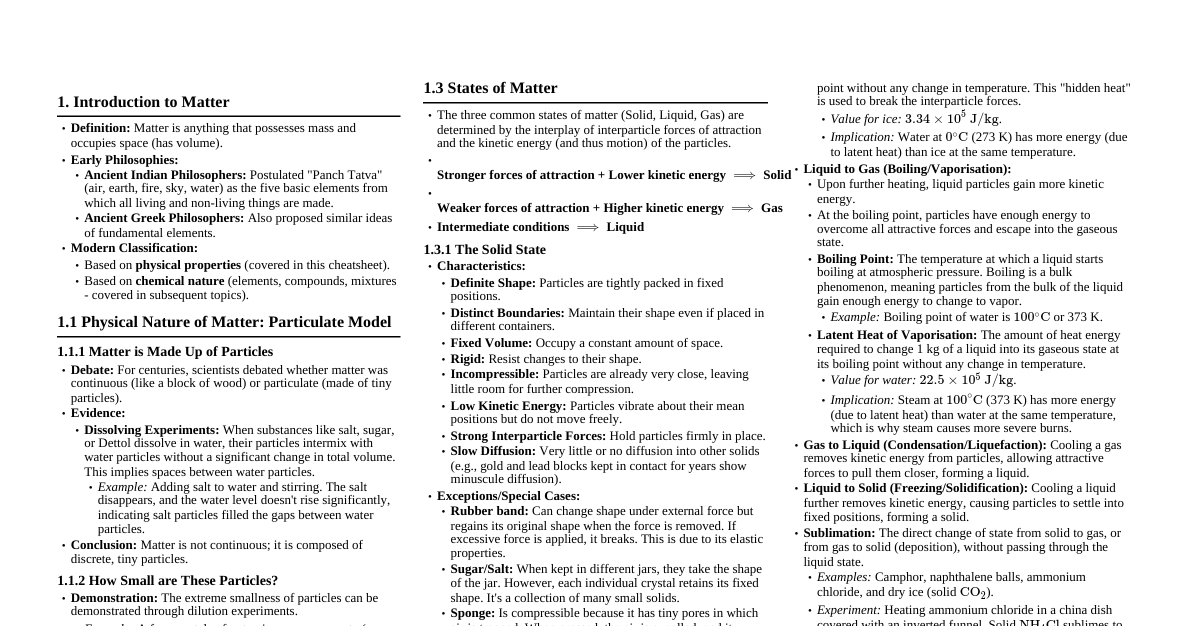
### Introduction: The Amazing World of Matter and Its Changes! Hello, young scientists! Have you ever wondered what everything around you is made of? The chair you're sitting on, the air you breathe, the juice you drink – it's all **matter**! Matter is anything that has mass (you can weigh it!) and takes up space (you can touch it!). At its core, matter is built from incredibly tiny building blocks called **atoms**. These atoms often join together to form groups called **molecules**. Imagine LEGO bricks; atoms are like individual bricks, and molecules are like small structures you build with them. These tiny particles are never still; they are always moving, vibrating, or zooming around! What's really fascinating is that matter can change. Sometimes it changes its appearance, like when ice melts into water. Other times, it changes into something completely new, like when you bake a cake. In this cheatsheet, we're going on an adventure to explore these amazing transformations of matter. Get ready to discover the secrets behind **physical changes** and **chemical changes**! ### Physical Changes: Same Stuff, Different Look! Imagine you have a piece of paper. If you tear it into tiny pieces, it's still paper, right? You haven't made a new substance. This is what we call a **physical change**. A **physical change** is a change in the *form* or *appearance* of a substance, but not its chemical identity. The atoms and molecules themselves don't change or rearrange to form new substances. It's like changing your outfit; you're still you, just looking different! #### Key Features of Physical Changes: * **No New Substance:** The most important rule! You always end up with the same substance you started with. * **Often Reversible:** Many physical changes can be undone. You can melt ice and then freeze the water back into ice. * **Changes in State:** This is the most common type of physical change. We'll talk more about this soon! * **Changes in Size or Shape:** Cutting, tearing, grinding, or crushing something are all physical changes. * **Mixing:** Dissolving sugar in water is a physical change. The sugar molecules are still sugar, just spread out in the water. You can often get the sugar back by evaporating the water. **Examples of Physical Changes:** * **Melting an ice cube:** Ice (solid water) becomes liquid water. Still water (H₂O). * **Boiling water:** Liquid water becomes steam (gaseous water). Still water (H₂O). * **Cutting wood:** You still have wood, just smaller pieces. * **Dissolving salt in water:** You have salty water, but the salt and water molecules haven't changed into something else. * **Bending a metal wire:** The wire changes shape, but it's still the same metal. *Think of it like playing with playdough - you can squish it, roll it, or break it, but it's always still playdough!* ### Chemical Changes: New Substances Emerge! Now, let's think about burning that piece of paper. After it burns, you're left with ash. Can you turn that ash back into paper? No! This is a **chemical change**. A **chemical change** (also called a chemical reaction) happens when substances combine or break apart to form *new* substances with different properties. The atoms and molecules rearrange themselves, breaking old connections and forming new ones. It's like taking your LEGO bricks apart and building a completely different model! #### What Happens During a Chemical Change? 1. **Reactants:** These are the starting substances in a chemical change. 2. **Products:** These are the *new* substances formed after the chemical change. 3. **Bond Breaking and Forming:** Energy is needed to break the bonds between atoms in the reactants. When new bonds form to create products, energy is usually released. This is why chemical reactions often feel hot or cold, or produce light. #### Evidence of a Chemical Change (Clues!): How can you tell if a chemical change has happened? Look for these clues! * **New Gas Produced (Bubbles!):** Like when you mix baking soda and vinegar. * **Change in Temperature:** The substance gets noticeably hotter (like burning wood) or colder (like some cold packs). * **Change in Color:** Rust forming on metal (reddish-brown) or fruit ripening. * **Odor Change:** Food spoiling, or the smell of burning toast. * **Formation of a Precipitate:** Two liquids mix and form a new solid that sinks to the bottom. * **Light or Sound Production:** Fireworks exploding, or a match striking. **Example:** When you light a match, the wood and the match head undergo chemical changes with oxygen in the air. They produce heat, light, smoke (new gases), and ash (a new solid). You can't turn the ash back into a match! #### Activity: The Penny Cleaner! 1. **What you need:** A few dull, dirty pennies, a small bowl, ketchup or lemon juice. 2. **How to do it:** Place the pennies in the bowl and cover them with ketchup or lemon juice. Let them sit for about 10-15 minutes. 3. **Observe:** Take out the pennies and rinse them with water. You should see them looking much shinier! 4. **Science:** The acids in the ketchup or lemon juice react chemically with the tarnish (a new substance that forms on copper) on the pennies, removing it and revealing the shiny copper underneath. This is a chemical change! #### Chemical Equations: The Recipe for Change Scientists use **chemical equations** to describe chemical changes. They show the reactants and the products. **Example:** Carbon (C) + Oxygen (O₂) → Carbon Dioxide (CO₂) This equation tells us that one atom of carbon reacts with one molecule of oxygen to produce one molecule of carbon dioxide. **Law of Conservation of Mass:** A super important rule! In any chemical change, the total mass of the reactants is always equal to the total mass of the products. This means atoms are never created or destroyed; they just rearrange! ### States of Matter: Solid, Liquid, and Gas – It's All About Particles! One of the most common and visible physical changes is when matter changes its **state**. The three main states of matter we observe every day are solid, liquid, and gas. What makes them so different? It's all about how their tiny particles (atoms and molecules) are arranged and how much energy they have! #### 1. Solids: The Organized Bunch * **Arrangement:** Imagine a marching band standing in perfect rows, shoulder to shoulder. In a solid, particles are packed very, very closely together in a fixed, regular pattern. They are held tightly by strong forces. * **Movement:** They can't move from their positions, but they can vibrate and wiggle in place. Think of them shaking in their spots. * **Shape and Volume:** Solids have a definite (fixed) shape and a definite volume. Your pencil always keeps its shape and size. * **Example:** Ice, a rock, your desk, a book. #### 2. Liquids: The Flowing Friends * **Arrangement:** Now imagine the marching band breaks ranks and starts mingling, but they're still in a crowded room. In a liquid, particles are still close together, but they are not in a fixed pattern. The forces holding them are weaker than in solids. * **Movement:** They can vibrate, rotate, and *slide past each other*. This is why liquids can flow! * **Shape and Volume:** Liquids have a definite volume, but they take the shape of their container. If you pour juice from a carton into a glass, it takes the shape of the glass. * **Example:** Water, juice, milk, oil. #### 3. Gases: The Free Spirits * **Arrangement:** Finally, imagine the marching band members are released into a huge open field and run in every direction! In a gas, particles are very far apart from each other. The forces holding them together are very, very weak or almost non-existent. * **Movement:** They move extremely fast and freely in all directions, constantly bumping into each other and the walls of their container. * **Shape and Volume:** Gases have no definite shape and no definite volume. They will spread out to fill any container they are in. * **Example:** Air, steam (water vapor), helium in a balloon. *To summarize, the key difference is the **energy** of the particles and the **strength of the forces** between them.* ### Processes of State Change: The Dance of Heat Energy Matter can change from one state to another. These changes are physical changes because the substance itself doesn't change into a new substance. What causes these changes? **Heat energy!** When you add heat energy to matter, its particles gain energy and move faster. When you remove heat energy, its particles lose energy and slow down. This change in particle movement and energy leads to a change in state. #### 1. Melting * **What happens:** Solid → Liquid * **How:** You add heat energy to a solid. Its particles start vibrating faster and faster. Eventually, they gain enough energy to overcome the strong forces holding them in fixed positions and start sliding past each other. * **Example:** An ice cube (solid water) sitting out on a warm day turns into liquid water. * **Melting Point:** Every pure solid has a specific temperature at which it melts. For ice, it's 0°C (32°F). #### 2. Freezing (Solidification) * **What happens:** Liquid → Solid * **How:** You remove heat energy from a liquid (cool it down). Its particles lose energy and slow down. The forces between them become strong enough to pull them into fixed, regular positions. * **Example:** Putting liquid water into the freezer turns it into solid ice. * **Freezing Point:** The temperature at which a liquid turns into a solid. For water, it's also 0°C (32°F)! #### 3. Boiling (Vaporization) * **What happens:** Liquid → Gas * **How:** You add a lot of heat energy to a liquid. Its particles gain a huge amount of energy, move very, very fast, and completely overcome the forces holding them together. They escape as individual gas particles. * **Example:** Water bubbling vigorously on a stove, turning into steam. * **Boiling Point:** The specific temperature at which a pure liquid boils. For water, it's 100°C (212°F) at sea level. * **Evaporation:** This is similar to boiling, but it happens slowly at the surface of a liquid, even below its boiling point. Think of a puddle drying up on a sunny day. #### 4. Condensation * **What happens:** Gas → Liquid * **How:** You remove heat energy from a gas (cool it down). Its fast-moving particles lose energy and slow down. The forces between them can then pull them closer together, forming tiny droplets of liquid. * **Example:** The "fog" you see on a cold mirror after a hot shower, or the water droplets forming on the outside of a cold drink glass. #### 5. Sublimation * **What happens:** Solid → Gas (skipping the liquid state!) * **How:** This is a special process where a solid turns directly into a gas without first becoming a liquid. This happens when particles on the surface of the solid gain enough energy to escape directly as gas. * **Example:** Dry ice (solid carbon dioxide) turns directly into a gas, creating a "fog" effect. You might also notice ice cubes in the freezer slowly getting smaller over time, even if they don't melt – that's sublimation! #### 6. Deposition * **What happens:** Gas → Solid (skipping the liquid state!) * **How:** The opposite of sublimation. A gas turns directly into a solid. * **Example:** Frost forming on cold surfaces on a chilly morning. Water vapor in the air directly turns into ice crystals. ### Comparing Physical and Chemical Changes: A Quick Look! | Feature | Physical Change | Chemical Change | | :-------------------- | :----------------------------------------------- | :----------------------------------------------- | | **New Substance?** | No | Yes, always! | | **Reversible?** | Often (e.g., melting/freezing) | Difficult or impossible (e.g., burning) | | **Atoms/Molecules?** | Same atoms/molecules, just rearranged or spread | Atoms rearrange to form NEW molecules | | **Energy Involved?** | Yes, usually less (e.g., heat for melting) | Yes, often more (e.g., heat, light, sound) | | **Examples** | Melting ice, cutting paper, dissolving sugar | Burning wood, rusting metal, baking a cake | *Remember, the big difference is whether you get something NEW at the end!* ### Quiz Time! Test Your Knowledge! Choose the best answer for each question. 1. Which of these is an example of a **chemical change**? a) Melting chocolate b) Bending a spoon c) Frying an egg d) Dissolving sugar in tea 2. In a **physical change**, what happens to the atoms and molecules of a substance? a) They are destroyed and new ones are created. b) They rearrange to form entirely new substances. c) They remain the same, but their arrangement or energy changes. d) They disappear completely. 3. Which state of matter has particles that are packed closely together in a fixed pattern and only vibrate in place? a) Liquid b) Gas c) Solid d) Plasma 4. What is the process called when a liquid turns into a gas? a) Melting b) Freezing c) Condensation d) Boiling (or Evaporation) 5. You see frost on your window on a cold morning. This is an example of water vapor (a gas) directly turning into ice (a solid). What is this process called? a) Sublimation b) Condensation c) Deposition d) Freezing 6. Which of these is NOT a clue that a chemical change might have occurred? a) A change in color b) A new gas is produced (bubbles) c) A change in shape (e.g., cutting) d) A change in temperature 7. When a match burns, it produces light and heat. This is evidence of what kind of change? a) Physical change b) State change c) Chemical change d) No change 8. The temperature at which a solid turns into a liquid is called the: a) Boiling point b) Freezing point c) Melting point d) Condensation point 9. If you dissolve salt in water, you still have salt and water. This is an example of a: a) Chemical change b) Physical change c) Sublimation d) Reaction 10. According to the Law of Conservation of Mass, in a chemical reaction: a) Mass is lost. b) Mass is gained. c) The total mass of reactants equals the total mass of products. d) Atoms are destroyed. #### Answers: 1. c) Frying an egg 2. c) They remain the same, but their arrangement or energy changes. 3. c) Solid 4. d) Boiling (or Evaporation) 5. c) Deposition 6. c) A change in shape (e.g., cutting) 7. c) Chemical change 8. c) Melting point 9. b) Physical change 10. c) The total mass of reactants equals the total mass of products. ### Fun Activities to Explore Changes in Matter! #### Activity 1: The Amazing Expanding Marshmallow! This activity shows how gases behave when heated. 1. **What you need:** A few marshmallows, a microwave-safe plate, a microwave. 2. **How to do it:** Place a few marshmallows on the plate. Put them in the microwave for about 10-15 seconds (watch closely!). 3. **Observe:** What happens to the marshmallows? They puff up and expand! 4. **Science:** Marshmallows contain tiny air pockets (gas). When you heat them in the microwave, the air molecules inside gain energy, move faster, and spread out, causing the marshmallow to expand dramatically. This is a **physical change** (the marshmallow is still marshmallow, just bigger!). It's also a great way to see how heat affects gases. #### Activity 2: The Colorful Cabbage Indicator! This activity helps you see chemical changes through color shifts! 1. **What you need:** Red cabbage, hot water, strainer, several clear cups, lemon juice, baking soda dissolved in water, vinegar, maybe some dish soap. 2. **How to make the indicator:** Chop up some red cabbage and put it in a bowl. Pour hot water over it (enough to cover the cabbage). Let it sit for about 10-15 minutes until the water turns a deep purple. Strain out the cabbage, keeping the purple liquid – this is your indicator! 3. **Experiment:** Pour a small amount of the purple cabbage juice into several clear cups. * Add a few drops of lemon juice to one cup. What color does it turn? (Red/Pink - acidic) * Add a few drops of vinegar to another cup. What color? (Red/Pink - acidic) * Add some baking soda solution to a third cup. What color? (Blue/Green - basic) * Try other household liquids! 4. **Science:** Red cabbage juice contains a natural indicator that changes color depending on whether it mixes with an **acid** or a **base**. When the indicator mixes with these substances, a **chemical reaction** occurs, causing the color to change. You are seeing new substances formed (the colored compounds!). #### Activity 3: "Invisible Ink" Message! 1. **What you need:** Lemon juice, a cotton swab or small paintbrush, a piece of white paper, a heat source (like a light bulb, a toaster, or an iron – **ask an adult to help with heat!**). 2. **How to do it:** Dip the cotton swab in lemon juice and write a message on the white paper. Let it dry completely – the message will seem to disappear! 3. **Reveal the message:** Carefully hold the paper over a warm light bulb, or have an adult iron it on a low setting, or briefly hold it near a warm toaster. 4. **Observe:** Your "invisible" message will slowly appear, turning light brown! 5. **Science:** Lemon juice contains carbon compounds. When these compounds are heated, they undergo a **chemical change** (oxidation), which causes them to turn brown, making your message visible!