Mechanics & Properties of Matter
Cheatsheet Content
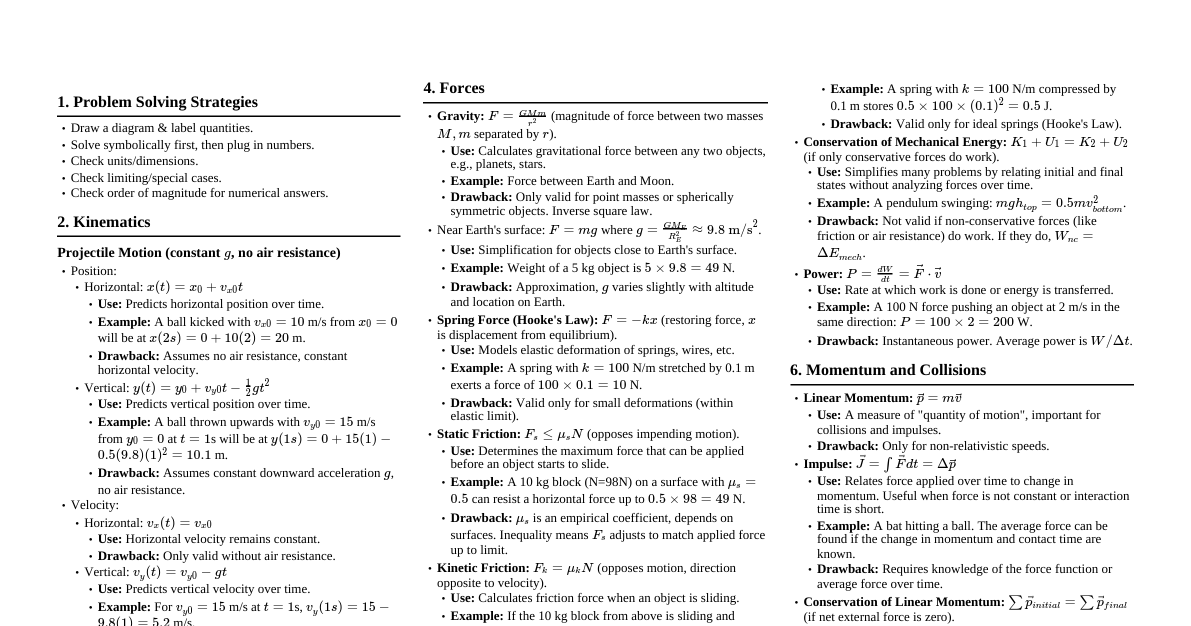
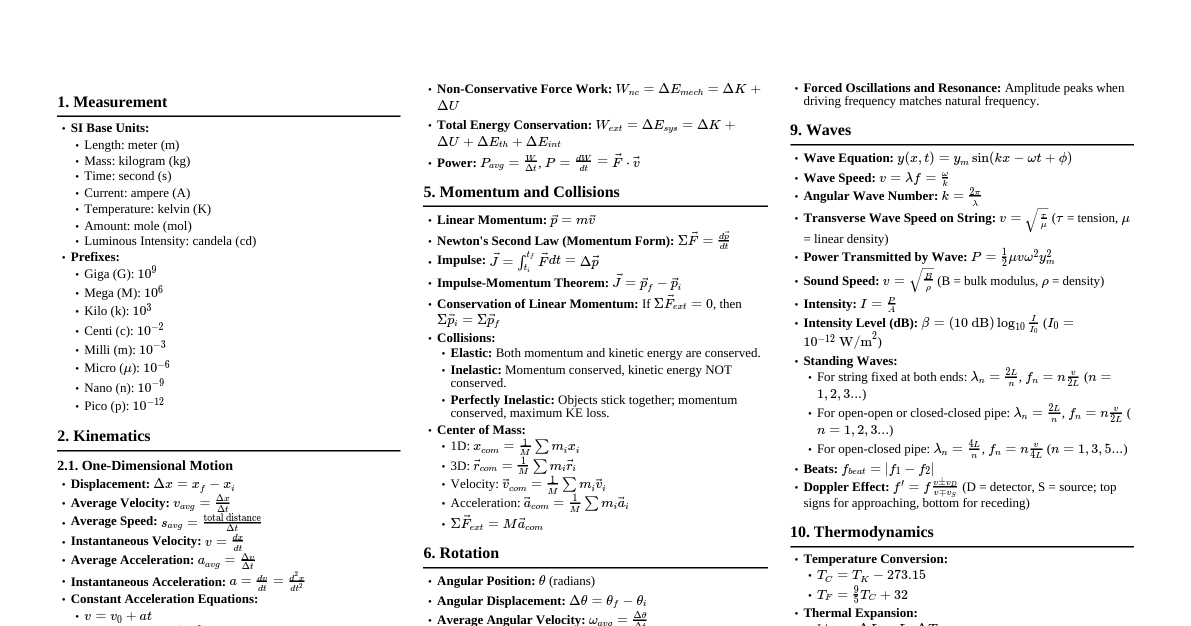
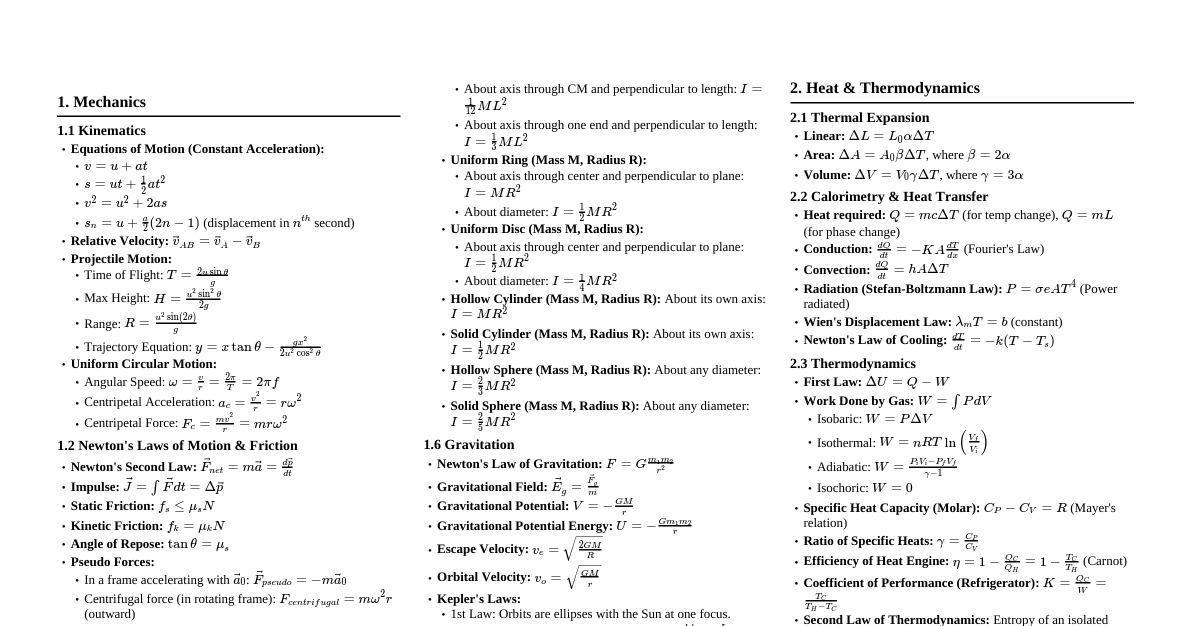
1. Kinematics 1.1. Linear Motion Displacement: $\Delta x = x_f - x_i$ Average Velocity: $v_{avg} = \frac{\Delta x}{\Delta t}$ Instantaneous Velocity: $v = \frac{dx}{dt}$ Average Acceleration: $a_{avg} = \frac{\Delta v}{\Delta t}$ Instantaneous Acceleration: $a = \frac{dv}{dt} = \frac{d^2x}{dt^2}$ Constant Acceleration Equations: $v = v_0 + at$ $\Delta x = v_0 t + \frac{1}{2}at^2$ $v^2 = v_0^2 + 2a\Delta x$ $\Delta x = \frac{1}{2}(v_0 + v)t$ 1.2. Projectile Motion Horizontal: $x = (v_0 \cos\theta) t$ Vertical: $y = (v_0 \sin\theta) t - \frac{1}{2}gt^2$ Vertical Velocity: $v_y = v_0 \sin\theta - gt$ Range: $R = \frac{v_0^2 \sin(2\theta)}{g}$ Time of Flight: $T = \frac{2v_0 \sin\theta}{g}$ 1.3. Circular Motion Angular Displacement: $\Delta\theta$ (radians) Angular Velocity: $\omega = \frac{d\theta}{dt}$ Angular Acceleration: $\alpha = \frac{d\omega}{dt}$ Tangential Velocity: $v_t = r\omega$ Tangential Acceleration: $a_t = r\alpha$ Centripetal Acceleration: $a_c = \frac{v_t^2}{r} = r\omega^2$ Period: $T = \frac{2\pi}{\omega}$ 2. Dynamics (Newton's Laws) Newton's First Law: An object at rest stays at rest... Newton's Second Law: $\vec{F}_{net} = m\vec{a}$ Newton's Third Law: $\vec{F}_{AB} = -\vec{F}_{BA}$ Weight: $W = mg$ Friction (Static): $f_s \le \mu_s N$ Friction (Kinetic): $f_k = \mu_k N$ Centripetal Force: $F_c = \frac{mv^2}{r}$ Hooke's Law: $F_s = -kx$ 3. Work, Energy, Power Work (Constant Force): $W = \vec{F} \cdot \vec{d} = Fd \cos\theta$ Work (Variable Force): $W = \int \vec{F} \cdot d\vec{r}$ Kinetic Energy: $K = \frac{1}{2}mv^2$ Gravitational Potential Energy: $U_g = mgh$ Elastic Potential Energy: $U_s = \frac{1}{2}kx^2$ Work-Energy Theorem: $W_{net} = \Delta K$ Conservation of Mechanical Energy: $E = K + U = \text{constant}$ (if only conservative forces) Power: $P = \frac{dW}{dt} = \vec{F} \cdot \vec{v}$ 4. Momentum and Collisions Linear Momentum: $\vec{p} = m\vec{v}$ Impulse: $\vec{J} = \Delta\vec{p} = \vec{F}_{avg}\Delta t = \int \vec{F} dt$ Conservation of Momentum: $\sum \vec{p}_{initial} = \sum \vec{p}_{final}$ (for isolated system) Elastic Collision: $K_{initial} = K_{final}$ (and momentum conserved) Inelastic Collision: $K_{initial} \ne K_{final}$ (momentum conserved) Perfectly Inelastic Collision: Objects stick together 5. Rotational Motion & Torque Torque: $\vec{\tau} = \vec{r} \times \vec{F} = rF\sin\theta$ Newton's Second Law (Rotational): $\sum\tau = I\alpha$ Moment of Inertia: $I = \sum m_i r_i^2 = \int r^2 dm$ Rotational Kinetic Energy: $K_{rot} = \frac{1}{2}I\omega^2$ Angular Momentum: $\vec{L} = I\vec{\omega}$ Conservation of Angular Momentum: $\vec{L}_{initial} = \vec{L}_{final}$ (if net external torque is zero) Work (Rotational): $W = \tau\Delta\theta$ Power (Rotational): $P = \tau\omega$ 6. Gravitation Newton's Law of Universal Gravitation: $F = G\frac{m_1 m_2}{r^2}$ Gravitational Potential Energy: $U_g = -G\frac{m_1 m_2}{r}$ Orbital Speed: $v = \sqrt{\frac{GM}{r}}$ Escape Velocity: $v_{esc} = \sqrt{\frac{2GM}{R}}$ Kepler's Laws: Orbits are ellipses with Sun at one focus. Equal areas swept in equal times. $T^2 \propto r^3$ (where $r$ is semi-major axis) 7. Simple Harmonic Motion (SHM) Displacement: $x(t) = A\cos(\omega t + \phi)$ Velocity: $v(t) = -A\omega\sin(\omega t + \phi)$ Acceleration: $a(t) = -A\omega^2\cos(\omega t + \phi) = -\omega^2 x(t)$ Angular Frequency: $\omega = \sqrt{\frac{k}{m}}$ (mass-spring) Angular Frequency: $\omega = \sqrt{\frac{g}{L}}$ (simple pendulum for small angles) Period: $T = \frac{2\pi}{\omega} = 2\pi\sqrt{\frac{m}{k}}$ (mass-spring) Period: $T = 2\pi\sqrt{\frac{L}{g}}$ (simple pendulum) Total Energy: $E = \frac{1}{2}kA^2 = \frac{1}{2}mv^2 + \frac{1}{2}kx^2$ 8. Properties of Matter 8.1. Density and Pressure Density: $\rho = \frac{m}{V}$ Pressure: $P = \frac{F}{A}$ Pressure in Fluid at Depth $h$: $P = P_0 + \rho gh$ Pascal's Principle: Pressure applied to an enclosed fluid is transmitted undiminished. $P_1 = P_2 \Rightarrow \frac{F_1}{A_1} = \frac{F_2}{A_2}$ Archimedes' Principle: Buoyant Force $F_B = \rho_{fluid} V_{displaced} g$ 8.2. Fluid Dynamics Continuity Equation: $A_1 v_1 = A_2 v_2$ (incompressible fluid) Bernoulli's Equation: $P_1 + \frac{1}{2}\rho v_1^2 + \rho gh_1 = P_2 + \frac{1}{2}\rho v_2^2 + \rho gh_2$ 8.3. Elasticity Stress: $\sigma = \frac{F}{A}$ Strain: $\epsilon = \frac{\Delta L}{L_0}$ (Tensile/Compressive) Young's Modulus: $Y = \frac{\text{Stress}}{\text{Strain}} = \frac{F/A}{\Delta L/L_0}$ Shear Strain: $\gamma = \frac{\Delta x}{h}$ Shear Modulus: $S = \frac{\text{Shear Stress}}{\text{Shear Strain}} = \frac{F/A}{\Delta x/h}$ Bulk Stress (Pressure): $\Delta P = -B\frac{\Delta V}{V_0}$ Bulk Modulus: $B = -\frac{\Delta P}{\Delta V/V_0}$