d- and f-Block Elements (JEE)
Cheatsheet Content
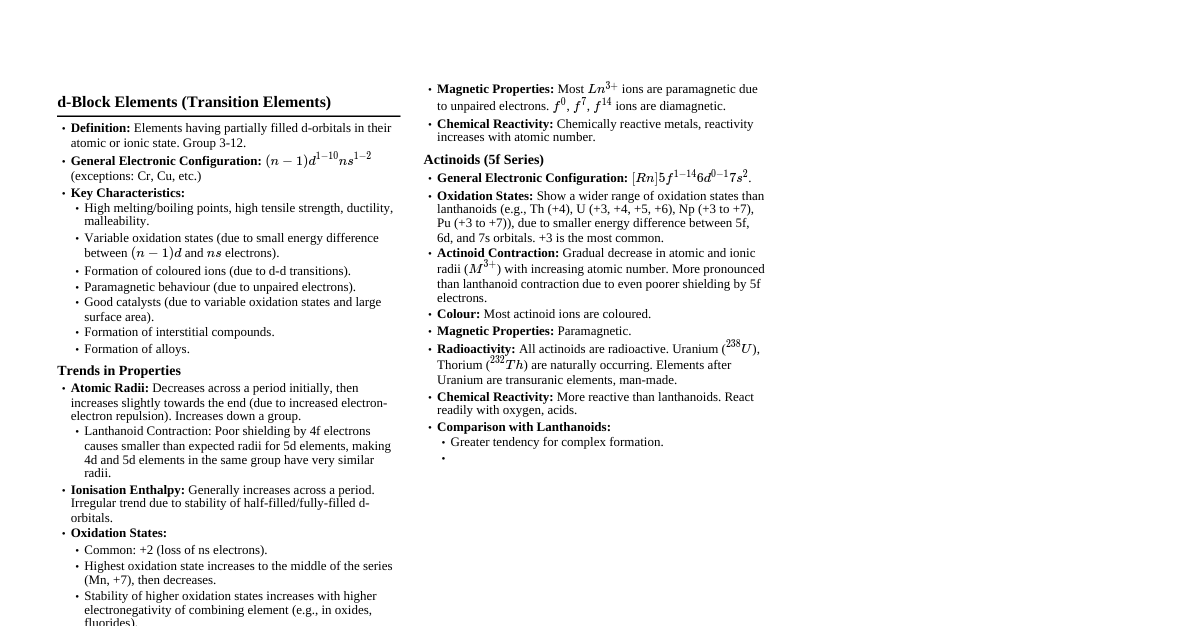
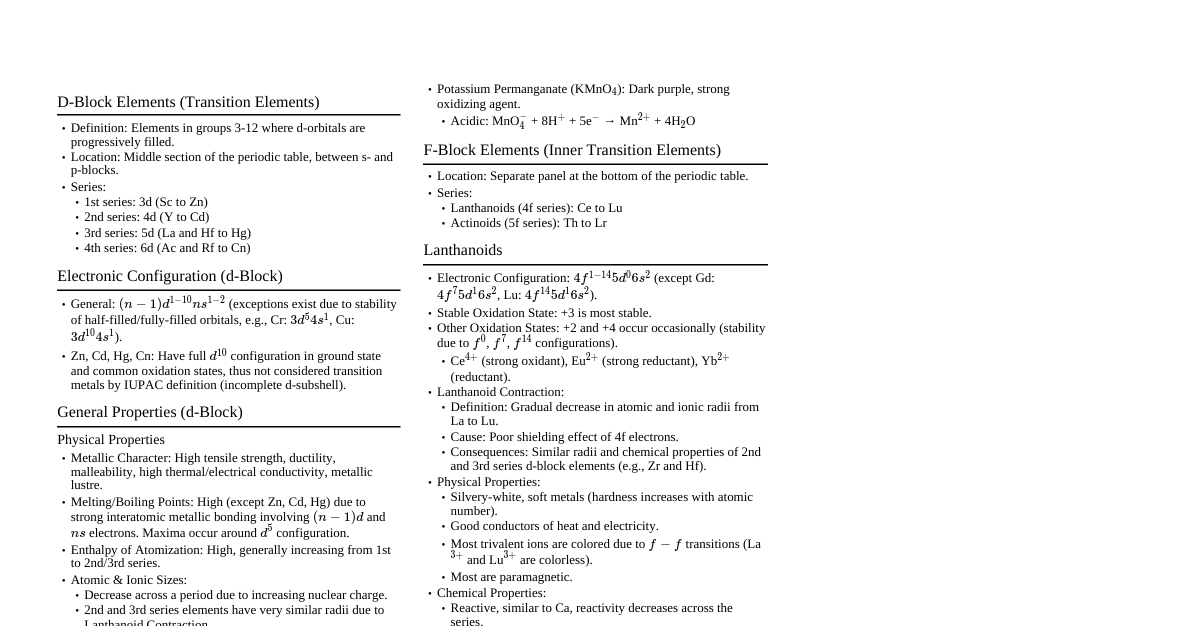
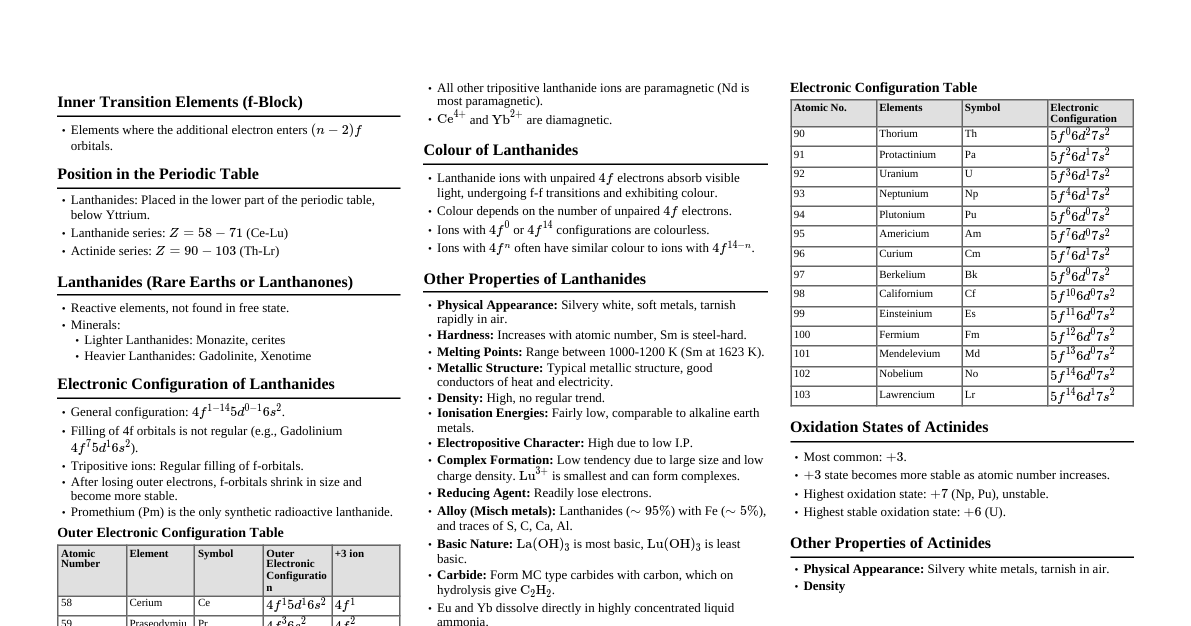
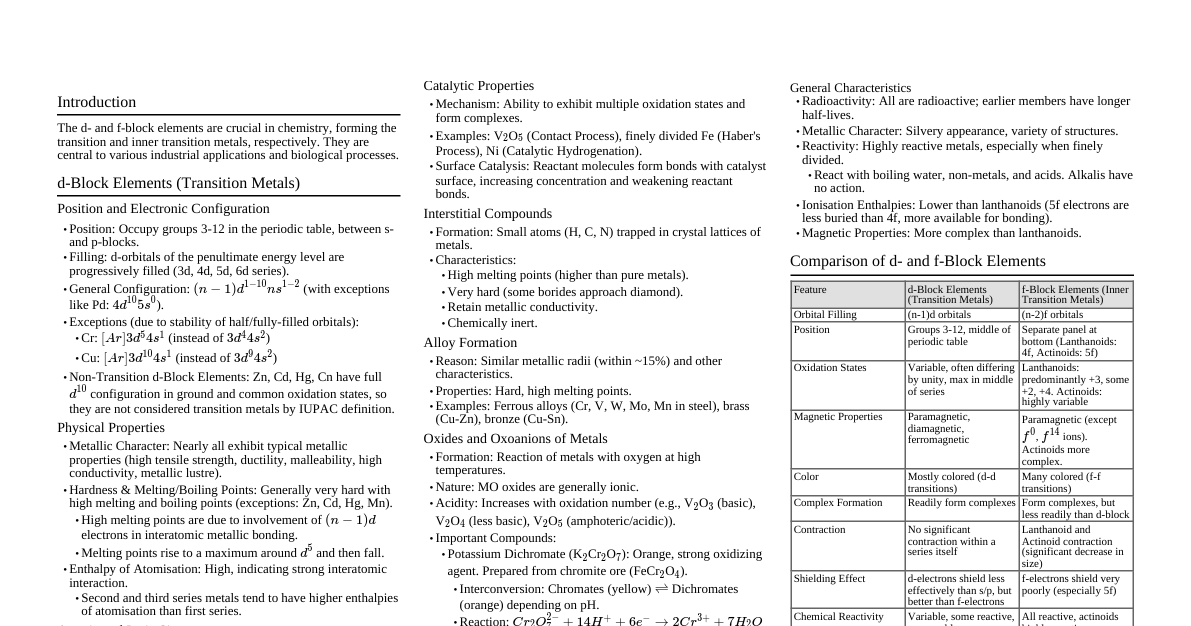
1. d-Block Elements (Transition Elements) 1.1 Introduction Elements with partially filled d-orbitals in their ground state or in one of their common oxidation states. General electronic configuration: $(n-1)d^{1-10} ns^{1-2}$. Located between s- and p-block elements (Groups 3-12). Often show variable oxidation states, form coloured ions, are good catalysts, and form alloys. 1.2 Electronic Configuration Series Shells General Configuration Examples 1st (3d) $n=4$ $[Ar] 3d^{1-10} 4s^{1-2}$ Sc (3d$^1$4s$^2$) to Zn (3d$^{10}$4s$^2$) 2nd (4d) $n=5$ $[Kr] 4d^{1-10} 5s^{1-2}$ Y (4d$^1$5s$^2$) to Cd (4d$^{10}$5s$^2$) 3rd (5d) $n=6$ $[Xe] 4f^{14} 5d^{1-10} 6s^{1-2}$ La (5d$^1$6s$^2$), Hf (4f$^{14}$5d$^2$6s$^2$) to Hg (4f$^{14}$5d$^{10}$6s$^2$) 4th (6d) $n=7$ $[Rn] 5f^{14} 6d^{1-10} 7s^{1-2}$ Ac (6d$^1$7s$^2$), Rf (5f$^{14}$6d$^2$7s$^2$) onwards Exceptions: Cr ($3d^5 4s^1$), Cu ($3d^{10} 4s^1$), Mo ($4d^5 5s^1$), Ag ($4d^{10} 5s^1$), Au ($5d^{10} 6s^1$). Stability of half-filled and fully-filled d-orbitals. Zn, Cd, Hg, and Cn are not considered transition elements due to fully filled d-orbitals in elemental state and common oxidation states. 1.3 General Properties Metallic Character: All are metals, good conductors of heat and electricity. High melting and boiling points due to strong metallic bonding (involving unpaired d-electrons). Atomic and Ionic Radii: Decrease across a period initially, then remain relatively constant, then increase slightly (due to increased electron-electron repulsion). Increase down a group. Lanthanoid Contraction: Poor shielding of 4f electrons leads to smaller than expected atomic/ionic radii for 3rd series elements (e.g., Zr and Hf have similar radii). Ionisation Enthalpy: Increases across a period, but less regularly than s- and p-block. Higher than s-block, lower than p-block. Oxidation States: Exhibit variable oxidation states (except Sc (+3), Zn (+2)). The most common oxidation state for 3d series is +2 (loss of 4s electrons). Highest oxidation state is often found in compounds with F and O (e.g., $MnO_4^-$, $Cr_2O_7^{2-}$). Stability of higher oxidation states decreases down a group (except for Cr, Mo, W). Standard Electrode Potentials: Generally negative, indicating reducing nature. Irregular trends due to hydration enthalpy, ionization enthalpy, and enthalpy of atomisation. Magnetic Properties: Paramagnetic: Possess unpaired electrons. Attracted by magnetic field. $N = \sqrt{n(n+2)}$ BM (Bohr Magneton), where $n$ is number of unpaired electrons. Diamagnetic: All electrons are paired. Repelled by magnetic field (e.g., $Sc^{3+}$, $Ti^{4+}$, $Zn^{2+}$, $Cu^+$). Colour: Most transition metal ions are coloured in solution/solid state due to d-d transitions (absorption of visible light excites electron from lower to higher d-orbital). The colour observed is the complementary colour of the light absorbed. (e.g., $Ti^{3+}$ (violet), $V^{3+}$ (green), $Cr^{3+}$ (violet), $Mn^{2+}$ (pale pink), $Fe^{3+}$ (yellow), $Co^{2+}$ (blue/pink), $Ni^{2+}$ (green), $Cu^{2+}$ (blue)). Catalytic Properties: Many transition metals and their compounds act as catalysts (e.g., V$_2$O$_5$ in contact process, Fe in Haber process, Ni in hydrogenation). Due to variable oxidation states and ability to form unstable intermediates. Complex Formation: Form a large number of complex compounds due to: Small size of metal ions. High ionic charges. Availability of vacant d-orbitals to accept lone pairs from ligands. Alloy Formation: Form alloys readily due to similar atomic sizes. (e.g., brass (Cu-Zn), bronze (Cu-Sn), stainless steel (Fe-Cr-Ni)). Interstitial Compounds: Formed when small atoms (H, C, N) get trapped in the interstitial sites of the metal lattice. They are non-stoichiometric, hard, chemically inert, and retain metallic conductivity. 1.4 Important Compounds of d-Block Elements Potassium Dichromate ($K_2Cr_2O_7$): Preparation: Chromite ore ($FeCr_2O_4$) $\rightarrow$ Sodium chromate $\rightarrow$ Sodium dichromate $\rightarrow$ Potassium dichromate. Orange solid, strong oxidising agent in acidic medium: $Cr_2O_7^{2-} + 14H^+ + 6e^- \rightarrow 2Cr^{3+} + 7H_2O$. Chromate-dichromate equilibrium: $Cr_2O_7^{2-}$ (orange) $\rightleftharpoons 2CrO_4^{2-}$ (yellow) in acidic/basic medium. Potassium Permanganate ($KMnO_4$): Preparation: Pyrolusite ($MnO_2$) $\rightarrow$ Potassium manganate ($K_2MnO_4$) $\rightarrow$ Potassium permanganate. Purple solid, strong oxidising agent. In acidic medium: $MnO_4^- + 8H^+ + 5e^- \rightarrow Mn^{2+} + 4H_2O$ (Equivalent wt. = M/5). In neutral/faintly alkaline medium: $MnO_4^- + 2H_2O + 3e^- \rightarrow MnO_2 + 4OH^-$ (Equivalent wt. = M/3). In strongly alkaline medium: $MnO_4^- + e^- \rightarrow MnO_4^{2-}$ (Equivalent wt. = M/1). 2. f-Block Elements (Inner Transition Elements) 2.1 Introduction Elements in which the differentiating electron enters the $(n-2)$f subshell. Two series: Lanthanoids (4f series) and Actinoids (5f series). Placed separately at the bottom of the periodic table. 2.2 Lanthanoids (4f Series) Elements from Ce (Z=58) to Lu (Z=71). General electronic configuration: $[Xe] 4f^{1-14} 5d^{0-1} 6s^2$. (Most common is $4f^n 6s^2$, $5d^0$ for many). Oxidation States: Most common is +3. Some show +2 (Eu, Yb) and +4 (Ce, Pr, Tb) due to stability of empty, half-filled, or fully-filled 4f orbitals. Lanthanoid Contraction: Steady decrease in atomic and ionic radii (M$^{3+}$) from Ce to Lu. Reason: Poor shielding effect of 4f electrons, leading to increased effective nuclear charge. Consequences: Similarity in properties of 2nd and 3rd row transition elements (e.g., Zr/Hf, Nb/Ta). Difficulty in separation of lanthanoids. Slight increase in basicity of hydroxides from $La(OH)_3$ to $Lu(OH)_3$. Colour: Most $Ln^{3+}$ ions are coloured in solid state and aqueous solutions (due to f-f transitions). $La^{3+}$ and $Lu^{3+}$ are colourless (no unpaired f-electrons). Magnetic Properties: Many $Ln^{3+}$ ions are paramagnetic due to unpaired f-electrons. $La^{3+}$ and $Lu^{3+}$ are diamagnetic. Chemical Reactivity: Highly electropositive. React with water, acids, halogens, etc. Mischmetal: An alloy of lanthanoid metals (95% La, Ce, Pr, Nd + 5% Fe + traces of S, C, Ca, Al). Used in lighter flints, bullet cores. 2.3 Actinoids (5f Series) Elements from Th (Z=90) to Lr (Z=103). General electronic configuration: $[Rn] 5f^{1-14} 6d^{0-1} 7s^2$. Oxidation States: Show a wider range of oxidation states than lanthanoids (e.g., Th (+4), Pa (+5), U (+3, +4, +5, +6), Np (+3 to +7)). +3 is most common. Actinoid Contraction: Gradual decrease in atomic and ionic radii. More pronounced than lanthanoid contraction due to even poorer shielding of 5f electrons. Radioactivity: All actinoids are radioactive. Those after Uranium (transuranic elements) are man-made. Colour: Most actinoid ions are coloured. Magnetic Properties: More complex than lanthanoids due to significant orbital contribution. Reactivity: Highly reactive metals, especially finely divided. Tendency to form complexes is greater than lanthanoids. 2.4 Differences between Lanthanoids and Actinoids Property Lanthanoids Actinoids Filling Orbital 4f 5f Oxidation States Mainly +3; few +2, +4 Mainly +3; wider range (+4, +5, +6, +7) Magnetic Properties Less complex More complex (orbital contribution significant) Complex Formation Less tendency Greater tendency Radioactivity Only Promethium (Pm) is radioactive All are radioactive Basicity of Hydroxides More basic Less basic