Thermodynamics Cheatsheet
Cheatsheet Content
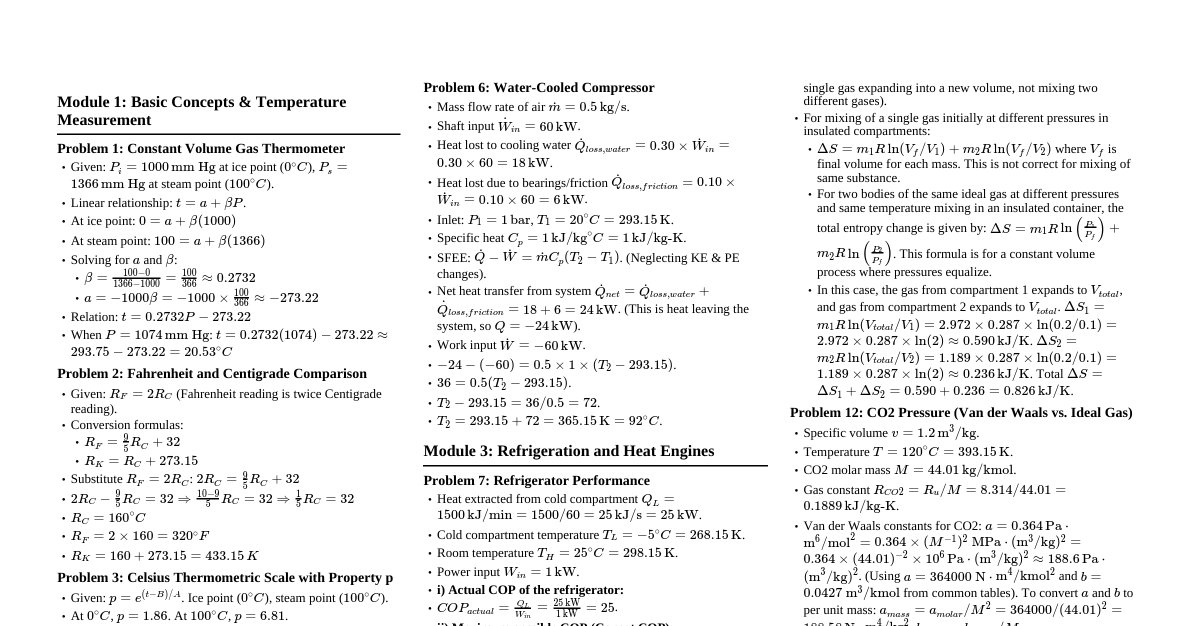
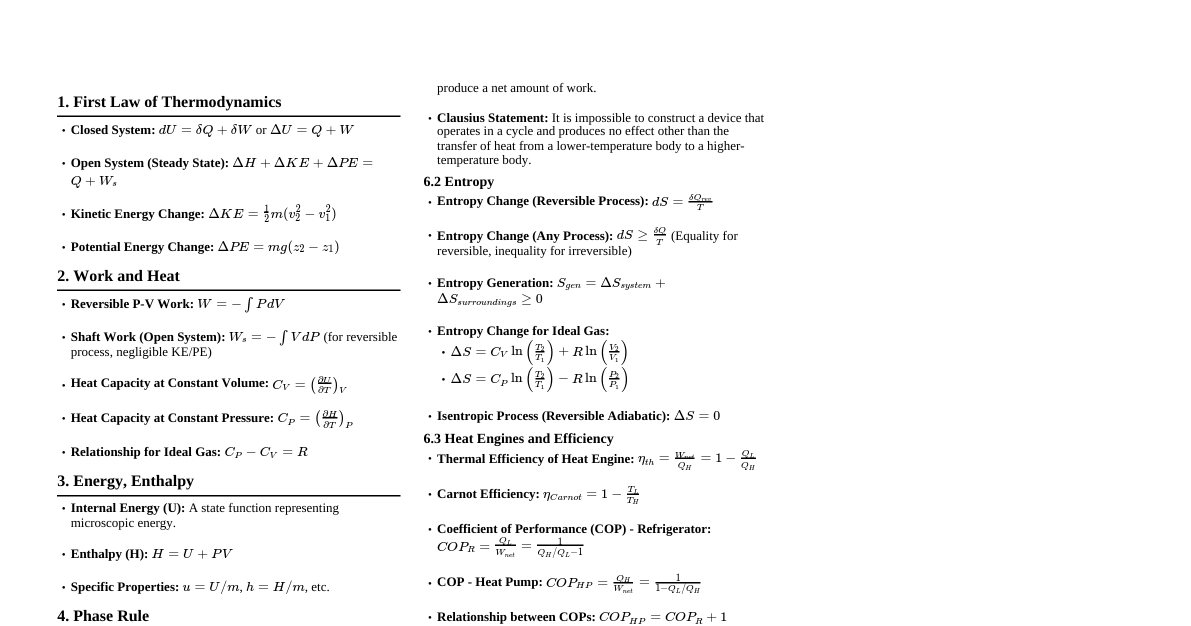
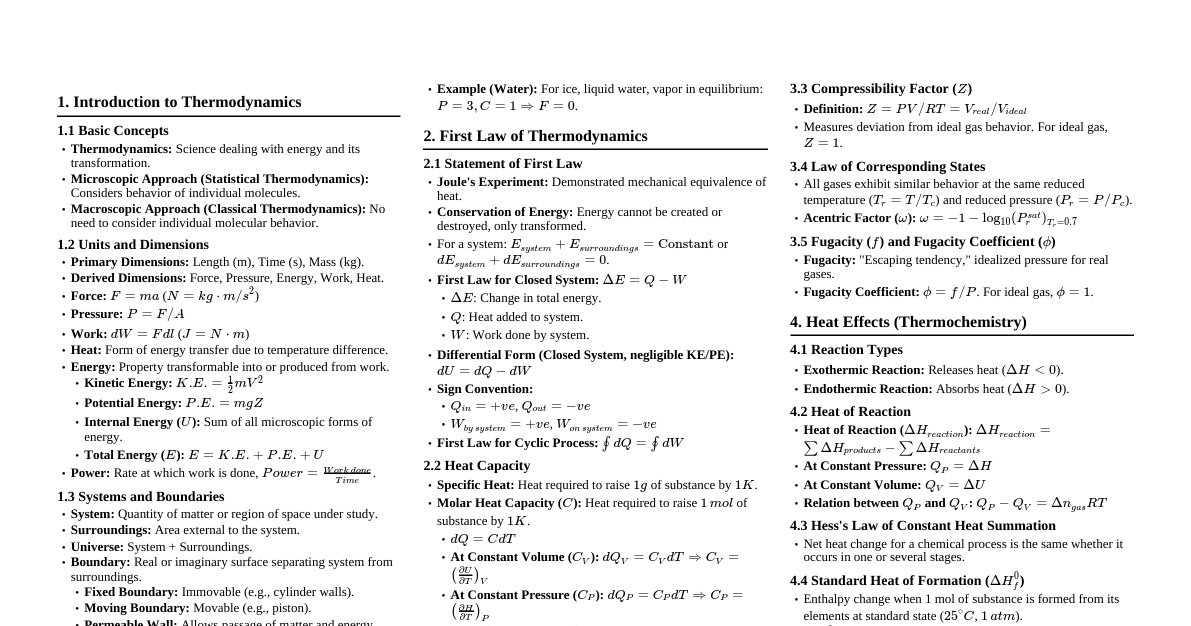
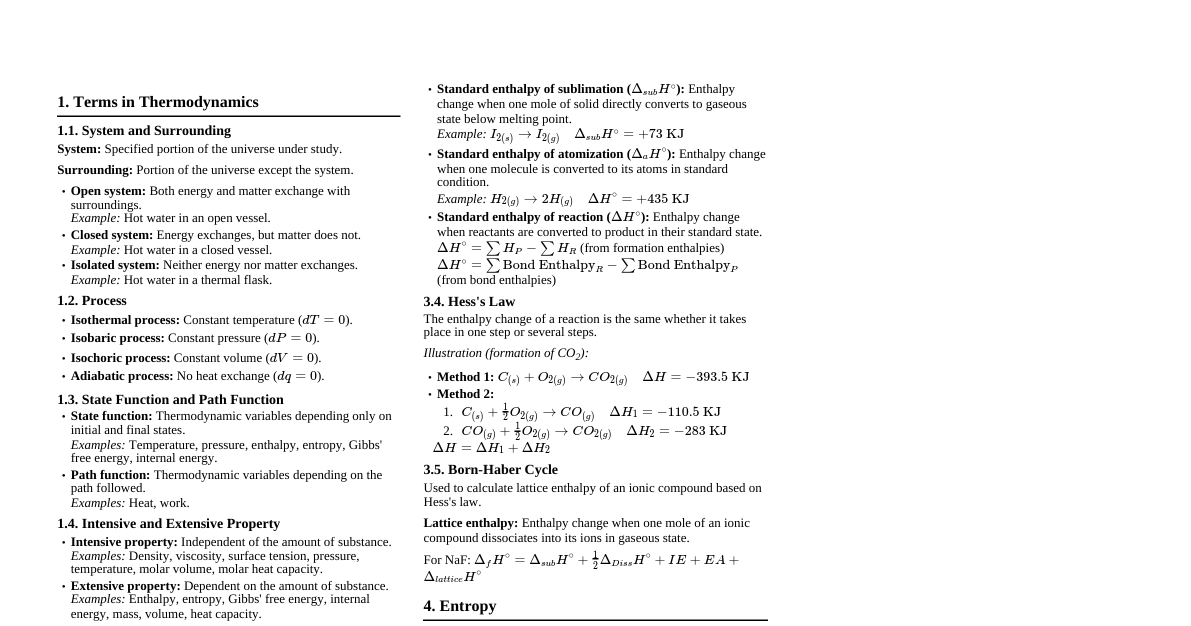
### Basic Concepts - **System:** Part of the universe under study. - **Open:** Exchanges mass & energy. - **Closed:** Exchanges energy, not mass. - **Isolated:** No exchange of mass or energy. - **Surroundings:** Everything outside the system. - **Boundary:** Separates system from surroundings. - **State Variables:** Properties describing the system (P, V, T, n, U, H, S, G). - **Extensive Properties:** Depend on system size (V, n, U, H, S, G). - **Intensive Properties:** Independent of system size (P, T, density). - **Equilibrium:** No net change in state variables over time. - **Process:** Change in state of a system. - **Reversible:** Can be reversed without leaving any change in the surroundings. - **Irreversible:** Cannot be reversed without leaving a change in the surroundings. - **Cyclic:** System returns to its initial state. ### Laws of Thermodynamics #### Zeroth Law - If two systems are each in thermal equilibrium with a third system, then they are in thermal equilibrium with each other. - Leads to the concept of **temperature (T)**. #### First Law (Conservation of Energy) - **Statement:** Energy cannot be created or destroyed, only transferred or transformed. - **Equation:** $\Delta U = Q - W$ - $\Delta U$: Change in internal energy of the system. - $Q$: Heat added *to* the system. - $W$: Work done *by* the system. - **Sign Conventions:** - $Q > 0$: Heat absorbed by system. - $Q 0$: Work done by system (expansion). - $W ### Work and Heat #### Work (W) - **Pressure-Volume Work:** $W = \int P_{ext} dV$ - For expansion: $P_{ext}$ is external pressure. - For reversible process: $W = \int P dV$ - **Constant Pressure (Isobaric):** $W = P_{ext} \Delta V$ - **Constant Volume (Isochoric):** $W = 0$ (since $dV=0$) - **Isothermal (Ideal Gas):** $W = nRT \ln(V_f/V_i)$ (reversible) - **Adiabatic (Ideal Gas):** $W = -\Delta U = \frac{P_f V_f - P_i V_i}{1-\gamma}$ or $W = nC_v(T_f - T_i)$ #### Heat (Q) - **Heat Capacity (C):** Amount of heat required to raise temperature by 1K. - $Q = C \Delta T$ - **Specific Heat Capacity (c):** $Q = mc \Delta T$ - **Molar Heat Capacity ($C_m$):** $Q = nC_m \Delta T$ - **Constant Volume:** $Q_v = \Delta U = nC_v \Delta T$ - **Constant Pressure:** $Q_p = \Delta H = nC_p \Delta T$ - **Relationship between $C_p$ and $C_v$ (Ideal Gas):** $C_p - C_v = R$ - **Adiabatic Index:** $\gamma = C_p / C_v$ #### Second Law (Entropy) - **Statement:** The total entropy of an isolated system can only increase over time, or remain constant in reversible processes. It can never decrease. - **Entropy (S):** Measure of disorder or randomness. State function. - **Equation:** $\Delta S_{universe} = \Delta S_{system} + \Delta S_{surroundings} \ge 0$ - **Reversible Process:** $\Delta S = \int \frac{dQ_{rev}}{T}$ - For isothermal reversible: $\Delta S = \frac{Q_{rev}}{T}$ - **Irreversible Process:** $\Delta S > \int \frac{dQ_{irr}}{T}$ - **For Ideal Gas:** $\Delta S = nC_v \ln(T_f/T_i) + nR \ln(V_f/V_i)$ - $\Delta S = nC_p \ln(T_f/T_i) - nR \ln(P_f/P_i)$ - **Phase Transition:** $\Delta S_{trans} = \frac{\Delta H_{trans}}{T_{trans}}$ #### Third Law - **Statement:** The entropy of a perfect crystal at absolute zero (0 K) is zero. - Allows for calculation of absolute entropies. ### Thermodynamic Processes #### 1. Isobaric Process (Constant Pressure) - $P = \text{constant}$ - $\Delta P = 0$ - $W = P \Delta V$ - $Q = \Delta H = nC_p \Delta T$ - $\Delta U = Q - W = nC_v \Delta T$ #### 2. Isochoric Process (Constant Volume) - $V = \text{constant}$ - $\Delta V = 0$ - $W = 0$ - $Q = \Delta U = nC_v \Delta T$ - $\Delta H = nC_p \Delta T$ #### 3. Isothermal Process (Constant Temperature) - $T = \text{constant}$ - $\Delta T = 0$ - For Ideal Gas: $\Delta U = 0$, $\Delta H = 0$ - $Q = W$ - $W_{rev} = nRT \ln(V_f/V_i) = nRT \ln(P_i/P_f)$ - $Q_{rev} = nRT \ln(V_f/V_i)$ #### 4. Adiabatic Process (No Heat Exchange) - $Q = 0$ - $\Delta U = -W$ - For Ideal Gas: - $P_i V_i^\gamma = P_f V_f^\gamma$ - $T_i V_i^{\gamma-1} = T_f V_f^{\gamma-1}$ - $T_i P_i^{(1-\gamma)/\gamma} = T_f P_f^{(1-\gamma)/\gamma}$ - $W = \frac{P_f V_f - P_i V_i}{1-\gamma} = \frac{nR(T_f - T_i)}{1-\gamma} = nC_v(T_i - T_f)$ #### 5. Cyclic Process - System returns to initial state. - $\Delta U_{cycle} = 0$, $\Delta H_{cycle} = 0$, $\Delta S_{cycle} = 0$, $\Delta G_{cycle} = 0$ - $Q_{cycle} = W_{cycle}$ #### 6. Polytropic Process - $P V^n = \text{constant}$ (where $n$ is the polytropic index) - Generalization of other processes: - Isothermal: $n=1$ - Adiabatic: $n=\gamma$ - Isobaric: $n=0$ - Isochoric: $n=\infty$ (or $V = \text{constant}$) - $W = \frac{P_f V_f - P_i V_i}{1-n}$ (for $n \ne 1$) #### 7. Reversible vs. Irreversible Processes - **Reversible:** - Infinitesimal changes, system always in equilibrium. - Maximum work done by system, minimum work done on system. - $\Delta S_{universe} = 0$ - **Irreversible:** - Finite, spontaneous changes, system not in equilibrium. - Less work done by system, more work done on system. - $\Delta S_{universe} > 0$ ### Free Energy #### Gibbs Free Energy (G) - **Definition:** $G = H - TS$ - **Criterion for Spontaneity (Constant T, P):** - $\Delta G 0$: Non-spontaneous (reverse is spontaneous) - **Equation for change:** $\Delta G = \Delta H - T \Delta S$ - **Relationship to work:** $\Delta G = W_{max, non-PV}$ (maximum non-PV work) - **Standard State:** $\Delta G^\circ = \Delta H^\circ - T \Delta S^\circ$ - **Temperature Dependence:** $\frac{\partial (G/T)}{\partial T} = -H/T^2$ (Gibbs-Helmholtz equation) - **Reaction Quotient (Q) & Equilibrium Constant (K):** - $\Delta G = \Delta G^\circ + RT \ln Q$ - At equilibrium, $\Delta G = 0$, $Q=K$: $\Delta G^\circ = -RT \ln K$ #### Helmholtz Free Energy (A) - **Definition:** $A = U - TS$ - **Criterion for Spontaneity (Constant T, V):** - $\Delta A 0$: Non-spontaneous - **Relationship to work:** $\Delta A = W_{max, total}$ (maximum total work) #### Maxwell Relations - Derived from exact differentials of thermodynamic potentials. - For $dU = TdS - PdV \implies (\frac{\partial T}{\partial V})_S = -(\frac{\partial P}{\partial S})_V$ - For $dH = TdS + VdP \implies (\frac{\partial T}{\partial P})_S = (\frac{\partial V}{\partial S})_P$ - For $dA = -SdT - PdV \implies (\frac{\partial S}{\partial V})_T = (\frac{\partial P}{\partial T})_V$ - For $dG = -SdT + VdP \implies -(\frac{\partial S}{\partial P})_T = (\frac{\partial V}{\partial T})_P$ ### Phase Transitions - **Melting/Freezing:** Solid $\rightleftharpoons$ Liquid - **Vaporization/Condensation:** Liquid $\rightleftharpoons$ Gas - **Sublimation/Deposition:** Solid $\rightleftharpoons$ Gas - **Clapeyron Equation:** $\frac{dP}{dT} = \frac{\Delta H}{T \Delta V}$ - Describes the slope of phase boundaries on a P-T diagram. - **Clausius-Clapeyron Equation (for liquid-gas transition, assuming ideal gas & $\Delta V \approx V_g$):** - $\ln(P_2/P_1) = -\frac{\Delta H_{vap}}{R} (\frac{1}{T_2} - \frac{1}{T_1})$ ### Heat Engines & Refrigerators #### Heat Engines - Convert heat into work. - **Efficiency ($\eta$):** $\eta = \frac{W_{net}}{Q_H} = 1 - \frac{Q_C}{Q_H}$ - $Q_H$: Heat absorbed from hot reservoir. - $Q_C$: Heat expelled to cold reservoir. - **Carnot Engine (Ideal, Reversible):** - $\eta_{Carnot} = 1 - \frac{T_C}{T_H}$ - Most efficient possible engine operating between $T_H$ and $T_C$. #### Refrigerators/Heat Pumps - Transfer heat from cold to hot reservoir. - **Coefficient of Performance (COP):** - **Refrigerator:** $COP_{ref} = \frac{Q_C}{W_{in}} = \frac{Q_C}{Q_H - Q_C}$ - **Heat Pump:** $COP_{hp} = \frac{Q_H}{W_{in}} = \frac{Q_H}{Q_H - Q_C}$ - **Carnot Refrigerator/Heat Pump:** - $COP_{ref, Carnot} = \frac{T_C}{T_H - T_C}$ - $COP_{hp, Carnot} = \frac{T_H}{T_H - T_C}$ ### Equations of State #### Ideal Gas Law - $PV = nRT$ - $R = 8.314 \text{ J/(mol·K)}$ or $0.0821 \text{ L·atm/(mol·K)}$ #### Van der Waals Equation (Real Gas) - $(P + \frac{an^2}{V^2})(V - nb) = nRT$ - $a$: Accounts for intermolecular attraction. - $b$: Accounts for finite volume of gas molecules.