Algebra Essentials
Cheatsheet Content
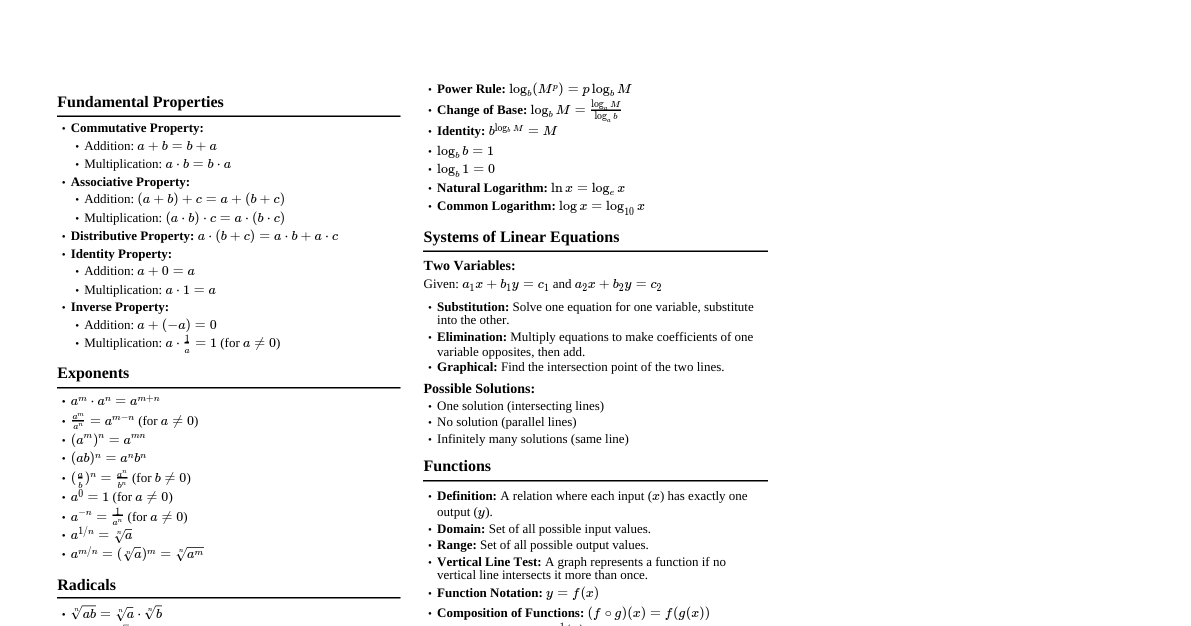
### Unit 2.1: Factors and Products #### Terminology - **Monomial:** One term (e.g., $3x^2$) - **Binomial:** Two terms (e.g., $x+1$) - **Trinomial:** Three terms (e.g., $x^2+2x+1$) - **Polynomial:** Many terms (sum of monomials) #### Exponent Laws - $x^a \cdot x^b = x^{a+b}$ - $\frac{x^a}{x^b} = x^{a-b}$ - $(x^a)^b = x^{ab}$ - $(xy)^a = x^a y^a$ - $(\frac{x}{y})^a = \frac{x^a}{y^a}$ - $x^0 = 1$ - $x^{-a} = \frac{1}{x^a}$ #### Simplifying Expressions - **Multiply coefficients, add exponents for same variables.** - Example: $(4x^2)(-3x) = -12x^3$ - **Distribute when multiplying a polynomial by a monomial.** - Example: $-2(x^2 - 3x + 1) = -2x^2 + 6x - 2$ #### Examples 1. Simplify: $(x^2y^3)(x^4y^2)$ Solution: $x^{2+4}y^{3+2} = x^6y^5$ 2. Simplify: $(2x^2)^3$ Solution: $2^3(x^2)^3 = 8x^6$ 3. Simplify: $-(x^2)(-x)^3(2x)^2$ Solution: $-(x^2)(-x^3)(4x^2) = -(-x^5)(4x^2) = 4x^7$ 4. Simplify: $\frac{-6x^5y^3}{2x^2y} = -3x^3y^2$ 5. Simplify: $(3x^2)(-2x^3y^2)(-4xy^3)$ Solution: $24x^6y^5$ ### Unit 2.2: Multiplying Polynomials When multiplying polynomials, multiply every piece in the first bracket by every piece in the second bracket. #### Binomial by Binomial (FOIL or Box Method) - **FOIL:** First, Outer, Inner, Last - **Box Method:** Organize terms in a grid to ensure all multiplications are covered. #### Examples 1. Expand and Simplify: $(a+5)(a+2)$ Solution: $a^2 + 2a + 5a + 10 = a^2 + 7a + 10$ 2. Expand and Simplify: $(2x-3y)(3x-y)$ Solution: $6x^2 - 2xy - 9xy + 3y^2 = 6x^2 - 11xy + 3y^2$ 3. Expand and Simplify: $(x+3)^2$ Solution: $(x+3)(x+3) = x^2 + 3x + 3x + 9 = x^2 + 6x + 9$ 4. Expand and Simplify: $(x+5)(3x-x^2+2)$ Solution: $3x^2 - x^3 + 2x + 15x - 5x^2 + 10 = -x^3 - 2x^2 + 17x + 10$ ### Unit 2.3: Operations with Polynomials When dealing with multiple operations, always seek to eliminate the brackets in the question first. #### Subtracting Polynomials When a polynomial is being subtracted, distribute the negative sign throughout the bracket. Example: $14 - (3x+1)$ Solution: $14 - 3x - 1 = -3x + 13$ #### Examples 1. Simplify: $(y^2-7x+4x-8) - (x^2-6x+2)$ Solution: $y^2 - 7x + 4x - 8 - x^2 + 6x - 2 = -x^2 + y^2 + 3x - 10$ 2. Simplify: $(3x-y)(2x-y) - (x+y)(4x-y)$ Solution: $(6x^2-5xy+y^2) - (4x^2+3xy-y^2) = 6x^2-5xy+y^2-4x^2-3xy+y^2 = 2x^2-8xy+2y^2$ 3. Simplify: $(-x)^2(x-2)^2$ Solution: $(x^2)(x^2-4x+4) = x^4-4x^3+4x^2$ 4. Simplify: $\frac{(4x-2)^2(4+6x)^2}{2}$ Solution: $\frac{(16x^2-16x+4)(16+48x+36x^2)}{2} = \frac{(4(4x^2-4x+1))(4(4+12x+9x^2))}{2} = \frac{16(4x^2-4x+1)(9x^2+12x+4)}{2} = 8(4x^2-4x+1)(9x^2+12x+4)$ ### Unit 2.4: Factoring by Removing the Greatest Common Factor (GCF) Factoring is the opposite of multiplication. It's like unwrapping a present. When factoring, always check if there is a GCF first. #### How to find GCF 1. Find the GCF of the coefficients. 2. Find the GCF of the variables (lowest exponent). 3. Multiply them to get the overall GCF. #### Examples 1. Factor: $20x-10y-30$ GCF: 10 Solution: $10(2x-y-3)$ 2. Factor: $-15x+12y$ GCF: -3 (if first term is negative, take out negative GCF) Solution: $-3(5x-4y)$ 3. Factor: $3x+4xy$ GCF: $x$ Solution: $x(3+4y)$ 4. Factor: $3x^2y^2-12xy^3$ GCF: $3xy^2$ Solution: $3xy^2(x-4y)$ 5. Factor: $-14x^2+10x^3-30x^4$ GCF: $-2x^2$ Solution: $-2x^2(7-5x+15x^2)$ #### Factoring by Grouping (4 terms) When you can't find a common factor for all terms, try to group terms (usually 2x2) and find a common factor for each group. The goal is to get a common binomial factor. Example: $xy+3x+2y+6$ 1. Group: $(xy+3x) + (2y+6)$ 2. Factor each group: $x(y+3) + 2(y+3)$ 3. Factor out common binomial: $(y+3)(x+2)$ ### Unit 2.5: Factoring Trinomials We need to split the middle term into 2 pieces to factor. #### Factoring $x^2+bx+c$ (where $a=1$) Find two numbers that: 1. Multiply to $c$ 2. Add to $b$ Example: Factor $x^2+7x+12$ Numbers are 3 and 4 (since $3 \cdot 4 = 12$ and $3+4=7$) Solution: $(x+3)(x+4)$ #### Factoring $ax^2+bx+c$ (where $a \neq 1$) 1. Find two numbers that multiply to $ac$ and add to $b$. 2. Rewrite the middle term ($bx$) using these two numbers. 3. Factor by grouping (as in Unit 2.4). Example: $6x^2-19x+10$ $ac = 6 \cdot 10 = 60$. $b = -19$. Numbers: -4, -15 (since $(-4)(-15)=60$ and $-4-15=-19$) Rewrite: $6x^2 - 4x - 15x + 10$ Group: $(6x^2-4x) - (15x-10)$ Factor: $2x(3x-2) - 5(3x-2)$ Solution: $(3x-2)(2x-5)$ ### Unit 2.6: Factoring Differences of Squares A difference of squares is a subtraction of two perfect squares. Formula: $a^2 - b^2 = (a-b)(a+b)$ #### Conditions for Difference of Squares 1. Must be a binomial (two terms). 2. Must be subtraction (a difference). 3. Both terms must be perfect squares. #### Examples 1. Factor: $x^2-9$ Solution: $(x-3)(x+3)$ 2. Factor: $k^2-49$ Solution: $(k-7)(k+7)$ 3. Factor: $16-y^2$ Solution: $(4-y)(4+y)$ 4. Factor: $4y^2-81$ Solution: $(2y-9)(2y+9)$ 5. Factor: $x^4-36$ Solution: $(x^2-6)(x^2+6)$ 6. Factor: $g^4-16$ Solution: $(g^2-4)(g^2+4) = (g-2)(g+2)(g^2+4)$