Algebra Essentials
Cheatsheet Content
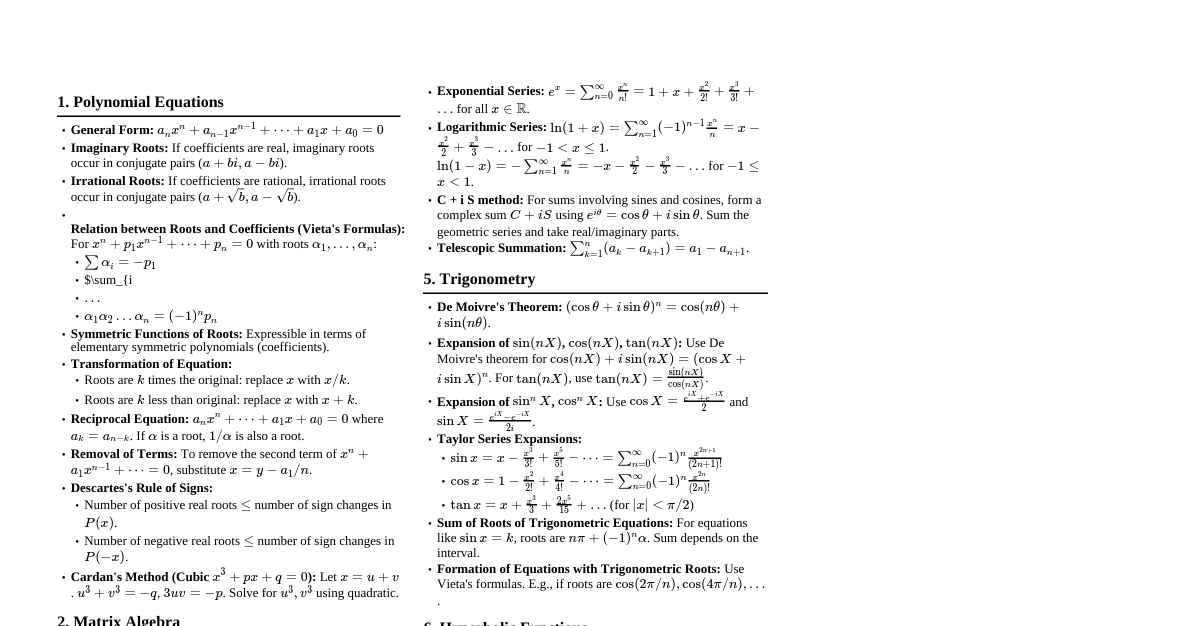
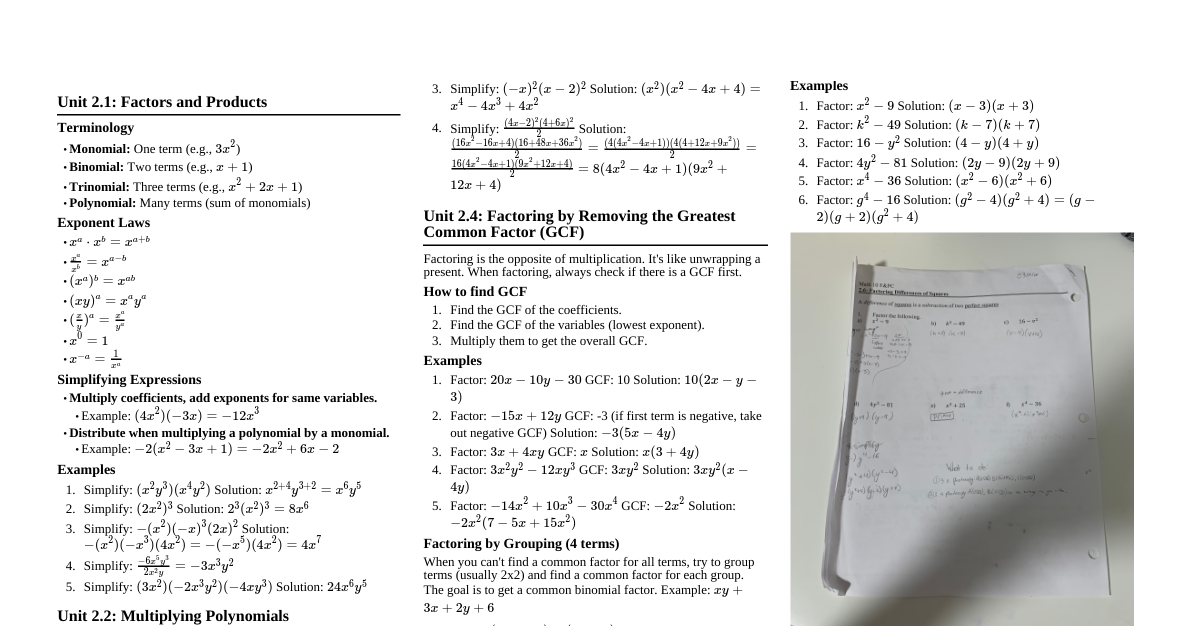
Fundamental Properties Commutative Property: Addition: $a + b = b + a$ Multiplication: $a \cdot b = b \cdot a$ Associative Property: Addition: $(a + b) + c = a + (b + c)$ Multiplication: $(a \cdot b) \cdot c = a \cdot (b \cdot c)$ Distributive Property: $a \cdot (b + c) = a \cdot b + a \cdot c$ Identity Property: Addition: $a + 0 = a$ Multiplication: $a \cdot 1 = a$ Inverse Property: Addition: $a + (-a) = 0$ Multiplication: $a \cdot \frac{1}{a} = 1$ (for $a \neq 0$) Exponents $a^m \cdot a^n = a^{m+n}$ $\frac{a^m}{a^n} = a^{m-n}$ (for $a \neq 0$) $(a^m)^n = a^{mn}$ $(ab)^n = a^n b^n$ $(\frac{a}{b})^n = \frac{a^n}{b^n}$ (for $b \neq 0$) $a^0 = 1$ (for $a \neq 0$) $a^{-n} = \frac{1}{a^n}$ (for $a \neq 0$) $a^{1/n} = \sqrt[n]{a}$ $a^{m/n} = (\sqrt[n]{a})^m = \sqrt[n]{a^m}$ Radicals $\sqrt[n]{ab} = \sqrt[n]{a} \cdot \sqrt[n]{b}$ $\sqrt[n]{\frac{a}{b}} = \frac{\sqrt[n]{a}}{\sqrt[n]{b}}$ (for $b \neq 0$) $\sqrt[n]{\sqrt[m]{a}} = \sqrt[nm]{a}$ Rationalizing the denominator: $\frac{1}{\sqrt{a}} = \frac{\sqrt{a}}{a}$ $\frac{1}{\sqrt{a} + \sqrt{b}} = \frac{\sqrt{a} - \sqrt{b}}{a - b}$ Factoring Formulas Difference of Squares: $a^2 - b^2 = (a - b)(a + b)$ Perfect Square Trinomials: $a^2 + 2ab + b^2 = (a + b)^2$ $a^2 - 2ab + b^2 = (a - b)^2$ Sum of Cubes: $a^3 + b^3 = (a + b)(a^2 - ab + b^2)$ Difference of Cubes: $a^3 - b^3 = (a - b)(a^2 + ab + b^2)$ Solving Linear Equations Isolate the variable. Example: $2x + 5 = 11$ $2x = 6$ $x = 3$ Solving Quadratic Equations Standard Form: $ax^2 + bx + c = 0$ (where $a \neq 0$) Factoring: If $x^2 - 5x + 6 = 0$, then $(x-2)(x-3) = 0$, so $x=2$ or $x=3$. Quadratic Formula: $x = \frac{-b \pm \sqrt{b^2 - 4ac}}{2a}$ Discriminant ($\Delta = b^2 - 4ac$): $\Delta > 0$: Two distinct real solutions $\Delta = 0$: One real solution (repeated) $\Delta Completing the Square: To solve $x^2 + bx + c = 0$: $x^2 + bx = -c$ $x^2 + bx + (\frac{b}{2})^2 = -c + (\frac{b}{2})^2$ $(x + \frac{b}{2})^2 = -c + \frac{b^2}{4}$ Take square root of both sides. Inequalities Adding/Subtracting a number: $a Multiplying/Dividing by a positive number: $a 0 \Rightarrow ac Multiplying/Dividing by a negative number (reverse inequality): $a bc, \frac{a}{c} > \frac{b}{c}$ Solving: Treat like equations, but remember to flip the inequality sign when multiplying or dividing by a negative number. Absolute Value Definition: $|x| = x$ if $x \ge 0$, and $|x| = -x$ if $x $|x| = k \Rightarrow x = k$ or $x = -k$ (for $k \ge 0$) $|x| 0$) $|x| > k \Rightarrow x k$ (for $k \ge 0$) Logarithms Definition: $y = \log_b x \iff b^y = x$ Product Rule: $\log_b (MN) = \log_b M + \log_b N$ Quotient Rule: $\log_b (\frac{M}{N}) = \log_b M - \log_b N$ Power Rule: $\log_b (M^p) = p \log_b M$ Change of Base: $\log_b M = \frac{\log_a M}{\log_a b}$ Identity: $b^{\log_b M} = M$ $\log_b b = 1$ $\log_b 1 = 0$ Natural Logarithm: $\ln x = \log_e x$ Common Logarithm: $\log x = \log_{10} x$ Systems of Linear Equations Two Variables: Given: $a_1x + b_1y = c_1$ and $a_2x + b_2y = c_2$ Substitution: Solve one equation for one variable, substitute into the other. Elimination: Multiply equations to make coefficients of one variable opposites, then add. Graphical: Find the intersection point of the two lines. Possible Solutions: One solution (intersecting lines) No solution (parallel lines) Infinitely many solutions (same line) Functions Definition: A relation where each input ($x$) has exactly one output ($y$). Domain: Set of all possible input values. Range: Set of all possible output values. Vertical Line Test: A graph represents a function if no vertical line intersects it more than once. Function Notation: $y = f(x)$ Composition of Functions: $(f \circ g)(x) = f(g(x))$ Inverse Functions ($f^{-1}(x)$): If $f(a) = b$, then $f^{-1}(b) = a$. $(f \circ f^{-1})(x) = x$ and $(f^{-1} \circ f)(x) = x$. To find $f^{-1}(x)$: replace $f(x)$ with $y$, swap $x$ and $y$, then solve for $y$. Horizontal Line Test: A function has an inverse if no horizontal line intersects its graph more than once. Polynomials Degree: Highest exponent of the variable. Leading Coefficient: Coefficient of the term with the highest degree. Roots/Zeros: Values of $x$ for which $P(x) = 0$. These are the x-intercepts. Remainder Theorem: If a polynomial $P(x)$ is divided by $(x-c)$, the remainder is $P(c)$. Factor Theorem: $(x-c)$ is a factor of $P(x)$ if and only if $P(c) = 0$. Rational Root Theorem: Possible rational roots are $\pm \frac{\text{factors of constant term}}{\text{factors of leading coefficient}}$. Complex Numbers Imaginary Unit: $i = \sqrt{-1}$, so $i^2 = -1$. Standard Form: $a + bi$, where $a$ is the real part and $b$ is the imaginary part. Addition: $(a + bi) + (c + di) = (a+c) + (b+d)i$ Subtraction: $(a + bi) - (c + di) = (a-c) + (b-d)i$ Multiplication: $(a + bi)(c + di) = (ac - bd) + (ad + bc)i$ Conjugate: The conjugate of $a + bi$ is $a - bi$. Division: $\frac{a+bi}{c+di} = \frac{a+bi}{c+di} \cdot \frac{c-di}{c-di} = \frac{(ac+bd) + (bc-ad)i}{c^2+d^2}$