Analog Electronics
Cheatsheet Content
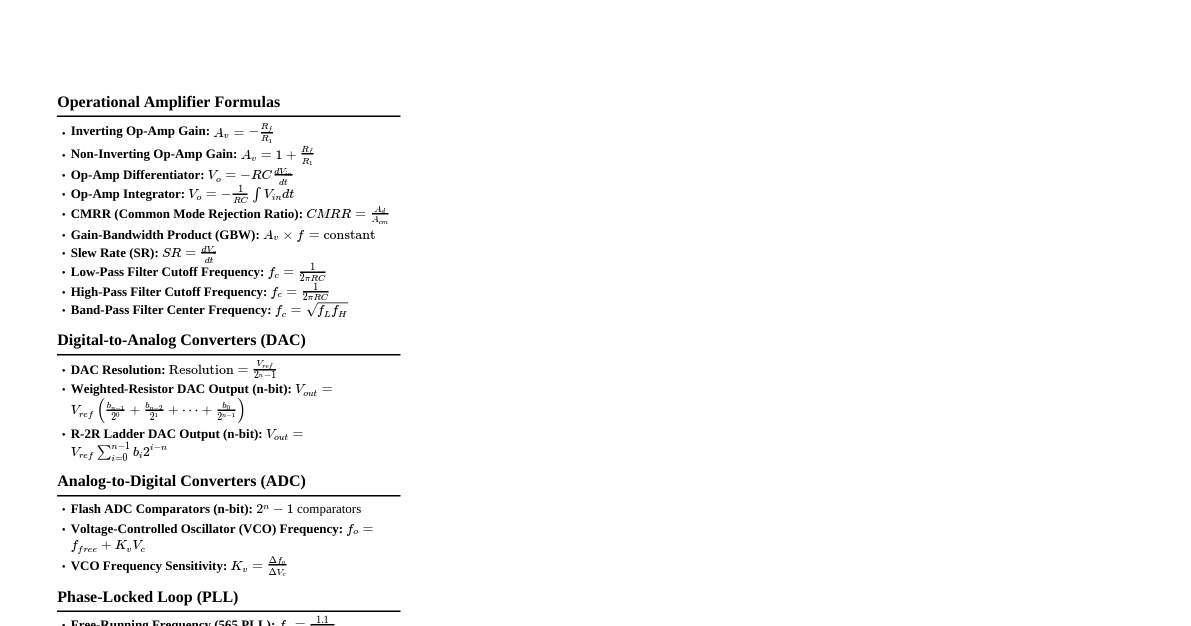
### Basic Components #### Resistor (R) - **Function:** Opposes current flow. - **Ohm's Law:** $V = IR$ - **Power Dissipation:** $P = IV = I^2R = V^2/R$ - **Series:** $R_{eq} = R_1 + R_2 + ...$ - **Parallel:** $1/R_{eq} = 1/R_1 + 1/R_2 + ...$ or $R_{eq} = (R_1 R_2) / (R_1 + R_2)$ (for two) #### Capacitor (C) - **Function:** Stores electric charge. - **Charge:** $Q = CV$ - **Current-Voltage:** $I = C \frac{dV}{dt}$ - **Energy Stored:** $E = \frac{1}{2}CV^2$ - **Series:** $1/C_{eq} = 1/C_1 + 1/C_2 + ...$ - **Parallel:** $C_{eq} = C_1 + C_2 + ...$ - **Reactance ($X_C$):** $X_C = \frac{1}{j\omega C} = \frac{1}{2\pi f C}$ (AC) #### Inductor (L) - **Function:** Stores energy in a magnetic field. - **Voltage-Current:** $V = L \frac{dI}{dt}$ - **Energy Stored:** $E = \frac{1}{2}LI^2$ - **Series:** $L_{eq} = L_1 + L_2 + ...$ - **Parallel:** $1/L_{eq} = 1/L_1 + 1/L_2 + ...$ - **Reactance ($X_L$):** $X_L = j\omega L = 2\pi f L$ (AC) ### DC Analysis #### Kirchhoff's Laws - **Kirchhoff's Current Law (KCL):** Sum of currents entering a node equals sum of currents leaving ($ \sum I_{in} = \sum I_{out} $). - **Kirchhoff's Voltage Law (KVL):** Sum of voltage drops around any closed loop is zero ($ \sum V_{drops} = 0 $). #### Voltage Divider - $V_{out} = V_{in} \frac{R_2}{R_1 + R_2}$ #### Current Divider - $I_{out} = I_{in} \frac{R_1}{R_1 + R_2}$ (through $R_2$) #### Thevenin's Theorem - Any linear circuit can be replaced by an equivalent voltage source ($V_{Th}$) in series with an equivalent resistance ($R_{Th}$). - $V_{Th}$: Open-circuit voltage at the terminals. - $R_{Th}$: Equivalent resistance looking into the terminals with independent sources turned off (voltage sources shorted, current sources opened). #### Norton's Theorem - Any linear circuit can be replaced by an equivalent current source ($I_N$) in parallel with an equivalent resistance ($R_N$). - $I_N$: Short-circuit current at the terminals. - $R_N = R_{Th}$. ### AC Analysis (Sinusoidal Steady State) #### Phasors - Represents sinusoidal voltage/current as complex numbers. - $V(t) = V_m \cos(\omega t + \phi) \leftrightarrow \mathbf{V} = V_m \angle \phi = V_m e^{j\phi}$ - $I(t) = I_m \cos(\omega t + \theta) \leftrightarrow \mathbf{I} = I_m \angle \theta = I_m e^{j\theta}$ #### Impedance (Z) - Generalized resistance for AC circuits. $\mathbf{Z} = R + jX$ - **Resistor:** $\mathbf{Z}_R = R$ - **Capacitor:** $\mathbf{Z}_C = \frac{1}{j\omega C} = -\frac{j}{\omega C}$ - **Inductor:** $\mathbf{Z}_L = j\omega L$ - **Ohm's Law (AC):** $\mathbf{V} = \mathbf{I}\mathbf{Z}$ #### Power in AC Circuits - **Apparent Power (S):** $S = V_{rms} I_{rms}$ (Volt-Amperes, VA) - **Real Power (P):** $P = S \cos\theta$ (Watts, W) ($\theta$ is phase angle between V and I) - **Reactive Power (Q):** $Q = S \sin\theta$ (Volt-Ampere Reactive, VAR) - **Power Factor (PF):** $PF = \cos\theta = P/S$ ### Diodes #### Ideal Diode - **Forward Bias:** Acts as a short circuit (0V drop). - **Reverse Bias:** Acts as an open circuit (no current). #### Real Diode (Silicon) - **Forward Bias:** Requires ~0.7V for conduction (cut-in voltage $V_{DO}$ or $V_F$). - **Reverse Bias:** Acts as an open circuit until breakdown voltage. - **IV Characteristic:** $I_D = I_S (e^{V_D / nV_T} - 1)$ - $I_S$: Reverse saturation current - $n$: Ideality factor (1 to 2) - $V_T$: Thermal voltage ($kT/q \approx 25.8mV$ at $300K$) #### Zener Diode - Designed to operate in reverse breakdown region. - Maintains a constant voltage ($V_Z$) across its terminals when reverse biased above $V_Z$. - Used for voltage regulation. #### Rectifiers - **Half-Wave Rectifier:** Converts AC to pulsating DC. - Output frequency = Input frequency. $V_{DC} \approx V_P / \pi$. - **Full-Wave Rectifier (Bridge):** More efficient, uses 4 diodes. - Output frequency = 2 * Input frequency. $V_{DC} \approx 2V_P / \pi$. - **Filter Capacitor:** Used to smooth the pulsating DC output, creating a ripple voltage. - Ripple Voltage ($V_r$) for full-wave: $V_r \approx \frac{I_{DC}}{2 f C}$ or $\frac{V_P}{2 f R_L C}$ ### Bipolar Junction Transistors (BJTs) #### Types - **NPN:** Emitter (n), Base (p), Collector (n). Current flows from collector to emitter. - **PNP:** Emitter (p), Base (n), Collector (p). Current flows from emitter to collector. #### Operating Regions (NPN) - **Active Region:** Used for amplification. - Base-Emitter (BE) junction forward-biased ($V_{BE} \approx 0.7V$). - Base-Collector (BC) junction reverse-biased. - $I_C = \beta I_B$ - $I_E = I_B + I_C = (\beta + 1) I_B = \frac{\beta+1}{\beta} I_C = \alpha I_E$ - $\alpha = \frac{\beta}{\beta+1}$ - **Saturation Region:** Acts like a closed switch. - Both BE and BC junctions forward-biased. - $V_{CE} \approx 0.2V$ (for NPN). - $I_C ### Field-Effect Transistors (FETs) #### Types - **JFET (Junction FET):** Voltage controlled current source. - **MOSFET (Metal-Oxide-Semiconductor FET):** Most common type, can be Enhancement or Depletion mode. - **n-MOSFET:** Channel created by positive gate voltage. - **p-MOSFET:** Channel created by negative gate voltage. #### n-MOSFET Operating Regions - **Cutoff Region:** $V_{GS} V_{th}$ and $V_{DS} V_{th}$ and $V_{DS} \ge (V_{GS} - V_{th})$. - $I_D = \frac{1}{2} k_n' \frac{W}{L} (V_{GS} - V_{th})^2 (1 + \lambda V_{DS})$ - $k_n' = \mu_n C_{ox}$ (transconductance parameter) - $\lambda$: Channel-length modulation parameter #### Common Source Amplifier - Voltage gain $A_v = -g_m R_D$ - Transconductance $g_m = k_n' \frac{W}{L} (V_{GS} - V_{th})$ or $g_m = \sqrt{2 k_n' \frac{W}{L} I_D}$ ### Operational Amplifiers (Op-Amps) #### Ideal Op-Amp Characteristics - **Infinite Input Impedance:** $I_+ = I_- = 0$ - **Zero Output Impedance:** $R_{out} = 0$ - **Infinite Open-Loop Gain:** $A_{OL} = \infty$ - **Infinite Bandwidth:** No frequency limitations. - **Zero Input Offset Voltage:** $V_+-V_-=0$ (when feedback is applied) #### Golden Rules (with negative feedback) 1. The voltage difference between the inverting and non-inverting inputs is zero: $V_+ = V_-$ 2. No current flows into or out of the input terminals: $I_+ = I_- = 0$ #### Basic Configurations - **Inverting Amplifier:** - $V_{out} = -\frac{R_f}{R_{in}} V_{in}$ - Input Impedance $R_{in}$ - **Non-Inverting Amplifier:** - $V_{out} = (1 + \frac{R_f}{R_1}) V_{in}$ - Input Impedance is very high (ideally infinite) - **Voltage Follower (Buffer):** - $R_f = 0$, $R_1 = \infty$ (or open circuit) - $V_{out} = V_{in}$ - Provides high input impedance and low output impedance, without gain. - **Summing Amplifier:** - $V_{out} = -R_f (\frac{V_1}{R_1} + \frac{V_2}{R_2} + ...)$ - **Difference Amplifier:** - $V_{out} = \frac{R_4}{R_3} (\frac{R_1+R_2}{R_1+R_4}) V_2 - \frac{R_2}{R_1} V_1$ - If $R_1=R_3$ and $R_2=R_4$, then $V_{out} = \frac{R_2}{R_1} (V_2 - V_1)$ - **Integrator:** - $V_{out} = -\frac{1}{R C} \int V_{in} dt$ - **Differentiator:** - $V_{out} = -R C \frac{dV_{in}}{dt}$ ### Filters #### Types - **Low-Pass Filter (LPF):** Passes low frequencies, attenuates high frequencies. - **High-Pass Filter (HPF):** Passes high frequencies, attenuates low frequencies. - **Band-Pass Filter (BPF):** Passes a specific range of frequencies. - **Band-Stop Filter (BSF) / Notch Filter:** Attenuates a specific range of frequencies. #### RC Low-Pass Filter - **Transfer Function:** $H(j\omega) = \frac{1}{1 + j\omega RC}$ - **Cutoff Frequency ($f_c$):** $f_c = \frac{1}{2\pi RC}$ (where $|H(j\omega)| = \frac{1}{\sqrt{2}} \approx 0.707$) #### RC High-Pass Filter - **Transfer Function:** $H(j\omega) = \frac{j\omega RC}{1 + j\omega RC}$ - **Cutoff Frequency ($f_c$):** $f_c = \frac{1}{2\pi RC}$ ### Oscillators #### Conditions for Oscillation (Barkhausen Criteria) 1. **Loop Gain Magnitude:** The magnitude of the loop gain ($|A\beta|$) must be equal to or greater than 1. 2. **Loop Gain Phase:** The total phase shift around the loop must be $0^\circ$ or $360^\circ$ (or integer multiples of $2\pi$). #### Types - **RC Phase-Shift Oscillator:** Uses three RC sections for $180^\circ$ phase shift. - **Wein Bridge Oscillator:** Uses an RC lead-lag network. - **Colpitts Oscillator:** Uses a tapped capacitor in a tank circuit. - **Hartley Oscillator:** Uses a tapped inductor in a tank circuit.