Atomic Structure IIT JEE
Cheatsheet Content
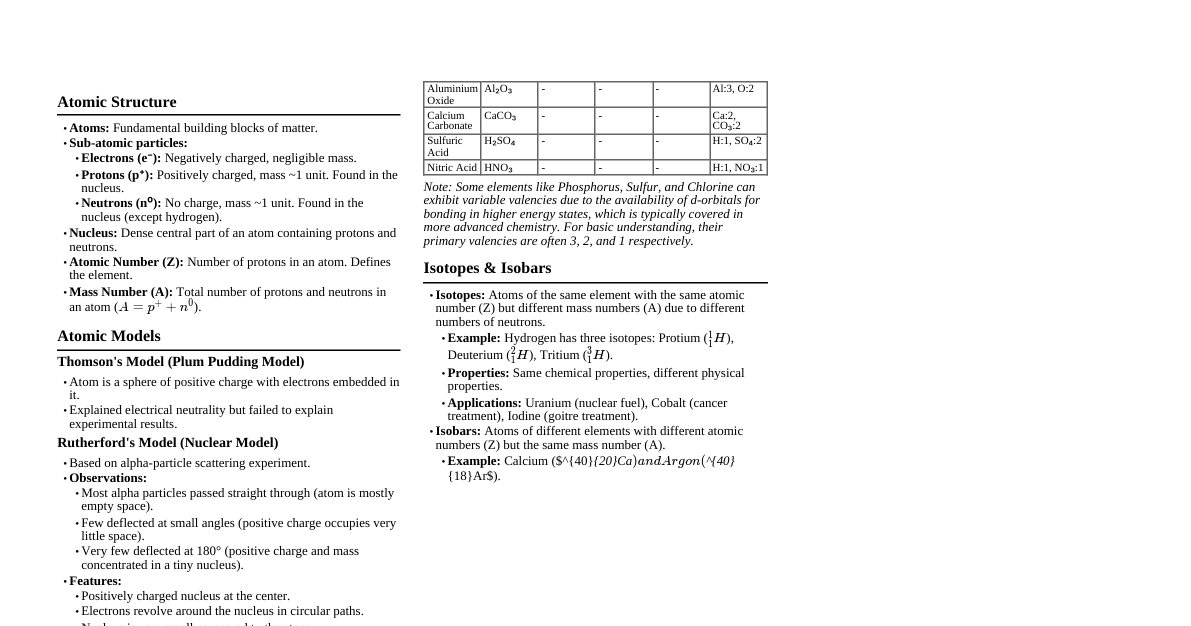
### History & Atomic Models - **Dalton's Atomic Theory (1808):** 1. Matter consists of indivisible atoms. 2. Atoms of same element are identical in mass & properties. 3. Atoms of different elements differ in mass & properties. 4. Atoms combine in simple whole-number ratios to form compounds. 5. Atoms are neither created nor destroyed in chemical reactions. - **Limitations:** Failed to explain subatomic particles, isotopes, isobars. - **Thomson's Plum Pudding Model (1898):** - Atom is a uniform sphere of positive charge with electrons embedded in it. - **Limitations:** Failed to explain Rutherford's $\alpha$-scattering experiment. - **Rutherford's Nuclear Model (1911):** - Based on $\alpha$-scattering experiment (gold foil experiment). - **Observations:** 1. Most $\alpha$-particles passed undeflected $\implies$ most of atom is empty space. 2. Few $\alpha$-particles deflected at small angles $\implies$ there's a positively charged core. 3. Very few $\alpha$-particles deflected at large angles or bounced back $\implies$ positive charge and mass concentrated in a very small region (nucleus). - **Postulates:** 1. Atom has a tiny, dense, positively charged nucleus at its center. 2. Electrons revolve around the nucleus in circular paths. 3. Centripetal force for electron's revolution is provided by electrostatic attraction between nucleus and electron. 4. Atom is electrically neutral. - **Limitations:** 1. **Stability of Atom (Maxwell's theory):** Accelerating electron should continuously radiate energy and spiral into the nucleus, making atom unstable. 2. **Line Spectrum:** Could not explain the line spectrum of elements, only continuous spectrum was predicted. ### Electromagnetic Radiation - **Wave Nature of Light:** - Light propagates as electromagnetic waves. - **Properties:** - **Wavelength ($\lambda$):** Distance between two consecutive crests or troughs. Unit: m, cm, nm, Å. - **Frequency ($\nu$):** Number of waves passing a point per second. Unit: Hz or s⁻¹. - **Velocity (c):** Speed of light in vacuum ($3 \times 10^8$ m/s). - **Relationship:** $c = \nu \lambda$. - **Wave Number ($\bar{\nu}$):** Number of waves per unit length. $\bar{\nu} = 1/\lambda = \nu/c$. Unit: m⁻¹, cm⁻¹. - **Amplitude (A):** Height of the crest or depth of the trough. Determines intensity. - **Particle Nature of Light (Planck's Quantum Theory):** - Energy is emitted or absorbed in discrete packets called quanta (photons for light). - Energy of a quantum: $E = h\nu = hc/\lambda$. - $h$ = Planck's constant ($6.626 \times 10^{-34}$ J s). - **Photoelectric Effect:** Emission of electrons from a metal surface when light of suitable frequency falls on it. - **Threshold Frequency ($\nu_0$):** Minimum frequency required to eject an electron. - **Work Function ($\phi_0$):** Minimum energy required to eject an electron. $\phi_0 = h\nu_0$. - **Kinetic Energy of ejected electron:** $KE = h\nu - h\nu_0$. - Number of electrons ejected depends on intensity of light. - KE of ejected electrons depends on frequency of light. ### Bohr's Model for Hydrogen Atom - **Postulates:** 1. Electrons revolve around the nucleus in fixed circular orbits (stationary states) without radiating energy. 2. Energy of an electron in an orbit is constant. 3. Electrons can jump from one stationary state to another by absorbing or emitting energy. - Absorption: Electron jumps to a higher energy orbit. - Emission: Electron drops to a lower energy orbit. - $\Delta E = E_2 - E_1 = h\nu$. 4. Angular momentum of an electron in a given orbit is quantized: $mvr = n(h/2\pi)$, where $n$ is an integer (principal quantum number). - **Key Derivations for H-like species (Z is atomic number):** - **Radius of n-th orbit ($r_n$):** $r_n = 0.529 \frac{n^2}{Z}$ Å - **Energy of n-th orbit ($E_n$):** $E_n = -13.6 \frac{Z^2}{n^2}$ eV/atom or $-2.18 \times 10^{-18} \frac{Z^2}{n^2}$ J/atom - **Velocity of electron in n-th orbit ($v_n$):** $v_n = 2.18 \times 10^6 \frac{Z}{n}$ m/s - **Frequency of revolution ($f_n$):** $f_n = \frac{v_n}{2\pi r_n} \propto \frac{Z^2}{n^3}$ - **Limitations of Bohr's Model:** 1. Applicable only to single-electron species (H, He⁺, Li²⁺, etc.). 2. Failed to explain the fine structure of spectral lines (splitting of lines in magnetic field - Zeeman effect, and electric field - Stark effect). 3. Could not explain the ability of atoms to form molecules (chemical bonding). 4. Did not consider the wave nature of electrons (de Broglie hypothesis). 5. Violated Heisenberg's Uncertainty Principle. ### Atomic Spectrum of Hydrogen - When an electron jumps from a higher energy level ($n_2$) to a lower energy level ($n_1$), a photon is emitted. - **Energy of emitted photon:** $\Delta E = E_{n_2} - E_{n_1} = 13.6 Z^2 \left(\frac{1}{n_1^2} - \frac{1}{n_2^2}\right)$ eV - **Wavelength/Wave number of spectral line:** - $\frac{1}{\lambda} = \bar{\nu} = R_H Z^2 \left(\frac{1}{n_1^2} - \frac{1}{n_2^2}\right)$ - $R_H$ = Rydberg constant = $1.09677 \times 10^7$ m⁻¹ or $1.097 \times 10^5$ cm⁻¹. - **Spectral Series:** 1. **Lyman Series:** $n_1 = 1$, $n_2 = 2, 3, 4, ...$ (Ultraviolet region) - First line: $n_2=2 \to n_1=1$ - Last line (series limit): $n_2=\infty \to n_1=1$ 2. **Balmer Series:** $n_1 = 2$, $n_2 = 3, 4, 5, ...$ (Visible region) 3. **Paschen Series:** $n_1 = 3$, $n_2 = 4, 5, 6, ...$ (Infrared region) 4. **Brackett Series:** $n_1 = 4$, $n_2 = 5, 6, 7, ...$ (Infrared region) 5. **Pfund Series:** $n_1 = 5$, $n_2 = 6, 7, 8, ...$ (Infrared region) - **Ionisation Energy (IE):** Energy required to remove an electron from the ground state ($n=1$) to infinity ($n=\infty$). - $IE = E_{\infty} - E_1 = 0 - (-13.6 Z^2/1^2) = 13.6 Z^2$ eV/atom. - **Number of spectral lines emitted:** - When an electron drops from $n_2$ to $n_1$ (single atom): $n_2 - n_1$. - When an electron drops from $n_2$ to $n_1$ (sample of atoms): $\frac{(n_2 - n_1)(n_2 - n_1 + 1)}{2}$ - For drop from $n$ to ground state ($n_1=1$): $\frac{n(n-1)}{2}$ ### Dual Nature of Matter & Heisenberg's Uncertainty Principle - **de Broglie Hypothesis (1924):** - All material particles (like electrons, protons, atoms) possess dual nature (wave and particle). - **de Broglie Wavelength ($\lambda$):** $\lambda = \frac{h}{mv} = \frac{h}{p}$ - $m$ = mass of particle, $v$ = velocity, $p$ = momentum. - For an electron accelerated through a potential difference $V$: - $KE = eV = \frac{1}{2}mv^2 \implies v = \sqrt{\frac{2eV}{m}}$ - $\lambda = \frac{h}{\sqrt{2meV}} = \frac{12.27}{\sqrt{V}}$ Å (for electron) - **Significance:** Explained Bohr's quantization condition. For a stable orbit, circumference must be an integral multiple of de Broglie wavelength: $2\pi r = n\lambda$. - **Heisenberg's Uncertainty Principle (1927):** - It is impossible to determine simultaneously, with perfect accuracy, both the position and momentum of a subatomic particle. - Mathematically: $\Delta x \cdot \Delta p \ge \frac{h}{4\pi}$ or $\Delta x \cdot m\Delta v \ge \frac{h}{4\pi}$ - Also, for energy and time: $\Delta E \cdot \Delta t \ge \frac{h}{4\pi}$ - **Implication:** The concept of definite orbits (as in Bohr's model) is not valid for microscopic particles. ### Quantum Mechanical Model of Atom - Based on the dual nature of matter and Heisenberg's uncertainty principle. - Describes electrons as waves in 3D space. - **Schrödinger Wave Equation:** - $\hat{H}\psi = E\psi$ - $\hat{H}$ = Hamiltonian operator (total energy operator). - $\psi$ = Wave function (amplitude function), describes the probability of finding an electron at a point. - $\psi^2$ = Probability density, represents the probability of finding an electron in a given region. - **Significance:** Solves for allowed energy states and corresponding wave functions. - **Atomic Orbitals:** - A three-dimensional space around the nucleus where the probability of finding an electron is maximum (typically 90-95%). - Defined by quantum numbers. - **Nodes:** Regions where the probability of finding an electron is zero ($\psi^2 = 0$). - **Radial Nodes (Spherical Nodes):** $(n - l - 1)$ - **Angular Nodes (Nodal Planes):** $l$ - **Total Nodes:** $(n - 1)$ ### Quantum Numbers - Set of four numbers that completely describe the state of an electron in an atom. - **1. Principal Quantum Number (n):** - Determines the main energy level (shell) and size of the orbital. - $n = 1, 2, 3, ...$ (K, L, M, ... shells) - Higher $n$ means larger size and higher energy. - Max electrons in a shell = $2n^2$. - **2. Azimuthal/Angular Momentum Quantum Number (l):** - Determines the shape of the orbital (subshell) and angular momentum. - $l = 0, 1, 2, ..., (n-1)$ - $l=0 \implies s$ orbital (spherical) - $l=1 \implies p$ orbital (dumbbell) - $l=2 \implies d$ orbital (double dumbbell/cloverleaf) - $l=3 \implies f$ orbital (complex) - Number of subshells in a shell = $n$. - Max electrons in a subshell = $2(2l+1)$. - **3. Magnetic Quantum Number ($m_l$):** - Determines the orientation of the orbital in space. - $m_l = -l, ..., 0, ..., +l$ - Number of orbitals in a subshell = $(2l+1)$. - For $l=0 (s)$, $m_l=0$ (1 orbital) - For $l=1 (p)$, $m_l=-1, 0, +1$ (3 orbitals: $p_x, p_y, p_z$) - For $l=2 (d)$, $m_l=-2, -1, 0, +1, +2$ (5 orbitals: $d_{xy}, d_{yz}, d_{zx}, d_{x^2-y^2}, d_{z^2}$) - **4. Spin Quantum Number ($m_s$):** - Describes the intrinsic angular momentum (spin) of the electron. - $m_s = +1/2$ (spin up) or $-1/2$ (spin down). - An orbital can hold a maximum of two electrons with opposite spins. ### Shapes of Atomic Orbitals - **s-orbital ($l=0$):** - Spherical and symmetrical. - Probability density is highest at the nucleus and decreases with increasing distance. - Contains $(n-1)$ radial nodes. - Example: 1s, 2s, 3s. 2s has one radial node, 3s has two. - **p-orbital ($l=1$):** - Dumbbell shaped. - Three degenerate orbitals: $p_x, p_y, p_z$, oriented along respective axes. - Each p-orbital has one angular node (a plane passing through the nucleus where electron probability is zero). - Contains $(n-2)$ radial nodes. - **d-orbital ($l=2$):** - Five degenerate orbitals. - Shapes: $d_{xy}, d_{yz}, d_{zx}$ (cloverleaf shape, lobes between axes) - $d_{x^2-y^2}$ (cloverleaf shape, lobes along axes) - $d_{z^2}$ (dumbbell along z-axis with a donut-shaped ring in xy-plane). - Each d-orbital has two angular nodes. - Contains $(n-3)$ radial nodes. - **f-orbital ($l=3$):** - Seven degenerate orbitals. - Complex shapes. - Each f-orbital has three angular nodes. - Contains $(n-4)$ radial nodes. ### Rules for Filling Orbitals - **Aufbau Principle:** - Electrons fill orbitals in increasing order of their energy. - **(n+l) Rule:** Orbitals with lower $(n+l)$ values are filled first. If $(n+l)$ is same, the orbital with lower $n$ is filled first. - Order: 1s, 2s, 2p, 3s, 3p, 4s, 3d, 4p, 5s, 4d, 5p, 6s, 4f, 5d, 6p, 7s, 5f, 6d, 7p... - **Pauli's Exclusion Principle:** - No two electrons in an atom can have all four quantum numbers identical. - An orbital can hold a maximum of two electrons, and these must have opposite spins. - **Hund's Rule of Maximum Multiplicity:** - For degenerate orbitals (orbitals of same energy, e.g., p, d, f orbitals), electron pairing does not occur until all available orbitals of a given subshell are singly occupied with parallel spins. - This maximizes the total spin and stability. ### Electronic Configuration - Arrangement of electrons in the orbitals of an atom. - **Notation:** $n l^x$ (n = principal quantum number, l = subshell, x = number of electrons) - Example: $1s^2 2s^2 2p^6$ (for Neon) - **Exceptional Configurations (due to extra stability of half-filled and completely filled orbitals):** - **Chromium (Cr, Z=24):** $[Ar] 3d^5 4s^1$ (Expected: $[Ar] 3d^4 4s^2$) - **Copper (Cu, Z=29):** $[Ar] 3d^{10} 4s^1$ (Expected: $[Ar] 3d^9 4s^2$) - Other exceptions: Mo, Ag, Au (similar pattern) - **Stability of Half-filled and Fully-filled Orbitals:** 1. **Symmetry:** Symmetrical distribution of electrons leads to more stability. Half-filled and fully-filled configurations are highly symmetrical. 2. **Exchange Energy:** When electrons with the same spin are present in degenerate orbitals, they can exchange their positions. The energy released during this exchange is called exchange energy. More exchange pairs $\implies$ more exchange energy $\implies$ more stability. - For $d^5$ (half-filled), there are $5C_2 = 10$ possible exchanges. - For $d^{10}$ (fully-filled), there are $10C_2 = 45$ possible exchanges. ### Isoelectronic Species - Atoms or ions having the same number of electrons. - Examples: N³⁻, O²⁻, F⁻, Ne, Na⁺, Mg²⁺, Al³⁺ all have 10 electrons. - **Ionic Radii:** For isoelectronic species, ionic radius decreases with increasing nuclear charge (Z). - N³⁻ > O²⁻ > F⁻ > Ne > Na⁺ > Mg²⁺ > Al³⁺