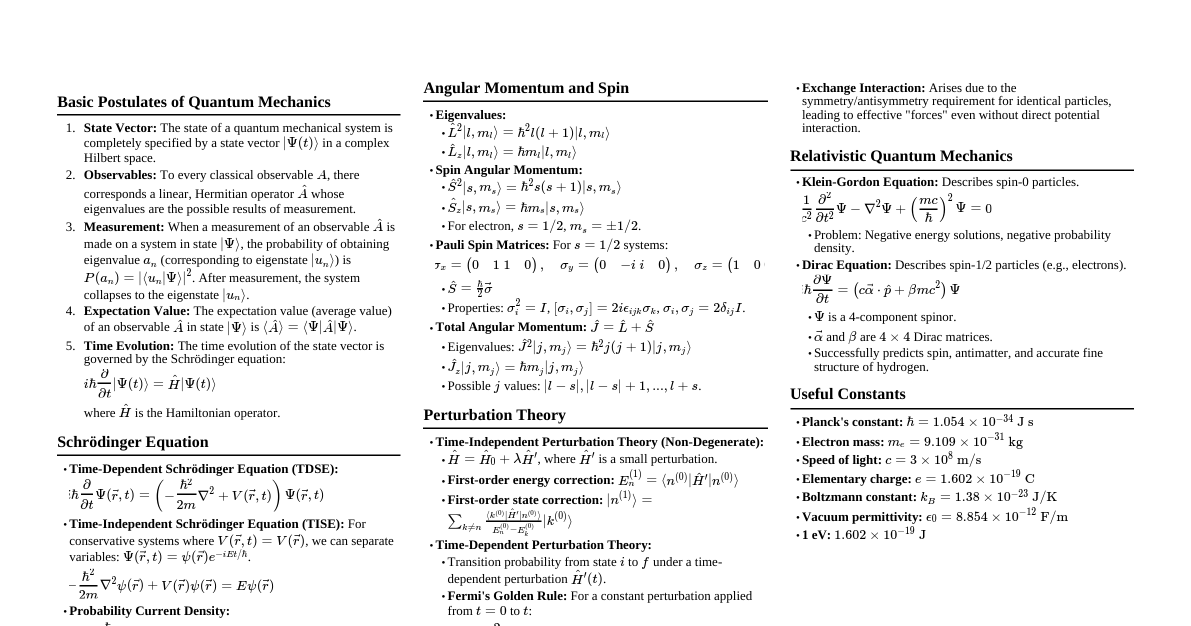
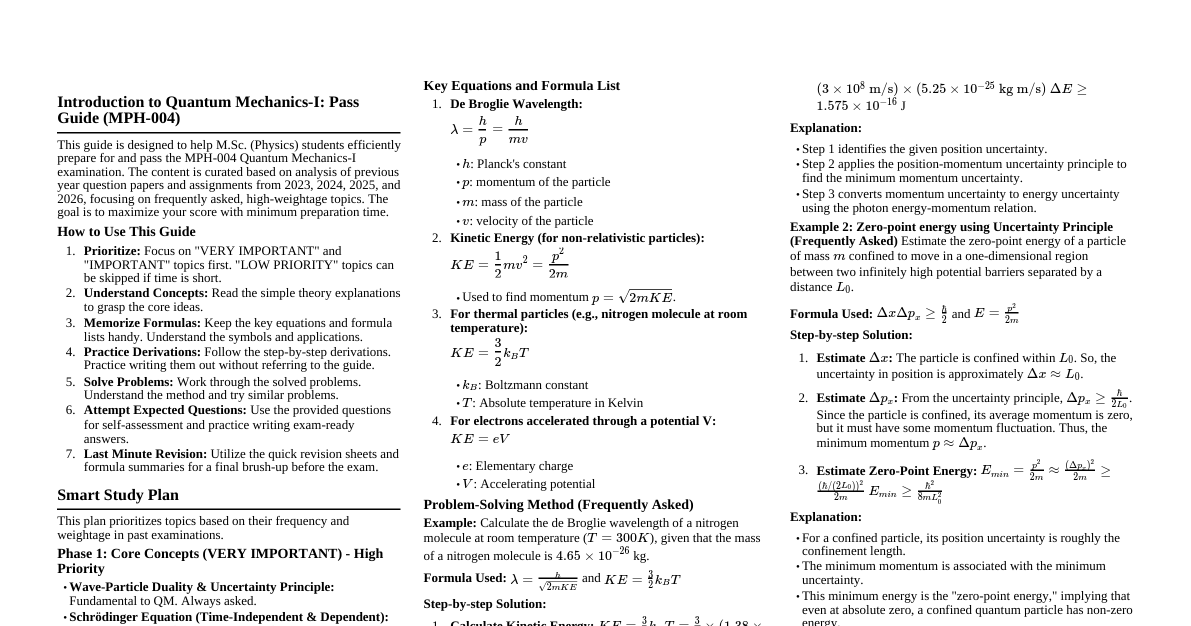
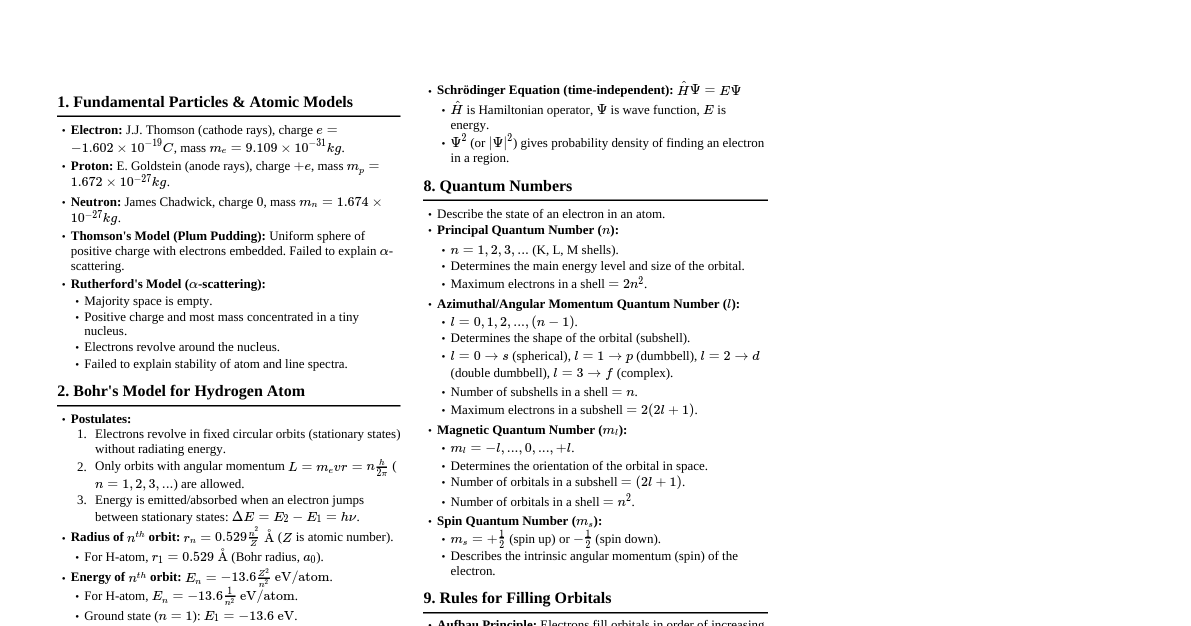
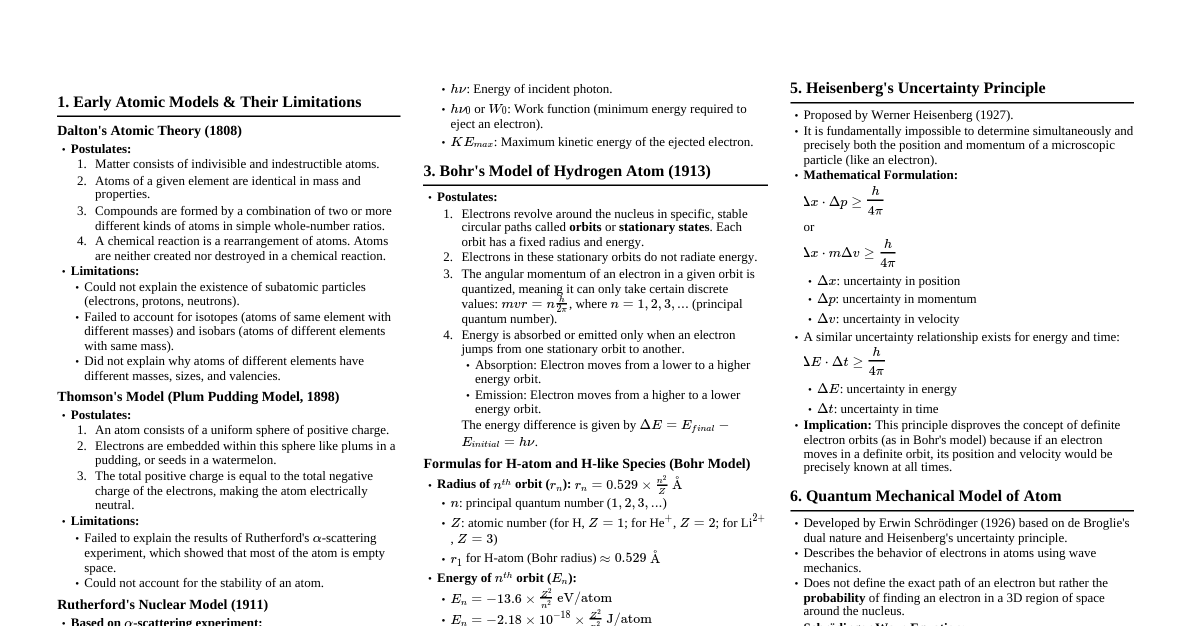
Atomic Structure & Quantum Mechanics
Cheatsheet Content
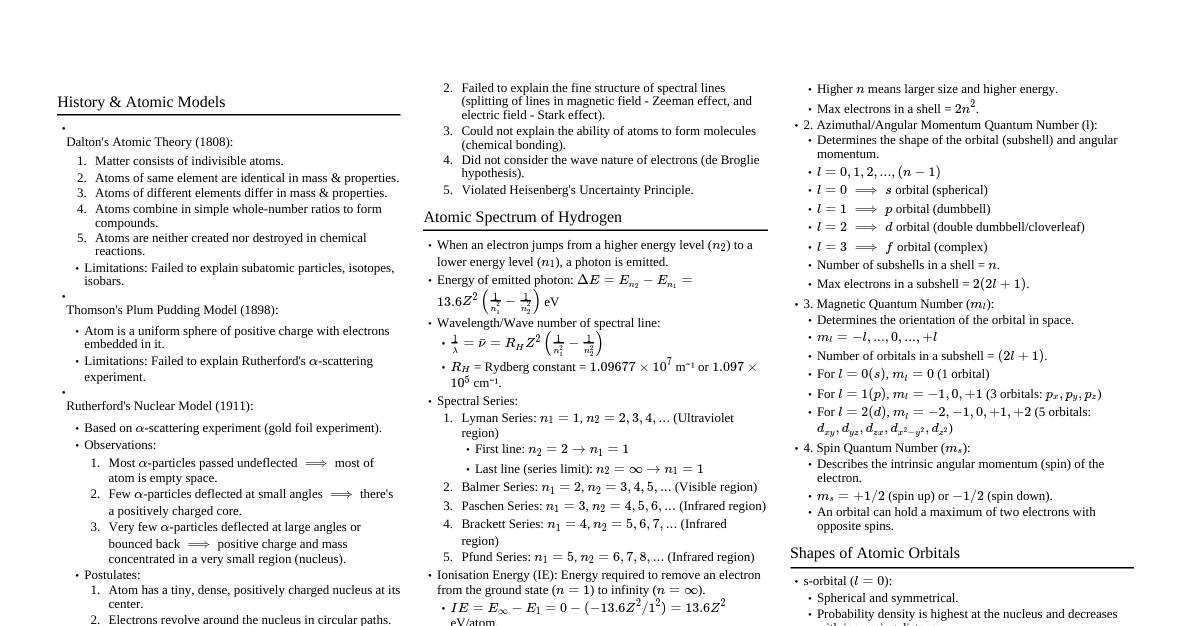
1. The Atom: A Tiny Solar System (and its flaws) Analogy: Imagine an atom as a tiny solar system. The nucleus is like the Sun, massive and at the center. Electrons are like planets orbiting the Sun. This analogy is good for visualizing basic structure but breaks down when we talk about electron behavior. Nucleus: Contains protons (positive charge, mass $\approx 1 \text{ amu}$) and neutrons (no charge, mass $\approx 1 \text{ amu}$). Electrons: Orbit the nucleus, negative charge, almost no mass ($\approx 1/1836 \text{ amu}$). Atomic Number (Z): Number of protons. Defines the element. Mass Number (A): Number of protons + neutrons. Isotopes: Atoms of the same element (same Z) but different number of neutrons (different A). 2. Early Atomic Models: From Billiard Balls to Planetary Orbits 2.1. Dalton's Atomic Theory (Early 1800s) Analogy: Atoms are like unchangeable, indestructible billiard balls. Each element has unique billiard balls. Elements are made of indivisible atoms. Atoms of a given element are identical in mass and properties. Atoms combine in simple whole-number ratios to form compounds. Atoms are rearranged in chemical reactions. 2.2. Thomson's Plum Pudding Model (1897) Analogy: Imagine a plum pudding or a chocolate chip cookie. The pudding/cookie dough is a positively charged sphere, and the "plums" or "chocolate chips" are negatively charged electrons embedded within it. + + + + + + e- + e- + + + + + + + e- + e- + + + + + + Discovered electrons using cathode ray tubes. Proposed a uniform sphere of positive charge with electrons embedded. 2.3. Rutherford's Nuclear Model (1911) Analogy: The atom is mostly empty space, like a vast stadium. The nucleus is like a tiny marble in the center of the stadium, and electrons are like dust motes flying around the stadium's perimeter. Gold Foil Experiment: Alpha particles fired at a thin gold foil. Most passed straight through (empty space). Some deflected slightly (interaction with positive charge). A few bounced back (hit a dense, positive nucleus). Proposed a dense, positively charged nucleus at the center, with electrons orbiting in a large empty space. Problem: Classical physics predicted orbiting electrons would lose energy and spiral into the nucleus. 3. Bohr Model: Quantized Orbits (1913) Analogy: Electrons are like cars on a multi-lane highway. They can only drive in specific lanes (energy levels), not in between. To change lanes, they must jump instantly, absorbing or emitting exact amounts of energy (toll payments/receipts). e- (n=3) ---- Energy Levels (shells) / \ / \ e- (n=2) ----- | | | | e- (n=1) ------ \ / O (Nucleus) Electrons orbit the nucleus in specific, stable energy levels (shells) without radiating energy. Each orbit has a fixed energy (quantized energy). Electrons can jump between energy levels by absorbing or emitting a photon of specific energy. Absorption: Electron moves to higher energy level (excited state). Emission: Electron moves to lower energy level (ground state), releasing a photon. Energy of emitted/absorbed photon: $E = h\nu = hc/\lambda$ Successfully explained the line spectra of hydrogen. Limitations: Only works for hydrogen and hydrogen-like ions; doesn't explain multi-electron atoms or spectral line intensities. 4. Quantum Mechanical Model: Electron Clouds (Modern View) Analogy: Instead of planets, electrons are like buzzing bees around a hive (the nucleus). You can't pinpoint a bee's exact position, but you know it's *somewhere* within the cloud around the hive. The denser parts of the cloud indicate where the bee is *most likely* to be found. Replaced discrete orbits with probability distributions (orbitals). Based on wave-particle duality and Heisenberg's Uncertainty Principle. 4.1. Wave-Particle Duality Analogy: Light and matter are like a coin that can show "heads" (wave) or "tails" (particle) depending on how you look at it. It's both, but you only observe one aspect at a time. Light: Behaves as both a wave (diffraction, interference) and a particle (photons, photoelectric effect). Matter (de Broglie Wavelength): Particles like electrons also exhibit wave-like properties. $\lambda = h/p = h/(mv)$ where $h$ is Planck's constant, $p$ is momentum, $m$ is mass, $v$ is velocity. 4.2. Heisenberg's Uncertainty Principle Analogy: Trying to precisely measure both the position and momentum of an electron is like trying to catch a greased watermelon while also measuring its speed. The act of measuring one inevitably disturbs the other. You can know one accurately, but not both simultaneously. It's impossible to precisely know both the position ($x$) and momentum ($p$) of a particle simultaneously. $\Delta x \cdot \Delta p \ge \hbar/2$ (where $\hbar = h/(2\pi)$) This principle means we cannot plot an exact orbit for an electron. 4.3. Schrödinger Equation Analogy: This is the "rulebook" for the electron bee. Solving it gives you the probability cloud (orbital) where the electron is likely to be found and its allowed energies. Mathematical equation that describes the wave function ($\Psi$) of a particle. $H\Psi = E\Psi$ (time-independent Schrödinger equation) The square of the wave function, $|\Psi|^2$, gives the probability density of finding an electron in a particular region of space. 5. Quantum Numbers: Electron's Address Analogy: Quantum numbers are like an electron's mailing address, specifying its state and location within the atom. Principal Quantum Number (n): The street address (main energy level/shell). Angular Momentum Quantum Number (l): The neighborhood (subshell/orbital shape). Magnetic Quantum Number (m_l): The house number (orientation of orbital in space). Spin Quantum Number (m_s): The resident's unique characteristic (electron spin). 5.1. Principal Quantum Number ($n$) Values: $1, 2, 3, \dots$ (positive integers). Determines the main energy level and average distance of the electron from the nucleus. Larger $n$ means higher energy and larger orbital. Corresponds to Bohr's shells (K, L, M...). 5.2. Angular Momentum (Azimuthal) Quantum Number ($l$) Values: $0, 1, 2, \dots, n-1$. Determines the shape of the orbital (subshell). $l=0 \implies s$ orbital (spherical) $l=1 \implies p$ orbital (dumbbell-shaped) $l=2 \implies d$ orbital (more complex, cloverleaf) $l=3 \implies f$ orbital (even more complex) s orbital (l=0) p orbital (l=1) O o---o (spherical) (dumbbell) 5.3. Magnetic Quantum Number ($m_l$) Values: $-l, \dots, 0, \dots, +l$. Determines the orientation of the orbital in space. For $l=0$ (s orbital), $m_l=0$ (1 orientation). For $l=1$ (p orbital), $m_l = -1, 0, +1$ (3 orientations: $p_x, p_y, p_z$). For $l=2$ (d orbital), $m_l = -2, -1, 0, +1, +2$ (5 orientations). 5.4. Spin Quantum Number ($m_s$) Values: $+1/2$ or $-1/2$. Describes the intrinsic angular momentum of an electron, often visualized as spin. Electrons in the same orbital must have opposite spins (Pauli Exclusion Principle). 6. Electron Configurations: Filling the Orbitals Analogy: Filling electron orbitals is like assigning seats in a theater. Aufbau Principle: Fill the cheapest seats (lowest energy orbitals) first. Pauli Exclusion Principle: Only two people (electrons) per seat (orbital), and they must face opposite directions (opposite spins). Hund's Rule: When there are multiple empty seats in the same row (degenerate orbitals), people will first spread out to occupy separate seats before pairing up. 6.1. Aufbau Principle Electrons fill atomic orbitals of the lowest available energy levels before occupying higher ones. Energy order: $1s < 2s < 2p < 3s < 3p < 4s < 3d < 4p < 5s < 4d \dots$ Mnemonic: "Diagonal Rule" or "Madelung Rule". 6.2. Pauli Exclusion Principle No two electrons in an atom can have the same set of four quantum numbers ($n, l, m_l, m_s$). An atomic orbital can hold a maximum of two electrons, and these two electrons must have opposite spins. 6.3. Hund's Rule of Maximum Multiplicity When orbitals of equal energy (degenerate orbitals, e.g., $2p_x, 2p_y, 2p_z$) are being filled, electrons occupy each orbital singly with parallel spins before any orbital is doubly occupied. This minimizes electron-electron repulsion. Example for Carbon ($1s^2 2s^2 2p^2$): 2p: ↑ ↑ _ 2s: ↑↓ 1s: ↑↓ 7. Periodic Trends Explained by Electron Configuration Analogy: The periodic table is like an apartment building, and the trends are how the residents (elements) behave based on their apartment (electron configuration) and floor (period) or stack (group). 7.1. Atomic Radius Across a period (left to right): Decreases. Analogy: As you add more people to the same floor (period), the landlord (nucleus) pulls them tighter because there are more positive charges in the nucleus, but the "floor" (number of shells) remains the same. Increased nuclear charge pulls valence electrons closer. Down a group (top to bottom): Increases. Analogy: As you move to higher floors (periods), you're adding more shells, making the apartment much larger, even if the nucleus is stronger. New electron shells are added, increasing the distance from the nucleus. 7.2. Ionization Energy (IE) Energy required to remove an electron from a gaseous atom. Across a period: Increases. Analogy: The landlord (nucleus) gets stronger across the floor, making it harder to pull a resident (electron) out of their apartment. Increased nuclear charge, smaller atomic radius, electrons held more tightly. Down a group: Decreases. Analogy: Residents on higher floors (more shells) are further from the landlord's (nucleus's) reach, making them easier to evict. The inner residents also "shield" the outer ones. Increased atomic radius, more shielding by inner electrons, outer electrons are less attracted to the nucleus. 7.3. Electron Affinity (EA) Energy change when an electron is added to a gaseous atom. Across a period: Generally increases (becomes more negative/exothermic). Analogy: Stronger landlord (nucleus) on the right side of the floor means they are more eager to attract new residents (electrons). Increased nuclear charge, smaller size, stronger attraction for an incoming electron. Down a group: Generally decreases (becomes less negative/exothermic). Analogy: On higher floors, the apartments are larger, and the outer residents are shielded, so it's less attractive for a new resident to move in. Increased atomic radius, more shielding, weaker attraction for an incoming electron. 7.4. Electronegativity Ability of an atom in a molecule to attract shared electrons. Across a period: Increases. Analogy: The stronger landlord (nucleus) on the right side of the floor is better at pulling shared resources (electrons in a bond) towards their apartment. Increased nuclear charge, smaller atomic radius. Down a group: Decreases. Analogy: Residents on higher floors are further from the landlord's (nucleus's) influence, making them less effective at pulling shared resources. Increased atomic radius, increased shielding. Fluorine (F) is the most electronegative element. 8. Light and Energy: Photons and Spectra Analogy: Light is like a stream of tiny energy packets (photons), each with a specific color (wavelength/frequency) and amount of energy. When an electron jumps between energy levels, it's like a person dropping a specific coin (photon) when they move down a step, or picking up a specific coin when they move up. Planck's Equation: $E = h\nu = hc/\lambda$ $E$: energy of a photon $h$: Planck's constant ($6.626 \times 10^{-34} \text{ J} \cdot \text{s}$) $\nu$: frequency of light (Hz or $s^{-1}$) $c$: speed of light ($3.00 \times 10^8 \text{ m/s}$) $\lambda$: wavelength of light (m) Atomic Spectra: Emission Spectrum: When excited electrons fall to lower energy levels, they emit photons of specific wavelengths, creating bright lines on a dark background. Unique for each element (fingerprint). Absorption Spectrum: When broad-spectrum light passes through a gas, electrons absorb photons of specific wavelengths to jump to higher energy levels, creating dark lines on a continuous spectrum. 9. Key Concepts Summary Quantization: Energy, angular momentum, etc., exist only in discrete packets (quanta), not continuous values. (Like a staircase vs. a ramp). Orbitals vs. Orbits: Orbits are defined paths (Bohr); orbitals are probability regions (Quantum Mechanical). Degenerate Orbitals: Orbitals within the same subshell (e.g., $2p_x, 2p_y, 2p_z$) that have the same energy. Valence Electrons: Electrons in the outermost principal energy level ($n$). These are involved in chemical bonding. Core Electrons: Inner electrons that are not involved in bonding. Shielding Effect: Inner electrons repel outer electrons, reducing the effective nuclear charge felt by the outer electrons. Effective Nuclear Charge ($Z_{eff}$): The net positive charge experienced by an electron in a multi-electron atom. $Z_{eff} = Z - S$ (where $S$ is the shielding constant).