Real Analysis: Sequences
Cheatsheet Content
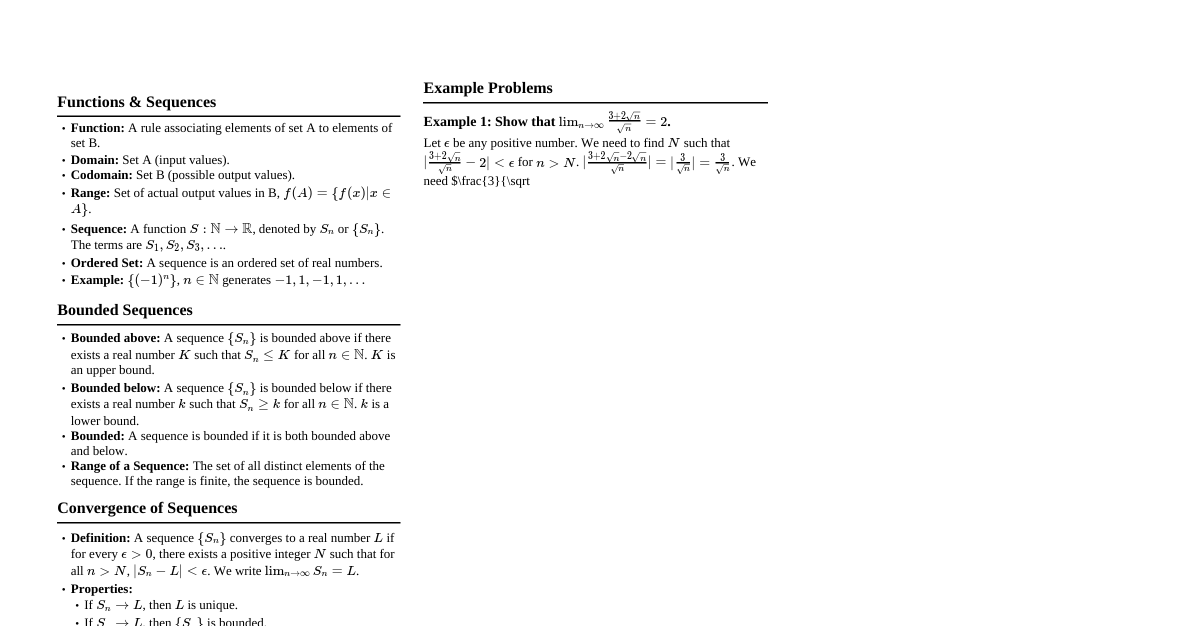
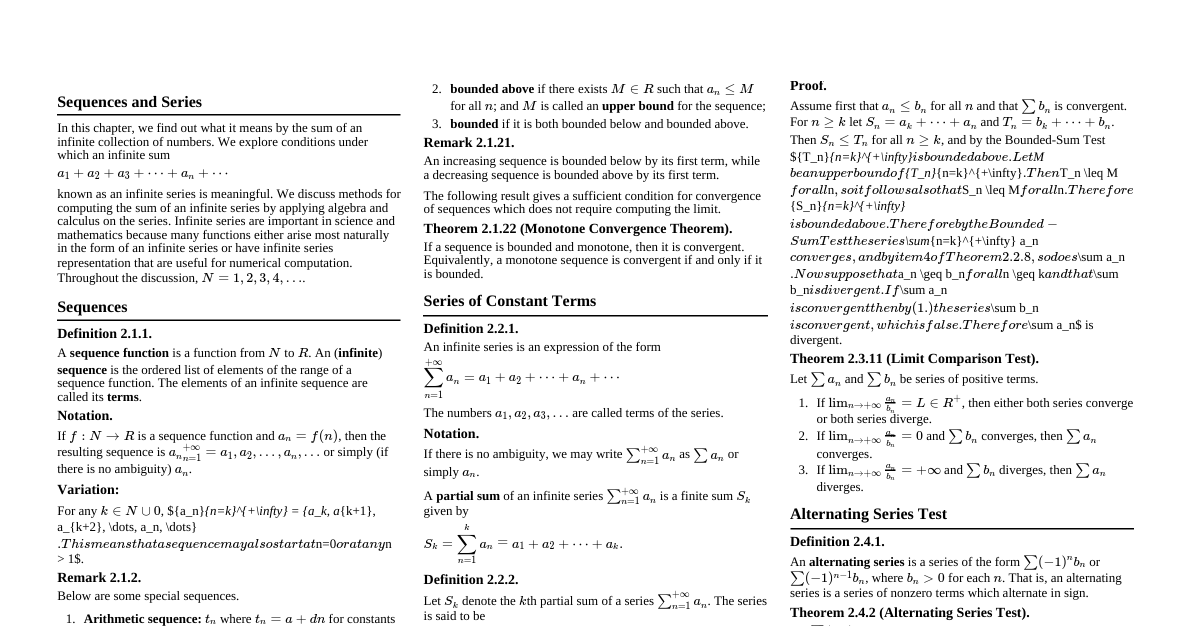
1. Sequences: Basic Definitions Definition: A sequence is a function $f: \mathbb{N} \to \mathbb{R}$. We denote $f(n)$ as $a_n$. Notation: $(a_n)_{n=1}^\infty$ or simply $(a_n)$. Examples: Constant sequence: $(c)$ i.e., $a_n = c$ for all $n$. Arithmetic progression: $(a + (n-1)d)$. Geometric progression: $(ar^{n-1})$. 2. Convergence of Sequences Definition: A sequence $(a_n)$ converges to a limit $L \in \mathbb{R}$ if for every $\epsilon > 0$, there exists an $N \in \mathbb{N}$ such that for all $n > N$, $|a_n - L| Notation: $\lim_{n \to \infty} a_n = L$ or $a_n \to L$. Divergence: A sequence that does not converge is said to diverge. Uniqueness of Limit: If a sequence converges, its limit is unique. 3. Properties of Convergent Sequences Boundedness: Every convergent sequence is bounded. (The converse is not necessarily true). Limit Laws: If $a_n \to A$ and $b_n \to B$, then: $\lim (a_n \pm b_n) = A \pm B$ $\lim (ca_n) = cA$ for $c \in \mathbb{R}$ $\lim (a_n b_n) = AB$ $\lim \left(\frac{a_n}{b_n}\right) = \frac{A}{B}$, provided $B \neq 0$ and $b_n \neq 0$ for all $n$. $\lim (a_n^p) = A^p$ for $p \in \mathbb{R}$ (if defined). $\lim |a_n| = |A|$. Squeeze Theorem (Sandwich Theorem): If $a_n \le b_n \le c_n$ for all $n > N_0$ and $\lim a_n = L$ and $\lim c_n = L$, then $\lim b_n = L$. Monotone Convergence Theorem: A monotone (either increasing or decreasing) and bounded sequence converges. 4. Types of Sequences Monotone Sequence: Increasing: $a_n \le a_{n+1}$ for all $n$. Strictly Increasing: $a_n Decreasing: $a_n \ge a_{n+1}$ for all $n$. Strictly Decreasing: $a_n > a_{n+1}$ for all $n$. Bounded Sequence: A sequence $(a_n)$ is bounded if there exists $M > 0$ such that $|a_n| \le M$ for all $n$. Bounded Above: $a_n \le M$ for some $M$. Bounded Below: $a_n \ge m$ for some $m$. 5. Subsequences Definition: Given a sequence $(a_n)$, a subsequence is a sequence $(a_{n_k})$ where $(n_k)$ is a strictly increasing sequence of natural numbers. Theorem: If a sequence $(a_n)$ converges to $L$, then every subsequence $(a_{n_k})$ also converges to $L$. Bolzano-Weierstrass Theorem: Every bounded sequence in $\mathbb{R}$ has a convergent subsequence. 6. Cauchy Sequences Definition: A sequence $(a_n)$ is a Cauchy sequence if for every $\epsilon > 0$, there exists an $N \in \mathbb{N}$ such that for all $m, n > N$, $|a_m - a_n| Cauchy Criterion for Convergence: A sequence of real numbers converges if and only if it is a Cauchy sequence. (This is a fundamental property of $\mathbb{R}$ called completeness). 7. Divergence to Infinity Definition: A sequence $(a_n)$ diverges to $\infty$ if for every $M \in \mathbb{R}$, there exists an $N \in \mathbb{N}$ such that for all $n > N$, $a_n > M$. Notation: $\lim_{n \to \infty} a_n = \infty$. Similarly for divergence to $-\infty$: $a_n 8. Limit Superior and Limit Inferior Definition: For a bounded sequence $(a_n)$: $\limsup a_n = \lim_{n \to \infty} (\sup \{a_k : k \ge n\})$ $\liminf a_n = \lim_{n \to \infty} (\inf \{a_k : k \ge n\})$ For an unbounded sequence, these can be $\pm \infty$. Property: A sequence $(a_n)$ converges if and only if $\limsup a_n = \liminf a_n$, in which case the limit is this common value.