JEE Mains Inorganic Chemistry
Shared 3/28/2026•158 views
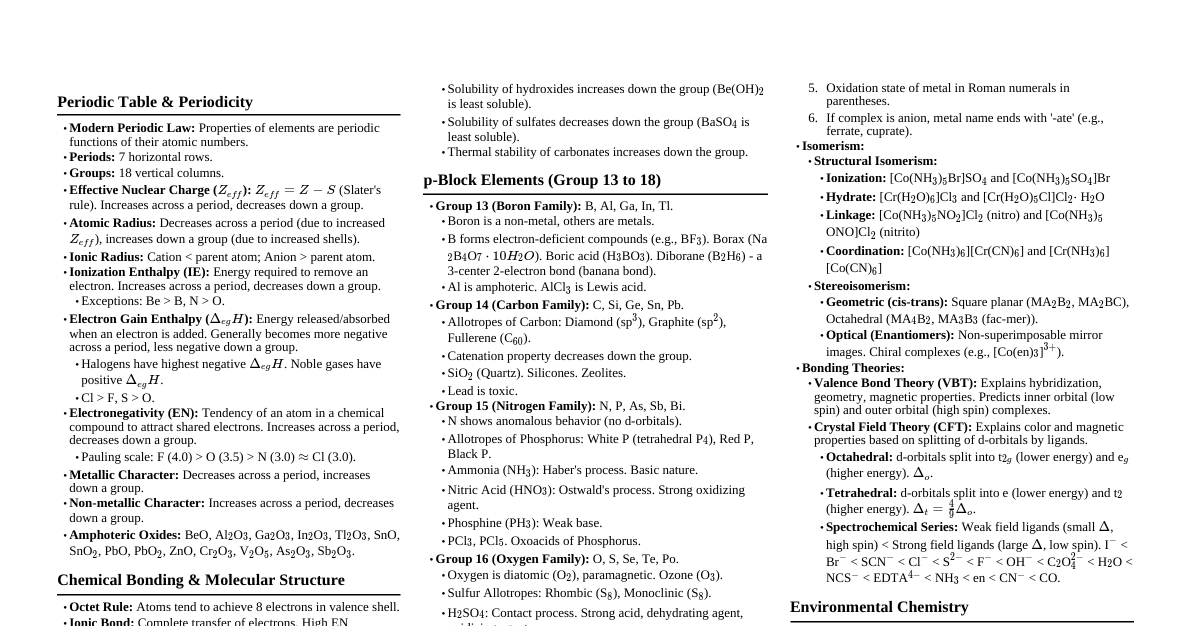
### Periodic Table & Periodicity - **Modern Periodic Law:** Physical & chemical properties are periodic functions of atomic number. - **Groups:** 18 vertical columns. - Group 1 (Alkali Metals), Group 2 (Alkaline Earth Metals) - Group 13 (Boron Family), Group 14 (Carbon Family), Group 15 (Nitrogen Family), Group 16 (Oxygen Family/Chalcogens), Group 17 (Halogens), Group 18 (Noble Gases) - **Periods:** 7 horizontal rows. - **Blocks:** - **s-block:** Groups 1 & 2. Highly reactive metals. - **p-block:** Groups 13 to 18. Non-metals, metalloids, and metals. - **d-block:** Groups 3 to 12. Transition metals. Variable oxidation states, colored compounds. - **f-block:** Lanthanides & Actinides. Inner transition metals. - **Periodic Trends:** - **Atomic Radii:** Decreases across a period (due to increased Zeff), Increases down a group (new shells). - **Ionic Radii:** Cations B, N > O. - **Electron Gain Enthalpy (EGE):** Energy change when an electron is added. Generally increases (more negative) across a period, Decreases (less negative) down a group. - Halogens have very high negative EGE. Noble gases have positive EGE. - F O > N ≈ Cl. - **Metallic Character:** Decreases across a period, Increases down a group. - **Non-metallic Character:** Increases across a period, Decreases down a group. - **Basic Character of Oxides:** Decreases across a period, Increases down a group. - **Acidic Character of Oxides:** Increases across a period, Decreases down a group. - **Diagonal Relationship:** Similar properties between elements of 2nd period and 3rd period (Li-Mg, Be-Al, B-Si). Due to similar charge/radius ratio. ### Chemical Bonding & Molecular Structure - **Octet Rule:** Atoms combine to achieve 8 electrons in valence shell. - **Ionic Bond:** Transfer of electrons. Formed between metals and non-metals (large EN difference). - Factors: Low IE of metal, high EGE of non-metal, high lattice enthalpy. - **Covalent Bond:** Sharing of electrons. Formed between non-metals. - **Bond Parameters:** Bond length, bond angle, bond enthalpy, bond order. - **Formal Charge:** For an atom in a polyatomic ion/molecule: $$FC = V - U - \frac{B}{2}$$ (V=valence e-, U=unshared e-, B=shared e-) - **VSEPR Theory (Valence Shell Electron Pair Repulsion):** Predicts molecular geometry based on minimizing repulsion between electron pairs. - LP-LP > LP-BP > BP-BP repulsion. - Examples: - $\text{BeCl}_2$: Linear, $180^\circ$ - $\text{BF}_3$: Trigonal planar, $120^\circ$ - $\text{CH}_4$: Tetrahedral, $109.5^\circ$ - $\text{NH}_3$: Pyramidal, $107^\circ$ (1 LP) - $\text{H}_2\text{O}$: Bent, $104.5^\circ$ (2 LP) - $\text{PCl}_5$: Trigonal bipyramidal - $\text{SF}_6$: Octahedral - **Hybridization:** Mixing of atomic orbitals to form new hybrid orbitals. - $sp$: Linear (e.g., $\text{C}_2\text{H}_2$) - $sp^2$: Trigonal planar (e.g., $\text{C}_2\text{H}_4$) - $sp^3$: Tetrahedral (e.g., $\text{CH}_4$) - $sp^3d$: Trigonal bipyramidal (e.g., $\text{PCl}_5$) - $sp^3d^2$: Octahedral (e.g., $\text{SF}_6$) - **Molecular Orbital Theory (MOT):** - Linear combination of atomic orbitals (LCAO) forms molecular orbitals (bonding & antibonding). - **Bond Order (BO):** $\frac{1}{2} (N_b - N_a)$. (Higher BO = more stable bond). - **Magnetic Properties:** Paramagnetic (unpaired electrons), Diamagnetic (all paired electrons). - **MO Configuration:** - For $\text{N}_2$ and below (total e- $\le 14$): $\sigma_{1s} \sigma^{*}_{1s} \sigma_{2s} \sigma^{*}_{2s} \pi_{2p_x} = \pi_{2p_y} \sigma_{2p_z} \pi^{*}_{2p_x} = \pi^{*}_{2p_y} \sigma^{*}_{2p_z}$ - For $\text{O}_2$ and above (total e- $> 14$): $\sigma_{1s} \sigma^{*}_{1s} \sigma_{2s} \sigma^{*}_{2s} \sigma_{2p_z} \pi_{2p_x} = \pi_{2p_y} \pi^{*}_{2p_x} = \pi^{*}_{2p_y} \sigma^{*}_{2p_z}$ - **Hydrogen Bonding:** Special dipole-dipole interaction where H is bonded to highly electronegative atoms (F, O, N). - **Intramolecular:** Within the same molecule (e.g., o-nitrophenol). - **Intermolecular:** Between different molecules (e.g., $\text{H}_2\text{O}$, HF). ### s-Block Elements (Groups 1 & 2) #### Group 1: Alkali Metals (Li, Na, K, Rb, Cs) - **Properties:** Soft, low melting points, highly reactive, strong reducing agents, form ionic compounds. - **Reactivity:** Increases down the group. - **Flame Coloration:** Li (crimson red), Na (golden yellow), K (lilac), Rb (red violet), Cs (blue). - **Oxides:** Form normal oxides ($M_2O$), peroxides ($M_2O_2$), and superoxides ($MO_2$). - **Hydroxides:** Strong bases, solubility increases down the group. - **Carbonates/Bicarbonates:** Stable, solubility increases down the group. - **Lithium Anomalous Behavior:** Small size, high polarizing power. Diagonal relationship with Mg. - Forms covalent compounds (e.g., LiCl is covalent). - Reacts slowly with water. - Forms only normal oxide ($\text{Li}_2\text{O}$). - Forms $\text{Li}_3\text{N}$ directly with $\text{N}_2$. #### Group 2: Alkaline Earth Metals (Be, Mg, Ca, Sr, Ba, Ra) - **Properties:** Harder, higher melting points than Group 1, less reactive than Group 1, strong reducing agents. - **Reactivity:** Increases down the group. - **Flame Coloration:** Ca (brick red), Sr (crimson), Ba (apple green). Be and Mg do not show. - **Oxides:** Basic, except BeO (amphoteric). - **Hydroxides:** Less basic than Group 1, solubility increases down the group. - **Carbonates/Sulfates:** Solubility decreases down the group. - **Beryllium Anomalous Behavior:** Small size, high polarizing power. Diagonal relationship with Al. - Forms covalent compounds (e.g., $\text{BeCl}_2$ is covalent). - Amphoteric oxide and hydroxide. - Forms beryllates (e.g., $\text{Na}_2\text{BeO}_2$). - **Important Compounds:** - **Washing Soda ($\text{Na}_2\text{CO}_3 \cdot 10\text{H}_2\text{O}$):** Solvay process. - **Baking Soda ($\text{NaHCO}_3$):** Used in baking, antacid. - **Quicklime (CaO):** From limestone calcination. - **Slaked Lime ($\text{Ca(OH)}_2$):** Used in whitewash, mortar. - **Plaster of Paris ($\text{CaSO}_4 \cdot \frac{1}{2}\text{H}_2\text{O}$):** From gypsum ($\text{CaSO}_4 \cdot 2\text{H}_2\text{O}$). - **Cement:** Mixture of silicates and aluminates of Ca. ### p-Block Elements (Groups 13 & 14) #### Group 13: Boron Family (B, Al, Ga, In, Tl) - **Electronic Configuration:** $[Xe] ns^2 np^1$. - **Oxidation State:** +3 (most common). +1 for Ga, In, Tl (inert pair effect). - **Boron:** Non-metal, forms covalent compounds. Hardest element. - **Aluminium:** Metal, amphoteric. - **Atomic Radii:** Ga Si > Ge > Sn. - **Allotropes of Carbon:** - **Diamond:** Hardest natural substance, $sp^3$ hybridized, tetrahedral, insulator. - **Graphite:** Soft, good conductor, $sp^2$ hybridized, planar hexagonal layers, lubricant. - **Fullerenes:** Cage-like molecules (e.g., $\text{C}_{60}$). - **Silicon:** Semiconductor. - **Important Compounds:** - **Carbon Monoxide (CO):** Neutral oxide, poisonous, strong reducing agent. - **Carbon Dioxide ($\text{CO}_2$):** Acidic oxide, greenhouse gas. - **Silicon Dioxide ($\text{SiO}_2$):** Covalent network solid, acidic. - **Silicones:** Organosilicon polymers. - **Zeolites:** Aluminosilicates, used as catalysts and ion exchangers. ### p-Block Elements (Groups 15-18) #### Group 15: Nitrogen Family (N, P, As, Sb, Bi) - **Electronic Configuration:** $[Xe] ns^2 np^3$. - **Oxidation States:** -3, +3, +5. Stability of +5 decreases, +3 increases down the group. - **Nitrogen:** Diatomic gas, high bond dissociation enthalpy (triple bond). - **Ammonia ($\text{NH}_3$):** Basic, pyramidal shape, H-bonding. Haber process. - **Nitric Acid ($\text{HNO}_3$):** Strong oxidizing agent. Ostwald process. - **Oxides of Nitrogen:** $\text{N}_2\text{O}$ (neutral), NO (neutral), $\text{N}_2\text{O}_3$ (acidic), $\text{NO}_2$ (acidic), $\text{N}_2\text{O}_4$ (acidic), $\text{N}_2\text{O}_5$ (acidic). - **Phosphorus:** Exists in various allotropic forms (white, red, black). - **White Phosphorus:** Most reactive, tetrahedral $\text{P}_4$ units, ignites spontaneously. - **Red Phosphorus:** Polymeric, less reactive. - **Phosphine ($\text{PH}_3$):** Weak base, highly poisonous. - **Phosphorus Halides:** $\text{PCl}_3$ (pyramidal), $\text{PCl}_5$ (trigonal bipyramidal). - **Oxoacids of Phosphorus:** $\text{H}_3\text{PO}_2$ (hypophosphorous, monobasic), $\text{H}_3\text{PO}_3$ (orthophosphorous, dibasic), $\text{H}_3\text{PO}_4$ (orthophosphoric, tribasic). #### Group 16: Oxygen Family (O, S, Se, Te, Po) - **Electronic Configuration:** $[Xe] ns^2 np^4$. - **Oxidation States:** -2, +2, +4, +6. - **Oxygen:** Diatomic gas. Ozone ($\text{O}_3$) is an allotrope, powerful oxidizing agent. - **Sulphur:** Exists as $\text{S}_8$ (rhombic, monoclinic). - **Sulphuric Acid ($\text{H}_2\text{SO}_4$):** King of Chemicals. Contact process. Strong dehydrating, oxidizing agent. - **Oxoacids of Sulphur:** $\text{H}_2\text{SO}_3$, $\text{H}_2\text{SO}_4$, $\text{H}_2\text{S}_2\text{O}_7$ (oleum). #### Group 17: Halogens (F, Cl, Br, I, At) - **Electronic Configuration:** $[Xe] ns^2 np^5$. - **Oxidation States:** -1 (most common), +1, +3, +5, +7 (for Cl, Br, I). - **Reactivity:** Decreases down the group. F is most reactive. - **Bond Dissociation Enthalpy:** $\text{Cl}_2 > \text{Br}_2 > \text{F}_2 > \text{I}_2$. - **Oxidizing Power:** $\text{F}_2 > \text{Cl}_2 > \text{Br}_2 > \text{I}_2$. - **Hydrogen Halides (HX):** Acidic strength: HF HI > HBr > HCl (due to H-bonding in HF). - **Interhalogen Compounds:** Formed between two different halogens (e.g., $\text{ClF}_3$, $\text{IF}_7$). More reactive than halogens (except $\text{F}_2$). - **Oxoacids of Halogens:** - Hypohalous acid (HOX) - Halous acid ($\text{HOXO}_2$) - Halic acid ($\text{HOXO}_3$) - Perhalic acid ($\text{HOXO}_3$) - Acidic strength: $\text{HClO}_4 > \text{HClO}_3 > \text{HClO}_2 > \text{HClO}$. #### Group 18: Noble Gases (He, Ne, Ar, Kr, Xe, Rn) - **Electronic Configuration:** $[Xe] ns^2 np^6$ (He: $1s^2$). - **Properties:** Monatomic, extremely low reactivity, high ionization enthalpy, positive electron gain enthalpy. - **Xenon Compounds:** Xe forms compounds with F and O due to relatively low IE. - **Fluorides:** $\text{XeF}_2$ (linear), $\text{XeF}_4$ (square planar), $\text{XeF}_6$ (distorted octahedral). - **Oxides:** $\text{XeO}_3$ (pyramidal), $\text{XeO}_4$ (tetrahedral). - **Oxyfluorides:** $\text{XeOF}_4$ (square pyramidal). ### d- and f-Block Elements #### d-Block Elements (Transition Elements) - **General Characteristics:** - Electronic configuration: $(n-1)d^{1-10} ns^{1-2}$. - High melting and boiling points. - Variable oxidation states (due to involvement of (n-1)d and ns electrons). - Form colored ions (d-d transitions). - Paramagnetic behavior (unpaired d-electrons). - Good catalysts (variable oxidation states, large surface area). - Form interstitial compounds. - Form alloys. - **Oxidation States:** - Sc: +3 - Ti: +2, +3, +4 - V: +2, +3, +4, +5 - Cr: +2, +3, +6 - Mn: +2, +3, +4, +6, +7 (highest is +7) - Fe: +2, +3 - Co: +2, +3 - Ni: +2 - Cu: +1, +2 - Zn: +2 (not a transition element as it has full d-subshell in common oxidation state) - **Important Compounds:** - **Potassium Dichromate ($\text{K}_2\text{Cr}_2\text{O}_7$):** Strong oxidizing agent in acidic medium (orange to green). - $\text{Cr}_2\text{O}_7^{2-} + 14\text{H}^+ + 6e^- \rightarrow 2\text{Cr}^{3+} + 7\text{H}_2\text{O}$ - **Potassium Permanganate ($\text{KMnO}_4$):** Strong oxidizing agent. - Acidic: $\text{MnO}_4^- + 8\text{H}^+ + 5e^- \rightarrow \text{Mn}^{2+} + 4\text{H}_2\text{O}$ (purple to colorless) - Neutral: $\text{MnO}_4^- + 2\text{H}_2\text{O} + 3e^- \rightarrow \text{MnO}_2 + 4\text{OH}^-$ (purple to brown ppt) - Alkaline: $\text{MnO}_4^- + e^- \rightarrow \text{MnO}_4^{2-}$ (purple to green) #### f-Block Elements (Inner Transition Elements) - **Lanthanoids (4f series):** - Electronic configuration: $[Xe] 4f^{1-14} 5d^{0-1} 6s^2$. - Common oxidation state: +3. Some show +2 and +4. - **Lanthanoid Contraction:** Atomic and ionic radii decrease steadily across the series due to poor shielding of 4f electrons. - Causes similar radii of 4d and 5d elements (e.g., Zr and Hf). - **Actinoids (5f series):** - Electronic configuration: $[Rn] 5f^{1-14} 6d^{0-1} 7s^2$. - Common oxidation state: +3, but also show higher oxidation states up to +7 (U, Np, Pu). - All are radioactive. - Actinoid contraction is more pronounced than lanthanoid contraction. ### Coordination Compounds - **Definitions:** - **Central Metal Ion:** Lewis acid. - **Ligand:** Lewis base, donates electron pair to central metal. - **Monodentate:** Donates one pair (e.g., $\text{NH}_3, \text{Cl}^-$). - **Polydentate:** Donates multiple pairs (e.g., ethylenediamine (en), EDTA). - **Ambidentate:** Can coordinate through two different atoms (e.g., $\text{NO}_2^-$, $\text{SCN}^-$). - **Coordination Number:** Number of ligand donor atoms directly bonded to metal. - **Coordination Sphere:** Central metal ion + ligands. - **Counter Ion:** Ion outside coordination sphere. - **Nomenclature (IUPAC):** 1. Cation named first, then anion. 2. Ligands named first (alphabetic order), then metal. 3. Ligands: Anionic end in -o ($\text{Cl}^-$ chloro), neutral are named as molecule ( $\text{NH}_3$ ammine, $\text{H}_2\text{O}$ aqua, CO carbonyl, NO nitrosyl). 4. Prefixes di-, tri-, tetra- for simple ligands. Bis-, tris-, tetrakis- for complex ligands. 5. Oxidation state of metal in Roman numerals in parentheses. 6. If complex is anion, metal name ends in -ate (e.g., ferrate, cuprate). - **Isomerism:** - **Structural Isomerism:** - **Ionization Isomerism:** Ligand and counter ion exchange places (e.g., $[\text{Co(NH}_3)_5\text{Br}]\text{SO}_4$ and $[\text{Co(NH}_3)_5\text{SO}_4]\text{Br}$). - **Linkage Isomerism:** Ambidentate ligand coordinates through different atoms (e.g., $\text{NO}_2^-$ vs $\text{ONO}^-$). - **Hydrate Isomerism:** Water molecule as ligand or solvent (e.g., $[\text{CrCl}_2(\text{H}_2\text{O})_4]\text{Cl} \cdot 2\text{H}_2\text{O}$ vs $[\text{CrCl}_3(\text{H}_2\text{O})_3] \cdot 3\text{H}_2\text{O}$). - **Coordination Isomerism:** Exchange of ligands between cationic and anionic complex ions (e.g., $[\text{Co(NH}_3)_6][\text{Cr(CN)}_6]$ and $[\text{Cr(NH}_3)_6][\text{Co(CN)}_6]$). - **Stereoisomerism:** - **Geometrical Isomerism (cis/trans):** - Square planar $(\text{Ma}_2\text{b}_2)$: cis/trans. - Octahedral $(\text{Ma}_4\text{b}_2)$: cis/trans. - Octahedral $(\text{Ma}_3\text{b}_3)$: facial (fac) / meridional (mer). - **Optical Isomerism (Enantiomers):** Non-superimposable mirror images. - Common in octahedral complexes with bidentate ligands (e.g., $[\text{Co(en)}_3]^{3+}$). - Square planar complexes rarely show optical isomerism. - **Bonding Theories:** - **Valence Bond Theory (VBT):** - Explains hybridization and geometry. - Inner orbital complexes (low spin): $(n-1)d$ orbitals used (e.g., $d^2sp^3$). - Outer orbital complexes (high spin): $nd$ orbitals used (e.g., $sp^3d^2$). - Doesn't explain color or quantitative magnetic properties well. - **Crystal Field Theory (CFT):** - Assumes point charges for ligands. - Explains splitting of d-orbitals in presence of ligands ($\Delta_o$ for octahedral, $\Delta_t$ for tetrahedral). - **Spectrochemical Series:** Weak field ligands (small splitting, high spin) ### Qualitative Analysis - **Salt Analysis (Cation & Anion Detection):** - **Anion Tests:** - **Dil. $\text{H}_2\text{SO}_4$ Group:** $\text{CO}_3^{2-}$ (effervescence with $\text{CO}_2$), $\text{SO}_3^{2-}$ (pungent gas, $\text{SO}_2$), $\text{S}^{2-}$ ($\text{H}_2\text{S}$ gas, black ppt with lead acetate), $\text{NO}_2^-$ (reddish brown fumes of $\text{NO}_2$). - **Conc. $\text{H}_2\text{SO}_4$ Group:** $\text{Cl}^-$ (white fumes of HCl, white ppt with $\text{AgNO}_3$), $\text{Br}^-$ (reddish brown fumes of $\text{Br}_2$), $\text{I}^-$ (violet fumes of $\text{I}_2$), $\text{NO}_3^-$ (brown ring test, reddish brown fumes). - **Independent Group:** $\text{SO}_4^{2-}$ (white ppt with $\text{BaCl}_2$ insoluble in conc. HCl), $\text{PO}_4^{3-}$ (yellow ppt with ammonium molybdate). - **Cation Tests (Group-wise precipitation):** - **Group 0 ($\text{NH}_4^+$):** $\text{NH}_3$ gas with NaOH. - **Group I ($\text{Ag}^+, \text{Pb}^{2+}, \text{Hg}_2^{2+}$):** Precipitated as chlorides with dil. HCl. - **Group II ($\text{Hg}^{2+}, \text{Pb}^{2+}, \text{Bi}^{3+}, \text{Cu}^{2+}, \text{Cd}^{2+}, \text{As}^{3+}, \text{Sb}^{3+}, \text{Sn}^{2+/4+}$):** Precipitated as sulfides with $\text{H}_2\text{S}$ in presence of dil. HCl. - **Group III ($\text{Al}^{3+}, \text{Fe}^{3+}, \text{Cr}^{3+}$):** Precipitated as hydroxides with $\text{NH}_4\text{OH}$ in presence of $\text{NH}_4\text{Cl}$. - **Group IV ($\text{Zn}^{2+}, \text{Mn}^{2+}, \text{Ni}^{2+}, \text{Co}^{2+}$):** Precipitated as sulfides with $\text{H}_2\text{S}$ in presence of $\text{NH}_4\text{OH}$ and $\text{NH}_4\text{Cl}$. - **Group V ($\text{Ba}^{2+}, \text{Sr}^{2+}, \text{Ca}^{2+}$):** Precipitated as carbonates with $\text{NH}_4\text{OH}$ and $\text{NH}_4\text{Cl}$ and $(\text{NH}_4)_2\text{CO}_3$. - **Group VI ($\text{Mg}^{2+}$):** No group reagent. Tested using disodium hydrogen phosphate. - **Specific Tests:** - **$\text{Fe}^{3+}$:** Blood red color with KCNS. - **$\text{Cu}^{2+}$:** Deep blue color with excess $\text{NH}_4\text{OH}$. - **$\text{Ni}^{2+}$:** Rose red ppt with Dimethylglyoxime (DMG). - **$\text{Cr}^{3+}$:** Yellow solution of chromate on oxidation. - **$\text{Mn}^{2+}$:** Pink ppt of $\text{MnO}_2$ on oxidation.