Elasticity Essentials
Cheatsheet Content
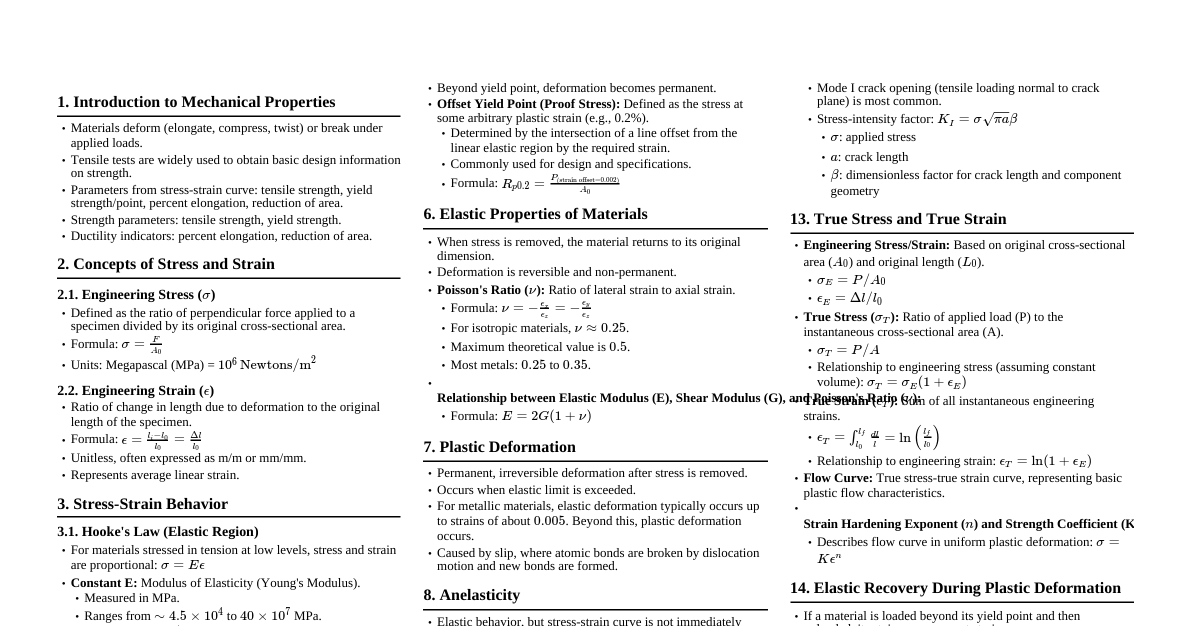
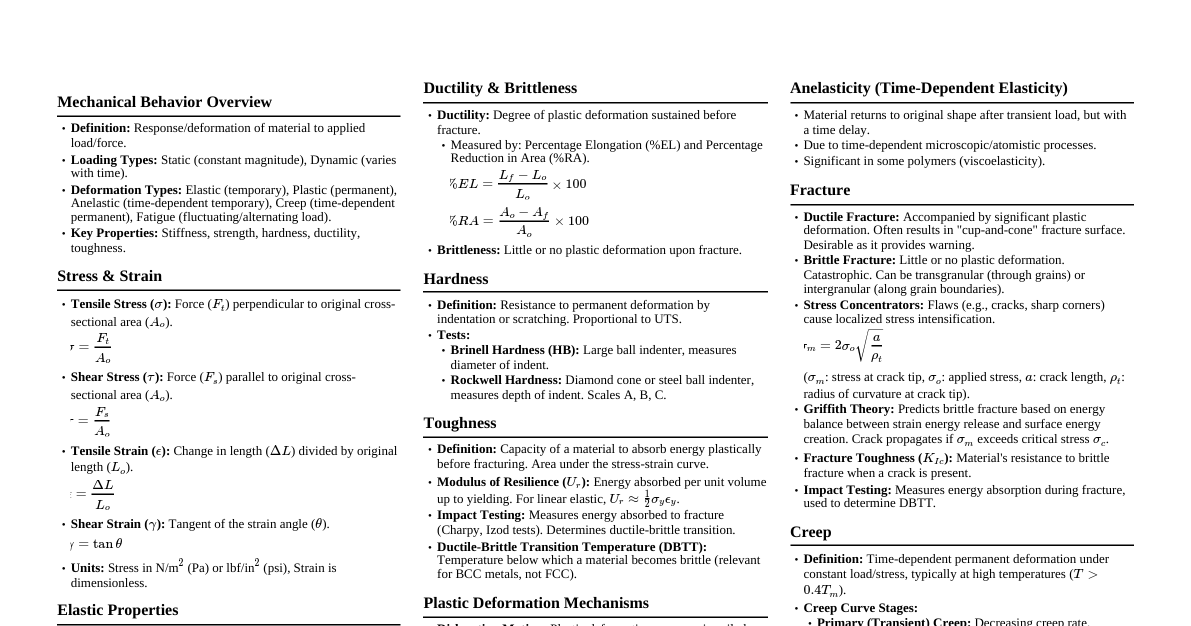
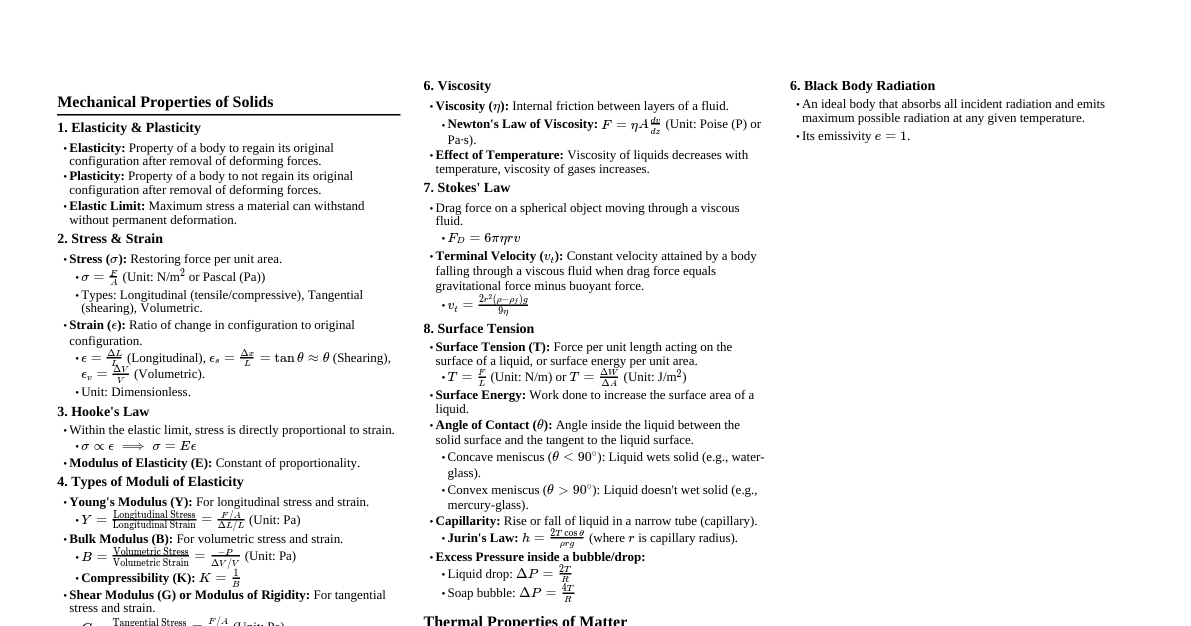
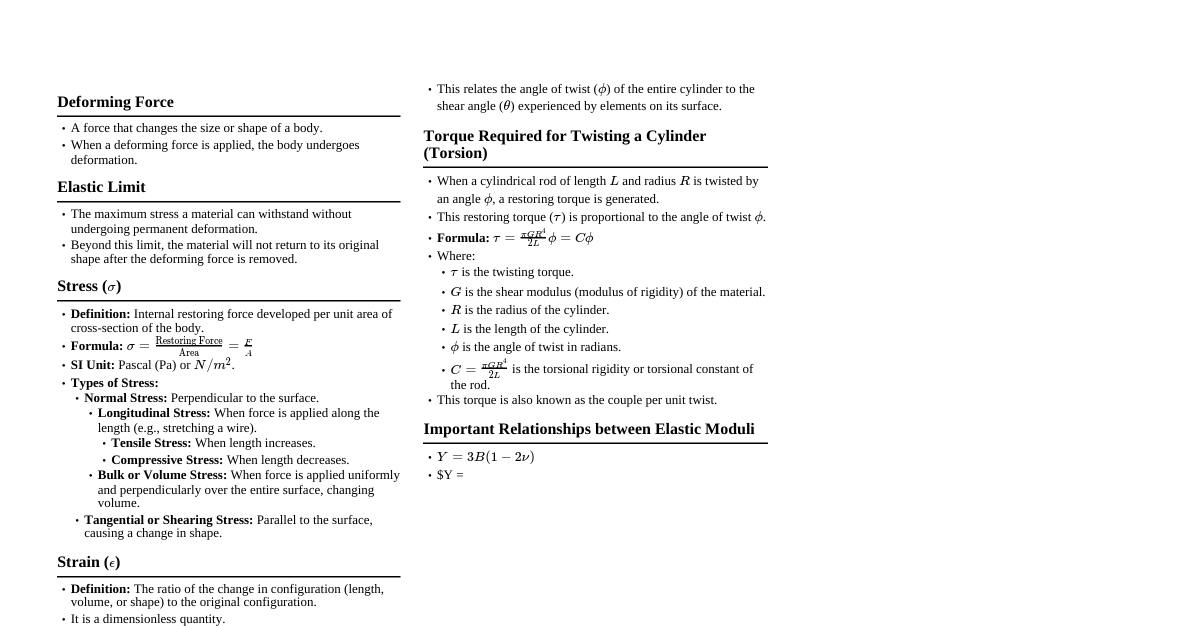
1. Hooke's Law Definition: Within the elastic limit, stress is directly proportional to strain. Mathematical Expression: $\text{Stress} \propto \text{Strain}$ $\sigma = E \epsilon$ (for Young's Modulus) $\tau = G \gamma$ (for Shear Modulus) 2. Stress-Strain Diagram Elastic Limit: Point up to which a material returns to its original shape after removing the load. Yield Point: Point at which the material begins to deform plastically. Ultimate Tensile Strength: Maximum stress a material can withstand before necking. Breaking Point: Point at which the material fractures. 3. Elastic Moduli 3.1 Young's Modulus ($E$) Definition: Ratio of normal stress to longitudinal strain. Expression: $E = \frac{\text{Normal Stress}}{\text{Longitudinal Strain}} = \frac{\sigma}{\epsilon} = \frac{F/A}{\Delta L/L}$ Units: Pascals (Pa) or $N/m^2$. 3.2 Bulk Modulus ($K$) Definition: Ratio of normal stress (or pressure) to volumetric strain. Expression: $K = \frac{\text{Normal Stress}}{\text{Volumetric Strain}} = \frac{-P}{\Delta V/V}$ Units: Pascals (Pa). The negative sign indicates that an increase in pressure causes a decrease in volume. 3.3 Shear Modulus (Modulus of Rigidity, $G$) Definition: Ratio of tangential stress to shear strain. Expression: $G = \frac{\text{Tangential Stress}}{\text{Shear Strain}} = \frac{\tau}{\gamma} = \frac{F/A}{x/h}$ Units: Pascals (Pa). 4. Poisson's Ratio ($\nu$) Definition: Ratio of lateral strain to longitudinal strain. Expression: $\nu = -\frac{\text{Lateral Strain}}{\text{Longitudinal Strain}} = -\frac{\Delta D/D}{\Delta L/L}$ Range: For most materials, $0 5. Relation Between Elastic Constants $E = 2G(1 + \nu)$ $E = 3K(1 - 2\nu)$ $G = \frac{3K E}{9K - E}$ $\nu = \frac{3K - 2G}{6K + 2G}$ $\frac{9}{E} = \frac{3}{G} + \frac{1}{K}$ 6. Work Done in Stretching a Wire Derivation: Consider a wire of length $L$ and area $A$. When stretched by a force $F$, its length increases by $dL$. Work done $dW = F dL$. From Young's Modulus: $E = \frac{F/A}{dL/L} \implies F = \frac{EA dL}{L}$. $dW = \frac{EA dL}{L} dL$. Total work done for stretching by $\Delta L$: $W = \int_0^{\Delta L} \frac{EA}{L} x dx = \frac{EA}{L} \left[ \frac{x^2}{2} \right]_0^{\Delta L} = \frac{1}{2} \frac{EA}{L} (\Delta L)^2$. Also, $W = \frac{1}{2} F \Delta L = \frac{1}{2} (\text{Stress} \times A) (\text{Strain} \times L) = \frac{1}{2} \text{Stress} \times \text{Strain} \times \text{Volume}$. Energy per unit volume: $U = \frac{1}{2} \text{Stress} \times \text{Strain} = \frac{1}{2} E (\text{Strain})^2 = \frac{1}{2E} (\text{Stress})^2$. 7. Work Done in Twisting a Wire Derivation: Consider a wire of length $L$ and radius $R$. When twisted, a shearing stress is produced. Angle of twist $\theta$. Angle of shear $\phi = \frac{r\theta}{L}$. For a small twist $d\theta$, work done $dW = C d\theta$, where $C$ is the restoring couple. The twisting couple $C = \frac{\pi G R^4}{2L} \theta$ (derived below). $W = \int_0^{\theta} \frac{\pi G R^4}{2L} \theta d\theta = \frac{1}{2} \frac{\pi G R^4}{2L} \theta^2 = \frac{1}{2} C \theta$. 8. Twisting Couple on a Cylinder (Wire) Derivation: Consider a cylindrical wire of length $L$ and radius $R$. Let one end be fixed and the other end be twisted by an angle $\theta$. Consider a thin cylindrical shell of radius $r$ and thickness $dr$. The angle of shear $\phi = \frac{r\theta}{L}$. Shearing stress $\tau = G \phi = G \frac{r\theta}{L}$. Shearing force on the shell's cross-section $dF = \tau dA = \tau (2\pi r dr) = G \frac{r\theta}{L} (2\pi r dr) = \frac{2\pi G \theta}{L} r^2 dr$. Moment of this force (twisting couple) $dC = r dF = \frac{2\pi G \theta}{L} r^3 dr$. Total twisting couple $C = \int_0^R \frac{2\pi G \theta}{L} r^3 dr = \frac{2\pi G \theta}{L} \left[ \frac{r^4}{4} \right]_0^R = \frac{\pi G R^4}{2L} \theta$. Expression: $C = \frac{\pi G R^4}{2L} \theta$. The term $\frac{\pi G R^4}{2L}$ is called the torsional rigidity ($k$). 9. Torsional Pendulum Definition: A heavy body (e.g., disc or cylinder) suspended by a wire, which oscillates in a horizontal plane when twisted and released. Restoring Couple: $C = k \theta$, where $k = \frac{\pi G R^4}{2L}$ is the torsional rigidity. Equation of Motion: $I \frac{d^2\theta}{dt^2} = -k\theta$, where $I$ is the moment of inertia of the suspended body. Angular Frequency: $\omega = \sqrt{\frac{k}{I}}$. Time Period: $T = \frac{2\pi}{\omega} = 2\pi \sqrt{\frac{I}{k}} = 2\pi \sqrt{\frac{2LI}{\pi G R^4}}$. This can be used to determine the modulus of rigidity ($G$) of the wire material. 10. Cantilever Definition: A beam fixed at one end and free at the other. Depression of the Free End (Load $W$ at free end): Consider a cantilever of length $L$ and rectangular cross-section (width $b$, depth $d$). The depression $\delta = \frac{WL^3}{3YI_g}$, where $Y$ is Young's Modulus and $I_g$ is the geometrical moment of inertia. For a rectangular cross-section, $I_g = \frac{bd^3}{12}$. So, $\delta = \frac{WL^3}{3Y(bd^3/12)} = \frac{4WL^3}{Ybd^3}$. Depression with Uniformly Distributed Load ($w$ per unit length): $\delta = \frac{wL^4}{8YI_g} = \frac{3wL^4}{2Ybd^3}$. 11. Bending of Beams Neutral Axis: The layer in a bent beam where the length remains unchanged, experiencing neither extension nor compression. Bending Moment: The sum of the moments of all forces acting on one side of a cross-section of the beam, tending to bend it. Radius of Curvature ($R$): For a bent beam, the radius of the circle formed by the neutral axis. Relation between Bending Moment and Radius of Curvature: $\frac{YI_g}{R} = M$, where $M$ is the bending moment. This is known as the Euler-Bernoulli beam equation for pure bending. Moment of Inertia ($I_g$): Also called the second moment of area, it represents the resistance of the cross-section to bending. For rectangular cross-section (width $b$, depth $d$ about an axis parallel to $b$ passing through centroid): $I_g = \frac{bd^3}{12}$. For circular cross-section (radius $r$): $I_g = \frac{\pi r^4}{4}$. Depression of a Beam Supported at Both Ends (Load $W$ at center): For a beam of length $L$, width $b$, depth $d$ supported at both ends with a load $W$ at the center: $\delta = \frac{WL^3}{48YI_g} = \frac{WL^3}{48Y(bd^3/12)} = \frac{WL^3}{4Ybd^3}$.