Calculus: Integration & Differential Eq.
Cheatsheet Content
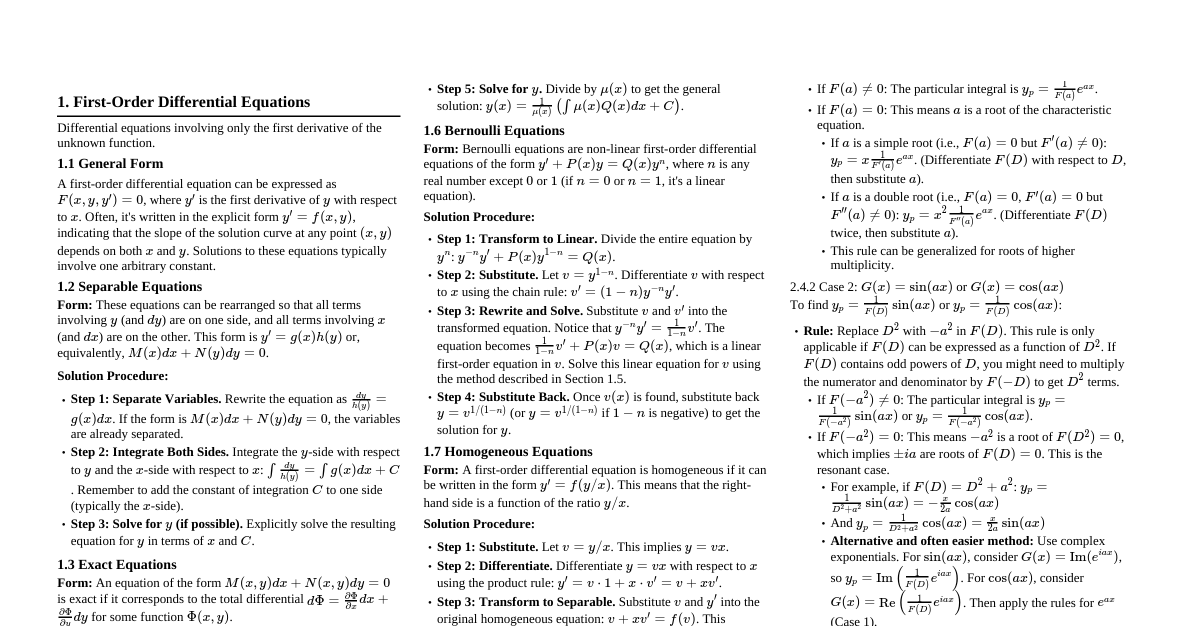
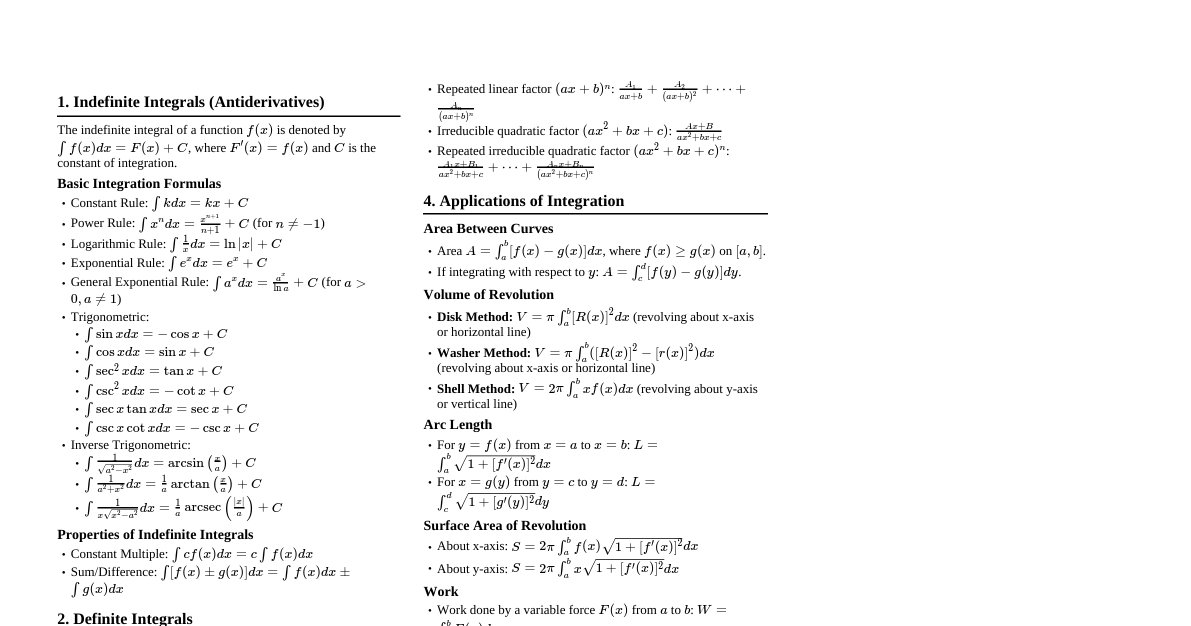
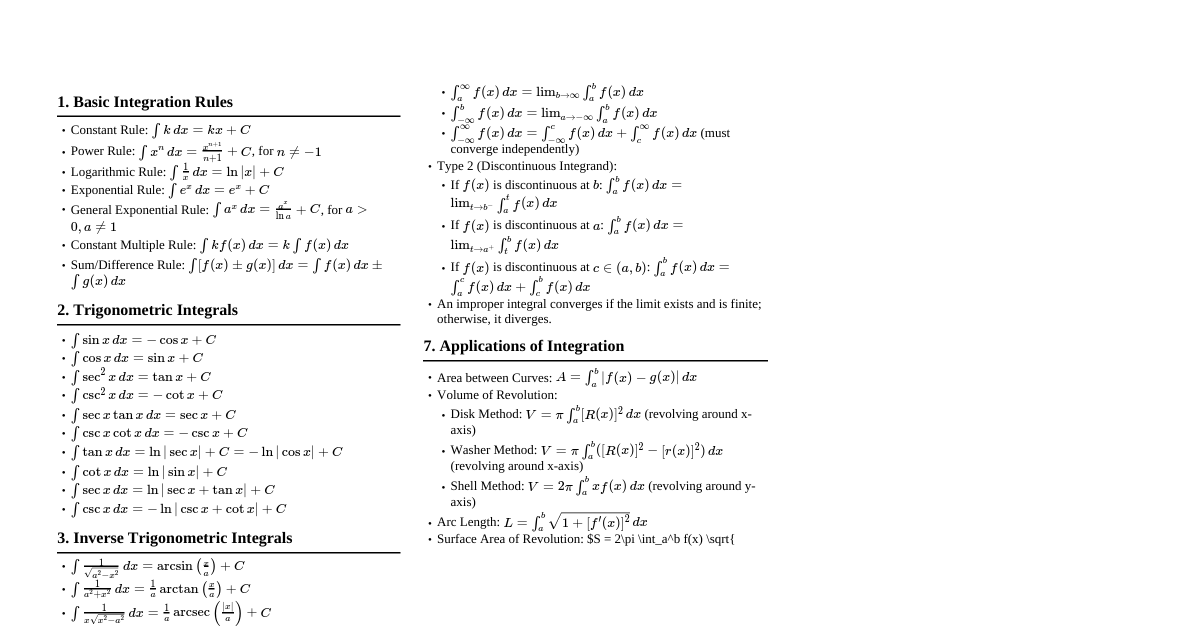
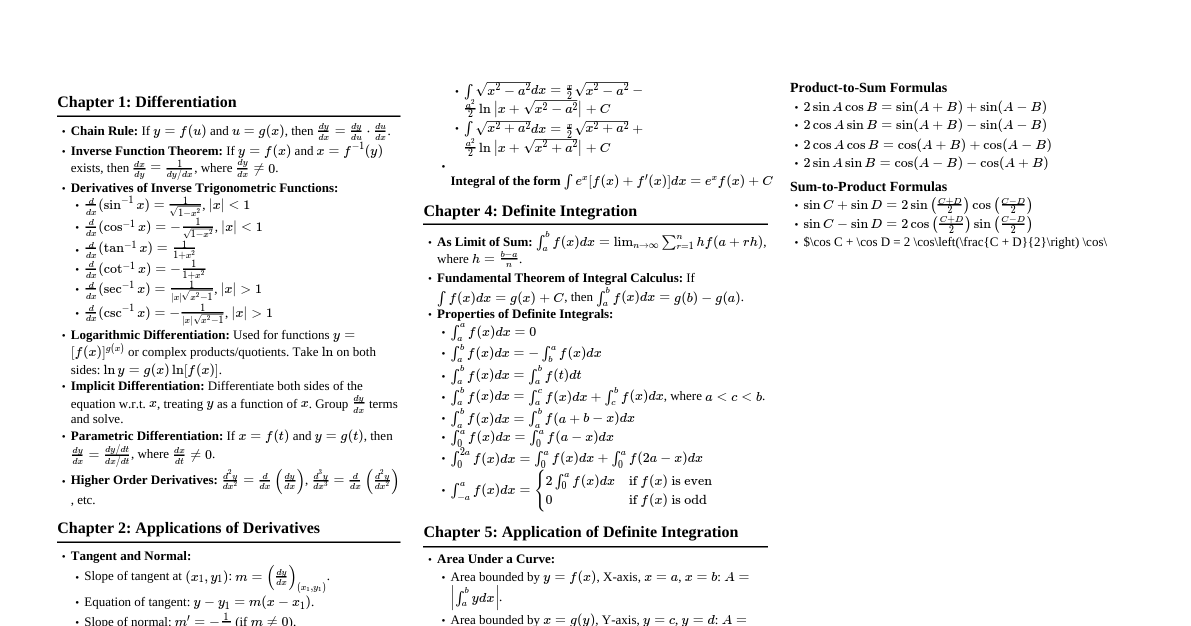
Indefinite Integration: Basic Formulas $\int x^n dx = \frac{x^{n+1}}{n+1} + C \quad (n \neq -1)$ $\int \frac{1}{x} dx = \ln|x| + C$ $\int e^x dx = e^x + C$; $\int a^x dx = \frac{a^x}{\ln a} + C$ $\int \sin x dx = -\cos x + C$; $\int \cos x dx = \sin x + C$ $\int \sec^2 x dx = \tan x + C$; $\int \csc^2 x dx = -\cot x + C$ $\int \sec x \tan x dx = \sec x + C$; $\int \csc x \cot x dx = -\csc x + C$ $\int \frac{1}{\sqrt{a^2 - x^2}} dx = \sin^{-1}\left(\frac{x}{a}\right) + C$ $\int \frac{1}{a^2 + x^2} dx = \frac{1}{a} \tan^{-1}\left(\frac{x}{a}\right) + C$ $\int \frac{1}{x\sqrt{x^2 - a^2}} dx = \frac{1}{a} \sec^{-1}\left(\frac{x}{a}\right) + C$ $\int \frac{1}{x^2 - a^2} dx = \frac{1}{2a} \ln\left|\frac{x-a}{x+a}\right| + C$ $\int \frac{1}{a^2 - x^2} dx = \frac{1}{2a} \ln\left|\frac{a+x}{a-x}\right| + C$ $\int \frac{1}{\sqrt{x^2 \pm a^2}} dx = \ln\left|x + \sqrt{x^2 \pm a^2}\right| + C$ $\int \sqrt{a^2 - x^2} dx = \frac{x}{2}\sqrt{a^2 - x^2} + \frac{a^2}{2}\sin^{-1}\left(\frac{x}{a}\right) + C$ $\int \sqrt{x^2 \pm a^2} dx = \frac{x}{2}\sqrt{x^2 \pm a^2} \pm \frac{a^2}{2}\ln\left|x + \sqrt{x^2 \pm a^2}\right| + C$ $\int \tan x dx = \ln|\sec x| + C$; $\int \cot x dx = \ln|\sin x| + C$ $\int \sec x dx = \ln|\sec x + \tan x| + C$; $\int \csc x dx = \ln|\csc x - \cot x| + C$ Methods of Integration Substitution: $t=g(x) \implies dt=g'(x)dx$. Forms: $\int \frac{f'(x)}{f(x)} dx = \ln|f(x)|$, $\int [f(x)]^n f'(x) dx = \frac{[f(x)]^{n+1}}{n+1}$. By Parts: $\int u \, dv = uv - \int v \, du$. Use ILATE for $u$. Partial Fractions: For rational functions $\frac{P(x)}{Q(x)}$. Decompose based on factors of $Q(x)$. Trigonometric: Use identities. For $\sin^m x \cos^n x$: $m$ odd $\implies u=\cos x$; $n$ odd $\implies u=\sin x$; both even $\implies$ double angle. For $\tan^m x \sec^n x$: $n$ even $\implies u=\tan x$; $m$ odd $\implies u=\sec x$. Universal sub: $t = \tan(x/2)$, $dx = \frac{2 \, dt}{1+t^2}$, $\sin x = \frac{2t}{1+t^2}$, $\cos x = \frac{1-t^2}{1+t^2}$. Special: $\int e^x (f(x) + f'(x)) dx = e^x f(x) + C$. Definite Integration FTC: $\int_a^b f(x) dx = F(b) - F(a)$. Properties: $\int_a^b f(x) dx = \int_a^b f(a+b-x) dx$; $\int_0^a f(x) dx = \int_0^a f(a-x) dx$. Even/Odd: $\int_{-a}^a f(x) dx = 2 \int_0^a f(x) dx$ (if $f(-x)=f(x)$); $0$ (if $f(-x)=-f(x)$). Periodic: $\int_0^{2a} f(x) dx = 2 \int_0^a f(x) dx$ if $f(2a-x)=f(x)$; $0$ if $f(2a-x)=-f(x)$. Leibniz Rule: $\frac{d}{dx} \int_{g(x)}^{h(x)} f(t) \, dt = f(h(x))h'(x) - f(g(x))g'(x)$. Wallis' Formula: For $\int_0^{\pi/2} \sin^n x \, dx$ or $\cos^n x \, dx$: $\frac{(n-1)!!}{n!!} \cdot K$, where $K=\frac{\pi}{2}$ if $n$ is even, $K=1$ if $n$ is odd. Differential Equations Order: Highest derivative. Degree: Power of highest derivative. Variable Separable: $\frac{dy}{dx} = f(x)g(y) \implies \int \frac{dy}{g(y)} = \int f(x) \, dx$. Homogeneous: $\frac{dy}{dx} = f\left(\frac{y}{x}\right)$. Substitute $y=vx$. Linear DE: $\frac{dy}{dx} + P(x)y = Q(x)$. IF $= e^{\int P(x) \, dx}$. Sol: $y \cdot (\text{IF}) = \int Q(x) \cdot (\text{IF}) \, dx + C$. Exact DE: $M(x,y) \, dx + N(x,y) \, dy = 0$. Check $\frac{\partial M}{\partial y} = \frac{\partial N}{\partial x}$. Sol: $\int M \, dx + \int (N - \frac{\partial}{\partial y} \int M \, dx \text{ (terms not containing x)}) \, dy = C$. Bernoulli: $\frac{dy}{dx} + P(x)y = Q(x)y^n$. Substitute $v = y^{1-n}$. Area Under the Curve Area with X-axis: $\int_a^b |f(x)| \, dx$. Sketch to find limits and absolute values. Area with Y-axis: $\int_c^d |f(y)| \, dy$. Between Two Curves: $\int_a^b |f(x) - g(x)| \, dx$. Integrate (Upper Curve - Lower Curve) or (Right Curve - Left Curve). Parametric: For $x=x(t)$, $y=y(t)$, Area $=\int y(t) x'(t) dt$. JEE Tips Master Formulas: Memorize all basic integration formulas and properties. Identify Type: Quickly recognize the method (substitution, parts, DE type) needed. Trigonometric Identities: Essential for simplification. Practice: Solve diverse problems, especially previous JEE questions. Sketching: Always draw for Area Under Curve problems. Constant of Integration: Don't forget '+ C' for indefinite integrals. Limits: Change limits during substitution in definite integrals. Modulus: Use $|x|$ for $\ln x$ when variable can be negative.