Derivative Cheatsheet
Cheatsheet Content
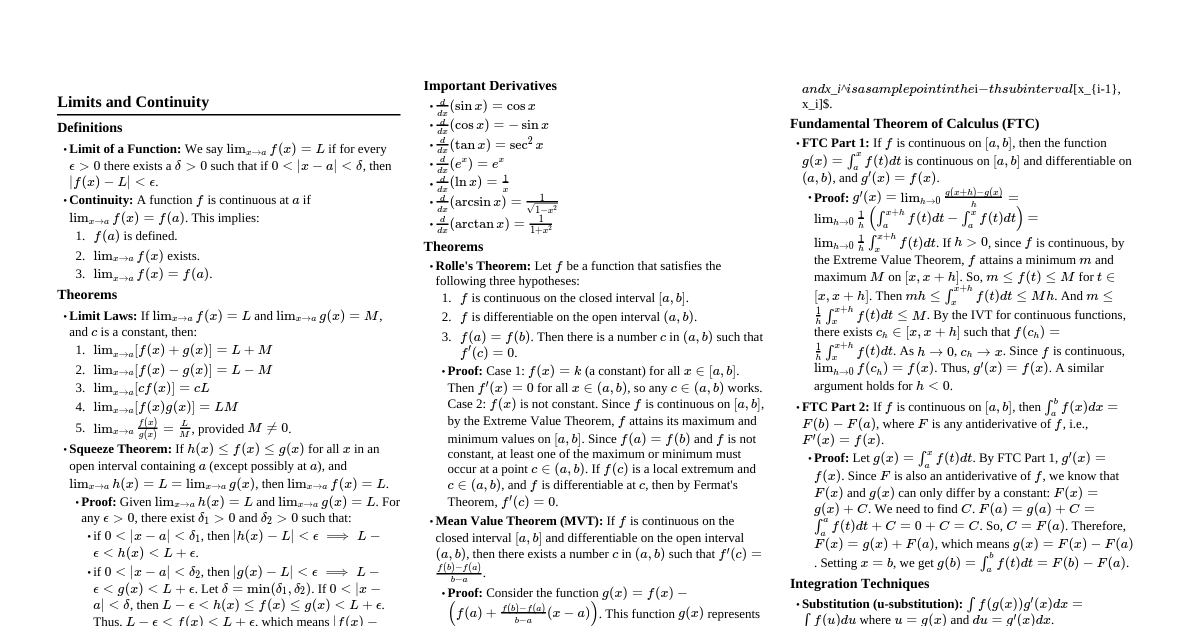
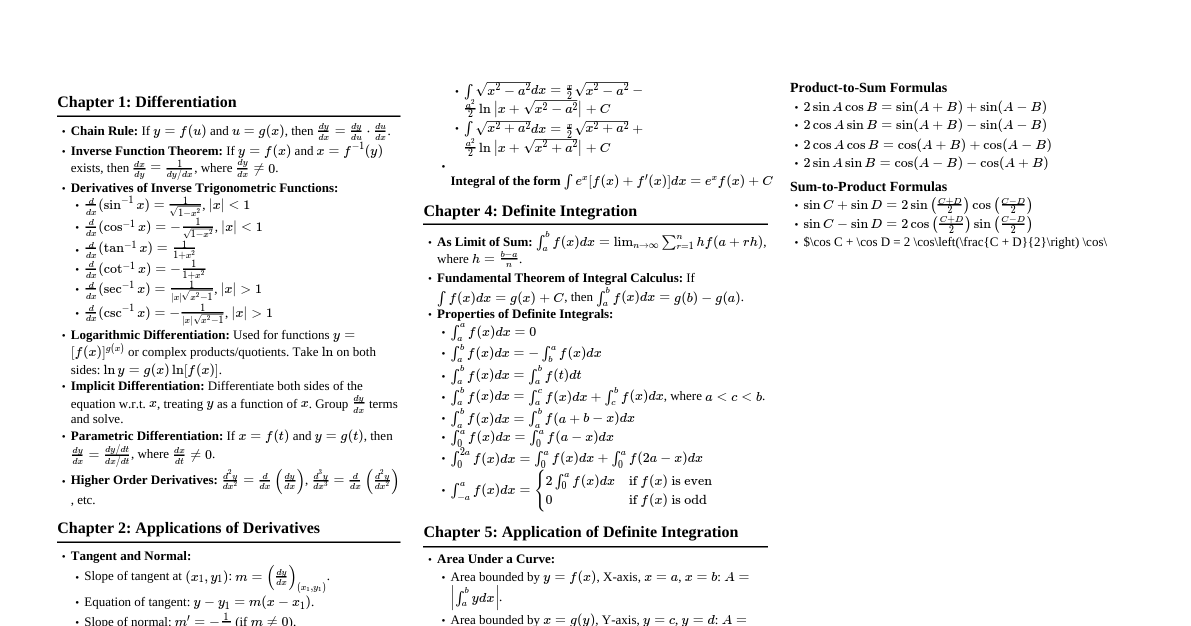
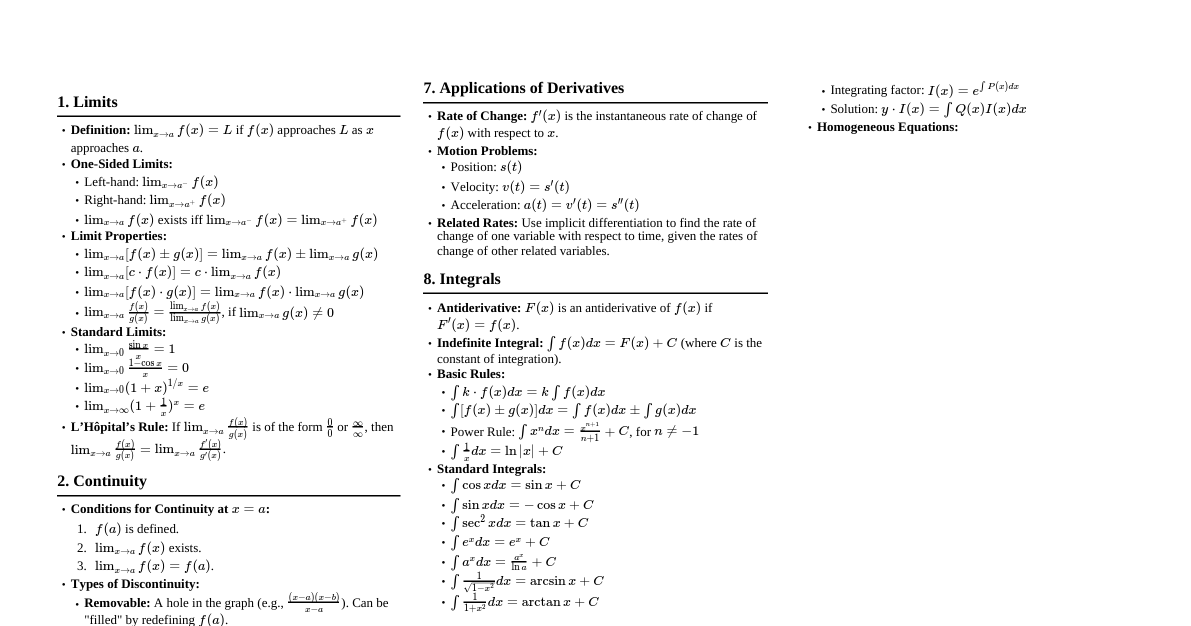
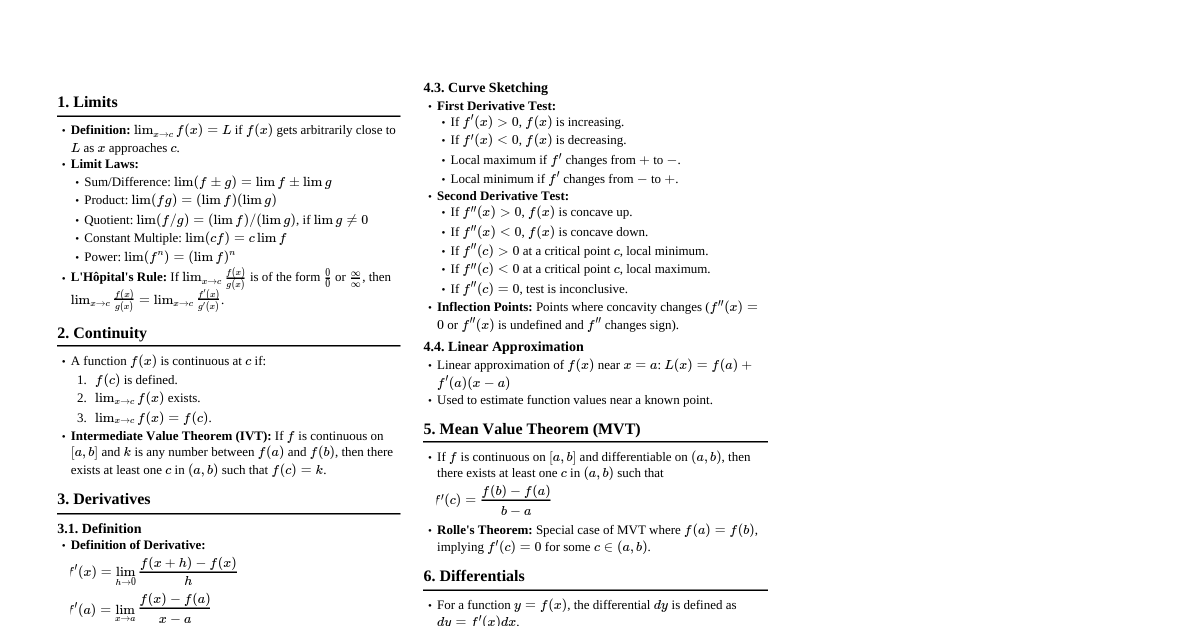
Definition of the Derivative Limit Definition: The derivative of a function $f(x)$ with respect to $x$ is given by: $$f'(x) = \lim_{h \to 0} \frac{f(x+h) - f(x)}{h}$$ provided the limit exists. Alternative Form: $$f'(a) = \lim_{x \to a} \frac{f(x) - f(a)}{x - a}$$ Interpretation: Slope of Tangent Line: $f'(a)$ is the slope of the tangent line to the graph of $f(x)$ at $x=a$. Instantaneous Rate of Change: $f'(x)$ represents the instantaneous rate of change of $f(x)$ with respect to $x$. Basic Differentiation Rules Constant Rule: If $c$ is a constant, then $\frac{d}{dx}(c) = 0$. Power Rule: $\frac{d}{dx}(x^n) = nx^{n-1}$ for any real number $n$. Constant Multiple Rule: $\frac{d}{dx}(cf(x)) = c \frac{d}{dx}(f(x))$. Sum/Difference Rule: $\frac{d}{dx}(f(x) \pm g(x)) = \frac{d}{dx}(f(x)) \pm \frac{d}{dx}(g(x))$. Product Rule: $\frac{d}{dx}(f(x)g(x)) = f'(x)g(x) + f(x)g'(x)$. Quotient Rule: $\frac{d}{dx}\left(\frac{f(x)}{g(x)}\right) = \frac{f'(x)g(x) - f(x)g'(x)}{[g(x)]^2}$. Chain Rule: $\frac{d}{dx}(f(g(x))) = f'(g(x)) \cdot g'(x)$. In Leibniz notation: $\frac{dy}{dx} = \frac{dy}{du} \cdot \frac{du}{dx}$ where $y=f(u)$ and $u=g(x)$. Derivatives of Common Functions Trigonometric Functions $\frac{d}{dx}(\sin x) = \cos x$ $\frac{d}{dx}(\cos x) = -\sin x$ $\frac{d}{dx}(\tan x) = \sec^2 x$ $\frac{d}{dx}(\cot x) = -\csc^2 x$ $\frac{d}{dx}(\sec x) = \sec x \tan x$ $\frac{d}{dx}(\csc x) = -\csc x \cot x$ Inverse Trigonometric Functions $\frac{d}{dx}(\arcsin x) = \frac{1}{\sqrt{1-x^2}}$ $\frac{d}{dx}(\arccos x) = -\frac{1}{\sqrt{1-x^2}}$ $\frac{d}{dx}(\arctan x) = \frac{1}{1+x^2}$ $\frac{d}{dx}(\text{arccot } x) = -\frac{1}{1+x^2}$ $\frac{d}{dx}(\text{arcsec } x) = \frac{1}{|x|\sqrt{x^2-1}}$ $\frac{d}{dx}(\text{arccsc } x) = -\frac{1}{|x|\sqrt{x^2-1}}$ Exponential and Logarithmic Functions $\frac{d}{dx}(e^x) = e^x$ $\frac{d}{dx}(a^x) = a^x \ln a$ $\frac{d}{dx}(\ln x) = \frac{1}{x}$ for $x > 0$ $\frac{d}{dx}(\log_a x) = \frac{1}{x \ln a}$ for $x > 0$ Higher-Order Derivatives Second Derivative: $f''(x) = \frac{d}{dx}(f'(x)) = \frac{d^2y}{dx^2}$. Represents concavity and acceleration. Third Derivative: $f'''(x) = \frac{d}{dx}(f''(x)) = \frac{d^3y}{dx^3}$. $n$-th Derivative: $f^{(n)}(x) = \frac{d^n y}{dx^n}$. Implicit Differentiation Used when $y$ is not explicitly defined as a function of $x$. Differentiate both sides of the equation with respect to $x$, treating $y$ as a function of $x$ (i.e., use the Chain Rule for terms involving $y$). Solve for $\frac{dy}{dx}$. Example: For $x^2 + y^2 = r^2$: $$2x + 2y \frac{dy}{dx} = 0 \implies \frac{dy}{dx} = -\frac{x}{y}$$ Related Rates Involves finding the rate at which one quantity changes by relating it to other quantities whose rates of change are known. Steps: Identify all quantities and given rates. Write an equation relating the quantities. Differentiate the equation implicitly with respect to time ($t$). Substitute known values and solve for the unknown rate. Applications of Derivatives Critical Points: Points where $f'(x)=0$ or $f'(x)$ is undefined. Candidates for local maxima/minima. First Derivative Test: If $f'(x)$ changes from $+$ to $-$ at $c$, $f(c)$ is a local maximum. If $f'(x)$ changes from $-$ to $+$ at $c$, $f(c)$ is a local minimum. If $f'(x)$ does not change sign, $f(c)$ is neither. Second Derivative Test: If $f'(c)=0$: If $f''(c) > 0$, $f(c)$ is a local minimum. If $f''(c) If $f''(c) = 0$, the test is inconclusive. Concavity: $f''(x) > 0 \implies$ Concave Up $f''(x) Inflection Points: Points where concavity changes ($f''(x)=0$ or $f''(x)$ is undefined and $f''(x)$ changes sign). Optimization: Using derivatives to find maximum or minimum values of a function. L'Hôpital's Rule: If $\lim_{x \to c} \frac{f(x)}{g(x)}$ is of the form $\frac{0}{0}$ or $\frac{\infty}{\infty}$, then $$\lim_{x \to c} \frac{f(x)}{g(x)} = \lim_{x \to c} \frac{f'(x)}{g'(x)}$$ provided the latter limit exists. Mean Value Theorem (MVT) If $f(x)$ is continuous on $[a, b]$ and differentiable on $(a, b)$, then there exists at least one $c$ in $(a, b)$ such that: $$f'(c) = \frac{f(b) - f(a)}{b - a}$$ Rolle's Theorem: A special case of MVT where if $f(a) = f(b)$, then there exists a $c$ in $(a, b)$ such that $f'(c) = 0$.