Aqueous Solutions Chemistry
Cheatsheet Content
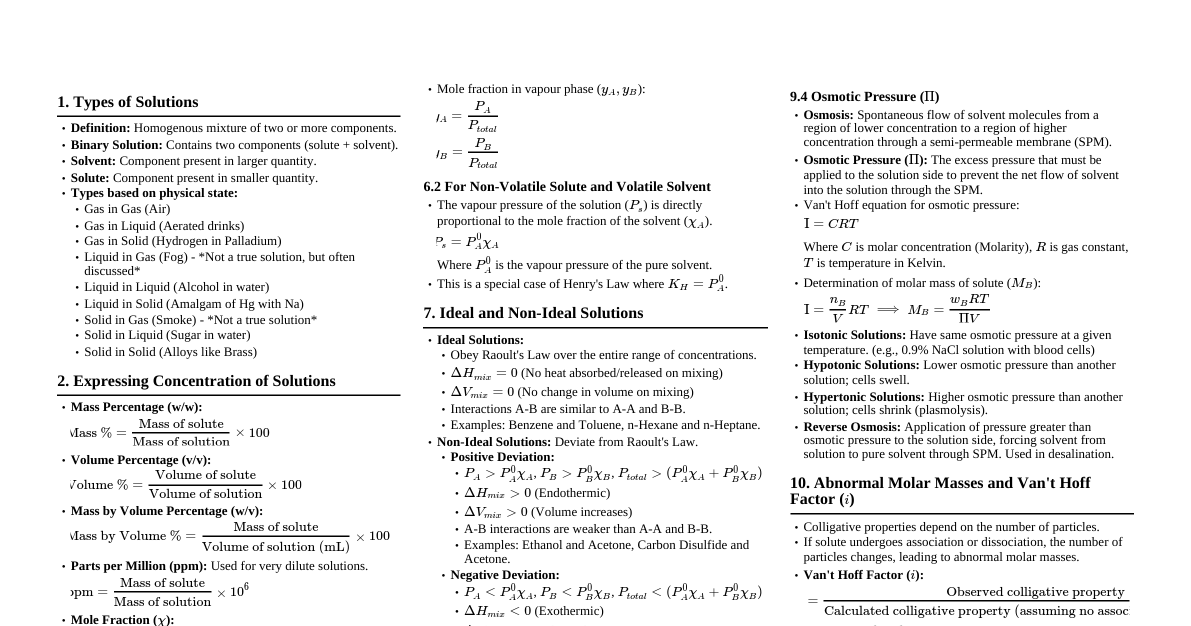
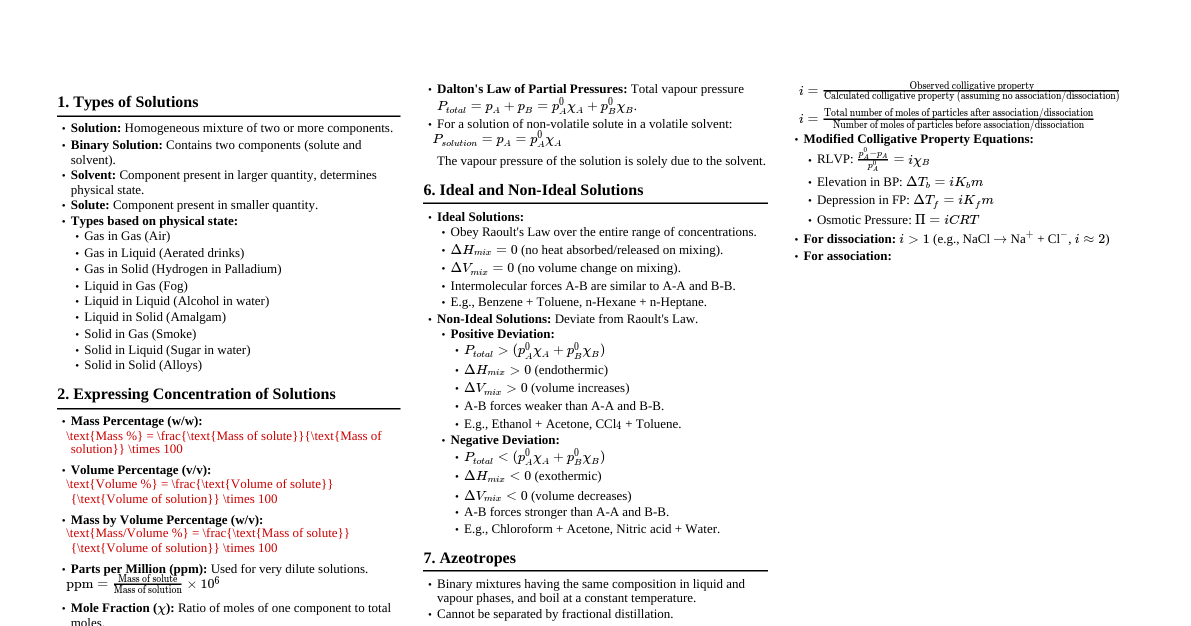
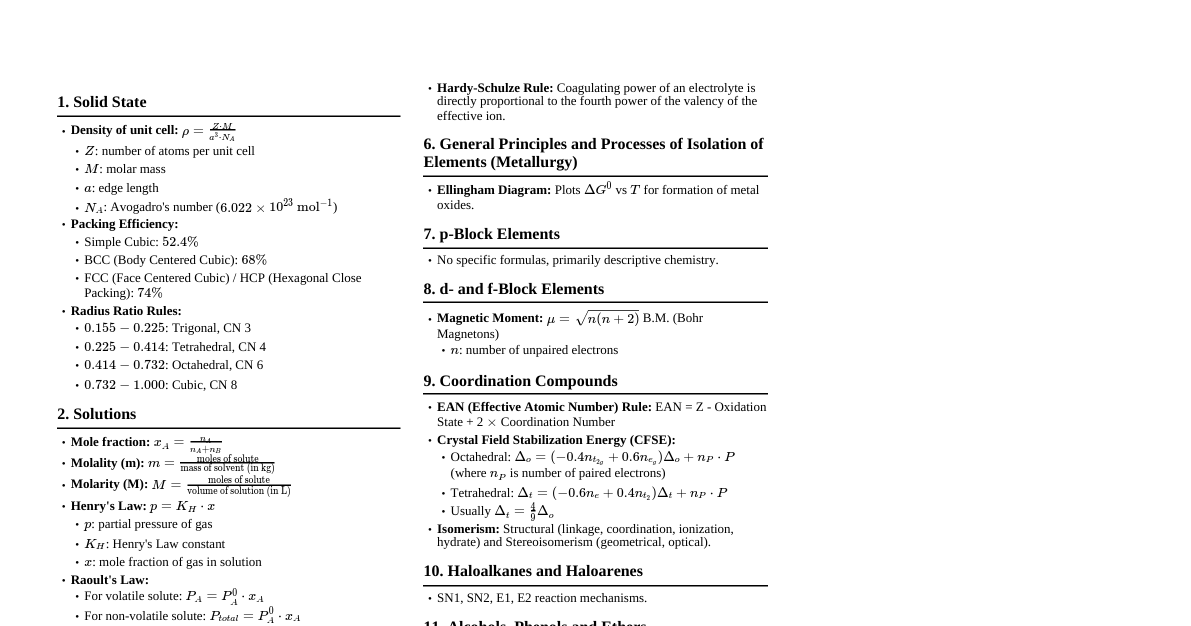
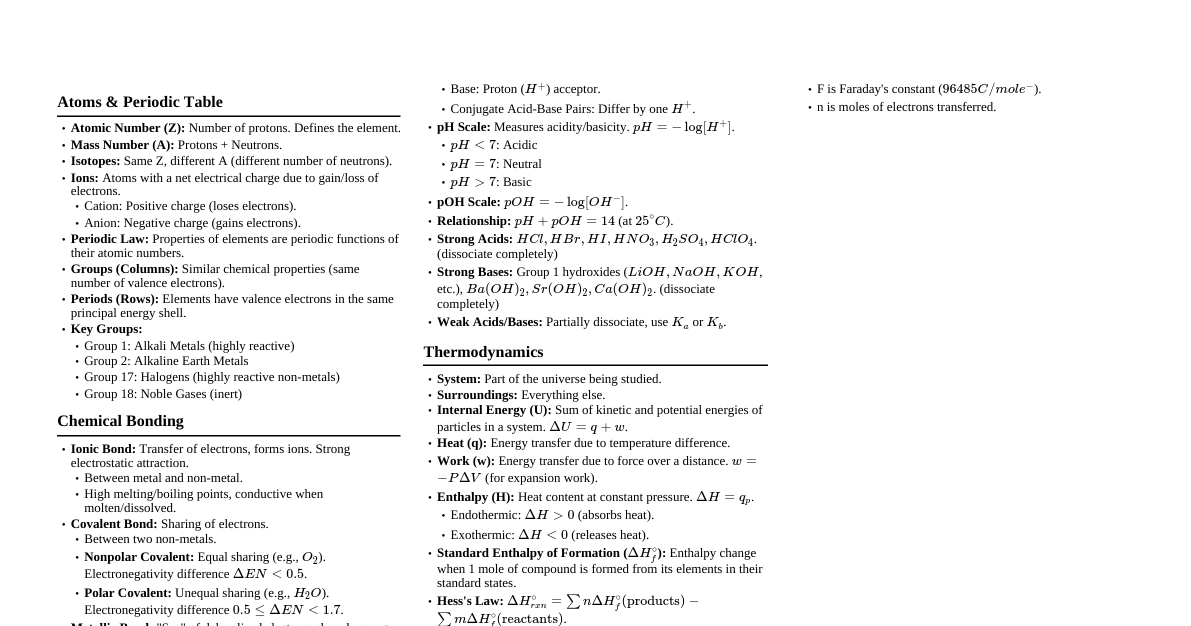
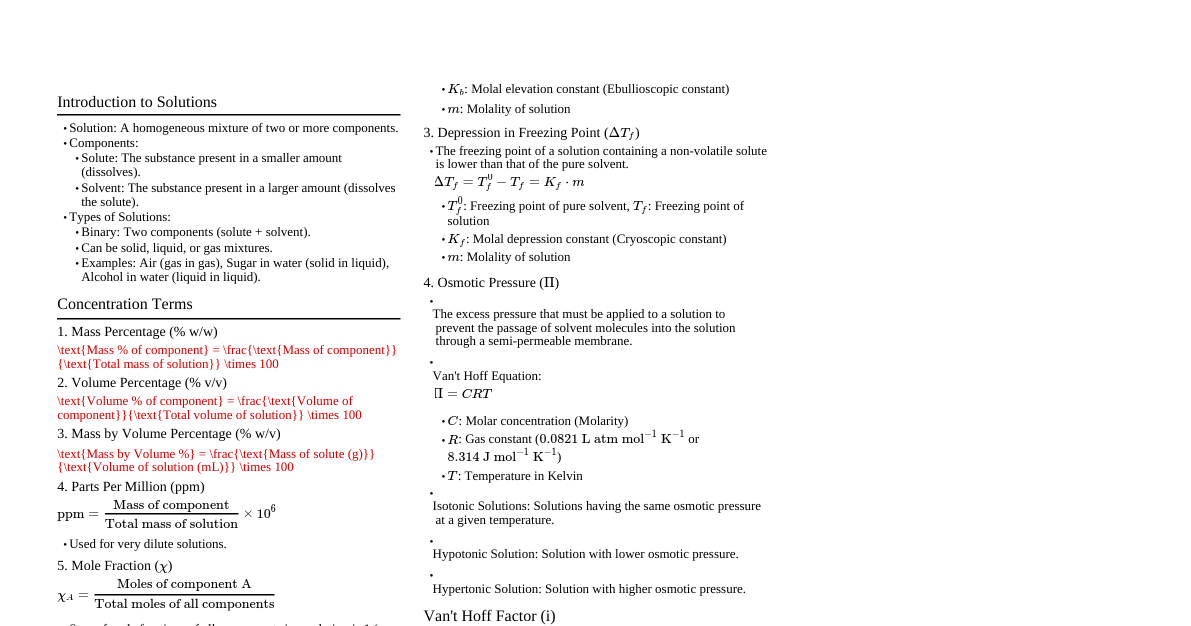
### Introduction to Aqueous Solutions - **Definition:** An aqueous solution is a solution in which the solvent is water. Water is often called the "universal solvent" due to its ability to dissolve many substances. - **Polarity of Water:** Water ($H_2O$) is a polar molecule. The oxygen atom is more electronegative than hydrogen, leading to partial negative ($\delta^-$) charge on oxygen and partial positive ($\delta^+$) charges on hydrogen. This polarity allows water to interact with and dissolve other polar and ionic substances. - **Hydrogen Bonding:** Water molecules form extensive hydrogen bonds with each other, which contributes to its high specific heat, high boiling point, and excellent solvent properties. ### Solubility Rules and Factors - **Solubility:** The maximum amount of solute that can dissolve in a given amount of solvent at a specific temperature and pressure. - **"Like Dissolves Like":** Polar solvents dissolve polar and ionic solutes; nonpolar solvents dissolve nonpolar solutes. - **General Solubility Rules for Ionic Compounds in Water:** - **Always Soluble:** Nitrates ($NO_3^-$), Acetates ($CH_3COO^-$), Group 1 metal ions ($Li^+, Na^+, K^+, Rb^+, Cs^+$), Ammonium ($NH_4^+$). - **Generally Soluble:** Chlorides ($Cl^-$), Bromides ($Br^-$), Iodides ($I^-$) (except with $Ag^+, Pb^{2+}, Hg_2^{2+}$). Sulfates ($SO_4^{2-}$) (except with $Ba^{2+}, Pb^{2+}, Hg_2^{2+}, Ca^{2+}, Sr^{2+}$). - **Generally Insoluble:** Carbonates ($CO_3^{2-}$), Phosphates ($PO_4^{3-}$), Sulfides ($S^{2-}$), Hydroxides ($OH^-$) (except with Group 1 metals, $NH_4^+$, and slightly with $Ca^{2+}, Sr^{2+}, Ba^{2+}$). - **Factors Affecting Solubility:** - **Temperature:** For most solids, solubility increases with temperature. For gases, solubility decreases with increasing temperature. - **Pressure:** For gases, solubility increases with increasing partial pressure of the gas above the solution (Henry's Law: $C = kP$). - **Nature of Solute/Solvent:** As described by "Like Dissolves Like". ### Concentration Units - **Molarity (M):** Moles of solute per liter of solution. $$M = \frac{\text{moles of solute}}{\text{liters of solution}}$$ - **Molality (m):** Moles of solute per kilogram of solvent. $$m = \frac{\text{moles of solute}}{\text{kilograms of solvent}}$$ - **Mass Percent (% w/w):** (Mass of solute / Mass of solution) $\times$ 100%. - **Volume Percent (% v/v):** (Volume of solute / Volume of solution) $\times$ 100%. - **Mole Fraction ($\chi$):** Moles of component / Total moles of all components. $$\chi_A = \frac{\text{moles of A}}{\text{total moles}}$$ - **Parts per Million (ppm):** (Mass of solute / Mass of solution) $\times 10^6$. Often used for very dilute solutions. ### Colligative Properties Properties of solutions that depend on the number of solute particles, not on their identity. - **Vapor Pressure Lowering (Raoult's Law):** The vapor pressure of a solvent above a solution is lower than that of the pure solvent. $$P_{solution} = \chi_{solvent} \cdot P_{solvent}^0$$ - **Boiling Point Elevation:** The boiling point of a solution is higher than that of the pure solvent. $$\Delta T_b = i \cdot K_b \cdot m$$ where $i$ is the van't Hoff factor (number of particles per formula unit of solute), $K_b$ is the molal boiling point elevation constant, and $m$ is molality. - **Freezing Point Depression:** The freezing point of a solution is lower than that of the pure solvent. $$\Delta T_f = i \cdot K_f \cdot m$$ where $K_f$ is the molal freezing point depression constant. - **Osmotic Pressure ($\Pi$):** The pressure required to stop osmosis (the net movement of solvent across a semipermeable membrane). $$\Pi = i \cdot M \cdot R \cdot T$$ where $M$ is molarity, $R$ is the ideal gas constant, and $T$ is temperature in Kelvin. ### Acids and Bases in Aqueous Solutions - **Arrhenius Definition:** - **Acid:** Produces $H^+$ ions (or $H_3O^+$) in water. - **Base:** Produces $OH^-$ ions in water. - **Brønsted-Lowry Definition:** - **Acid:** Proton ($H^+$) donor. - **Base:** Proton ($H^+$) acceptor. - **Strong vs. Weak:** - **Strong Acids/Bases:** Ionize completely in water (e.g., $HCl, NaOH$). - **Weak Acids/Bases:** Ionize partially in water, establishing equilibrium (e.g., $CH_3COOH, NH_3$). - **pH Scale:** Measures the acidity or basicity of an aqueous solution. $$pH = -\log[H_3O^+]$$ $$pOH = -\log[OH^-]$$ $$pH + pOH = 14$$ - **Neutralization Reaction:** The reaction between an acid and a base, typically producing a salt and water. $$Acid + Base \rightarrow Salt + Water$$ Example: $HCl(aq) + NaOH(aq) \rightarrow NaCl(aq) + H_2O(l)$ ### Redox Reactions in Aqueous Solutions - **Oxidation-Reduction (Redox):** Reactions involving the transfer of electrons. - **Oxidation:** Loss of electrons (LEO - Lose Electrons Oxidation). Oxidation number increases. - **Reduction:** Gain of electrons (GER - Gain Electrons Reduction). Oxidation number decreases. - **Oxidizing Agent:** The species that is reduced (causes oxidation). - **Reducing Agent:** The species that is oxidized (causes reduction). - **Balancing Redox Reactions (Half-Reaction Method):** 1. Separate into half-reactions (oxidation and reduction). 2. Balance atoms other than O and H. 3. Balance O atoms by adding $H_2O$. 4. Balance H atoms by adding $H^+$ (for acidic solutions) or $H_2O$ and $OH^-$ (for basic solutions). 5. Balance charge by adding electrons ($e^-$). 6. Multiply half-reactions to equalize electrons. 7. Add half-reactions and cancel common species.