Kinematics (Class 11)
Cheatsheet Content
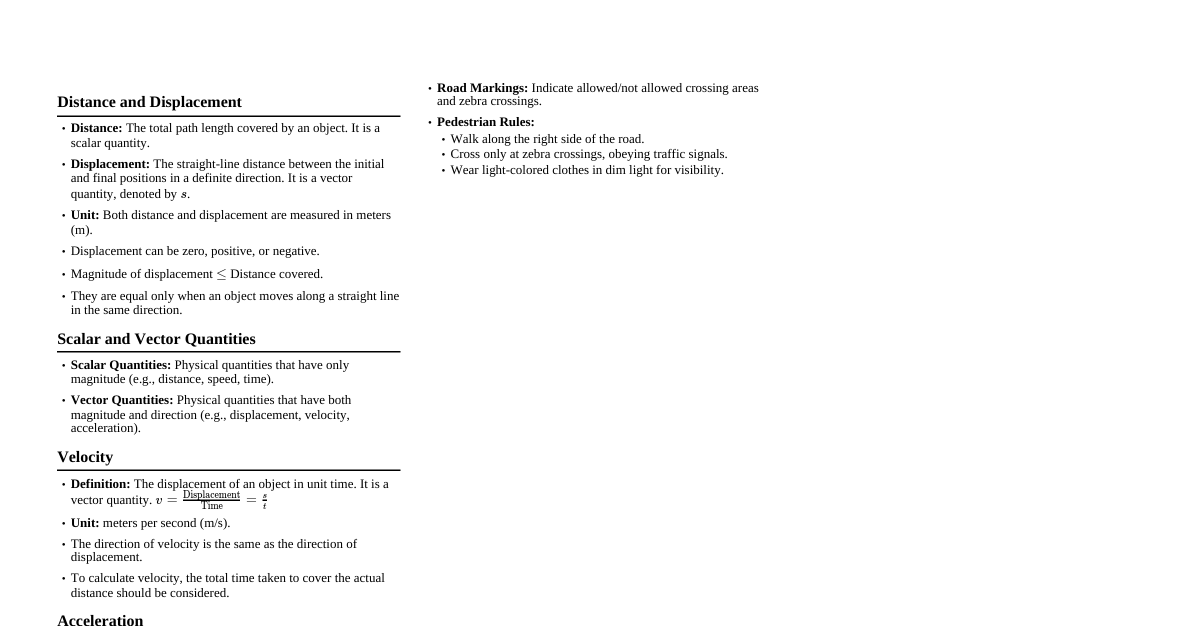
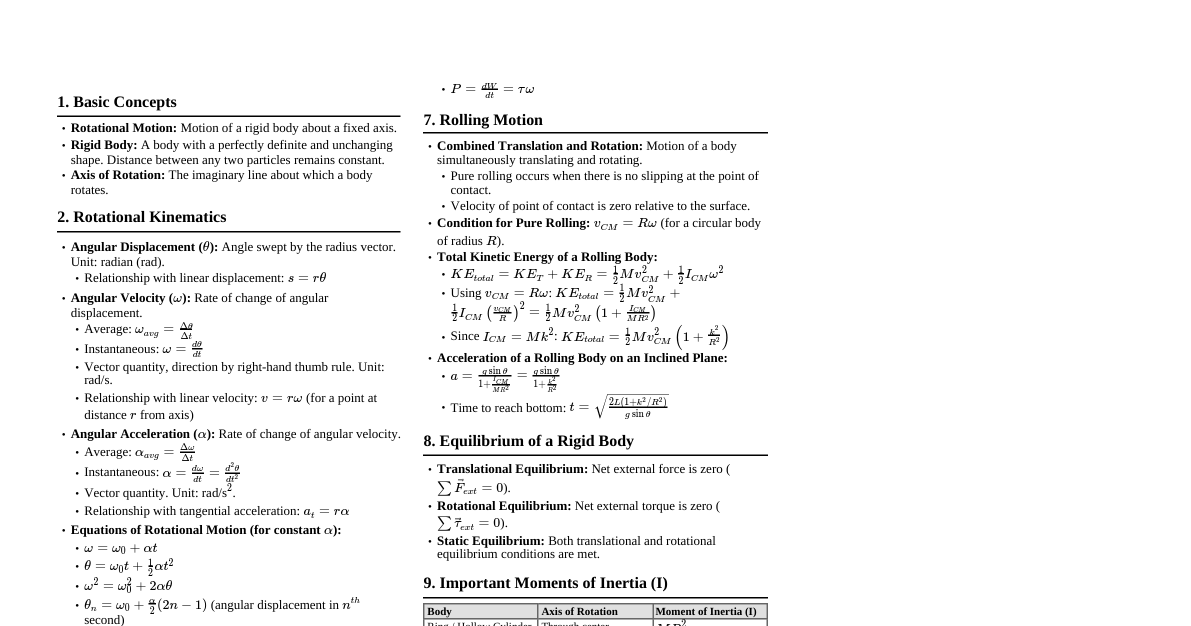
1. Introduction to Motion Mechanics: Study of motion of objects. Statics: Objects at rest. Kinematics: Motion without considering cause (force). Dynamics: Motion considering cause (force). Rest: Position relative to surroundings does not change. Motion: Position relative to surroundings changes. Point Object: Object size is negligible compared to distance traveled. 2. Position, Distance, and Displacement Position: Location of an object with respect to an origin. Distance: Total path length covered by an object. Scalar quantity. Always positive. Displacement: Change in position vector, shortest distance between initial and final points. Vector quantity. Can be positive, negative, or zero. Displacement $\Delta \vec{x} = \vec{x}_f - \vec{x}_i$. Magnitude of displacement $\le$ Distance. 3. Speed and Velocity 3.1 Speed Definition: Rate of change of distance. Scalar quantity. Units: m/s. Average Speed: $v_{avg} = \frac{\text{Total Distance}}{\text{Total Time}}$. Instantaneous Speed: Speed at a particular instant. Magnitude of instantaneous velocity. 3.2 Velocity Definition: Rate of change of displacement. Vector quantity. Units: m/s. Average Velocity: $\vec{v}_{avg} = \frac{\text{Total Displacement}}{\text{Total Time}} = \frac{\Delta \vec{x}}{\Delta t}$. Instantaneous Velocity: $\vec{v} = \lim_{\Delta t \to 0} \frac{\Delta \vec{x}}{\Delta t} = \frac{d\vec{x}}{dt}$. Slope of position-time graph. 4. Acceleration Definition: Rate of change of velocity. Vector quantity. Units: m/s$^2$. Average Acceleration: $\vec{a}_{avg} = \frac{\text{Change in Velocity}}{\text{Time Interval}} = \frac{\Delta \vec{v}}{\Delta t}$. Instantaneous Acceleration: $\vec{a} = \lim_{\Delta t \to 0} \frac{\Delta \vec{v}}{\Delta t} = \frac{d\vec{v}}{dt} = \frac{d^2\vec{x}}{dt^2}$. Slope of velocity-time graph. Retardation/Deceleration: Negative acceleration (velocity decreasing). 5. Equations of Motion (for Uniform Acceleration) These equations apply when acceleration ($a$) is constant. Let $u$ = initial velocity, $v$ = final velocity, $a$ = acceleration, $t$ = time, $s$ = displacement. $v = u + at$ $s = ut + \frac{1}{2}at^2$ $v^2 = u^2 + 2as$ Displacement in $n^{th}$ second: $s_n = u + \frac{a}{2}(2n-1)$ 6. Motion Under Gravity When an object moves freely under gravity, $a = g$ (acceleration due to gravity). Near Earth's surface, $g \approx 9.8 \text{ m/s}^2$ (or $10 \text{ m/s}^2$ for approximations). For upward motion, $a = -g$. For downward motion, $a = +g$. 6.1 Vertically Upward Motion $v = u - gt$ $h = ut - \frac{1}{2}gt^2$ $v^2 = u^2 - 2gh$ At maximum height ($H_{max}$), $v=0$. So, $H_{max} = \frac{u^2}{2g}$. Time to reach max height: $t_{asc} = \frac{u}{g}$. 6.2 Vertically Downward Motion (from rest) If dropped ($u=0$): $v = gt$ $h = \frac{1}{2}gt^2$ $v^2 = 2gh$ 7. Graphs of Motion 7.1 Position-Time (x-t) Graph Slope: Gives velocity. ($v = dx/dt$) Straight line: Uniform velocity. Curved line: Non-uniform velocity (acceleration). Horizontal line: Object at rest. 7.2 Velocity-Time (v-t) Graph Slope: Gives acceleration. ($a = dv/dt$) Area under curve: Gives displacement. ($\Delta x = \int v dt$) Straight line (non-horizontal): Uniform acceleration. Horizontal line: Uniform velocity (zero acceleration). 7.3 Acceleration-Time (a-t) Graph Area under curve: Gives change in velocity. ($\Delta v = \int a dt$) 8. Relative Velocity Relative Velocity of A with respect to B: $\vec{v}_{AB} = \vec{v}_A - \vec{v}_B$. Relative Velocity of B with respect to A: $\vec{v}_{BA} = \vec{v}_B - \vec{v}_A$. Magnitude of relative velocity for 1D motion: Objects moving in same direction: $|v_A - v_B|$. Objects moving in opposite direction: $|v_A + v_B|$. 9. Projectile Motion Motion in 2D under constant acceleration (gravity). Horizontal motion: Uniform velocity. ($a_x = 0$) Vertical motion: Uniform acceleration. ($a_y = -g$) 9.1 Projectile Fired Horizontally (from height $h$) Initial velocity: $\vec{u} = u_x \hat{i}$ ($u_y = 0$). Horizontal distance (Range): $R = u_x t$. Time of flight: $t = \sqrt{\frac{2h}{g}}$. Vertical velocity at ground: $v_y = gt = \sqrt{2gh}$. Resultant velocity at ground: $v = \sqrt{u_x^2 + v_y^2}$. 9.2 Projectile Fired at Angle $\theta$ with Horizontal Initial velocity components: $u_x = u \cos\theta$, $u_y = u \sin\theta$. Time of Flight ($T$): $T = \frac{2u \sin\theta}{g}$. Maximum Height ($H_{max}$): $H_{max} = \frac{u^2 \sin^2\theta}{2g}$. Horizontal Range ($R$): $R = \frac{u^2 \sin(2\theta)}{g}$. Maximum Range at $\theta = 45^\circ$. $R_{max} = \frac{u^2}{g}$. Range is same for $\theta$ and $(90^\circ - \theta)$. Equation of Trajectory: $y = x \tan\theta - \frac{g x^2}{2u^2 \cos^2\theta}$. Velocity at time $t$: $v_x = u \cos\theta$ $v_y = u \sin\theta - gt$ $v = \sqrt{v_x^2 + v_y^2}$