Charge of GST Essentials
Cheatsheet Content
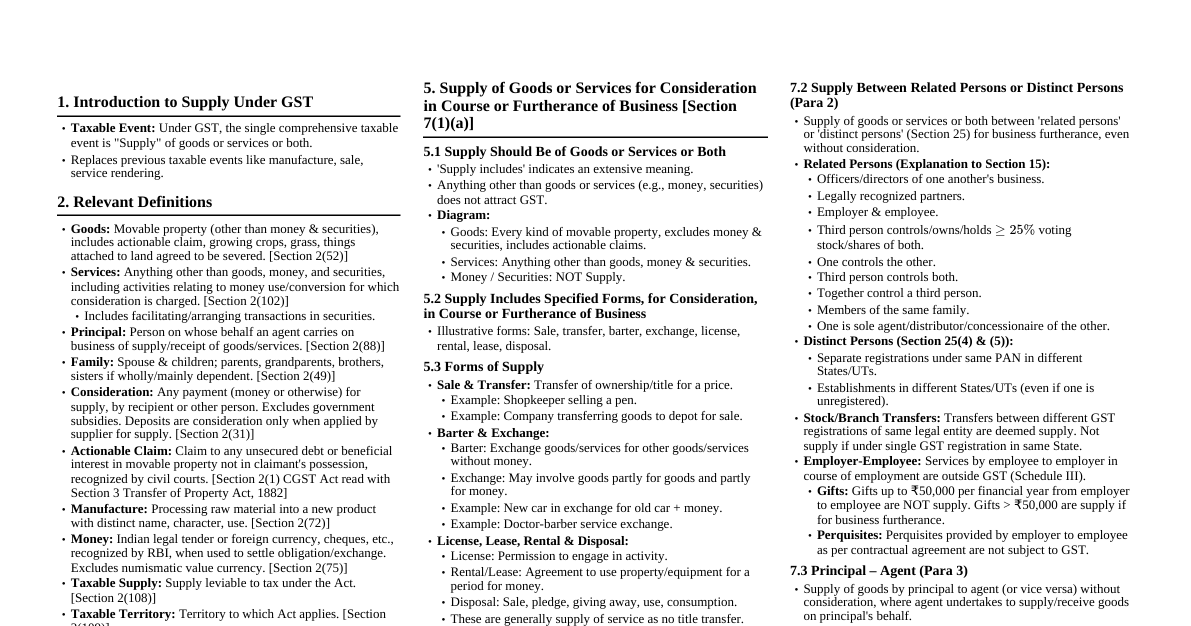
1. Introduction to GST Power to levy tax is from the Constitution of India. 101st Constitutional Amendment Act, 2016 paved the way for GST. Taxable event under GST is SUPPLY . CGST and SGST/UTGST are levied on intra-State supplies . IGST is levied on inter-State supplies . Intra-State supply: Location of supplier and place of supply are in the same State/Union territory. Inter-State supply: Location of supplier and place of supply are in two different States, two different Union Territories, or a State and a Union territory. 2. Relevant Definitions Central tax: CGST levied under Section 9 of CGST Act [Section 2(21)]. Integrated tax: IGST levied under IGST Act. State tax: Tax levied under any State Goods and Services Tax Act [Section 2(104)]. Goods: All movable property except money and securities; includes actionable claims, growing crops, etc. [Section 2(52)]. Electronic Commerce: Supply of goods, services, or both (including digital products) over digital/electronic networks [Section 2(44)]. Electronic Commerce Operator: Person owning, operating, or managing a digital/electronic facility for e-commerce [Section 2(45)]. Exempt supply: Supply of goods/services with nil tax rate or wholly exempt from tax; includes non-taxable supply [Section 2(47)]. Non-taxable supply: Supply of goods/services not leviable to tax under this Act or IGST Act [Section 2(79)]. Aggregate turnover: Aggregate value of all taxable supplies (excluding inward supplies on which RCM applies), exempt supplies, exports, and inter-State supplies of persons with same PAN, computed on all India basis. Excludes central tax, State tax, Union territory tax, IGST, and cess [Section 2(6)]. Business: Includes any trade, commerce, manufacture, profession, vocation, adventure, wager or similar activity, whether or not for pecuniary benefit; activities incidental or ancillary to these; supply or acquisition of goods/services in connection with commencement or closure of business; provision by clubs/associations/societies; admission for consideration; services by office holders; race club activities; activities by Central/State Government or local authority as public authorities [Section 2(17)]. Consideration: Any payment (money or otherwise) for supply of goods/services; excludes subsidies from Central/State Government. Monetary value of any act or forbearance for supply; excludes subsidies from Central/State Government. Deposits are not consideration unless applied as such [Section 2(31)]. Person: Includes individuals, HUFs, companies, firms, LLPs, associations of persons/bodies of individuals, corporations, co-operative societies, local authorities, Central/State Governments, societies, trusts, and artificial juridical persons [Section 2(84)]. Recipient: Where consideration is payable: Person liable to pay consideration. Where no consideration is payable (goods): Person to whom goods are delivered/made available, or to whom possession/use is given. Where no consideration is payable (service): Person to whom service is rendered. Includes agent acting on behalf of recipient [Section 2(93)]. Registered Person: Person registered under Section 25, excluding those with unique identity number. Reverse charge: Liability to pay tax by recipient instead of supplier for notified goods/services under Section 9(3)/9(4) of CGST Act or Section 5(3)/5(4) of IGST Act [Section 2(98)]. Services: Anything other than goods, money, securities; includes activities relating to use/conversion of money for separate consideration. Includes facilitating/arranging transactions in securities [Section 2(102)]. Taxable supply: Supply of goods/services leviable to tax under CGST Act [Section 2(108)]. Taxable person: Person registered or liable to be registered under Section 22 or 24 of CGST Act [Section 2(107)]. (Includes unregistered persons liable to be registered, and voluntarily registered persons). 3. Extent & Commencement of GST Law Central Goods and Services Tax Act, 2017: Extends to the whole of India [Section 1 of CGST Act]. India: Territory as per Article 1 of the Constitution, its territorial waters, seabed, sub-soil, continental shelf, exclusive economic zone, other maritime zones (Territorial Waters, Continental Shelf, Exclusive Economic Zone and other Maritime Zones Act, 1976), and airspace above these [Section 2(56) of CGST Act]. Territorial Waters: 12 NM Contiguous Zone: 24 NM Exclusive Economic Zone: 200 NM State GST law: Extends to the whole of the respective State/Union Territory with Legislature (Delhi, Puducherry, Jammu & Kashmir). Integrated Goods and Services Tax Act, 2017: Extends to the whole of India [Section 1 of IGST Act]. Union Territory Goods and Services Tax Act, 2017: Extends to Union Territories without Legislature (Andaman & Nicobar Islands, Lakshadweep, Dadra & Nagar Haveli and Daman & Diu, Ladakh, Chandigarh, and other territory) [Section 1 of UTGST Act]. 4. Levy & Collection of CGST & IGST (Section 9 of CGST Act & Section 5 of IGST Act) 4.1. Statutory Provisions - CGST Act, Section 9 Sub-section Particulars (1) Levy of CGST on all intra-State supplies of goods/services (except alcoholic liquor for human consumption), on value determined under Section 15, at rates not exceeding 20% (as notified by Government on Council's recommendations), collected as prescribed, paid by taxable person. (2) CGST on petroleum crude, high speed diesel, motor spirit (petrol), natural gas, aviation turbine fuel to be levied from a date notified by Government on Council's recommendations. (3) Government may notify categories of goods/services where tax is paid on reverse charge basis by the recipient. All CGST Act provisions apply to recipient as if they are the person liable for tax. (4) Government may notify registered persons who shall pay tax on reverse charge basis for specified goods/services received from an unregistered supplier. All CGST Act provisions apply to recipient as if they are the person liable for tax. (5) Government may notify categories of services where tax on intra-State supplies is paid by the electronic commerce operator (ECO) if supplied through it. All CGST Act provisions apply to ECO as if it is the supplier liable for tax. 4.2. Statutory Provisions - IGST Act, Section 5 Sub-section Particulars (1) Levy of IGST on all inter-State supplies of goods/services (except alcoholic liquor for human consumption), on value determined under Section 15 of CGST Act, at rates not exceeding 40% (as notified by Government on Council's recommendations), collected as prescribed, paid by taxable person. (2) IGST on petroleum crude, high speed diesel, motor spirit (petrol), natural gas, aviation turbine fuel to be levied from a date notified by Government on Council's recommendations. (3) Government may notify categories of goods/services where tax is paid on reverse charge basis by the recipient. All IGST Act provisions apply to recipient as if they are the person liable for tax. (4) Government may notify registered persons who shall pay tax on reverse charge basis for specified goods/services received from an unregistered supplier. All IGST Act provisions apply to recipient as if they are the person liable for tax. (5) Government may notify categories of services where tax on inter-State supplies is paid by the electronic commerce operator (ECO) if supplied through it. All IGST Act provisions apply to ECO as if it is the supplier liable for tax. Proviso: If ECO has no physical presence in taxable territory, its representative is liable to pay tax. If no physical presence and no representative, ECO must appoint a person in taxable territory to pay tax. 4.3. Analysis of Levy & Collection CGST: Levied on all intra-State supplies of goods/services. Tax collected and paid by taxable person. Excludes alcoholic liquor for human consumption. Max rate 20%. IGST: Levied on inter-State supplies of goods/services. Tax collected and paid by taxable person. Excludes alcoholic liquor for human consumption. IGST is sum of CGST and SGST/UTGST. Max rate 40%. Value for Levy: Transaction value under Section 15 of CGST Act. Items not yet levied CGST/IGST: Petroleum crude, high speed diesel, motor spirit (petrol), natural gas, aviation turbine fuel. Will be levied from future notified date. 4.4. Tax Payable Under Reverse Charge Mechanism (RCM) CGST/IGST paid by the recipient, not the supplier, in the following cases: Supply of goods/services notified by the Government. Supply of specified goods/services by an unregistered supplier to specified registered persons. Concept of RCM: Generally, supplier pays GST. Under RCM, recipient pays GST. Statutory liability (registration, tax deposit, returns) shifts from supplier to recipient. Types of RCM Scenarios: Supply of specified goods/services (Section 9(3) CGST/SGST/UTGST Act, Section 5(3) IGST Act). Supply of specified goods/services by unregistered supplier to registered recipient (Section 9(4) CGST Act, Section 5(4) IGST Act). Goods/Services Notified Under RCM (Section 9(3) CGST Act / Section 5(3) IGST Act): A. Supplies of goods taxable under RCM: Examples include cashewnuts, bidi wrapper leaves, tobacco leaves, raw cotton (from agriculturist to registered person), lottery (from State Govt. etc. to distributor), silk yarn, used vehicles, seized/confiscated goods, old/used goods, waste/scrap (from Govt. to registered person), priority sector lending certificates. (These are for knowledge, not examination). B. Supplies of services taxable under RCM: Goods Transport Agency (GTA) services: Supplier: GTA. Recipient: Any factory, society, co-operative society, registered person, body corporate, partnership firm, or casual taxable person, located in the taxable territory. RCM not applicable if: Supplier registered under CGST Act and opts to pay tax under forward charge, and issues tax invoice charging CGST at applicable rates with declaration. RCM also not applicable for services to: Central/State Govt. Depts./establishments, local authorities, Governmental agencies, registered only for TDS under Section 51 and not for making taxable supply. Tax Rates for GTA: @ 5% (2.5% CGST + 2.5% SGST/UTGST or 5% IGST) if GTA has NOT taken ITC on goods/services used in supplying GTA service. If GTA exercises option to pay GST: Person liable to pay GST is GTA (Forward charge). If GTA does NOT exercise option to pay GST: GST is payable by recipient (Reverse charge). @ 12% (6% CGST + 6% SGST/UTGST or 12% IGST) if GTA exercises option to pay GST. No restriction on availing ITC. Person liable to pay GST is GTA (Forward charge). Recipient of GTA service: Person who pays/is liable to pay freight for transport of goods by road in goods carriage, located in taxable territory. Services by individual advocate, senior advocate or firm of advocates: Supplier: Individual advocate, senior advocate, or firm of advocates. Recipient: Any business entity located in the taxable territory. Legal service: Advice, consultancy, assistance in law, representational services before court/tribunal/authority. Services by an arbitral tribunal: Supplier: Arbitral tribunal. Recipient: Any business entity located in the taxable territory. Services by way of sponsorship: Supplier: Any person. Recipient: Any body corporate or partnership firm located in the taxable territory. Services by Central Government, State Government, Union territory or local authority to a business entity (excluding specified services): Supplier: Central Govt., State Govt., Union territory, or local authority. Recipient: Any business entity located in the taxable territory. Excluded services: Renting of immovable property. Services by Department of Posts and Ministry of Railways (Indian Railways). Services related to an aircraft or vessel (inside or outside precincts of port/airport). Transport of goods or passengers. Services by Central Government (excluding Ministry of Railways), State Government, Union territory or local authority by way of renting of immovable property to a registered person: Supplier: Central Govt. (excluding Ministry of Railways), State Govt., Union territory, or local authority. Recipient: Any registered person under CGST Act, 2017. Service by way of renting of residential dwelling to a registered person: Supplier: Any person. Recipient: Any registered person. Services by way of renting of any immovable property other than residential dwelling: Supplier: Any unregistered person. Recipient: Any registered person. Services by a director of a company/body corporate: Supplier: A director of a company/body corporate. Recipient: The said company/body corporate located in the taxable territory. Director's remuneration: Taxable if declared separately other than salaries and subject to TDS u/s 194J of IT Act (fees for professional/technical services). Not taxable if declared as salaries and subject to TDS u/s 192 of IT Act (employer-employee relationship). Only services supplied in capacity of director are taxable under RCM. Services in private capacity (e.g., renting immovable property) are not under RCM. Services by an insurance agent: Supplier: An insurance agent. Recipient: Any person carrying on insurance business, located in the taxable territory. Services by a recovery agent: Supplier: A recovery agent. Recipient: A banking company/financial institution or a non-banking financial company, located in the taxable territory. Supply of services by music composer, photographer, artist or the like by way of transfer/permitting use/enjoyment of copyright under Section 13(1)(a) of Copyright Act, 1957 (dramatic, musical, artistic works): Supplier: Music composer, photographer, artist, or the like. Recipient: Music company, producer or the like, located in the taxable territory. Supply of services by an author by way of transfer/permitting use/enjoyment of copyright under Section 13(1)(a) of Copyright Act, 1957 (original literary works): Supplier: Author. Recipient: Publisher located in the taxable territory. Author can opt for forward charge if: Registered under CGST Act, files declaration to pay CGST under Section 9(1) (cannot withdraw for 1 year), and issues tax invoice with prescribed declaration. Supply of services by members of Overseeing Committee constituted by RBI: Supplier: Members of Overseeing Committee. Recipient: RBI. Services by individual Direct Selling Agents (DSAs) (other than body corporate, partnership or LLP firm) to bank or non-banking financial company (NBFCs): Supplier: Individual DSAs (other than body corporate, partnership or LLP firm). Recipient: A banking company or an NBFC, located in the taxable territory. Services by business facilitator to a banking company: Supplier: Business facilitator. Recipient: A banking company, located in the taxable territory. Services by an agent of business correspondent to business correspondent: Supplier: An agent of business correspondent. Recipient: A business correspondent, located in the taxable territory. Security services (supply of security personnel) by any person (other than a body corporate) to a registered person: Supplier: Any person other than a body corporate. Recipient: A registered person. RCM not applicable if: Recipient is a Department/Establishment of Central/State Govt., local authority, or Governmental agency, registered only for TDS and not for making taxable supply. Services by way of renting of any motor vehicle designed to carry passengers where cost of fuel is included in consideration, provided to a body corporate: Supplier: Any person other than a body corporate who supplies service to a body corporate and doesn't issue an invoice charging CGST @ 6% to service recipient. Recipient: Any body corporate located in the taxable territory. Tax Rates for Renting Motor Vehicle: @ 5% (2.5% CGST + 2.5% SGST/UTGST or 5% IGST) if supplier has taken only limited ITC (input services in same line of business). If supplier is Body Corporate: Person liable to pay GST is Supplier (Forward charge). If supplier is other than Body Corporate, and recipient is Body Corporate: Person liable to pay GST is Recipient (Reverse charge). If supplier is other than Body Corporate, and recipient is other than Body Corporate: GST is exempt. @ 12% (6% CGST + 6% SGST/UTGST or 12% IGST) if supplier opts to pay GST at said rate. No restriction on availing ITC. Person liable to pay GST is Supplier (Forward charge). Distinction between Renting Motor Vehicle and Passenger Transport: Renting: Renter defines how/when vehicle operated, schedules, routes. RCM applies if body corporate hires for a period (e.g., employee transport). Passenger Transport: Pre-determined routes/schedules. RCM does NOT apply if body corporate avails for specific journeys. Services of lending of securities under Securities Lending Scheme, 1997: Supplier: Lender (person who deposits securities). Recipient: Borrower (person who borrows securities through approved intermediary of SEBI). Tax Payable by ECO on Notified Services (Section 9(5) CGST Act / Section 5(5) IGST Act): Government may notify specific services where ECO pays tax if supplied through it. All provisions apply to ECO as if it is the supplier. Notified services: Transportation of passengers by radio-taxi, motorcab, maxicab, motor cycle, or any other motor vehicle (except omnibus). Transportation of passengers by an omnibus (except where company supplying service through ECO is liable). Accommodation in hotels, inns, guest houses, clubs, campsites, etc. (except where person supplying service through ECO is liable for registration under Section 22(1)). House-keeping services (plumbing, carpentering, etc.) (except where person supplying service through ECO is liable for registration under Section 22(1)). Restaurant service (other than services by restaurants at specified premises). ECO's liability: ECO pays tax on all restaurant services supplied through it, including from unregistered persons. ECO not required to collect TCS for restaurant services. ECO not required to take separate registration for paying tax on restaurant service. Aggregate turnover of person supplying restaurant services through ECO includes their supplies through ECO. Restaurant services through ECO are not inward supply for ECOs liable to RCM. ECO not required to reverse proportionate ITC on input goods/services for restaurant services. ECO to raise invoice for restaurant service. Person liable to pay GST for specified services when supplied through ECO: If ECO located in taxable territory: ECO. If ECO has no physical presence in taxable territory: Person representing ECO. If ECO has no physical presence nor representative: Person appointed by ECO. 5. Composition Levy (Section 10 of CGST Act) Alternative method of tax for small taxpayers to simplify compliance. 5.1. Statutory Provisions Sub-section Particulars (1) Registered person (aggregate turnover in preceding FY not exceeding ₹50 lakh) may opt to pay tax at prescribed rates (not exceeding): Manufacturer: 1% of turnover in State/UT. Persons making supplies under Schedule II (restaurant service): 2.5% of turnover in State/UT. (Effective rate 5%) Other suppliers: 0.5% of turnover in State/UT. (Effective rate 1%) Government may increase limit up to ₹1.5 crore. Proviso: May supply services (other than Schedule II, para 6(b)) up to 10% of turnover in preceding FY or ₹5 lakh, whichever is higher. Explanation: Value of exempt supply of services (deposits, loans, advances) by way of interest/discount not included for turnover limit for services. (2) Eligibility conditions for composition levy under Section 10(1): Registered person is NOT: Engaged in supply of services (save as provided in proviso to 10(1)). Engaged in supply of goods/services not leviable to tax. Engaged in inter-State outward supplies of goods/services. Supplying through ECO required to collect TCS u/s 52. Manufacturer of notified goods (ice cream, pan masala, tobacco, aerated waters, fly ash bricks, etc.). Casual taxable person or non-resident taxable person. Proviso: All registered persons with same PAN must opt for composition scheme. (2A) Registered person not eligible under 10(1) & 10(2), whose aggregate turnover in preceding FY did not exceed ₹50 lakh, may opt to pay tax at 3% of turnover in State/UT (Effective rate 6%), if NOT: Engaged in supply of goods/services not leviable to tax. Engaged in inter-State outward supplies of goods/services. Supplying through ECO required to collect TCS u/s 52. Manufacturer of notified goods/supplier of notified services. Casual taxable person or non-resident taxable person. Proviso: All registered persons with same PAN must opt for composition scheme. (3) Option lapses if aggregate turnover during FY exceeds limit (₹1.5 crore or ₹50 lakh). (4) Cannot collect tax from recipient, not entitled to input tax credit. (5) Penalty for irregular availment (Sections 73 or 74 apply). 5.2. Overview of the Scheme Voluntary and optional scheme for small taxpayers. Simplifies compliance, reduces cost. Initially for goods suppliers and restaurant service providers. Later, suppliers could supply other services up to a small specified value. Composition scheme under Section 10(2A) for small service providers (turnover up to ₹50 lakh in preceding FY) to pay 6% tax. Easy compliance: No elaborate accounts/records, no tax invoice (Bill of Supply instead), quarterly tax payment (Form GST CMP 08), annual return. 5.3. Turnover Limit for Opting for Composition Levy Under Section 10(1): General limit: ₹1.5 crore aggregate turnover in preceding FY. Special Category States (Arunachal Pradesh, Uttarakhand, Manipur, Meghalaya, Mizoram, Nagaland, Sikkim, Tripura): ₹75 lakh. Assam, Himachal Pradesh, Jammu & Kashmir: ₹1.5 crore. Under Section 10(2A): ₹50 lakh aggregate turnover in preceding FY. Lapse of option: If aggregate turnover exceeds the threshold limit during the current FY, the option lapses from that day. 5.4. Aggregate Turnover Under Composition Levy (Section 2(6) read with Explanation 1 to Section 10) Includes: Taxable supplies, exempt supplies, exports, inter-State supplies. Excludes: Value of inward supplies on which RCM tax is payable, taxes (including cess) under GST law. Computed on all India basis for persons with same PAN. For eligibility, includes value of supplies from 1st April of FY up to date of becoming liable for registration. For eligibility, excludes value of exempt supply of services (deposits, loans, advances) by way of interest/discount. 5.5. Rates of Tax Under Composition Levy Scheme Composition Scheme Category of Registered Persons Rate For Goods (Section 10(1)) Manufacturer 1% (0.5% CGST + 0.5% SGST/UTGST) of turnover Restaurant Service 5% (2.5% CGST + 2.5% SGST/UTGST) of turnover Others 1% (0.5% CGST + 0.5% SGST/UTGST) of taxable supplies For Services (Section 10(2A)) Any service provider eligible under 10(2A) 6% (3% CGST + 3% SGST/UTGST) of turnover 5.6. Who are NOT Eligible to Opt for Composition Scheme? Not Eligible for 10(1) Not Eligible for 10(2A) Supplier engaged in supply of services (except as provided in proviso to 10(1)) Supplier engaged in supply of services (except as provided in 10(2A)) Supplier engaged in making any supply of goods/services not leviable to tax Supplier engaged in making any supply of goods/services not leviable to tax Supplier engaged in making any inter-State outward supplies of goods/services Supplier engaged in making any inter-State outward supplies of goods/services Person supplying any services through an ECO required to collect TCS u/s 52 Person supplying any services through an ECO required to collect TCS u/s 52 Manufacturer of notified goods (ice cream, pan masala, tobacco, aerated waters, fly ash bricks, etc.) Manufacturer of notified goods or supplier of notified services Casual taxable person or non-resident taxable person Casual taxable person or non-resident taxable person 5.7. Person Engaged in Marginal Supply of Services (Section 10(1) Proviso) A manufacturer/trader opting for composition scheme under Section 10(1) can supply services (other than restaurant services) up to a maximum value of: 10% of turnover in State/UT in preceding FY, OR ₹5 lakh, whichever is higher. Interest income from deposits, loans, advances is excluded when determining the value of services for this limit. 5.8. Conditions and Restrictions for Composition Levy (Rule 5) Pay tax on inward supplies under RCM (Section 9(3)/9(4)). Not a casual taxable person or non-resident taxable person. Mention "composition taxable person, not eligible to collect tax on supplies" on Bill of Supply. Mention "composition taxable person" on notice/signboard at principal and additional places of business. If goods in stock are liable to RCM (Section 9(4)), tax must be paid. Not engaged in manufacture of notified goods (for 10(1) taxpayers). 5.9. Intimation of Opting for Composition Levy (Rules 3 & 4) By person applying for new registration: Option in Part B of Form GST REG-01. Effective from date of registration. By registered person: Electronically file intimation on GST Common Portal before commencement of FY for which option is exercised. Effective from beginning of FY. Intimation for one place of business is deemed for all places with same PAN. 5.10. Withdrawal from Composition Scheme (Rule 6) By taxpayer ceasing to satisfy conditions: Option lapses from day conditions are no longer met (e.g., turnover exceeds limit). Must pay tax under regular scheme from that day, issue tax invoices. File intimation for withdrawal within 7 days. Effective date of withdrawal: Date indicated in intimation (not prior to commencement of FY). By taxpayer intending to withdraw: File application in prescribed form before withdrawal date. Effective date of withdrawal: Date indicated in application (not prior to commencement of FY). Denial by tax authorities: If proper officer believes taxpayer was ineligible or contravened provisions, may issue SCN. Order issued after reply to SCN. Effective date of denial: Date determined by authorities (may be retrospective). In all withdrawal/denial cases, statement of stock of inputs/semi-finished/finished goods must be furnished within 30 days. 5.11. Other Important Points Composition scheme supplier cannot collect tax from recipient. Composition scheme supplier cannot enter into credit chain (not entitled to ITC). Penalty for irregular availment of composition scheme (Sections 73 or 74 apply). Composition scheme must be adopted uniformly by all registered persons having the same PAN.