Laws of Motion (NEET)
Cheatsheet Content
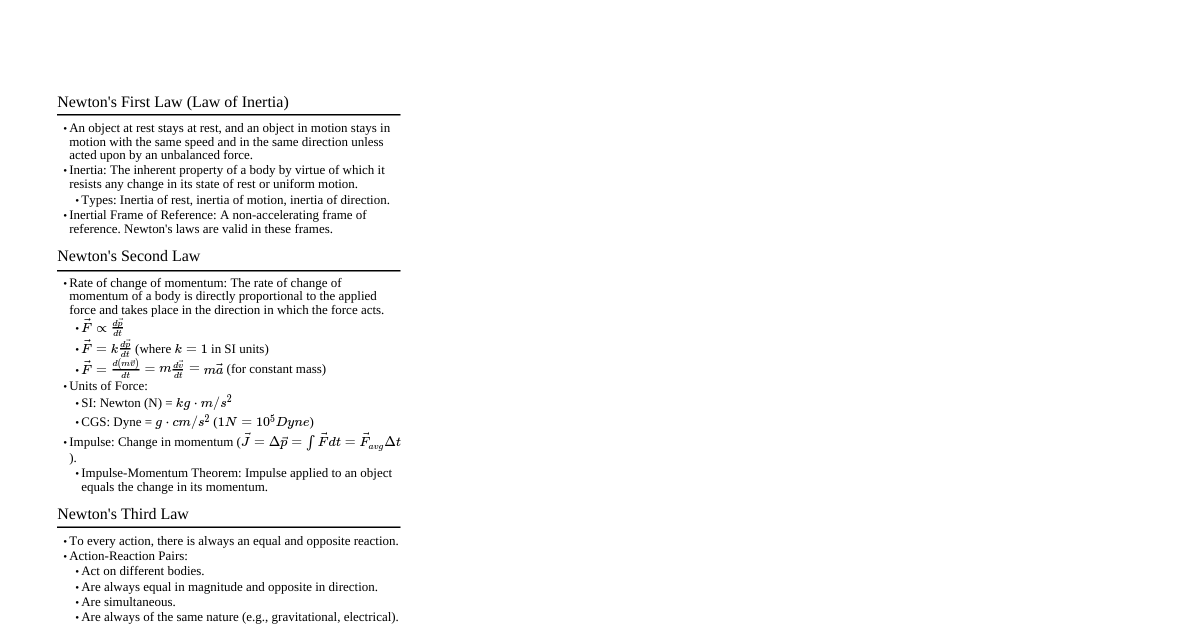
### Newton's Laws of Motion - **Newton's First Law (Law of Inertia):** An object at rest stays at rest, and an object in motion stays in motion with the same speed and in the same direction unless acted upon by an unbalanced force. - **Newton's Second Law:** The rate of change of momentum of an object is directly proportional to the applied unbalanced force in the direction of the force. - Force: $\vec{F} = m\vec{a}$ (for constant mass) - Momentum: $\vec{p} = m\vec{v}$ - General form: $\vec{F} = \frac{d\vec{p}}{dt}$ - Units of Force: Newton (N) = kg m/s$^2$ - **Trick:** If force is given as a function of time, integrate to find impulse/change in momentum: $\Delta p = \int F(t) dt$. If force is given as a function of position, use work-energy theorem. - **Newton's Third Law:** For every action, there is an equal and opposite reaction. - $\vec{F}_{AB} = -\vec{F}_{BA}$ - **Trick:** Action-reaction pairs always act on *different* bodies. ### Momentum & Impulse - **Linear Momentum:** $\vec{p} = m\vec{v}$ - **Impulse:** $\vec{J} = \vec{F}_{avg}\Delta t = \Delta\vec{p} = \vec{p}_f - \vec{p}_i$ - Also, $\vec{J} = \int \vec{F} dt$ - **Trick:** Impulse is the area under the Force-time graph. - **Conservation of Linear Momentum:** In an isolated system (no external forces), the total linear momentum remains constant. - $m_1\vec{v}_1 + m_2\vec{v}_2 = m_1\vec{v}_1' + m_2\vec{v}_2'$ - **Trick:** Apply conservation of momentum to collisions, explosions, and recoil problems. Remember it's a vector quantity. ### Friction - **Static Friction ($f_s$):** Force that opposes the initiation of motion. - $f_s \le \mu_s N$ (where $\mu_s$ is coefficient of static friction, $N$ is normal force) - $f_{s,max} = \mu_s N$ - **Kinetic Friction ($f_k$):** Force that opposes motion between surfaces in contact. - $f_k = \mu_k N$ (where $\mu_k$ is coefficient of kinetic friction) - Generally, $\mu_s > \mu_k$ - **Angle of Repose ($\theta_R$):** The maximum angle of inclination of a plane at which a body placed on it just begins to slide. - $\tan\theta_R = \mu_s$ - **Trick:** Angle of Repose is numerically equal to the Angle of Friction (angle made by the resultant of normal reaction and limiting friction with the normal reaction). - **Motion on an Inclined Plane:** - **Trick (Downward Motion):** Acceleration $a = g(\sin\theta - \mu_k \cos\theta)$ - **Trick (Upward Motion with initial push):** Deceleration $a = g(\sin\theta + \mu_k \cos\theta)$ ### Momentum & Impulse - **Linear Momentum:** $\vec{p} = m\vec{v}$ - **Impulse:** $\vec{J} = \vec{F}_{avg}\Delta t = \Delta\vec{p} = \vec{p}_f - \vec{p}_i$ - Also, $\vec{J} = \int \vec{F} dt$ - **Conservation of Linear Momentum:** In an isolated system (no external forces), the total linear momentum remains constant. - $m_1\vec{v}_1 + m_2\vec{v}_2 = m_1\vec{v}_1' + m_2\vec{v}_2'$ ### Friction - **Static Friction ($f_s$):** Force that opposes the initiation of motion. - $f_s \le \mu_s N$ (where $\mu_s$ is coefficient of static friction, $N$ is normal force) - $f_{s,max} = \mu_s N$ - **Kinetic Friction ($f_k$):** Force that opposes motion between surfaces in contact. - $f_k = \mu_k N$ (where $\mu_k$ is coefficient of kinetic friction) - Generally, $\mu_s > \mu_k$ - **Angle of Repose ($\theta_R$):** The maximum angle of inclination of a plane at which a body placed on it just begins to slide. - $\tan\theta_R = \mu_s$ ### Circular Motion - **Centripetal Force ($F_c$):** Force directed towards the center of the circular path. - $F_c = \frac{mv^2}{r} = m\omega^2 r$ - **Centripetal Acceleration ($a_c$):** - $a_c = \frac{v^2}{r} = \omega^2 r$ - **Angular Velocity ($\omega$):** - $\omega = \frac{v}{r} = \frac{2\pi}{T} = 2\pi f$ - **Banking of Roads:** - Optimal speed for banked road: $v_0 = \sqrt{rg \tan\theta}$ - Maximum safe speed (considering friction): $v_{max} = \sqrt{\frac{rg(\mu_s + \tan\theta)}{1 - \mu_s \tan\theta}}$ - **Conical Pendulum:** - Tension $T = \frac{mg}{\cos\theta}$ - Angular speed $\omega = \sqrt{\frac{g \tan\theta}{r}}$ ### Spring Force - **Hooke's Law:** $F = -kx$ - $k$: spring constant - $x$: displacement from equilibrium - **Potential Energy stored in a spring:** $U = \frac{1}{2}kx^2$ ### Apparent Weight in a Lift - **Lift at rest or moving with constant velocity:** $R = mg$ - **Lift accelerating upwards:** $R = m(g+a)$ - **Lift accelerating downwards:** $R = m(g-a)$ - **Lift falling freely (cable breaks):** $R = m(g-g) = 0$ (weightlessness)