Healthcare Laws, Ethics & Counselling
Cheatsheet Content
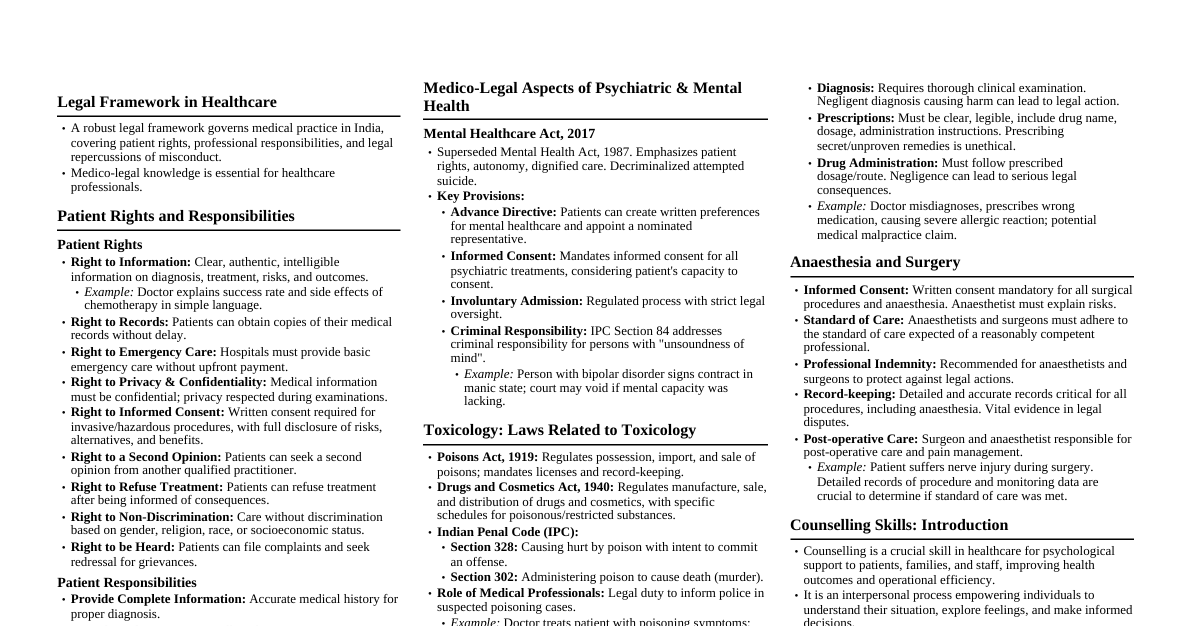
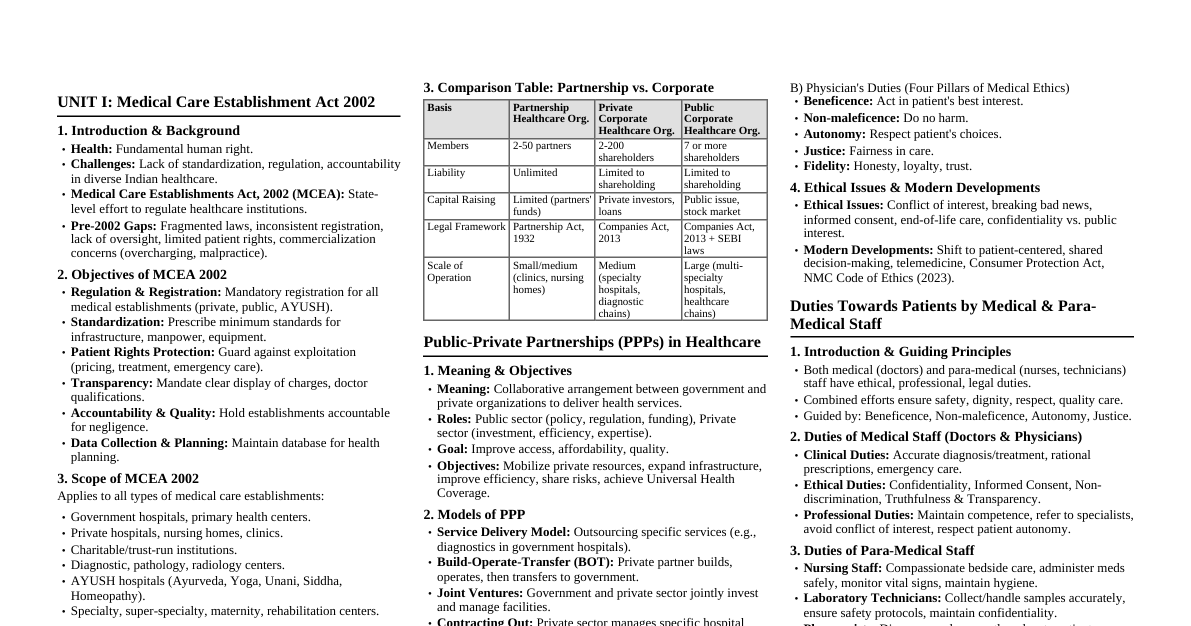
Contractual Obligations in Hospital Services Meaning of Contracts Hospitals enter into contracts with patients for medical services. Express Contracts: Written or verbal agreements. Implied Contracts: Based on conduct (e.g., admission and treatment). Obligations for Patient & Family Payment: Obligation to pay for services and facilities. Information: Provide complete and accurate health-related information. Cooperation: Cooperate with staff and follow treatment plans. Respectful Conduct: Behave respectfully towards staff and other patients. Obligations for Hospital & Doctors Duty of Care: Provide medical services with proper care and skill. Vicariously liable for staff negligence. Emergency Care: Stabilize patients without advance payment (paramount obligation). Informed Consent: Obtain valid, prior, and informed consent before hazardous tests/treatments. Confidentiality: Maintain patient health information confidentiality. Transfer of Records: Provide medical records upon request (e.g., for second opinion). Discharge: Cannot detain patient or deceased patient's body over payment dispute. Standard Care: Provide standard care and treatment. Qualified Staff: Ensure staff are qualified. Informing Patients: Inform about risks and procedures. Requisites of a Valid Contract (Indian Contract Act, 1872) Legally enforceable under Indian Contract Act, 1872, Section 10. Offer and Acceptance: Clear, unambiguous proposal (offer) and unconditional acceptance. Hospital's willingness to treat is offer; patient's acceptance (e.g., checking in) is acceptance. Intention to Create Legal Relations: Parties intend agreement to be legally binding, unlike casual social agreements. Medical context: seeking treatment for a fee implies legal intention. Lawful Consideration: Something of value exchanged (e.g., hospital's medical service for patient's payment). Must be real, lawful, and not immoral. Competency of Parties: Parties must be legally competent: Age of majority (18+ in India). Sound mind. Not disqualified by law. Legal guardian consents for minors or unsound mind patients. Free Consent: Consent must be free and voluntary, not influenced by: Coercion (threats) Undue influence (abuse of power) Fraud (intentional deception) Misrepresentation (innocent but untrue statement) Mistake (misunderstanding of facts) Informed Consent: Critical in medical services; patient fully informed of risks/benefits. Lawful Object: Purpose of contract must be lawful, not forbidden by law, immoral, or against public policy. Legitimate medical treatment satisfies this; illegal acts (e.g., unlawful abortion) void the contract. Certainty of Terms: Terms must be clear, certain, and not vague (e.g., itemized bill). Possibility of Performance: Acts required must be capable of being performed. Medical contracts are based on doctor exercising reasonable care/skill, not guaranteeing a cure. Not Expressly Declared Void: Agreement must not be one declared void or illegal by the Indian Contract Act. Legal Formalities: Some contracts require writing, attestation, or registration. Oral/implied contracts for medical services are generally valid, but complex procedures often require written consent. Contractual Liability and Damages Liability Hospitals are liable for breach of contract by: Failing to provide agreed services. Providing substandard care. Damages Compensatory: Restore patient to position as if contract performed correctly. Medical expenses, lost income, non-pecuniary damages (mental distress). Punitive: Punish malicious/wilful misconduct; rare in medical malpractice. Injunctive Relief: Court orders specific action or restraint (e.g., stop disclosing confidential info). Account of Profits: Defendant may be forced to give up profits from breach. No Guarantee of Success: Damages cannot be claimed for poor outcome alone; patient must prove breach of standard of care. Contractual Liability in Healthcare Basis of Healthcare Contract Implied Contract: Doctor-patient relationship implies agreement for provider to use reasonable care and skill. Express Contract: Specific promise/warranty about outcome (less common). Breach of Healthcare Contract Breach of Implied Contract: Medical negligence/malpractice (failure to exercise standard of care). Breach of Express Contract: Failure to deliver specific, promised outcome. Distinguishing from Tortious Liability Liability Standards: Contract: Requires proof of contractual obligation and breach, regardless of negligence. Tort (Negligence): Requires proving breach of legal "duty of care" based on professional standards. Purpose and Scope: Contract: Remedies are restrictive, placing non-breaching party in position as if contract fulfilled. Tort: Broader compensation, including pain, suffering, emotional distress. Liability under Consumer Protection Act (India) 1995 Ruling: Indian Medical Association v. V.P. Shantha ruled medical services are "service" under CPA. Contractual Relationship: Allows patients to seek compensation for "deficiency in service." CPA Coverage: Covers "contracts for service" (provider uses discretion) but not "contracts of personal service" (employer-employee). Ethical Considerations Ethical principles and breaching them can lead to legal action. Informed Consent: Process of education and conversation, not just signature. Breach can be breach of contract if harm occurs. Confidentiality: Both legal and ethical duty. Legal: Liability for breach of contract for disclosing private info without consent. Ethical: Breaches erode trust. Counselling Skills: Ethical considerations and counselling are central to patient autonomy and trust. Communication barriers: Can compromise informed consent. Criminal Liability and Defences Criminal Liability Under Bharatiya Nyaya Sanhita (BNS) 2023: Clause 104: Doctors criminally liable for gross negligence causing death or injury. Clause 26: Immunity for actions taken in good faith , especially in emergencies. When Criminal Liability Arises Gross Negligence (IPC 304A): Causing death by rash/negligent act (very high degree of negligence, e.g., operating without qualifications). Causing Harm (IPC 337, 338): Less severe cases of hurt/grievous hurt by rash/negligent act. Patient Abandonment: Negligently withdrawing from case without proper notice. Refusal of Care: Hospital refusing emergency care. Defences Against Criminal Liability Good Faith and Consent (IPC 88): Act in good faith for patient's benefit with consent is not an offense, even if harm occurs. Protects doctors performing risky procedures with informed consent and no criminal intent. Accident (IPC 80): Act done by accident/misfortune without criminal intention/knowledge. Act to Prevent Greater Harm (IPC 81): Act in good faith to prevent more significant harm (e.g., saving mother or child). Compliance with Supreme Court Guidelines: Jacob Mathew v. State of Punjab case requires preliminary inquiry and credible medical opinion before arrest for medical negligence. Tortious and Vicarious Liability Tortious Liability (Civil) Arises from negligence or breach of duty of care. Based on Law of Torts. Negligent party pays compensation for damages. Burden of proof: "preponderance of probabilities." When Tortious (Civil) Liability Arises Breach of Duty: Healthcare provider owes duty of care to patient, including: Deciding whether to take on a case. Deciding appropriate treatment. Administering treatment with reasonable care and skill. Bolam Test: Medical professional not negligent if acting in accordance with practice accepted by responsible body of professionals. Res Ipsa Loquitur : "The thing speaks for itself." Burden of proof shifts to hospital/doctor in obvious negligence cases (e.g., surgical instrument left inside patient). Under Consumer Protection Act: Medical services are "service." Patients can complain for "deficiency in service" (established by Indian Medical Association v. V.P. Shantha ). Defences Against Tortious Liability No Breach of Duty: Doctor exercised reasonable care and skill. Error of Judgment: Mere error of clinical judgment is not negligence if doctor acted with reasonable competence. Informed Consent ( Volenti Non-Fit Injuria ): Patient fully informed and voluntarily consented. Does not absolve provider of negligence. Contributory Negligence: Patient's own actions contributed to injury. Vicarious Liability Hospital is responsible for negligent acts of its employees (doctors, nurses) committed during employment. Example: Hospital liable if nurse administers wrong drug during duty. When Vicarious Liability Arises Employer-Employee Relationship: Based on respondent superior ("let the master answer"). Independent Contractors: Hospitals can be liable for independent consultants if patient contracted with hospital based on its reputation. Negligence by Staff: Includes negligent acts of resident doctors, nurses, and other support staff. Corporate Negligence: Hospital directly liable for its own negligence (e.g., failing to provide adequate equipment, clean facilities). Defences Against Vicarious Liability No Employment Relationship: Medical professional was independent contractor, not employee. Act Outside Scope of Employment: Employee's negligent act was outside course/scope of employment. Borrowed Servant Doctrine: Liability shifts to surgeon's primary employer if "borrowed" from another hospital. Legal Remedies Available to Patients Under Various Laws Consumer Protection Act, 2019: Complaints for deficiency in service. Civil Law: Sue for damages under tort or breach of contract. Criminal Law: FIR for gross negligence. Medical Council: Complaint for ethical violations. 1. Remedies under Consumer Protection Act, 2019 (CoPRA) Most common and accessible avenue for "deficiency in service." For Paid Services: Healthcare services for a fee are "service" ( Indian Medical Association v. V.P. Shantha ). For Partially/Fully Free Services: 2019 Act includes partially/fully free services in hospitals that otherwise charge fees. Jurisdiction of Forums: District Commission: Claims up to ₹1 crore. State Commission: Claims ₹1 crore - ₹10 crore. National Commission: Claims over ₹10 crore. Remedy Awarded: Compensation for losses, litigation costs, refund medical expenses. Impact on Healthcare: Increased accountability; concerns about "defensive medicine." 2. Civil Suit under Law of Torts Recourse for monetary compensation through civil court. Plaintiff must prove: Duty of Care: Legal obligation to provide care. Breach of Duty: Failed to meet required standard of care. Damage: Breach resulted in actual harm. Key Principle (Bolam Test): Standard of care judged by accepted practice of responsible medical professionals. Supreme Court notes judges not bound by illogical professional opinions. 3. Criminal Proceedings For gross negligence causing death/grievous bodily harm (Bharatiya Nyaya Sanhita, 2023). BNS 2023: Max punishment 2 years imprisonment + fine for medical negligence causing death. High Threshold: "Very high degree" of negligence required to protect doctors from frivolous prosecutions. 4. Disciplinary Action by Medical Councils Complaint against registered medical practitioner for professional misconduct (State Medical Council or NMC). Grounds: Negligence, false certificates, unethical advertising, revealing patient identity without consent. Action: Council investigates; if found guilty, can suspend/remove practitioner from register. Patient's Right to Appeal: National Medical Commission Act, 2019, silent on appeal rights for aggrieved patients. 5. Constitutional Remedy through Human Rights Commissions NHRC/SHRC can be approached if right to life and health (Article 21) violated by medical negligence, especially in govt. hospitals. Powers: Investigate and recommend compensation. 6. Hospital-level Internal Grievance Redressal Charter of Patients' Rights requires internal redressal mechanisms. Right to Complain: Patients/caregivers can lodge complaints. Response Timeline: Hospital must register complaint and provide outcome within 15 days. Key Patient Rights Protected by These Remedies Right to Information: Complete info on diagnosis, treatment, costs. Right to Records: Copies of medical records. Denial is misconduct. Right to Informed Consent: Consent needed before invasive test/treatment. Right to Emergency Medical Care: Hospitals cannot deny emergency treatment. Right to Seek Redressal: Right to complain and have grievances addressed. Hospital as a Bailee Legal Concept Under Section 148 of Indian Contract Act, a "bailment" is delivery of goods for specific purpose, to be returned/disposed of. Bailor: Patient Bailee: Hospital Hospital must take reasonable care of patient's belongings. Hospital as Bailee (Indian Contract Act, 1872) Contract of Bailment: Implied contract formed when hospital takes temporary possession of patient's personal items (clothes, jewelry). Duty of Reasonable Care: Hospital must take "as much care of the goods bailed to him as a man of ordinary prudence would." Failure is negligence. Liability for Loss/Damage: Hospital liable to compensate if patient's belongings lost/stolen/damaged due to hospital's negligence. Burden of proof on patient, but res ipsa loquitur may apply. Case Law Precedent: NCDRC has held hospitals responsible for loss of patient's belongings. Consumer Protection Act (CP Act), 2019 CP Act and Medical Services Supreme Court rulings (e.g., Indian Medical Association vs. V.P. Shantha ) established medical services under CPA purview. 1. Who is a Consumer? Patient who pays for services ("consideration"). Patients receiving free services in hospitals that generally charge fees are consumers (cost cross-subsidized). Patients receiving entirely free services at government hospital generally not consumers. 2. What Constitutes "Deficiency in Service"? Any "fault, imperfection, shortcoming, or inadequacy in quality, nature, and manner of performance." Includes negligence in diagnosis, improper treatment, faulty equipment, failure to maintain records. 3. Accountability and Rights under CPA: Right to Safety: Protection from hazardous services. Right to Information: Informed about quality and standard of service. Right to Redressal: Remedy for grievances through consumer forum (faster, less expensive). 4. Impact of CPA on Healthcare: Increased accountability for hospitals/professionals. Concerns about "defensive medicine" (unnecessary tests due to litigation fear). Right to Information (RTI) Act, 2005 in Healthcare Applies to healthcare institutions, varying by public/private status. 1. RTI and Medical Records: Right to Access: Patient has undeniable right to access own medical records (court/CIC rulings). Duty to Provide: Physician must provide copies within 72 hours (Indian Medical Council Regulations, 2002). Consequences of Denial: "Deficiency in service" under CPA, professional misconduct, adverse inference in legal proceedings. 2. Applicability to Public and Private Hospitals: Public Hospitals: RTI Act applies directly; patients can file RTI for records. Private Hospitals: Not public authorities, so RTI Act doesn't apply directly. Patients still have right to records based on ethical codes, judicial pronouncements, Medical Council Regulations. Info can be sought indirectly via RTI to regulating public authority. 3. Confidentiality and Third-Party Information: Protection of Privacy: Medical records of other individuals are "personal information," exempt under RTI Act Section 8(1)(j). Public Interest Exception: Disclosure only in larger public interest. Spousal Records: Cannot normally seek partner's medical records without compelling public interest reason. Application in Healthcare: Patients can seek info from government hospitals (treatment records, billing, staff qualifications). Ethics and Counselling Skills Fundamental to effective and humane healthcare. 1. Ethical Principles in Healthcare: Beneficence: Acting in patient's best interest. Non-maleficence: "Do no harm." Autonomy: Respecting patient's right to informed decisions. Justice: Ensuring fairness, equal access to basic services. Informed Consent: Legal/ethical requirement for patient to understand/agree to procedure after being briefed on risks/benefits/alternatives. 2. Counselling Skills: Confidentiality: Privacy of patient info (Indian Medical Council code mandates absolute confidentiality with limited exceptions). Communication: Building rapport, trust, addressing anxiety. Cultural Sensitivity: Awareness/respect for diverse cultural backgrounds. Empathy: Active listening, understanding patient's perspective, patient-centered care. 3. Shift from Ethics to Law: Historically, doctor-patient relationship based on ethics/trust. Ethical values codified into law (CPA, judicial interpretations) making them enforceable rights. Focus shifted to patient rights, legal accountability, transparency. Summary Table Topic Key Idea Example Contractual Obligations Hospital must provide promised care Surgery with post-op care Valid Contract Offer, acceptance, lawful terms Agreement for paid treatment Contractual Liability Breach leads to damages No post-op care provided Criminal Liability Gross negligence punished Death due to reckless surgery Tort & Vicarious Liability Hospital liable for staff Nurse gives wrong drug Legal Remedies Consumer, civil, criminal options Complaint for misdiagnosis Hospital as Bailee Responsible for patient's goods Lost valuables during admission CP Act Patients = consumers Refund for unperformed test RTI Info from govt hospitals RTI for denied treatment