Indian Knowledge System
Cheatsheet Content
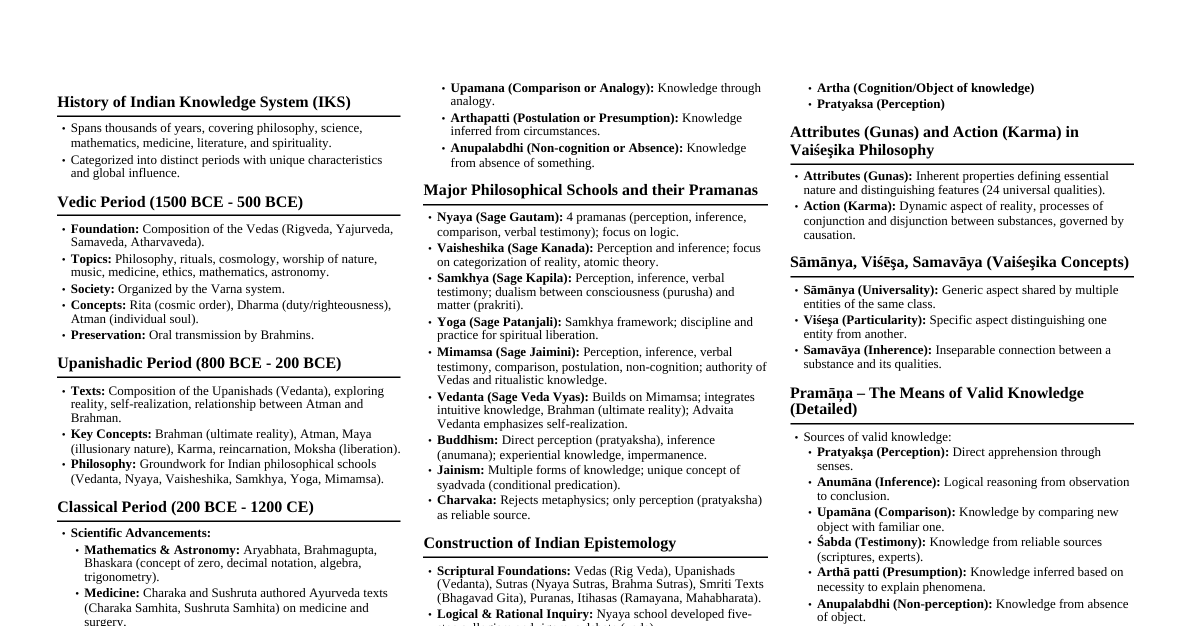
### Introduction to Indian Knowledge System (IKS) - A comprehensive framework of knowledge spanning over 5000 years. - Encompasses philosophy, science, mathematics, astronomy, medicine, arts, and governance. - Rooted in ancient texts: Vedas, Upanishads, Puranas, and other classical literature. - Emphasizes holistic understanding of reality, consciousness, and existence. - Integrates spiritual, intellectual, and practical dimensions of life. ### Key Characteristics of IKS #### Foundational Principles: - Cyclical view of time - Interconnectedness of all existence - Multiple paths to truth - Experiential validation - Oral and textual transmission #### Core Domains: - Darshanas (Philosophical schools) - Ayurveda (Medicine) - Jyotisha (Astronomy) - Yoga and meditation - Ethics and dharma ### Karma: Etymology & Basic Definition #### Sanskrit Origin: - **Karma** derives from the root *kri* meaning "to do" or "to act." - Literally means "action," "deed," or "work." - First appears in the Rigveda (circa 1500 BCE). - Evolved from ritualistic actions to moral and ethical dimensions. - Central concept across Hindu, Buddhist, Jain, and Sikh traditions. ### The Law of Karma #### Fundamental Principle: - Every action has consequences that affect the doer, either in this life or future lives. #### Key Components: 1. **Action (Karma):** Physical, verbal, and mental acts. 2. **Intention (Sankalpa):** The motive behind the action. 3. **Consequence (Phala):** The result or fruit of the action. 4. **Accumulation (Sanchita):** Storage of karmic imprints. - "As you sow, so shall you reap." ### Types of Karma - **Sanchita Karma:** Accumulated karma from all past lives; the total storehouse of karmic debt. - **Prarabdha Karma:** Portion of sanchita karma allocated for the current lifetime; already "ripening." - **Kriyamana/Agami Karma:** Karma being created in the present moment through current actions. | Time | Karma Type | Description | | :------ | :----------- | :----------------------------------------------------------------------- | | Past | Sanchita | Accumulated from all past lives. | | Present | Prarabdha | Portion manifesting in current life. | | Future | Agami | Being created by current actions. | ### Karma in Ancient Texts - **Rigveda (circa 1500 BCE):** - Initial focus on ritual actions and their efficacy. - Karma as sacrificial acts pleasing to deities. - **Upanishads (circa 800-200 BCE):** - Shift to moral and ethical dimensions. - Connection between karma and rebirth (samsara). - Karma as determining factor in one's destiny. - **Bhagavad Gita (circa 200 BCE):** - Detailed exposition of karma yoga. - Emphasis on action without attachment to results. - Integration of duty (dharma) with karma. ### The Cycle of Karma and Rebirth - **Samsara:** The cycle of birth, death, and rebirth. - **Moksha:** Liberation from the karmic cycle. - **Karma** binds the soul (atman) to the material world. ### Karma Yoga: The Path of Action #### Core Teaching from Bhagavad Gita: - "You have a right to perform your prescribed duties, but you are not entitled to the fruits of your actions" (BG 2.47). #### Principles of Karma Yoga: - Perform one's duty (svadharma) without attachment. - Act with proper intention and dedication. - Surrender results to the divine. - Transform work into spiritual practice. - Neutralize karmic bondage through selfless action. ### Overview of Indian Philosophy Indian philosophy is traditionally divided into: 1. **Astika (Orthodox):** Schools that accept the authority of the Vedas. - Six orthodox darshanas (systems). 2. **Nastika (Heterodox):** Schools that reject Vedic authority. - Buddhism, Jainism, Charvaka. - **Note:** This classification is based on epistemological stance, not theistic belief. ### The Six Orthodox Darshanas (Astika) 1. **Nyaya:** - Logic and epistemology. - Founded by Gautama. 2. **Vaisheshika:** - Atomic theory, metaphysics. - Founded by Kanada. 3. **Samkhya:** - Dualistic realism. - Founded by Kapila. 4. **Yoga:** - Meditation and practice. - Systematized by Patanjali. 5. **Mimamsa:** - Vedic exegesis. - Founded by Jaimini. 6. **Vedanta:** - Ultimate reality. - Based on Upanishads. ### Nyaya: The School of Logic - **Founded by:** Gautama (Aksapada). - **Key Text:** Nyaya Sutras. #### Focus: - Systematic logic and reasoning. - Theory of knowledge (pramana). - Valid means of knowledge: perception, inference, comparison, testimony. #### Contribution to Karma: - Provides logical framework for understanding cause-effect relationships. - Analyzes the epistemology of moral knowledge. ### Introduction to Nyaya Philosophy - Founded by **Sage Gautama (Aksapada)** in the *Nyaya Sutras*. - One of the six orthodox (**astika**) schools. - Focuses on **Pramana-shastra**: The science of valid knowledge. - **Ultimate Goal**: Liberation (**Moksha**) through the removal of ignorance via right knowledge. ### Epistemology: Sources of Valid Knowledge (Pramanas) According to Nyaya, there are four ways to attain **Prama** (valid knowledge): 1. **Pratyaksha (Perception):** Direct contact between sense organs and objects. 2. **Anumana (Inference):** Using a known sign (*linga*) to reach the unknown. 3. **Upamana (Comparison):** Knowledge based on similarity and descriptions. 4. **Shabda (Testimony):** Reliable verbal knowledge from an *Apta* (trustworthy person). ### Logic: The Nyaya Syllogism (Anumana) Nyaya uses a five-step process to establish a truth. Let's use the classic example: 1. **Pratijna (Proposition):** There is fire on the hill. 2. **Hetu (Reason):** Because there is smoke. 3. **Udaharana (Example):** Wherever there is smoke, there is fire (e.g., in a kitchen). 4. **Upanaya (Application):** The hill has smoke that is invariably associated with fire. 5. **Nigamana (Conclusion):** Therefore, there is fire on the hill. ### The Heart of Logic: Vyapti #### Definition: - **Vyapti** is the relationship of **invariable concomitance** between the middle term (*hetu*) and the major term (*sadhya*). - It ensures the inference is not accidental. - **Example:** The relationship between Smoke and Fire. - Without establishing a valid Vyapti, the argument results in a **Fallacy (Hetvabhasa)**. ### Vaisheshika: Atomic Pluralism - **Founded by:** Kanada. - **Key Text:** Vaisheshika Sutras. #### Focus: - Categories of reality (padarthas). - Atomic theory of matter. - Six categories: substance, quality, action, generality, particularity, inherence. #### View on Karma: - Karma as a quality (*guna*) that inheres in the soul. - Explains physical causation underlying karmic effects. ### Samkhya: Dualistic Philosophy - **Founded by:** Kapila. - **Key Text:** Samkhya Karika. #### Core Dualism: - **Purusha:** Pure consciousness, the eternal witness (25th principle). - **Prakriti:** Primordial matter, consisting of three *gunas* (sattva, rajas, tamas). #### 24 Evolutes from Prakriti: - **Internal Instruments (3):** Mahat (Intellect), Ahankara (Ego), Manas (Mind). - **Perception Faculties (5):** Ears, Skin, Eyes, Tongue, Nose. - **Action Faculties (5):** Speech, Hands, Feet, Excretion, Procreation. - **Subtle Elements (5):** Sound, Touch, Form, Taste, Smell. - **Gross Elements (5):** Space, Air, Fire, Water, Earth. - **Total:** 24 Evolutes + Purusha (Consciousness) = 25 Tattvas. #### Liberation: - Discrimination between *purusha* and *prakriti*. ### Samkhya and Karma #### Karmic Process in Samkhya: - Actions create impressions (*samskaras*) in the mind. - These impressions are stored in *prakriti*. - They manifest as tendencies (*vasanas*) and future experiences. - *Purusha*, though uninvolved, appears to be the experiencer. #### Key Insight: - Karma operates entirely within *prakriti*. - Liberation occurs when *purusha* realizes its distinction from *prakriti*. - Pure consciousness is untouched by karmic bondage. ### Yoga and Karma #### Three Types of Karma in Yoga Philosophy: - **Shukla Karma:** Pure/white karma from virtuous actions. - **Krishna Karma:** Dark karma from harmful actions. - **Shukla-Krishna Karma:** Mixed karma from ordinary worldly actions. - **Neither-white-nor-black:** Actions of yogis who have transcended duality. #### Yogic Method: - Burn karmic seeds through practice (*abhyasa*) and detachment (*vairagya*). - Purify the mind to reduce karmic accumulation. - Attain *kaivalya* (isolation/liberation) from karmic bondage. ### Mimamsa: Vedic Ritualism - **Founded by:** Jaimini. - **Key Text:** Mimamsa Sutras. #### Focus: - Interpretation of Vedic rituals and injunctions. - Dharma as primary reality. - Apurva: unseen power generated by ritual actions. #### Unique View on Karma: - Emphasizes ritual karma over moral karma. - Proper performance of Vedic rituals generates merit. - Apurva bridges the temporal gap between action and result. ### Vedanta: The Philosophy of Unity - **Based on:** Upanishads, Brahma Sutras, Bhagavad Gita. #### Three Main Schools: 1. **Advaita Vedanta (Non-dualism):** Adi Shankaracharya. 2. **Vishishtadvaita (Qualified non-dualism):** Ramanuja. 3. **Dvaita (Dualism):** Madhvacharya. #### Central Concepts: - **Brahman:** Ultimate reality. - **Atman:** Individual self. - **Maya:** Cosmic illusion. - **Moksha:** Liberation through knowledge. ### Advaita Vedanta and Karma #### Adi Shankaracharya's Teaching: - **Core Principle:** Brahman (ultimate reality) is one, non-dual, and identical with Atman (self). #### Two Levels of Reality: - **Vyavaharika:** Empirical/conventional reality where karma operates. - **Paramarthika:** Absolute reality where only Brahman exists. #### View on Karma: - Karma is real at the empirical level. - From absolute standpoint, karma is part of *maya* (illusion). - Knowledge (*jnana*) of one's true nature liberates from karma. - "Tat Tvam Asi" (That Thou Art) - realization dissolves karmic bondage. ### Heterodox Systems: Buddhism - **Founded by:** Siddhartha Gautama (Buddha). - **Core Teaching:** Four Noble Truths and Noble Eightfold Path. #### Buddhist View of Karma: - Rejects permanent self (*anatman*). - Karma as intentional action (*cetana*). - Emphasis on mental karma over ritual. - Chain of dependent origination (*pratityasamutpada*). - Liberation through cessation of craving and ignorance. #### Key Difference: - Buddhism emphasizes intention and mental states more than physical actions. ### Heterodox Systems: Jainism - **Founded by:** Mahavira. - **Core Principle:** Ahimsa (non-violence). #### Jain View of Karma: - Karma as subtle material particles that bind to the soul. - Eight types of karma affecting the soul. - Detailed classification of karmic matter. - Liberation through asceticism and purification. - Emphasis on non-violence to avoid karmic accumulation. #### Unique Feature: - Jainism treats karma as physical substance, not just moral force. ### Comparative Analysis: Karma Across Schools | School | Nature of Karma | Liberation Path | | :--------- | :----------------------------------------- | :---------------------------------------- | | Samkhya | Quality in *prakriti* | Discrimination (*viveka*) | | Yoga | Mental modifications | Practice & detachment | | Vedanta | Illusion at highest level | Knowledge (*jnana*) | | Buddhism | Intentional action | Eightfold path | | Jainism | Material particles | Asceticism & *ahimsa* | | Mimamsa | Ritual efficacy | Proper ritual action | #### Common Thread: - All systems acknowledge karma's role in bondage and seek liberation from it. ### Contemporary Relevance #### Karma in Modern Context: - Ethical responsibility and accountability. - Understanding consequences of actions. - Mind-body connection in psychology. - Environmental ethics and sustainability. - Social justice and collective karma. #### Philosophical Contributions: - Alternative models of causation. - Non-materialist frameworks of consciousness. - Integration of ethics and metaphysics. - Holistic approaches to knowledge. ### Critical Perspectives #### Challenges to Karma Theory: - Problem of verification (past life actions). - Tension with free will and determinism. - Risk of fatalism and social apathy. - Justice concerns: blaming victims for suffering. - Compatibility with modern science. #### Responses from Tradition: - Karma as probabilistic, not deterministic. - Present actions can modify future outcomes. - Emphasis on compassion alongside karma. - Karma as moral pedagogy, not absolute law. ### Summary: Key Takeaways 1. Indian Knowledge System offers comprehensive framework spanning millennia. 2. Karma is central concept: action, intention, and consequence. 3. Six orthodox darshanas provide diverse philosophical perspectives. 4. Each school offers unique understanding of karma and liberation. 5. Heterodox systems (Buddhism, Jainism) add important variations. 6. Karma intersects with ethics, metaphysics, and soteriology. 7. Contemporary relevance in ethics, psychology, and environmental thought. 8. Critical engagement necessary for mature understanding. ### Discussion Questions 1. How does the concept of karma address the problem of moral responsibility? 2. What are the strengths and limitations of karma as an ethical framework? 3. How do different philosophical schools resolve the tension between karma and free will? 4. Can karma be reconciled with modern scientific worldviews? 5. What is the relevance of these ancient philosophical systems in contemporary society? ### Further Reading #### Primary Sources: - Bhagavad Gita (Translation by Eknath Easwaran or Radhakrishnan). - Yoga Sutras of Patanjali. - Principal Upanishads. #### Secondary Sources: - Radhakrishnan, S. *Indian Philosophy* (2 volumes). - Potter, K. (Ed.) *Encyclopedia of Indian Philosophies*. - Hiriyanna, M. *Outlines of Indian Philosophy*. - Reichenbach, B. *The Law of Karma*.