Inorganic Chemistry - Hinglish
Cheatsheet Content
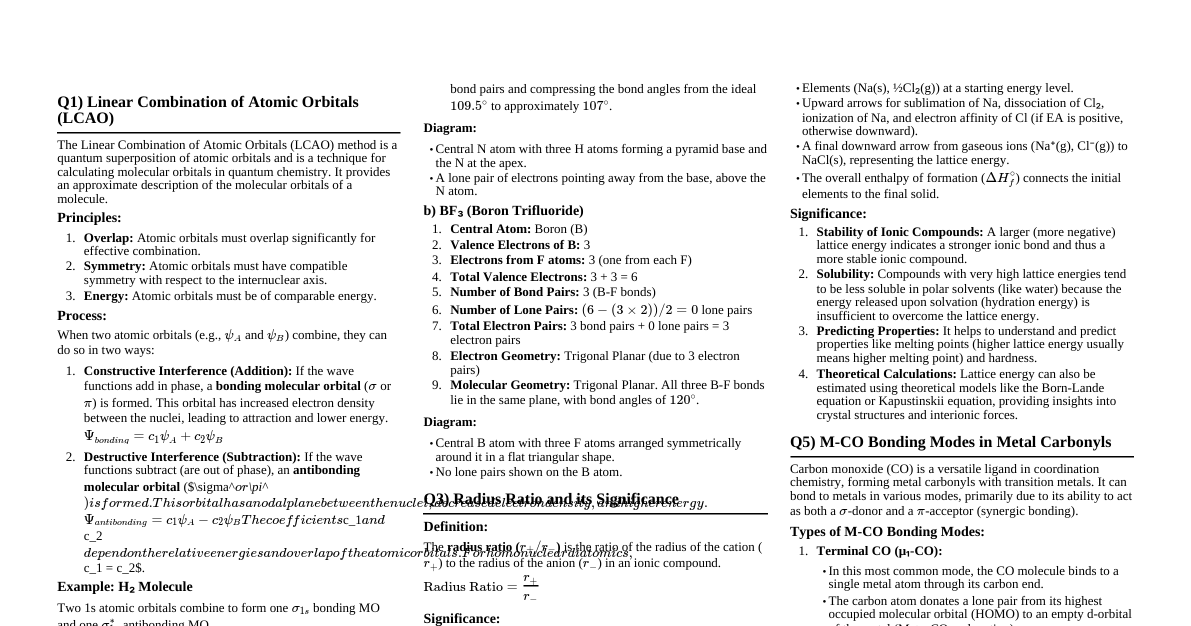
### VSEPR vs VBT vs MOT Ye teeno theories chemical bonding ko alag-alag levels par explain karti hain: - **VSEPR (Valence Shell Electron Pair Repulsion):** - **Focus:** Molecule ki geometry aur shape predict karna. - **Working:** Central atom ke around electron pairs ke repulsion par based hai. - **Limitations:** Bond formation, orbital overlap, aur electronic structure ko explain nahi karta. Sirf approximate geometry deta hai. - **VBT (Valence Bond Theory):** - **Focus:** Covalent bond formation ko atomic orbital overlap aur hybridization ke terms mein explain karna. (Linus Pauling, Nobel 1954) - **Working:** Overlap of atomic orbitals (s, p, d) se sigma (σ) aur pi (π) bonds bante hain. Hybridization (sp, sp², sp³, dsp², d²sp³) se atomic orbitals combine hoke naye hybrid orbitals banate hain jo bonding ke liye suitable hote hain. - **Shapes (Hybridization):** | Hybridization | Atomic Orbitals Involved | Spatial Arrangement | Examples | |---------------|--------------------------|--------------------------------|---------------------------| | sp | s + p | Linear (180°) | C₂H₂, HgCl₂ | | sp² | s + p + p | Trigonal Planar (120°) | BCl₃ | | sp³ | s + p + p + p | Tetrahedral (109.5°) | CH₄ | | dsp² | d + s + p + p | Square Planar (90°) | Ni(CN)₄²⁻ | | dsp³ | d + s + p + p + p | Trigonal Bipyramidal (90°, 120°) | PCl₅ | | d²sp³ | d + d + s + p + p + p | Octahedral (90°, 180°) | SF₆ | - **Limitations:** Aromaticity, magnetic properties, aur kuch molecules ki stability ko theek se explain nahi kar pata. - **MOT (Molecular Orbital Theory):** - **Focus:** Poore molecule ke liye molecular orbitals banana aur unmein electrons distribute karna. - **Working:** Atomic orbitals combine hoke bonding molecular orbitals (lower energy) aur anti-bonding molecular orbitals (higher energy) banate hain. Electrons in molecular orbitals mein fill hote hain according to Hund's rule aur Pauli's exclusion principle. - **Advantages:** Magnetic properties (e.g., O₂ ka paramagnetic nature), bond order, aur electronic spectra ko zyada acche se explain karta hai. - **Limitations:** Zyada complex molecules ke liye calculations bahut mushkil ho jaati hain. **Conclusion:** - **VSEPR** quick geometry prediction ke liye best hai. - **VBT** bond formation aur hybridization ko visualize karne ke liye useful hai. - **MOT** complex electronic properties aur stability ko samajhne ke liye zyada accurate hai. #### Molecular Orbital Theory (MOT) ke Baare Mein Aur Jaankari MOT ek aisa approach hai jismein orbitals poore molecule ko cover karte hain, naaki sirf do atoms ke beech localized hon. **Molecular Orbitals Kaise Bante Hain:** - Molecular orbitals (MOs) atomic orbitals (AOs) ke combination se bante hain. - Kyuki orbitals wave functions hote hain, ye do tarah se combine ho sakte hain: - **Constructively (judkar):** Isse **bonding molecular orbital** banta hai, jismein electron density nuclei ke beech badhti hai aur energy kam hoti hai. - **Destructively (ghatakar):** Isse **antibonding molecular orbital** banta hai, jismein nuclei ke beech ek **node** (zero electron density ka region) hota hai aur energy zyada hoti hai. **Molecular Orbitals Kab Bante Hain:** - MOs tab bante hain jab AOs ki energy similar ho aur unki symmetry bhi sahi ho (proper overlap). - Agar AOs ki energies bahut alag hon ya spatial orientation galat ho (orthogonal), toh wo combine nahi hote aur **non-bonding orbitals** kehte hain. **MO Theory Kyun Zaroori Hai:** - **VBT ki kamiyaan:** Valence Bond Theory kuch simple molecules ki bonding ko explain nahi kar pata. Jaise: - **Oxygen (O₂):** VBT ke according O₂ mein double bond hota hai, jo sahi hai. Lekin VBT O₂ ke **paramagnetic** nature ko explain nahi kar pata (O₂ mein do unpaired electrons hote hain). MOT ise explain karta hai. - **Resonance:** VBT resonance structures use karta hai, jabki MOT ek single, delocalized picture deta hai. - **Extended π systems:** Jin molecules mein extended π systems hote hain (jaise Benzene), unki bonding ko MOT zyada acche se describe karta hai. #### Hydrogen Molecule (H₂) ka MO Diagram Jab do Hydrogen atoms (H_A aur H_B) ke 1s atomic orbitals combine karte hain: - **Constructive Overlap:** Ψ_bonding = (1/√2) [Φ(1s_A) + Φ(1s_B)] - Ye **sigma (σ)** bonding orbital banata hai. Ismein electron density nuclei ke beech badhti hai aur energy kam hoti hai. - **Destructive Overlap:** Ψ_antibonding = (1/√2) [Φ(1s_A) - Φ(1s_B)] - Ye **sigma star (σ*)** antibonding orbital banata hai. Ismein nuclei ke beech ek node hota hai aur energy zyada hoti hai. **Result:** H₂ molecule mein, dono electrons bonding σ orbital mein jaate hain, jisse molecule individual atoms se zyada stable ho jaata hai. #### Types of Molecular Orbitals 1. **Sigma (σ) Bonding Orbitals:** - Electrons nuclei ke beech axis par delocalized hote hain. - Shared electrons ko represent karte hain, jaise H:H ya H:F. 2. **Non-bonding (n) Orbitals:** - Ye atomic orbitals se zyada change nahi hote aur ek single atom par localized rehte hain (unshared). - Ek atom par lone pair of electrons ko represent karte hain. 3. **Sigma Star (σ*) Anti-bonding Orbitals:** - Nuclei ke beech axis par node hota hai. - Ye bonding mein contribute nahi karte, balki bonding ko "undo" karte hain. #### Atomic Orbitals Combine Karne Ke Rules 1. **MOs ki sankhya:** Jitne atomic orbitals combine honge, utne hi molecular orbitals banenge. 2. **Bond ki strength:** Bond ki strength orbital overlap ki degree par depend karti hai. Jitna zyada overlap, utna strong bond. #### Period 2 Diatomic Molecules Mein MOs - Period 2 ke elements mein, s orbitals s orbitals se aur p orbitals p orbitals se combine karte hain. - **p orbitals ki symmetry:** p orbitals ki symmetry end-on-end (bond axis ke along) overlap ya side-by-side (bond axis ke around) overlap allow karti hai. #### MOs using p orbitals - **End-on-end overlap (p_x - p_x):** Ye **sigma (σ)** bonding aur **sigma star (σ*)** antibonding orbitals banate hain. - σ bonding orbital mein electron density internuclear axis ke around symmetric hoti hai. - σ* antibonding orbital mein internuclear axis ke around node hota hai. - **Side-by-side overlap (p_y - p_y ya p_z - p_z):** Ye **pi (π)** bonding aur **pi star (π*)** antibonding orbitals banate hain. - π bonding orbital mein electron density internuclear axis ke upar aur neeche hoti hai. - π* antibonding orbital mein internuclear axis ke along node hota hai. - **Energy:** π bonding orbitals σ bonding orbitals se thode higher energy ke hote hain, kyuki side-by-side overlap end-on-end overlap se kam effective hota hai. **Gerade (g) aur Ungerade (u) Notation:** - Kuch texts MOs ki symmetry ko indicate karne ke liye `g` (gerade, symmetric) aur `u` (ungerade, asymmetric) use karte hain. - σ bonding orbital `σ_g` hota hai. - σ antibonding orbital `σ_u*` hota hai. - π bonding orbital `π_u` hota hai. - π antibonding orbital `π_g*` hota hai. - **Important:** `g` ya `u` hamesha bonding ya antibonding se correlate nahi karte. #### Molecular Orbital Diagrams Ke Rules 1. **Energy preference:** Electrons hamesha lowest energy MOs mein jaate hain. 2. **Electron capacity:** Har MO mein maximum do electrons aa sakte hain (Pauli Exclusion Principle). 3. **Spin pairing:** Agar do electrons ek hi MO mein hain, toh unki spin paired honi chahiye. 4. **Degenerate orbitals:** Agar degenerate (same energy) MOs hon, toh electrons pehle har orbital mein ek-ek karke parallel spin ke saath jaate hain, phir pairing hoti hai (Hund's Rule). #### MO Diagram for O₂ Molecule - O₂ mein total 12 valence electrons hote hain. - MO diagram se pata chalta hai ki O₂ mein do unpaired electrons hote hain, jo iske **paramagnetic** nature ko explain karta hai. - **Bond Order (बंध क्रम):** (Bonding electrons - Antibonding electrons) / 2 - O₂ ke liye bond order = (8 - 4) / 2 = 2. Ye double bond ko confirm karta hai. #### s-p Mixing - **Kab hota hai:** s-p mixing tab hota hai jab s aur p atomic orbitals ki energy mein zyada difference na ho (jaise Period 2 ke Li, Be, B, C, N mein). - **Asar:** s-p mixing ki wajah se σ_s aur σ_p orbitals ki energies shift ho jaati hain. σ_s ki energy kam hoti hai aur σ_p ki energy badh jaati hai. - **Consequence:** N₂ tak (Z ≤ 7), π_p orbitals σ_p orbitals se kam energy ke hote hain. O₂ aur F₂ (Z ≥ 8) mein, σ_p orbitals π_p orbitals se kam energy ke hote hain. - **C₂ example:** VBT C₂ ko diamagnetic predict karta hai, lekin MO theory s-p mixing ke saath isko diamagnetic aur bond order 2 explain karta hai. #### Heteronuclear Diatomic Molecules (alag-alag atoms wale molecules) - **Electronegativity ka asar:** - Zyada electronegative atom ke orbitals ki energy kam hoti hai aur wo bonding orbitals mein zyada contribute karta hai. - Kam electronegative atom ke orbitals ki energy zyada hoti hai aur wo antibonding orbitals mein zyada contribute karta hai. - **HF example:** Fluorine (F) zyada electronegative hai, isliye HF ke bonding orbitals F ki taraf zyada pull hote hain. Hydrogen (H) kam electronegative hai, isliye antibonding orbitals H ki taraf zyada pull hote hain. - **LiF example:** LiF mein bhi similar trend follow hota hai. #### Carbon Monoxide (CO) as a Ligand - CO ek **sigma donor** aur **pi acceptor** ligand hai. - **Sigma donation:** CO apne **HOMO (Highest Occupied Molecular Orbital)** se electrons metal ko donate karta hai (HOMO carbon-centered hota hai). - **Pi acceptance (Back-bonding):** Metal ke filled d orbitals se electrons CO ke empty **LUMO (Lowest Unoccupied Molecular Orbital)** mein accept karta hai (LUMO pi-star antibonding orbital hota hai aur oxygen-centered hota hai). - **Back-bonding ka asar:** Back-bonding se C-O bond length badhti hai aur stretching frequency kam hoti hai. - **CO vs CO⁺:** CO⁺ mein ek electron antibonding orbital se nikalta hai, jisse bond order badhta hai aur bond length kam hoti hai. #### Electronic Spectroscopy - Molecules alag-alag wavelengths ki light absorb karke color show karte hain. - Electronic spectroscopy se MO diagrams ko experimentally determine kiya ja sakta hai. Electrons lower energy MO se higher energy MO mein jump karte hain (electronic transitions), jisse absorption spectra milti hai. #### Larger Molecules Ke MOs - Bade molecules (jaise H₂O, Benzene) ke liye MO diagrams banane ke liye **Group Theory** ka use kiya jaata hai. - **Group Orbitals:** Non-central atoms ke orbitals ko combine karke group orbitals banate hain. - **Symmetry Matching:** Phir in group orbitals ko central atom ke appropriate atomic orbitals ke saath combine kiya jaata hai. - **Benzene ka π Bonding:** Benzene mein π bonding ko group theory se analyse kiya jaata hai. Ismein 6 carbon atoms ke p_z orbitals combine hoke 6 π molecular orbitals banate hain, jinmein se kuch bonding aur kuch antibonding hote hain. - Fewer nodes wale MOs low energy ke hote hain (zyada bonding). - Zyada nodes wale MOs high energy ke hote hain (zyada antibonding).