Inorganic Chemistry: f-Block Elements
Cheatsheet Content
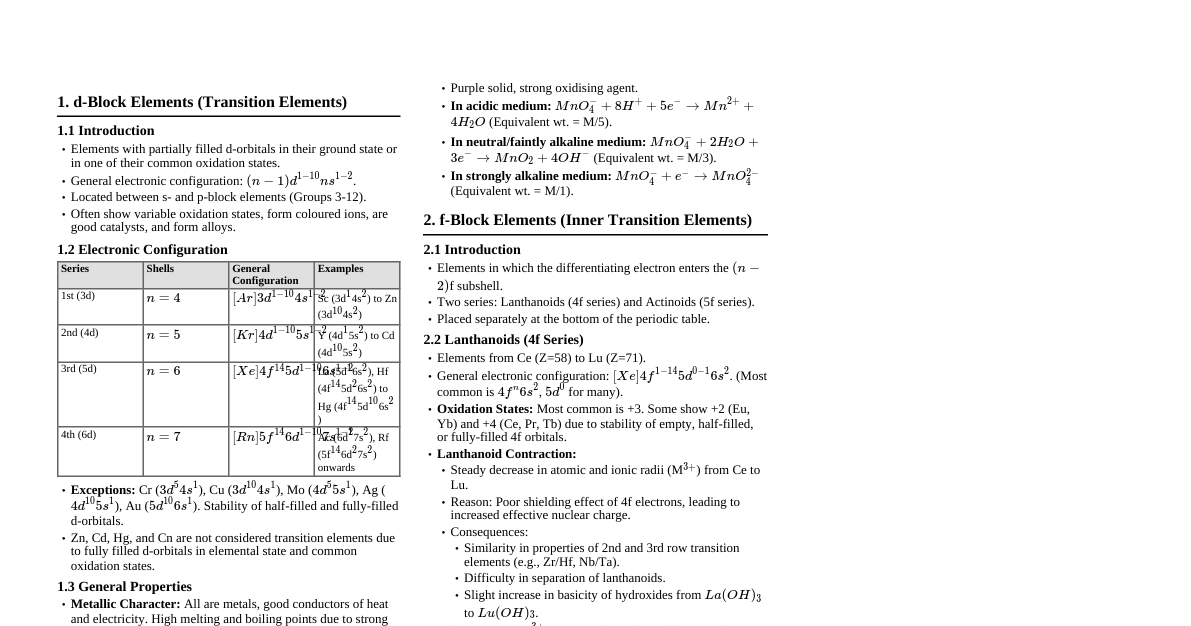
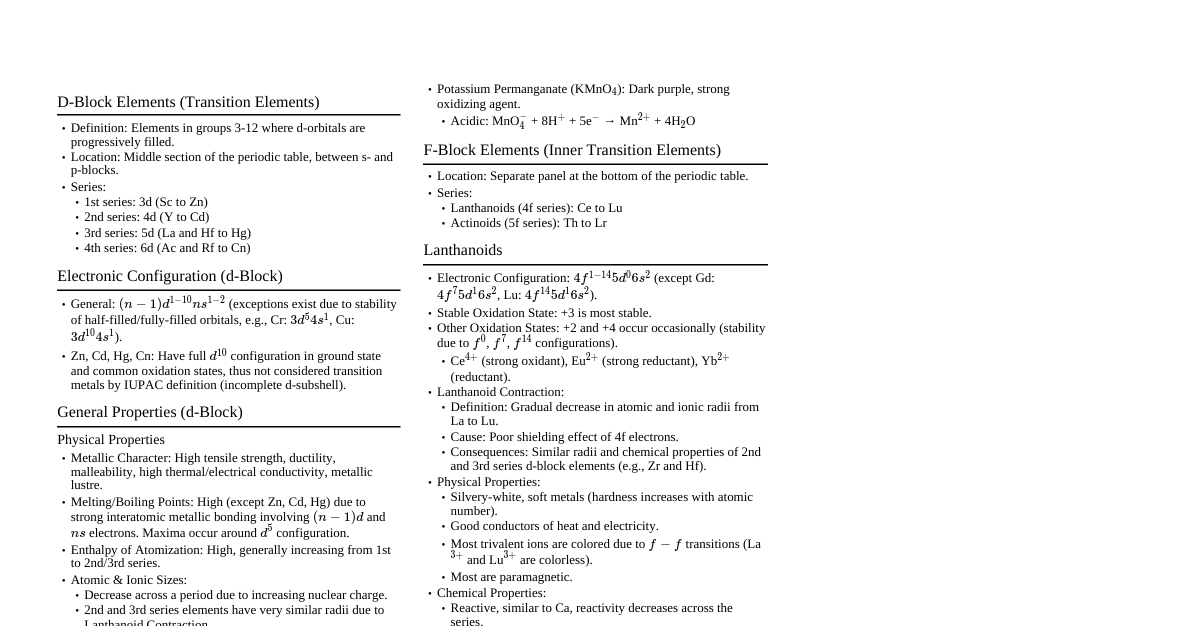
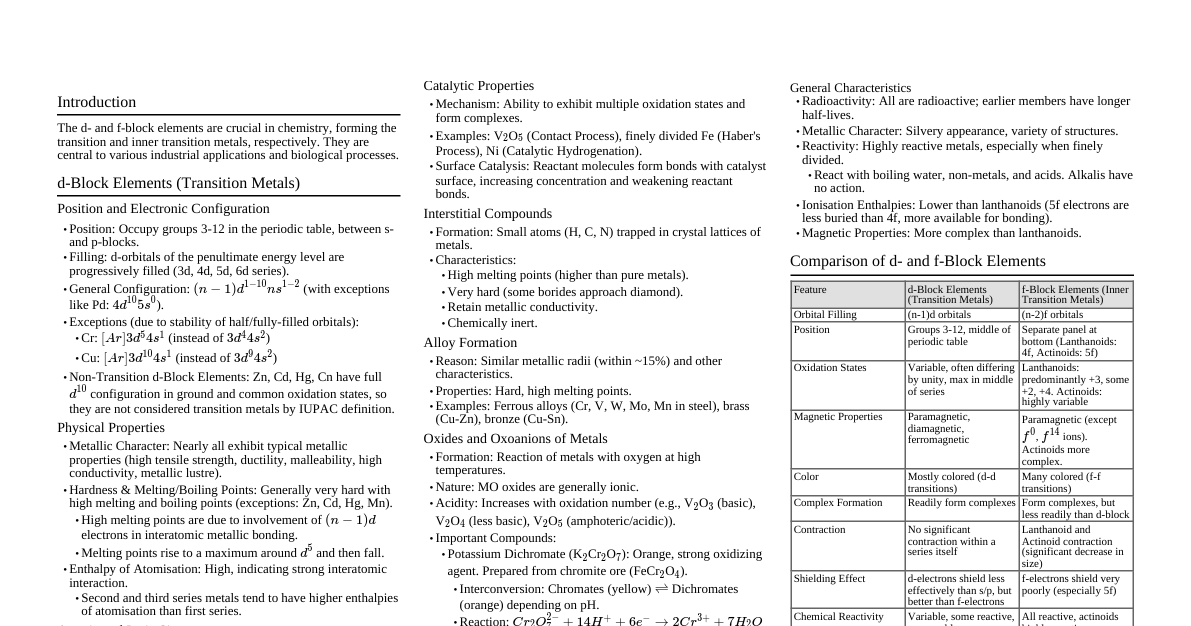
Inner Transition Elements (f-Block) Elements where the additional electron enters $(n-2)f$ orbitals. Position in the Periodic Table Lanthanides: Placed in the lower part of the periodic table, below Yttrium. Lanthanide series: $Z = 58-71$ (Ce-Lu) Actinide series: $Z = 90-103$ (Th-Lr) Lanthanides (Rare Earths or Lanthanones) Reactive elements, not found in free state. Minerals: Lighter Lanthanides: Monazite, cerites Heavier Lanthanides: Gadolinite, Xenotime Electronic Configuration of Lanthanides General configuration: $4f^{1-14}5d^{0-1}6s^2$. Filling of 4f orbitals is not regular (e.g., Gadolinium $4f^75d^16s^2$). Tripositive ions: Regular filling of f-orbitals. After losing outer electrons, f-orbitals shrink in size and become more stable. Promethium (Pm) is the only synthetic radioactive lanthanide. Outer Electronic Configuration Table Atomic Number Element Symbol Outer Electronic Configuration +3 ion 58 Cerium Ce $4f^15d^16s^2$ $4f^1$ 59 Praseodymium Pr $4f^36s^2$ $4f^2$ 60 Neodymium Nd $4f^46s^2$ $4f^3$ 61 Promethium Pm $4f^56s^2$ $4f^4$ 62 Samarium Sm $4f^66s^2$ $4f^5$ 63 Europium Eu $4f^76s^2$ $4f^6$ 64 Gadolinium Gd $4f^75d^16s^2$ $4f^7$ 65 Terbium Tb $4f^96s^2$ $4f^8$ 66 Dysprosium Dy $4f^{10}6s^2$ $4f^9$ 67 Holmium Ho $4f^{11}6s^2$ $4f^{10}$ 68 Erbium Er $4f^{12}6s^2$ $4f^{11}$ 69 Thulium Tm $4f^{13}6s^2$ $4f^{12}$ 70 Ytterbium Yb $4f^{14}6s^2$ $4f^{13}$ 71 Lutetium Lu $4f^{14}5d^16s^2$ $4f^{14}$ Oxidation States of Lanthanides Most common: $+3$. Higher oxidation states ($+4$) for Ce, Pr, Tb. Lower oxidation states ($+2$) for Eu, Yb. Oxidation states in brackets are unstable. Oxidation State Table Lanthanides Oxidation Actinides Oxidation State Ce$_{58}$ $+3, +4$ Th$_{90}$ $+4$ Pr$_{59}$ $+3, (+4)$ Pa$_{91}$ $(+4), +5$ Nd$_{60}$ $+3$ U$_{92}$ $(+3), (+4), (+5), +6$ Pm$_{61}$ $+3$ Np$_{93}$ $(+3), (+4), +5, (+6), (+7)$ Sm$_{62}$ $(+2), +3$ Pu$_{94}$ $(+3), +4, (+5), (+6), (+7)$ Eu$_{63}$ $+2, +3$ Am$_{95}$ $+2, (+3), (+4), (+5), (+6)$ Gd$_{64}$ $+3$ Cm$_{96}$ $+3, (+4)$ Tb$_{65}$ $+3, +4$ Bk$_{97}$ $+3, (+4)$ Dy$_{66}$ $+3, (+4)$ Cf$_{98}$ $+3$ Ho$_{67}$ $+3$ Es$_{99}$ $+3$ Er$_{68}$ $(+2), +3$ Fm$_{100}$ $+3$ Tm$_{69}$ $(+2), +3$ Md$_{101}$ $+3$ Yb$_{70}$ $+2, +3$ No$_{102}$ $+3$ Lu$_{71}$ $+3$ Lr$_{103}$ $+3$ Explanation of Oxidation States Lanthanides have two $6s$ electrons, leading to an expected $+2$ state, but $+3$ is common. $+3$ state involves two $6s$ electrons and one inner electron (either $5d$ or $4f$). $+2$ and $+4$ states occur when they lead to stable configurations: Noble gas configuration: $\text{Ce}^{4+}$ ($f^0$). Strong oxidant, but slow reaction rate. Half-filled $f$ orbital: $\text{Eu}^{2+}$ ($f^7$). Strong reducing agent. Completely filled $f$ orbital: $\text{Yb}^{2+}$ ($f^{14}$). Reductant. Higher oxidation states act as oxidizers; lower states as reducers. Magnetic Properties of Lanthanides Tripositive lanthanide ions: Unpaired electrons increase from La to Gd (0 to 7), then decrease to Lu (7 to 0). La and Lu ions are diamagnetic. All other tripositive lanthanide ions are paramagnetic (Nd is most paramagnetic). $\text{Ce}^{4+}$ and $\text{Yb}^{2+}$ are diamagnetic. Colour of Lanthanides Lanthanide ions with unpaired $4f$ electrons absorb visible light, undergoing f-f transitions and exhibiting colour. Colour depends on the number of unpaired $4f$ electrons. Ions with $4f^0$ or $4f^{14}$ configurations are colourless. Ions with $4f^n$ often have similar colour to ions with $4f^{14-n}$. Other Properties of Lanthanides Physical Appearance: Silvery white, soft metals, tarnish rapidly in air. Hardness: Increases with atomic number, Sm is steel-hard. Melting Points: Range between 1000-1200 K (Sm at 1623 K). Metallic Structure: Typical metallic structure, good conductors of heat and electricity. Density: High, no regular trend. Ionisation Energies: Fairly low, comparable to alkaline earth metals. Electropositive Character: High due to low I.P. Complex Formation: Low tendency due to large size and low charge density. $\text{Lu}^{3+}$ is smallest and can form complexes. Reducing Agent: Readily lose electrons. Alloy (Misch metals): Lanthanides ($\sim 95\%$) with Fe ($\sim 5\%$), and traces of S, C, Ca, Al. Basic Nature: $\text{La}(\text{OH})_3$ is most basic, $\text{Lu}(\text{OH})_3$ is least basic. Carbide: Form MC type carbides with carbon, which on hydrolysis give $\text{C}_2\text{H}_2$. Eu and Yb dissolve directly in highly concentrated liquid ammonia. Chemical Reactions of Lanthanoids $\text{Ln} + \text{O}_2 \xrightarrow{\text{burns in}} \text{Ln}_2\text{O}_3$ $\text{Ln} + \text{S} \xrightarrow{\text{heated with}} \text{Ln}_2\text{S}_3$ $\text{Ln} + \text{N} \xrightarrow{\text{heated with}} \text{LnN}$ $\text{Ln} + \text{C} \xrightarrow{2773K} \text{LnC}_2, \text{Ln}_2\text{C}_3, \text{Ln}_3\text{C}$ $\text{Ln} + \text{acids} \xrightarrow{\text{with}} \text{H}_2$ $\text{Ln} + \text{halogens} \xrightarrow{\text{with}} \text{LnX}_3$ $\text{Ln} + \text{H}_2\text{O} \xrightarrow{\text{with}} \text{Ln}(\text{OH})_3 + \text{H}_2$ Lanthanide Contraction Progressive decrease in size from La to Lu (or $\text{La}^{3+}$ to $\text{Lu}^{3+}$) with increasing atomic number. Caused by poor shielding effect of $(n-2)f$ electrons. Enhanced nuclear charge contracts the size of atoms/ions. Europium and Ytterbium have unexpectedly large atomic volumes due to weaker metallic bonding (they use only two electrons for bonding, like Ba, because of stable $f^7$ and $f^{14}$ configurations). Effects of Lanthanide Contraction Close resemblance of Lanthanides: Small increase in ionisation energies, gradual decrease in basic/ionic nature from La to Lu. Explains variations in properties like hydrolysis tendency, complex salt formation, thermal stability. Similarity of Yttrium with Lanthanides: Yttrium properties are very similar to lanthanides. Anomalous behaviour of post-lanthanides: Atomic size: Ionic radius of $\text{Hf}^{4+}$ is virtually equal to $\text{Zr}^{4+}$ (instead of increasing). This explains similarities between 2nd and 3rd transition series. Ionisation potential and electronegativity: Increased IP and electronegativity for 3rd transition series elements due to stronger positive field and tighter electron holding. High density: Post-lanthanide elements have very high densities due to compact packing of atoms. Applications of Lanthanides Cerium: Ceramic applications: $\text{CeO}_2$, $\text{La}_2\text{O}_3$, $\text{Nd}_2\text{O}_3$, $\text{Pr}_2\text{O}_3$ as decolourizing agents for glasses. $\text{CeS}$ (m.p. $\sim 2000^\circ\text{C}$): Used in crucibles and refractories. Cerium molybdate, cerium tungstate: Used as paints and dyes. Ce salts: Used in textile and leather industries. Misch metal: Pyrophoric, used in cigarette & gas lighters. Actinides (5f - Block Elements) Elements where the extra electron enters $5f$-orbitals. Man-made elements $\text{Np}_{93}-\text{Lr}_{103}$ are trans-uranium elements. Th, Pa, U are natural elements. Electronic Configuration of Actinides General configuration: $5f^{1-14}6d^{0-1}7s^2$. Electronic Configuration Table Atomic No. Elements Symbol Electronic Configuration 90 Thorium Th $5f^06d^27s^2$ 91 Protactinium Pa $5f^26d^17s^2$ 92 Uranium U $5f^36d^17s^2$ 93 Neptunium Np $5f^46d^17s^2$ 94 Plutonium Pu $5f^66d^07s^2$ 95 Americium Am $5f^76d^07s^2$ 96 Curium Cm $5f^76d^17s^2$ 97 Berkelium Bk $5f^96d^07s^2$ 98 Californium Cf $5f^{10}6d^07s^2$ 99 Einsteinium Es $5f^{11}6d^07s^2$ 100 Fermium Fm $5f^{12}6d^07s^2$ 101 Mendelevium Md $5f^{13}6d^07s^2$ 102 Nobelium No $5f^{14}6d^07s^2$ 103 Lawrencium Lr $5f^{14}6d^17s^2$ Oxidation States of Actinides Most common: $+3$. $+3$ state becomes more stable as atomic number increases. Highest oxidation state: $+7$ (Np, Pu), unstable. Highest stable oxidation state: $+6$ (U). Other Properties of Actinides Physical Appearance: Silvery white metals, tarnish in air. Density: High (except Th, Am). Colour: Actinide ions are generally coloured, depends on number of $5f$-electrons. Ions with no unpaired $5f$-electrons are colourless. Ionisation Energies: Low values. Electropositive Character: Highly electropositive, resemble lanthanides. Melting/Boiling Points: High, no regular gradation. Magnetic Properties: Paramagnetic due to unpaired electrons. Radioactive Nature: All actinides are radioactive. Actinide Contraction: Regular decrease in atomic/cation size along the series due to poor shielding of $5f$-electrons. Comparison of Lanthanides and Actinides Points of Resemblance Dominant oxidation state: $+3$. Electropositive and strong reducing agents. Paramagnetic due to unpaired electrons. Most cations are coloured. Steady decrease in ionic radii (lanthanide and actinide contraction). Differences Lanthanides Actinides Besides $+3$, show $+2$ and $+4$ oxidation states in certain elements. Besides $+3$, show $+4, +5, +6$ oxidation states. Less tendency towards complex formation. Stronger tendency towards complex formation. Except Promethium, non-radioactive. All are radioactive. Oxides and hydroxides are less basic. Oxides and hydroxides are more basic. Important Uses of Actinides Thorium: Used in atomic reactors as fuel rods, cancer treatment. Uranium: Nuclear fuel, salts in glass industry (green colour), textile industry, medicine. Plutonium: Fuel for atomic reactors, atomic bombs.