JEE Vectors Cheatsheet
Cheatsheet Content
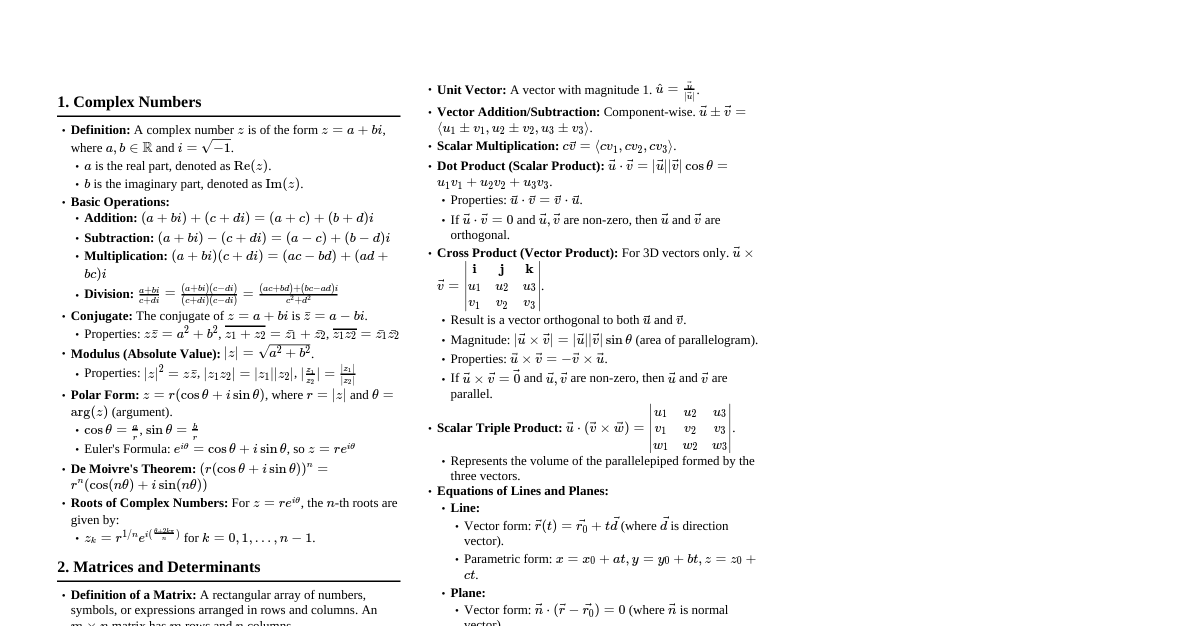
### Basics of Vectors - **Definition:** A quantity having magnitude and direction. Represented as $\vec{a}$ or $\mathbf{a}$. - **Magnitude (Modulus):** Length of the vector, denoted as $|\vec{a}|$. If $\vec{a} = x\hat{i} + y\hat{j} + z\hat{k}$, then $|\vec{a}| = \sqrt{x^2 + y^2 + z^2}$. - **Unit Vector:** A vector with magnitude 1. $\hat{a} = \frac{\vec{a}}{|\vec{a}|}$. - **Position Vector:** $\vec{OP}$ of a point $P(x, y, z)$ from origin $O(0, 0, 0)$ is $x\hat{i} + y\hat{j} + z\hat{k}$. - **Vector joining two points:** If $A(x_1, y_1, z_1)$ and $B(x_2, y_2, z_2)$, then $\vec{AB} = (x_2-x_1)\hat{i} + (y_2-y_1)\hat{j} + (z_2-z_1)\hat{k}$. - **Collinear Vectors:** Vectors are collinear if they are parallel to the same line. $\vec{a} = \lambda\vec{b}$ for some scalar $\lambda$. - **Coplanar Vectors:** Vectors are coplanar if they lie in the same plane. ### Types of Vectors - **Zero Vector:** $\vec{0}$, magnitude 0, no specific direction. - **Equal Vectors:** Same magnitude and direction. - **Negative of a Vector:** Same magnitude, opposite direction. $\vec{-a}$. - **Co-initial Vectors:** Vectors having the same initial point. - **Co-terminal Vectors:** Vectors having the same terminal point. - **Localized Vector:** A vector fixed at a particular point. - **Free Vector:** A vector whose initial point is not fixed. ### Vector Addition & Subtraction - **Triangle Law:** If $\vec{a}$ and $\vec{b}$ are two sides of a triangle, then the third side is $\vec{a} + \vec{b}$. $$\vec{AB} + \vec{BC} = \vec{AC}$$ - **Parallelogram Law:** If $\vec{a}$ and $\vec{b}$ are adjacent sides of a parallelogram, then the diagonal from the common vertex is $\vec{a} + \vec{b}$. - **Properties:** - Commutative: $\vec{a} + \vec{b} = \vec{b} + \vec{a}$ - Associative: $(\vec{a} + \vec{b}) + \vec{c} = \vec{a} + (\vec{b} + \vec{c})$ - Identity: $\vec{a} + \vec{0} = \vec{a}$ - **Subtraction:** $\vec{a} - \vec{b} = \vec{a} + (-\vec{b})$. ### Scalar Multiplication - For a scalar $k$ and vector $\vec{a}$, $k\vec{a}$ has magnitude $|k||\vec{a}|$ and direction same as $\vec{a}$ if $k>0$, opposite if $k ### Dot Product (Scalar Product) - **Definition:** $\vec{a} \cdot \vec{b} = |\vec{a}||\vec{b}|\cos\theta$, where $\theta$ is the angle between $\vec{a}$ and $\vec{b}$. - If $\vec{a} = a_1\hat{i} + a_2\hat{j} + a_3\hat{k}$ and $\vec{b} = b_1\hat{i} + b_2\hat{j} + b_3\hat{k}$, then $\vec{a} \cdot \vec{b} = a_1b_1 + a_2b_2 + a_3b_3$. - **Properties:** - Commutative: $\vec{a} \cdot \vec{b} = \vec{b} \cdot \vec{a}$ - Distributive: $\vec{a} \cdot (\vec{b} + \vec{c}) = \vec{a} \cdot \vec{b} + \vec{a} \cdot \vec{c}$ - $\vec{a} \cdot \vec{a} = |\vec{a}|^2$ - If $\vec{a} \perp \vec{b}$, then $\vec{a} \cdot \vec{b} = 0$. - $\hat{i} \cdot \hat{i} = \hat{j} \cdot \hat{j} = \hat{k} \cdot \hat{k} = 1$ - $\hat{i} \cdot \hat{j} = \hat{j} \cdot \hat{k} = \hat{k} \cdot \hat{i} = 0$ - **Angle between vectors:** $\cos\theta = \frac{\vec{a} \cdot \vec{b}}{|\vec{a}||\vec{b}|}$. - **Projection of $\vec{a}$ on $\vec{b}$:** $\frac{\vec{a} \cdot \vec{b}}{|\vec{b}|}$. Vector projection: $\left(\frac{\vec{a} \cdot \vec{b}}{|\vec{b}|^2}\right)\vec{b}$. ### Cross Product (Vector Product) - **Definition:** $\vec{a} \times \vec{b} = |\vec{a}||\vec{b}|\sin\theta \hat{n}$, where $\hat{n}$ is a unit vector perpendicular to both $\vec{a}$ and $\vec{b}$ (right-hand rule). - If $\vec{a} = a_1\hat{i} + a_2\hat{j} + a_3\hat{k}$ and $\vec{b} = b_1\hat{i} + b_2\hat{j} + b_3\hat{k}$, then: $$\vec{a} \times \vec{b} = \begin{vmatrix} \hat{i} & \hat{j} & \hat{k} \\ a_1 & a_2 & a_3 \\ b_1 & b_2 & b_3 \end{vmatrix}$$ - **Properties:** - Anti-commutative: $\vec{a} \times \vec{b} = -(\vec{b} \times \vec{a})$ - Distributive: $\vec{a} \times (\vec{b} + \vec{c}) = \vec{a} \times \vec{b} + \vec{a} \times \vec{c}$ - If $\vec{a} \parallel \vec{b}$, then $\vec{a} \times \vec{b} = \vec{0}$. - $\hat{i} \times \hat{i} = \hat{j} \times \hat{j} = \hat{k} \times \hat{k} = \vec{0}$ - $\hat{i} \times \hat{j} = \hat{k}$, $\hat{j} \times \hat{k} = \hat{i}$, $\hat{k} \times \hat{i} = \hat{j}$ - **Geometric Interpretation:** $|\vec{a} \times \vec{b}|$ is the area of the parallelogram with adjacent sides $\vec{a}$ and $\vec{b}$. Area of triangle = $\frac{1}{2}|\vec{a} \times \vec{b}|$. ### Scalar Triple Product (Box Product) - **Definition:** $[\vec{a} \vec{b} \vec{c}] = \vec{a} \cdot (\vec{b} \times \vec{c})$ - If $\vec{a} = a_1\hat{i} + a_2\hat{j} + a_3\hat{k}$, $\vec{b} = b_1\hat{i} + b_2\hat{j} + b_3\hat{k}$, $\vec{c} = c_1\hat{i} + c_2\hat{j} + c_3\hat{k}$, then: $$[\vec{a} \vec{b} \vec{c}] = \begin{vmatrix} a_1 & a_2 & a_3 \\ b_1 & b_2 & b_3 \\ c_1 & c_2 & c_3 \end{vmatrix}$$ - **Properties:** - Cyclic permutation: $[\vec{a} \vec{b} \vec{c}] = [\vec{b} \vec{c} \vec{a}] = [\vec{c} \vec{a} \vec{b}]$ - Sign change on non-cyclic permutation: $[\vec{a} \vec{b} \vec{c}] = -[\vec{b} \vec{a} \vec{c}]$ - If any two vectors are equal or parallel, STP is 0. - If $\vec{a}, \vec{b}, \vec{c}$ are coplanar, then $[\vec{a} \vec{b} \vec{c}] = 0$. - **Geometric Interpretation:** $|[\vec{a} \vec{b} \vec{c}]|$ is the volume of the parallelepiped with coterminous edges $\vec{a}, \vec{b}, \vec{c}$. Volume of tetrahedron = $\frac{1}{6}|[\vec{a} \vec{b} \vec{c}]|$. ### Vector Triple Product - **Definition:** $\vec{a} \times (\vec{b} \times \vec{c})$ - **Formula:** $\vec{a} \times (\vec{b} \times \vec{c}) = (\vec{a} \cdot \vec{c})\vec{b} - (\vec{a} \cdot \vec{b})\vec{c}$ (BAC - CAB rule) - **Properties:** - Not associative: $\vec{a} \times (\vec{b} \times \vec{c}) \neq (\vec{a} \times \vec{b}) \times \vec{c}$ - The vector $\vec{a} \times (\vec{b} \times \vec{c})$ is coplanar with $\vec{b}$ and $\vec{c}$. ### Line in 3D - **Vector Equation:** - Through a point $\vec{a}$ and parallel to $\vec{b}$: $\vec{r} = \vec{a} + \lambda\vec{b}$ - Through two points $\vec{a}$ and $\vec{b}$: $\vec{r} = \vec{a} + \lambda(\vec{b} - \vec{a})$ - **Cartesian Equation:** - Through $(x_1, y_1, z_1)$ with direction ratios $(a, b, c)$: $$\frac{x-x_1}{a} = \frac{y-y_1}{b} = \frac{z-z_1}{c}$$ - Through $(x_1, y_1, z_1)$ and $(x_2, y_2, z_2)$: $$\frac{x-x_1}{x_2-x_1} = \frac{y-y_1}{y_2-y_1} = \frac{z-z_1}{z_2-z_1}$$ - **Angle between two lines:** $\cos\theta = \left|\frac{\vec{b_1} \cdot \vec{b_2}}{|\vec{b_1}||\vec{b_2}|}\right|$. - **Shortest Distance between skew lines:** - Vector form: $\frac{|(\vec{a_2} - \vec{a_1}) \cdot (\vec{b_1} \times \vec{b_2})|}{|\vec{b_1} \times \vec{b_2}|}$ - If lines are parallel: $\frac{|(\vec{a_2} - \vec{a_1}) \times \vec{b}|}{|\vec{b}|}$ ### Plane in 3D - **Vector Equation:** - Normal form (distance $p$ from origin, unit normal $\hat{n}$): $\vec{r} \cdot \hat{n} = p$ - Through a point $\vec{a}$ and normal to $\vec{n}$: $(\vec{r} - \vec{a}) \cdot \vec{n} = 0 \implies \vec{r} \cdot \vec{n} = \vec{a} \cdot \vec{n}$ - Through three non-collinear points $\vec{a}, \vec{b}, \vec{c}$: $(\vec{r} - \vec{a}) \cdot [(\vec{b} - \vec{a}) \times (\vec{c} - \vec{a})] = 0$ - **Cartesian Equation:** - General form: $Ax + By + Cz + D = 0$ (normal vector is $(A,B,C)$) - Intercept form: $\frac{x}{a} + \frac{y}{b} + \frac{z}{c} = 1$ - Normal form: $lx + my + nz = p$ (where $l^2+m^2+n^2=1$) - **Angle between two planes:** Angle between their normals. $\cos\theta = \left|\frac{\vec{n_1} \cdot \vec{n_2}}{|\vec{n_1}||\vec{n_2}|}\right|$. - **Angle between a line and a plane:** If $\vec{b}$ is direction vector of line and $\vec{n}$ is normal to plane, $\sin\phi = \left|\frac{\vec{b} \cdot \vec{n}}{|\vec{b}||\vec{n}|}\right|$. - **Distance of a point from a plane:** - Point $P(x_1, y_1, z_1)$ from plane $Ax+By+Cz+D=0$: $\frac{|Ax_1+By_1+Cz_1+D|}{\sqrt{A^2+B^2+C^2}}$ ### JEE Important Questions & Concepts - **JEE Mains & Advanced Focus:** Understanding of vector operations, 3D geometry (lines & planes), and their applications. - **Key Areas:** 1. **Coplanarity:** Determining if vectors/points are coplanar ($[\vec{a} \vec{b} \vec{c}]=0$). 2. **Shortest Distance:** Between skew lines and parallel lines. 3. **Images and Foot of Perpendiculars:** Finding the image of a point in a plane/line, or foot of perpendicular. 4. **Area/Volume:** Using cross product for area of parallelogram/triangle, STP for volume of parallelepiped/tetrahedron. 5. **Perpendicularity/Parallelism:** Conditions using dot and cross products. 6. **Locus Problems:** Involving vector conditions. 7. **Vector Identities:** Mastering $\vec{a} \times (\vec{b} \times \vec{c})$ and $(\vec{a} \times \vec{b}) \cdot (\vec{c} \times \vec{d})$. 8. **Equation of Plane/Line:** Deriving equations based on given conditions. - **Example Problems:** - Find the value of $\lambda$ for which the vectors $\hat{i} + \lambda\hat{j} + 3\hat{k}$ and $3\hat{i} + 2\hat{j} + 9\hat{k}$ are parallel. - If $\vec{a}, \vec{b}, \vec{c}$ are non-coplanar, find the value of $x$ such that $\vec{a} + x\vec{b}$, $\vec{b} + x\vec{c}$, and $\vec{c} + x\vec{a}$ are coplanar. - Find the distance of the point $(1, 2, -1)$ from the plane $x - 2y + 4z = 10$. - A line passes through $(1, 2, 3)$ and $(4, 5, 6)$. Find its vector and cartesian equations. - If $\vec{a} = 2\hat{i} - \hat{j} + \hat{k}$ and $\vec{b} = \hat{i} + 2\hat{j} - \hat{k}$, find a unit vector perpendicular to both $\vec{a}$ and $\vec{b}$. - **Tips for JEE:** - Practice visualizing 3D geometry problems. - Memorize all formulas for dot product, cross product, STP, VTP, and 3D line/plane equations. - Understand the geometric interpretations of vector operations. - Pay attention to scalar vs. vector quantities in problems. - Solve previous year's JEE problems extensively.