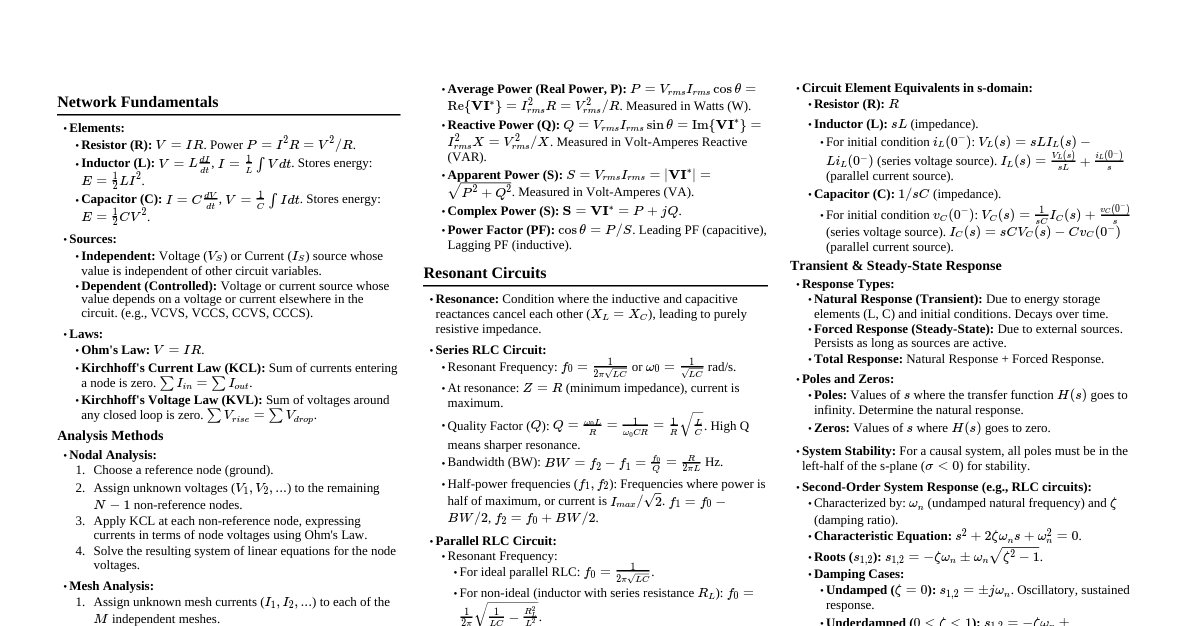
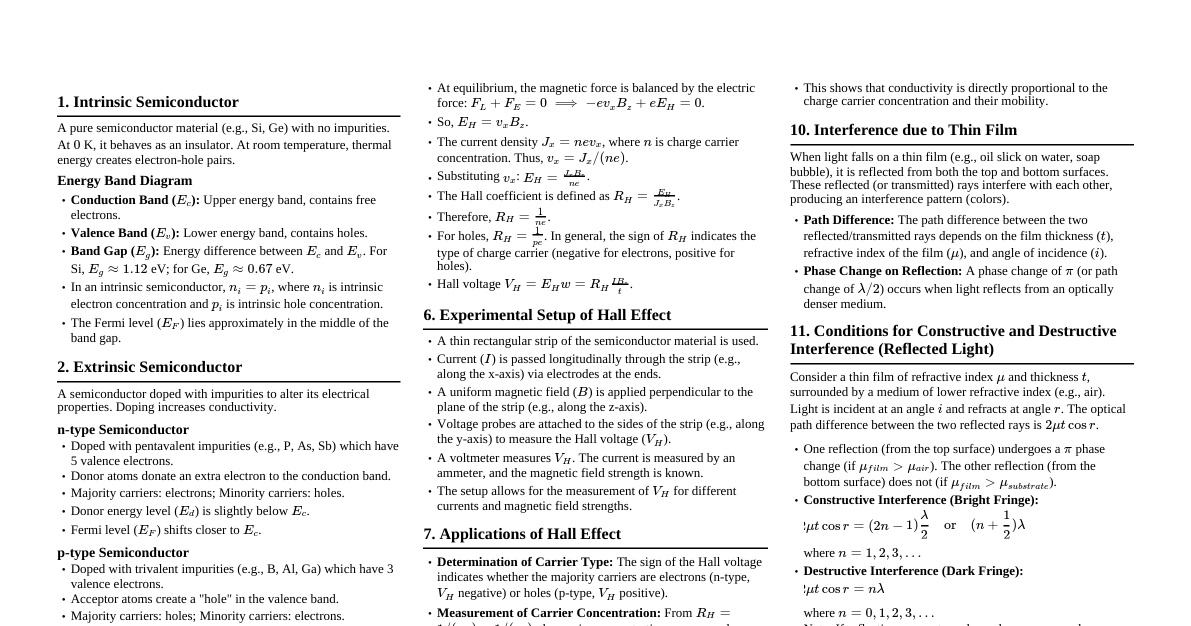
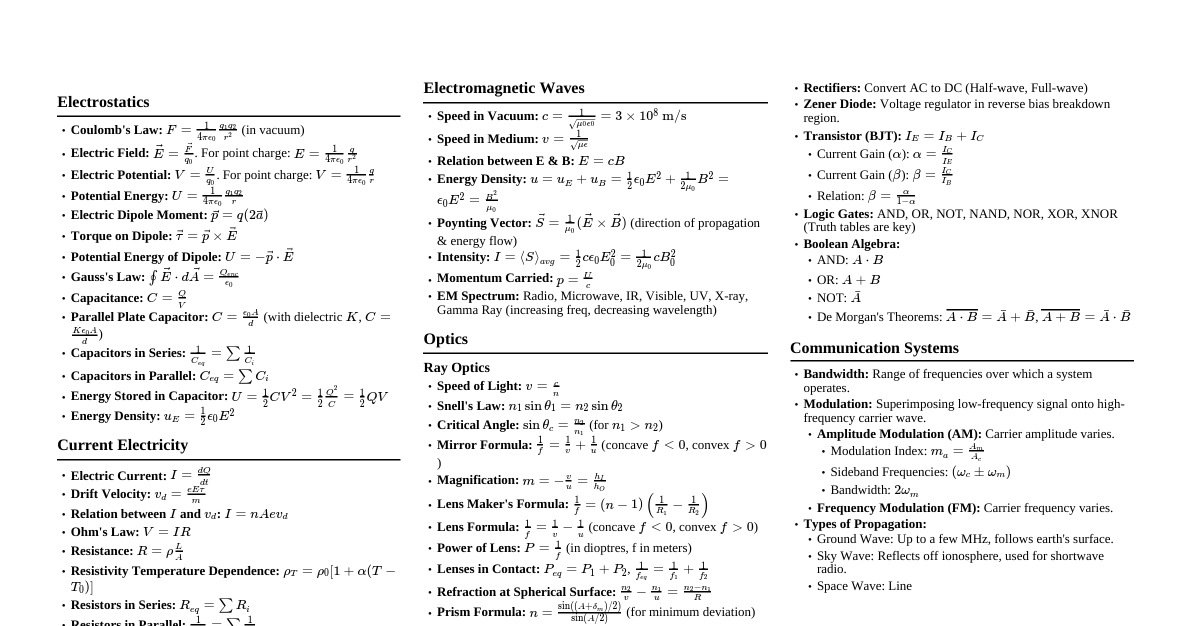
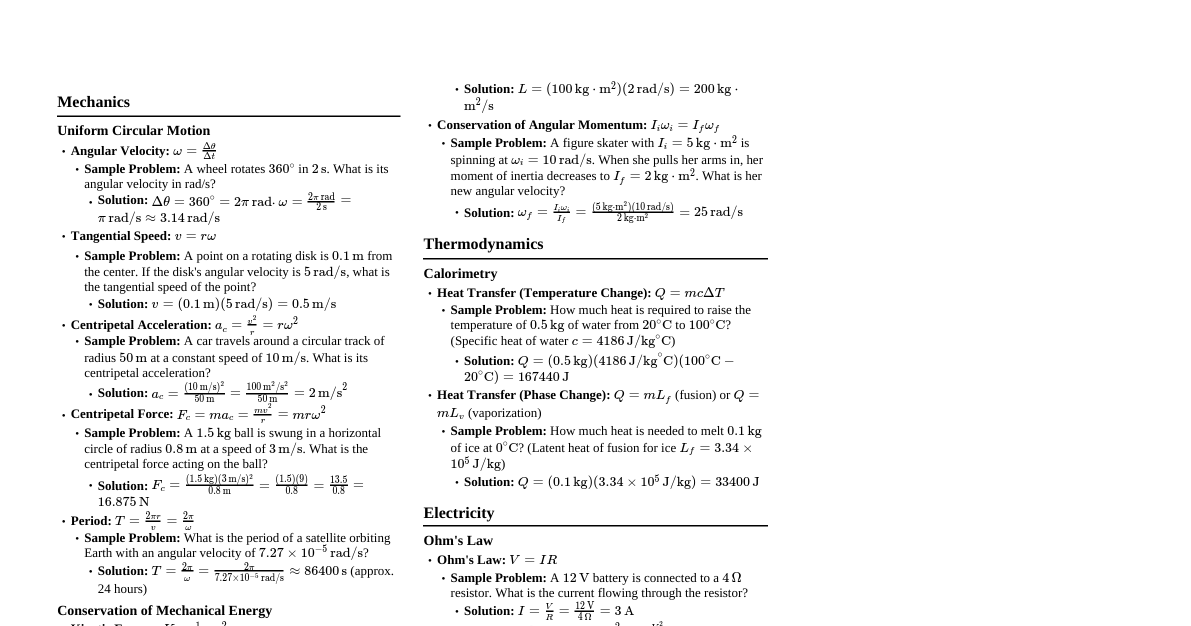
Physics Theory Cheatsheet
Shared 2/27/2026•138 views
### Units and Measurements **Q. Why do we have different units for the same physical quantity?** **A.** The value of any given physical quantity may vary over a wide range, thus requiring different units for convenience. For example, the length of a pen is measured in cm, the height of a tree in meters, and astronomical distances in light-years. **Q. Name the device used for measuring the mass of atoms and molecules.** **A.** A mass spectrograph is used for measuring the mass of atoms and molecules. **Q. Express unified atomic mass unit in kg.** **A.** One atomic mass unit (1 amu or 1u) is defined as 1/12th of the mass of a carbon-12 atom. Mass of one mole of C-12 atom = 12 g. Number of atoms in one mole (Avogadro's number) = $6.023 \times 10^{23}$. Mass of one C-12 atom = $12 / (6.023 \times 10^{23})$ g. Therefore, $1 \text{ amu} = (1/12) \times (12 / (6.023 \times 10^{23})) \text{ g} = 1.66 \times 10^{-24} \text{ g} = 1.66 \times 10^{-27} \text{ kg}$. **Q. Why is it necessary for $f(\theta)$ to be a dimensionless quantity?** **A.** If $f(\theta)$ is defined as a sum of different powers of $\theta$ (e.g., $f(\theta) = 1 - \theta^2/2! + \theta^4/4! - \dots$), then by the principle of homogeneity, all terms in the sum must have the same dimensions. If the first term (1) is dimensionless, then all subsequent terms must also be dimensionless, making the entire function $f(\theta)$ dimensionless. **Q. Why length, mass and time are chosen as base quantities in mechanics?** **A.** Length, mass, and time are chosen as base quantities in mechanics because: 1. They are independent of each other and cannot be derived from one another. 2. All other physical quantities in mechanics can be expressed in terms of these three base quantities. **Q. Which of the following measurement is most precise? (a) 5.00 mm (b) 5.00 cm (c) 5.00 m (d) 5.00 km** **A.** (a) 5.00 mm. Precision refers to the resolution or limit to which a quantity is measured. All options have three significant figures. However, 5.00 mm has the smallest unit (millimeter), implying the smallest absolute uncertainty (e.g., $\pm 0.01 \text{ mm}$), making it the most precise measurement among the choices. ### Motion in a Straight Line **Q. In one dimensional motion, instantaneous speed $v$ satisfies $0 \le v ### Motion in a Plane **Q. A football is kicked into the air vertically upwards. What is its (a) acceleration and (b) velocity at the highest point?** **A.** (a) At the highest point, the acceleration of the football is still the acceleration due to gravity, acting vertically downwards, which is approximately $9.8 \text{ m/s}^2$. (b) At the highest point of its trajectory, the football's vertical component of velocity momentarily becomes zero before it starts falling back down. So, its velocity is zero. **Q. A, B and C are three non-collinear, non co-planar vectors. What can you say about direction of $(\vec{A} \times \vec{B}) \times \vec{C}$?** **A.** The direction of $(\vec{A} \times \vec{B})$ is perpendicular to the plane containing $\vec{A}$ and $\vec{B}$ (by the right-hand rule). Let $\vec{D} = \vec{A} \times \vec{B}$. Then the expression becomes $\vec{D} \times \vec{C}$. The direction of $(\vec{D} \times \vec{C})$ will be perpendicular to the plane containing $\vec{D}$ and $\vec{C}$. This means $(\vec{A} \times \vec{B}) \times \vec{C}$ will lie in the plane containing $\vec{A}$ and $\vec{B}$, and it will be perpendicular to $\vec{C}$. **Q. A boy travelling in an open car moving on a levelled road with constant speed tosses a ball vertically up in the air and catches it back. Sketch the motion of the ball as observed by a boy standing on the footpath. Give explanation to support your diagram.** **A.** As observed by a boy standing on the footpath (a stationary frame of reference), the motion of the ball will be parabolic. This is because the ball retains the horizontal velocity of the car (due to inertia) even after being tossed upwards. While gravity acts vertically downwards, causing vertical motion, the horizontal velocity remains constant (neglecting air resistance). The combination of constant horizontal velocity and vertical motion under gravity results in a parabolic trajectory. **Q. In dealing with motion of projectile in air, we ignore effect of air resistance on motion. This gives trajectory as a parabola as you have studied. What would the trajectory look like if air resistance is included? Sketch such a trajectory and explain why you have drawn it that way.** **A.** If air resistance is included, the trajectory would no longer be a perfect parabola. Air resistance is a force that opposes motion, meaning it acts opposite to the velocity vector. The trajectory would appear asymmetric: * **Ascending path:** The horizontal velocity component would decrease because air resistance acts against it. The vertical velocity component would also decrease more rapidly than under gravity alone. * **Descending path:** Both horizontal and vertical velocity components would be opposed by air resistance. The horizontal range would be reduced, and the descending path would be steeper than the ascending path, as the drag force continually slows the projectile. **Diagram:** The curve would start high, rise less steeply, and fall more sharply than a standard parabola, resulting in a shorter range. The peak of the trajectory would also be lower and shifted slightly to the left (for motion from left to right) compared to the ideal parabolic path. ### Laws of Motion **Q. Conservation of momentum in a collision between particles can be understood from** **A.** Conservation of momentum in a collision between particles can be understood from **both Newton's second and third laws**. * **Newton's Third Law:** In a collision, particles exert equal and opposite forces on each other. These are internal forces within the system. * **Newton's Second Law:** The net external force on a system is equal to the rate of change of its total momentum ($\vec{F}_{ext} = d\vec{p}/dt$). If the net external force on the system is zero (as is often assumed for a brief collision, where internal forces are much larger than external ones), then the total momentum of the system remains constant. **Q. A hockey player is moving northward and suddenly turns westward with the same speed to avoid an opponent. The force that acts on the player is** **A.** The force acts in the direction of the change in momentum. The initial momentum is northward, and the final momentum is westward. The change in momentum is $\vec{p}_{final} - \vec{p}_{initial}$. If we represent northward as $+\hat{j}$ and westward as $-\hat{i}$, then $\vec{p}_{initial} = m v \hat{j}$ and $\vec{p}_{final} = -m v \hat{i}$. The change in momentum is $\Delta \vec{p} = -m v \hat{i} - m v \hat{j}$. This vector points in the south-west direction. The force causing this change must also be in the south-west direction. This force is typically the **frictional force along south-West** exerted by the ground on the player's skates/shoes. **Q. A person driving a car suddenly applies the brakes on seeing a child on the road ahead. If he is not wearing seat belt, he falls forward and hits his head against the steering wheel. Why?** **A.** This phenomenon is explained by **Newton's First Law of Motion (Law of Inertia)**. When the car is moving, the driver's body is also in motion with the same velocity as the car. When the brakes are suddenly applied, the car decelerates rapidly. However, due to inertia, the driver's body (especially the upper torso and head) tends to continue moving forward at its initial velocity. Since there is no external force to decelerate the driver's body at the same rate as the car, they are thrown forward, potentially hitting the steering wheel or dashboard. **Q. Why are porcelain objects wrapped in paper or straw before packing for transportation?** **A.** Porcelain objects are wrapped in paper or straw to increase the time duration of impact during any sudden jerks or falls during transportation. According to the impulse-momentum theorem ($F \Delta t = \Delta p$), for a given change in momentum ($\Delta p$), increasing the time of impact ($\Delta t$) reduces the average force ($F$) exerted on the objects. The paper or straw acts as a cushioning material, absorbing some of the impact energy and distributing the force over a longer time, thereby preventing the porcelain objects from breaking. **Q. Why are mountain roads generally made winding upwards rather than going straight up?** **A.** Mountain roads are made winding upwards (with a gradual slope) rather than going straight up (a steep slope) for several reasons, primarily related to frictional forces and vehicle stability: 1. **Reduced Force Requirement:** On a winding road, the angle of inclination ($\theta$) with the horizontal is smaller. The component of gravitational force acting down the incline is $mg \sin\theta$. A smaller $\theta$ means a smaller $mg \sin\theta$, so the engine needs to exert less force to move the vehicle uphill. 2. **Increased Friction for Traction:** The normal force on an inclined plane is $N = mg \cos\theta$. The maximum static friction available for traction is $f_s = \mu_s N = \mu_s mg \cos\theta$. For a steeper slope (larger $\theta$), $\cos\theta$ is smaller, reducing the available friction and increasing the risk of skidding or slipping. Winding roads ensure a larger $\cos\theta$, providing better traction. 3. **Stability and Safety:** Steeper slopes make it harder to control the vehicle, especially during braking or in adverse weather conditions. Winding roads offer a safer and more manageable ascent and descent. **Q. A mass of 2 kg is suspended with thread AB (figure). Thread CD of the same type is attached to the other end of 2 kg mass. Lower thread is pulled gradually, harder and harder in the downward direction, so as to apply force on AB. Which of the threads will break and why?** **A.** **Thread AB will break.** When the lower thread CD is pulled gradually, the tension in thread CD is equal to the applied force. The tension in thread AB, however, is equal to the applied force *plus* the weight of the 2 kg mass. Since the tension in AB is greater than in CD, and both threads are of the same type (implying they have the same breaking strength), thread AB will reach its breaking limit first and snap. **Q. In the above given problem if the lower thread is pulled with a jerk, what happens?** **A.** If the lower thread CD is pulled with a jerk (a sudden, strong pull), **thread CD will break.** This occurs due to inertia. When a sudden jerk is applied to CD, a large, instantaneous force is created. Due to the inertia of the 2 kg mass, it resists this sudden change in motion. The force applied to CD does not have enough time to propagate through the mass and increase the tension in thread AB significantly before thread CD snaps under the sudden stress. The tension in CD momentarily becomes very high, exceeding its breaking strength, while the tension in AB remains relatively low due to the mass's inertia. ### Work, Energy and Power **Q. A man squatting on the ground gets straight up and stand. The force of reaction of ground on the man during the process is** **A.** The force of reaction from the ground is initially **greater than mg and later becomes equal to mg**. When the man is squatting and starts to stand up, he needs to accelerate his center of mass upwards. According to Newton's second law, to produce an upward acceleration, the net upward force must be positive. This means the upward reaction force from the ground must be greater than his downward weight ($mg$). Once he has accelerated and is standing still, his acceleration becomes zero, and the reaction force from the ground becomes equal to his weight ($mg$). **Q. A body is falling freely under the action of gravity alone in vacuum. Which of the following quantities remain constant during the fall?** **A.** **Total mechanical energy** (Kinetic Energy + Potential Energy) remains constant. In a vacuum, there is no air resistance, so gravity is the only force doing work. Gravity is a conservative force, and for systems under conservative forces, total mechanical energy is conserved. Kinetic energy increases and potential energy decreases, but their sum stays constant. **Q. During inelastic collision between two bodies, which of the following quantities always remain conserved?** **A.** **Total linear momentum** always remains conserved during any collision (elastic or inelastic), provided no external forces act on the system of colliding bodies. Kinetic energy is generally *not* conserved in inelastic collisions, as some of it is converted into other forms of energy (e.g., heat, sound, deformation). **Q. A rough inclined plane is placed on a cart moving with a constant velocity $u$ on horizontal ground. A block of mass $M$ rests on the incline. Is any work done by force of friction between the block and incline? Is there then a dissipation of energy?** **A.** **No, there is no work done by the force of friction**, and **no dissipation of energy** due to friction in this specific scenario. Since the block of mass $M$ rests on the incline and the cart is moving with a constant velocity $u$, the block is also moving with the same constant velocity as the cart. This means there is no relative motion or tendency of relative motion between the block and the incline. Therefore, the static frictional force acting between the block and the incline does no work (as work done requires displacement in the direction of the force) and there is no energy dissipated as heat due to friction. **Q. Why is electrical power required at all when the elevator is descending? Why should there be a limit on the number of passengers in this case?** **A.** **Electrical power is required even when an elevator is descending** for several reasons: 1. **Controlled Descent:** The motor does not just let the elevator free-fall. It controls the rate of descent. This involves either applying a braking force (which can be electric) or using the motor to resist the downward pull of gravity. In some modern elevators, the descending weight can be used to generate electricity (regenerative braking), but this still involves active power management. 2. **Overcoming Friction:** There is always friction in the guide rails and moving parts, which needs to be overcome for smooth operation. 3. **Operating Control Systems:** Electrical power is needed for the elevator's control systems, lighting, doors, and safety mechanisms. **There must be a limit on the number of passengers** because: 1. **Safety:** Exceeding the weight limit can strain the cables, motor, and braking system beyond their design capacity, leading to mechanical failure and potential accidents. 2. **Performance:** An overloaded elevator will descend too rapidly if the motor cannot adequately resist the excessive weight, or it may not be able to move at all. 3. **Structural Integrity:** Repeated overloading can weaken the elevator's structural components over time. **Q. A body is being raised to a height $h$ from the surface of earth. What is the sign of work done by (a) applied force and (b) gravitational force?** **A.** (a) **Work done by applied force: Positive (+)**. The applied force acts upwards, and the displacement is also upwards (in the direction of the applied force). Work done ($W = F \cdot d \cos\theta$) is positive when the force and displacement are in the same direction ($\theta = 0^\circ$). (b) **Work done by gravitational force: Negative (-)**. The gravitational force acts downwards, while the displacement is upwards (opposite to the gravitational force). Work done is negative when the force and displacement are in opposite directions ($\theta = 180^\circ$). **Q. Calculate the work done by a car against gravity in moving along a straight horizontal road. The mass of the car is 400 kg and the distance moved is 2 m.** **A.** The work done by a car against gravity when moving along a straight horizontal road is **zero**. Gravity acts vertically downwards, while the displacement of the car is horizontal. The angle between the gravitational force and the displacement is $90^\circ$. Since Work Done $W = Fd \cos\theta$, and $\cos(90^\circ) = 0$, the work done against gravity is zero. **Q. A body falls towards earth in air. Will its total mechanical energy be conserved during the fall? Justify.** **A.** **No, its total mechanical energy will not be conserved** during the fall. Justification: Total mechanical energy (Kinetic Energy + Potential Energy) is conserved only when conservative forces (like gravity) are acting and non-conservative forces (like air resistance/drag) are absent or negligible. When a body falls through the air, air resistance is a non-conservative force that acts opposite to the direction of motion. This force does negative work on the body, converting some of its mechanical energy into thermal energy (heat and sound). Consequently, the total mechanical energy of the body continuously decreases during its fall. **Q. A body is moved along a closed loop. Is the work done in moving the body necessarily zero? If not, state the condition under which work done over a closed path is always zero.** **A.** **No, the work done in moving the body along a closed loop is not necessarily zero.** The work done over a closed path is always zero **only if all the forces acting on the body are conservative forces**. If non-conservative forces (like friction or air resistance) are present and do work on the body, then the total work done over a closed path will generally not be zero. In fact, the work done by non-conservative forces over a closed path is typically negative, representing energy dissipated from the system. **Q. In an elastic collision of two billiard balls, which of the following quantities remain conserved during the short time of collision of the balls (i.e., when they are in contact)? (a) Kinetic energy. (b) Total linear momentum. Give reason for your answer in each case.** **A.** During the short time when the billiard balls are in contact during an elastic collision: (a) **Kinetic energy is NOT conserved.** Reason: While the collision is elastic overall (meaning kinetic energy is conserved before and after the collision), during the brief moment of contact, the balls deform. This deformation involves a conversion of kinetic energy into elastic potential energy. As the balls deform, their kinetic energy decreases, reaching a minimum when deformation is maximum, and then increases as they regain their shape and separate. (b) **Total linear momentum IS conserved.** Reason: The total linear momentum of the system of two billiard balls is conserved throughout the entire collision process (before, during, and after). This is because the forces acting between the balls are internal forces. Assuming no significant external forces (like friction from the table or air resistance) act on the system during the very short collision time, the net external force is zero, and thus, the total linear momentum of the system remains constant. **Q. Give example of a situation in which an applied force does not result in a change in kinetic energy.** **A.** One example is a **charged particle moving in a uniform magnetic field perpendicular to its velocity**. The magnetic force ($\vec{F} = q(\vec{v} \times \vec{B})$) is always perpendicular to the velocity of the particle. Therefore, the work done by the magnetic force ($W = \vec{F} \cdot \vec{d}$) is always zero, as there is no component of force in the direction of displacement. According to the work-energy theorem ($W_{net} = \Delta KE$), if the magnetic force is the only force doing work, then the change in kinetic energy is zero, meaning the kinetic energy (and thus the speed) of the particle remains constant. The particle's direction changes, but its speed does not. **Q. Two bodies of unequal mass are moving in the same direction with equal kinetic energy. The two bodies are brought to rest by applying retarding force of same magnitude. How would the distance moved by them before coming to rest compare?** **A.** The distance moved by them before coming to rest will be **equal**. According to the **Work-Energy Theorem**, the net work done on an object is equal to the change in its kinetic energy ($W_{net} = \Delta KE$). Here, the initial kinetic energy ($KE_{initial}$) is the same for both bodies. They are brought to rest, so their final kinetic energy ($KE_{final}$) is zero. Thus, the change in kinetic energy ($\Delta KE = KE_{final} - KE_{initial} = 0 - KE_{initial}$) is the same for both bodies. The work done by the retarding force is $W = -F \cdot d$, where $F$ is the magnitude of the retarding force and $d$ is the distance moved. Since $\Delta KE$ is the same for both bodies and the magnitude of the retarding force ($F$) is also the same for both, the distance $d$ must also be the same for both bodies. **Q. A bob of mass $m$ suspended by a light string of length $L$ is whirled into a vertical circle as shown in figure. What will be the trajectory of the particle, if the string is cut at (a) point B? (b) point C? (c) point X?** **A.** When the string is cut, the tension force (which provides the centripetal force) disappears. The bob will then follow a trajectory determined by its instantaneous velocity at that moment and the force of gravity. (a) **At point B (highest point):** The velocity of the bob is purely horizontal. When the string is cut at B, the bob will move horizontally for a short distance (due to its initial horizontal velocity) and then fall under gravity, following a **parabolic trajectory** (like a projectile launched horizontally). (b) **At point C (lowest point):** The velocity of the bob is purely horizontal. When the string is cut at C, the bob will also follow a **parabolic trajectory**, but it will start from a lower height and immediately begin to fall while moving horizontally. (c) **At point X (intermediate point):** The velocity of the bob at point X is tangential to the circular path and directed upwards and to the left (assuming counter-clockwise motion). When the string is cut at X, the bob will follow a **parabolic trajectory** (like a projectile launched at an angle), rising to a certain height before falling back down. **Q. A raindrop of mass 1.00 g falling from a height of 1 km hits the ground with a speed of 50 m s$^{-1}$. Calculate (a) the loss of PE of the drop. (b) the gain in KE of the drop. (c) Is the gain in KE equal to loss of PE? If not why? Take, $g = 10 \text{ ms}^{-2}$.** **A.** Given: Mass $m = 1.00 \text{ g} = 1.00 \times 10^{-3} \text{ kg}$, height $h = 1 \text{ km} = 1000 \text{ m}$, final speed $v = 50 \text{ m/s}$, $g = 10 \text{ m/s}^2$. (a) **Loss of PE of the drop:** $\Delta PE = mgh = (1.00 \times 10^{-3} \text{ kg}) \times (10 \text{ m/s}^2) \times (1000 \text{ m}) = 10 \text{ J}$. (b) **Gain in KE of the drop:** (Assuming initial velocity is 0) $\Delta KE = \frac{1}{2}mv^2 - 0 = \frac{1}{2}(1.00 \times 10^{-3} \text{ kg}) \times (50 \text{ m/s})^2 = \frac{1}{2} \times 10^{-3} \times 2500 = 1.25 \text{ J}$. (c) **Is the gain in KE equal to loss of PE? If not why?** No, the gain in KE ($1.25 \text{ J}$) is not equal to the loss of PE ($10 \text{ J}$). The reason is that **air resistance (a non-conservative force) acts on the raindrop during its fall.** Air resistance does negative work on the drop, converting a significant portion of its initial potential energy into thermal energy (heat and sound) rather than kinetic energy. Therefore, the mechanical energy is not conserved, and the gain in KE is less than the loss in PE. **Q. Suppose the average mass of raindrops is $3.0 \times 10^{-5}$ kg and their average terminal velocity $9 \text{ m s}^{-1}$. Calculate the energy transferred by rain to each square metre of the surface at a place which receives 100 cm of rain in a year.** **A.** Given: Average mass of raindrop $m_{drop} = 3.0 \times 10^{-5} \text{ kg}$. Average terminal velocity $v = 9 \text{ m/s}$. Height of rain $h = 100 \text{ cm} = 1 \text{ m}$. Surface area $A = 1 \text{ m}^2$. Density of water $\rho_{water} = 1000 \text{ kg/m}^3$. First, calculate the total mass of rain falling on $1 \text{ m}^2$ in a year: Volume of rain $V_{rain} = A \times h = 1 \text{ m}^2 \times 1 \text{ m} = 1 \text{ m}^3$. Mass of rain $M_{rain} = \rho_{water} \times V_{rain} = 1000 \text{ kg/m}^3 \times 1 \text{ m}^3 = 1000 \text{ kg}$. The energy transferred to the surface by the rain is the kinetic energy of this mass of water as it hits the ground at terminal velocity: Energy $E = \frac{1}{2} M_{rain} v^2 = \frac{1}{2} \times (1000 \text{ kg}) \times (9 \text{ m/s})^2 = \frac{1}{2} \times 1000 \times 81 = 40500 \text{ J} = 4.05 \times 10^4 \text{ J}$. ### System of Particles and Rotational Motion **Q. For which of the following does the centre of mass lie outside the body?** **A.** The center of mass lies outside the body for objects that are hollow or have a significant void within them, such as a **bangle** (ring). For a bangle, the center of mass is at the geometric center of the circle, which is an empty space. **Q. When a disc rotates with uniform angular velocity, which of the following is not true?** **A.** The statement that is **not true** is: **(d) The angular acceleration is non-zero and remains same**. Explanation: * Uniform angular velocity means the angular velocity ($\omega$) is constant in both magnitude and direction. * Angular acceleration ($\alpha$) is the rate of change of angular velocity ($\alpha = d\omega/dt$). * If $\omega$ is constant, then $d\omega/dt = 0$. * Therefore, the angular acceleration is zero, not non-zero. **Q. The centre of gravity of a body on the earth coincides with its centre of mass for a small object whereas for an extended object it may not. What is the qualitative meaning of small and extended in this regard? For which of the following two coincides? A building, a pond, a lake, a mountain?** **A.** **Qualitative Meaning:** * **Small object:** An object is considered "small" in this context if its vertical dimensions are negligible compared to the Earth's radius, such that the acceleration due to gravity ($g$) can be considered uniform across its entire extent. * **Extended object:** An object is "extended" if its vertical dimensions are significant enough such that there is a noticeable variation in the acceleration due to gravity ($g$) from one part of the object to another. Different parts of the object experience slightly different gravitational forces, both in magnitude and direction, relative to a common reference point. **For which of the following two coincides?** The center of mass (CM) and center of gravity (CG) coincide for: * **A building:** Typically, a building is considered a "small" object where $g$ is uniform across its height. * **A pond:** A pond is also generally "small" in vertical extent. The CM and CG **may not perfectly coincide** for: * **A deep lake:** If the lake is exceptionally deep, there might be a slight variation in $g$ from the surface to the bottom, causing a tiny separation. * **A mountain:** A mountain is a prime example of an "extended" object where $g$ can vary significantly from its base to its peak. The CG would be slightly lower than the CM because the lower parts (closer to Earth's center) experience a slightly stronger gravitational pull. **Q. Why does a solid sphere have smaller moment of inertia than a hollow cylinder of same mass and radius, about an axis passing through their axes of symmetry?** **A.** The moment of inertia depends on how the mass is distributed relative to the axis of rotation. The formula for moment of inertia is $I = \sum m_i r_i^2$. * For a **hollow cylinder** (about its symmetry axis), almost all its mass is concentrated at the maximum radius $R$ from the axis. Its moment of inertia is $I_{hollow\_cylinder} = MR^2$. * For a **solid sphere** (about its diameter), its mass is distributed throughout its volume, from the center ($r=0$) to the surface ($r=R$). A significant portion of its mass is closer to the axis of rotation than $R$. Its moment of inertia is $I_{solid\_sphere} = \frac{2}{5}MR^2$. Since $\frac{2}{5} ### Gravitation **Q. The earth is an approximate sphere. If the interior contained matter which is not of the same density everywhere, then on the surface of the earth, the acceleration due to gravity** **A.** If the interior of the Earth is not of uniform density, then on the surface of the Earth, the acceleration due to gravity **(a) will be directed towards the centre but not the same everywhere**. Explanation: * The gravitational force (and thus acceleration due to gravity) is always directed towards the center of mass of the Earth. If the Earth is spherically symmetric (even if density varies radially), this direction is towards the geometric center. * However, if the density is not uniform (e.g., denser regions or voids), the distribution of mass is not perfectly homogeneous. This means the gravitational pull will vary slightly from one point to another on the surface, depending on the underlying mass distribution. Therefore, the magnitude of $g$ will not be the same everywhere. **Q. As observed from the earth, the sun appears to move in an approximate circular orbit. For the motion of another planet like mercury as observed from the earth, this would** **A.** For the motion of Mercury as observed from Earth, this would **(c) not be true because the major gravitational force on Mercury is due to the sun**. Explanation: * The Sun's apparent motion around Earth is dominated by the Earth's revolution around the Sun. * For Mercury, its motion is primarily governed by the Sun's strong gravitational pull. Earth also exerts a gravitational force on Mercury, but this is much weaker than the Sun's. * When observed from Earth, Mercury's orbit would appear complex, not simple and circular. This is because both Earth and Mercury are orbiting the Sun, and Earth itself is not a stationary frame of reference for observing Mercury's motion. Mercury's path would be a complex epicycle-like curve relative to Earth, not an approximate circular orbit. **Q. Satellites orbiting the earth have finite life and sometimes debris of satellites fall to the earth. This is because** **A.** Satellites have a finite life and sometimes fall to Earth primarily **(c) of viscous forces causing the speed of satellite and hence height to gradually decrease**. Explanation: * Even in "empty" space, there's a very thin atmosphere (exosphere) extending hundreds of kilometers above Earth. * Satellites in low Earth orbit (LEO) experience a tiny amount of atmospheric drag (viscous force) from these sparse air molecules. * This drag does negative work on the satellite, causing it to lose energy. * When a satellite loses energy, its orbital radius (and thus height) decreases. As it descends into denser layers of the atmosphere, the drag increases, leading to a faster decay of its orbit and eventually re-entry and burning up (or falling as debris) into the Earth's atmosphere. **Q. Both the earth and the moon are subject to the gravitational force of the sun. As observed from the sun, the orbit of the moon** **A.** As observed from the Sun, the orbit of the Moon **(b) will not be strictly elliptical because the total gravitational force on it is not central.** Explanation: * If only the Sun's gravity acted on the Moon, the Moon's orbit around the Sun would be elliptical. * However, the Moon is also strongly influenced by Earth's gravity. * Therefore, from the Sun's perspective, the Moon experiences gravitational forces from *both* the Sun and the Earth. The combination of these two forces means the net gravitational force on the Moon is not always directed precisely towards the Sun (it's not a purely central force from the Sun's viewpoint). * This causes the Moon's path around the Sun to be a complex, wavy curve, which deviates from a simple ellipse. It's roughly an ellipse around the Sun, but with small perturbations (wobbles) caused by Earth's pull. **Q. In our solar system, the inter-planetary region has chunks of matter (much smaller in size compared to planets) called asteroids. They** **A.** Asteroids **(d) will move in orbits like planets and obey Kepler’s laws**. Explanation: * Asteroids are celestial bodies orbiting the Sun, just like planets. * Their motion is primarily governed by the Sun's gravitational force, which is a central force. * Therefore, their orbits are generally elliptical (though some can be highly eccentric) and they follow Kepler's laws of planetary motion, which describe the motion of any object under a central inverse-square law force. **Q. Choose the wrong option. (a) Inertial mass is a measure of difficulty of accelerating a body by an external force whereas the gravitational mass is relevant in determining the gravitational force on it by an external mass (b) That the gravitational mass and inertial mass are equal is an experimental result (c) That the acceleration due to gravity on the earth is the same for all bodies is due to the equality of gravitational mass and inertial mass (d) Gravitational mass of a particle like proton can depend on the presence of neighbouring heavy objects but the inertial mass cannot** **A.** The wrong option is **(d) Gravitational mass of a particle like proton can depend on the presence of neighbouring heavy objects but the inertial mass cannot**. Explanation: * Both inertial mass and gravitational mass are fundamental properties of a particle. They are constant for a given particle and do not depend on the presence or absence of other nearby objects. This statement is incorrect. * (a), (b), and (c) are correct statements. Inertial mass ($m_i$) is found in $F = m_i a$, and gravitational mass ($m_g$) is found in $F = G m_g M / r^2$. The equivalence principle states that $m_i = m_g$, which is an experimental result and explains why all objects fall with the same acceleration due to gravity ($a = g = G M / r^2$, where $m_g$ in the force equation cancels $m_i$ in Newton's second law if $m_i=m_g$). **Q. Which of the following options are correct? (a) Acceleration due to gravity decreases with increasing altitude (b) Acceleration due to gravity increases with increasing depth (assume the earth to be a sphere of uniform density) (c) Acceleration due to gravity increases with increasing latitude (d) Acceleration due to gravity is independent of the mass of the earth** **A.** The correct options are **(a) Acceleration due to gravity decreases with increasing altitude** and **(c) Acceleration due to gravity increases with increasing latitude**. Explanation: * **(a) Acceleration due to gravity decreases with increasing altitude:** Correct. The formula for $g$ at height $h$ is $g_h = G M / (R+h)^2$. As $h$ increases, $g_h$ decreases. * **(b) Acceleration due to gravity increases with increasing depth (assume the earth to be a sphere of uniform density):** Incorrect. For a uniform density Earth, $g_d = g(1 - d/R)$. As depth $d$ increases, $g_d$ decreases, reaching zero at the center of the Earth. * **(c) Acceleration due to gravity increases with increasing latitude:** Correct. Due to Earth's rotation, there is a centrifugal effect that reduces the effective $g$ at the equator. The formula is $g' = g - \omega^2 R \cos^2\phi$, where $\phi$ is latitude. As $\phi$ increases, $\cos^2\phi$ decreases, so $g'$ increases (maximum at poles where $\phi=90^\circ$). * **(d) Acceleration due to gravity is independent of the mass of the earth:** Incorrect. The formula $g = GM/R^2$ clearly shows that $g$ is directly proportional to the mass of the Earth ($M$). **Q. If the law of gravitation, instead of being inverse square law, becomes an inverse cube law (a) planets will not have elliptic orbits (b) circular orbits of planets is not possible (c) projectile motion of a stone thrown by hand on the surface of the earth will be approximately parabolic (d) there will be no gravitational force inside a spherical shell of uniform density** **A.** The correct options are **(a) planets will not have elliptic orbits** and **(c) projectile motion of a stone thrown by hand on the surface of the earth will be approximately parabolic**. Explanation: * **(a) Planets will not have elliptic orbits:** Correct. Kepler's laws (including elliptical orbits) are derived specifically for an inverse square law force. An inverse cube law would lead to different types of orbits, not stable ellipses. * **(b) Circular orbits of planets is not possible:** Incorrect. Circular orbits are possible even with an inverse cube law, but they would be unstable. If the speed slightly changes, the orbit would spiral inward or outward. * **(c) Projectile motion of a stone thrown by hand on the surface of the earth will be approximately parabolic:** Correct. Near the Earth's surface, the change in distance from the center is negligible. So, an inverse cube law $F \propto 1/r^3$ would effectively mean the gravitational force is roughly constant in a small region, similar to how we treat $g$ as constant for projectile motion under an inverse square law. Therefore, the trajectory would still be approximately parabolic. * **(d) There will be no gravitational force inside a spherical shell of uniform density:** Incorrect. Gauss's Law for gravity (which states zero field inside a uniform spherical shell) relies on the inverse square nature of the force. For an inverse cube law, the gravitational force inside a uniform spherical shell would generally *not* be zero. **Q. If the sun and the planets carried huge amounts of opposite charges, (a) all three of Kepler’s laws would still be valid (b) only the third law will be valid (c) the second law will not change (d) the first law will still be valid** **A.** The correct options are **(a) all three of Kepler's laws would still be valid**, **(c) the second law will not change**, and **(d) the first law will still be valid**. Explanation: * Kepler's laws are a consequence of the gravitational force being a **central force** and an **inverse square law force**. * If the Sun and planets carried huge amounts of opposite charges, an additional **electrostatic force of attraction** would exist between them. * This electrostatic force is also an **inverse square law force** ($F_e \propto 1/r^2$) and a **central force** (directed along the line joining the centers of the charged bodies). * Since the total force (gravitational + electrostatic) would still be a central, inverse square law force, all three of Kepler's laws would remain valid, but the effective constant in the force law would be modified. **Q. There have been suggestions that the value of the gravitational constant G becomes smaller when considered over very large time period (in billions of years) in the future. If that happens, for our earth, (a) nothing will change (b) we will become hotter after billions of years (c) we will be going around but not strictly in closed orbits (d) after sufficiently long time we will leave the solar system** **A.** The correct options are **(c) we will be going around but not strictly in closed orbits** and **(d) after sufficiently long time we will leave the solar system**. Explanation: * The gravitational force between the Sun and Earth is $F = GMm/r^2$. This force provides the centripetal force for Earth's orbit. * If $G$ decreases, the gravitational force would become weaker. * A weaker attractive force would mean that Earth's current orbital velocity would be too high for the reduced gravitational pull to keep it in its current orbit. * Consequently, Earth's orbit would gradually expand. It would no longer be a stable closed ellipse but would slowly spiral outwards. * If $G$ continues to decrease, eventually the gravitational pull would become too weak to hold Earth in orbit around the Sun, and Earth would escape the solar system. **Q. Which of the following are true? (a) A polar satellite goes around the earth’s pole in north-south direction (b) A geostationary satellite goes around the earth in east-west direction (c) A geostationary satellite goes around the earth in west-east direction (d) A polar satellite goes around the earth in east-west direction** **A.** The correct options are **(a) A polar satellite goes around the earth’s pole in north-south direction** and **(c) A geostationary satellite goes around the earth in west-east direction**. Explanation: * **(a) Polar satellite:** Orbits Earth in a north-south direction, passing over or near both poles. These orbits are typically low Earth orbits. * **(c) Geostationary satellite:** Orbits Earth directly above the equator (0° latitude) and moves in the same direction as Earth's rotation (west to east). Its orbital period is 24 hours, so it appears stationary relative to a point on the Earth's surface. **Q. The centre of mass of an extended body on the surface of the earth and its centre of gravity (a) are always at the same point for any size of the body (b) are always at the same point only for spherical bodies (c) can never be at the same point (d) is close to each other for objects, say of sizes less than 100 m (e) both can change if the object is taken deep inside the earth** **A.** The correct option is **(d) is close to each other for objects, say of sizes less than 100 m**. Explanation: * The **center of mass (CM)** is the point where the entire mass of the body is considered to be concentrated. * The **center of gravity (CG)** is the point where the resultant gravitational force on the body acts. * For small objects (where the variation of $g$ across the object's dimensions is negligible), the CM and CG coincide. * For very large extended objects (like a mountain or a very tall building), where $g$ can vary significantly across its height, the CG will be slightly lower than the CM (as parts closer to Earth's center experience a stronger $g$). * Objects of size less than 100 m on Earth's surface are generally considered "small" enough for $g$ to be practically uniform, so their CM and CG are very close. **Q. Molecules in air in the atmosphere are attracted by gravitational force of the earth. Explain why all of them do not fall into the earth just like an apple falling from a tree.** **A.** The primary reason why air molecules do not fall to Earth like an apple is their **high kinetic energy and constant random thermal motion**. 1. **Kinetic Energy and Speed:** Air molecules are in continuous, random motion. At typical atmospheric temperatures, their average kinetic energy is high enough for them to move at very high speeds (on the order of hundreds of m/s). 2. **Collisions:** These molecules constantly collide with each other and with objects, transferring momentum and energy. This prevents any single molecule from continuously accelerating towards the Earth's surface. 3. **Pressure Gradient:** The constant motion and collisions of molecules create atmospheric pressure. This pressure exerts an upward force (pressure gradient force) that counteracts the downward gravitational force on layers of air. 4. **Escape Velocity (for the very top layers):** While individual molecules are bound by Earth's gravity, some at the very top of the atmosphere might gain enough speed from collisions to exceed Earth's escape velocity and leave the atmosphere, but the bulk of the atmosphere is held by gravity. An apple, being a macroscopic object, has negligible thermal motion relative to its overall fall, and its mass is large enough that gravity dominates over any minor air resistance effects. **Q. Give one example each of central force and non-central force.** **A.** * **Central Force:** A force whose magnitude depends only on the distance from a central point and is directed along the line joining the particle to that central point. * **Example:** Gravitational force (e.g., between Earth and Moon), Electrostatic force (e.g., between two charged particles). * **Non-Central Force:** A force that is not always directed towards a fixed center, or whose magnitude depends on more than just the distance from a central point (e.g., on velocity or orientation). * **Example:** Nuclear force (depends on spin orientation), Magnetic force on a moving charge (depends on velocity and magnetic field direction). **Q. Draw areal velocity versus time graph for mars.** **A.** According to **Kepler's Second Law of Planetary Motion**, the line joining a planet and the Sun sweeps out equal areas in equal intervals of time. This means the **areal velocity of a planet is constant**. Therefore, for Mars, the areal velocity versus time graph would be a **horizontal straight line**. **Graph:** ``` ^ Areal Velocity | | -------------------- | / | / | / +---------------------------> Time ``` **Q. What is the direction of areal velocity of the earth around the sun?** **A.** The areal velocity of the Earth around the Sun is a vector quantity. Its direction is given by the direction of the Earth's angular momentum vector ($\vec{L}$). According to the formula for areal velocity: $d\vec{A}/dt = \vec{L}/(2m)$, where $m$ is the mass of the Earth. The direction of angular momentum $\vec{L}$ is perpendicular to the plane of Earth's orbit (the ecliptic plane). By convention, using the right-hand rule (curling fingers in the direction of Earth's revolution), the direction of areal velocity (and angular momentum) is **perpendicular to the plane of Earth's orbit**, pointing **out of the plane** (if the Earth orbits counter-clockwise when viewed from above the North Pole). **Q. How is the gravitational force between two point masses affected when they are dipped in water keeping the separation between them the same?** **A.** The gravitational force between two point masses is **not affected** when they are dipped in water (or any other medium), keeping the separation between them the same. Gravitational force depends only on the masses of the two objects and the distance between their centers, as described by Newton's Law of Universal Gravitation ($F = G m_1 m_2 / r^2$). It is **independent of the intervening medium** between the masses. Unlike electrostatic forces, gravity does not get screened or modified by the permittivity or permeability of the medium. **Q. Is it possible for a body to have inertia but no weight?** **A.** **Yes, it is possible for a body to have inertia but no weight.** * **Inertia** is a measure of an object's mass, its resistance to changes in motion. Any object with mass possesses inertia. * **Weight** is the force of gravity acting on an object ($W = mg$). A body would have no weight if: 1. **It is in a region where $g=0$**: For example, at the exact center of the Earth (if it were hollow), or theoretically, infinitely far away from any gravitating mass in deep space. 2. **It is in a state of freefall (apparent weightlessness)**: For example, astronauts in an orbiting spacecraft continuously fall around the Earth. They still have mass (and thus inertia), but they experience apparent weightlessness because they are accelerating with the gravity, and there is no normal force supporting them. **Q. We can shield a charge from electric fields by putting it inside a hollow conductor. Can we shield a body from the gravitational influence of nearby matter by putting it inside a hollow sphere or by some other means?** **A.** **No, we cannot shield a body from the gravitational influence of nearby matter** by putting it inside a hollow sphere or by any other known means. Explanation: * **Gravitational force is always attractive** and cannot be canceled out by an opposing gravitational field in the same way that electric fields can be. Positive and negative charges exist, allowing for cancellation. Only "positive" mass exists for gravity. * **Gravity penetrates all matter without attenuation.** There is no known material that can block or refract gravity. * **Gauss's Law for gravity** states that inside a hollow spherical shell of uniform mass density, the gravitational field is zero. However, this only shields from the gravity of the shell itself, not from *external* gravitational sources. The external gravitational field will still penetrate the hollow sphere and influence the body inside. **Q. An astronaut inside a small spaceship orbiting around the earth cannot detect gravity. If the space station orbiting around the earth has a large size, can he hope to detect gravity?** **A.** **Yes, if the space station orbiting around the Earth has a sufficiently large size, an astronaut inside it could hope to detect gravity (or more precisely, tidal forces).** Explanation: * In a **small spaceship**, all parts of the ship and the astronaut are essentially at the same distance from Earth's center and experience almost the same gravitational acceleration. They are all in freefall together, leading to apparent weightlessness, and no *differential* gravitational forces are felt. * In a **very large space station**, different parts of the station (and thus the astronaut's body) would be at slightly different distances from the Earth's center. The gravitational force from Earth varies with distance. This difference in gravitational force across the extended body of the space station creates **tidal forces**. These tidal forces would cause a slight stretching or compressing effect, which an astronaut could potentially detect as a subtle gravitational influence. For example, if the station is very long and radial, the end closer to Earth would experience slightly stronger gravity than the end farther away, creating a measurable difference. **Q. Out of aphelion and perihelion, where is the speed of the earth more and why?** **A.** The speed of the Earth is more at **perihelion**. Reason: This is explained by **Kepler's Second Law of Planetary Motion (Law of Equal Areas)**, which states that a line joining a planet and the Sun sweeps out equal areas in equal intervals of time. This law is a direct consequence of the conservation of angular momentum ($\vec{L} = \vec{r} \times m\vec{v}$). * **Perihelion** is the point in Earth's orbit where it is closest to the Sun ($\vec{r}$ is minimum). * **Aphelion** is the point where it is farthest from the Sun ($\vec{r}$ is maximum). For angular momentum to be conserved ($L = rmv_\perp = \text{constant}$), when the distance $r$ is minimum (at perihelion), the perpendicular component of velocity $v_\perp$ (which is essentially the orbital speed at these points) must be maximum. Conversely, when $r$ is maximum (at aphelion), $v_\perp$ must be minimum. Therefore, Earth moves faster at perihelion. **Q. What is the angle between the equatorial plane and the orbital plane of (a) polar satellite? (b) geostationary satellite?** **A.** (a) **Polar satellite:** The orbital plane of a polar satellite is typically inclined at an angle close to **$90^\circ$** with respect to the equatorial plane. This allows it to pass over or near both poles on each revolution. (b) **Geostationary satellite:** The orbital plane of a geostationary satellite is the **equatorial plane** itself. Therefore, the angle between its orbital plane and the equatorial plane is **$0^\circ$**. ### Mechanical Properties of Solids **Q. Modulus of rigidity of ideal liquids is** **A.** The modulus of rigidity (or shear modulus) of ideal liquids is **zero**. Explanation: * Rigidity modulus measures a material's resistance to shearing deformation (change in shape). * Ideal liquids are perfectly incompressible and non-viscous. They offer no resistance to shearing stress; they flow instantly under any shear force. * Therefore, they cannot sustain a shear stress, and their modulus of rigidity is zero. **Q. The maximum load a wire can withstand without breaking, when its length is reduced to half of its original length, will** **A.** The maximum load a wire can withstand without breaking will **remain the same**. Explanation: * The breaking load (maximum force a wire can sustain) is determined by the material's **breaking stress** and the **cross-sectional area** of the wire. * Breaking Stress = Breaking Load / Cross-sectional Area. * Breaking stress is an intrinsic property of the material and its cross-sectional area. * Changing the length of the wire does not change its cross-sectional area or the intrinsic breaking stress of the material. Therefore, the maximum load it can withstand remains the same. **Q. The temperature of a wire is doubled. The Young’s modulus of elasticity** **A.** The Young's modulus of elasticity will **decrease**. Explanation: * Young's modulus ($Y$) is a measure of a material's stiffness or resistance to elastic deformation under tensile or compressive stress. * Materials generally become less stiff (more ductile and less elastic) as their temperature increases. This is because increased thermal energy causes atoms to vibrate more vigorously, weakening the interatomic bonds and making it easier for the material to deform. * Therefore, for most materials, Young's modulus decreases with increasing temperature. **Q. A spring is stretched by applying a load to its free end. The strain produced in the spring is** **A.** When a spring is stretched, the strain produced is **both longitudinal and shear**. Explanation: * **Longitudinal strain:** The overall length of the spring increases, which is a longitudinal deformation. * **Shear strain:** The coiling structure of the spring means that when it is stretched, the material of the wire itself undergoes a twisting or shearing action in addition to being stretched. Each turn of the spring experiences a torque that causes shear deformation. **Q. The Young’s modulus for steel is much more than that for rubber. For the same longitudinal strain, which one will have greater tensile stress?** **A.** **Steel will have greater tensile stress.** Explanation: Young's Modulus ($Y$) is defined as the ratio of tensile stress to longitudinal strain: $Y = \text{Stress} / \text{Strain}$ Therefore, $\text{Stress} = Y \times \text{Strain}$. Given that the longitudinal strain is the same for both steel and rubber, and $Y_{steel} > Y_{rubber}$, it follows that: $\text{Stress}_{steel} = Y_{steel} \times \text{Strain}$ $\text{Stress}_{rubber} = Y_{rubber} \times \text{Strain}$ Since $Y_{steel}$ is much greater than $Y_{rubber}$, for the same strain, the tensile stress in steel will be much greater than in rubber. This means steel requires a much larger force per unit area to achieve the same amount of elongation as rubber. **Q. Is stress a vector quantity?** **A.** **No, stress is not a vector quantity.** It is a **tensor quantity**. Explanation: While stress has both magnitude and direction (the direction of the force and the orientation of the area it acts upon), it cannot be fully described by a single direction like a vector. Stress needs two directions for its complete description: one for the force component and one for the normal to the surface on which the force acts. For example, normal stress acts perpendicular to a surface, while shear stress acts parallel to a surface. Therefore, stress is more complex than a simple vector and is classified as a tensor. However, in elementary contexts, it is often treated as a scalar magnitude (e.g., in uniaxial tension), but this is an oversimplification. **Q. Identical springs of steel and copper are equally stretched. On which, more work will have to be done?** **A.** More work will have to be done on the **steel spring**. Explanation: Work done in stretching a spring (or wire) is given by $W = \frac{1}{2} F \Delta L$, where $F$ is the force applied and $\Delta L$ is the extension. Alternatively, $W = \frac{1}{2} k (\Delta L)^2$, where $k$ is the spring constant. For a material, the spring constant $k = \frac{YA}{L}$, where $Y$ is Young's modulus, $A$ is the cross-sectional area, and $L$ is the length. Given that the springs are identical (same $A$ and $L$) and equally stretched (same $\Delta L$): $W = \frac{1}{2} (\frac{YA}{L}) (\Delta L)^2$. Since $A$, $L$, and $\Delta L$ are the same for both springs, $W \propto Y$. We know that Young's modulus for steel ($Y_{steel}$) is much greater than for copper ($Y_{copper}$). Therefore, $W_{steel} > W_{copper}$. More work is required to stretch the steel spring by the same amount. **Q. What is the Young’s modulus for a perfect rigid body?** **A.** The Young's modulus for a perfect rigid body is **infinite ($\infty$)**. Explanation: Young's modulus ($Y$) is defined as the ratio of stress to strain ($Y = \text{Stress} / \text{Strain}$). For a perfectly rigid body, there is no deformation (change in length) even under the application of stress. This means the strain ($\Delta L / L$) produced is zero. Since $Y = \text{Stress} / 0$, the Young's modulus for a perfectly rigid body is infinite. **Q. What is the Bulk modulus for a perfect rigid body?** **A.** The Bulk modulus for a perfect rigid body is **infinite ($\infty$)**. Explanation: Bulk modulus ($B$) is defined as the ratio of volumetric stress (pressure change, $\Delta P$) to volumetric strain ($\Delta V / V$): $B = -\Delta P / (\Delta V / V)$. For a perfectly rigid body, there is no change in volume ($\Delta V = 0$) even under the application of pressure. Since $B = -\Delta P / 0$, the Bulk modulus for a perfectly rigid body is infinite. **Q. A wire of length $L$ and radius $r$ is clamped rigidly at one end. When the other end of the wire is pulled by a force $f$, its length increases by $l$. Another wire of the same material of length $2L$ and radius $2r$, is pulled by a force $2f$. Find the increase in length of this wire.** **A.** We use the formula for Young's modulus ($Y$): $Y = \frac{\text{Stress}}{\text{Strain}} = \frac{F/A}{\Delta L/L} = \frac{FL}{A \Delta L}$ So, the increase in length is $\Delta L = \frac{FL}{AY}$. For the first wire: $L_1 = L$, $r_1 = r$, $A_1 = \pi r^2$, $F_1 = f$, $\Delta L_1 = l$. $l = \frac{fL}{\pi r^2 Y}$ (Equation 1) For the second wire: $L_2 = 2L$, $r_2 = 2r$, $A_2 = \pi (2r)^2 = 4\pi r^2$, $F_2 = 2f$. Let the increase in length be $\Delta L_2$. $\Delta L_2 = \frac{(2f)(2L)}{(4\pi r^2) Y} = \frac{4fL}{4\pi r^2 Y} = \frac{fL}{\pi r^2 Y}$ (Equation 2) Comparing Equation 1 and Equation 2, we see that $\Delta L_2 = l$. Thus, the increase in length of the second wire is **$l$**. **Q. Two identical solid balls, one of ivory and the other of wet-clay, are dropped from the same height on the floor. Which one will rise to a greater height after striking the floor and why?** **A.** The **ivory ball** will rise to a greater height after striking the floor. Reason: This is because ivory is a much more **elastic** material than wet clay. * **Elasticity:** An elastic material deforms when impacted but recovers its original shape almost completely, converting a large fraction of its kinetic energy back into kinetic energy after the collision. * **Inelasticity:** Wet clay is highly inelastic. When it strikes the floor, it deforms significantly and permanently. A large portion of its kinetic energy is dissipated as heat, sound, and energy for permanent deformation, rather than being converted back into kinetic energy for rebound. Since the ivory ball loses less kinetic energy during the impact due to its higher elasticity, it retains more kinetic energy to rebound to a greater height. ### Mechanical Properties of Fluids **Q. A tall cylinder is filled with viscous oil. A round pebble is dropped from the top with zero initial velocity. From the plot shown in figure, indicate the one that represents the velocity ($v$) of the pebble as a function of time ($t$).** **A.** The correct plot is **(c)**. Explanation: 1. **Initial Stage:** When the pebble is first dropped, its velocity is low, so the viscous drag force is small. Gravity is the dominant force, causing the pebble to accelerate. 2. **Intermediate Stage:** As the velocity increases, the viscous drag force (which depends on velocity) also increases. The net downward force (gravity - drag) decreases, so the acceleration decreases. 3. **Final Stage (Terminal Velocity):** Eventually, the viscous drag force becomes equal in magnitude to the gravitational force. At this point, the net force on the pebble is zero, and its acceleration becomes zero. The pebble then falls with a constant maximum velocity called **terminal velocity**. Plot (c) correctly shows an initial increase in velocity, followed by the velocity gradually leveling off to a constant value (terminal velocity). **Q. Which of the following diagrams does not represent a streamline flow?** **A.** The diagram that does not represent a streamline flow is one where **streamlines cross each other**. Explanation: * In a streamline flow (or laminar flow), the velocity of each fluid particle at any given point remains constant over time. * If two streamlines were to cross, it would imply that a fluid particle arriving at the intersection point could follow either path. This would mean the velocity of the fluid at that point is not unique or constant, which contradicts the definition of streamline flow. * Therefore, streamlines can never cross each other. **Q. Along a streamline,** **A.** Along a streamline, **(b) the velocity of all fluid particles crossing a given position is constant**. Explanation: * A streamline is a path traced by a massless particle in a steady flow. * In **steady flow**, the velocity of the fluid at any specific point in space does not change with time. This means all particles passing through that particular point will have the same velocity. * However, the velocity of a *single fluid particle* does not necessarily remain constant as it moves along the streamline (e.g., if the cross-sectional area changes, its speed changes according to the continuity equation). Also, different particles at different points on the same streamline will generally have different velocities. **Q. The angle of contact at the interface of water-glass is $0^\circ$, ethyl alcohol-glass is $0^\circ$, mercury-glass is $140^\circ$ and methyliodide-glass is $30^\circ$. A glass capillary is put in a trough containing one of these four liquids. It is observed that the meniscus is convex. The liquid in the trough is** **A.** The liquid in the trough is **(c) mercury**. Explanation: * A **convex meniscus** is formed when the liquid does not wet the solid surface well, meaning the cohesive forces within the liquid are stronger than the adhesive forces between the liquid and the solid. * This condition corresponds to an **obtuse angle of contact** (i.e., $\theta > 90^\circ$). * Among the given options, only mercury-glass has an angle of contact of $140^\circ$, which is obtuse. The other liquids (water, ethyl alcohol, methyliodide) have acute angles of contact, forming a concave meniscus. **Q. For a surface molecule,** **A.** For a surface molecule: * **(b) there is a net downward force**. Molecules in the bulk of the liquid are surrounded by other molecules on all sides, resulting in no net force. However, a molecule on the surface experiences attractive forces from molecules below and to its sides, but fewer molecules above. This imbalance results in a net attractive force pulling the surface molecule inwards, into the bulk of the liquid. * **(d) the potential energy is more than that of a molecule inside**. To bring a molecule from the bulk to the surface against the net inward attractive force, work must be done. This work is stored as potential energy, making surface molecules have higher potential energy compared to molecules in the interior. This excess potential energy per unit area is what gives rise to surface tension. **Q. Pressure is a scalar quantity, because** **A.** Pressure is a scalar quantity because **(c) it is the ratio of the component of the force normal to the area**. Explanation: * Pressure is defined as $P = F_{\perp}/A$, where $F_{\perp}$ is the magnitude of the force component acting perpendicular (normal) to the surface area $A$. * By definition, it specifies only a magnitude at a point (how much force per unit area), not a direction in space. * Although force is a vector and area can be represented by a vector (area vector), pressure itself is a scalar quantity because it describes an isotropic effect (it acts equally in all directions at a point within a fluid at rest). **Q. Is viscosity a vector?** **A.** **No, viscosity is not a vector.** It is a **scalar quantity**. Explanation: Viscosity is a measure of a fluid's resistance to flow or shear deformation. It describes an intrinsic property of the fluid material itself, indicating the magnitude of internal friction. It does not have a direction associated with it. **Q. Is surface tension a vector?** **A.** **No, surface tension is not a vector.** It is a **scalar quantity**. Explanation: Surface tension is typically defined as the force per unit length acting perpendicularly to a line drawn on the liquid surface, tending to contract the surface, or as the surface energy per unit area. While the force acting along a line has a direction, surface tension itself describes the magnitude of this force or energy density, which is a scalar property of the liquid surface. **Q. Iceberg floats in water with part of it submerged. What is the fraction of the volume of iceberg submerged, if the density of ice is $\rho_i = 0.917 \text{ g cm}^{-3}$?** **A.** For an object floating in a fluid, the weight of the object is equal to the weight of the fluid displaced. Let $V_{total}$ be the total volume of the iceberg and $V_{submerged}$ be the volume submerged in water. Weight of iceberg = $m_{ice} g = (\rho_{ice} V_{total}) g$ Weight of water displaced = $m_{water\_displaced} g = (\rho_{water} V_{submerged}) g$ Equating the two: $\rho_{ice} V_{total} g = \rho_{water} V_{submerged} g$ $\rho_{ice} V_{total} = \rho_{water} V_{submerged}$ The fraction of the volume submerged is $V_{submerged} / V_{total}$: $V_{submerged} / V_{total} = \rho_{ice} / \rho_{water}$ Given $\rho_{ice} = 0.917 \text{ g cm}^{-3}$. The density of water $\rho_{water} = 1.00 \text{ g cm}^{-3}$. Fraction submerged $= 0.917 / 1.00 = \textbf{0.917}$. This means approximately 91.7% of the iceberg's volume is submerged. **Q. A vessel filled with water is kept on a weighing pan and the scale adjusted to zero. A block of mass $M$ and density $\rho$ is suspended by a massless spring of spring constant $k$. This block is submerged inside into the water in the vessel. What is the reading of the scale?** **A.** The reading of the scale will be equal to the **buoyant force** exerted by the water on the submerged block. Explanation: When the block is submerged in water, it displaces a volume of water equal to its own volume ($V_{block}$). According to Archimedes' principle, the water exerts an upward buoyant force ($F_B$) on the block, given by $F_B = \rho_{water} V_{block} g$. By Newton's third law, the block exerts an equal and opposite downward force on the water. This downward force is what the weighing pan measures. The volume of the block can be expressed in terms of its mass and density: $V_{block} = M / \rho$. So, the buoyant force is $F_B = \rho_{water} (M/\rho) g$. Therefore, the reading of the scale will be $\frac{\rho_{water}}{\rho} Mg$. **Q. A cubical block of density $\rho$ is floating on the surface of water. Out of its height $L$, fraction $x$ is submerged in water. The vessel is in an elevator accelerating upward with acceleration $a$. What is the fraction immersed?** **A.** The fraction immersed will **remain the same**. Explanation: Let $\rho_w$ be the density of water. When the block is floating in a stationary elevator, the buoyant force balances the weight: $F_B = W_{block}$ $(\rho_w A x) g = (\rho A L) g$ $x/L = \rho / \rho_w$ (Equation 1) When the elevator accelerates upward with acceleration $a$, the effective acceleration due to gravity becomes $g' = g+a$. In this accelerating frame, the effective weight of the block is $W'_{block} = (\rho A L) (g+a)$. The effective buoyant force is $F'_B = (\rho_w A x') (g+a)$, where $x'$ is the new submerged height. For floating equilibrium in the accelerating elevator: $F'_B = W'_{block}$ $(\rho_w A x') (g+a) = (\rho A L) (g+a)$ Dividing both sides by $A(g+a)$: $\rho_w x' = \rho L$ $x'/L = \rho / \rho_w$ (Equation 2) Comparing Equation 1 and Equation 2, we see that the fraction immersed ($x/L$ or $x'/L$) remains the same, $\rho / \rho_w$. The acceleration of the elevator affects both the weight and the buoyant force proportionally, so their balance remains unchanged. **Q. The sap in trees, which consists mainly of water in summer, rises in a system of capillaries of radius $r = 2.5 \times 10^{-5}$ m. The surface tension of sap is $T = 7.28 \times 10^{-2} \text{ Nm}^{-1}$ and the angle of contact is $0^\circ$. Does surface tension alone account for the supply of water to the top of all trees?** **A.** Let's calculate the maximum height to which sap can rise due to capillarity: The height $h$ to which a liquid rises in a capillary tube is given by: $h = \frac{2T \cos\theta}{\rho g r}$ Where: $T = 7.28 \times 10^{-2} \text{ N/m}$ (surface tension) $\theta = 0^\circ$ (angle of contact, so $\cos\theta = 1$) $\rho = 1000 \text{ kg/m}^3$ (density of water/sap) $g = 9.8 \text{ m/s}^2$ (acceleration due to gravity) $r = 2.5 \times 10^{-5} \text{ m}$ (radius of capillary) $h = \frac{2 \times (7.28 \times 10^{-2} \text{ N/m}) \times 1}{(1000 \text{ kg/m}^3) \times (9.8 \text{ m/s}^2) \times (2.5 \times 10^{-5} \text{ m})}$ $h = \frac{14.56 \times 10^{-2}}{245 \times 10^{-3}} = \frac{0.1456}{0.245} \approx 0.594 \text{ m}$ This calculated maximum height is approximately **0.6 meters**. **Conclusion:** **No, surface tension alone does not account for the supply of water to the top of all trees.** Many trees, especially tall ones like redwoods, can reach heights of tens or even over a hundred meters. The capillary rise due to surface tension is insufficient to explain water transport to such heights. Other mechanisms, primarily **transpiration pull** (driven by evaporation from leaves creating negative pressure), are responsible for the bulk of water transport in tall trees. **Q. The free surface of oil in a tanker, at rest, is horizontal. If the tanker starts accelerating the free surface will be titled by an angle $\theta$. If the acceleration is $a \text{ ms}^{-2}$, what will be the slope of the free surface?** **A.** When a tanker accelerates horizontally with acceleration $a$, the free surface of the liquid inside it will tilt. This is because the liquid experiences an inertial (pseudo) force in the direction opposite to the acceleration. Consider a small element of liquid on the tilted surface. It is subjected to two forces: 1. Gravity ($mg$): acting vertically downwards. 2. Pseudo force ($ma$): acting horizontally in the direction opposite to the tanker's acceleration. For the liquid surface to be in equilibrium relative to the accelerating tanker, the resultant of these two forces must be perpendicular to the tilted surface. Let $\theta$ be the angle the free surface makes with the horizontal. From the force triangle, the tangent of this angle is: $\tan\theta = \frac{\text{Pseudo force}}{\text{Gravitational force}} = \frac{ma}{mg} = \frac{a}{g}$ Therefore, the slope of the free surface is $\tan\theta = \frac{a}{g}$. **Q. If a drop of liquid breaks into smaller droplets, it results in lowering of temperature of the droplets. Let a drop of radius $R$, break into $N$ small droplets each of radius $r$. Estimate the drop in temperature.** **A.** When a large drop of liquid breaks into smaller droplets, the total surface area of the liquid increases. To create this new surface area, energy is required, which comes from the internal thermal energy of the liquid. This loss of internal energy manifests as a drop in temperature. 1. **Conservation of Volume:** The total volume of the liquid remains constant. Volume of large drop = Sum of volumes of $N$ small droplets $\frac{4}{3}\pi R^3 = N \times \frac{4}{3}\pi r^3 \implies R^3 = N r^3 \implies N = \left(\frac{R}{r}\right)^3$ 2. **Change in Surface Area:** Initial surface area $A_1 = 4\pi R^2$ Final surface area $A_2 = N \times 4\pi r^2 = \left(\frac{R}{r}\right)^3 \times 4\pi r^2 = 4\pi \frac{R^3}{r}$ Change in surface area $\Delta A = A_2 - A_1 = 4\pi \left(\frac{R^3}{r} - R^2\right) = 4\pi R^2 \left(\frac{R}{r} - 1\right)$ Since $R > r$, $\Delta A$ is positive, meaning the surface area increases. 3. **Energy Absorbed for Surface Creation:** Energy absorbed $E = T \Delta A = T \times 4\pi R^2 \left(\frac{R}{r} - 1\right)$, where $T$ is the surface tension of the liquid. 4. **Drop in Temperature:** This energy is drawn from the thermal energy of the liquid, causing a temperature drop ($\Delta \theta$). $E = m s \Delta \theta$, where $m$ is the total mass of the liquid, and $s$ is its specific heat capacity. Mass $m = \rho \times \text{Volume} = \rho \times \frac{4}{3}\pi R^3$. So, $T \times 4\pi R^2 \left(\frac{R}{r} - 1\right) = \left(\rho \times \frac{4}{3}\pi R^3\right) s \Delta \theta$ $\Delta \theta = \frac{T \times 4\pi R^2 \left(\frac{R}{r} - 1\right)}{\rho \times \frac{4}{3}\pi R^3 s} = \frac{3T}{\rho s R} \left(\frac{R}{r} - 1\right)$ This formula gives the estimated drop in temperature. ### Thermal Properties of Matter **Q. A bimetallic strip is made of aluminium and steel ($\alpha_{Al} > \alpha_{steel}$). On heating, the strip will** **A.** On heating, the bimetallic strip will **(d) bend with steel on concave side**. Explanation: * Bimetallic strips are made of two different metals with different coefficients of linear expansion ($\alpha$). * When heated, the metal with the higher $\alpha$ (in this case, aluminum) will expand more than the metal with the lower $\alpha$ (steel). * To accommodate this difference in expansion, the strip bends. The metal that expands more (aluminum) will be on the **convex (outer) side** of the curve, while the metal that expands less (steel) will be on the **concave (inner) side** of the curve. **Q. A uniform metallic rod rotates about its perpendicular bisector with constant angular speed. If it is heated uniformly to raise its temperature slightly** **A.** Its speed of rotation **(b) decreases**. Explanation: * When the metallic rod is heated uniformly, its length increases due to thermal expansion. * The moment of inertia ($I$) of a rod rotating about its perpendicular bisector is $I = \frac{1}{12} ML^2$. As the length ($L$) increases, the moment of inertia ($I$) increases. * Since there are no external torques acting on the system (as it's rotating uniformly and heated uniformly, implying symmetrical expansion), the **angular momentum ($L_{ang} = I\omega$) must be conserved**. * If $I$ increases and $L_{ang}$ is conserved, then the angular speed ($\omega$) must decrease. **Q. An aluminium sphere is dipped into water. Which of the following is true?** **A.** The true statement is **(a) Buoyancy will be less in water at $0^\circ\text{C}$ than that in water at $4^\circ\text{C}$**. Explanation: * Buoyant force ($F_B$) is given by Archimedes' principle: $F_B = \rho_{liquid} V_{submerged} g$. * Assuming the aluminum sphere is fully submerged (or the volume submerged is constant), $V_{submerged}$ is constant. $g$ is constant. * Therefore, $F_B \propto \rho_{liquid}$. * Water exhibits anomalous expansion: its density is maximum at $4^\circ\text{C}$ ($\rho_{water, 4^\circ\text{C}} \approx 1000 \text{ kg/m}^3$). As temperature decreases from $4^\circ\text{C}$ to $0^\circ\text{C}$, the density of water decreases ($\rho_{water, 0^\circ\text{C}} ### Thermodynamics **Q. An ideal gas undergoes four different processes from the same initial state (figure). Four processes are adiabatic, isothermal, isobaric and isochoric. Out of 1, 2, 3 and 4 which one is adiabatic?** **A.** The adiabatic process is **(c) 2**. Explanation: * **Isochoric (constant volume):** Process 1 is a vertical line on the p-V diagram, indicating constant volume. * **Isobaric (constant pressure):** Process 4 is a horizontal line on the p-V diagram, indicating constant pressure. * **Isothermal (constant temperature):** For an isothermal process ($pV = \text{constant}$), the slope $|dp/dV| = |P/V|$. * **Adiabatic (no heat exchange):** For an adiabatic process ($pV^\gamma = \text{constant}$), the slope $|dp/dV| = |\gamma P/V|$. Since $\gamma > 1$ for all gases, the absolute slope of an adiabatic curve is always steeper than an isothermal curve passing through the same point. Comparing processes 2 and 3, both are curves. Process 2 is steeper than process 3. Therefore, **Process 2 is adiabatic**, and Process 3 is isothermal. **Q. Which of the processes described below are irreversible?** **A.** The irreversible processes are: * **(a) The increase in temperature of an iron rod by hammering it:** Hammering involves friction and inelastic deformation, converting mechanical work into heat. This heat cannot spontaneously be converted back into the ordered mechanical work to un-hammer the rod and cool it down. * **(b) A gas in a small container at a temperature $T_1$ is brought in contact with a big reservoir at a higher temperature $T_2$ which increases the temperature of the gas:** Heat flows spontaneously from a hotter body to a colder body ($T_2 \to T_1$). This process cannot be reversed without external work. * **(d) An ideal gas is enclosed in a piston cylinder arrangement with adiabatic walls. A weight $w$ is added to the piston, resulting in compression of gas:** This is a rapid, non-quasi-static compression. The system is not always infinitesimally close to equilibrium, and internal friction or turbulence can occur. The work done on the gas cannot be recovered entirely to lift the weight back without leaving some change in the surroundings. **Q. An ideal gas undergoes isothermal process from some initial state $i$ to final state $f$. Choose the correct alternatives.** **A.** For an isothermal process ($\Delta T = 0$) of an ideal gas: * **(a) $dU = 0$:** Correct. For an ideal gas, internal energy ($U$) depends only on temperature. Since temperature is constant, the change in internal energy is zero. * **(d) $dQ = dW$:** Correct. According to the First Law of Thermodynamics, $dQ = dU + dW$. Since $dU = 0$, it implies $dQ = dW$. This means all the heat supplied to the gas is converted into work done by the gas (or vice-versa). **Q. Consider a cycle followed by an engine (figure.) 1 to 2 is isothermal, 2 to 3 is adiabatic, 3 to 1 is adiabatic. Such a process does not exist, because** **A.** Such a process does not exist because **(a) heat is completely converted to mechanical energy in such a process, which is not possible** and **(c) curves representing two adiabatic processes don’t intersect**. Explanation: * **Why it doesn't exist (from 2nd Law of Thermodynamics):** The cycle shown consists of an isothermal expansion (1-2) where heat is absorbed, and two adiabatic processes (2-3 and 3-1). If it were a closed cycle, the net work done would be the area enclosed. For a cycle, $\Delta U = 0$, so $Q_{net} = W_{net}$. In this cycle, heat is only absorbed during the isothermal process (1-2). If the cycle were valid, it would imply that all the heat absorbed is converted into work (since there's no heat exchange in adiabatic processes). This violates the **Kelvin-Planck statement of the Second Law of Thermodynamics**, which states that it is impossible to construct a heat engine that operates in a cycle and produces no other effect than the absorption of heat from a single reservoir and the performance of an equivalent amount of work. * **Why it doesn't exist (from properties of adiabatic curves):** Adiabatic curves are steeper than isothermal curves. Moreover, **two adiabatic curves for the same substance can never intersect**. If they did, it would imply that a state could be reached by two different adiabatic paths, which contradicts the uniqueness of adiabatic processes from a given state. In the given diagram, two adiabatic curves (2-3 and 3-1) intersect at point 3, which is physically impossible. **Q. Can a system be heated and its temperature remains constant?** **A.** **Yes, a system can be heated and its temperature remains constant.** This occurs during a **phase change** (like melting or boiling). When a substance undergoes a phase transition (e.g., ice melting into water at $0^\circ\text{C}$, or water boiling into steam at $100^\circ\text{C}$), the heat added (latent heat) is used to change the internal potential energy of the molecules (breaking bonds or increasing intermolecular separation) rather than increasing their kinetic energy. Since temperature is a measure of the average kinetic energy of molecules, the temperature remains constant during these processes. **Q. If a refrigerator’s door is kept open, will the room become cool or hot? Explain.** **A.** If a refrigerator's door is kept open, the room will eventually become **hotter**. Explanation: A refrigerator is a heat pump. Its purpose is to transfer heat from a colder region (inside the fridge) to a warmer region (the room). To do this, it requires work input (from electricity). 1. **Heat Extraction:** The refrigerator extracts heat from the air inside it (and the room). 2. **Heat Rejection:** It then rejects this extracted heat, *plus* the heat generated by the work done by its compressor motor, into the surroundings (the room). Because the total heat rejected into the room is always greater than the heat extracted from the air (due to the work input), keeping the door open means the refrigerator is constantly pumping heat from the room, doing work, and then dumping *more* heat back into the same room. The net effect is an increase in the room's overall internal energy, leading to a rise in its temperature. **Q. Is it possible to increase the temperature of a gas without adding heat to it? Explain.** **A.** **Yes, it is possible to increase the temperature of a gas without adding heat to it.** This occurs during an **adiabatic compression**. Explanation: * According to the First Law of Thermodynamics, $dQ = dU + dW$. * In an adiabatic process, there is no heat exchange with the surroundings, so $dQ = 0$. * Therefore, the First Law becomes $0 = dU + dW$, or $dU = -dW$. * When a gas is **compressed**, work is done *on* the gas, so $dW$ is negative. * Since $dU = -(-dW) = +dW$, the internal energy ($dU$) of the gas increases. * For an ideal gas, internal energy is directly proportional to temperature. Thus, an increase in internal energy means an increase in the temperature of the gas. This is why a bicycle pump gets hot during use. **Q. Air pressure in a car tyre increases during driving. Explain.** **A.** Air pressure in a car tyre increases during driving primarily due to an **increase in the temperature of the air inside the tyre**. Explanation: 1. **Friction and Deformation:** As the car drives, the tyres flex and deform due to the weight of the vehicle and contact with the road. This flexing and deformation, along with friction between the tyre and the road, generates heat. 2. **Heat Transfer to Air:** This heat is transferred to the air inside the tyre, causing its temperature to rise. 3. **Pressure-Temperature Relationship (Gay-Lussac's Law):** For a fixed volume of gas (the tyre's volume is relatively constant) and a constant amount of gas (assuming no leaks), the pressure of the gas is directly proportional to its absolute temperature ($P \propto T$). 4. **Increased Pressure:** As the temperature of the air inside the tyre increases, the gas molecules move faster and collide with the tyre walls more frequently and with greater force, leading to an increase in the internal pressure. **Q. Consider a Carnot’s cycle operating between $T_1 = 500 \text{ K}$ and $T_2 = 300 \text{ K}$ producing 1 kJ of mechanical work per cycle. Find the heat transferred to the engine by the reservoirs.** **A.** Given: Temperature of the hot reservoir (source), $T_1 = 500 \text{ K}$ Temperature of the cold reservoir (sink), $T_2 = 300 \text{ K}$ Work done per cycle, $W = 1 \text{ kJ} = 1000 \text{ J}$ We need to find the heat transferred to the engine (heat absorbed from the source), $Q_1$. The efficiency ($\eta$) of a Carnot engine is given by: $\eta = 1 - \frac{T_2}{T_1}$ $\eta = 1 - \frac{300 \text{ K}}{500 \text{ K}} = 1 - \frac{3}{5} = \frac{2}{5} = 0.4$ The efficiency is also defined as the ratio of work done to the heat absorbed from the source: $\eta = \frac{W}{Q_1}$ So, $Q_1 = \frac{W}{\eta}$ $Q_1 = \frac{1000 \text{ J}}{0.4} = \frac{1000}{2/5} = 1000 \times \frac{5}{2} = 2500 \text{ J}$ The heat transferred to the engine by the reservoirs is **2500 J**. **Q. A person of mass 60 kg wants to lose 5 kg by going up and down a 10 m high stairs. Assume he burns twice as much fat while going up than coming down. If 1 kg of fat is burnt on expending 7000 k cal, how many times must he go up and down to reduce his weight by 5 kg?** **A.** Given: Mass of person $m = 60 \text{ kg}$ Height of stairs $h = 10 \text{ m}$ Energy from 1 kg of fat $= 7000 \text{ kcal}$ Target fat loss $= 5 \text{ kg}$ Total energy to be expended $= 5 \text{ kg} \times 7000 \text{ kcal/kg} = 35000 \text{ kcal}$. We need to convert kcal to Joules for gravitational potential energy calculation: $1 \text{ cal} = 4.184 \text{ J}$ $1 \text{ kcal} = 4184 \text{ J}$ So, $35000 \text{ kcal} = 35000 \times 4184 \text{ J} = 146440000 \text{ J} = 1.4644 \times 10^8 \text{ J}$. Energy expended in one trip up the stairs: $E_{up} = mgh = 60 \text{ kg} \times 9.8 \text{ m/s}^2 \times 10 \text{ m} = 5880 \text{ J}$. Assume $g \approx 10 \text{ m/s}^2$ as common in such problems for simpler calculation, if not specified. Let's use $g=10 \text{ m/s}^2$: $E_{up} = 60 \times 10 \times 10 = 6000 \text{ J}$. Energy expended in one trip down the stairs: Given he burns twice as much fat going up than coming down, so $E_{down} = E_{up} / 2 = 6000 \text{ J} / 2 = 3000 \text{ J}$. Total energy expended in one "up and down" cycle: $E_{cycle} = E_{up} + E_{down} = 6000 \text{ J} + 3000 \text{ J} = 9000 \text{ J}$. Number of cycles required $= \frac{\text{Total energy to be expended}}{\text{Energy expended per cycle}}$ Number of cycles $= \frac{1.4644 \times 10^8 \text{ J}}{9000 \text{ J/cycle}} \approx 16271.1$ cycles. If using $g=9.8 \text{ m/s}^2$: $E_{up} = 60 \times 9.8 \times 10 = 5880 \text{ J}$ $E_{down} = 5880 / 2 = 2940 \text{ J}$ $E_{cycle} = 5880 + 2940 = 8820 \text{ J}$ Number of cycles $= \frac{1.4644 \times 10^8 \text{ J}}{8820 \text{ J/cycle}} \approx 16603.17$ cycles. Rounding to a reasonable whole number, he must go up and down approximately **16603 times**. **Q. If a refrigerator is of 1kW power and heat transferred from $-3^\circ \text{C}$ to $27^\circ \text{C}$, find the heat taken out of the refrigerator per second assuming its efficiency is 50% of a perfect engine.** **A.** Given: Power of motor $P = 1 \text{ kW} = 1000 \text{ W}$ (This is the work done per second, $W$). Temperature of cold reservoir (inside fridge) $T_2 = -3^\circ \text{C} = 270 \text{ K}$. Temperature of hot reservoir (room) $T_1 = 27^\circ \text{C} = 300 \text{ K}$. Efficiency of actual refrigerator $\eta_{actual} = 50\%$ of efficiency of a perfect engine ($\eta_{Carnot}$). First, calculate the efficiency of a perfect (Carnot) engine operating between $T_1$ and $T_2$: $\eta_{Carnot} = 1 - \frac{T_2}{T_1} = 1 - \frac{270 \text{ K}}{300 \text{ K}} = 1 - \frac{9}{10} = \frac{1}{10} = 0.1$. Now, calculate the efficiency of the actual engine (refrigerator operating as an engine): $\eta_{actual} = 0.5 \times \eta_{Carnot} = 0.5 \times 0.1 = 0.05$. For a refrigerator, we are interested in its **Coefficient of Performance (COP)**, not efficiency. The COP of a refrigerator is given by: $\text{COP} = \frac{Q_2}{W}$ (where $Q_2$ is heat extracted from the cold reservoir). For a Carnot refrigerator (perfect engine operating in reverse), the COP is: $\text{COP}_{Carnot} = \frac{T_2}{T_1 - T_2} = \frac{270 \text{ K}}{300 \text{ K} - 270 \text{ K}} = \frac{270}{30} = 9$. The COP of the actual refrigerator is 50% of the Carnot COP: $\text{COP}_{actual} = 0.5 \times \text{COP}_{Carnot} = 0.5 \times 9 = 4.5$. Now, use the actual COP to find the heat taken out ($Q_2$) per second: $\text{COP}_{actual} = \frac{Q_2}{W}$ $4.5 = \frac{Q_2}{1000 \text{ W}}$ (since $W = 1 \text{ kJ/s} = 1000 \text{ J/s}$) $Q_2 = 4.5 \times 1000 \text{ J/s} = 4500 \text{ J/s} = 4.5 \text{ kJ/s}$. The heat taken out of the refrigerator per second is **4.5 kJ/s**. **Q. If the coefficient of performance of a refrigerator is 5 and operates at the room temperature ($27^\circ \text{C}$), find the temperature inside the refrigerator.** **A.** Given: Coefficient of performance ($\text{COP}$) of the refrigerator $= 5$. Room temperature (hot reservoir temperature) $T_1 = 27^\circ \text{C} = 27 + 273 = 300 \text{ K}$. Let the temperature inside the refrigerator (cold reservoir temperature) be $T_2$. The formula for the coefficient of performance of a refrigerator is: $\text{COP} = \frac{T_2}{T_1 - T_2}$ Substitute the given values: $5 = \frac{T_2}{300 - T_2}$ $5(300 - T_2) = T_2$ $1500 - 5T_2 = T_2$ $1500 = 6T_2$ $T_2 = \frac{1500}{6} = 250 \text{ K}$. To convert this back to Celsius: $T_2 = 250 - 273 = -23^\circ \text{C}$. The temperature inside the refrigerator is **$-23^\circ \text{C}$**. ### Kinetic Theory **Q. A cubic vessel (with face horizontal + vertical) contains an ideal gas at NTP. The vessel is being carried by a rocket which is moving at a speed of $500 \text{ m s}^{-1}$ in vertical direction. The pressure of the gas inside the vessel as observed by us on the ground** **A.** The pressure of the gas inside the vessel as observed by us on the ground **(b) remains the same because motion of the vessel as a whole does not affect the relative motion of the gas molecules and the walls**. Explanation: * Pressure in a gas arises from the collisions of gas molecules with the walls of the container. * When the vessel moves as a whole (like in a rocket), the velocity of the entire frame of reference changes. * However, the *relative velocities* of the gas molecules with respect to the moving walls of the container remain unchanged. It's these relative velocities that determine the frequency and force of collisions, and thus the pressure. * Therefore, the pressure inside the vessel, as measured by an observer moving with the vessel or observed from the ground (considering the relative motion), remains the same. The translational motion of the entire system does not affect the internal state of the gas. **Q. 1 mole of an ideal gas is contained in a cubical volume $V$, ABCDEFGH at 300K (figure). One face of the cube (EFGH) is made up of a material which totally absorbs any gas molecule incident on it. At any given time,** **A.** At any given time, **(d) the pressure on EFGH would be half that on ABCD**. Explanation: * Pressure is caused by the change in momentum of gas molecules when they collide with the walls. For an elastic collision, a molecule hitting a wall with momentum $p$ (normal component) rebounds with $-p$, so the change in momentum is $2p$. * For a perfectly absorbing wall (like EFGH), a molecule hitting it with momentum $p$ is absorbed, so its final momentum is $0$. The change in momentum transferred to the wall is only $p$. * Since the change in momentum per collision is halved for the absorbing wall compared to an elastic wall, the pressure exerted on the absorbing face (EFGH) will be half the pressure on an ordinary elastic face. * The face ABCD is opposite EFGH. Molecules hitting ABCD would typically rebound elastically, leading to higher pressure than on the absorbing face. **Q. Boyle’s law is applicable for an** **A.** Boyle's law is applicable for an **(b) isothermal process**. Explanation: Boyle's Law states that for a fixed amount of gas at constant temperature, the pressure of the gas is inversely proportional to its volume ($P \propto 1/V$ or $PV = \text{constant}$). The condition of "constant temperature" is precisely what defines an isothermal process. **Q. A cylinder containing an ideal gas is in vertical position and has a piston of mass M that is able to move up or down without friction (figure). If the temperature is increased** **A.** If the temperature is increased, **(c) V will change but not p**. Explanation: * The piston is free to move without friction. This means the pressure inside the cylinder is determined by the external atmospheric pressure ($P_{atm}$) plus the pressure due to the weight of the piston ($Mg/A$, where $A$ is the piston's area). * $P_{gas} = P_{atm} + Mg/A$. * Since $P_{atm}$, $M$, $g$, and $A$ are constant, the pressure $P_{gas}$ inside the cylinder remains constant. This is an **isobaric process**. * According to the ideal gas law ($PV = nRT$), if $P$ is constant and $T$ is increased, then the volume $V$ must increase ($V \propto T$). * Therefore, the volume $V$ will change (increase), but the pressure $p$ will remain constant. **Q. Volume versus temperature graphs for a given mass of an ideal gas are shown in figure. At two different values of constant pressure. What can be inferred about relation between $p_1$ and $p_2$?** **A.** The correct inference is **(a) $p_1 > p_2$**. Explanation: * For an ideal gas, the ideal gas law is $PV = nRT$. * Rearranging to get $V$ as a function of $T$: $V = (\frac{nR}{P})T$. * This equation is in the form $y = mx$, where $y=V$, $x=T$, and the slope $m = \frac{nR}{P}$. * From the graph, the line corresponding to $p_2$ has a steeper slope than the line corresponding to $p_1$. This means: Slope$_2 >$ Slope$_1$ $\frac{nR}{p_2} > \frac{nR}{p_1}$ * Since $nR$ is a positive constant, we can invert the inequality (and reverse the sign) for pressures: $\frac{1}{p_2} > \frac{1}{p_1}$ $p_1 > p_2$. **Q. 1 mole of H$_2$ gas is contained in a box of volume $V = 1.00 \text{ m}^3$ at $T = 300 \text{ K}$. The gas is heated to a temperature of $T = 3000 \text{ K}$ and the gas gets converted to a gas of hydrogen atoms. The final pressure would be (considering all gases to be ideal)** **A.** The final pressure would be **(d) 20 times the pressure initially**. Explanation: Let the initial state be $(P_1, V_1, n_1, T_1)$ and the final state be $(P_2, V_2, n_2, T_2)$. The ideal gas law is $PV = nRT$. Initial state: $V_1 = V = 1.00 \text{ m}^3$ $n_1 = 1 \text{ mole}$ (of H$_2$ molecules) $T_1 = 300 \text{ K}$ $P_1 V_1 = n_1 R T_1 \implies P_1 = \frac{n_1 R T_1}{V_1} = \frac{1 \times R \times 300}{V}$ Final state: The gas is heated to $T_2 = 3000 \text{ K}$. The gas gets converted to hydrogen atoms (H). Since each H$_2$ molecule dissociates into two H atoms, the number of moles of gas particles doubles. $n_2 = 2 \times n_1 = 2 \text{ moles}$ (of H atoms) The volume of the box remains the same, so $V_2 = V$. $P_2 V_2 = n_2 R T_2 \implies P_2 = \frac{n_2 R T_2}{V_2} = \frac{2 \times R \times 3000}{V}$ Now, find the ratio of final pressure to initial pressure: $\frac{P_2}{P_1} = \frac{(2 \times R \times 3000 / V)}{(1 \times R \times 300 / V)} = \frac{2 \times 3000}{1 \times 300} = \frac{6000}{300} = 20$. So, $P_2 = 20 P_1$. **Q. A gas mixture consists of 2.0 moles of oxygen and 4.0 moles of neon at temperature T. Neglecting all vibrational modes, calculate the total internal energy of the system. (Oxygen has two rotational modes.)** **A.** The total internal energy of an ideal gas mixture is the sum of the internal energies of its components. The internal energy of $n$ moles of a gas at temperature $T$ is given by $U = \frac{f}{2}nRT$, where $f$ is the number of degrees of freedom. 1. **Oxygen (O$_2$)**: * Molecules: 2.0 moles ($n_{O_2} = 2.0$). * Nature: Diatomic. * Degrees of freedom ($f_{O_2}$): * Translational: 3 * Rotational: 2 (given, as it's a diatomic molecule, it has two rotational axes perpendicular to the molecular axis). * Vibrational: Neglected (given). * Total $f_{O_2} = 3 + 2 = 5$. * Internal energy $U_{O_2} = \frac{5}{2} n_{O_2} RT = \frac{5}{2} \times 2.0 \times RT = 5RT$. 2. **Neon (Ne)**: * Molecules: 4.0 moles ($n_{Ne} = 4.0$). * Nature: Monoatomic. * Degrees of freedom ($f_{Ne}$): * Translational: 3 * Rotational: 0 (monoatomic atoms are considered point masses). * Vibrational: 0. * Total $f_{Ne} = 3$. * Internal energy $U_{Ne} = \frac{3}{2} n_{Ne} RT = \frac{3}{2} \times 4.0 \times RT = 6RT$. Total internal energy of the system $U_{total} = U_{O_2} + U_{Ne}$: $U_{total} = 5RT + 6RT = \textbf{11RT}$. **Q. Calculate the ratio of the mean free paths of the molecules of two gases having molecular diameters 1Å and 2Å. The gases may be considered under identical conditions of temperature, pressure and volume.** **A.** The mean free path ($\lambda$) of gas molecules is given by the formula: $\lambda = \frac{1}{\sqrt{2} \pi d^2 n}$ Where: $d$ is the molecular diameter. $n$ is the number density of molecules (number of molecules per unit volume). Given that the gases are under identical conditions of temperature, pressure, and volume, their number densities ($n$) will be the same (Avogadro's law). Therefore, the mean free path is inversely proportional to the square of the molecular diameter: $\lambda \propto \frac{1}{d^2}$ For two gases (1 and 2): $\frac{\lambda_1}{\lambda_2} = \frac{d_2^2}{d_1^2} = \left(\frac{d_2}{d_1}\right)^2$ Given molecular diameters: $d_1 = 1 \text{ Å}$ $d_2 = 2 \text{ Å}$ $\frac{\lambda_1}{\lambda_2} = \left(\frac{2 \text{ Å}}{1 \text{ Å}}\right)^2 = (2)^2 = 4$. The ratio of the mean free paths is $\textbf{4:1}$. **Q. A gas mixture consists of molecules of A, B and C with masses $m_A > m_B > m_C$. Rank the three types of molecules in decreasing order of (a) average KE (b) rms speeds.** **A.** (a) **Average Kinetic Energy (KE):** The average translational kinetic energy of gas molecules depends only on the absolute temperature of the gas, not on the mass of the individual molecules. For a gas mixture in thermal equilibrium, all components are at the same temperature. Average $KE = \frac{3}{2} k_B T$, where $k_B$ is the Boltzmann constant and $T$ is the absolute temperature. Since all three types of molecules (A, B, C) are part of the same gas mixture at temperature $T$, their average kinetic energies will be the same. So, Average $KE_A = \text{Average } KE_B = \text{Average } KE_C$. (b) **Root Mean Square (rms) Speeds:** The rms speed of gas molecules is given by $v_{rms} = \sqrt{\frac{3 k_B T}{m}}$, where $m$ is the mass of a single molecule. From this formula, $v_{rms} \propto \frac{1}{\sqrt{m}}$. Given $m_A > m_B > m_C$. Therefore, the rms speed will be inversely proportional to the square root of the mass. So, $v_{rms,C} > v_{rms,B} > v_{rms,A}$. Ranking in decreasing order of rms speeds: $\textbf{C > B > A}$. **Q. We have 0.5 g of hydrogen gas in a cubic chamber of size 3 cm kept at NTP. The gas in the chamber is compressed keeping the temperature constant till a final pressure of 100 atm. Is one justified in assuming the ideal gas law, in the final state? (Hydrogen molecules can be consider as spheres of radius 1 Å).** **A.** To determine if the ideal gas law is justified in the final state, we need to compare the volume occupied by the gas molecules themselves (the molecular volume) with the total volume available to the gas in the final state. The ideal gas law assumes that the volume occupied by the molecules is negligible compared to the container volume. Given: Initial state (NTP): $T_i = 273.15 \text{ K}$, $P_i = 1 \text{ atm}$. Mass of hydrogen gas $m_{H_2} = 0.5 \text{ g}$. Molar mass of H$_2$ ($M_{H_2}$) = $2 \text{ g/mol}$. Number of moles $n = \frac{0.5 \text{ g}}{2 \text{ g/mol}} = 0.25 \text{ mol}$. Radius of hydrogen molecule $r = 1 \text{ Å} = 1 \times 10^{-10} \text{ m}$. Final state: $P_f = 100 \text{ atm}$. Temperature is constant, $T_f = T_i = 273.15 \text{ K}$. 1. **Calculate the final volume ($V_f$) using Boyle's Law (since T is constant):** $P_i V_i = P_f V_f$ First, find the initial volume $V_i$ at NTP using the ideal gas law: $V_i = \frac{nRT_i}{P_i}$ Using $R = 0.0821 \text{ L atm/mol K}$ (or $8.314 \text{ J/mol K}$ and convert units). $V_i = \frac{(0.25 \text{ mol}) \times (0.0821 \text{ L atm/mol K}) \times (273.15 \text{ K})}{1 \text{ atm}} \approx 5.608 \text{ L}$. Now, for the final state: $V_f = \frac{P_i V_i}{P_f} = \frac{(1 \text{ atm}) \times (5.608 \text{ L})}{100 \text{ atm}} = 0.05608 \text{ L} = 0.05608 \times 10^{-3} \text{ m}^3$. 2. **Calculate the actual volume occupied by the hydrogen molecules:** Volume of one hydrogen molecule $V_{mol} = \frac{4}{3}\pi r^3 = \frac{4}{3}\pi (1 \times 10^{-10} \text{ m})^3 \approx 4.189 \times 10^{-30} \text{ m}^3$. Number of hydrogen molecules $N = n \times N_A = 0.25 \text{ mol} \times (6.022 \times 10^{23} \text{ molecules/mol}) \approx 1.5055 \times 10^{23}$ molecules. Total molecular volume $V_{total\_mol} = N \times V_{mol} = (1.5055 \times 10^{23}) \times (4.189 \times 10^{-30} \text{ m}^3) \approx 6.307 \times 10^{-7} \text{ m}^3$. 3. **Compare $V_f$ with $V_{total\_mol}$:** $V_f \approx 0.05608 \times 10^{-3} \text{ m}^3 = 5.608 \times 10^{-5} \text{ m}^3$. $V_{total\_mol} \approx 6.307 \times 10^{-7} \text{ m}^3$. The ratio $\frac{V_{total\_mol}}{V_f} = \frac{6.307 \times 10^{-7} \text{ m}^3}{5.608 \times 10^{-5} \text{ m}^3} \approx 0.0112 = 1.12\%$. **Conclusion:** In the final state, the volume occupied by the hydrogen molecules themselves is about **1.12%** of the total volume available to the gas. While this is a small percentage, it is not entirely negligible (the ideal gas law usually assumes this volume is *zero*). For very high pressures, real gas behavior (like van der Waals equation) becomes more significant. Therefore, one is **marginally justified** in assuming the ideal gas law. For more rigorous accuracy at 100 atm, deviations would likely be observed. **Q. When air is pumped into a cycle tyre the volume and pressure of the air in the tyre both are increased. What about Boyle’s law in this case?** **A.** Boyle's Law states that for a **fixed amount of gas (constant number of moles, $n$)** at **constant temperature ($T$)**, the pressure ($P$) is inversely proportional to the volume ($V$) ($PV = \text{constant}$). In the case of pumping air into a cycle tyre: 1. **Number of moles ($n$) is increasing:** Each pump stroke adds more air molecules to the tyre. 2. **Volume ($V$) is increasing:** The tyre inflates, so its volume increases (though it's not a free expansion, it's constrained by the tyre's elasticity). 3. **Pressure ($P$) is increasing:** As more air is forced in, the pressure inside rises. 4. **Temperature ($T$) may also change:** Pumping air is typically a fast process, which can lead to adiabatic compression and a rise in temperature. Since the **number of moles of gas is not constant**, and potentially the **temperature is also not constant**, **Boyle's Law is not applicable** in this scenario. Boyle's Law is a specific case of the ideal gas law for an isolated system with a fixed amount of gas at constant temperature. **Q. An insulated container containing monoatomic gas of molar mass $m$ is moving with a velocity $v_0$. If the container is suddenly stopped, find the change in temperature.** **A.** Given: Mass of monoatomic gas = $M_{gas}$ (let's assume this is the total mass of the gas, not molar mass $m$). Let molar mass be $M_{molar}$. Velocity of container = $v_0$. The container is insulated, so $Q=0$. When it is suddenly stopped, the kinetic energy of the container and the gas within it is converted into the internal energy of the gas. 1. **Initial Kinetic Energy of the gas (due to bulk motion):** $KE_{initial} = \frac{1}{2} M_{gas} v_0^2$. 2. **Conversion to Internal Energy:** This kinetic energy is converted into the internal energy of the gas molecules. For an ideal gas (monoatomic in this case), the internal energy is directly related to its temperature. The change in internal energy $\Delta U = KE_{initial}$. $\Delta U = \frac{1}{2} M_{gas} v_0^2$. 3. **Change in Internal Energy for a Monoatomic Gas:** For $n$ moles of a monoatomic ideal gas, the change in internal energy is given by: $\Delta U = n C_v \Delta T$. For a monoatomic gas, $C_v = \frac{3}{2}R$. So, $\Delta U = n \left(\frac{3}{2}R\right) \Delta T$. The number of moles $n = \frac{M_{gas}}{M_{molar}}$. $\Delta U = \frac{M_{gas}}{M_{molar}} \frac{3}{2}R \Delta T$. 4. **Equating Energy Changes:** $\frac{1}{2} M_{gas} v_0^2 = \frac{M_{gas}}{M_{molar}} \frac{3}{2}R \Delta T$. Cancel $M_{gas}$ and $\frac{1}{2}$: $v_0^2 = \frac{3}{M_{molar}}R \Delta T$. $\Delta T = \frac{M_{molar} v_0^2}{3R}$. The change in temperature is $\Delta T = \frac{M_{molar} v_0^2}{3R}$. **Q. Explain why (a) there is no atmosphere on moon (b) there is fall in temperature with altitude.** **A.** (a) **There is no atmosphere on the Moon:** This is due to the **Moon's weak gravitational pull** and the **high thermal speeds of gas molecules**. 1. **Low Escape Velocity:** The Moon's mass is much smaller than Earth's, resulting in a significantly lower gravitational force and thus a lower escape velocity (approximately $2.38 \text{ km/s}$) compared to Earth's ($11.2 \text{ km/s}$). 2. **High Molecular Speeds:** Gas molecules in an atmosphere are in constant, random thermal motion. Their speeds follow a Maxwell-Boltzmann distribution. Even if the average speed (like rms speed) is less than the escape velocity, a significant fraction of molecules always have speeds exceeding this value. 3. **Thermal Leakage:** Over geological timescales, these high-speed molecules gradually escape the Moon's gravitational field. Without a strong enough gravitational force to retain them, the Moon's initial atmosphere slowly "leaked" away into space. Additionally, solar wind and radiation can contribute to stripping away an atmosphere. (b) **There is a fall in temperature with altitude:** This phenomenon is observed in Earth's troposphere (the lowest layer of the atmosphere) and is due to several factors: 1. **Adiabatic Expansion:** As air rises, the atmospheric pressure decreases. The rising air parcel expands. If this expansion happens rapidly enough such that little heat is exchanged with the surroundings (an approximately adiabatic process), the expanding air does work against the surrounding pressure. This work comes from the internal energy of the gas, causing its temperature to drop. 2. **Reduced Absorption of Terrestrial Radiation:** The Earth's surface absorbs solar radiation and re-radiates it as long-wave infrared radiation, which warms the lower atmosphere. As altitude increases, the air is farther from this primary heat source and there are fewer greenhouse gas molecules to absorb this outgoing radiation, leading to less warming. 3. **Convection:** Warmer, less dense air at the surface rises, and cooler, denser air from higher altitudes sinks. This convective mixing distributes heat, but the overall trend is a decrease in temperature with height because the primary heat source is at the bottom. 4. **Decreased Density and Heat Capacity:** Higher altitudes have lower air density. Less dense air means fewer molecules to hold and transfer heat, leading to lower temperatures. ### Oscillations **Q. The displacement of a particle is represented by the equation $y = 3 \cos(\frac{\pi}{4} - 2\omega t)$. The motion of the particle is** **A.** The motion of the particle is **(b) simple harmonic with period $\pi/\omega$**. Explanation: The given equation is $y = 3 \cos(\frac{\pi}{4} - 2\omega t)$. We can rewrite this using $\cos(-x) = \cos(x)$ and $\cos(\pi/2 - x) = \sin(x)$: $y = 3 \cos(2\omega t - \frac{\pi}{4})$ This is in the standard form of a simple harmonic motion (SHM): $y = A \cos(\omega' t + \phi)$, where $A$ is the amplitude, $\omega'$ is the angular frequency, and $\phi$ is the phase constant. Comparing, we have the angular frequency $\omega' = 2\omega$. The period $T$ of SHM is given by $T = \frac{2\pi}{\omega'}$. So, $T = \frac{2\pi}{2\omega} = \frac{\pi}{\omega}$. **Q. The displacement of a particle is represented by the equation $y = \sin^3(\omega t)$. The motion is** **A.** The motion is **(b) periodic but not simple harmonic**. Explanation: The given equation is $y = \sin^3(\omega t)$. We know the trigonometric identity: $\sin(3\theta) = 3\sin\theta - 4\sin^3\theta$. From this, $\sin^3\theta = \frac{3\sin\theta - \sin(3\theta)}{4}$. So, $y = \frac{3\sin(\omega t) - \sin(3\omega t)}{4}$. This equation is a superposition of two simple harmonic motions with different angular frequencies ($\omega$ and $3\omega$). To check if it's SHM, we need to find its acceleration and see if $a \propto -y$. $y = \frac{3}{4}\sin(\omega t) - \frac{1}{4}\sin(3\omega t)$ Velocity: $v = \frac{dy}{dt} = \frac{3}{4}\omega\cos(\omega t) - \frac{1}{4}(3\omega)\cos(3\omega t)$ Acceleration: $a = \frac{dv}{dt} = -\frac{3}{4}\omega^2\sin(\omega t) - \frac{9}{4}\omega^2\sin(3\omega t)$ $a = -\omega^2 \left( \frac{3}{4}\sin(\omega t) + \frac{9}{4}\sin(3\omega t) \right)$ Since $a$ is not proportional to $-y$ (because of the $9/4$ factor for $\sin(3\omega t)$ term instead of $-1/4$), the motion is not simple harmonic. However, since it's a sum of sine functions, it's a **periodic motion**. The period would be the least common multiple of the individual periods $(2\pi/\omega)$ and $(2\pi/(3\omega))$. **Q. The relation between acceleration and displacement of four particles are given below (a) $a = 2x$ (b) $a = -2x^2$ (c) $a = -2x^2$ (d) $a = -2x$. Which, one of the particle is exempting simple harmonic motion?** **A.** The particle exhibiting simple harmonic motion is **(d) $a = -2x$**. Explanation: For a motion to be simple harmonic motion (SHM), the acceleration ($a$) must be directly proportional to the displacement ($x$) from the equilibrium position and directed opposite to the displacement. Mathematically, this is expressed as: $a = -\omega^2 x$ where $\omega$ is the angular frequency, which is a positive constant. Comparing this with the given options: * (a) $a = 2x$: Acceleration is proportional to displacement but in the same direction. This is unstable motion, not SHM. * (b) $a = -2x^2$: Acceleration is proportional to the square of displacement, not linear displacement. Not SHM. * (c) $a = -2x^2$: Same as (b). Not SHM. * (d) $a = -2x$: Acceleration is proportional to displacement and in the opposite direction. Here, $\omega^2 = 2$, so $\omega = \sqrt{2}$. This represents SHM. **Q. Motion of an oscillating liquid column in a U-tube is** **A.** The motion of an oscillating liquid column in a U-tube is **(c) simple harmonic and time period is independent of the density of the liquid**. Explanation: When the liquid in one arm of the U-tube is disturbed, it oscillates. Let $A$ be the cross-sectional area of the tube, $L$ be the total length of the liquid column in the U-tube, and $\rho$ be the density of the liquid. If the liquid is displaced by a distance $x$ from its equilibrium position in one arm, it will rise by $x$ in the other arm, creating a height difference of $2x$. The restoring force is due to the weight of the liquid column of height $2x$: $F = \text{weight of column} = (\text{volume}) \times (\text{density}) \times g = (A \times 2x) \times \rho \times g = 2A\rho gx$. This force acts to restore the liquid to equilibrium. The effective mass oscillating is the total mass of the liquid column, $M = A L \rho$. The acceleration is $a = F/M = (2A\rho gx) / (AL\rho) = (2g/L)x$. Since $a = -(2g/L)x$ (restoring force is opposite to displacement), this is of the form $a = -\omega^2 x$. Thus, the motion is **simple harmonic**. The angular frequency is $\omega^2 = 2g/L \implies \omega = \sqrt{2g/L}$. The time period is $T = 2\pi/\omega = 2\pi \sqrt{L/(2g)}$. Notice that the density $\rho$ cancels out, so the time period is **independent of the density of the liquid**. **Q. Four pendulums A, B, C and D are suspended from the same elastic support as shown in figure. A and C are of the same length, while B is smaller than A and D is larger than A. If A is given a transverse displacement,** **A.** If pendulum A is given a transverse displacement, **(b) C will vibrate with maximum amplitude**. Explanation: This phenomenon is an example of **resonance**. * The elastic support transmits the oscillations of pendulum A to all other pendulums. * Pendulum A acts as the driver. * Resonance occurs when the frequency of the driving force (pendulum A's oscillation frequency) matches the natural frequency of the driven system (another pendulum). * The natural frequency of a simple pendulum depends on its length ($f \propto 1/\sqrt{L}$). * Since pendulums A and C have the same length, they have the same natural frequency. * Therefore, pendulum C will be driven at (or very close to) its natural frequency by pendulum A, leading to a large energy transfer and causing C to vibrate with maximum amplitude. Pendulums B and D, having different lengths, will oscillate with smaller amplitudes. **Q. The equation of motion of a particle is $x = a \cos(\alpha t^2)$. The motion is** **A.** The motion is **(c) oscillatory but not periodic**. Explanation: The given equation is $x = a \cos(\alpha t^2)$. * **Oscillatory:** The presence of the cosine function means the particle's displacement will repeatedly move back and forth between $+a$ and $-a$. Hence, it is oscillatory. * **Periodic:** For a motion to be periodic, it must repeat itself after a fixed interval of time, $T$. This means $x(t) = x(t+T)$ for all $t$. In this case, the argument of the cosine function is $\alpha t^2$. For the motion to be periodic, $\alpha (t+T)^2 - \alpha t^2 = 2\pi n$ (for some integer $n$). $\alpha (t^2 + 2tT + T^2) - \alpha t^2 = 2\pi n$ $\alpha (2tT + T^2) = 2\pi n$ This equation shows that the required period $T$ depends on $t$ (unless $T=0$, which is trivial). Since the time interval for one complete oscillation is not constant, the motion is **not periodic**. The "frequency" of oscillation actually increases with time. **Q. When a mass $m$ is connected individually to two springs $S_1$ and $S_2$, the oscillation frequencies are $n_1$ and $n_2$. If the same mass is attached to the two springs as shown in figure, the oscillation frequency would be** **A.** The oscillation frequency would be **(b) $\sqrt{n_1^2 + n_2^2}$**. Explanation: 1. **Individual Frequencies:** * For spring $S_1$ with spring constant $k_1$: $n_1 = \frac{1}{2\pi}\sqrt{\frac{k_1}{m}} \implies k_1 = 4\pi^2 m n_1^2$. * For spring $S_2$ with spring constant $k_2$: $n_2 = \frac{1}{2\pi}\sqrt{\frac{k_2}{m}} \implies k_2 = 4\pi^2 m n_2^2$. 2. **Springs in Parallel:** When the mass is attached to both springs as shown (each spring connected to the mass and a fixed support), the springs are effectively in a **parallel combination**. * The effective spring constant for parallel springs is $k_{eq} = k_1 + k_2$. 3. **Combined Frequency:** The new oscillation frequency $n$ for the combined system is: $n = \frac{1}{2\pi}\sqrt{\frac{k_{eq}}{m}} = \frac{1}{2\pi}\sqrt{\frac{k_1 + k_2}{m}}$ Substitute the expressions for $k_1$ and $k_2$: $n = \frac{1}{2\pi}\sqrt{\frac{4\pi^2 m n_1^2 + 4\pi^2 m n_2^2}{m}}$ $n = \frac{1}{2\pi}\sqrt{4\pi^2 (n_1^2 + n_2^2)}$ $n = \frac{1}{2\pi} (2\pi) \sqrt{n_1^2 + n_2^2}$ $n = \sqrt{n_1^2 + n_2^2}$. **Q. The rotation of earth about its axis is** **A.** The rotation of Earth about its axis is **(a) periodic motion** and **(c) periodic but not simple harmonic motion**. Explanation: * **Periodic Motion:** Earth's rotation repeats itself after a fixed interval of time (approximately 24 hours). Any motion that repeats itself at regular intervals is periodic. * **Not Simple Harmonic Motion (SHM):** SHM is characterized by a restoring force (or torque) that is directly proportional to the displacement from an equilibrium position and directed towards that equilibrium. Earth's rotation is a continuous circular motion, not an oscillation back and forth about a fixed equilibrium point. Therefore, it is not SHM. **Q. Motion of a ball bearing inside a smooth curved bowl, when released from a point slightly above the lower point is** **A.** The motion of a ball bearing inside a smooth curved bowl, when released from a point slightly above the lower point, is **(a) simple harmonic motion** and **(c) periodic motion**. Explanation: * **Periodic Motion:** Since the ball will oscillate back and forth, repeating its path over time, the motion is periodic. * **Simple Harmonic Motion (SHM):** For small displacements from the lowest point (equilibrium position), the restoring force acting on the ball is approximately proportional to its displacement. Let the bowl be a part of a sphere of radius $R$. If the ball is displaced by a small angle $\theta$, the restoring component of gravity is $mg \sin\theta$. For small $\theta$, $\sin\theta \approx \theta$. The displacement along the arc is $x = R\theta$. So, $F_{restoring} \approx mg\theta = mg(x/R)$. Since $F_{restoring} \propto x$ and is directed towards the equilibrium position, the motion is approximately Simple Harmonic Motion for small oscillations. **Q. Which of the following statements is/are true for a simple harmonic oscillator?** **A.** The true statements for a simple harmonic oscillator are: * **(a) Force acting is directly proportional to displacement from the mean position and opposite to it:** This is the defining characteristic of SHM ($F = -kx$). * **(b) Motion is periodic:** SHM is a type of oscillatory motion that repeats itself at regular intervals. * **(d) The velocity is periodic:** If displacement is $x = A\sin(\omega t + \phi)$, then velocity is $v = A\omega\cos(\omega t + \phi)$. Since the cosine function is periodic, velocity is also periodic. The statement "(c) Acceleration of the oscillator is constant" is false. Acceleration in SHM is $a = -\omega^2 x$, which is variable and depends on displacement. It is maximum at extreme positions and zero at the mean position. **Q. What are the two basic characteristics of a simple harmonic motion?** **A.** The two basic characteristics of a simple harmonic motion (SHM) are: 1. **Restoring Force/Acceleration Proportional to Displacement:** The net force acting on the oscillating particle (and thus its acceleration) is directly proportional to its displacement from the equilibrium (mean) position. 2. **Direction of Restoring Force/Acceleration:** The net force (and acceleration) is always directed towards the equilibrium (mean) position, i.e., opposite to the direction of displacement. Mathematically, this is expressed as $F = -kx$ or $a = -\omega^2 x$. **Q. When will the motion of a simple pendulum be simple harmonic?** **A.** The motion of a simple pendulum will be simple harmonic **when the angular displacement (or amplitude of oscillation) is small**. Explanation: For a simple pendulum, the restoring force component along the arc is $F = -mg \sin\theta$, where $\theta$ is the angular displacement. For the motion to be SHM, the restoring force must be directly proportional to the displacement ($\theta$ for angular displacement, or $x = L\theta$ for linear displacement) and directed opposite to it. If $\theta$ is small (typically less than about $10^\circ-15^\circ$), then $\sin\theta \approx \theta$ (in radians). In this approximation, the restoring force becomes $F \approx -mg\theta$. Since $F \propto -\theta$, the motion is approximately simple harmonic. If the angle is not small, the $\sin\theta$ term makes the motion oscillatory but not simple harmonic. **Q. What is the ratio of maximum acceleration to the maximum velocity of a simple harmonic oscillator?** **A.** Let the displacement of a simple harmonic oscillator be $x(t) = A \sin(\omega t + \phi)$. 1. **Velocity:** $v(t) = \frac{dx}{dt} = A\omega \cos(\omega t + \phi)$. The maximum velocity is $v_{max} = A\omega$ (when $\cos(\omega t + \phi) = \pm 1$). 2. **Acceleration:** $a(t) = \frac{dv}{dt} = -A\omega^2 \sin(\omega t + \phi)$. The maximum acceleration is $a_{max} = A\omega^2$ (when $\sin(\omega t + \phi) = \pm 1$). The ratio of maximum acceleration to maximum velocity is: $\frac{a_{max}}{v_{max}} = \frac{A\omega^2}{A\omega} = \omega$ So, the ratio is **$\omega$ (the angular frequency)**. **Q. What is the ratio between the distance travelled by the oscillator in one time period and amplitude?** **A.** Let the amplitude of the oscillation be $A$. In one complete time period, a simple harmonic oscillator starts from an extreme position (e.g., $+A$), moves through the mean position ($0$) to the other extreme position ($-A$), and then returns through the mean position ($0$) to its starting extreme position ($+A$). Let's trace the distance: 1. From $+A$ to $0$: Distance $= A$. 2. From $0$ to $-A$: Distance $= A$. 3. From $-A$ to $0$: Distance $= A$. 4. From $0$ to $+A$: Distance $= A$. Total distance travelled in one time period $= A + A + A + A = 4A$. The amplitude is $A$. The ratio of the distance travelled in one time period to the amplitude is $\frac{4A}{A} = \textbf{4}$. **Q. Show that for a particle executing SHM, velocity and displacement have a phase difference of $\pi/2$.** **A.** Let the displacement of a particle executing SHM be described by the equation: $x(t) = A \cos(\omega t + \phi)$ (Equation 1) Where $A$ is the amplitude, $\omega$ is the angular frequency, and $\phi$ is the initial phase. To find the velocity, we differentiate the displacement with respect to time: $v(t) = \frac{dx}{dt} = \frac{d}{dt} [A \cos(\omega t + \phi)]$ $v(t) = -A\omega \sin(\omega t + \phi)$ (Equation 2) To compare the phases, it's helpful to express both displacement and velocity using the same trigonometric function (e.g., cosine): We know that $-\sin(\theta) = \cos(\theta + \pi/2)$. So, substitute $\theta = (\omega t + \phi)$ into Equation 2: $v(t) = A\omega \cos(\omega t + \phi + \pi/2)$ (Equation 3) Now, compare the phase terms in Equation 1 and Equation 3: * Phase of displacement: $(\omega t + \phi)$ * Phase of velocity: $(\omega t + \phi + \pi/2)$ The phase difference between velocity and displacement is $(\omega t + \phi + \pi/2) - (\omega t + \phi) = \pi/2$. Therefore, velocity leads displacement by a phase of $\pi/2$ (or $90^\circ$). **Q. The length of a second’s pendulum on the surface of earth is 1 m. What will be the length of a second’s pendulum on the moon?** **A.** A second's pendulum is defined as a simple pendulum whose period of oscillation is exactly 2 seconds. The time period ($T$) of a simple pendulum is given by: $T = 2\pi \sqrt{\frac{L}{g}}$ On Earth: $T_E = 2 \text{ s}$ $L_E = 1 \text{ m}$ $g_E$: acceleration due to gravity on Earth. So, $2 = 2\pi \sqrt{\frac{1}{g_E}} \implies 1 = \pi \sqrt{\frac{1}{g_E}} \implies g_E = \pi^2 \text{ m/s}^2$. (This is an approximation, as $g_E \approx 9.8 \text{ m/s}^2$). On the Moon: We want it to still be a second's pendulum, so $T_M = 2 \text{ s}$. Let $L_M$ be the length of the pendulum on the Moon. $g_M$: acceleration due to gravity on the Moon. The acceleration due to gravity on the Moon is approximately one-sixth of that on Earth: $g_M = \frac{g_E}{6}$. So, $2 = 2\pi \sqrt{\frac{L_M}{g_M}}$ $1 = \pi \sqrt{\frac{L_M}{g_M}}$ Square both sides: $1 = \pi^2 \frac{L_M}{g_M} \implies L_M = \frac{g_M}{\pi^2}$. Substitute $g_M = \frac{g_E}{6}$: $L_M = \frac{g_E / 6}{\pi^2} = \frac{1}{6} \left(\frac{g_E}{\pi^2}\right)$. From the Earth's case, we know $1 = \frac{g_E}{\pi^2}$. So, $L_M = \frac{1}{6} \times 1 \text{ m} = \frac{1}{6} \text{ m}$. The length of a second's pendulum on the Moon will be approximately $\textbf{1/6 m}$ (or about $16.7 \text{ cm}$). **Q. A body of mass $m$ is situated in a potential field $U(x) = U_0 (1 - \cos ax)$ when, $U_0$ and $a$ are constants. Find the time period of small oscillations.** **A.** Given potential energy function: $U(x) = U_0 (1 - \cos ax)$. To find the force $F(x)$, we differentiate the potential energy with respect to $x$: $F(x) = -\frac{dU}{dx}$ $F(x) = -\frac{d}{dx} [U_0 (1 - \cos ax)]$ $F(x) = -U_0 [0 - (-\sin ax) \cdot a]$ $F(x) = -U_0 a \sin(ax)$ For **small oscillations**, we assume $ax$ is small. For small angles, $\sin\theta \approx \theta$. So, $\sin(ax) \approx ax$. Substitute this approximation into the force equation: $F(x) \approx -U_0 a (ax)$ $F(x) \approx -(U_0 a^2) x$ This force is in the form $F = -kx$, where $k = U_0 a^2$ is the effective spring constant. This indicates that the motion is Simple Harmonic Motion (SHM). For SHM, the angular frequency $\omega$ is given by $\omega = \sqrt{\frac{k}{m}}$. $\omega = \sqrt{\frac{U_0 a^2}{m}} = a \sqrt{\frac{U_0}{m}}$ The time period $T$ of oscillation is $T = \frac{2\pi}{\omega}$. $T = \frac{2\pi}{a \sqrt{\frac{U_0}{m}}} = \frac{2\pi}{a} \sqrt{\frac{m}{U_0}}$. The time period of small oscillations is $\textbf{T = \frac{2\pi}{a} \sqrt{\frac{m}{U_0}}}$. **Q. A mass of 2 kg is attached to the spring of spring constant $50 \text{ Nm}^{-1}$. The block is pulled to a distance of 5 cm from its equilibrium position at $x = 0$ on a horizontal frictionless surface from rest at $t = 0$. Write the expression for its displacement at anytime $t$.** **A.** Given: Mass $m = 2 \text{ kg}$. Spring constant $k = 50 \text{ N/m}$. Amplitude (distance pulled from equilibrium) $A = 5 \text{ cm} = 0.05 \text{ m}$. Initial condition: At $t=0$, the block is pulled to $x = A$ and released from rest ($v=0$). 1. **Calculate the angular frequency ($\omega$):** $\omega = \sqrt{\frac{k}{m}} = \sqrt{\frac{50 \text{ N/m}}{2 \text{ kg}}} = \sqrt{25 \text{ s}^{-2}} = 5 \text{ rad/s}$. 2. **General equation for SHM:** The displacement $x(t)$ of a simple harmonic oscillator is generally given by $x(t) = A \cos(\omega t + \phi)$ or $x(t) = A \sin(\omega t + \phi)$. 3. **Determine the phase constant ($\phi$) using initial conditions:** At $t=0$, $x = A$. Using $x(t) = A \cos(\omega t + \phi)$: $A = A \cos(\omega \times 0 + \phi)$ $A = A \cos(\phi)$ $\cos(\phi) = 1$ So, $\phi = 0$. (If we had used $x(t) = A \sin(\omega t + \phi)$, then $A = A\sin(\phi) \implies \sin(\phi)=1 \implies \phi=\pi/2$. This would give $x(t) = A\sin(\omega t + \pi/2) = A\cos(\omega t)$, which is the same result). 4. **Substitute values into the displacement equation:** $x(t) = A \cos(\omega t)$ $x(t) = (0.05 \text{ m}) \cos(5t \text{ rad/s})$ Or, if the displacement is desired in centimeters: $x(t) = (5 \text{ cm}) \cos(5t \text{ rad/s})$. The expression for its displacement at any time $t$ is $\textbf{x(t) = 5 \cos(5t) cm}$ (or $x(t) = 0.05 \cos(5t) \text{ m}$). **Q. Consider a pair of identical pendulums, which oscillate with equal amplitude independently such that when one pendulum is at its extreme position making an angle of $2^\circ$ to the right with the vertical, the other pendulum makes an angle of $1^\circ$ to the left of the vertical. What is the phase difference between the pendulums?** **A.** Let the angular displacement of a simple pendulum be given by $\theta(t) = \theta_0 \cos(\omega t + \phi)$, where $\theta_0$ is the amplitude. For identical pendulums, $\omega$ is the same. They oscillate with equal amplitude, so $\theta_0$ is the same for both. Let's assume the amplitude $\theta_0 = 2^\circ$. For the first pendulum (Pendulum 1): At some time $t_0$, it is at its extreme position $2^\circ$ to the right. $\theta_1(t_0) = 2^\circ$. Since it's at its extreme position, $\cos(\omega t_0 + \phi_1)$ must be $\pm 1$. As it's at $+2^\circ$ and $\theta_0=2^\circ$, $\cos(\omega t_0 + \phi_1) = 1$. This implies $\omega t_0 + \phi_1 = 2n\pi$ for some integer $n$. Let's take $n=0$, so $\omega t_0 + \phi_1 = 0$. For the second pendulum (Pendulum 2): At the same time $t_0$, it makes an angle of $1^\circ$ to the left of the vertical. $\theta_2(t_0) = -1^\circ$. (Negative sign indicates left of vertical). So, $-1^\circ = 2^\circ \cos(\omega t_0 + \phi_2)$. $\cos(\omega t_0 + \phi_2) = -1/2$. Now, we need to find the phase difference $\Delta\phi = (\omega t_0 + \phi_2) - (\omega t_0 + \phi_1)$. From Pendulum 1, we set $\omega t_0 + \phi_1 = 0$. So, $\Delta\phi = \omega t_0 + \phi_2$. We have $\cos(\Delta\phi) = -1/2$. The possible values for $\Delta\phi$ are $\frac{2\pi}{3}$ (or $120^\circ$) or $\frac{4\pi}{3}$ (or $240^\circ$). To determine which one, we need to consider the direction of motion. If the first pendulum is at its positive extreme, its velocity is zero. The second pendulum is at $-1^\circ$, moving either left or right. Without more information (like its velocity), we can only state the phase difference based on displacement. However, usually, phase difference is taken as the smaller angle. The values for $\cos(\theta) = -1/2$ are $\theta = \frac{2\pi}{3}$ and $\theta = \frac{4\pi}{3}$. The phase difference is $\textbf{2\pi/3 radians (or 120 degrees)}$. ### Waves **Q. Water waves produced by a motorboat sailing in water are** **A.** Water waves produced by a motorboat sailing in water are **(b) both longitudinal and transverse**. Explanation: * **Transverse component:** The up-and-down motion of the water particles (perpendicular to the direction of wave propagation) creates crests and troughs. * **Longitudinal component:** The back-and-forth motion of water particles (parallel to the direction of wave propagation) creates compressions and rarefactions, especially for deeper water waves. Surface waves in water are complex; they are neither purely longitudinal nor purely transverse. The particles at the surface typically move in circular or elliptical paths, which involves both perpendicular and parallel components relative to the wave's direction of travel. **Q. Speed of sound wave in air (a) is independent of temperature (b) increases with pressure (c) increases with increase in humidity (d) decreases with increase in humidity** **A.** The correct statement is **(c) increases with increase in humidity**. Explanation: * **(a) is independent of temperature:** Incorrect. The speed of sound in a gas is $v = \sqrt{\gamma RT/M}$, so $v \propto \sqrt{T}$. Speed increases with temperature. * **(b) increases with pressure:** Incorrect. For an ideal gas at constant temperature, if pressure increases, density also increases proportionally, so the ratio $P/\rho$ remains constant. Thus, speed of sound is independent of pressure for an ideal gas at constant temperature. * **(c) increases with increase in humidity:** Correct. When air becomes humid, water vapor molecules (molecular mass $\approx 18 \text{ g/mol}$) replace nitrogen (molecular mass $\approx 28 \text{ g/mol}$) and oxygen (molecular mass $\approx 32 \text{ g/mol}$) molecules. Since water vapor has a lower molecular mass than the average molecular mass of dry air, the average molecular mass of humid air is lower than that of dry air. Since $v \propto 1/\sqrt{M}$, a decrease in average molecular mass leads to an increase in the speed of sound. **Q. Change in temperature of the medium changes** **A.** Change in temperature of the medium changes **(c) wavelength of sound waves**. Explanation: * The speed of sound in a medium ($v$) depends on the temperature of the medium ($v \propto \sqrt{T}$ for gases). So, if temperature changes, $v$ changes. * The fundamental relationship between speed, frequency ($f$), and wavelength ($\lambda$) is $v = f\lambda$. * The **frequency ($f$) of a sound wave is determined by its source** and remains unchanged as the wave travels from one medium to another or if the medium's properties change (unless it's a Doppler effect due to relative motion). * Since $f$ is constant and $v$ changes with temperature, then $\lambda = v/f$ must also change. Specifically, if temperature increases, $v$ increases, and thus $\lambda$ increases. **Q. With propagation of longitudinal waves through a medium, the quantity transmitted is** **A.** With the propagation of longitudinal waves through a medium, the quantity transmitted is **(b) energy**. Explanation: * Waves are phenomena that involve the transfer of energy without the net transfer of matter. The particles of the medium oscillate about their equilibrium positions (for longitudinal waves, parallel to the direction of wave propagation), but they do not travel along with the wave. * Since there is no net transfer of matter, there is also no net transfer of momentum (as momentum is mass times velocity). Energy, however, is carried by the oscillating particles and transferred from one region of the medium to the next. **Q. Which of the following statements are true for wave motion?** **A.** The true statement for wave motion is **(c) Mechanical transverse waves can propagate through solids only**. Explanation: * **Mechanical waves** require a medium for propagation. * **Transverse waves** involve particles of the medium oscillating perpendicular to the direction of wave propagation. This type of oscillation requires the medium to have rigidity or shear strength, meaning it must be able to resist changes in shape. * **Solids** possess rigidity (shear modulus) and can therefore support transverse waves. * **Liquids and gases** (fluids) do not possess rigidity; they yield to shear stress and flow. Therefore, mechanical transverse waves generally cannot propagate through the bulk of ideal liquids or gases. They can exist on the surface of liquids (like water waves), but these are complex and not purely transverse. **Q. A sound wave is passing through air column in the form of compression and rarefaction. In consecutive compressions and rarefactions,** **A.** In consecutive compressions and rarefactions: **(d) there is no transfer of heat**. Explanation: * Sound waves propagate through a medium by creating regions of compression (higher density, higher pressure) and rarefaction (lower density, lower pressure). * This process of compression and rarefaction occurs very rapidly. Due to the high speed of sound, there isn't enough time for significant heat exchange to occur between the compressed/rarefied regions and their surroundings. * Therefore, the propagation of sound waves is considered an **adiabatic process**, meaning there is no net transfer of heat. * Options (a) and (b) are incorrect because density and pressure *do* change, so Boyle's law (constant P for constant T, or constant PV for constant T) is not directly obeyed. * Option (c) is incorrect because the bulk modulus is a property of the material and does not oscillate. **Q. A train whistling at constant frequency is moving towards a station at a constant speed $v$. The train goes past a stationary observer on the station. The frequency $n'$ of the sound as heard by the observer is plotted as a function of time $t$ (figure). Identify the expected curve.** **A.** The expected curve is **(c)**. Explanation: This situation describes the **Doppler Effect**. 1. **Train approaching the observer:** When the source (train) is moving towards a stationary observer, the apparent frequency ($n_{app}$) heard by the observer is higher than the actual frequency ($n_0$) of the whistle. $n_{app} = n_0 \left(\frac{v_{sound}}{v_{sound} - v_{source}}\right)$. Since $v_{sound} - v_{source} n_0$. 2. **Train moving away from the observer:** When the source (train) is moving away from a stationary observer, the apparent frequency ($n_{app}$) heard by the observer is lower than the actual frequency ($n_0$). $n_{app} = n_0 \left(\frac{v_{sound}}{v_{sound} + v_{source}}\right)$. Since $v_{sound} + v_{source} > v_{sound}$, $n_{app} 5 \text{ Hz}$, which means more than 5 beats. This contradicts the observation. Therefore, the original frequency of tuning fork B when not loaded must have been $\textbf{517 Hz}$. **Q. The displacement of an elastic wave is given by the function $y = 3 \sin\omega t + 4 \cos\omega t$, where $y$ is in cm and $t$ is in second. Calculate the resultant amplitude.** **A.** The given displacement is a superposition of two simple harmonic motions of the same frequency and along the same direction, but with a phase difference. $y = 3 \sin\omega t + 4 \cos\omega t$ We can express this in the form $y = A \sin(\omega t + \phi)$, where $A$ is the resultant amplitude. To do this, we compare: $A \sin(\omega t + \phi) = A (\sin\omega t \cos\phi + \cos\omega t \sin\phi)$ $y = (A \cos\phi) \sin\omega t + (A \sin\phi) \cos\omega t$ Comparing with the given equation: $A \cos\phi = 3$ (Equation 1) $A \sin\phi = 4$ (Equation 2) To find the resultant amplitude $A$, square and add Equation 1 and Equation 2: $(A \cos\phi)^2 + (A \sin\phi)^2 = 3^2 + 4^2$ $A^2 (\cos^2\phi + \sin^2\phi) = 9 + 16$ $A^2 (1) = 25$ $A^2 = 25$ $A = \sqrt{25} = 5$. The resultant amplitude is $\textbf{5 cm}$. **Q. A sitar wire is replaced by another wire of same length and material but of three times the earlier radius. If the tension in the wire remains the same, by what factor will the frequency change?** **A.** The fundamental frequency ($f$) of a vibrating string (like a sitar wire) fixed at both ends is given by: $f = \frac{1}{2L} \sqrt{\frac{T}{\mu}}$ Where: $L$ = length of the wire $T$ = tension in the wire $\mu$ = linear mass density (mass per unit length) of the wire The linear mass density ($\mu$) can be expressed in terms of the material's density ($\rho$) and the wire's cross-sectional area ($A$): $\mu = \frac{\text{mass}}{\text{length}} = \frac{\rho \times A \times L}{L} = \rho A$ For a wire with radius $r$, its cross-sectional area is $A = \pi r^2$. So, $\mu = \rho \pi r^2$. Substitute this into the frequency formula: $f = \frac{1}{2L} \sqrt{\frac{T}{\rho \pi r^2}} = \frac{1}{2L r} \sqrt{\frac{T}{\rho \pi}}$ Given that the length ($L$), material ($\rho$), and tension ($T$) remain the same. The frequency is inversely proportional to the radius ($r$): $f \propto \frac{1}{r}$ Let $f_1$ be the initial frequency with radius $r_1$, and $f_2$ be the new frequency with radius $r_2$. $r_2 = 3 r_1$ (three times the earlier radius). $\frac{f_2}{f_1} = \frac{1/r_2}{1/r_1} = \frac{r_1}{r_2}$ $\frac{f_2}{f_1} = \frac{r_1}{3r_1} = \frac{1}{3}$ $f_2 = \frac{1}{3}f_1$. The frequency will change by a factor of $\textbf{1/3}$ (it will become one-third of its earlier value). **Q. At what temperatures (in $^\circ\text{C}$) will the speed of sound in air be 3 times its value at $0^\circ\text{C}$?** **A.** The speed of sound in air (an ideal gas) is proportional to the square root of its absolute temperature: $v \propto \sqrt{T}$ So, $\frac{v_2}{v_1} = \sqrt{\frac{T_2}{T_1}}$. Given: Initial temperature $T_1 = 0^\circ\text{C} = 0 + 273.15 = 273.15 \text{ K}$. Final speed $v_2 = 3 v_1$. Substitute these values into the ratio equation: $\frac{3v_1}{v_1} = \sqrt{\frac{T_2}{273.15 \text{ K}}}$ $3 = \sqrt{\frac{T_2}{273.15}}$ Square both sides: $3^2 = \frac{T_2}{273.15}$ $9 = \frac{T_2}{273.15}$ $T_2 = 9 \times 273.15 \text{ K} = 2458.35 \text{ K}$. Convert this temperature back to Celsius: $T_2 (\text{in } ^\circ\text{C}) = 2458.35 - 273.15 = 2185.2^\circ\text{C}$. The speed of sound in air will be 3 times its value at $0^\circ\text{C}$ at approximately $\textbf{2185.2^\circ\text{C}}$. **Q. When two waves of almost equal frequencies $n_1$ and $n_2$ reach at a point simultaneously, what is the time interval between successive maxima?** **A.** When two waves of almost equal frequencies ($n_1$ and $n_2$) interfere, they produce **beats**. The number of beats per second (beat frequency, $n_b$) is the absolute difference between the two frequencies: $n_b = |n_1 - n_2|$ The time interval between successive maxima (or successive minima) is the period of these beats. The period of beats ($T_b$) is the reciprocal of the beat frequency: $T_b = \frac{1}{n_b} = \frac{1}{|n_1 - n_2|}$. The time interval between successive maxima is $\textbf{\frac{1}{|n_1 - n_2|}}$ seconds. **Q. A pipe 20 cm long is closed at one end. Which harmonic mode of the pipe is resonantly excited by a source of 1237.5 Hz? (sound velocity in air = $330 \text{ ms}^{-1}$)** **A.** Given: Length of the pipe $L = 20 \text{ cm} = 0.20 \text{ m}$. Speed of sound in air $v = 330 \text{ m/s}$. Frequency of the source $f_{source} = 1237.5 \text{ Hz}$. The pipe is closed at one end. For a closed organ pipe, only odd harmonics are possible. The frequencies of the harmonics are given by: $f_n = n \frac{v}{4L}$, where $n = 1, 3, 5, \dots$ (odd integers). First, calculate the fundamental frequency ($n=1$): $f_1 = 1 \times \frac{330 \text{ m/s}}{4 \times 0.20 \text{ m}} = \frac{330}{0.80} = 412.5 \text{ Hz}$. Now, find which harmonic ($n$) corresponds to the source frequency: $f_{source} = n \times f_1$ $1237.5 \text{ Hz} = n \times 412.5 \text{ Hz}$ $n = \frac{1237.5}{412.5} = 3$. Since $n=3$, it is an odd integer, so this harmonic mode is possible. The pipe is resonantly excited in its **3rd harmonic mode**. **Q. The wave pattern on a stretched string is shown in figure. Interpret what kind of wave this is and find its wavelength.** **A.** **Interpretation of the wave:** The figure shows a wave pattern on a stretched string at different instants of time ($t=0, t=T/4, t=T/2, t=3T/4, t=T$). * At positions $x=0$, $x=20 \text{ cm}$, $x=40 \text{ cm}$, the displacement is always zero at all times. These are **nodes**. * At positions $x=10 \text{ cm}$, $x=30 \text{ cm}$, the displacement varies from maximum positive to maximum negative, indicating **antinodes**. This pattern of fixed nodes and varying-amplitude antinodes is characteristic of a **stationary wave (or standing wave)**. **Wavelength:** In a stationary wave, the distance between two consecutive nodes is $\lambda/2$. From the figure, the distance between the first node ($x=0$) and the second node ($x=20 \text{ cm}$) is $20 \text{ cm}$. So, $\lambda/2 = 20 \text{ cm}$. $\lambda = 2 \times 20 \text{ cm} = 40 \text{ cm}$. The wavelength of the wave is $\textbf{40 cm}$. **Q. A tuning fork vibrating with a frequency of 512 Hz is kept close to the open end of a tube filled with water (figure). The water level in the tube is gradually lowered. When the water level is 17 cm below the open end, maximum intensity of sound is heard. If the room temperature is $20^\circ\text{C}$, calculate (a) speed of sound in air at room temperature. (b) speed of sound in air at $0^\circ\text{C}$. (c) if the water in the tube is replaced with mercury, will there be any difference in your observations?** **A.** Given: Frequency of tuning fork $f = 512 \text{ Hz}$. Length of air column (first resonance) $L_1 = 17 \text{ cm} = 0.17 \text{ m}$. Room temperature $T_{room} = 20^\circ\text{C}$. (a) **Speed of sound in air at room temperature ($20^\circ\text{C}$):** The tube closed at one end (by the water surface) acts as a closed organ pipe. For the first resonance (fundamental mode), the length of the air column is $L_1 = \frac{\lambda}{4}$. So, the wavelength $\lambda = 4L_1$. The speed of sound $v = f\lambda = f (4L_1)$. $v = 512 \text{ Hz} \times (4 \times 0.17 \text{ m}) = 512 \times 0.68 \text{ m/s} = 348.16 \text{ m/s}$. The speed of sound in air at $20^\circ\text{C}$ is $\textbf{348.16 m/s}$. (b) **Speed of sound in air at $0^\circ\text{C}$:** The speed of sound in air is proportional to the square root of its absolute temperature: $v \propto \sqrt{T}$. So, $\frac{v_{20^\circ\text{C}}}{v_{0^\circ\text{C}}} = \sqrt{\frac{T_{20^\circ\text{C}}}{T_{0^\circ\text{C}}}}$. $T_{20^\circ\text{C}} = 20 + 273.15 = 293.15 \text{ K}$. $T_{0^\circ\text{C}} = 0 + 273.15 = 273.15 \text{ K}$. $v_{0^\circ\text{C}} = v_{20^\circ\text{C}} \sqrt{\frac{T_{0^\circ\text{C}}}{T_{20^\circ\text{C}}}} = 348.16 \text{ m/s} \sqrt{\frac{273.15}{293.15}}$. $v_{0^\circ\text{C}} = 348.16 \times \sqrt{0.9318} \approx 348.16 \times 0.9653 \approx 336.1 \text{ m/s}$. The speed of sound in air at $0^\circ\text{C}$ is approximately $\textbf{336.1 m/s}$. (c) **If the water in the tube is replaced with mercury, will there be any difference in your observations?** **No, there will be no significant difference in the observed resonance lengths for the air column.** Explanation: * The resonance phenomenon in the tube depends on the formation of a stationary wave in the air column, with a node at the closed end (the liquid surface) and an antinode at the open end. * The "closed end" is effectively determined by the ability of the liquid surface to act as a rigid boundary, reflecting the sound waves. Both water and mercury surfaces are dense liquids and act as good reflectors, creating a node at their surface. * Mercury is denser than water, so it might be an even better reflector (less energy transmitted into the liquid), potentially leading to a slightly sharper or more intense resonance. However, the *position* of the resonance (the length of the air column) is determined by the speed of sound in air and the frequency of the tuning fork, not the properties of the liquid forming the closed end, as long as it acts as a good reflector. **Q. Show that when a string fixed at its two ends vibrates in 1 loop, 2 loops, 3 loops and 4 loops, the frequencies are in the ratio $1:2:3:4$.** **A.** Consider a string of length $L$ fixed at both ends. When it vibrates, stationary waves are formed. For a stationary wave to form, the ends of the string must be nodes (points of zero displacement). The possible wavelengths ($\lambda_n$) for the $n$-th mode of vibration are given by: $L = n \frac{\lambda_n}{2}$ where $n = 1, 2, 3, \dots$ is an integer representing the number of loops (or harmonic number). From this, $\lambda_n = \frac{2L}{n}$. The frequency ($f_n$) of vibration for the $n$-th mode is related to the wave speed ($v$) and wavelength ($\lambda_n$) by: $f_n = \frac{v}{\lambda_n}$ Substitute the expression for $\lambda_n$: $f_n = \frac{v}{2L/n} = n \frac{v}{2L}$. The term $\frac{v}{2L}$ is the fundamental frequency ($f_1$), which occurs when $n=1$. So, $f_n = n f_1$. Now, let's look at the frequencies for different numbers of loops: * **1 loop (n=1):** This is the fundamental mode (first harmonic). $f_1 = 1 \times \frac{v}{2L}$ * **2 loops (n=2):** This is the second harmonic (first overtone). $f_2 = 2 \times \frac{v}{2L} = 2f_1$ * **3 loops (n=3):** This is the third harmonic (second overtone). $f_3 = 3 \times \frac{v}{2L} = 3f_1$ * **4 loops (n=4):** This is the fourth harmonic (third overtone). $f_4 = 4 \times \frac{v}{2L} = 4f_1$ Therefore, the frequencies are in the ratio: $f_1 : f_2 : f_3 : f_4 = f_1 : 2f_1 : 3f_1 : 4f_1 = \textbf{1 : 2 : 3 : 4}$. **Q. If $c$ is rms speed of molecules in a gas and $v$ is the speed of sound waves in the gas, show that $c/v$ is constant and independent of temperature for all diatomic gases.** **A.** 1. **rms speed ($c$) of molecules in a gas:** The root mean square (rms) speed of gas molecules is given by: $c = \sqrt{\frac{3RT}{M}}$ where $R$ is the universal gas constant, $T$ is the absolute temperature, and $M$ is the molar mass of the gas. 2. **Speed of sound waves ($v$) in a gas:** The speed of sound in an ideal gas is given by: $v = \sqrt{\frac{\gamma RT}{M}}$ where $\gamma$ is the adiabatic index (ratio of specific heats, $C_p/C_v$). 3. **Ratio $c/v$:** Now, let's find the ratio of $c$ to $v$: $\frac{c}{v} = \frac{\sqrt{\frac{3RT}{M}}}{\sqrt{\frac{\gamma RT}{M}}} = \sqrt{\frac{3RT/M}{\gamma RT/M}} = \sqrt{\frac{3}{\gamma}}$ 4. **For diatomic gases:** For diatomic gases (like H$_2$, O$_2$, N$_2$) at moderate temperatures (where vibrational modes are not excited but rotational modes are), the adiabatic index $\gamma$ is approximately $\frac{7}{5}$. Substituting $\gamma = \frac{7}{5}$ into the ratio: $\frac{c}{v} = \sqrt{\frac{3}{7/5}} = \sqrt{\frac{15}{7}}$. **Conclusion:** The ratio $\frac{c}{v} = \sqrt{\frac{15}{7}}$ which is a constant value ($\approx \sqrt{2.14} \approx 1.46$). This ratio is independent of temperature $T$ and molar mass $M$, and it is constant for all diatomic gases (assuming they behave ideally and their vibrational modes are not excited).