Integration Techniques
Shared 5/5/2026•0 views
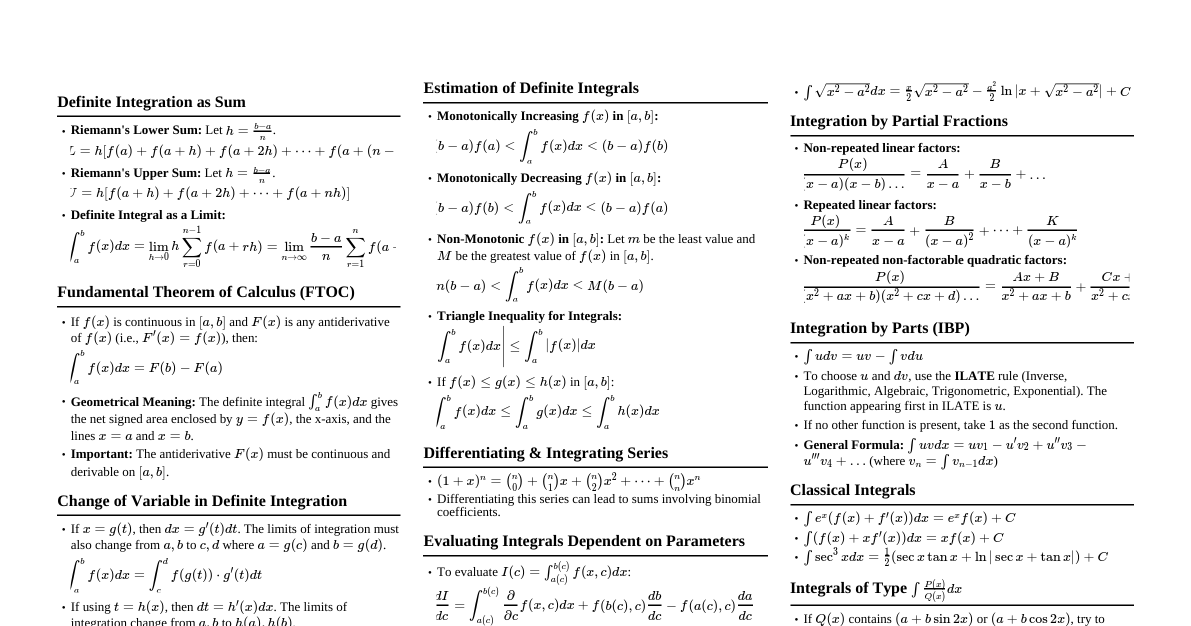
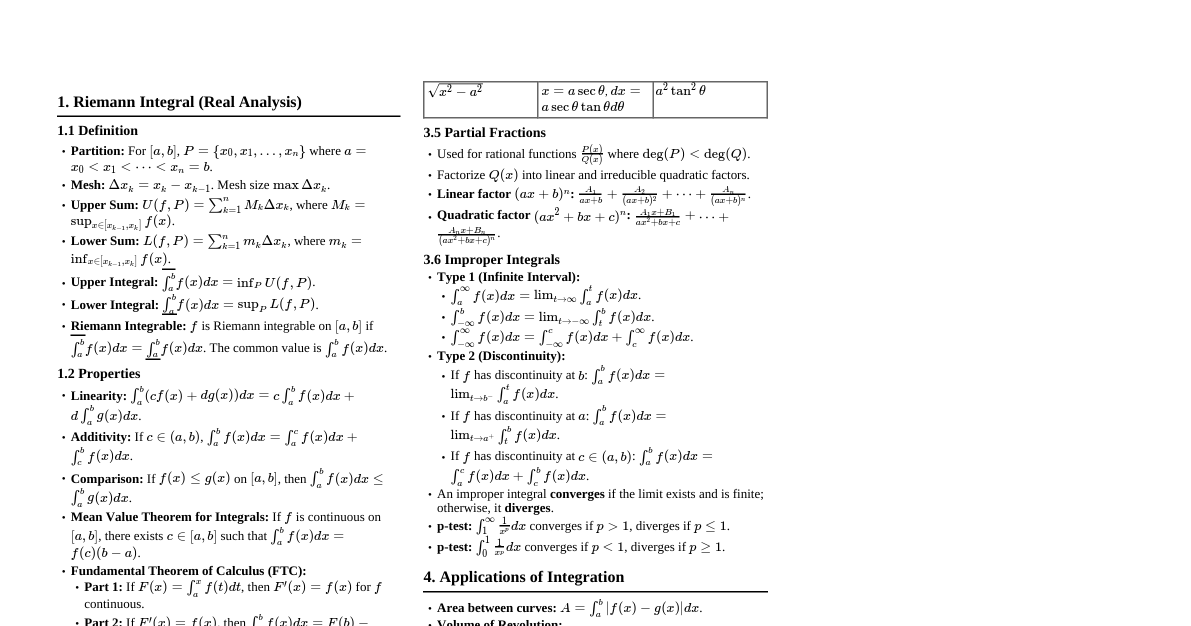
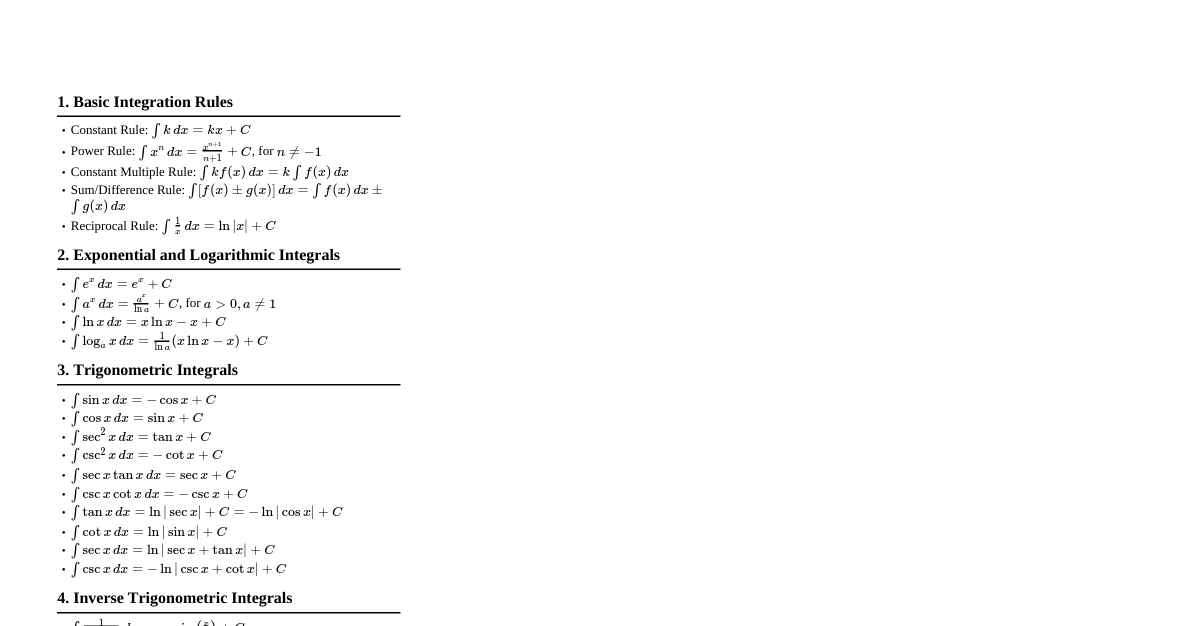
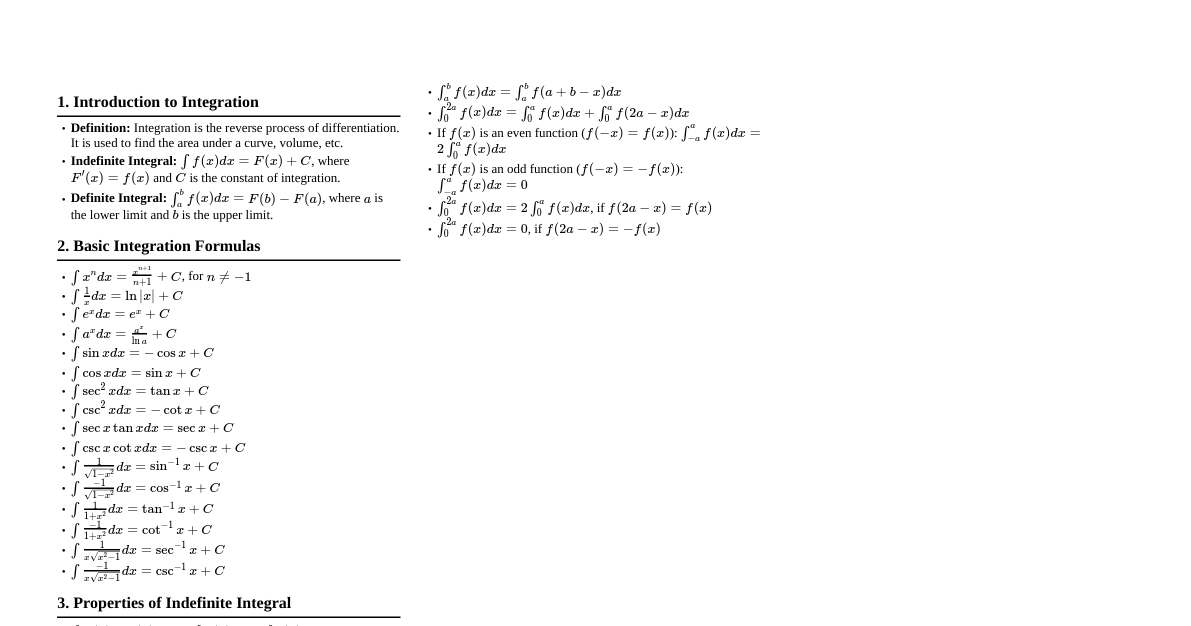
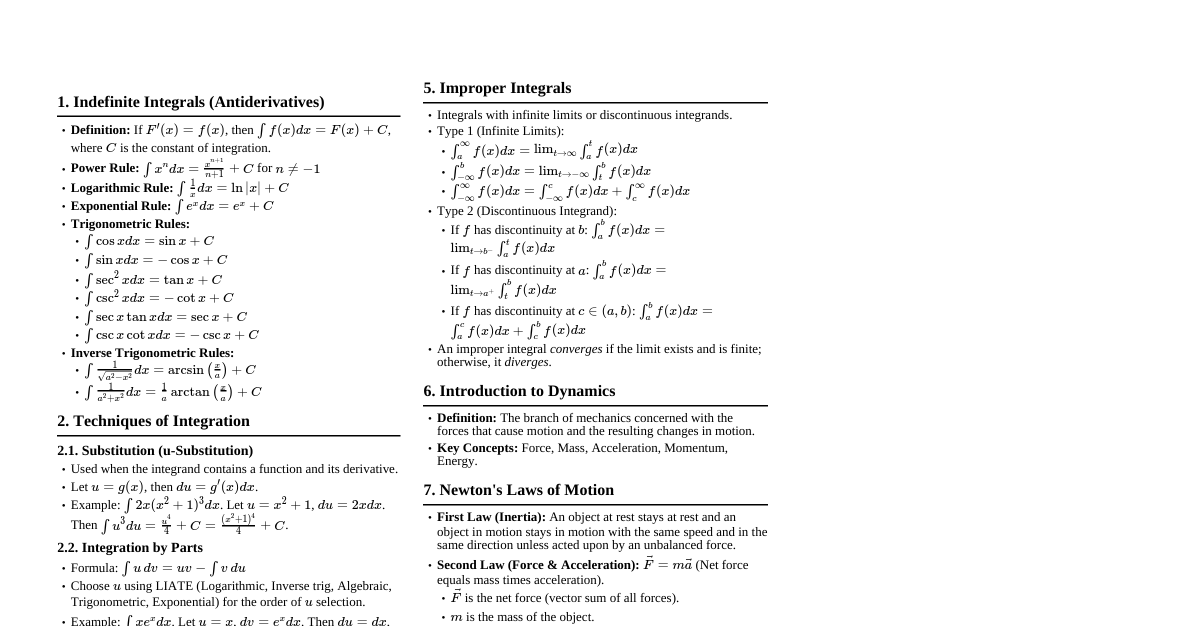
### Integration by Parts The integration by parts formula is: $$\int u \, dv = uv - \int v \, du$$ #### Choosing $u$ and $dv$ A common heuristic for choosing $u$ is LIATE: - **L**ogarithmic functions ($\ln x$) - **I**nverse trigonometric functions ($\arctan x$) - **A**lgebraic functions ($x^n$) - **T**rigonometric functions ($\sin x, \cos x$) - **E**xponential functions ($e^x$) Choose $u$ as the function that comes first in the LIATE order. $dv$ will be the remaining part of the integrand. #### Tabular Integration for Repeated Integrations For integrals of the form $\int P(x) \cdot f(x) \, dx$ where $P(x)$ is a polynomial and $f(x)$ is easily integrable multiple times (e.g., $e^{ax}$, $\sin(ax)$, $\cos(ax)$), tabular integration (or the DI method) can be used: | Differentiate (u) | Integrate (dv) | Sign | |:------------------|:---------------|:-----| | $P(x)$ | $f(x)$ | $+$ | | $P'(x)$ | $\int f(x)dx$ | $-$ | | $P''(x)$ | $\int\int f(x)dx$ | $+$ | | ... | ... | ... | | $0$ | ... | | The integral is the sum of the products of the diagonal entries, with alternating signs. ### Trigonometric Integrals These techniques apply to integrals involving powers of trigonometric functions. #### Powers of Sine and Cosine For integrals of the form $\int \sin^m x \cos^n x \, dx$: 1. **If $m$ is odd:** ($m = 2k+1$) - Save one $\sin x$ factor and convert the remaining $\sin^m x$ to powers of $\cos x$ using $\sin^2 x = 1 - \cos^2 x$. - Let $u = \cos x$, so $du = -\sin x \, dx$. - Example: $\int \sin^3 x \cos^6 x \, dx = \int \sin^2 x \cos^6 x \sin x \, dx = \int (1-\cos^2 x) \cos^6 x \sin x \, dx$. Let $u=\cos x$. 2. **If $n$ is odd:** ($n = 2k+1$) - Save one $\cos x$ factor and convert the remaining $\cos^n x$ to powers of $\sin x$ using $\cos^2 x = 1 - \sin^2 x$. - Let $u = \sin x$, so $du = \cos x \, dx$. - Example: $\int \sin^2 x \cos^5 x \, dx = \int \sin^2 x \cos^4 x \cos x \, dx = \int \sin^2 x (1-\sin^2 x)^2 \cos x \, dx$. Let $u=\sin x$. 3. **If both $m$ and $n$ are even:** - Use half-angle identities: - $\sin^2 x = \frac{1 - \cos(2x)}{2}$ - $\cos^2 x = \frac{1 + \cos(2x)}{2}$ - Example: $\int \sin^4 x \cos^2 x \, dx = \int \left(\frac{1-\cos(2x)}{2}\right)^2 \left(\frac{1+\cos(2x)}{2}\right) \, dx$. #### Powers of Tangent and Secant For integrals of the form $\int \tan^m x \sec^n x \, dx$: 1. **If $n$ is even:** ($n = 2k$, $k \ge 2$) - Save a $\sec^2 x$ factor and convert the remaining $\sec^{n-2} x$ to powers of $\tan x$ using $\sec^2 x = 1 + \tan^2 x$. - Let $u = \tan x$, so $du = \sec^2 x \, dx$. - Example: $\int \tan^6 x \sec^4 x \, dx = \int \tan^6 x \sec^2 x \sec^2 x \, dx = \int \tan^6 x (1+\tan^2 x) \sec^2 x \, dx$. Let $u=\tan x$. 2. **If $m$ is odd:** ($m = 2k+1$, $k \ge 1$) - Save a $\sec x \tan x$ factor and convert the remaining $\tan^{m-1} x$ to powers of $\sec x$ using $\tan^2 x = \sec^2 x - 1$. - Let $u = \sec x$, so $du = \sec x \tan x \, dx$. - Example: $\int \tan^5 x \sec^7 x \, dx = \int \tan^4 x \sec^6 x (\sec x \tan x) \, dx = \int (\sec^2 x - 1)^2 \sec^6 x (\sec x \tan x) \, dx$. Let $u=\sec x$. 3. **Other cases:** - Use identities like $\tan^2 x = \sec^2 x - 1$ to reduce powers. - Integrals of $\tan x$: $\int \tan x \, dx = \ln|\sec x| + C$ - Integrals of $\sec x$: $\int \sec x \, dx = \ln|\sec x + \tan x| + C$ #### Products of Sine and Cosine with Different Arguments For integrals of the form $\int \sin(Ax)\cos(Bx) \, dx$, $\int \sin(Ax)\sin(Bx) \, dx$, or $\int \cos(Ax)\cos(Bx) \, dx$: Use product-to-sum identities: - $\sin A \cos B = \frac{1}{2}[\sin(A-B) + \sin(A+B)]$ - $\sin A \sin B = \frac{1}{2}[\cos(A-B) - \cos(A+B)]$ - $\cos A \cos B = \frac{1}{2}[\cos(A-B) + \cos(A+B)]$ #### Reduction Formulas For $\int \sin^n x \, dx$: $$\int \sin^n x \, dx = -\frac{1}{n}\sin^{n-1}x \cos x + \frac{n-1}{n} \int \sin^{n-2}x \, dx$$ For $\int \cos^n x \, dx$: $$\int \cos^n x \, dx = \frac{1}{n}\cos^{n-1}x \sin x + \frac{n-1}{n} \int \cos^{n-2}x \, dx$$ ### Trigonometric Substitutions Used for integrals containing expressions of the form $\sqrt{a^2 - x^2}$, $\sqrt{a^2 + x^2}$, or $\sqrt{x^2 - a^2}$. | Expression | Substitution | Identity | |:-----------|:-------------|:---------| | $\sqrt{a^2 - x^2}$ | $x = a \sin \theta$, $-\frac{\pi}{2} \le \theta \le \frac{\pi}{2}$ | $a^2 - a^2 \sin^2 \theta = a^2 \cos^2 \theta$ | | $\sqrt{a^2 + x^2}$ | $x = a \tan \theta$, $-\frac{\pi}{2} ### Integration of Rational Functions by Partial Fractions Used for integrating rational functions of the form $\frac{P(x)}{Q(x)}$, where $P(x)$ and $Q(x)$ are polynomials. #### Steps: 1. **Polynomial Long Division:** If the degree of $P(x)$ is greater than or equal to the degree of $Q(x)$, perform polynomial long division to get $\frac{P(x)}{Q(x)} = S(x) + \frac{R(x)}{Q(x)}$, where $S(x)$ is the quotient and $\frac{R(x)}{Q(x)}$ is a proper rational function (degree of $R(x)$ is less than degree of $Q(x)$). 2. **Factor the Denominator $Q(x)$:** Factor $Q(x)$ into linear factors ($ax+b$) and irreducible quadratic factors ($ax^2+bx+c$). 3. **Decompose into Partial Fractions:** - **For each distinct linear factor $(ax+b)$:** Assign a term $\frac{A}{ax+b}$. - **For each repeated linear factor $(ax+b)^m$:** Assign terms $\frac{A_1}{ax+b} + \frac{A_2}{(ax+b)^2} + \dots + \frac{A_m}{(ax+b)^m}$. - **For each distinct irreducible quadratic factor $(ax^2+bx+c)$:** Assign a term $\frac{Ax+B}{ax^2+bx+c}$. - **For each repeated irreducible quadratic factor $(ax^2+bx+c)^m$:** Assign terms $\frac{A_1x+B_1}{ax^2+bx+c} + \frac{A_2x+B_2}{(ax^2+bx+c)^2} + \dots + \frac{A_mx+B_m}{(ax^2+bx+c)^m}$. 4. **Solve for Coefficients:** Multiply both sides of the partial fraction decomposition by $Q(x)$ to clear denominators. Then, solve for the unknown coefficients ($A, B, C, \dots$) by: - Substituting roots of linear factors into the equation. - Equating coefficients of like powers of $x$. - Substituting convenient values of $x$. 5. **Integrate:** Integrate the resulting partial fractions. - $\int \frac{A}{ax+b} \, dx = \frac{A}{a} \ln|ax+b| + C$ - $\int \frac{A}{(ax+b)^n} \, dx = \frac{A}{a(1-n)(ax+b)^{n-1}} + C$ for $n \ne 1$ - Integrals involving quadratic factors might require completing the square or trigonometric substitution. ### Logarithms and Exponentials #### Natural Logarithm Function The natural logarithm function is defined as: $$\ln x = \int_1^x \frac{1}{t} \, dt, \quad x > 0$$ - **Properties:** - $\ln(ab) = \ln a + \ln b$ - $\ln(\frac{a}{b}) = \ln a - \ln b$ - $\ln(a^r) = r \ln a$ - $\ln 1 = 0$ - **Derivative:** $\frac{d}{dx}(\ln x) = \frac{1}{x}$ - **General Logarithm Derivative:** $\frac{d}{dx}(\log_a x) = \frac{1}{x \ln a}$ - **Integral:** $\int \frac{1}{x} \, dx = \ln|x| + C$ #### Natural Exponential Function The natural exponential function $e^x$ is the inverse of $\ln x$. - **Properties:** - $e^{\ln x} = x$ for $x > 0$ - $\ln(e^x) = x$ for all $x$ - $e^x e^y = e^{x+y}$ - $\frac{e^x}{e^y} = e^{x-y}$ - $(e^x)^y = e^{xy}$ - **Derivative:** $\frac{d}{dx}(e^x) = e^x$ - **General Exponential Derivative:** $\frac{d}{dx}(a^x) = a^x \ln a$ - **Integral:** $\int e^x \, dx = e^x + C$ - **General Exponential Integral:** $\int a^x \, dx = \frac{a^x}{\ln a} + C$ #### General Logarithm and Exponential - **Definition:** $a^x = e^{x \ln a}$ for $a > 0$. - **Change of Base Formula:** $\log_a x = \frac{\ln x}{\ln a}$ - **Inverse Properties:** - $a^{\log_a x} = x$ for $x > 0$ - $\log_a(a^x) = x$ for all $x$