Thermodynamics Cheatsheet
Shared 5/4/2026•0 views
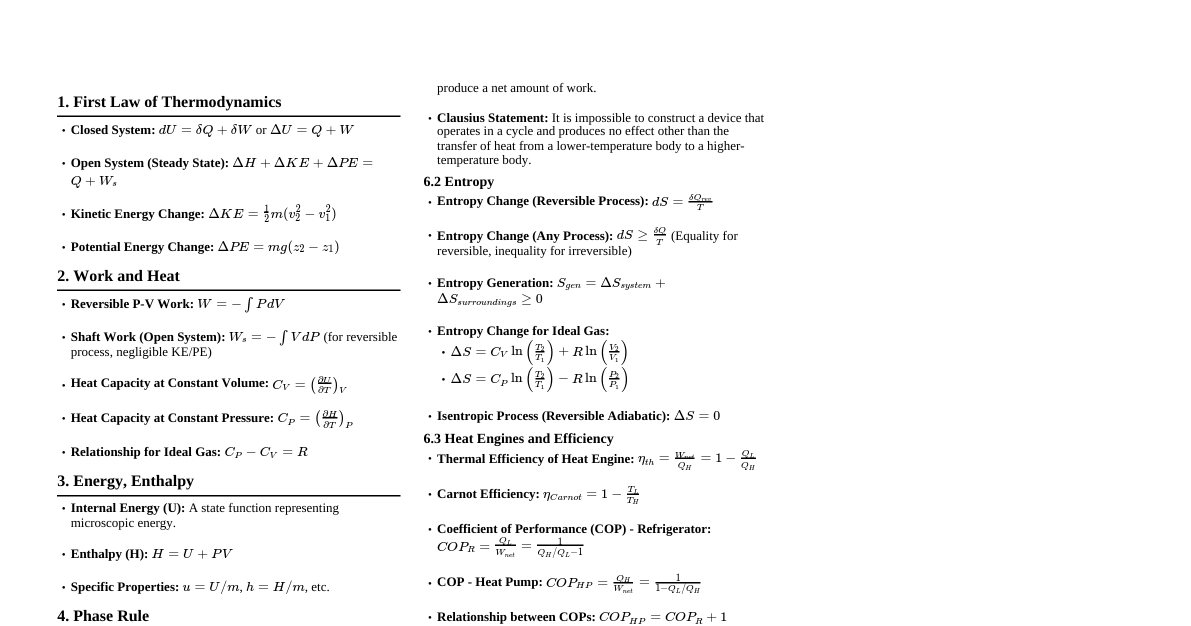
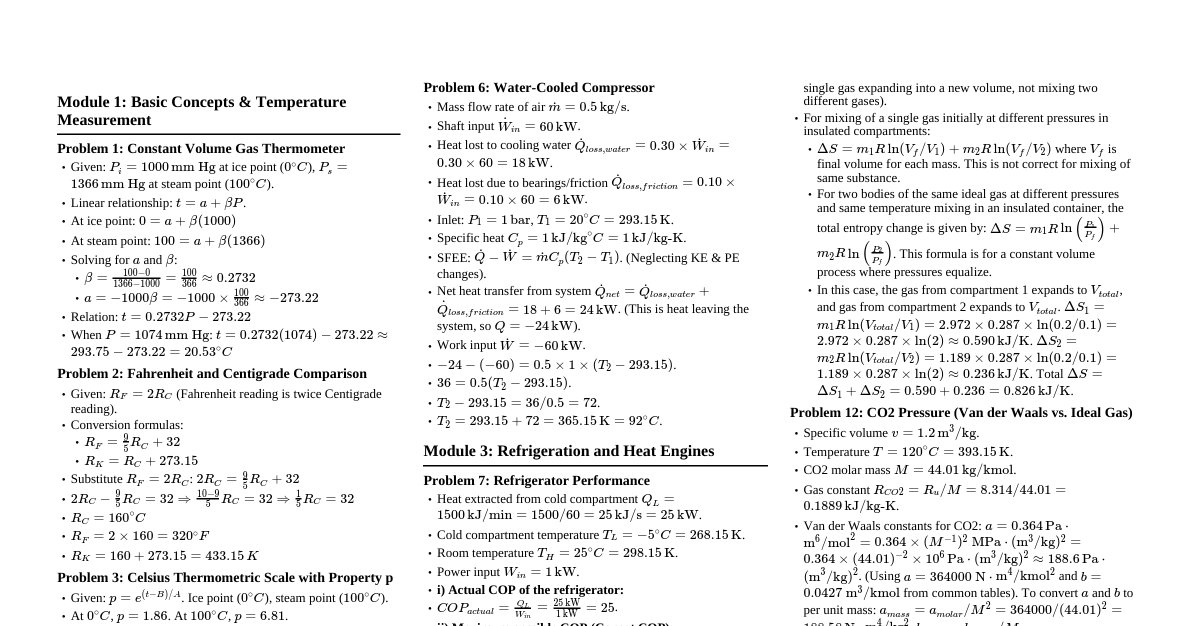
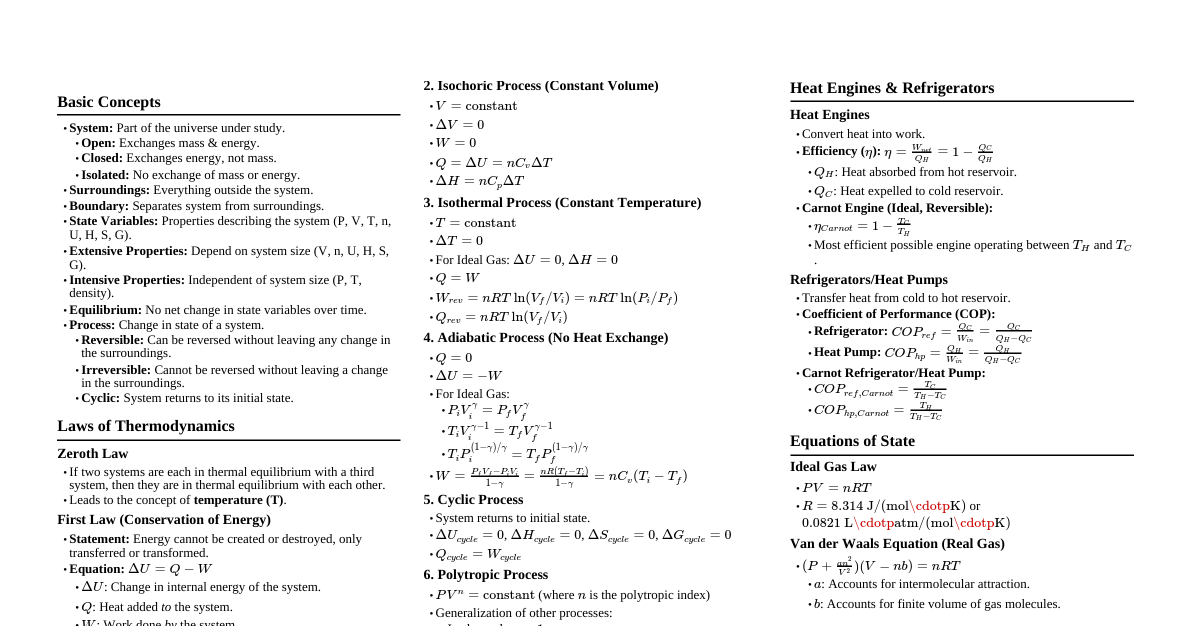
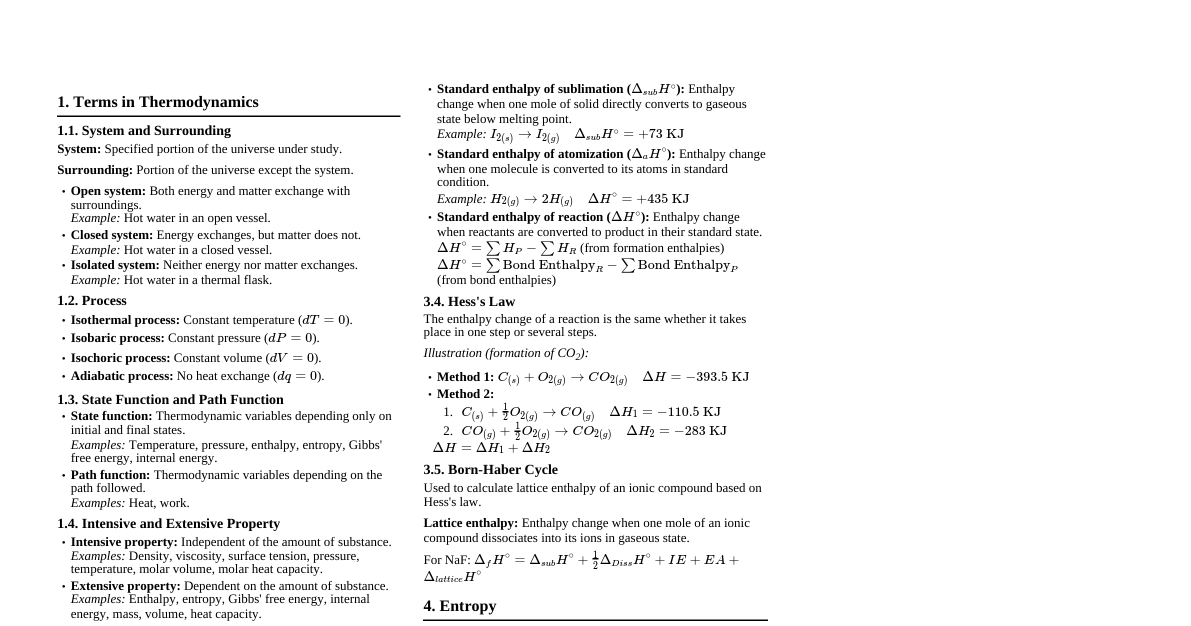
### Basic Definitions - **System:** The part of the universe under consideration. - **Surroundings:** Everything outside the system. - **Boundary:** Separates the system from its surroundings. - **State:** Condition of a system described by properties (P, V, T). - **Process:** Change of state. - **Path:** Sequence of states a system passes through during a process. - **Extensive Property:** Depends on the amount of substance (e.g., mass, volume, energy). - **Intensive Property:** Independent of the amount of substance (e.g., temperature, pressure, density). ### Laws of Thermodynamics #### 1. Zeroth Law - If two systems are each in thermal equilibrium with a third system, they are in thermal equilibrium with each other. - Basis for temperature measurement. #### 2. First Law (Conservation of Energy) - $\Delta U = Q - W$ - $\Delta U$: Change in internal energy of the system. - $Q$: Heat added *to* the system. - $W$: Work done *by* the system. - For a cyclic process: $\Delta U = 0 \implies Q = W$. - Enthalpy: $H = U + PV$ - For constant pressure process: $\Delta H = Q_p$ #### 3. Second Law (Entropy) - The total entropy of an isolated system can only increase over time, or remain constant in ideal cases. It never decreases. - $\Delta S_{universe} = \Delta S_{system} + \Delta S_{surroundings} \ge 0$ - Entropy change: $dS = \frac{\delta Q_{rev}}{T}$ - For an irreversible process: $\Delta S > \int \frac{\delta Q}{T}$ - Gibbs Free Energy: $G = H - TS$ - For a process at constant T and P, spontaneous if $\Delta G ### Thermodynamic Processes - **Isothermal:** Constant temperature ($T$ = const). $\Delta U = 0$ for ideal gas. - **Isobaric:** Constant pressure ($P$ = const). $W = P\Delta V$. - **Isochoric (Isometric):** Constant volume ($V$ = const). $W = 0$. $\Delta U = Q_v$. - **Adiabatic:** No heat exchange ($Q = 0$). $\Delta U = -W$. - **Cyclic:** Initial and final states are the same. $\Delta U = 0$, $Q = W$. - **Reversible:** A process that can be reversed without leaving any trace on the surroundings. - **Irreversible:** All natural processes are irreversible. ### Heat Engines & Refrigerators #### 1. Heat Engine - Converts heat into work. - Efficiency ($\eta$): $\eta = \frac{W_{net}}{Q_H} = 1 - \frac{Q_L}{Q_H}$ - Carnot Efficiency: $\eta_{Carnot} = 1 - \frac{T_L}{T_H}$ (Maximum possible efficiency) #### 2. Refrigerator / Heat Pump - Transfers heat from a low-temperature reservoir to a high-temperature reservoir. - Coefficient of Performance (COP): - Refrigerator: $COP_R = \frac{Q_L}{W_{net}} = \frac{Q_L}{Q_H - Q_L}$ - Heat Pump: $COP_{HP} = \frac{Q_H}{W_{net}} = \frac{Q_H}{Q_H - Q_L}$ - Carnot COP: - $COP_{R,Carnot} = \frac{T_L}{T_H - T_L}$ - $COP_{HP,Carnot} = \frac{T_H}{T_H - T_L}$ ### Ideal Gases - **Ideal Gas Law:** $PV = nRT = mRT$ - $P$: Absolute pressure - $V$: Volume - $n$: Number of moles - $m$: Mass - $R$: Universal gas constant ($8.314 \text{ J/(mol·K)}$ or $0.08206 \text{ L·atm/(mol·K)}$) - $T$: Absolute temperature in Kelvin - **Specific Heats:** - Constant Volume ($C_v$): $dU = C_v dT$ - Constant Pressure ($C_p$): $dH = C_p dT$ - For ideal gas: $C_p - C_v = R$ - Ratio of specific heats: $\gamma = \frac{C_p}{C_v}$ - **Work done by ideal gas:** - Isothermal: $W = nRT \ln\left(\frac{V_2}{V_1}\right) = nRT \ln\left(\frac{P_1}{P_2}\right)$ - Isobaric: $W = P(V_2 - V_1)$ - Adiabatic: $PV^\gamma = \text{const}$, $W = \frac{P_1V_1 - P_2V_2}{\gamma - 1}$