JEE Physics: Vectors
Shared 5/5/2026•2 views
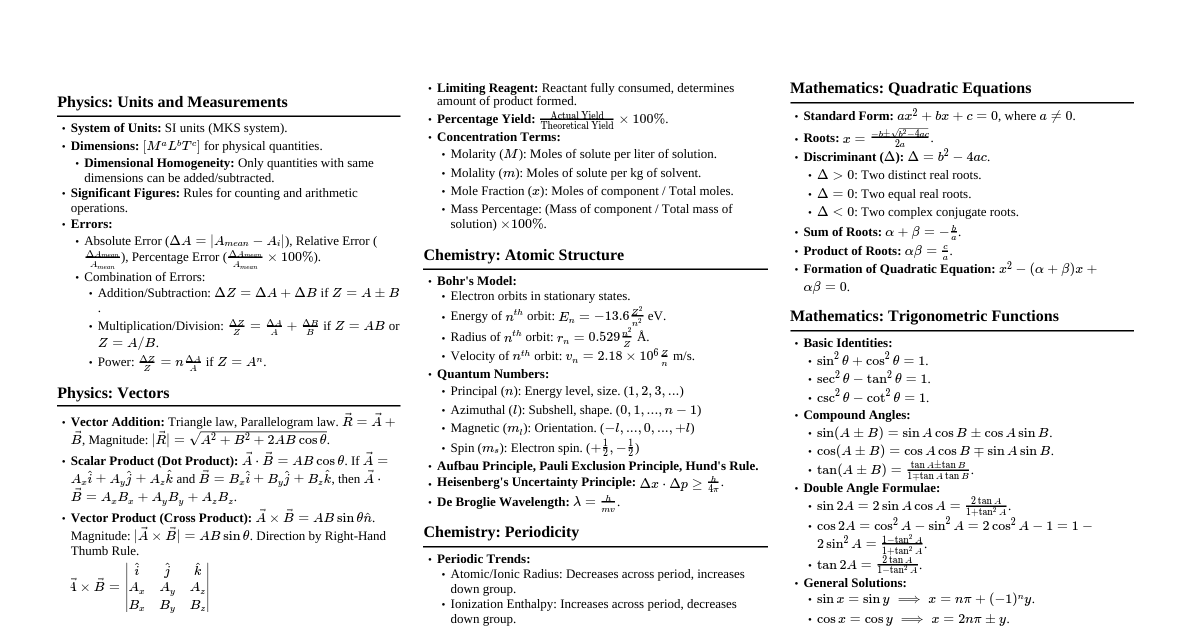
### Introduction to Vectors - **Scalar:** A quantity with magnitude only (e.g., mass, speed, time, distance). - **Vector:** A quantity with both magnitude and direction (e.g., displacement, velocity, acceleration, force, momentum). - **Representation:** A vector $\vec{A}$ is represented by an arrow. Its length indicates magnitude, and the arrowhead indicates direction. - **Notation:** $\vec{A}$ or $\mathbf{A}$. Magnitude is $|\vec{A}|$ or $A$. ### Types of Vectors - **Zero Vector (Null Vector):** A vector with zero magnitude and arbitrary direction. $\vec{0}$. - **Unit Vector:** A vector with magnitude 1. Used to specify direction. $\hat{A} = \frac{\vec{A}}{|\vec{A}|}$. - **Co-initial Vectors:** Vectors having the same starting point. - **Co-planar Vectors:** Vectors lying in the same plane. - **Collinear Vectors:** Vectors acting along the same line or parallel lines. - **Equal Vectors:** Two vectors are equal if they have the same magnitude and direction. - **Negative Vector:** A vector having the same magnitude as a given vector but acting in the opposite direction. $\vec{B} = -\vec{A}$. - **Position Vector:** A vector that specifies the position of a point relative to an origin. $\vec{r} = x\hat{i} + y\hat{j} + z\hat{k}$. - **Displacement Vector:** The change in position vector. $\Delta\vec{r} = \vec{r}_2 - \vec{r}_1$. ### Vector Addition - **Triangle Law of Vector Addition:** If two vectors are represented by two sides of a triangle taken in order, their resultant is given by the third side taken in the opposite order. $$\vec{R} = \vec{A} + \vec{B}$$ $$|\vec{R}| = \sqrt{A^2 + B^2 + 2AB\cos\theta}$$ where $\theta$ is the angle between $\vec{A}$ and $\vec{B}$. Direction: $\tan\alpha = \frac{B\sin\theta}{A + B\cos\theta}$ (angle with $\vec{A}$) - **Parallelogram Law of Vector Addition:** If two vectors are represented by the two adjacent sides of a parallelogram drawn from a common point, their resultant is given by the diagonal passing through that common point. Formulas for magnitude and direction are the same as for the Triangle Law. - **Polygon Law of Vector Addition:** For multiple vectors, if $n-1$ vectors are represented by $n-1$ sides of a polygon taken in order, their resultant is given by the closing $n^{th}$ side taken in the opposite order. - **Properties of Vector Addition:** - Commutative: $\vec{A} + \vec{B} = \vec{B} + \vec{A}$ - Associative: $(\vec{A} + \vec{B}) + \vec{C} = \vec{A} + (\vec{B} + \vec{C})$ ### Vector Subtraction - Subtraction is a special case of addition: $\vec{A} - \vec{B} = \vec{A} + (-\vec{B})$. - Magnitude of resultant: $$|\vec{R}| = |\vec{A} - \vec{B}| = \sqrt{A^2 + B^2 - 2AB\cos\theta}$$ where $\theta$ is the angle between $\vec{A}$ and $\vec{B}$. - Direction: $\tan\alpha = \frac{B\sin\theta}{A - B\cos\theta}$ (angle with $\vec{A}$) ### Resolution of Vectors - Breaking a vector into components along specified axes. - If $\vec{A}$ makes an angle $\theta$ with the x-axis: - x-component: $A_x = A\cos\theta$ - y-component: $A_y = A\sin\theta$ - Vector form: $\vec{A} = A_x\hat{i} + A_y\hat{j}$ - Magnitude: $A = \sqrt{A_x^2 + A_y^2}$ - Direction: $\tan\theta = \frac{A_y}{A_x}$ - In 3D: $\vec{A} = A_x\hat{i} + A_y\hat{j} + A_z\hat{k}$ - Magnitude: $A = \sqrt{A_x^2 + A_y^2 + A_z^2}$ - Direction Cosines: $\cos\alpha = \frac{A_x}{A}$, $\cos\beta = \frac{A_y}{A}$, $\cos\gamma = \frac{A_z}{A}$ - $\cos^2\alpha + \cos^2\beta + \cos^2\gamma = 1$ ### Scalar (Dot) Product - **Definition:** $\vec{A} \cdot \vec{B} = AB\cos\theta$ - $\theta$ is the angle between $\vec{A}$ and $\vec{B}$. - Result is a scalar quantity. - **Properties:** - Commutative: $\vec{A} \cdot \vec{B} = \vec{B} \cdot \vec{A}$ - Distributive: $\vec{A} \cdot (\vec{B} + \vec{C}) = \vec{A} \cdot \vec{B} + \vec{A} \cdot \vec{C}$ - If $\vec{A} \perp \vec{B}$, then $\vec{A} \cdot \vec{B} = 0$ (as $\cos 90^\circ = 0$). - If $\vec{A} \parallel \vec{B}$, then $\vec{A} \cdot \vec{B} = AB$ (as $\cos 0^\circ = 1$). - $\hat{i} \cdot \hat{i} = \hat{j} \cdot \hat{j} = \hat{k} \cdot \hat{k} = 1$ - $\hat{i} \cdot \hat{j} = \hat{j} \cdot \hat{k} = \hat{k} \cdot \hat{i} = 0$ - In component form: $\vec{A} \cdot \vec{B} = (A_x\hat{i} + A_y\hat{j} + A_z\hat{k}) \cdot (B_x\hat{i} + B_y\hat{j} + B_z\hat{k}) = A_xB_x + A_yB_y + A_zB_z$ - **Applications:** - Work done: $W = \vec{F} \cdot \vec{d}$ - Power: $P = \vec{F} \cdot \vec{v}$ - Angle between vectors: $\cos\theta = \frac{\vec{A} \cdot \vec{B}}{|\vec{A}||\vec{B}|}$ - Projection of $\vec{A}$ on $\vec{B}$: $\frac{\vec{A} \cdot \vec{B}}{|\vec{B}|}$ ### Vector (Cross) Product - **Definition:** $\vec{A} \times \vec{B} = (AB\sin\theta)\hat{n}$ - $\theta$ is the angle between $\vec{A}$ and $\vec{B}$. - $\hat{n}$ is a unit vector perpendicular to the plane containing $\vec{A}$ and $\vec{B}$, given by the right-hand thumb rule. - Result is a vector quantity. - **Magnitude:** $|\vec{A} \times \vec{B}| = AB\sin\theta$. This is also the area of the parallelogram formed by $\vec{A}$ and $\vec{B}$. - **Properties:** - Not Commutative: $\vec{A} \times \vec{B} = -(\vec{B} \times \vec{A})$ - Distributive: $\vec{A} \times (\vec{B} + \vec{C}) = \vec{A} \times \vec{B} + \vec{A} \times \vec{C}$ - If $\vec{A} \parallel \vec{B}$, then $\vec{A} \times \vec{B} = 0$ (as $\sin 0^\circ = 0$). - If $\vec{A} \perp \vec{B}$, then $|\vec{A} \times \vec{B}| = AB$ (as $\sin 90^\circ = 1$). - $\hat{i} \times \hat{i} = \hat{j} \times \hat{j} = \hat{k} \times \hat{k} = 0$ - Cyclic order: $\hat{i} \times \hat{j} = \hat{k}$, $\hat{j} \times \hat{k} = \hat{i}$, $\hat{k} \times \hat{i} = \hat{j}$ - Anti-cyclic order: $\hat{j} \times \hat{i} = -\hat{k}$, etc. - In component form (determinant method): $$\vec{A} \times \vec{B} = \begin{vmatrix} \hat{i} & \hat{j} & \hat{k} \\ A_x & A_y & A_z \\ B_x & B_y & B_z \end{vmatrix}$$ $$= (A_yB_z - A_zB_y)\hat{i} - (A_xB_z - A_zB_x)\hat{j} + (A_xB_y - A_yB_x)\hat{k}$$ - **Direction:** The direction of $\hat{n}$ is determined by the right-hand rule. If you curl the fingers of your right hand from $\vec{A}$ to $\vec{B}$, your thumb points in the direction of $\hat{n}$. - **Applications:** - Torque: $\vec{\tau} = \vec{r} \times \vec{F}$ - Angular momentum: $\vec{L} = \vec{r} \times \vec{p}$ - Force on a charge in magnetic field: $\vec{F} = q(\vec{v} \times \vec{B})$ - Area of parallelogram: $|\vec{A} \times \vec{B}|$ - Area of triangle: $\frac{1}{2}|\vec{A} \times \vec{B}|$ - **Sine Rule of Direction (for a triangle with sides A, B, R and opposite angles $\alpha, \beta, \theta$):** $$\frac{A}{\sin\alpha} = \frac{B}{\sin\beta} = \frac{R}{\sin\theta}$$ (Note: The sine rule in the form $\sin\alpha + \sin\beta + \sin\gamma = 2$ is not a general vector identity and typically applies to specific geometric conditions or trigonometric problems, not directly a fundamental vector operation. The formula above is the standard Sine Rule for triangles which is relevant to vector addition geometry.)