Class 11 & 12 Chemistry Cheats
Cheatsheet Content
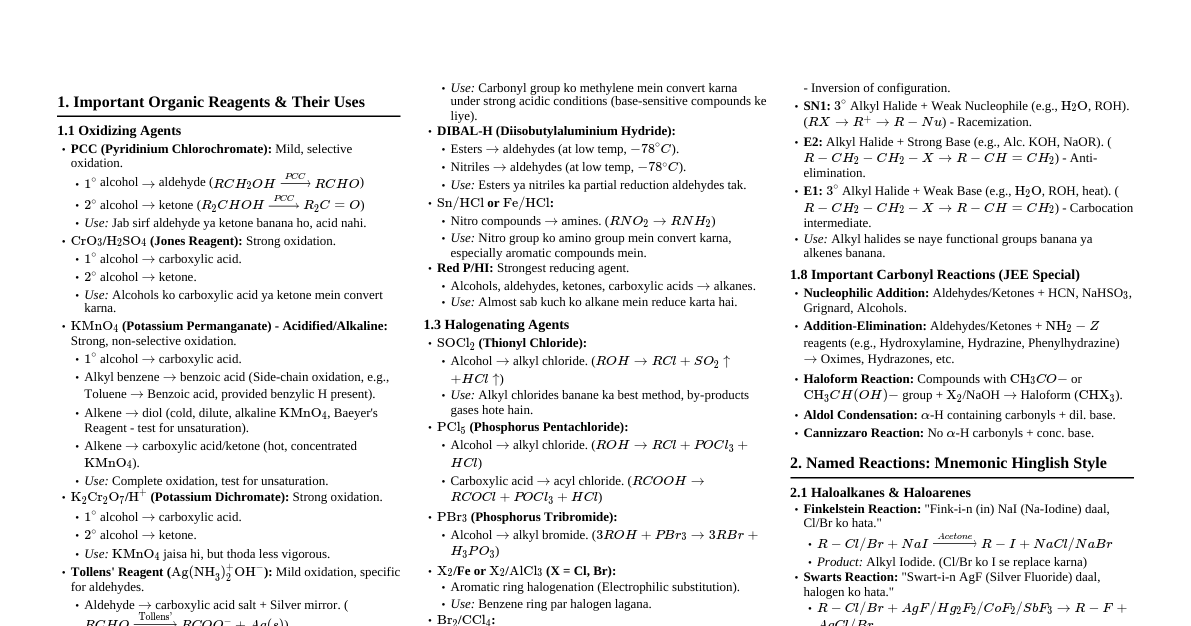
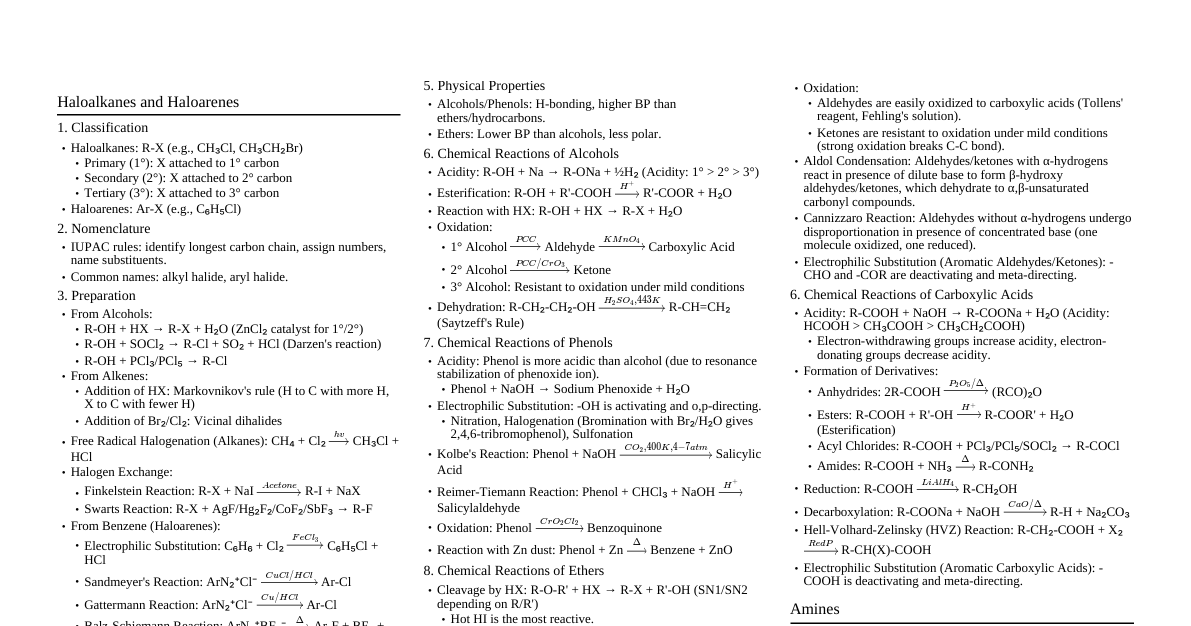
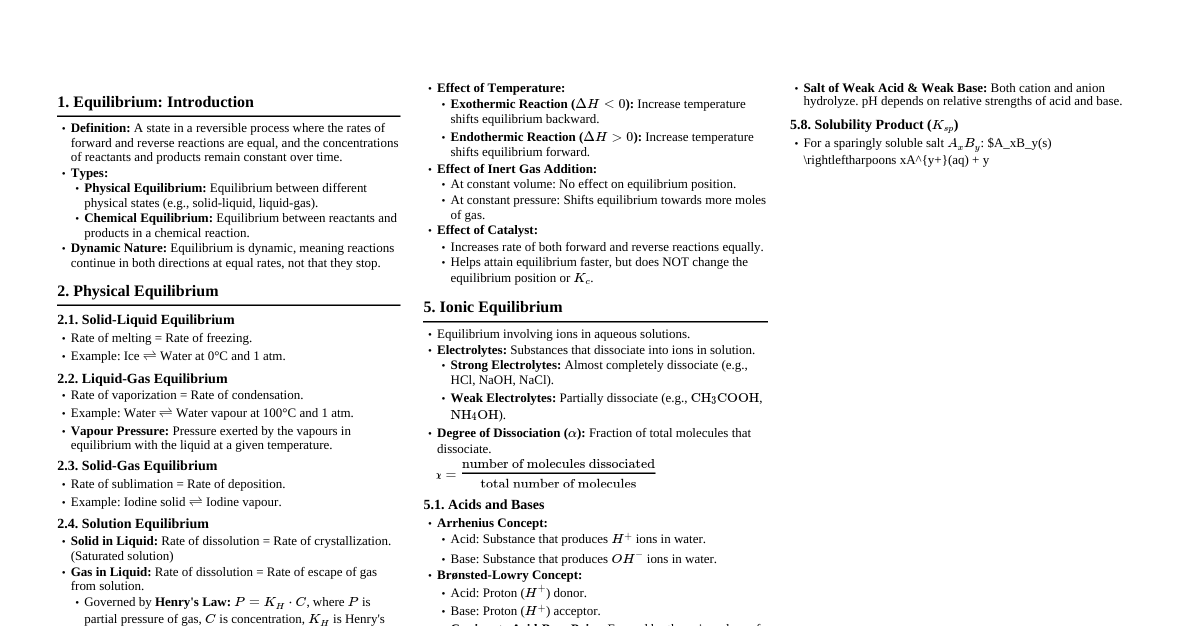
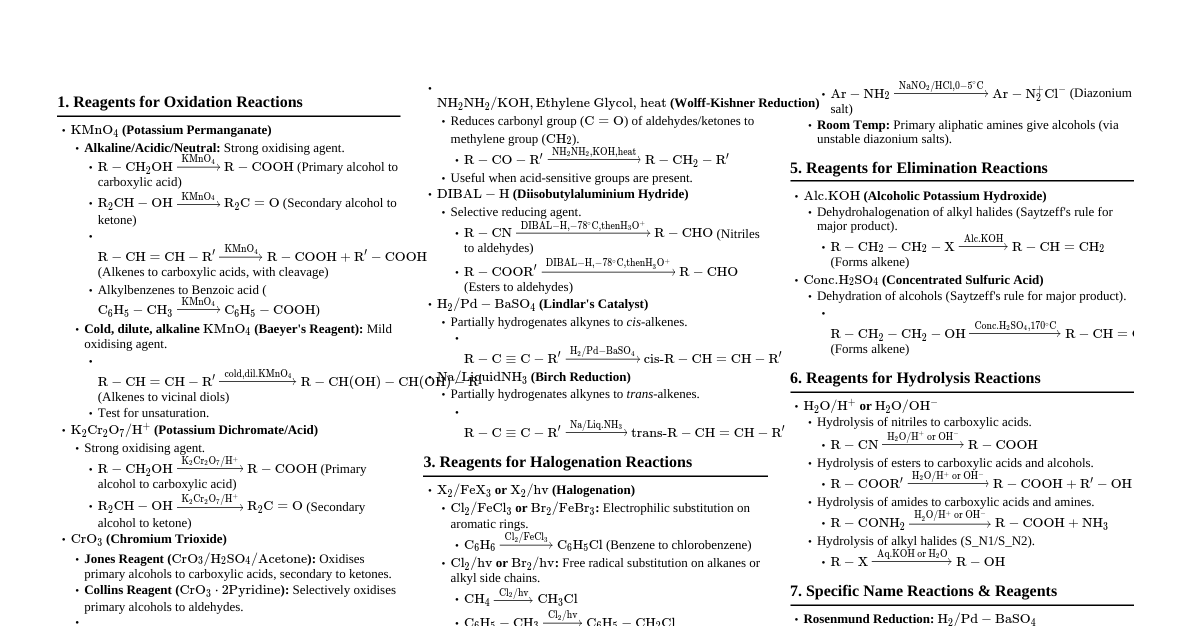
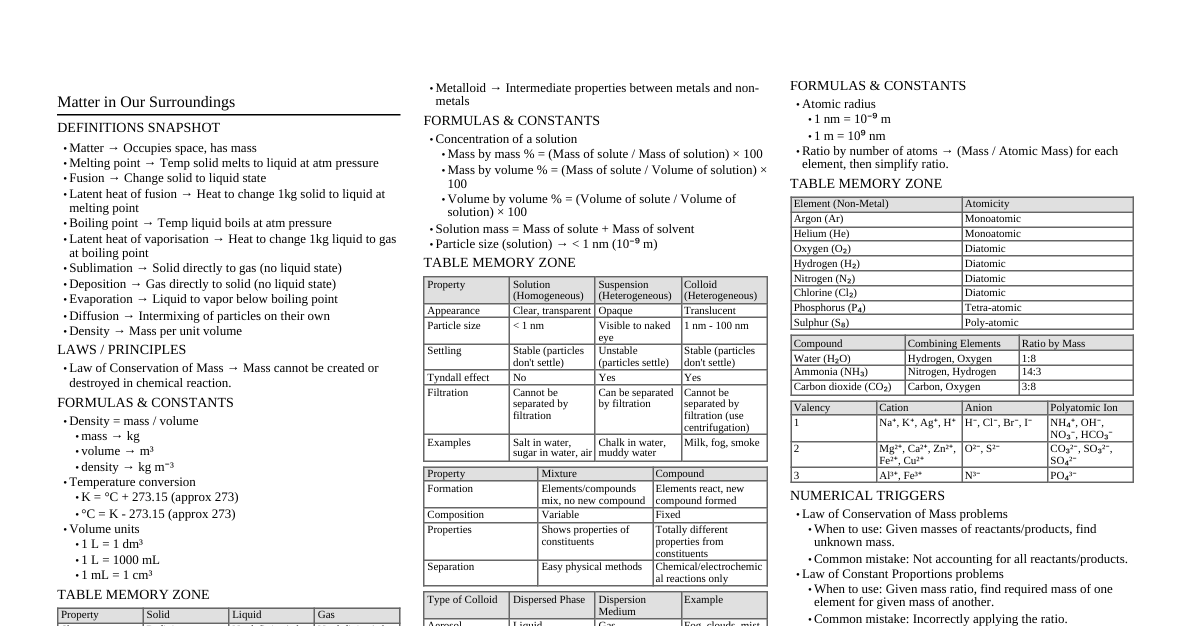
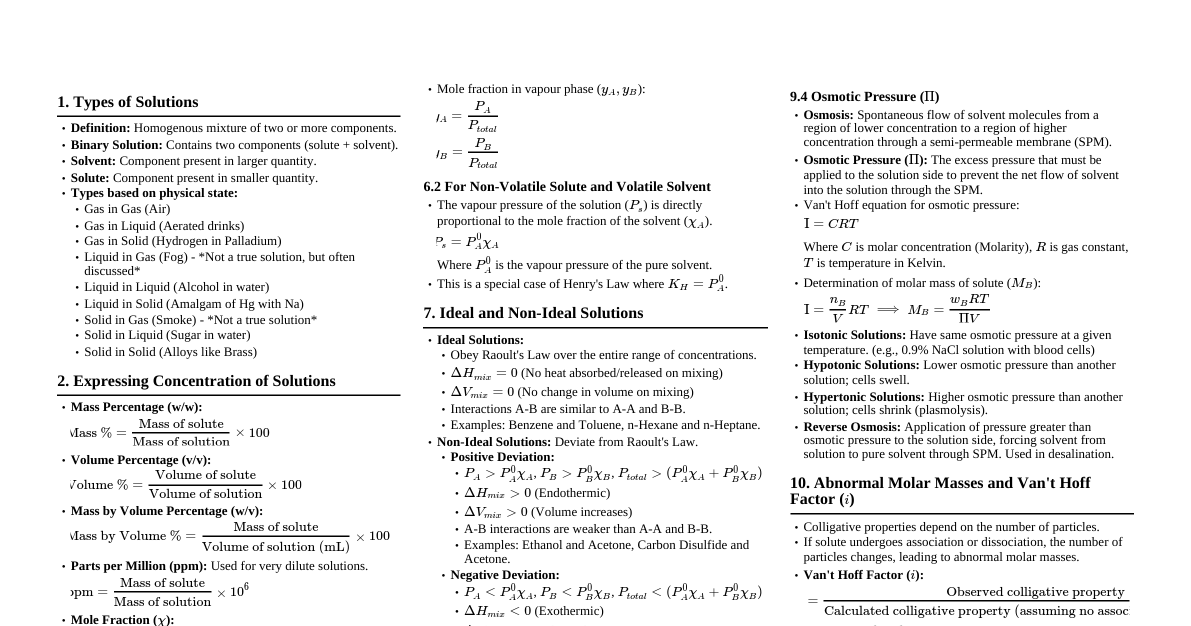
### **Semester 1 (Class 11 - Part 1)** #### Some Basic Concepts of Chemistry - **Key Formulas & Expressions:** - **Mole concept:** Moles = Mass / Molar Mass - **Molarity (M):** Moles of solute / Volume of solution (L) - **Molality (m):** Moles of solute / Mass of solvent (kg) - **Mass %:** (Mass of component / Total mass of mixture) * 100 - **Limiting Reagent:** Reactant consumed first, determines product amount. - **Crucial Definitions/Laws:** - **Law of Conservation of Mass:** Mass is neither created nor destroyed. - **Law of Definite Proportions:** A given compound always contains elements in fixed proportions by mass. - **Law of Multiple Proportions:** If two elements combine to form more than one compound, the masses of one element that combine with a fixed mass of the other are in small whole-number ratios. - **Avogadro's Law:** Equal volumes of all gases at the same temperature and pressure contain equal numbers of molecules ($N_A = 6.022 \times 10^{23}$). #### Structure of Atom - **Key Formulas & Expressions:** - **Planck's Quantum Theory:** $E = h\nu = hc/\lambda$ (where $\mathbf{h} = 6.626 \times 10^{-34}$ J s) - **Bohr's Model:** - Energy of electron in n-th orbit: $E_n = -R_H(1/n^2)$ (where $\mathbf{R_H} = 2.18 \times 10^{-18}$ J) - Radius of n-th orbit: $r_n = 0.529 \times n^2 / Z$ Å - **De Broglie Wavelength:** $\lambda = h / mv$ - **Heisenberg's Uncertainty Principle:** $\Delta x \cdot \Delta p \ge h / 4\pi$ - **Crucial Definitions/Laws:** - **Atomic Number (Z):** Number of protons. - **Mass Number (A):** Number of protons + neutrons. - **Isotopes:** Same Z, different A. - **Isobars:** Same A, different Z. - **Quantum Numbers:** - **Principal (n):** Shell, energy level ($\mathbf{1, 2, 3,...}$) - **Azimuthal (l):** Subshell, shape of orbital ($\mathbf{0}$ to $\mathbf{n-1}$, s, p, d, f) - **Magnetic ($m_l$):** Orientation of orbital ($\mathbf{-l}$ to $\mathbf{+l}$) - **Spin ($m_s$):** Electron spin ($\mathbf{+1/2, -1/2}$) - **Aufbau Principle:** Fill orbitals in increasing order of energy. - **Pauli Exclusion Principle:** No two electrons can have all four quantum numbers identical. - **Hund's Rule:** Orbitals of same energy are first singly occupied before pairing. #### Classification of Elements and Periodicity in Properties - **Crucial Definitions/Laws:** - **Modern Periodic Law:** Properties of elements are a periodic function of their atomic numbers. - **Atomic Radius:** Distance from nucleus to outermost electron shell. Decreases across period, increases down group. - **Ionic Radius:** Size of ion. Cation neutral atom. - **Ionization Enthalpy:** Energy required to remove an electron. Increases across period, decreases down group. - **Electron Gain Enthalpy:** Energy released when an electron is added. Generally increases across period (more negative), less negative down group. - **Electronegativity:** Tendency of an atom to attract shared electrons. Increases across period, decreases down group. - **Metallic Character:** Tendency to lose electrons. Decreases across period, increases down group. #### Chemical Bonding and Molecular Structure - **Key Formulas & Expressions:** - **Formal Charge:** Valence electrons - Non-bonding electrons - (1/2) Bonding electrons. - **Bond Order:** (Number of bonding electrons - Number of anti-bonding electrons) / 2. - **Crucial Definitions/Laws:** - **Octet Rule:** Atoms tend to gain, lose, or share electrons to achieve 8 valence electrons. - **Ionic Bond:** Electrostatic attraction between ions formed by electron transfer. - **Covalent Bond:** Sharing of electrons between atoms. - **VSEPR Theory:** Electron pairs (bonding and lone pairs) repel each other and arrange to minimize repulsion. Determines molecular geometry. - **Linear:** $\mathbf{sp}$ hybridization, $\mathbf{180^\circ}$ - **Trigonal Planar:** $\mathbf{sp^2}$ hybridization, $\mathbf{120^\circ}$ - **Tetrahedral:** $\mathbf{sp^3}$ hybridization, $\mathbf{109.5^\circ}$ - **Trigonal Bipyramidal:** $\mathbf{sp^3d}$ hybridization - **Octahedral:** $\mathbf{sp^3d^2}$ hybridization - **Valence Bond Theory (VBT):** Explains bond formation through orbital overlap. - **Hybridization:** Mixing of atomic orbitals to form new hybrid orbitals. - **Molecular Orbital Theory (MOT):** Electrons occupy molecular orbitals formed by linear combination of atomic orbitals (LCAO). - **Hydrogen Bonding:** Special dipole-dipole interaction involving H bonded to highly electronegative atoms (F, O, N). ### **Semester 2 (Class 11 - Part 2)** #### Thermodynamics - **Key Formulas & Expressions:** - **First Law of Thermodynamics:** $\Delta U = q + w$ (Internal energy change = Heat + Work) - **Work done (expansion):** $w = -P_{ext}\Delta V$ - **Enthalpy change:** $\Delta H = \Delta U + P\Delta V$ (at constant pressure) - **Hess's Law:** $\Delta H$ for a reaction is independent of the path. - **Gibbs Free Energy:** $\Delta G = \Delta H - T\Delta S$ - **Spontaneity:** $\Delta G 0$ (non-spontaneous), $\Delta G = 0$ (equilibrium) - **Crucial Definitions/Laws:** - **System:** Part of the universe under study. - **Surroundings:** Rest of the universe. - **Isolated System:** No exchange of matter or energy. - **Closed System:** Exchange of energy, not matter. - **Open System:** Exchange of both matter and energy. - **Extensive Properties:** Depend on amount of substance (e.g., mass, volume, enthalpy). - **Intensive Properties:** Independent of amount of substance (e.g., temperature, pressure, density). - **Entropy (S):** Measure of disorder or randomness. - **Second Law of Thermodynamics:** Entropy of an isolated system tends to increase. - **Third Law of Thermodynamics:** Entropy of a perfect crystalline substance is zero at absolute zero. #### Equilibrium - **Key Formulas & Expressions:** - **Equilibrium Constant:** - For $aA + bB \rightleftharpoons cC + dD$: $K_c = [C]^c[D]^d / [A]^a[B]^b$ - $K_p = (P_C)^c(P_D)^d / (P_A)^a(P_B)^b$ - $K_p = K_c(RT)^{\Delta n}$ (where $\Delta n$ = moles of gaseous products - moles of gaseous reactants) - **Ionic Product of Water:** $K_w = [H^+][OH^-] = 10^{-14}$ at $\mathbf{25^\circ C}$ - **pH:** $pH = -\log[H^+]$ - **Henderson-Hasselbalch Equation (Buffer):** $pH = pK_a + \log([Salt]/[Acid])$ - **Crucial Definitions/Laws:** - **Dynamic Equilibrium:** Forward and reverse reaction rates are equal, concentrations remain constant. - **Le Chatelier's Principle:** If a change of condition is applied to a system in equilibrium, the system will shift in a direction that relieves the stress. - **Concentration:** Add reactant, shifts right; Add product, shifts left. - **Temperature:** Increase T, shifts endothermic direction; Decrease T, shifts exothermic direction. - **Pressure:** Increase P, shifts to side with fewer gas moles; Decrease P, shifts to side with more gas moles. - **Arrhenius Acids/Bases:** Acids produce $H^+$ in water, Bases produce $OH^-$ in water. - **Brønsted-Lowry Acids/Bases:** Acids donate $H^+$, Bases accept $H^+$. - **Lewis Acids/Bases:** Acids accept electron pairs, Bases donate electron pairs. - **Common Ion Effect:** Suppression of dissociation of a weak electrolyte by adding a strong electrolyte containing a common ion. - **Buffer Solution:** Resists changes in pH upon addition of small amounts of acid or base. #### Redox Reactions - **Crucial Definitions/Laws:** - **Oxidation:** Loss of electrons, increase in oxidation number. - **Reduction:** Gain of electrons, decrease in oxidation number. - **Oxidizing Agent:** Causes oxidation, itself gets reduced. - **Reducing Agent:** Causes reduction, itself gets oxidized. - **Oxidation Number:** Hypothetical charge an atom would have if all bonds were ionic. Rules for assigning oxidation numbers. #### Organic Chemistry - Some Basic Principles and Techniques (GOC) & Hydrocarbons - **Key Formulas & Expressions:** - **General formula for Alkanes:** $C_nH_{2n+2}$ - **General formula for Alkenes:** $C_nH_{2n}$ - **General formula for Alkynes:** $C_nH_{2n-2}$ - **Crucial Definitions/Laws:** - **Inductive Effect:** Electron displacement along a sigma bond due to difference in electronegativity. - **Resonance Effect (Mesomeric Effect):** Delocalization of pi electrons or lone pairs. - **Hyperconjugation:** Delocalization of sigma electrons of C-H bond with an adjacent empty/partially filled p-orbital or pi bond. - **Electrophile:** Electron-deficient species, accepts electron pair. - **Nucleophile:** Electron-rich species, donates electron pair. - **Homolytic Fission:** Bond breaks symmetrically, forming free radicals. - **Heterolytic Fission:** Bond breaks unsymmetrically, forming ions. - **Isomerism:** Same molecular formula, different structural or spatial arrangement. - **Structural Isomerism:** Chain, position, functional, metamerism, tautomerism. - **Stereoisomerism:** Geometrical (cis-trans), Optical (enantiomers, diastereomers). - **Named Reactions & Examples (Hydrocarbons):** - **Wurtz Reaction:** $2RX + 2Na \xrightarrow{dry \ ether} R-R + 2NaX$ (for alkanes, limited to symmetrical) - **Friedel-Crafts Alkylation:** **Benzene** + $R-X \xrightarrow{AlCl_3} \text{Alkylbenzene} + HX$ - **Friedel-Crafts Acylation:** **Benzene** + $RCOCl \xrightarrow{AlCl_3} \text{Acylbenzene} + HCl$ - **Kolbe's Electrolytic Method:** $2RCOONa + 2H_2O \xrightarrow{electrolysis} R-R + 2CO_2 + H_2 + 2NaOH$ - **Markownikoff's Rule:** In addition of unsymmetrical reagent to unsymmetrical alkene, negative part of reagent adds to carbon with fewer hydrogen atoms. - **Anti-Markownikoff's Rule (Peroxide Effect):** In presence of peroxides, addition of HBr to unsymmetrical alkenes occurs opposite to Markownikoff's rule. ### **Semester 3 (Class 12 - Part 1)** #### Solutions - **Key Formulas & Expressions:** - **Raoult's Law:** $P_A = P_A^0 X_A$ (for volatile solute) - **Relative Lowering of Vapor Pressure:** $(P^0 - P_s)/P^0 = X_{solute}$ - **Elevation in Boiling Point:** $\Delta T_b = K_b m$ (where $\mathbf{K_b}$ is molal elevation constant) - **Depression in Freezing Point:** $\Delta T_f = K_f m$ (where $\mathbf{K_f}$ is molal depression constant) - **Osmotic Pressure:** $\Pi = CRT$ (where $\mathbf{R} = 0.083$ L bar mol$^{-1}$ K$^{-1}$) - **Van't Hoff Factor (i):** $i = \text{Observed Colligative Property / Normal Colligative Property}$ - $i = 1 + (n-1)\alpha$ (for dissociation) - $i = 1 + (1/n-1)\alpha$ (for association) - **Crucial Definitions/Laws:** - **Ideal Solution:** Obeys Raoult's Law over entire concentration range. $\Delta H_{mix} = 0$, $\Delta V_{mix} = 0$. - **Non-Ideal Solutions:** Deviate from Raoult's Law. - **Positive Deviation:** $P_{total} > P_A^0 X_A + P_B^0 X_B$. Weaker A-B interactions. - **Negative Deviation:** $P_{total} #### Electrochemistry - **Key Formulas & Expressions:** - **Nernst Equation:** $E_{cell} = E_{cell}^0 - (RT/nF) \ln Q$ or $E_{cell} = E_{cell}^0 - (0.0592/n) \log Q$ (at $\mathbf{298 K}$) - (where $\mathbf{F} = 96485$ C mol$^{-1}$) - **Relationship between $\Delta G^0$ and $E_{cell}^0$:** $\Delta G^0 = -nFE_{cell}^0$ - **Conductivity (k):** $k = (1/R) \times (l/A)$ - **Molar Conductivity ($\Lambda_m$):** $\Lambda_m = k \times 1000 / M$ - **Kohlrausch's Law:** $\Lambda_m^0 = x\lambda_A^0 + y\lambda_B^0$ (for $A_xB_y$) - **Faraday's First Law of Electrolysis:** $W = ZIt$ (where $\mathbf{Z}$ is electrochemical equivalent) - **Faraday's Second Law of Electrolysis:** $W_1/W_2 = E_1/E_2$ (where $\mathbf{E}$ is equivalent weight) - **Crucial Definitions/Laws:** - **Electrochemical Cell (Galvanic/Voltaic):** Converts chemical energy to electrical energy. Spontaneous redox reaction. - **Electrolytic Cell:** Converts electrical energy to chemical energy. Non-spontaneous redox reaction. - **Standard Electrode Potential ($E^0$):** Reduction potential relative to Standard Hydrogen Electrode (SHE). - **Cell Potential ($E_{cell}$):** $E_{cathode} - E_{anode}$ - **Salt Bridge:** Completes electrical circuit, maintains electrical neutrality. #### Chemical Kinetics - **Key Formulas & Expressions:** - **Rate Law:** Rate $= k[A]^x[B]^y$ - **Integrated Rate Laws:** - **Zero order:** $[A]_t = [A]_0 - kt$ - **First order:** $\ln[A]_t = \ln[A]_0 - kt$ or $[A]_t = [A]_0 e^{-kt}$ - **Second order:** $1/[A]_t = 1/[A]_0 + kt$ - **Half-life ($t_{1/2}$):** - **Zero order:** $t_{1/2} = [A]_0 / 2k$ - **First order:** $t_{1/2} = 0.693 / k$ - **Arrhenius Equation:** $k = A e^{-E_a/RT}$ or $\ln k = \ln A - E_a/RT$ - (where $\mathbf{R} = 8.314$ J K$^{-1}$ mol$^{-1}$) - **Crucial Definitions/Laws:** - **Rate of Reaction:** Change in concentration of reactants/products per unit time. - **Order of Reaction:** Sum of powers of concentration terms in the rate law. Experimentally determined. - **Molecularity:** Number of reacting species in an elementary step. - **Activation Energy ($E_a$):** Minimum energy required for reactants to form products. - **Collision Theory:** For a reaction to occur, molecules must collide with sufficient energy (activation energy) and proper orientation. #### d & f Block Elements - **Crucial Definitions/Laws:** - **Transition Elements (d-block):** Elements with incomplete d-subshell in their atomic or common ionic state. - **Lanthanoids (4f series):** Elements after **Lanthanum**. Exhibit **Lanthanoid Contraction** (decrease in atomic/ionic radii across the series due to poor shielding by 4f electrons). - **Actinoids (5f series):** Elements after **Actinium**. Radioactive, show variety of oxidation states. - **Catalytic Properties:** Many transition metals and their compounds act as catalysts due to multiple oxidation states and large surface area. - **Color:** Due to d-d transitions (absorption of visible light causing electrons to jump between d-orbitals). - **Magnetic Properties:** - **Paramagnetic:** Unpaired electrons (attracted to magnetic field). - **Diamagnetic:** All electrons paired (repelled by magnetic field). - **Complex Formation:** Tendency to form coordination compounds due to small size, high ionic charge, and availability of d-orbitals. ### **Semester 4 (Class 12 - Part 2)** #### Haloalkanes and Haloarenes - **Named Reactions & Examples:** - **Finkelstein Reaction:** $R-X + NaI \xrightarrow{acetone} R-I + NaX$ (Halogen exchange for **Iodoalkanes**) - **Swarts Reaction:** $R-Br + AgF \rightarrow R-F + AgBr$ (for **Fluoroalkanes**) - **Wurtz-Fittig Reaction:** **Haloarene** + $R-X + 2Na \xrightarrow{dry \ ether} \text{Alkylbenzene} + 2NaX$ - **Fittig Reaction:** $2\text{Haloarene} + 2Na \xrightarrow{dry \ ether} \text{Biphenyl} + 2NaX$ - **Elimination Reaction (Dehydrohalogenation):** **Haloalkane** $\xrightarrow{alc. KOH} \text{Alkene}$ (follows **Saytzeff's Rule**: more substituted alkene is major product) - **Nucleophilic Substitution Reactions:** - **SN1:** Unimolecular, two steps, carbocation intermediate, racemization/inversion. Favored by tertiary **haloalkanes**, polar protic solvents. - **SN2:** Bimolecular, one step, transition state, inversion of configuration. Favored by primary **haloalkanes**, polar aprotic solvents. #### Alcohols, Phenols, and Ethers - **Named Reactions & Examples:** - **Reimer-Tiemann Reaction:** **Phenol** $\xrightarrow{CHCl_3/NaOH, H^+} \text{Salicylaldehyde}$ - **Kolbe's Reaction (Kolbe-Schmidt):** **Phenol** $\xrightarrow{CO_2/NaOH, H^+} \text{Salicylic acid}$ - **Williamson Synthesis:** $R-ONa + R'-X \rightarrow R-O-R' + NaX$ (for **Ethers**, primary **alkyl halides** preferred) - **Dehydration of Alcohols:** $R-OH \xrightarrow{conc. H_2SO_4, 170^\circ C} \text{Alkene}$ - **Oxidation of Alcohols:** - Primary alcohol $\xrightarrow{PCC} \text{Aldehyde}$ - Primary alcohol $\xrightarrow{K_2Cr_2O_7/H^+} \text{Carboxylic acid}$ - Secondary alcohol $\xrightarrow{K_2Cr_2O_7/H^+} \text{Ketone}$ #### Aldehydes, Ketones, and Carboxylic Acids - **Named Reactions & Examples:** - **Rosenmund Reduction:** $RCOCl + H_2 \xrightarrow{Pd/BaSO_4} RCHO + HCl$ (for **Aldehydes**) - **Stephen Reaction:** $RCN + SnCl_2/HCl \xrightarrow{H_3O^+} RCHO$ (for **Aldehydes**) - **Gattermann-Koch Reaction:** **Benzene** $\xrightarrow{CO/HCl, AlCl_3/CuCl} \text{Benzaldehyde}$ - **Clemmensen Reduction:** Carbonyl compound $\xrightarrow{Zn-Hg/conc. HCl} \text{Alkane}$ - **Wolff-Kishner Reduction:** Carbonyl compound $\xrightarrow{N_2H_4/KOH, ethylene \ glycol} \text{Alkane}$ - **Aldol Condensation:** Carbonyl compounds with $\alpha$-hydrogen $\xrightarrow{dil. NaOH} \beta$-hydroxy aldehyde/ketone $\xrightarrow{\Delta} \alpha,\beta$-unsaturated aldehyde/ketone - **Cannizzaro Reaction:** Carbonyl compounds without $\alpha$-hydrogen $\xrightarrow{conc. NaOH} \text{Alcohol + Carboxylate}$ (disproportionation) - **Hell-Volhard-Zelinsky (HVZ) Reaction:** $R-CH_2-COOH \xrightarrow{X_2/Red P} R-CH(X)-COOH$ ($\alpha$-halo carboxylic acid) - **Esterification:** Carboxylic acid + Alcohol $\xrightarrow{H^+} \text{Ester} + H_2O$ - **Decarboxylation:** $R-COOH \xrightarrow{NaOH/CaO, \Delta} R-H + Na_2CO_3$ - **Crucial Definitions/Laws:** - **Tollens' Reagent:** $[\text{Ag}(NH_3)_2]^+$ (mild oxidizing agent, gives silver mirror with **aldehydes**). - **Fehling's Solution:** $\text{Cu}^{2+}$ complex (mild oxidizing agent, gives red ppt of $\text{Cu}_2O$ with **aldehydes**). - **Nucleophilic Addition Reactions:** Characteristic of **aldehydes** and **ketones**. - **Acidity of Carboxylic Acids:** Increased by electron-withdrawing groups, decreased by electron-donating groups. #### Amines - **Named Reactions & Examples:** - **Hofmann Bromamide Degradation:** $RCONH_2 + Br_2 + 4NaOH \rightarrow RNH_2 + Na_2CO_3 + 2NaBr + 2H_2O$ (produces primary **amine** with one less carbon) - **Gabriel Phthalimide Synthesis:** Phthalimide $\xrightarrow{KOH} \text{Potassium Phthalimide} \xrightarrow{R-X} N-\text{Alkylphthalimide} \xrightarrow{H_2O/H^+} RNH_2 + \text{Phthalic acid}$ (for primary **amines**) - **Carbylamine Reaction (Isocyanide Test):** Primary **amine** + $CHCl_3 + 3KOH \xrightarrow{\Delta} R-NC + 3KCl + 3H_2O$ (foul-smelling isocyanide, for primary **amines**) - **Diazotisation:** Primary aromatic **amine** $\xrightarrow{NaNO_2/HCl, 0-5^\circ C} \text{Diazonium Salt}$ - **Hinsberg Test:** Distinguishes primary, secondary, and tertiary **amines** using **Benzenesulfonyl chloride**. - **Crucial Definitions/Laws:** - **Basicity of Amines:** Due to lone pair on nitrogen. - Gas phase: $3^\circ > 2^\circ > 1^\circ > NH_3$ - Aqueous phase: $2^\circ > 1^\circ > 3^\circ > NH_3$ (for alkylamines, due to solvation and inductive effects) - Aromatic amines are less basic than aliphatic amines due to resonance. #### Biomolecules - **Crucial Definitions/Laws:** - **Carbohydrates:** Polyhydroxy aldehydes or ketones. - **Monosaccharides:** Glucose, Fructose. - **Disaccharides:** Sucrose (Glucose + Fructose), Maltose (Glucose + Glucose), Lactose (Glucose + Galactose). - **Polysaccharides:** Starch, Cellulose, Glycogen. - **Proteins:** Polymers of $\alpha$-amino acids linked by **peptide bonds**. - **Amino Acids:** Contain both amino and carboxyl groups. Exist as **Zwitterions**. - **Denaturation:** Loss of biological activity due to change in protein structure (e.g., heat, pH). - **Primary Structure:** Sequence of amino acids. - **Secondary Structure:** $\alpha$-helix, $\beta$-pleated sheet. - **Tertiary Structure:** 3D folding of polypeptide chain. - **Quaternary Structure:** Arrangement of multiple polypeptide units. - **Enzymes:** Biological catalysts, mostly proteins. - **Vitamins:** Organic compounds required in small amounts for specific biological functions. - **Fat-soluble:** A, D, E, K. - **Water-soluble:** B, C. - **Nucleic Acids:** DNA and RNA. Polymers of **nucleotides**. - **Nucleotide:** Base + Sugar + Phosphate. - **Nucleoside:** Base + Sugar. - **DNA:** Double helix, A-T, G-C pairing. - **RNA:** Single strand, A-U, G-C pairing. - **Hormones:** Chemical messengers produced by endocrine glands.