Fluid Dynamics (MDCAT)
Cheatsheet Content
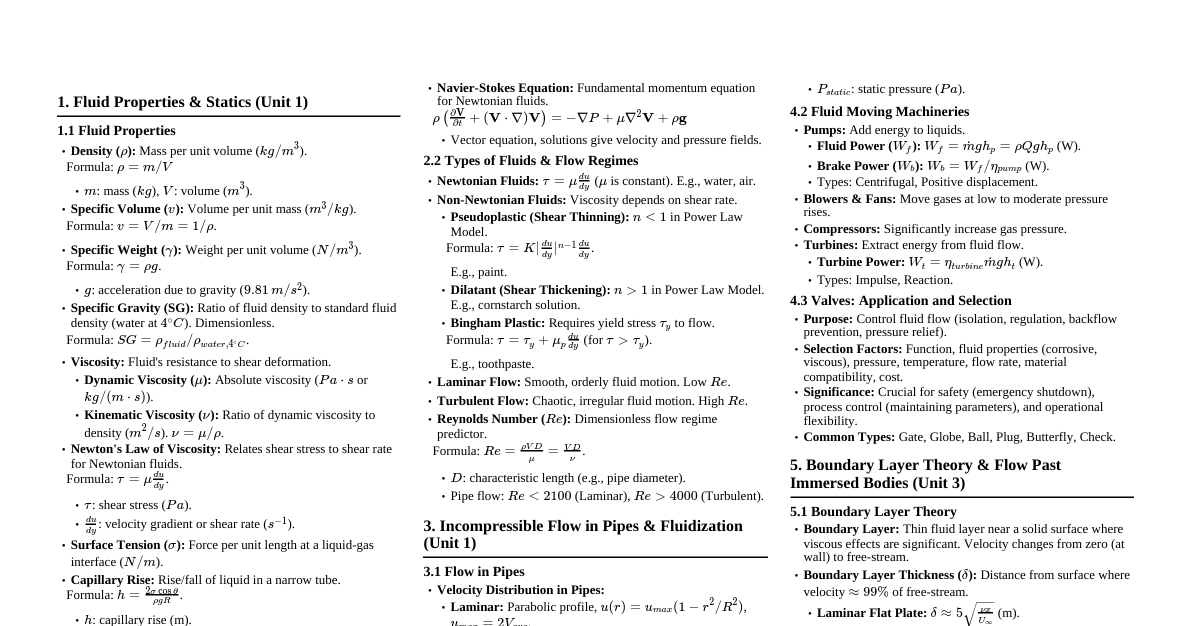
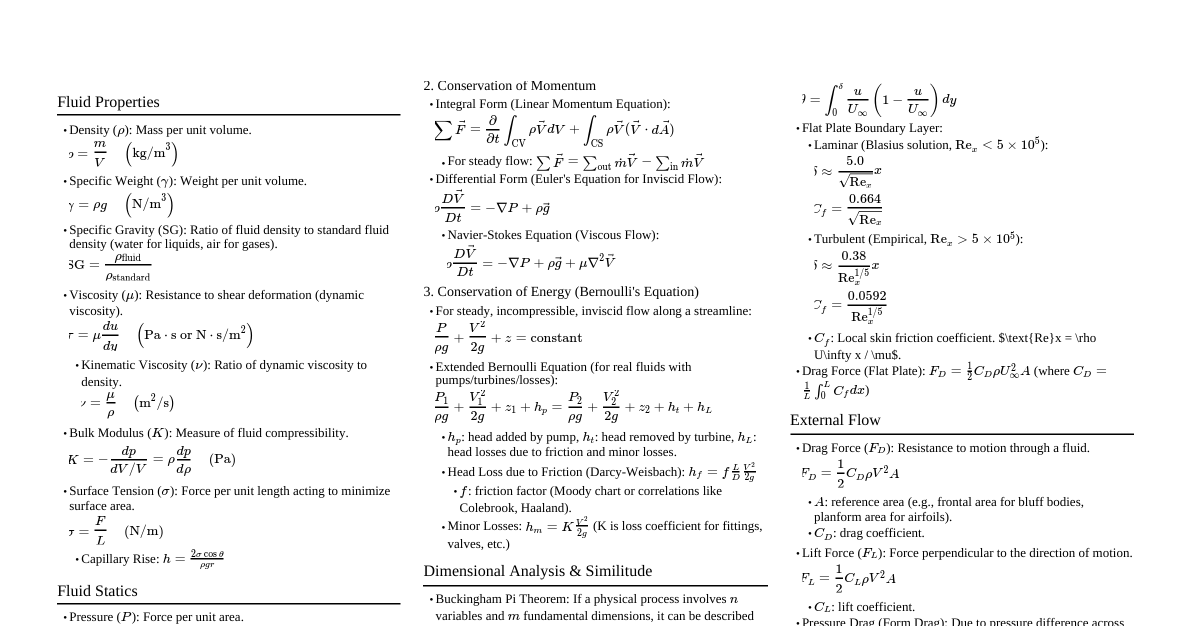
### Fluid Properties - **Density ($\rho$)**: Mass per unit volume. - $\rho = \frac{m}{V}$ - SI unit: $kg/m^3$ - **Pressure (P)**: Force per unit area exerted by a fluid. - $P = \frac{F}{A}$ - SI unit: Pascal ($Pa = N/m^2$) - **Gauge Pressure**: $P_g = P_{abs} - P_{atm}$ - **Absolute Pressure**: $P_{abs} = P_{atm} + \rho gh$ (at depth $h$) - **Specific Gravity (Relative Density)**: Ratio of fluid density to density of reference substance (usually water at $4^\circ C$, $\rho_{water} = 1000 kg/m^3$). - $SG = \frac{\rho_{fluid}}{\rho_{water}}$ (dimensionless) ### Pascal's Principle - Pressure applied to an enclosed incompressible fluid is transmitted undiminished to every portion of the fluid and to the walls of the container. - **Hydraulic Lift**: $\frac{F_1}{A_1} = \frac{F_2}{A_2}$ - Work done is equal: $F_1 d_1 = F_2 d_2$ ### Buoyancy & Archimedes' Principle - **Buoyant Force ($F_B$)**: Upward force exerted by a fluid that opposes the weight of an immersed object. - $F_B = \rho_{fluid} g V_{displaced}$ - An object floats if $F_B \ge W_{object}$ (weight of object). - An object sinks if $F_B < W_{object}$. - **Apparent Weight**: $W_{apparent} = W_{object} - F_B$ ### Fluid Flow - **Ideal Fluid Characteristics**: 1. **Incompressible**: Density is constant. 2. **Non-viscous**: No internal friction. 3. **Laminar (Streamline) Flow**: Smooth, orderly flow; fluid particles follow streamlines without crossing. 4. **Steady Flow**: Velocity at any point does not change with time. - **Types of Flow**: - **Laminar Flow**: Smooth, ordered. - **Turbulent Flow**: Irregular, chaotic, swirling; high Reynolds number. - **Viscosity ($\eta$)**: Measure of a fluid's resistance to flow (internal friction). - Higher viscosity means higher resistance. - SI unit: Pascal-second ($Pa \cdot s$) or Poise ($P = 0.1 Pa \cdot s$). ### Continuity Equation - For an incompressible, ideal fluid flowing in a pipe: - **Mass Flow Rate**: $\frac{\Delta m}{\Delta t} = \rho A v$ (constant) - **Volume Flow Rate (Q)**: $Q = A v$ (constant) - Therefore, $A_1 v_1 = A_2 v_2$ - Where A is cross-sectional area and v is fluid velocity. - Implies that fluid speed increases where the pipe constricts. ### Bernoulli's Principle - For an ideal fluid in steady, streamline flow, the sum of pressure, kinetic energy per unit volume, and potential energy per unit volume is constant along a streamline. - $P + \frac{1}{2}\rho v^2 + \rho gh = \text{constant}$ - $P$: Absolute pressure - $\frac{1}{2}\rho v^2$: Dynamic pressure - $\rho gh$: Hydrostatic pressure - **Applications**: Venturi effect, airplane lift, atomizers. ### Torricelli's Theorem - The speed of efflux (outflow) from a hole at depth $h$ below the surface of an open tank is the same as the speed a body would acquire in falling freely from rest through a vertical distance $h$. - $v = \sqrt{2gh}$