Fluid Mechanics
Cheatsheet Content
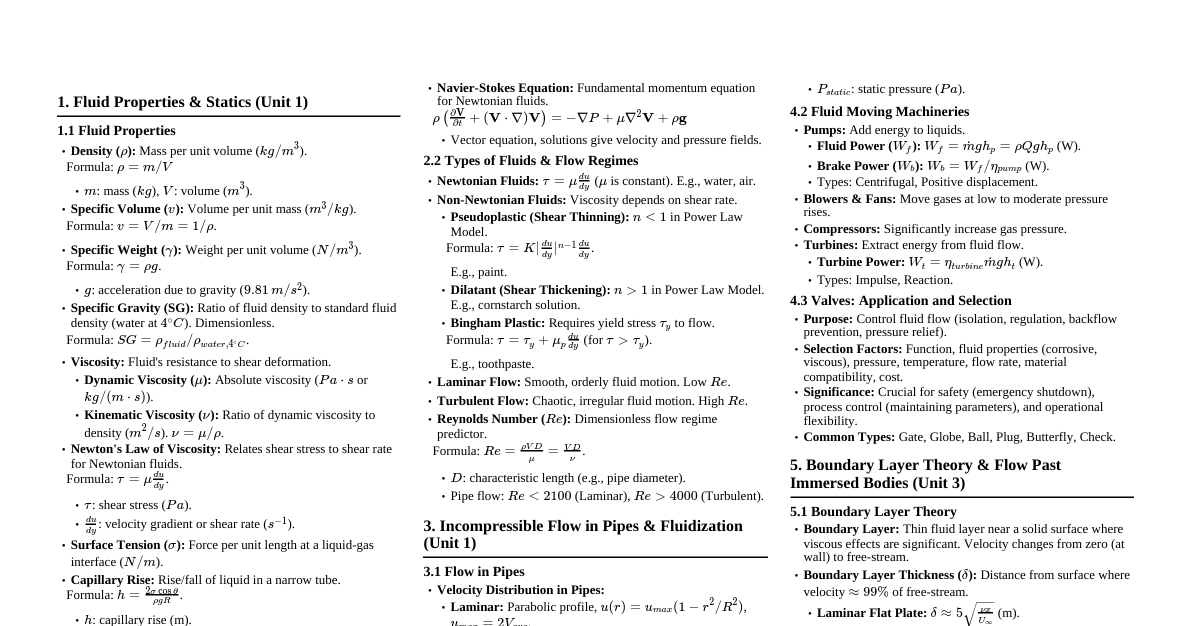
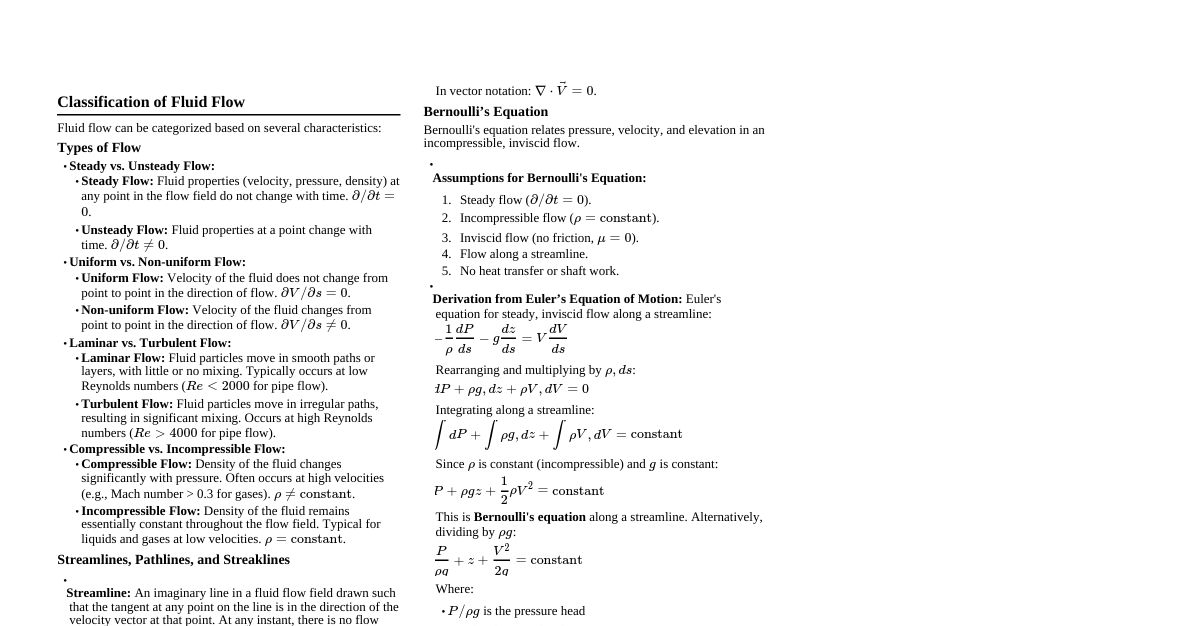
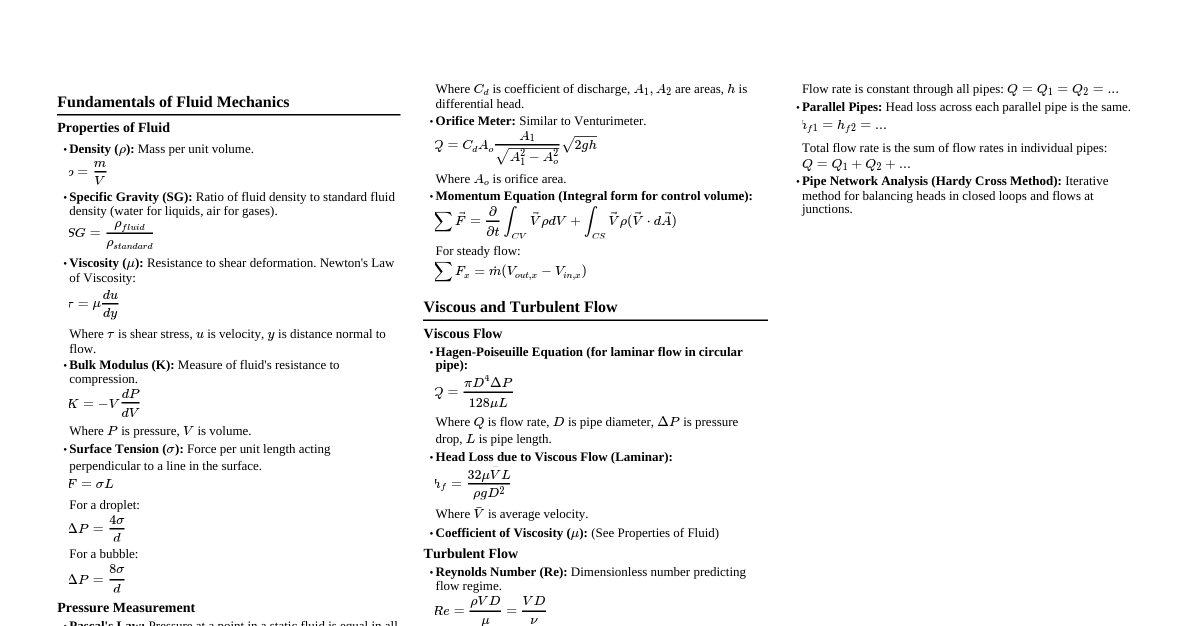
### Fluid Properties - **Density ($\rho$):** Mass per unit volume. $$\rho = \frac{m}{V} \quad \left(\text{kg/m}^3\right)$$ - **Specific Weight ($\gamma$):** Weight per unit volume. $$\gamma = \rho g \quad \left(\text{N/m}^3\right)$$ - **Specific Gravity (SG):** Ratio of fluid density to standard fluid density (water for liquids, air for gases). $$\text{SG} = \frac{\rho_{\text{fluid}}}{\rho_{\text{standard}}}$$ - **Viscosity ($\mu$):** Resistance to shear deformation (dynamic viscosity). $$\tau = \mu \frac{du}{dy} \quad \left(\text{Pa} \cdot \text{s or N} \cdot \text{s/m}^2\right)$$ - **Kinematic Viscosity ($\nu$):** Ratio of dynamic viscosity to density. $$\nu = \frac{\mu}{\rho} \quad \left(\text{m}^2\text{/s}\right)$$ - **Bulk Modulus ($K$):** Measure of fluid compressibility. $$K = -\frac{dp}{dV/V} = \rho \frac{dp}{d\rho} \quad \left(\text{Pa}\right)$$ - **Surface Tension ($\sigma$):** Force per unit length acting to minimize surface area. $$\sigma = \frac{F}{L} \quad \left(\text{N/m}\right)$$ - **Capillary Rise:** $h = \frac{2\sigma \cos\theta}{\rho g r}$ ### Fluid Statics - **Pressure ($P$):** Force per unit area. $$P = \frac{F}{A} \quad \left(\text{Pa or N/m}^2\right)$$ - **Absolute Pressure:** $P_{\text{abs}} = P_{\text{gauge}} + P_{\text{atm}}$ - **Pressure Variation in a Static Fluid:** $$\frac{dp}{dz} = -\rho g$$ - For incompressible fluid: $P_2 - P_1 = -\rho g (z_2 - z_1)$ or $P = P_0 + \rho g h$ - **Manometry:** Pressure difference based on fluid column height. $$P_A - P_B = (\rho_2 - \rho_1)gh$$ - **Hydrostatic Force on Submerged Plane Surfaces:** - **Magnitude:** $F_R = P_c A = \rho g h_c A$ (where $h_c$ is depth to centroid) - **Location (Center of Pressure):** $y_p = y_c + \frac{I_{xx,c}}{y_c A}$ - For inclined surfaces: $x_p = x_c + \frac{I_{xy,c}}{y_c A}$ - **Buoyancy (Archimedes' Principle):** - Buoyant force $F_B$ equals the weight of the fluid displaced. $$F_B = \rho_{\text{fluid}} g V_{\text{displaced}}$$ - For a floating body, $F_B = W_{\text{body}}$. ### Fluid Kinematics - **Velocity Field:** $\vec{V} = u\hat{i} + v\hat{j} + w\hat{k}$ - **Acceleration Field:** $\vec{a} = \frac{D\vec{V}}{Dt} = \frac{\partial\vec{V}}{\partial t} + (\vec{V} \cdot \nabla)\vec{V}$ - **Material Derivative:** $\frac{D}{Dt} = \frac{\partial}{\partial t} + u\frac{\partial}{\partial x} + v\frac{\partial}{\partial y} + w\frac{\partial}{\partial z}$ - **Streamline:** A line everywhere tangent to the velocity vector. $$\frac{dx}{u} = \frac{dy}{v} = \frac{dz}{w}$$ - **Streakline:** Locus of particles that have passed through a specific point. - **Pathline:** Actual path traversed by a fluid particle. - **Volume Flow Rate ($Q$):** $$Q = \int_A \vec{V} \cdot d\vec{A} \quad \left(\text{m}^3\text{/s}\right)$$ - **Mass Flow Rate ($\dot{m}$):** $$\dot{m} = \int_A \rho \vec{V} \cdot d\vec{A} = \rho Q \quad \left(\text{kg/s}\right)$$ ### Conservation Laws - **Reynolds Transport Theorem (RTT):** Relates system approach to control volume approach. $$\frac{dB_{\text{sys}}}{Dt} = \frac{\partial}{\partial t}\int_{\text{CV}} \rho b dV + \int_{\text{CS}} \rho b (\vec{V} \cdot d\vec{A})$$ - Where $B$ is an extensive property, $b = B/m$ is the intensive property. #### 1. Conservation of Mass (Continuity Equation) - **Integral Form (Steady Flow):** $$\sum_{\text{out}} \dot{m} - \sum_{\text{in}} \dot{m} = 0$$ - For incompressible flow: $\sum_{\text{out}} Q - \sum_{\text{in}} Q = 0 \implies A_1V_1 = A_2V_2$ - **Differential Form:** $$\frac{\partial\rho}{\partial t} + \nabla \cdot (\rho\vec{V}) = 0$$ - For incompressible flow: $\nabla \cdot \vec{V} = 0 \implies \frac{\partial u}{\partial x} + \frac{\partial v}{\partial y} + \frac{\partial w}{\partial z} = 0$ #### 2. Conservation of Momentum - **Integral Form (Linear Momentum Equation):** $$\sum \vec{F} = \frac{\partial}{\partial t}\int_{\text{CV}} \rho \vec{V} dV + \int_{\text{CS}} \rho \vec{V} (\vec{V} \cdot d\vec{A})$$ - For steady flow: $\sum \vec{F} = \sum_{\text{out}} \dot{m}\vec{V} - \sum_{\text{in}} \dot{m}\vec{V}$ - **Differential Form (Euler's Equation for Inviscid Flow):** $$\rho \frac{D\vec{V}}{Dt} = -\nabla P + \rho\vec{g}$$ - **Navier-Stokes Equation (Viscous Flow):** $$\rho \frac{D\vec{V}}{Dt} = -\nabla P + \rho\vec{g} + \mu \nabla^2 \vec{V}$$ #### 3. Conservation of Energy (Bernoulli's Equation) - **For steady, incompressible, inviscid flow along a streamline:** $$\frac{P}{\rho g} + \frac{V^2}{2g} + z = \text{constant}$$ - **Extended Bernoulli Equation (for real fluids with pumps/turbines/losses):** $$\frac{P_1}{\rho g} + \frac{V_1^2}{2g} + z_1 + h_p = \frac{P_2}{\rho g} + \frac{V_2^2}{2g} + z_2 + h_t + h_L$$ - $h_p$: head added by pump, $h_t$: head removed by turbine, $h_L$: head losses due to friction and minor losses. - **Head Loss due to Friction (Darcy-Weisbach):** $h_f = f \frac{L}{D} \frac{V^2}{2g}$ - $f$: friction factor (Moody chart or correlations like Colebrook, Haaland). - **Minor Losses:** $h_m = K \frac{V^2}{2g}$ (K is loss coefficient for fittings, valves, etc.) ### Dimensional Analysis & Similitude - **Buckingham Pi Theorem:** If a physical process involves $n$ variables and $m$ fundamental dimensions, it can be described by $n-m$ dimensionless $\Pi$ groups. - **Common Dimensionless Numbers:** - **Reynolds Number (Re):** Ratio of inertial to viscous forces. $$\text{Re} = \frac{\rho VL}{\mu} = \frac{VL}{\nu}$$ - Laminar flow: $\text{Re} 4000$ (pipes), $\text{Re} > 5 \times 10^5$ (flat plate) - **Froude Number (Fr):** Ratio of inertial to gravitational forces. $$\text{Fr} = \frac{V}{\sqrt{gL}}$$ - **Mach Number (Ma):** Ratio of fluid speed to speed of sound. $$\text{Ma} = \frac{V}{c}$$ - **Euler Number (Eu):** Ratio of pressure to inertial forces. $$\text{Eu} = \frac{\Delta P}{\rho V^2}$$ - **Weber Number (We):** Ratio of inertial to surface tension forces. $$\text{We} = \frac{\rho V^2 L}{\sigma}$$ ### Flow in Pipes & Channels - **Laminar Flow (Hagen-Poiseuille Equation for circular pipes):** $$\Delta P = \frac{32\mu L \bar{V}}{D^2}$$ $$Q = \frac{\pi D^4 \Delta P}{128 \mu L}$$ - Friction factor: $f = \frac{64}{\text{Re}}$ - **Turbulent Flow:** - Friction factor $f$ is determined by Moody Chart or empirical equations (e.g., Colebrook, Haaland). - **Colebrook Equation:** $\frac{1}{\sqrt{f}} = -2.0 \log\left(\frac{\epsilon/D}{3.7} + \frac{2.51}{\text{Re}\sqrt{f}}\right)$ - **Haaland Equation (explicit approximation):** $\frac{1}{\sqrt{f}} \approx -1.8 \log\left[\left(\frac{\epsilon/D}{3.7}\right)^{1.11} + \frac{6.9}{\text{Re}}\right]$ - **Open Channel Flow (Manning's Equation):** $$V = \frac{1}{n} R_h^{2/3} S_0^{1/2}$$ - $R_h$: Hydraulic Radius ($R_h = A/P$, where $A$ is flow area, $P$ is wetted perimeter). - $S_0$: Channel bed slope. - $n$: Manning roughness coefficient. ### Boundary Layers - **Definition:** Thin layer near a solid surface where viscous effects are significant. - **Boundary Layer Thickness ($\delta$):** Distance from the surface where $u \approx 0.99 U_\infty$. - **Displacement Thickness ($\delta^*$):** Distance by which the solid boundary would have to be shifted to account for the reduction in flow rate due to boundary layer. $$\delta^* = \int_0^\delta \left(1 - \frac{u}{U_\infty}\right) dy$$ - **Momentum Thickness ($\theta$):** Measure of the loss of momentum due to the boundary layer. $$\theta = \int_0^\delta \frac{u}{U_\infty}\left(1 - \frac{u}{U_\infty}\right) dy$$ - **Flat Plate Boundary Layer:** - **Laminar (Blasius solution, $\text{Re}_x 5 \times 10^5$):** $$\delta \approx \frac{0.38}{\text{Re}_x^{1/5}} x$$ $$C_f = \frac{0.0592}{\text{Re}_x^{1/5}}$$ - $C_f$: Local skin friction coefficient. $\text{Re}_x = \rho U_\infty x / \mu$. - **Drag Force (Flat Plate):** $F_D = \frac{1}{2} C_D \rho U_\infty^2 A$ (where $C_D = \frac{1}{L} \int_0^L C_f dx$) ### External Flow - **Drag Force ($F_D$):** Resistance to motion through a fluid. $$F_D = \frac{1}{2} C_D \rho V^2 A$$ - $A$: reference area (e.g., frontal area for bluff bodies, planform area for airfoils). - $C_D$: drag coefficient. - **Lift Force ($F_L$):** Force perpendicular to the direction of motion. $$F_L = \frac{1}{2} C_L \rho V^2 A$$ - $C_L$: lift coefficient. - **Pressure Drag (Form Drag):** Due to pressure difference across the body. - **Viscous Drag (Skin Friction Drag):** Due to friction between fluid and surface. - **Stall:** Condition where lift decreases rapidly due to flow separation.