Physics For Engineers
Cheatsheet Content
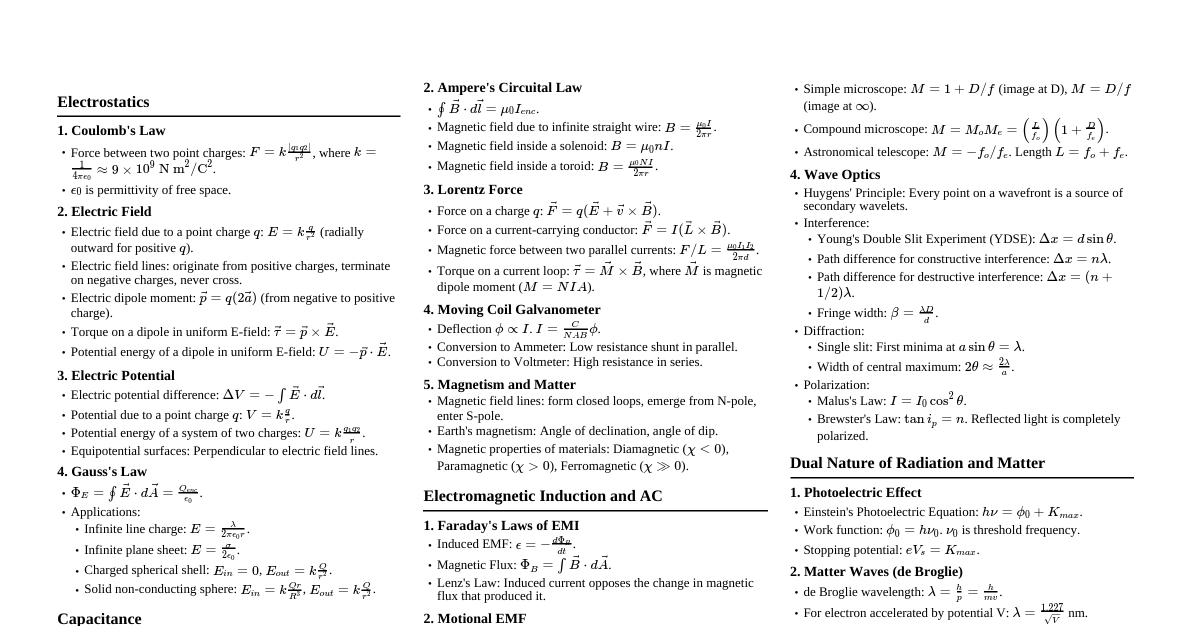
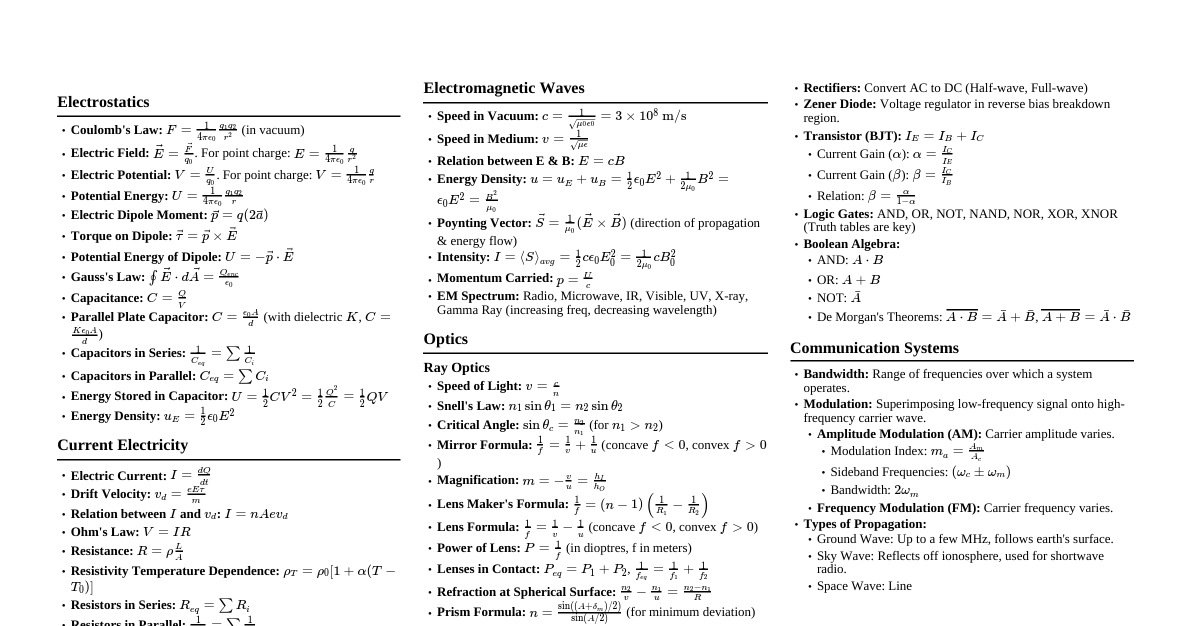
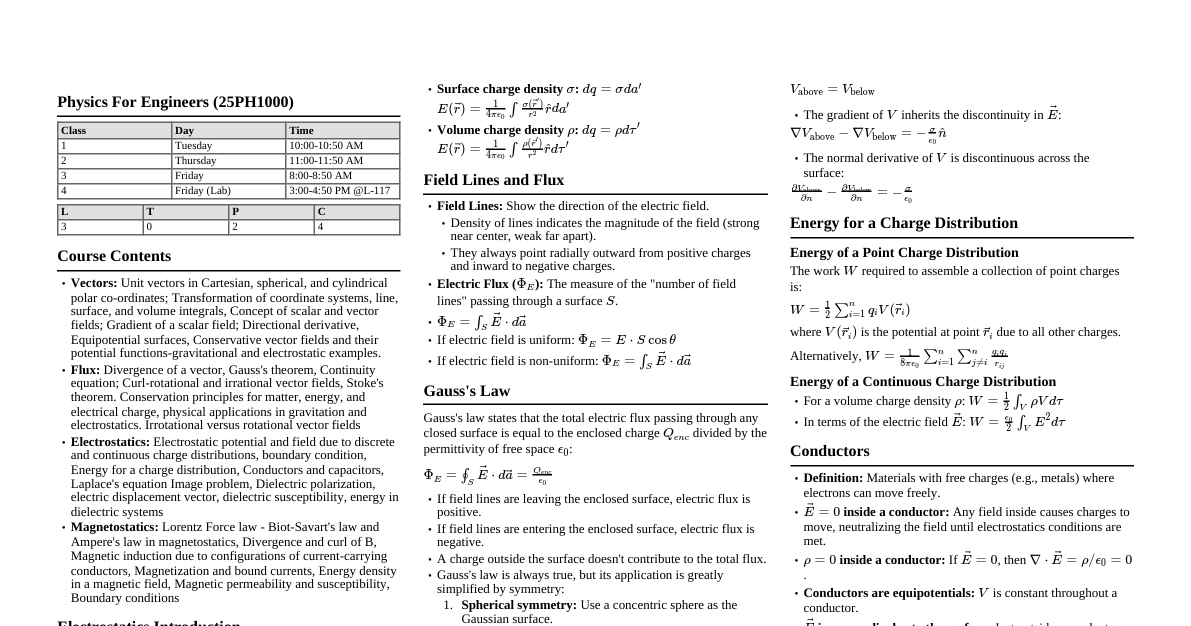
Course Information Class Day Time 1 Tuesday 10:00-10:50 AM 2 Thursday 11:00-11:50 AM 3 Friday 8:00-8:50 AM 4 (Lab) Friday 3:00-4:50 PM @L-117 L T P C 3 0 2 4 Instructor Dr. Y. Ashok Kumar Reddy Assistant Professor of Physics IIITDM Kancheepuram, Chennai, India Email: akreddy@iiitdm.ac.in Office: 119-K (North-East) Course Contents: Physics for Engineers (25PH1000) Vectors Introduction: Unit vectors in Cartesian, spherical, and cylindrical polar co-ordinates. Transformation of coordinate systems, line, surface, and volume integrals. Concept of scalar and vector fields; Gradient of a scalar field; Directional derivative, Equipotential surfaces. Conservative vector fields and their potential functions (gravitational and electrostatic examples). Flux, divergence of a vector, Gauss's theorem, Continuity equation. Curl-rotational and irrational vector fields, Stoke's theorem. Conservation principles for matter, energy, and electrical charge. Physical applications in gravitation and electrostatics. Irrotational versus rotational vector fields. Electrostatics Electrostatic potential and field due to discrete and continuous charge distributions. Boundary condition, Energy for a charge distribution. Conductors and capacitors, Laplace's equation. Image problem, Dielectric polarization, electric displacement vector, dielectric susceptibility, energy in dielectric systems. Magnetostatics Lorentz Force law - Biot-Savart's law and Ampere's law in magnetostatics. Divergence and curl of $B$. Magnetic induction due to configurations of current-carrying conductors. Magnetization and bound currents. Energy density in a magnetic field. Magnetic permeability and susceptibility, Boundary conditions. Textbooks David J. Griffiths, Introduction to Electrodynamics , 4th Edition, Pearson, 2015, ISBN-13: 978-9332550445. Bhag Singh Guru and Huseyin R. Hiziroglu, Electromagnetic Field Theory Fundamentals , 2nd Edition, Cambridge University Press, 2009, ISBN-13: 978-0521116022. Capacitors Parallel-Plate Capacitor Problem: Find the capacitance of a parallel-plate capacitor consisting of two metal surfaces of area '$A$' held a distance '$d$' apart. Solution: If we put $+Q$ on the top and $-Q$ on the bottom, charges will spread out uniformly over the two surfaces. Surface charge density: $\sigma = Q/A$ on the top plate. Electric field: $E = \frac{\sigma}{\epsilon_0} = \frac{Q}{A\epsilon_0}$ Potential difference: $V = E \cdot d = \frac{Qd}{A\epsilon_0}$ Capacitance: $C = \frac{Q}{V} = \frac{Q}{Qd/(A\epsilon_0)} = \frac{A\epsilon_0}{d}$ Example: Plates are square with sides $1 \text{ cm}$ long, held $1 \text{ mm}$ apart. $\epsilon_0 \approx 8.85 \times 10^{-12} \text{ F/m}$. $A = (0.01 \text{ m})^2 = 10^{-4} \text{ m}^2$, $d = 10^{-3} \text{ m}$. $C = \frac{10^{-4} \text{ m}^2 \cdot 8.85 \times 10^{-12} \text{ F/m}}{10^{-3} \text{ m}} = 8.85 \times 10^{-13} \text{ F} \approx 9 \times 10^{-13} \text{ F}$. Concentric Spherical Metal Shells Problem: Find the capacitance of two concentric spherical metal shells with radii '$a$' (inner) and '$b$' (outer). Solution: Place charge $+Q$ on the inner sphere, and $-Q$ on the outer one. Electric field between spheres ($a Potential difference: $V = -\int_b^a E \cdot dl = -\int_b^a \frac{1}{4\pi\epsilon_0} \frac{Q}{r^2} dr = \frac{Q}{4\pi\epsilon_0} \left( \frac{1}{a} - \frac{1}{b} \right)$ Capacitance: $C = \frac{Q}{V} = \frac{Q}{\frac{Q}{4\pi\epsilon_0} \left( \frac{b-a}{ab} \right)} = 4\pi\epsilon_0 \frac{ab}{b-a}$ Poisson's Equation & Laplace's Equation Electric field can be written as the gradient of a scalar potential: $E = -\nabla V$ Divergence of $E$: $\nabla \cdot E = \nabla \cdot (-\nabla V) = -\nabla^2 V$ Curl of $E$: $\nabla \times E = 0$ (for electrostatic fields) Gauss's law in differential form: $\nabla \cdot E = \frac{\rho}{\epsilon_0}$ Combining these: $-\nabla^2 V = \frac{\rho}{\epsilon_0} \implies \nabla^2 V = -\frac{\rho}{\epsilon_0}$ ( Poisson's Equation ) In regions where there is no charge ($\rho = 0$), Poisson's equation reduces to $\nabla^2 V = 0$ ( Laplace's Equation ) Laplace's equations in different coordinates Rectangular: $\frac{\partial^2 V}{\partial x^2} + \frac{\partial^2 V}{\partial y^2} + \frac{\partial^2 V}{\partial z^2} = 0$ Cylindrical: $\frac{1}{\rho} \frac{\partial}{\partial \rho} \left( \rho \frac{\partial V}{\partial \rho} \right) + \frac{1}{\rho^2} \frac{\partial^2 V}{\partial \phi^2} + \frac{\partial^2 V}{\partial z^2} = 0$ Spherical: $\frac{1}{r^2} \frac{\partial}{\partial r} \left( r^2 \frac{\partial V}{\partial r} \right) + \frac{1}{r^2 \sin\theta} \frac{\partial}{\partial \theta} \left( \sin\theta \frac{\partial V}{\partial \theta} \right) + \frac{1}{r^2 \sin^2\theta} \frac{\partial^2 V}{\partial \phi^2} = 0$ Uniqueness Theorem If a solution to Laplace's equation can be found that satisfies the boundary conditions, then the solution is unique. Solving Laplace and Poisson equations Method of images: A powerful technique for solving electrostatics problems involving charges and conductors. Separation of variables: Useful for solving partial differential equations, frequently used in quantum mechanics. Multipole expansion: Expand in a power series to approach problems not immediately accessible by other means. The Image Charge Potential at any point on the plane bisecting the dipole is zero. Electric field intensity is normal to the plane. The field pattern of the dipole remains unchanged if a conducting plane is in place of the bisecting plane. Total charge induced on the surface of the conductor is $-q$. For two bisecting planes, the number of images will be finite if the angle between the planes is a submultiple of $360^\circ$. If $\theta$ is the angle of intersection of two planes, the field due to a point charge placed between the planes can be obtained by replacing the planes with $n-1$ image charges, where $n = 360^\circ/\theta$ is an integer. Image Problem-1: Point charge above an infinite grounded conducting plane Problem: Consider a point charge $q$ held at distance $d$ above an infinite grounded conducting plane. Boundary Conditions: $V(x,y,0) = 0$ and $V(x,y,z) \to 0$ as $x,y,z \to \infty$. Solution: Use an image charge $-q$ at distance $d$ below the plane. Potential: $V(x,y,z) = \frac{1}{4\pi\epsilon_0} \left[ \frac{q}{\sqrt{x^2+y^2+(z-d)^2}} - \frac{q}{\sqrt{x^2+y^2+(z+d)^2}} \right]$ Induced surface charge density: $\sigma = -\frac{qd}{2\pi(x^2+y^2+d^2)^{3/2}}$ Total induced charge: $Q_{total} = -q$ Image Problem-2: Point charge and a grounded sphere Problem: A point charge $q$ is placed at a distance $d$ from the center of a grounded conducting sphere of radius $a$. Calculate the surface charge density on the sphere. Solution: Replace the sphere with an image charge $q' = -q \frac{a}{d}$ located at $b = \frac{a^2}{d}$ from the center along the line connecting $q$ and the center. Surface charge density: $\sigma = \frac{-q(d^2-a^2)}{4\pi a (d^2+a^2-2ad \cos\theta)^{3/2}}$ Image Problem-3: Multiple Images (Two semi-infinite grounded conducting planes at right angles) To satisfy boundary conditions, three image charges must be added to the system. If the charge $q$ is at $(a,b)$, images are at $(-a,b), (a,-b), (-a,-b)$. The net force on $q$ is the vector sum of forces due to the three image charges. The electrostatic energy of the real system is $1/4$ of the electrostatic energy of the image-charge system. Polarization & Dielectrics Dielectrics: Materials where charges are attached to specific atoms or molecules. Microscopic displacements of charges account for dielectric behavior. Mechanisms: Stretching and rotating of atomic/molecular dipoles. Induced dipoles: When a neutral atom is in an electric field $E$, the nucleus and electron cloud are displaced, creating a dipole moment $p$. $p = \alpha E$, where $\alpha$ is the atomic polarizability. Polarization vector ($P$): Dipole moment per unit volume. $P = \lim_{\Delta v \to 0} \sum p_i / \Delta v$. Electric Displacement Field ($D$): $D = \epsilon_0 E + P$. For linear dielectrics: $P = \epsilon_0 \chi_e E$. Thus, $D = \epsilon_0 E + \epsilon_0 \chi_e E = \epsilon_0 (1 + \chi_e) E = \epsilon E$. $\epsilon = \epsilon_0 (1 + \chi_e)$ is the permittivity of the material. $\chi_e$ is the electric susceptibility. Relative permittivity (dielectric constant): $\epsilon_r = \frac{\epsilon}{\epsilon_0} = 1 + \chi_e$. Bound Charges Polarization $P$ produces bound volume charge density $\rho_b$ and bound surface charge density $\sigma_b$. $\rho_b = -\nabla \cdot P$ (bound volume charge density). $\sigma_b = P \cdot \hat{n}$ (bound surface charge density). Physical interpretation: Accumulation of bound charges where polarization is non-uniform or at interfaces. Gauss's Law in Dielectrics Total charge density: $\rho = \rho_b + \rho_f$. Gauss's law: $\nabla \cdot E = \frac{\rho}{\epsilon_0} = \frac{\rho_b + \rho_f}{\epsilon_0}$. Using $\rho_b = -\nabla \cdot P$: $\nabla \cdot E = \frac{-\nabla \cdot P + \rho_f}{\epsilon_0}$. $\epsilon_0 \nabla \cdot E + \nabla \cdot P = \rho_f$. $\nabla \cdot (\epsilon_0 E + P) = \rho_f \implies \nabla \cdot D = \rho_f$. This means Gauss's law for $D$ only depends on free charge density $\rho_f$. Boundary Conditions Normal component of $D$: $D_{1n} - D_{2n} = \sigma_f$ (if $\sigma_f$ is free surface charge density). Tangential component of $E$: $E_{1t} - E_{2t} = 0$. In the absence of free charge ($\sigma_f = 0$): $D_{1n} = D_{2n}$. Energy in Dielectric Systems Work done to charge a capacitor: $W = \frac{1}{2} C V^2$. If a capacitor (C) is filled with linear dielectric, its capacitance increases by a factor of $\epsilon_r$: $C = \epsilon_r C_{vac}$. Energy stored in any electrostatic system: $W = \frac{1}{2} \int_V \epsilon E^2 d\tau$. For a dielectric-filled capacitor: $W = \frac{1}{2} \int_V D \cdot E d\tau$. Also, $W = \int_0^Q \frac{q'}{C} dq' = \frac{1}{2} \frac{Q^2}{C}$. Example: Total energy for a concentric linear dielectric material Problem: Calculate the total energy for a concentric linear dielectric material having radius $R_1$ and susceptibility $\chi_e$ by surrounding with a spherical conductor of radius $R_2$, which carries a charge '$q$'. Solution: For $r For $r > R_2$: $D = \frac{q}{4\pi r^2} \hat{r}$. Electric field for $R_2 Electric field for $r > R_1$: $E = \frac{D}{\epsilon_0} = \frac{q}{4\pi\epsilon_0 r^2} \hat{r}$. Total energy: $W = \frac{1}{2} \int D \cdot E d\tau$. $W = \frac{q^2}{8\pi\epsilon_0} \left[ \frac{1}{\epsilon_r} \left( \frac{1}{R_2} - \frac{1}{R_1} \right) + \frac{1}{R_1} \right]$ Using $\epsilon_r = 1 + \chi_e$: $W = \frac{q^2}{8\pi\epsilon_0 (1+\chi_e)} \left[ \frac{R_2-R_1+(1+\chi_e)R_1}{R_1 R_2} \right]$. Example: Electric energy stored in a metallic sphere Problem: A metallic sphere of radius $10 \text{ cm}$ has a surface charge density of $10 \text{ nC/m}^2$. Calculate the electric energy stored in the system. Solution: Radius $r = 0.1 \text{ m}$, $\sigma = 10 \times 10^{-9} \text{ C/m}^2$. Energy stored: $W = \frac{1}{2} Q V$. Total charge $Q = \sigma A = \sigma (4\pi r^2) = 10 \times 10^{-9} \text{ C/m}^2 \cdot 4\pi (0.1 \text{ m})^2 \approx 1.257 \times 10^{-9} \text{ C}$. Potential $V = \frac{Q}{4\pi\epsilon_0 r} = \frac{1.257 \times 10^{-9} \text{ C}}{4\pi \cdot 8.85 \times 10^{-12} \text{ F/m} \cdot 0.1 \text{ m}} \approx 113.1 \text{ V}$. $W = \frac{1}{2} (1.257 \times 10^{-9} \text{ C}) (113.1 \text{ V}) \approx 71.08 \times 10^{-9} \text{ J}$.