Organic Reactions Summary
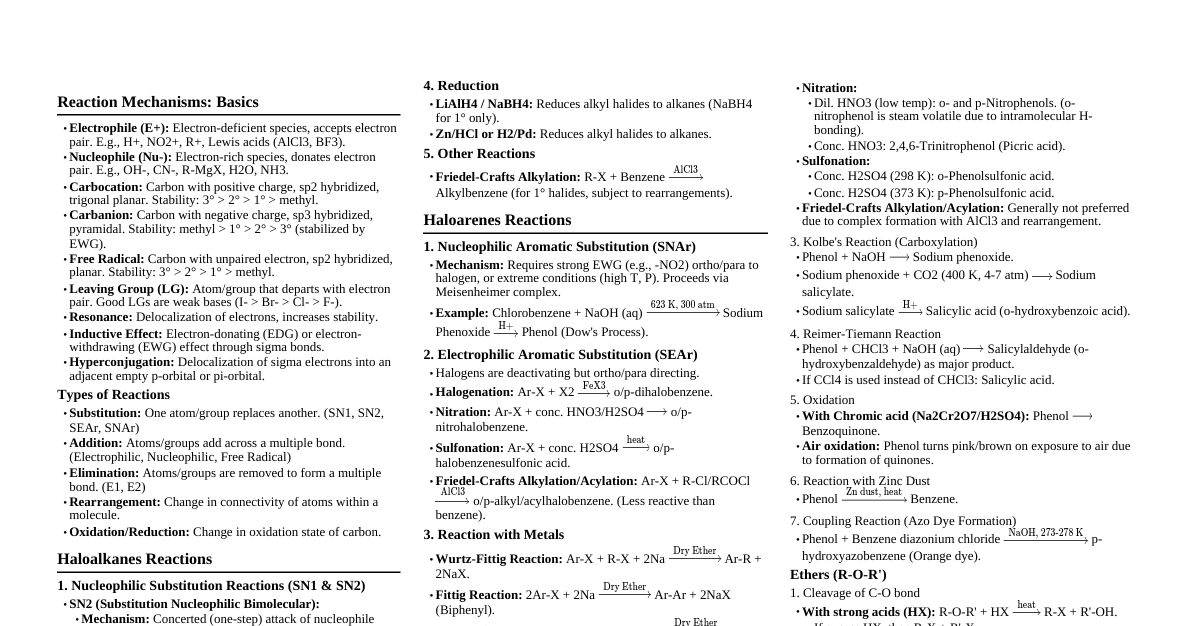
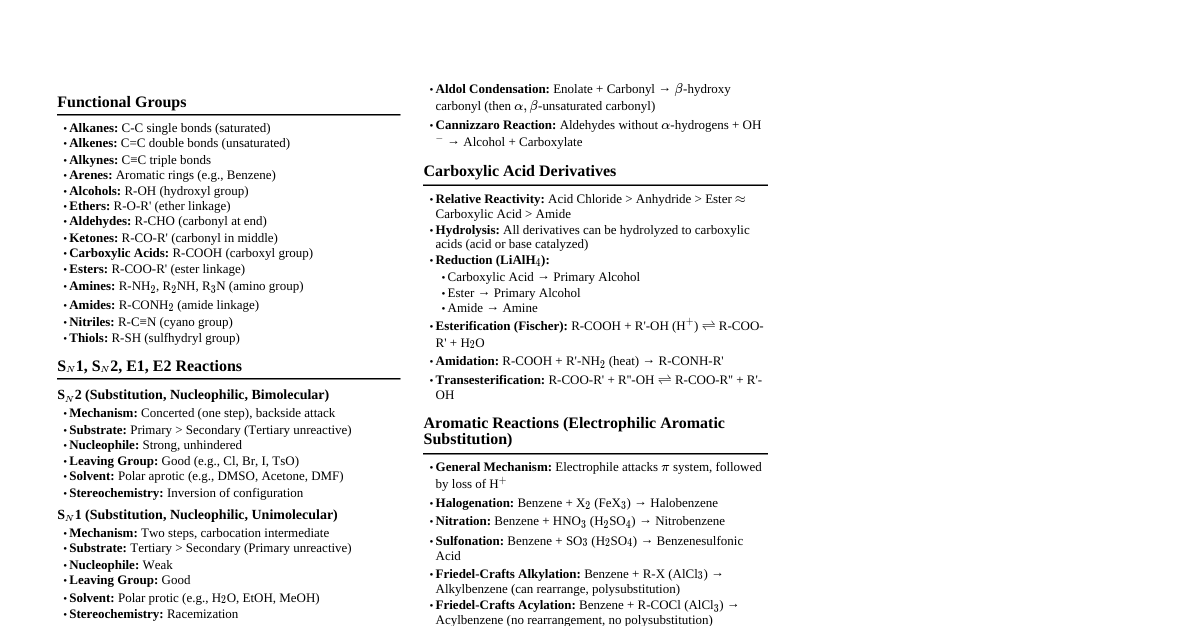
Cheatsheet Content
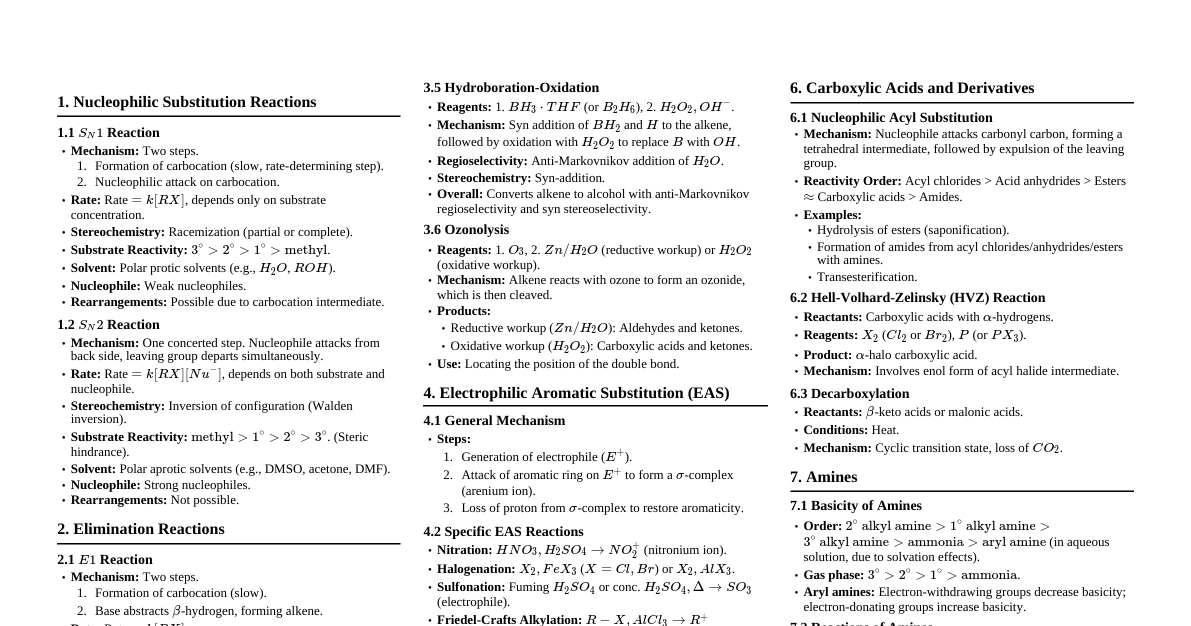
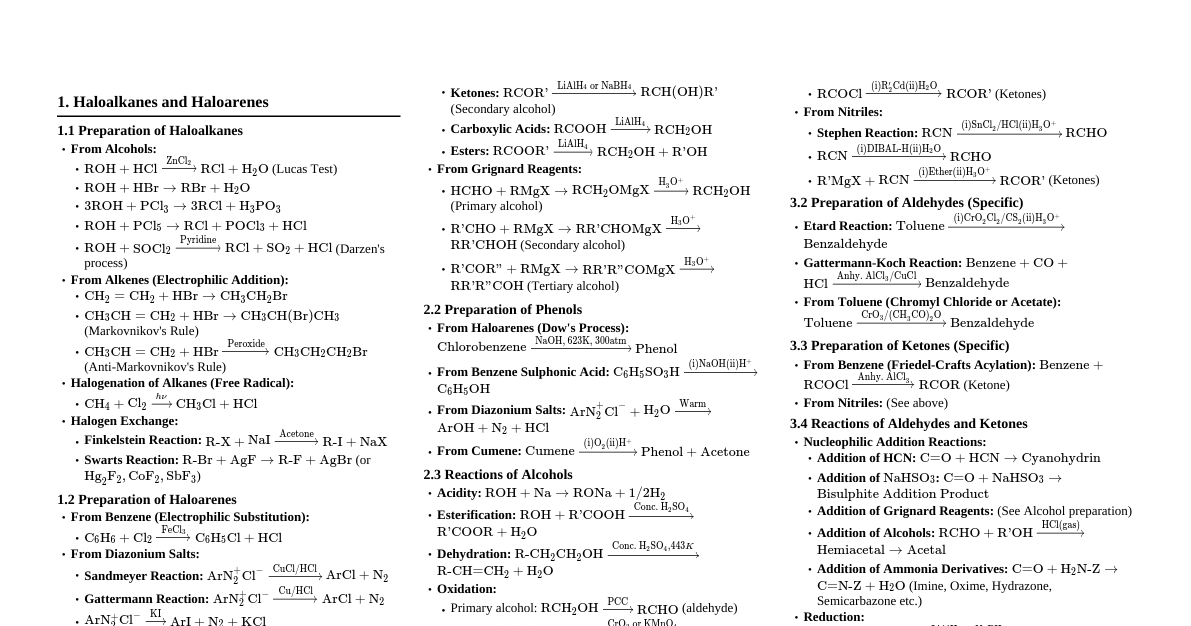
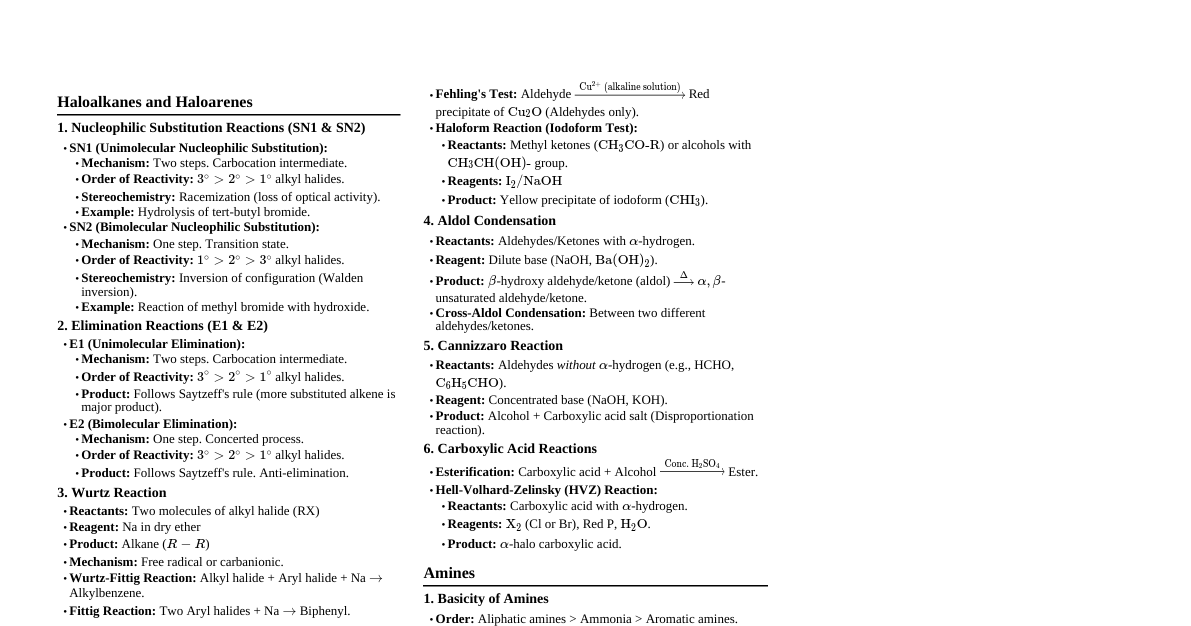
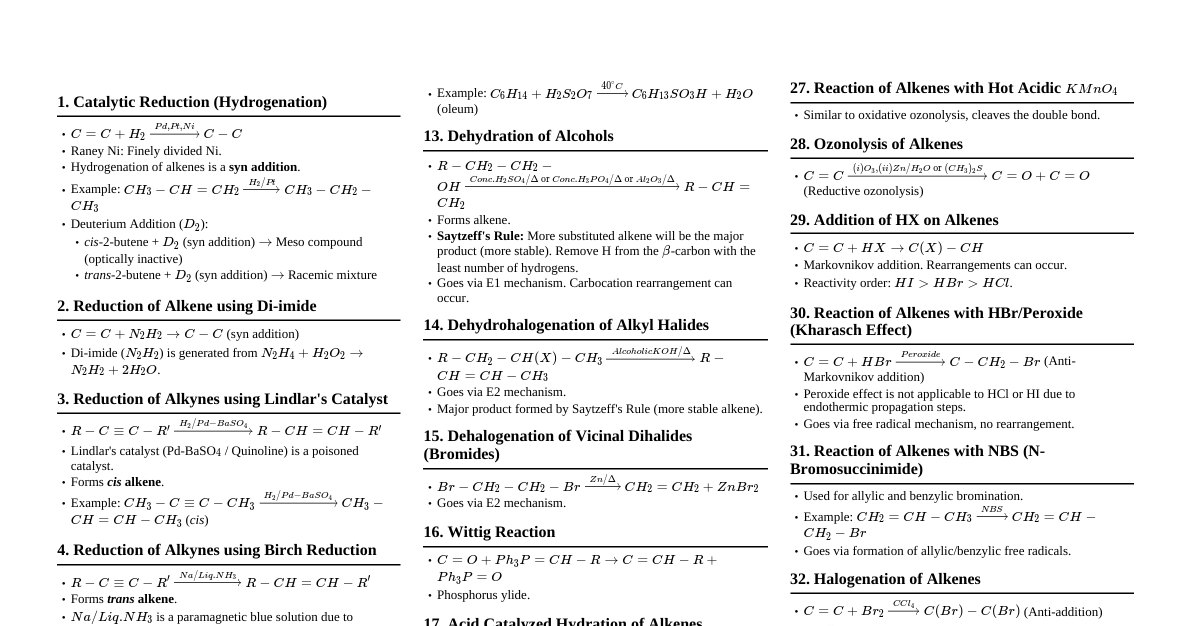
🌟"> 🌟"> ### 🌟 Basic Organic Reaction Types (Excluding Aldol & Cannizzaro) 🌟 This section provides a colorful, quick-reference guide to fundamental organic reactions for JEE. Focus on **bolded terms** and **key reagents**! Reaction Type Description & Mechanism Highlights Key Substrates / Features Typical Applications / Products Substitution 🔄 Replacement of one atom/group by another. **Nucleophilic ($S_N1, S_N2$)** or **Electrophilic ($S_E$)**. - **Nucleophilic:** Alkyl halides, alcohols, good leaving groups - **Electrophilic:** Aromatic rings (e.g., benzene) - **Functional group interconversion** (e.g., alcohol → halide) - Synthesis of ethers, esters, amines - Introducing substituents onto **aromatic rings** (nitration, halogenation) * $S_N1$ Two-step, **carbocation intermediate**, racemization. Tertiary > Secondary R-X. Tertiary/Secondary Alkyl Halides * $S_N2$ One-step, **backside attack**, **inversion of configuration**. Primary > Secondary R-X. Primary/Secondary Alkyl Halides Addition ➕ Two molecules combine → larger one. **Breaks π bond**, forms new σ bonds. - **Alkenes, Alkynes** (C=C, C≡C) - **Carbonyl compounds** (C=O) - Conjugated dienes - **Increasing saturation** (hydrogenation) - Adding functional groups across double/triple bonds - Formation of polymers * $A_E$ Electrophile attacks π bond. Follows Markovnikov's rule. Alkenes, Alkynes Hydrohalogenation, Hydration * $A_N$ Nucleophile attacks electron-deficient carbon. Eg. Carbonyls. Aldehydes, Ketones Cyanohydrin formation, Grignard additions Elimination ➖ Removal of atoms/groups from adjacent carbons → **forms π bond**. Reverse of addition. - Alkyl halides, Alcohols (E1, E2 mechanisms) - Favored by **strong bases + heat** - **Formation of alkenes and alkynes** - Dehydration of alcohols, dehydrohalogenation of alkyl halides * $E1$ Two-step, **carbocation intermediate**, governed by Zaitsev's rule. Tertiary/Secondary Alkyl Halides/Alcohols * $E2$ One-step, concerted, **anti-periplanar geometry**. Primary/Secondary Alkyl Halides/Alcohols Oxidation ⬆️ **Increase in oxidation state**. Gain O / Loss H / Loss e-. - Alcohols, Aldehydes, Alkenes, Alkynes - **Key Reagents:** KMnO­$_4$ (strong), K­$_2$Cr­$_2$O­$_7$, PCC (mild), O­$_3$, Tollens', Fehling's - Synthesis of **carboxylic acids, ketones** - Double bond cleavage (ozonolysis) Reduction ⬇️ **Decrease in oxidation state**. Loss O / Gain H / Gain e-. - **Carbonyl compounds** (aldehydes, ketones, esters, acids) - Alkenes, Alkynes, Nitro compounds - Synthesis of **alcohols, alkanes, amines** * Reagents LiAlH­$_4$ (strong), NaBH­$_4$ (mild), H­$_2$/catalyst (Pd, Pt, Ni) Rearrangement 🔀 Reorganization of atoms within a molecule → **structural isomer**. Often involves **migration of groups/H atoms**. - **Carbocations** (e.g., during $S_N1$ or $E1$) - **Named Reactions:** Pinacol-Pinacolone, Baeyer-Villiger, Beckmann, Wagner-Meerwein - Increasing **stability** of intermediates/products - Formation of more stable products Pericyclic 💫 **Concerted reactions**, single transition state, no intermediates. Cyclic rearrangement of electrons. - **Conjugated dienes** (Diels-Alder), unsaturated systems - Often **stereospecific**, sensitive to heat/light - Formation of **cyclic compounds** (e.g., Diels-Alder cycloaddition) - Important in natural product synthesis ### 🌿 Electrophilic Aromatic Substitution ($S_EAr$) 🌿 *Exclusively for Aromatic Rings!* - **🎯 Definition:** An **electrophile replaces a hydrogen atom** on an **aromatic ring**. - **⚙️ Mechanism Overview:** 1. **Generation of a strong electrophile**. 2. Aromatic $\pi$ electrons **attack the electrophile** $\to$ **carbocation intermediate** (arenium ion, temporarily loses aromaticity). 3. Deprotonation $\to$ **aromaticity restored** . - **💡 Key Substrates:** **Benzene**, substituted benzenes (e.g., toluene, nitrobenzene, chlorobenzene). - **📝 Examples (Memorize Reagents!):** - **Nitration:** Benzene $\xrightarrow{\color{#800080}HNO_3/H_2SO_4}$ Nitrobenzene (Adds -NO$_2$) - **Halogenation:** Benzene $\xrightarrow{\color{#800080}Br_2/FeBr_3}$ Bromobenzene (Adds -Br) - **Sulfonation:** Benzene $\xrightarrow{\color{#800080}conc. H_2SO_4, \Delta}$ Benzenesulfonic Acid (Adds -SO$_3H$) - **Friedel-Crafts Alkylation:** Benzene $\xrightarrow{\color{#800080}R-Cl/AlCl_3}$ Alkylbenzene (Adds -R, *carbocation rearrangement possible!* ) - **Friedel-Crafts Acylation:** Benzene $\xrightarrow{\color{#800080}RCOCl/AlCl_3}$ Acylbenzene (Adds -COR, *no rearrangement!* ) - **📍 Regioselectivity (Directing Effects):** Substituents decide *where* the new group adds. - **Activating & o,p-Directing:** -OH, -NH$_2$, -OR, -R, -X (halogens are a special case: deactivating but o,p-directing!) - **Deactivating & m-Directing:** -NO$_2$, -COOH, -CHO, -CN, -SO$_3H$, -C=O-R