Calculus Foundations (NCERT Class 11)
Cheatsheet Content
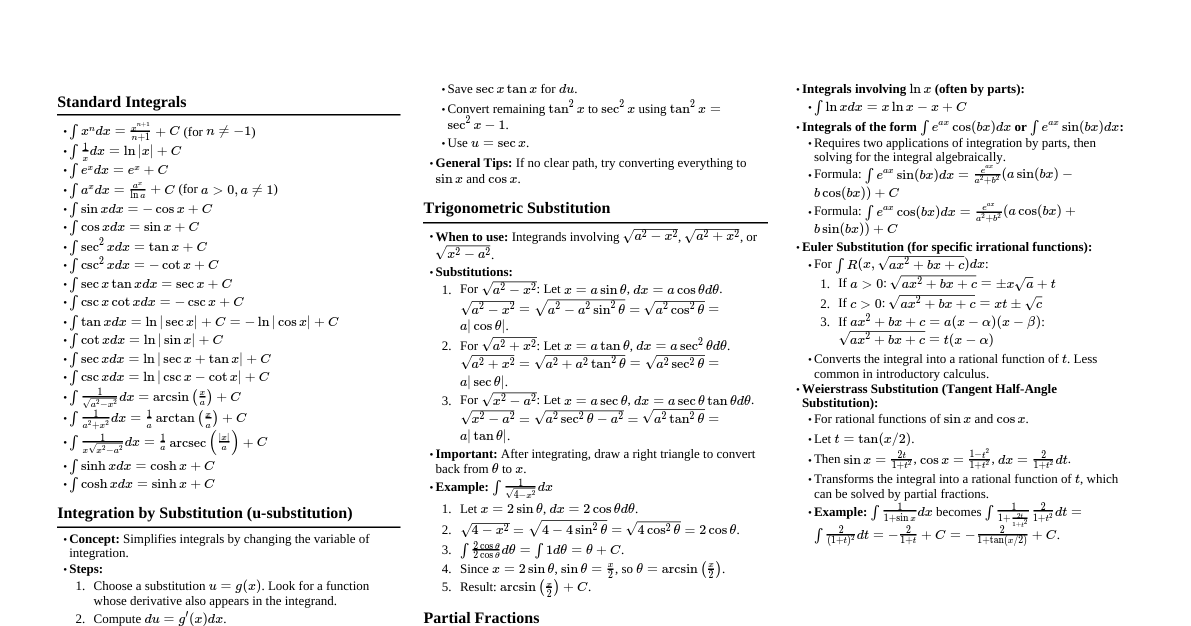
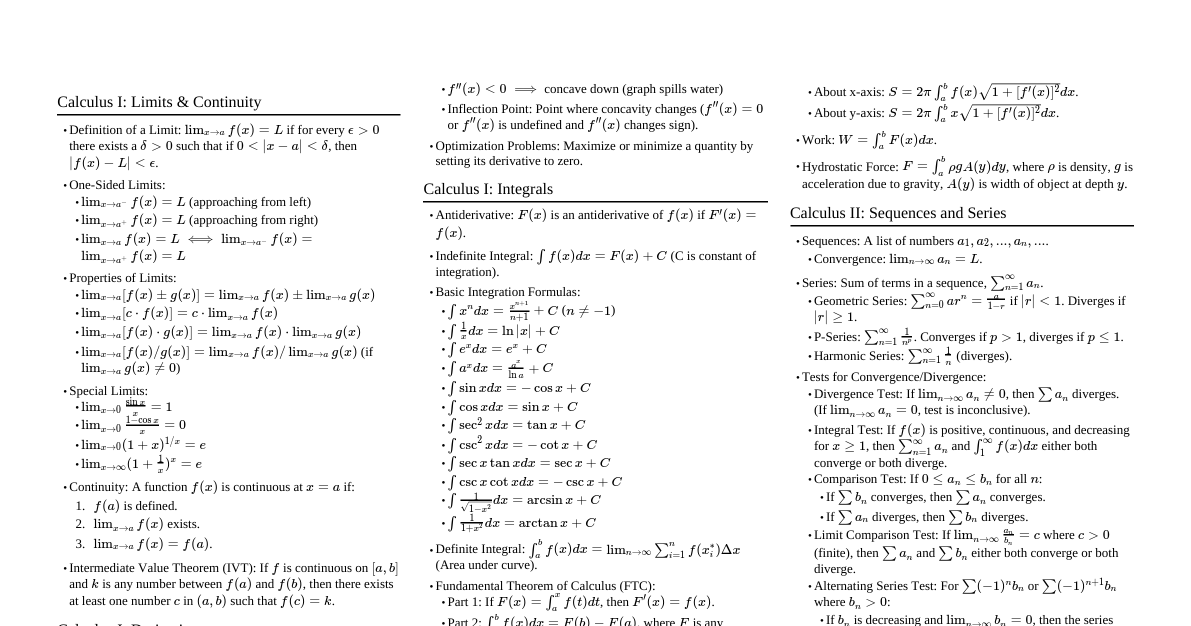
1. Introduction to Calculus: The Science of Infinite Change Definition: Calculus is the fundamental mathematical study of continuous change. It provides the analytical tools to understand how quantities change and accumulate over infinitesimal intervals. Historical Genesis: Independently developed by Sir Isaac Newton (focused on physical laws) and Gottfried Wilhelm Leibniz (focused on systematic notation) in the late 17th century, driven by challenges like instantaneous velocity, tangent lines, and areas under curves. Fundamental Pillars: Limits: The conceptual cornerstone, defining how functions behave near specific points. Differential Calculus: Focuses on instantaneous rates of change and slopes of curves (derivatives). Integral Calculus: Focuses on the accumulation of quantities and areas under curves (integrals – formal introduction in Class 12, but conceptual understanding begins here). Ubiquitous Applications (NCERT Class 11 Context): Mathematics: Essential for advanced function analysis, continuity, and rigorous definitions of rates and change. Physics: The indispensable language for kinematics, dynamics, energy, fields, and oscillations; it quantifies how physical quantities evolve over time or space. Chemistry: Critical for chemical kinetics (reaction rates), thermodynamics (energy changes), and understanding molecular dynamics and equilibrium shifts. 2. Limits: Probing Functional Behavior (Mathematics) 2.1. Core Concept & Notation Intuitive Definition: A limit is the value $f(x)$ approaches as the input $x$ gets arbitrarily close to a specific number $a$, without necessarily being equal to $a$. It represents the "intended height" of the function's graph. Notation: $\lim_{x \to a} f(x) = L$. (Read: "the limit of $f(x)$ as $x$ approaches $a$ is $L$"). Significance: Forms the bedrock for defining continuity and derivatives rigorously. Enables analysis of function behavior at points of discontinuity or where direct evaluation leads to indeterminate forms (e.g., $\frac{0}{0}, \frac{\infty}{\infty}$). Example: Consider $f(x) = \frac{x^3 - 27}{x - 3}$. $f(3)$ is undefined ($\frac{0}{0}$). $\lim_{x \to 3} \frac{(x-3)(x^2+3x+9)}{x-3} = \lim_{x \to 3} (x^2+3x+9) = 3^2+3(3)+9 = 9+9+9 = 27$. The function approaches 27 as $x$ approaches 3. 2.2. One-Sided Limits & Existence of a Limit For a limit to exist at a point, the function must approach the same value from both directions. Left-Hand Limit (LHL): $\lim_{x \to a^-} f(x)$. Value approached as $x \to a$ from values $x Right-Hand Limit (RHL): $\lim_{x \to a^+} f(x)$. Value approached as $x \to a$ from values $x > a$. Condition for Existence: $\lim_{x \to a} f(x) = L \iff \left( \lim_{x \to a^-} f(x) = L \text{ AND } \lim_{x \to a^+} f(x) = L \right)$. If LHL $\neq$ RHL, the limit does not exist (e.g., jump discontinuities). Example (Non-Existent Limit): For $f(x) = \lceil x \rceil$ (ceiling function) at $x=1$: LHL: $\lim_{x \to 1^-} \lceil x \rceil = 1$ (e.g., $\lceil 0.9 \rceil = 1$). RHL: $\lim_{x \to 1^+} \lceil x \rceil = 2$ (e.g., $\lceil 1.1 \rceil = 2$). Since $1 \neq 2$, $\lim_{x \to 1} \lceil x \rceil$ does not exist. 2.3. Algebra of Limits If $\lim_{x \to a} f(x) = L$ and $\lim_{x \to a} g(x) = M$ (where $L, M$ are finite real numbers): Sum/Difference: $\lim_{x \to a} [f(x) \pm g(x)] = L \pm M$ Product: $\lim_{x \to a} [f(x) \cdot g(x)] = L \cdot M$ Quotient: $\lim_{x \to a} \frac{f(x)}{g(x)} = \frac{L}{M}$ (if $M \neq 0$; if $M=0$, further analysis needed, e.g., $\pm \infty$ or DNE). Constant Multiple: $\lim_{x \to a} [c \cdot f(x)] = c \cdot L$ Power: $\lim_{x \to a} [f(x)]^n = L^n$ (if $L^n$ is defined and real) 2.4. Techniques for Evaluating Limits Direct Substitution: Applicable if $f(x)$ is continuous at $x=a$. Always the first attempt. Eg: $\lim_{x \to 0} (e^x + \cos x) = e^0 + \cos 0 = 1 + 1 = 2$. Factorization & Cancellation: For $\frac{0}{0}$ indeterminate forms. Factorize numerator/denominator to cancel the common factor $(x-a)$. Eg: $\lim_{x \to -2} \frac{x^2 + 5x + 6}{x + 2} = \lim_{x \to -2} \frac{(x+2)(x+3)}{x+2} = \lim_{x \to -2} (x+3) = -2+3 = 1$. Rationalization: For $\frac{0}{0}$ forms involving radicals. Multiply numerator and denominator by the conjugate. Eg: $\lim_{x \to 0} \frac{\sqrt{x+4} - 2}{x} = \lim_{x \to 0} \frac{(\sqrt{x+4} - 2)(\sqrt{x+4} + 2)}{x(\sqrt{x+4} + 2)} = \lim_{x \to 0} \frac{x}{x(\sqrt{x+4} + 2)} = \lim_{x \to 0} \frac{1}{\sqrt{x+4} + 2} = \frac{1}{4}$. Using Standard Limits: Apply specific formulas (see Page 2, Section 1 for a comprehensive list). Eg: $\lim_{x \to 0} \frac{\sin(5x)}{3x} = \lim_{x \to 0} \frac{\sin(5x)}{5x} \cdot \frac{5x}{3x} = 1 \cdot \frac{5}{3} = \frac{5}{3}$. Limits at Infinity: For rational functions $\frac{P(x)}{Q(x)}$, analyze by dividing all terms by the highest power of $x$ in the denominator, or by comparing degrees. If deg($P$) If deg($P$) = deg($Q$), limit is ratio of leading coefficients. If deg($P$) > deg($Q$), limit is $\pm \infty$. Eg: $\lim_{x \to \infty} \frac{4x^3 + 2x^2 - 7}{9x^3 - x + 5} = \frac{4}{9}$. 3. Continuity: Unbroken Functions (Mathematics) A function $f(x)$ is continuous at $x=a$ if its graph can be drawn without any breaks, holes, or jumps at that point. Three essential conditions must be satisfied: $f(a)$ exists (the function is defined at $x=a$). $\lim_{x \to a} f(x)$ exists (the limit from both sides converges to a single finite value). $\lim_{x \to a} f(x) = f(a)$ (the limit value equals the function's actual value at $a$). Types of Discontinuities: Removable (Hole): Occurs when $\lim_{x \to a} f(x)$ exists, but $f(a)$ is undefined or $f(a) \neq \lim_{x \to a} f(x)$. Jump: Occurs when LHL $\neq$ RHL. Common in piecewise functions. Infinite: Occurs when the function values approach $\pm \infty$ as $x \to a$ (vertical asymptote). Physical Relevance: In physics and chemistry, most observable quantities (position, temperature, concentration) are typically modeled as continuous functions. Discontinuities often represent idealizations (e.g., instantaneous impacts) or specific physical phenomena (e.g., phase transitions in chemistry). 4. Derivatives: Instantaneous Rates of Change (Mathematics) 4.1. Definition from First Principles (Delta Method) The derivative of $f(x)$ with respect to $x$ is defined as: $f'(x) = \lim_{h \to 0} \frac{f(x+h) - f(x)}{h}$. Interpretations: Instantaneous Rate of Change: Measures how quickly $y=f(x)$ changes at a particular point $x$. Slope of the Tangent Line: Geometrically, $f'(x)$ gives the precise slope of the line tangent to the curve $y=f(x)$ at the point $(x, f(x))$. Differentiability: A function is differentiable at $x=a$ if $f'(a)$ exists. A differentiable function is always continuous. However, a continuous function is not always differentiable (e.g., $f(x)=|x|$ at $x=0$ has a sharp corner). Example (First Principle): For $f(x) = \sqrt{x}$: $f'(x) = \lim_{h \to 0} \frac{\sqrt{x+h} - \sqrt{x}}{h} = \lim_{h \to 0} \frac{(\sqrt{x+h} - \sqrt{x})(\sqrt{x+h} + \sqrt{x})}{h(\sqrt{x+h} + \sqrt{x})} = \lim_{h \to 0} \frac{x+h-x}{h(\sqrt{x+h} + \sqrt{x})} = \lim_{h \to 0} \frac{1}{\sqrt{x+h} + \sqrt{x}} = \frac{1}{2\sqrt{x}}$. 4.2. Rules of Differentiation Let $u=f(x)$ and $v=g(x)$ be differentiable functions, $c$ a constant. Constant Multiple: $\frac{d}{dx}(cu) = c \frac{du}{dx}$ Sum/Difference: $\frac{d}{dx}(u \pm v) = \frac{du}{dx} \pm \frac{dv}{dx}$ Product Rule: $\frac{d}{dx}(uv) = u \frac{dv}{dx} + v \frac{du}{dx}$ Quotient Rule: $\frac{d}{dx}\left(\frac{u}{v}\right) = \frac{v \frac{du}{dx} - u \frac{dv}{dx}}{v^2}$ Chain Rule: For composite functions $y=f(g(x))$, $\frac{dy}{dx} = f'(g(x)) \cdot g'(x)$ or $\frac{dy}{dx} = \frac{dy}{du} \cdot \frac{du}{dx}$ (if $y=f(u)$ and $u=g(x)$). Eg: $\frac{d}{dx}(e^{\sin x})$. Let $u = \sin x$. Then $y = e^u$. $\frac{dy}{dx} = \frac{dy}{du} \cdot \frac{du}{dx} = (e^u) \cdot (\cos x) = e^{\sin x} \cos x$. 4.3. Higher Order Derivatives Second Derivative: $f''(x) = \frac{d^2y}{dx^2} = \frac{d}{dx}\left(\frac{dy}{dx}\right)$. Represents the rate of change of the first derivative. Mathematical Interpretation: Determines concavity of a curve ($f''(x)>0 \implies$ concave up; $f''(x) Physical Interpretation: In kinematics, the second derivative of position ($x$) with respect to time ($t$) is acceleration ($a$). Third Derivative (Jerk): $f'''(x) = \frac{d^3y}{dx^3}$. Represents the rate of change of acceleration. 1. Standard Limit Formulas (Mathematics) $\lim_{x \to a} \frac{x^n - a^n}{x - a} = n a^{n-1}$ $\lim_{x \to 0} \frac{\sin x}{x} = 1$ (x in radians) $\lim_{x \to 0} \frac{\tan x}{x} = 1$ (x in radians) $\lim_{x \to 0} \frac{1 - \cos x}{x} = 0$ (x in radians) $\lim_{x \to 0} (1+x)^{1/x} = e$ $\lim_{x \to \infty} (1+\frac{1}{x})^x = e$ $\lim_{x \to 0} \frac{e^x - 1}{x} = 1$ $\lim_{x \to 0} \frac{\ln(1+x)}{x} = 1$ $\lim_{x \to 0} \frac{a^x - 1}{x} = \ln a$ 2. Standard Derivatives (Mathematics) Function $f(x)$ Derivative $f'(x)$ Function $f(x)$ Derivative $f'(x)$ $c$ (constant) $0$ $\sin x$ $\cos x$ $x^n$ $nx^{n-1}$ $\cos x$ $-\sin x$ $e^x$ $e^x$ $\tan x$ $\sec^2 x$ $a^x$ ($a>0, a \ne 1$) $a^x \ln a$ $\cot x$ $-\csc^2 x$ $\ln x$ $\frac{1}{x}$ $\sec x$ $\sec x \tan x$ $\log_a x$ $\frac{1}{x \ln a}$ $\csc x$ $-\csc x \cot x$ 3. Physics Applications (NCERT Class 11 Formulas) 3.1. Kinematics (Motion) Position: $x(t)$ (displacement from origin as a function of time) Instantaneous Velocity: $v(t) = \frac{dx}{dt}$ (rate of change of position) Instantaneous Acceleration: $a(t) = \frac{dv}{dt} = \frac{d^2x}{dt^2}$ (rate of change of velocity) Interconversion: $x(t) \xrightarrow{\text{differentiate}} v(t) \xrightarrow{\text{differentiate}} a(t)$ and $a(t) \xrightarrow{\text{integrate}} v(t) \xrightarrow{\text{integrate}} x(t)$ Example: If a particle's position is $x(t) = 3t^4 - 2t^2 + 5t$ (m), then: $v(t) = \frac{d}{dt}(3t^4 - 2t^2 + 5t) = 12t^3 - 4t + 5$ (m/s). $a(t) = \frac{d}{dt}(12t^3 - 4t + 5) = 36t^2 - 4$ (m/s$^2$). 3.2. Simple Harmonic Motion (SHM) Displacement: $x(t) = A \sin(\omega t + \phi)$ (or $A \cos(\omega t + \phi)$) Velocity: $v(t) = \frac{dx}{dt} = A\omega \cos(\omega t + \phi)$ Acceleration: $a(t) = \frac{dv}{dt} = -A\omega^2 \sin(\omega t + \phi) = -\omega^2 x(t)$ (Defining equation of SHM) 3.3. Power and Work Instantaneous Power: $P = \frac{dW}{dt}$ (rate of doing work) Power in terms of Force and Velocity: $P = \vec{F} \cdot \vec{v}$ (for constant or instantaneous values) 3.4. Rotational Motion Angular Displacement: $\theta(t)$ Angular Velocity: $\omega(t) = \frac{d\theta}{dt}$ Angular Acceleration: $\alpha(t) = \frac{d\omega}{dt} = \frac{d^2\theta}{dt^2}$ 3.5. General Rate of Change (Physics) If a physical quantity $Q$ depends on variable $X$, its rate of change is $\frac{dQ}{dX}$. Example: Rate of change of momentum $p$ with time $t$ is $\frac{dp}{dt} = F$ (Newton's 2nd Law). Example: Rate of flow of liquid (volume $V$) from a tank with respect to time $t$ is $\frac{dV}{dt}$. 4. Chemistry Applications (NCERT Class 11 Formulas) 4.1. Chemical Kinetics (Rates of Reaction) For a general reaction: $aA + bB \to cC + dD$ Instantaneous Rate: Rate $= -\frac{1}{a}\frac{d[A]}{dt} = -\frac{1}{b}\frac{d[B]}{dt} = +\frac{1}{c}\frac{d[C]}{dt} = +\frac{1}{d}\frac{d[D]}{dt}$ Negative sign for reactants (concentration decreases), positive for products (concentration increases). Differential Rate Laws: Zero Order: Rate $= -\frac{d[A]}{dt} = k$ (Rate is independent of concentration of A) First Order: Rate $= -\frac{d[A]}{dt} = k[A]$ (Rate is directly proportional to concentration of A) Second Order: Rate $= -\frac{d[A]}{dt} = k[A]^2$ (Rate is proportional to square of concentration of A) Example: For the decomposition of $N_2O_5$: $2N_2O_5(g) \to 4NO_2(g) + O_2(g)$ Rate $= -\frac{1}{2}\frac{d[N_2O_5]}{dt} = +\frac{1}{4}\frac{d[NO_2]}{dt} = +\frac{d[O_2]}{dt}$. 4.2. Thermodynamics (Conceptual and Advanced Forms) Heat Capacity at constant volume: $C_V = \left(\frac{\partial U}{\partial T}\right)_V$ (Rate of change of Internal Energy with Temperature at constant Volume). This uses partial derivatives as internal energy depends on multiple variables. Heat Capacity at constant pressure: $C_P = \left(\frac{\partial H}{\partial T}\right)_P$ (Rate of change of Enthalpy with Temperature at constant Pressure). Fundamental Thermodynamic Relation: $dU = TdS - PdV$ (Differential form describing change in internal energy based on infinitesimal changes in entropy and volume). 5. Elementary Integration (Conceptual for Class 11) Indefinite Integral: $\int f(x) dx = F(x) + C$, where $F'(x) = f(x)$. ($C$ is the constant of integration, representing a family of anti-derivatives). Power Rule for Integration: $\int x^n dx = \frac{x^{n+1}}{n+1} + C$ (for $n \neq -1$). Special Integrals: $\int \frac{1}{x} dx = \ln|x| + C$ $\int e^x dx = e^x + C$ $\int a^x dx = \frac{a^x}{\ln a} + C$ $\int \cos x dx = \sin x + C$ $\int \sin x dx = -\cos x + C$ $\int \sec^2 x dx = \tan x + C$ $\int \csc^2 x dx = -\cot x + C$ $\int \sec x \tan x dx = \sec x + C$ $\int \csc x \cot x dx = -\csc x + C$ Physical Significance (Inverse Operations): Position from Velocity: $x(t) = \int v(t) dt$. Velocity from Acceleration: $v(t) = \int a(t) dt$. Work done by variable force: $W = \int_{x_1}^{x_2} F(x) dx$. Impulse from force: $I = \int_{t_1}^{t_2} F(t) dt$. Area under a curve: $\int_{a}^{b} f(x) dx$ gives the area between $f(x)$ and the x-axis from $a$ to $b$.