Organic Compounds Cheatsheet
Shared 3/20/2026•94 views
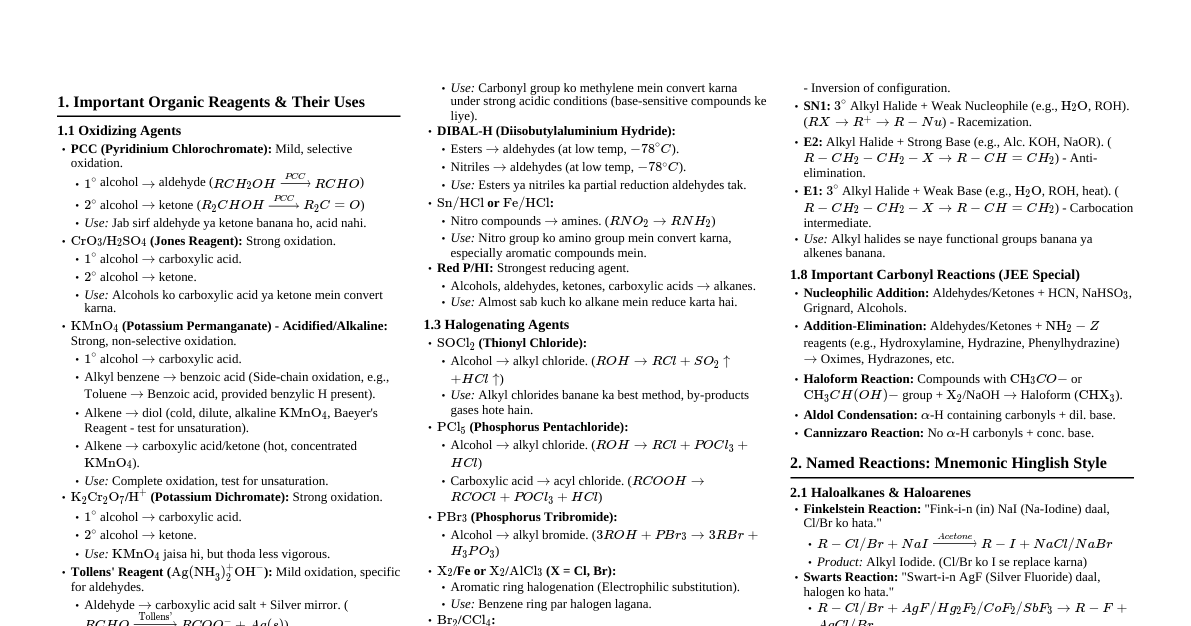
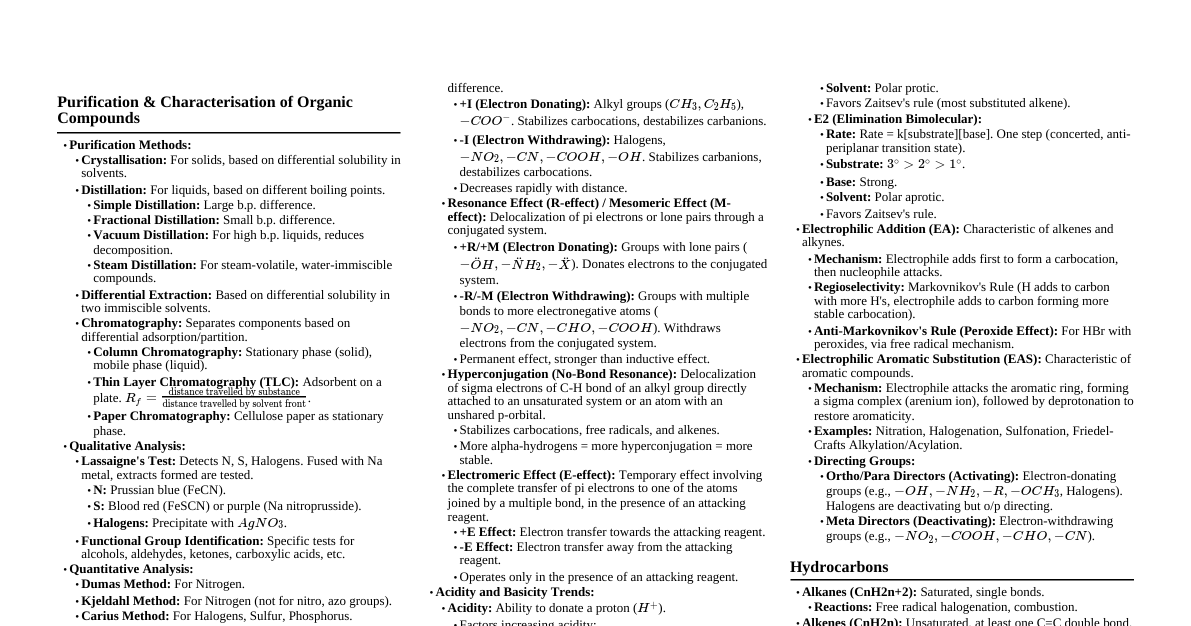
### Functional Groups - **Alkanes:** R-H (single bonds, saturated) - **Alkenes:** R-C=C-R (double bond, unsaturated) - **Alkynes:** R-C≡C-R (triple bond, unsaturated) - **Arenes (Aromatics):** Benzene ring (conjugated system) - **Alkyl Halides:** R-X (X = F, Cl, Br, I) - **Alcohols:** R-OH - **Ethers:** R-O-R' - **Amines:** R-NH$_2$, R$_2$NH, R$_3$N - **Aldehydes:** R-CHO - **Ketones:** R-CO-R' - **Carboxylic Acids:** R-COOH - **Esters:** R-COO-R' - **Amides:** R-CONH$_2$, R-CONHR', R-CONR'R'' - **Nitriles:** R-C≡N ### Isomerism #### Structural Isomers - Different connectivity of atoms. - **Chain Isomers:** Different arrangement of carbon skeleton (e.g., n-butane vs. isobutane) - **Position Isomers:** Different position of functional group or substituent (e.g., 1-propanol vs. 2-propanol) - **Functional Group Isomers:** Different functional groups (e.g., ethanol vs. dimethyl ether) #### Stereoisomers - Same connectivity, different spatial arrangement. - **Conformational Isomers (Conformers):** Interconvert by rotation around single bonds (e.g., staggered vs. eclipsed ethane). - **Configurational Isomers:** Require bond breaking to interconvert. - **Enantiomers:** Non-superimposable mirror images (chiral centers). Rotate plane-polarized light in opposite directions. - **Diastereomers:** Stereoisomers that are not mirror images. Can have multiple chiral centers. - **Geometric Isomers (cis/trans):** Due to restricted rotation (e.g., C=C double bonds or cyclic structures). - **E/Z Notation:** For more complex alkenes. E (entgegen) = opposite, Z (zusammen) = together. ### IUPAC Nomenclature Basics 1. **Find the longest continuous carbon chain** containing the principal functional group (parent chain). 2. **Number the chain** to give the principal functional group the lowest possible number. If no functional group, give substituents lowest numbers. 3. **Identify and name substituents.** 4. **Alphabetize substituents.** Use prefixes di-, tri-, tetra- for multiple identical substituents (ignored for alphabetizing). 5. **Assemble the name:** (Substituents) - (Parent Chain) - (Functional Group Suffix). #### Common Suffixes - **Alkane:** -ane - **Alkene:** -ene - **Alkyne:** -yne - **Alcohol:** -ol - **Aldehyde:** -al - **Ketone:** -one - **Carboxylic Acid:** -oic acid - **Ester:** -oate - **Amine:** -amine - **Haloalkane:** prefix like chloro-, bromo- ### Major Reaction Types - **Substitution:** One atom/group replaced by another. - **Nucleophilic Substitution (SN1/SN2):** Common for alkyl halides. - **SN2:** Bimolecular, concerted, inversion of configuration, favored by primary alkyl halides & strong nucleophiles. - **SN1:** Unimolecular, two steps (carbocation intermediate), racemization, favored by tertiary alkyl halides & weak nucleophiles. - **Electrophilic Aromatic Substitution (EAS):** Benzene ring reactions (e.g., nitration, halogenation, Friedel-Crafts). - **Addition:** Atoms/groups added across a double or triple bond. - **Electrophilic Addition:** Common for alkenes/alkynes (e.g., HBr, H$_2$O, Br$_2$ addition). Markovnikov's Rule applies (H adds to carbon with more H's). - **Hydrogenation:** Addition of H$_2$ (e.g., alkene to alkane). - **Elimination:** Atoms/groups removed to form a double or triple bond. - **E1/E2:** Often compete with SN1/SN2. - **E2:** Bimolecular, concerted, anti-periplanar transition state, favored by strong bases. Saytzeff's Rule (most substituted alkene formed). - **E1:** Unimolecular, two steps (carbocation intermediate), often competes with SN1. - **Oxidation/Reduction:** Change in oxidation state (often involves gain/loss of O or H). - **Oxidation:** Increase C-O bonds, decrease C-H bonds (e.g., alcohol to aldehyde/ketone to carboxylic acid). - **Reduction:** Decrease C-O bonds, increase C-H bonds (e.g., aldehyde/ketone to alcohol). - **Condensation:** Two molecules combine, often with loss of small molecule (e.g., H$_2$O). - **Hydrolysis:** Reaction with water, often breaking a bond (e.g., ester hydrolysis). ### Spectroscopy Basics #### Nuclear Magnetic Resonance (NMR) - **$^1$H NMR:** - **Chemical Shift ($\delta$):** Indicates electronic environment of protons. Upfield (low $\delta$) for shielded, downfield (high $\delta$) for deshielded (near electronegative atoms, aromatic). - **Integration:** Relative number of protons for each signal. - **Multiplicity (Splitting):** (n+1) rule for neighboring equivalent protons (n). Singlet (s), doublet (d), triplet (t), quartet (q), multiplet (m). - **$^{13}$C NMR:** - **Chemical Shift ($\delta$):** Indicates electronic environment of carbons. No splitting typically observed. #### Infrared (IR) Spectroscopy - Identifies functional groups based on bond vibrations. - **Key stretches:** - O-H (alcohols/acids): Broad, 3200-3600 cm$^{-1}$ (alcohols), 2500-3300 cm$^{-1}$ (acids) - C=O (carbonyls): Strong, 1650-1780 cm$^{-1}$ (exact position depends on type) - C≡C (alkynes): Weak/medium, ~2100-2260 cm$^{-1}$ - C≡N (nitriles): Medium, ~2200-2260 cm$^{-1}$ - C-H (alkanes): ~2850-2960 cm$^{-1}$ - C=C (alkenes): ~1620-1680 cm$^{-1}$ #### Mass Spectrometry (MS) - Determines molecular weight and provides structural information from fragmentation patterns. - **Molecular Ion (M$^+$):** Represents the molecular weight of the compound. - **Base Peak:** Most intense peak in the spectrum. - **Isotopic Peaks:** M+1 (for $^{13}$C), M+2 (for Cl, Br). ### Acidity and Basicity - **Acids:** Proton donors (H$^+$). - **Bases:** Proton acceptors (H$^+$) or electron pair donors (Lewis Bases). #### Factors Affecting Acidity (for H-A) 1. **Electronegativity of A:** More electronegative A = stronger acid (e.g., HF > H$_2$O > NH$_3$). 2. **Atomic Size of A:** Larger A = stronger acid (e.g., HI > HBr > HCl > HF). 3. **Resonance Stabilization of Conjugate Base (A$^-$):** Delocalization of negative charge increases acidity. 4. **Inductive Effects:** Electron-withdrawing groups near the acidic proton increase acidity. 5. **Hybridization:** sp > sp$^2$ > sp$^3$ for C-H acidity (due to s-character). #### Factors Affecting Basicity 1. **Availability of lone pair electrons:** More available = stronger base. 2. **Inductive Effects:** Electron-donating groups increase basicity. 3. **Resonance:** Delocalization of lone pair electrons decreases basicity. 4. **Hybridization:** sp$^3$ > sp$^2$ > sp for basicity (less s-character means lone pair is less tightly held). ### Stereochemistry Key Terms - **Chiral:** A molecule that is non-superimposable on its mirror image. - **Chiral Center:** An atom (usually carbon) bonded to four different groups. - **Achiral:** A molecule that IS superimposable on its mirror image (has a plane of symmetry). - **Meso Compound:** An achiral compound that contains chiral centers (due to internal plane of symmetry). - **Racemic Mixture:** A 50:50 mixture of two enantiomers. Optically inactive. - **Optical Activity:** The ability of a chiral substance to rotate the plane of plane-polarized light. - **Dextrorotatory (+):** Rotates light clockwise. - **Levorotatory (-):** Rotates light counter-clockwise. - **Specific Rotation ($[\alpha]$):** Standardized measure of optical activity. #### R/S Configuration (Cahn-Ingold-Prelog Rules) 1. **Assign priorities** to the four groups attached to the chiral center (based on atomic number). 2. **Orient the molecule** so the lowest priority group (4) is pointing away from you. 3. **Trace a path** from priority 1 to 2 to 3. - If path is clockwise: **R** (Rectus) - If path is counter-clockwise: **S** (Sinister)