JEE Main Syllabus
Cheatsheet Content
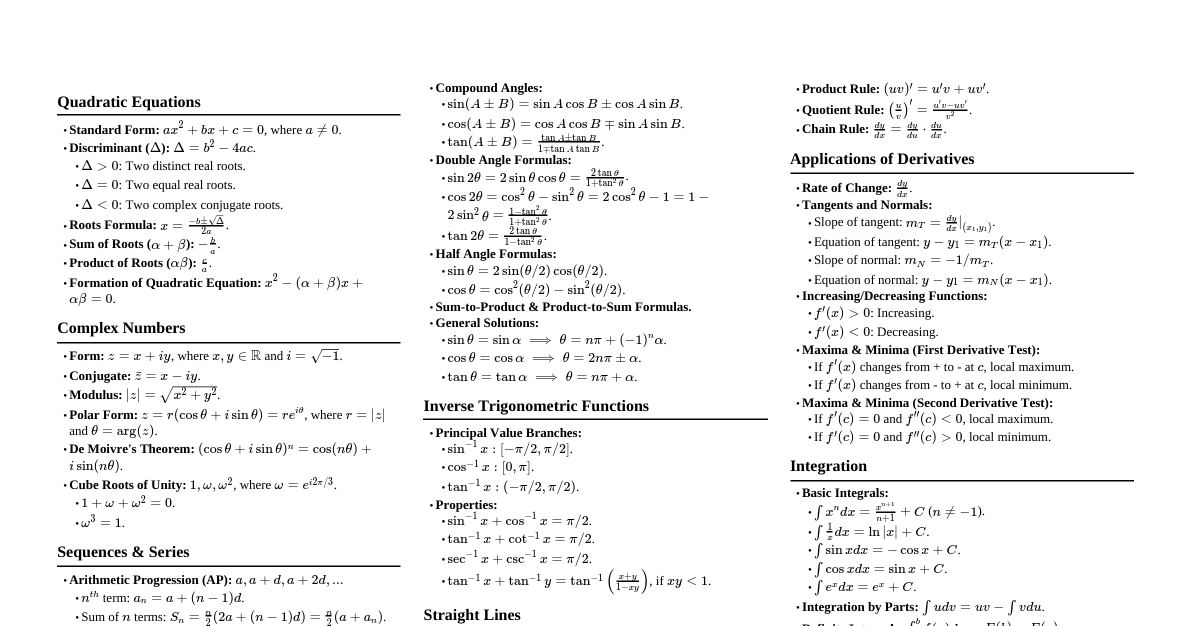
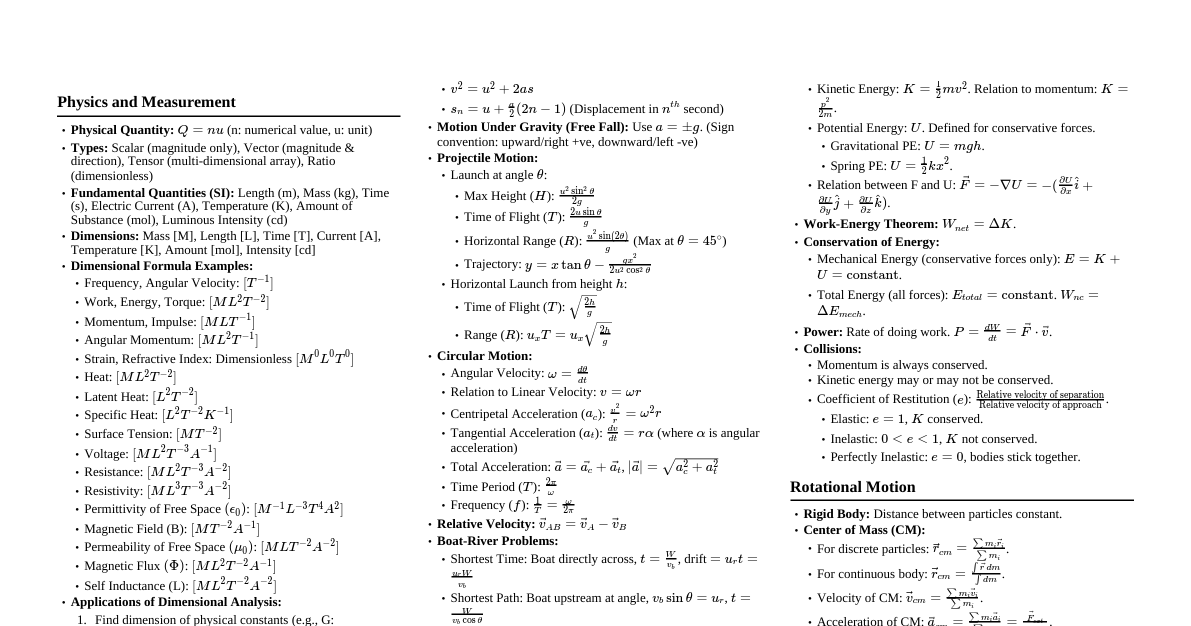
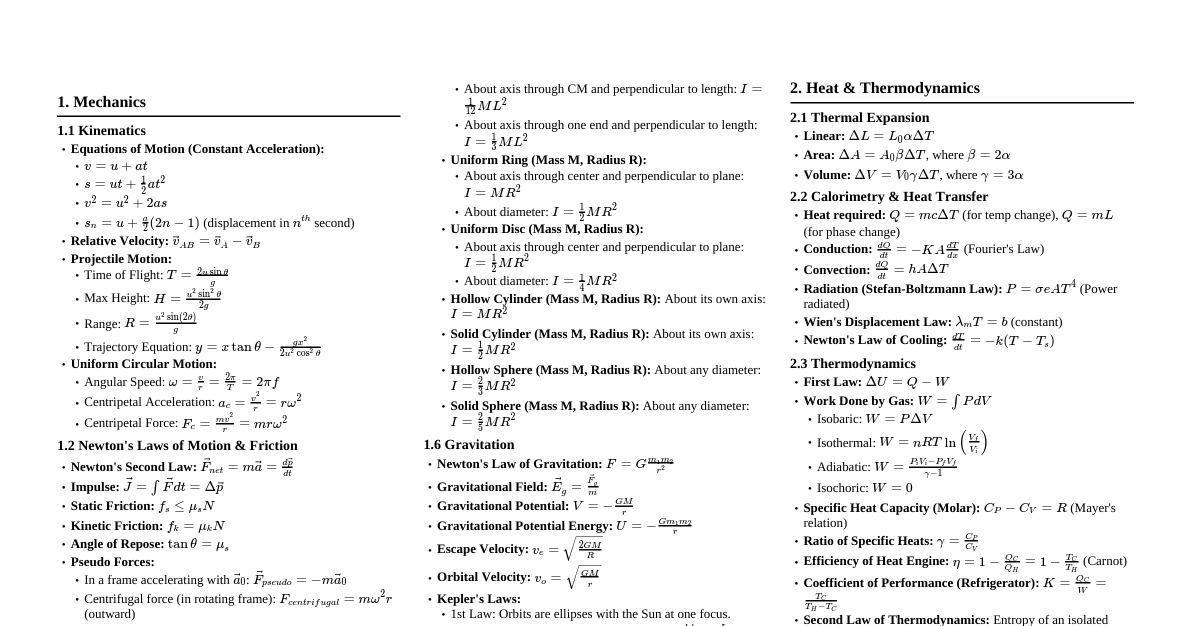
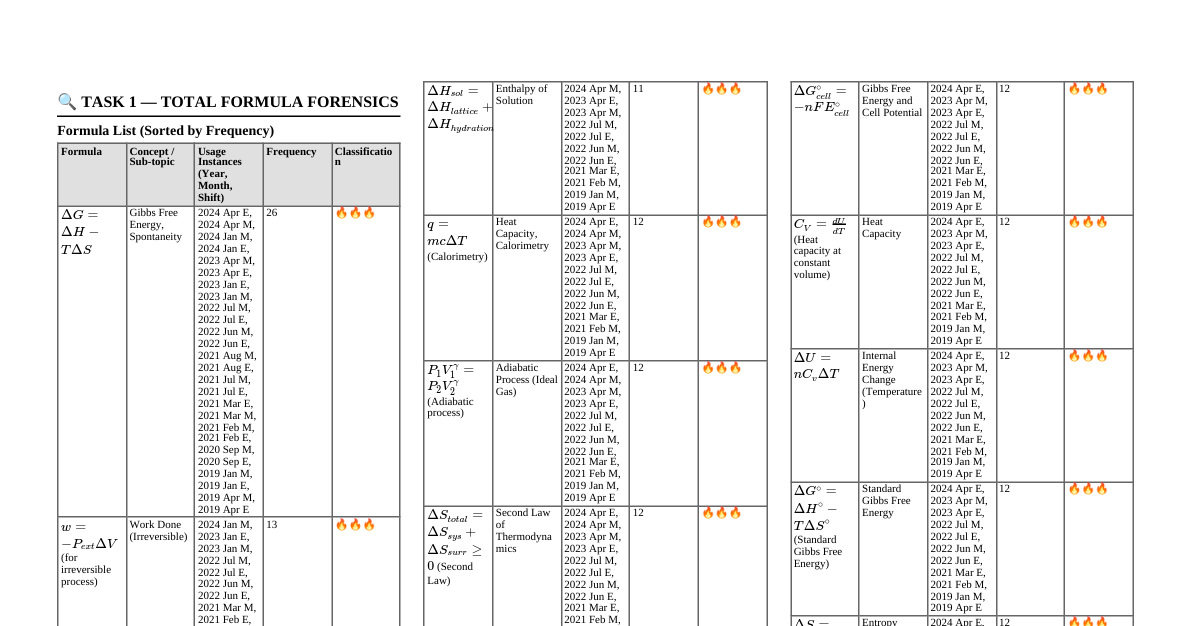
### Mathematics: Sets, Relations & Functions - **Sets:** Collections of distinct objects. - **Union ($A \cup B$):** Elements in A or B or both. - **Intersection ($A \cap B$):** Elements common to both A and B. - **Difference ($A - B$):** Elements in A but not in B. - **Complement ($A'$):** Elements not in A (within universal set). - **Power Set ($P(A)$):** Set of all subsets of A. If $|A|=n$, then $|P(A)|=2^n$. - **De Morgan's Laws:** $(A \cup B)' = A' \cap B'$, $(A \cap B)' = A' \cup B'$. - **Relations:** A subset of the Cartesian product of two sets. - **Reflexive:** $aRa$ for all $a \in A$. (e.g., $x=x$) - **Symmetric:** If $aRb$, then $bRa$. (e.g., $x=y \implies y=x$) - **Transitive:** If $aRb$ and $bRc$, then $aRc$. (e.g., $x=y \text{ and } y=z \implies x=z$) - An **Equivalence relation** is reflexive, symmetric, and transitive. - **Functions:** A special type of relation where each input has exactly one output. - **One-to-one (Injective):** Distinct elements of the domain have distinct images in the codomain. - **Onto (Surjective):** Every element in the codomain has at least one pre-image in the domain. - **Bijective:** Both one-to-one and onto. - **Composition of functions:** $(f \circ g)(x) = f(g(x))$. - **Inverse function ($f^{-1}(x)$):** Exists if and only if the function is bijective. $f(f^{-1}(x)) = x$. - **Types of Functions:** - **Polynomial:** $P(x) = a_n x^n + \dots + a_0$. - **Rational:** Ratio of two polynomials $P(x)/Q(x)$. - **Exponential:** $f(x) = a^x$. - **Logarithmic:** $f(x) = \log_a x$. - **Trigonometric:** $\sin x, \cos x, \tan x$, etc. ### Mathematics: Complex Numbers & Quadratic Equations - **Complex Numbers:** $z = x + iy$. Modulus $|z| = \sqrt{x^2+y^2}$. Argument $\arg(z) = \theta$. Polar form $z = r(\cos\theta + i\sin\theta)$. Euler form $z = re^{i\theta}$. De Moivre's Theorem: $( \cos\theta + i\sin\theta )^n = \cos n\theta + i\sin n\theta$. Roots of unity. - **Quadratic Equations:** $ax^2 + bx + c = 0$. Roots $x = \frac{-b \pm \sqrt{b^2-4ac}}{2a}$. Discriminant $D = b^2 - 4ac$. - $D > 0$: Two distinct real roots. - $D = 0$: Two equal real roots. - $D ### Mathematics: Permutations & Combinations - **Permutations ($P(n,r)$):** Arrangement of $r$ items from $n$. $P(n,r) = \frac{n!}{(n-r)!}$. - **Combinations ($C(n,r)$):** Selection of $r$ items from $n$. $C(n,r) = \frac{n!}{r!(n-r)!}$. - **Properties:** $C(n,r) = C(n, n-r)$. $C(n,r) + C(n, r-1) = C(n+1, r)$. ### Mathematics: Binomial Theorem - **Binomial Expansion:** $(x+y)^n = \sum_{r=0}^n C(n,r) x^{n-r} y^r$. - **General Term:** $T_{r+1} = C(n,r) x^{n-r} y^r$. - **Middle Term:** If $n$ is even, $T_{n/2+1}$. If $n$ is odd, $T_{(n+1)/2}$ and $T_{(n+3)/2}$. - **Properties:** Sum of coefficients: $2^n$. ### Mathematics: Sequences & Series - **Arithmetic Progression (AP):** $a, a+d, a+2d, \dots$. $n^{th}$ term $a_n = a + (n-1)d$. Sum $S_n = \frac{n}{2}(2a + (n-1)d) = \frac{n}{2}(a + a_n)$. - **Geometric Progression (GP):** $a, ar, ar^2, \dots$. $n^{th}$ term $a_n = ar^{n-1}$. Sum $S_n = \frac{a(r^n-1)}{r-1}$ ($r \neq 1$). Sum to infinity $S_\infty = \frac{a}{1-r}$ ($|r| ### Mathematics: Limit, Continuity & Differentiability - **Limit:** $\lim_{x \to a} f(x)$. Indeterminate forms ($0/0, \infty/\infty$). L'Hopital's Rule. - **Continuity:** A function $f(x)$ is continuous at $x=a$ if $\lim_{x \to a^-} f(x) = \lim_{x \to a^+} f(x) = f(a)$. - **Differentiability:** A function $f(x)$ is differentiable at $x=a$ if $\lim_{h \to 0} \frac{f(a+h)-f(a)}{h}$ exists. Left-hand derivative = Right-hand derivative. - **Standard Limits:** $\lim_{x \to 0} \frac{\sin x}{x} = 1$, $\lim_{x \to 0} \frac{\tan x}{x} = 1$, $\lim_{x \to 0} \frac{e^x-1}{x} = 1$, $\lim_{x \to 0} \frac{\ln(1+x)}{x} = 1$. ### Mathematics: Differentiation - **Basic Rules:** Product Rule $(uv)' = u'v + uv'$, Quotient Rule $(u/v)' = \frac{u'v - uv'}{v^2}$, Chain Rule $(f(g(x)))' = f'(g(x))g'(x)$. - **Derivatives of Standard Functions:** - $\frac{d}{dx}(x^n) = nx^{n-1}$ - $\frac{d}{dx}(\sin x) = \cos x$ - $\frac{d}{dx}(\cos x) = -\sin x$ - $\frac{d}{dx}(\tan x) = \sec^2 x$ - $\frac{d}{dx}(e^x) = e^x$ - $\frac{d}{dx}(\ln x) = 1/x$ - **Implicit Differentiation:** Differentiating both sides with respect to $x$, treating $y$ as a function of $x$. ### Mathematics: Applications of Derivatives - **Rate of Change:** $\frac{dy}{dx}$. - **Tangents and Normals:** Slope of tangent $m = f'(x_0)$. Equation of tangent $y - y_0 = m(x - x_0)$. Slope of normal $-1/m$. - **Monotonicity:** $f'(x) > 0 \implies$ strictly increasing, $f'(x) 0$ (local minimum), $f''(x) ### Mathematics: Integration - **Indefinite Integral:** $\int f(x) dx = F(x) + C$. - **Standard Integrals:** - $\int x^n dx = \frac{x^{n+1}}{n+1} + C$ ($n \neq -1$) - $\int \frac{1}{x} dx = \ln|x| + C$ - $\int \sin x dx = -\cos x + C$ - $\int \cos x dx = \sin x + C$ - $\int e^x dx = e^x + C$ - **Methods of Integration:** Substitution, Integration by Parts ($\int u dv = uv - \int v du$), Partial Fractions. - **Definite Integral:** $\int_a^b f(x) dx = F(b) - F(a)$. - **Properties of Definite Integrals:** $\int_a^b f(x) dx = \int_a^b f(a+b-x) dx$. $\int_0^a f(x) dx = \int_0^a f(a-x) dx$. ### Mathematics: Applications of Integrals - **Area under curve:** Area $= \int_a^b y dx$. - **Area between two curves:** Area $= \int_a^b (y_2 - y_1) dx$. ### Mathematics: Differential Equations - **Order and Degree:** Order is highest derivative. Degree is power of highest derivative after making polynomial in derivatives. - **Types:** Variable separable, Homogeneous, Linear ($dy/dx + Py = Q$), Exact. - **Linear Differential Equation:** $dy/dx + Py = Q$. Integrating Factor (IF) $= e^{\int P dx}$. Solution: $y \cdot \text{IF} = \int Q \cdot \text{IF} dx + C$. ### Mathematics: Coordinate Geometry - **Distance Formula:** $\sqrt{(x_2-x_1)^2 + (y_2-y_1)^2}$. - **Section Formula:** $(x,y) = (\frac{m x_2 + n x_1}{m+n}, \frac{m y_2 + n y_1}{m+n})$. Midpoint. - **Area of Triangle:** $\frac{1}{2} |x_1(y_2-y_3) + x_2(y_3-y_1) + x_3(y_1-y_2)|$. - **Straight Lines:** Slope $m = \tan\theta = (y_2-y_1)/(x_2-x_1)$. - Equation forms: $y-y_1 = m(x-x_1)$ (Point-slope), $y = mx+c$ (Slope-intercept), $x/a + y/b = 1$ (Intercept), $Ax+By+C=0$ (General). - Distance from a point $(x_1, y_1)$ to line $Ax+By+C=0$: $\frac{|Ax_1+By_1+C|}{\sqrt{A^2+B^2}}$. - **Circles:** $(x-h)^2 + (y-k)^2 = r^2$. General form $x^2+y^2+2gx+2fy+c=0$. Center $(-g,-f)$, radius $\sqrt{g^2+f^2-c}$. - **Conic Sections:** - **Parabola:** $y^2 = 4ax$, Focus $(a,0)$, Directrix $x=-a$. - **Ellipse:** $\frac{x^2}{a^2} + \frac{y^2}{b^2} = 1$, Foci $(\pm ae, 0)$, Directrices $x = \pm a/e$. Eccentricity $e = \sqrt{1 - b^2/a^2}$. - **Hyperbola:** $\frac{x^2}{a^2} - \frac{y^2}{b^2} = 1$, Foci $(\pm ae, 0)$, Directrices $x = \pm a/e$. Eccentricity $e = \sqrt{1 + b^2/a^2}$. ### Mathematics: Three Dimensional Geometry - **Direction Cosines (DC):** $\cos\alpha, \cos\beta, \cos\gamma$. $l^2+m^2+n^2=1$. - **Direction Ratios (DR):** $a, b, c$. - **Line:** - Vector form: $\vec{r} = \vec{a} + \lambda\vec{b}$. - Cartesian form: $\frac{x-x_1}{a} = \frac{y-y_1}{b} = \frac{z-z_1}{c}$. - **Plane:** - Vector form: $\vec{r} \cdot \vec{n} = d$. - Cartesian form: $Ax+By+Cz+D=0$. - Distance from a point $(x_1, y_1, z_1)$ to plane $Ax+By+Cz+D=0$: $\frac{|Ax_1+By_1+Cz_1+D|}{\sqrt{A^2+B^2+C^2}}$. ### Mathematics: Vector Algebra - **Vector Addition/Subtraction:** Triangle/Parallelogram Law. - **Scalar (Dot) Product:** $\vec{a} \cdot \vec{b} = |\vec{a}||\vec{b}|\cos\theta = a_x b_x + a_y b_y + a_z b_z$. - **Vector (Cross) Product:** $\vec{a} \times \vec{b} = |\vec{a}||\vec{b}|\sin\theta \hat{n}$. Magnitude is area of parallelogram. - $\vec{a} \times \vec{b} = \begin{vmatrix} \mathbf{i} & \mathbf{j} & \mathbf{k} \\ a_x & a_y & a_z \\ b_x & b_y & b_z \end{vmatrix}$. - **Scalar Triple Product:** $[\vec{a} \vec{b} \vec{c}] = \vec{a} \cdot (\vec{b} \times \vec{c})$. Volume of parallelepiped. - **Vector Triple Product:** $\vec{a} \times (\vec{b} \times \vec{c}) = (\vec{a} \cdot \vec{c})\vec{b} - (\vec{a} \cdot \vec{b})\vec{c}$. ### Mathematics: Statistics & Probability - **Measures of Central Tendency:** Mean, Median, Mode. - **Measures of Dispersion:** Variance ($\sigma^2$), Standard Deviation ($\sigma$), Mean Deviation. - **Probability:** - $P(A \cup B) = P(A) + P(B) - P(A \cap B)$. - Conditional Probability: $P(A|B) = P(A \cap B) / P(B)$. - Independent Events: $P(A \cap B) = P(A)P(B)$. - Bayes' Theorem: $P(A_i|B) = \frac{P(B|A_i)P(A_i)}{\sum_j P(B|A_j)P(A_j)}$. - **Binomial Distribution:** $P(X=k) = C(n,k) p^k (1-p)^{n-k}$. Mean $np$, Variance $np(1-p)$. ### Mathematics: Trigonometry - **Identities:** $\sin^2\theta + \cos^2\theta = 1$, $\sec^2\theta - \tan^2\theta = 1$, $\csc^2\theta - \cot^2\theta = 1$. - **Sum/Difference Formulas:** - $\sin(A \pm B) = \sin A \cos B \pm \cos A \sin B$. - $\cos(A \pm B) = \cos A \cos B \mp \sin A \sin B$. - $\tan(A \pm B) = \frac{\tan A \pm \tan B}{1 \mp \tan A \tan B}$. - **Double Angle Formulas:** $\sin 2A = 2\sin A \cos A$, $\cos 2A = \cos^2 A - \sin^2 A = 2\cos^2 A - 1 = 1 - 2\sin^2 A$, $\tan 2A = \frac{2\tan A}{1-\tan^2 A}$. - **Half Angle Formulas.** - **Inverse Trigonometric Functions:** $\sin^{-1}x + \cos^{-1}x = \pi/2$, $\tan^{-1}x + \cot^{-1}x = \pi/2$. - **Solution of Triangles:** Sine Rule $\frac{a}{\sin A} = \frac{b}{\sin B} = \frac{c}{\sin C}$, Cosine Rule $a^2 = b^2+c^2 - 2bc \cos A$. ### Physics: Units & Measurements - **SI Units:** Fundamental (m, kg, s, A, K, mol, cd) and Derived Units. - **Dimensional Analysis:** Checking consistency of equations, deriving relations. - **Errors in Measurement:** Absolute error, Relative error, Percentage error. Combination of errors. - **Significant Figures:** Rules for addition, subtraction, multiplication, division. ### Physics: Kinematics - **Vectors:** Scalar & Vector quantities. Vector addition (Triangle, Parallelogram), Resolution of vectors. Dot product, Cross product. - **Motion in 1D:** Position, Displacement, Distance. Velocity, Speed. Acceleration. - $v = u + at$ - $s = ut + \frac{1}{2}at^2$ - $v^2 = u^2 + 2as$ - **Motion in 2D:** Projectile motion, Uniform Circular Motion. - Projectile Range $R = \frac{u^2 \sin 2\theta}{g}$, Max Height $H = \frac{u^2 \sin^2 \theta}{2g}$, Time of Flight $T = \frac{2u \sin \theta}{g}$. - Centripetal acceleration $a_c = v^2/r = \omega^2 r$. ### Physics: Laws of Motion - **Newton's Laws:** - 1st Law: Inertia. - 2nd Law: $F = ma$. Impulse $J = F \Delta t = \Delta p$. - 3rd Law: Action-reaction pair. - **Friction:** Static friction $f_s \le \mu_s N$. Kinetic friction $f_k = \mu_k N$. Angle of repose. - **Banking of Roads:** $\tan\theta = v^2/rg$. ### Physics: Work, Energy & Power - **Work:** $W = \vec{F} \cdot \vec{d} = Fd \cos\theta$. - **Kinetic Energy:** $KE = \frac{1}{2}mv^2$. Work-Energy Theorem $W = \Delta KE$. - **Potential Energy:** Gravitational $PE = mgh$. Spring $PE = \frac{1}{2}kx^2$. - **Conservation of Mechanical Energy:** $KE_i + PE_i = KE_f + PE_f$ (for conservative forces). - **Power:** $P = W/t = \vec{F} \cdot \vec{v}$. ### Physics: Rotational Motion - **Angular Quantities:** $\theta, \omega, \alpha$. - **Equations of Rotational Motion:** Similar to linear. - **Moment of Inertia (I):** $I = \sum mr^2$. Parallel and Perpendicular Axis Theorems. - **Torque ($\tau$):** $\vec{\tau} = \vec{r} \times \vec{F}$. $\tau = I\alpha$. - **Angular Momentum ($\vec{L}$):** $\vec{L} = \vec{r} \times \vec{p} = I\vec{\omega}$. - **Conservation of Angular Momentum:** If $\tau_{ext} = 0$, then $L = \text{constant}$. - **Rolling Motion:** $v = R\omega$. $KE_{total} = \frac{1}{2}mv^2 + \frac{1}{2}I\omega^2$. ### Physics: Gravitation - **Newton's Law of Gravitation:** $F = G \frac{m_1 m_2}{r^2}$. - **Acceleration due to gravity (g):** $g = GM/R^2$. Variation with height and depth. - **Gravitational Potential Energy:** $U = -G \frac{m_1 m_2}{r}$. - **Gravitational Potential:** $V = -GM/r$. - **Escape Velocity:** $v_e = \sqrt{2GM/R}$. - **Orbital Velocity:** $v_o = \sqrt{GM/r}$. - **Kepler's Laws:** 1st (Orbits are ellipses), 2nd (Equal areas in equal times), 3rd ($T^2 \propto R^3$). ### Physics: Properties of Matter - **Elasticity:** Stress, Strain, Young's Modulus $Y = \frac{\text{Stress}}{\text{Strain}}$. Bulk Modulus, Shear Modulus. - **Fluid Mechanics:** - Pressure $P = F/A$. Pascal's Law. - Archimedes' Principle. Buoyancy. - Bernoulli's Principle: $P + \frac{1}{2}\rho v^2 + \rho gh = \text{constant}$. - Viscosity: Stokes' Law, Poiseuille's formula. - Surface Tension: Surface energy, Capillarity. - **Thermal Properties:** Thermal expansion (linear, area, volume). Specific heat capacity. Latent heat. Heat transfer (Conduction, Convection, Radiation). Newton's Law of Cooling. ### Physics: Thermodynamics - **Thermodynamic Systems:** Isolated, Closed, Open. - **Zeroth Law:** Thermal equilibrium. - **First Law:** $\Delta U = Q - W$. (Internal energy, Heat, Work). - **Thermodynamic Processes:** Isothermal ($T=\text{constant}$), Adiabatic ($Q=0$), Isobaric ($P=\text{constant}$), Isochoric ($V=\text{constant}$). - **Heat Engines & Refrigerators:** Efficiency, COP. Carnot Cycle. - **Second Law:** Entropy. Kelvin-Planck and Clausius statements. ### Physics: Kinetic Theory of Gases - **Ideal Gas Equation:** $PV = nRT$. - **Assumptions of KTG.** - **Pressure of an ideal gas:** $P = \frac{1}{3} \rho \overline{v^2}$. - **Average Kinetic Energy:** $\frac{3}{2} kT$ per molecule. - **Degrees of Freedom:** $f$. Internal energy $U = \frac{f}{2} nRT$. - **Specific Heats:** $C_P - C_V = R$. $\gamma = C_P/C_V = (f+2)/f$. ### Physics: Oscillations & Waves - **Simple Harmonic Motion (SHM):** $x = A \sin(\omega t + \phi)$. Velocity $v = A\omega \cos(\omega t + \phi)$. Acceleration $a = -A\omega^2 \sin(\omega t + \phi) = -\omega^2 x$. - **Energy in SHM:** $KE = \frac{1}{2}m\omega^2(A^2-x^2)$, $PE = \frac{1}{2}m\omega^2 x^2$. Total $E = \frac{1}{2}m\omega^2 A^2$. - **Waves:** Transverse, Longitudinal. Wave equation $y(x,t) = A \sin(kx - \omega t + \phi)$. - **Speed of wave:** $v = f\lambda = \omega/k$. - **Sound Waves:** Speed in media. Intensity. Doppler Effect: $f' = f \frac{v \pm v_o}{v \mp v_s}$. - **Superposition:** Standing waves, Beats. ### Physics: Electrostatics - **Coulomb's Law:** $F = k \frac{q_1 q_2}{r^2}$. - **Electric Field:** $\vec{E} = \vec{F}/q_0$. Due to point charge $E = k q/r^2$. - **Electric Potential:** $V = W/q_0$. Due to point charge $V = k q/r$. - **Electric Dipole:** Dipole moment $\vec{p} = q(2\vec{a})$. Torque $\vec{\tau} = \vec{p} \times \vec{E}$. Potential energy $U = -\vec{p} \cdot \vec{E}$. - **Gauss's Law:** $\oint \vec{E} \cdot d\vec{A} = Q_{enc}/\epsilon_0$. Applications for spheres, lines, planes. - **Capacitance:** $C = Q/V$. Parallel plate capacitor $C = \epsilon_0 A/d$. - **Combinations of Capacitors:** Series ($1/C_{eq} = \sum 1/C_i$), Parallel ($C_{eq} = \sum C_i$). - **Energy stored in capacitor:** $U = \frac{1}{2}CV^2 = \frac{1}{2}Q^2/C = \frac{1}{2}QV$. ### Physics: Current Electricity - **Electric Current:** $I = dQ/dt$. Drift velocity. - **Ohm's Law:** $V = IR$. Resistance $R = \rho L/A$. - **Combinations of Resistors:** Series ($R_{eq} = \sum R_i$), Parallel ($1/R_{eq} = \sum 1/R_i$). - **Kirchhoff's Laws:** Junction Rule ($\sum I = 0$), Loop Rule ($\sum \Delta V = 0$). - **Heating Effect of Current:** Joule's Law $H = I^2Rt = V^2t/R = VIt$. - **Cells:** EMF, Internal Resistance. Combination of cells. - **Measuring Instruments:** Wheatstone bridge, Meter bridge, Potentiometer. ### Physics: Magnetic Effects of Current & Magnetism - **Biot-Savart Law:** $d\vec{B} = \frac{\mu_0}{4\pi} \frac{I d\vec{l} \times \vec{r}}{r^3}$. - **Ampere's Circuital Law:** $\oint \vec{B} \cdot d\vec{l} = \mu_0 I_{enc}$. Applications for straight wire, solenoid, toroid. - **Force on a moving charge:** $\vec{F} = q(\vec{v} \times \vec{B})$. Lorentz force. - **Force on a current-carrying conductor:** $\vec{F} = I(\vec{L} \times \vec{B})$. - **Torque on a current loop:** $\vec{\tau} = \vec{M} \times \vec{B}$, where $\vec{M} = NI\vec{A}$ (magnetic dipole moment). - **Earth's Magnetism:** Magnetic elements (Declination, Dip, Horizontal component). - **Magnetic Properties of Materials:** Dia, Para, Ferro magnetism. Hysteresis. ### Physics: Electromagnetic Induction & AC - **Faraday's Laws of EMI:** $\mathcal{E} = -d\Phi_B/dt$. Lenz's Law. - **Motional EMF:** $\mathcal{E} = B L v$. - **Self-Inductance:** $L$. Energy stored $U = \frac{1}{2}LI^2$. - **Mutual Inductance:** $M$. - **Alternating Current (AC):** RMS value, Peak value. - **AC Circuits:** Resistor, Inductor, Capacitor. Reactance ($X_L = \omega L$, $X_C = 1/\omega C$). Impedance $Z = \sqrt{R^2 + (X_L-X_C)^2}$. - **Resonance:** $X_L = X_C$, $f_r = \frac{1}{2\pi\sqrt{LC}}$. - **Power in AC circuit:** $P = V_{rms} I_{rms} \cos\phi$. Power factor $\cos\phi = R/Z$. - **Transformers:** $N_s/N_p = V_s/V_p = I_p/I_s$. ### Physics: Electromagnetic Waves - **Properties:** Transverse, don't require medium, travel at speed of light $c = 1/\sqrt{\mu_0 \epsilon_0}$. - **Spectrum:** Radio, Micro, IR, Visible, UV, X-ray, Gamma ray. - **Energy density:** $u = \frac{1}{2}\epsilon_0 E^2 + \frac{1}{2\mu_0} B^2$. ### Physics: Optics - **Reflection:** Laws of reflection. Spherical mirrors (concave, convex). Mirror formula $1/f = 1/v + 1/u$. Magnification $m = -v/u$. - **Refraction:** Snell's Law $n_1 \sin i = n_2 \sin r$. Critical angle, Total Internal Reflection. - **Lenses:** Thin lens formula $1/f = 1/v - 1/u$. Lensmaker's formula. Power $P = 1/f$. Combination of lenses. - **Optical Instruments:** Human eye, Microscope, Telescope. - **Wave Optics:** - **Interference:** Young's Double Slit Experiment. Fringe width $\beta = \lambda D/d$. - **Diffraction:** Single slit diffraction. - **Polarization:** Malus's Law $I = I_0 \cos^2\theta$. Brewster's Law. ### Physics: Dual Nature of Matter & Radiation - **Photoelectric Effect:** Einstein's equation $h\nu = \phi_0 + KE_{max}$. Work function $\phi_0$. Threshold frequency. - **De Broglie Wavelength:** $\lambda = h/p = h/mv$. - **Heisenberg's Uncertainty Principle:** $\Delta x \Delta p \ge h/4\pi$. ### Physics: Atoms & Nuclei - **Bohr's Model of Hydrogen Atom:** Quantized orbits, energy levels $E_n = -13.6/n^2$ eV. Radius $r_n = 0.529 n^2$ Å. - **Hydrogen Spectrum:** Lyman, Balmer, Paschen, Brackett, Pfund series. - **Nuclei:** Composition (protons, neutrons). Mass defect, Binding energy. Nuclear reactions (fission, fusion). - **Radioactivity:** Alpha, Beta, Gamma decay. Half-life $T_{1/2} = \frac{0.693}{\lambda}$. Decay law $N = N_0 e^{-\lambda t}$. ### Physics: Electronic Devices - **Semiconductors:** Intrinsic, Extrinsic (n-type, p-type). - **p-n Junction Diode:** Forward and reverse bias. V-I characteristics. - **Rectifiers:** Half-wave, Full-wave. - **Zener Diode:** Voltage regulator. - **Transistor:** pnp, npn. Common Emitter configuration. Current gain $\alpha, \beta$. - **Logic Gates:** AND, OR, NOT, NAND, NOR, XOR, XNOR. Truth tables. ### Physics: Communication Systems - **Elements of a Communication System:** Transmitter, Channel, Receiver. - **Modulation:** Amplitude Modulation (AM), Frequency Modulation (FM). Bandwidth. - **Propagation of EM waves:** Ground, Sky, Space waves. - **Basic terminology:** Transducer, Signal, Noise, Attenuation. ### Chemistry: Basic Concepts of Chemistry & Stoichiometry - **Matter:** Elements, Compounds, Mixtures. Physical & Chemical properties. - **Laws of Chemical Combination:** Conservation of Mass, Definite Proportions, Multiple Proportions, Reciprocal Proportions, Gay-Lussac's Law. - **Dalton's Atomic Theory.** - **Atomic Mass, Molecular Mass, Mole Concept:** Avogadro's number $N_A = 6.022 \times 10^{23}$. Molar mass. - **Stoichiometry:** Limiting reagent, Percentage yield. - **Solutions:** Molarity, Molality, Mole fraction, Mass percentage. ### Chemistry: Atomic Structure - **Bohr's Model:** Postulates, Energy of electron in $n^{th}$ orbit ($E_n = -13.6/n^2$ eV), Radius ($r_n = 0.529 n^2$ Å). - **Quantum Mechanical Model:** Wave-particle duality (de Broglie), Heisenberg Uncertainty Principle. - **Quantum Numbers:** Principal ($n$), Azimuthal ($l$), Magnetic ($m_l$), Spin ($m_s$). - **Orbitals:** Shapes of s, p, d orbitals. - **Electronic Configuration:** Aufbau Principle, Pauli Exclusion Principle, Hund's Rule. ### Chemistry: Classification of Elements & Periodicity - **Modern Periodic Law:** Properties are periodic functions of atomic number. - **Periodic Trends:** Atomic radius, Ionic radius, Ionization energy, Electron gain enthalpy, Electronegativity. - **Groups & Periods:** s, p, d, f blocks. ### Chemistry: Chemical Bonding & Molecular Structure - **Ionic Bond:** Formation, Lattice energy. - **Covalent Bond:** Lewis structures, Octet rule, Formal charge. - **VSEPR Theory:** Shapes of molecules (e.g., $\text{NH}_3, \text{H}_2\text{O}, \text{CH}_4$). - **Valence Bond Theory (VBT):** Hybridization (sp, sp$^2$, sp$^3$, sp$^3$d, sp$^3$d$^2$). Sigma ($\sigma$) and Pi ($\pi$) bonds. - **Molecular Orbital Theory (MOT):** Bonding & Antibonding MOs. Bond order, Magnetic properties. - **Hydrogen Bonding:** Intermolecular, Intramolecular. ### Chemistry: States of Matter - **Gaseous State:** - **Gas Laws:** Boyle's, Charles', Gay-Lussac's, Avogadro's. - **Ideal Gas Equation:** $PV = nRT$. - **Dalton's Law of Partial Pressures.** - **Graham's Law of Diffusion.** - **Kinetic Theory of Gases.** - **Real Gases:** Van der Waals equation. - **Liquid State:** Vapour pressure, Surface tension, Viscosity. - **Solid State:** Crystalline vs Amorphous. Unit cells (SC, BCC, FCC). Packing efficiency. Defects. ### Chemistry: Thermodynamics - **Terms:** System, Surroundings, State functions, Path functions. - **First Law:** $\Delta U = Q + W$. Enthalpy ($\Delta H$). - **Hess's Law:** Enthalpy of reaction is independent of path. - **Second Law:** Entropy ($\Delta S$), Spontaneity ($\Delta G = \Delta H - T\Delta S$). - **Third Law:** Entropy of perfect crystal at 0 K is zero. - **Gibbs Free Energy:** $\Delta G = -RT \ln K_{eq}$. ### Chemistry: Equilibrium - **Chemical Equilibrium:** Law of Mass Action. Equilibrium constant $K_c, K_p$. Relation $K_p = K_c(RT)^{\Delta n}$. - **Le Chatelier's Principle:** Effect of concentration, pressure, temperature. - **Ionic Equilibrium:** - **Acids & Bases:** Arrhenius, Bronsted-Lowry, Lewis theories. - **pH scale:** $pH = -\log[H^+]$. $pH+pOH=14$. - **Hydrolysis of Salts.** - **Buffer Solutions.** - **Solubility Product ($K_{sp}$):** Common ion effect. ### Chemistry: Redox Reactions & Electrochemistry - **Redox Reactions:** Oxidation numbers. Balancing redox reactions. - **Electrochemical Cells:** Galvanic (Voltaic) cell, Electrolytic cell. - **Standard Electrode Potential:** Nernst Equation $E_{cell} = E^\circ_{cell} - \frac{0.0591}{n} \log Q$. - **Relation between $\Delta G^\circ$ and $E^\circ_{cell}$:** $\Delta G^\circ = -nFE^\circ_{cell}$. - **Faraday's Laws of Electrolysis.** - **Conductance:** Molar and Equivalent conductivity. Kohlrausch's Law. ### Chemistry: Chemical Kinetics - **Rate of Reaction:** Average rate, Instantaneous rate. - **Rate Law:** Order of reaction, Molecularity. - **Integrated Rate Equations:** Zero order, First order. Half-life ($t_{1/2}$). - **Activation Energy:** Arrhenius equation $k = A e^{-E_a/RT}$. - **Effect of Temperature & Catalyst.** ### Chemistry: Surface Chemistry - **Adsorption:** Physisorption, Chemisorption. Freundlich & Langmuir isotherms. - **Catalysis:** Homogeneous, Heterogeneous. Enzyme catalysis. - **Colloids:** Types, Preparation, Properties (Tyndall effect, Brownian movement, Electrophoresis, Coagulation). Emulsions. ### Chemistry: Hydrogen - **Position in Periodic Table.** - **Preparation & Properties of Dihydrogen.** - **Hydrides:** Ionic, Covalent, Metallic. - **Water:** Structure, Properties, Hardness (temporary, permanent). - **Hydrogen Peroxide ($\text{H}_2\text{O}_2$):** Structure, Preparation, Properties, Uses. ### Chemistry: S-Block Elements - **Alkali Metals (Group 1):** Electronic configuration, Trends in atomic/ionic radii, Ionization enthalpy, Hydration enthalpy. Chemical properties (reaction with air, water, halogens, liquid ammonia). Diagonal relationship. - **Alkaline Earth Metals (Group 2):** Similar trends as Group 1. Preparation & properties of important compounds (oxides, hydroxides, carbonates, sulphates). ### Chemistry: P-Block Elements - **General Introduction:** Electronic configuration, Oxidation states, Trends. - **Group 13 (Boron Family):** Borax, Boric acid, Diborane. - **Group 14 (Carbon Family):** Allotropes of carbon, Oxides of carbon, Silicones, Silicates, Zeolites. - **Group 15 (Nitrogen Family):** Ammonia, Nitric acid, Oxides of nitrogen, Phosphorus allotropes, Phosphine, Halides of phosphorus. - **Group 16 (Oxygen Family):** Dioxygen, Ozone, Sulphur (allotropes, compounds like $\text{SO}_2, \text{H}_2\text{SO}_4$). - **Group 17 (Halogen Family):** Halogens (reactivity, oxidation states). Hydrogen halides, Interhalogen compounds, Oxoacids of halogens. - **Group 18 (Noble Gases):** Electronic configuration, Inert nature, Compounds of Xenon. ### Chemistry: D and F-Block Elements - **D-Block (Transition Elements):** Electronic configuration, General characteristics (variable oxidation states, colour, magnetic properties, catalytic properties, interstitial compounds, alloy formation). - **F-Block (Lanthanoids & Actinoids):** Electronic configuration, Oxidation states, Lanthanoid contraction. ### Chemistry: Coordination Compounds - **Werner's Theory.** - **Definitions:** Ligands, Coordination number, Central metal ion, Oxidation state, Homoleptic/Heteroleptic. - **Nomenclature (IUPAC).** - **Isomerism:** Structural (linkage, coordination, ionization, hydrate), Stereoisomerism (geometrical, optical). - **Bonding:** VBT (hybridization, magnetic properties), Crystal Field Theory (CFSE, colour, magnetic properties). ### Chemistry: Environmental Chemistry - **Environmental Pollution:** Air, Water, Soil. - **Atmospheric Pollution:** Tropospheric (smog, acid rain, greenhouse effect), Stratospheric (ozone depletion). - **Water Pollution:** BOD, COD. - **Green Chemistry.** ### Chemistry: Purification of Organic Compounds - **Qualitative Analysis:** Detection of C, H, N, S, Halogens. - **Quantitative Analysis:** Estimation of C, H, N, S, Halogens, Phosphorus. - **Methods of Purification:** Crystallization, Sublimation, Distillation (simple, fractional, steam, vacuum), Chromatography (column, thin layer). ### Chemistry: General Organic Chemistry (GOC) - **Hybridization:** sp, sp$^2$, sp$^3$. - **Isomerism:** Structural (chain, position, functional, metamerism, tautomerism), Stereoisomerism (geometrical, optical). Chirality, Enantiomers, Diastereomers, Meso compounds. - **Electronic Effects:** Inductive effect, Resonance effect, Hyperconjugation. - **Reaction Intermediates:** Carbocations, Carbanions, Free radicals (stability). - **Types of Reactions:** Substitution, Addition, Elimination, Rearrangement. ### Chemistry: Hydrocarbons - **Alkanes:** Preparation (Wurtz, Decarboxylation, Hydrogenation), Conformations (Ethane). - **Alkenes:** Preparation (Dehydration, Dehydrohalogenation), Reactions (Hydrogenation, Halogenation, Hydrohalogenation - Markovnikov's, Anti-Markovnikov's, Ozonoysis, Polymerization). - **Alkynes:** Preparation, Acidity of terminal alkynes, Reactions (Hydrogenation, Halogenation, Hydrohalogenation). - **Aromatic Hydrocarbons (Benzene):** Structure, Aromaticity (Huckel's Rule). Electrophilic Substitution Reactions (Nitration, Halogenation, Sulphonation, Friedel-Crafts Alkylation/Acylation). ### Chemistry: Haloalkanes & Haloarenes - **Haloalkanes:** Preparation (from alcohols, alkanes), Nucleophilic Substitution (S$_N$1, S$_N$2), Elimination (E1, E2 - Saytzeff's Rule). - **Haloarenes:** Preparation (Halogenation of benzene), Nucleophilic Substitution (difficult), Electrophilic Substitution. ### Chemistry: Alcohols, Phenols & Ethers - **Alcohols:** Preparation (from alkenes, carbonyl compounds, Grignard reagents). Reactions (Oxidation, Dehydration, Esterification, Reaction with PCl$_5$, HX). Acidity. - **Phenols:** Preparation (from haloarenes, benzene sulphonic acid, cumene). Acidity, Electrophilic Substitution (Nitration, Halogenation, Kolbe's, Reimer-Tiemann). - **Ethers:** Preparation (Williamson synthesis). Reactions (Cleavage with HI/HBr). ### Chemistry: Aldehydes, Ketones & Carboxylic Acids - **Aldehydes & Ketones:** - **Preparation:** Oxidation of alcohols, Ozonolysis of alkenes, Friedel-Crafts acylation, Rosenmund reduction, Stephen reaction, Etard reaction. - **Reactions:** Nucleophilic Addition (HCN, Grignard, Alcohols), Reduction (Clemmensen, Wolff-Kishner), Oxidation (Tollens', Fehling's), Aldol Condensation, Cannizzaro Reaction, Haloform Reaction. - **Carboxylic Acids:** - **Preparation:** Oxidation of alcohols/aldehydes, Hydrolysis of nitriles/esters, Grignard reagent + $\text{CO}_2$. - **Reactions:** Acidity, Esterification, Reduction (LiAlH$_4$), Hell-Volhard-Zelinsky (HVZ) reaction. - **Derivatives:** Esters, Acid Anhydrides, Acid Chlorides, Amides. ### Chemistry: Organic Compounds Containing Nitrogen - **Amines:** - **Preparation:** Reduction of nitro compounds, nitriles, amides. Gabriel phthalimide synthesis, Hoffmann bromamide degradation. - **Reactions:** Basicity, Alkylation, Acylation, Carbylamine reaction, Reaction with $\text{HNO}_2$. - **Diazonium Salts:** Preparation, Sandmeyer, Gattermann, Balz-Schiemann reactions. - **Cyanides & Isocyanides.** - **Nitro Compounds.** ### Chemistry: Biomolecules - **Carbohydrates:** Monosaccharides (glucose, fructose), Disaccharides (sucrose, lactose, maltose), Polysaccharides (starch, cellulose, glycogen). Structure, Classification. - **Proteins:** Amino acids (essential, non-essential), Peptide bond. Structure (primary, secondary, tertiary, quaternary). Denaturation. - **Vitamins:** Classification (fat-soluble, water-soluble), Deficiency diseases. - **Nucleic Acids:** DNA, RNA (structure, differences). Nucleotides, Nucleosides. - **Hormones.** ### Chemistry: Polymers - **Classification:** Natural, Synthetic. Addition (homopolymers, copolymers), Condensation. - **Molecular Mass:** Number average, Weight average. - **Important Polymers:** Polyethene, PVC, Teflon, Nylon-6, Nylon-6,6, Buna-S, Buna-N, Bakelite, Melamine, Natural rubber. - **Biodegradable Polymers.** ### Chemistry: Chemistry in Everyday Life - **Drugs:** Analgesics, Tranquilizers, Antiseptics, Disinfectants, Antibiotics, Antihistamines, Antacids. - **Food Preservatives.** - **Artificial Sweetening Agents.** - **Soaps & Detergents.**