Thermodynamics JEE Main PYQ Analysis
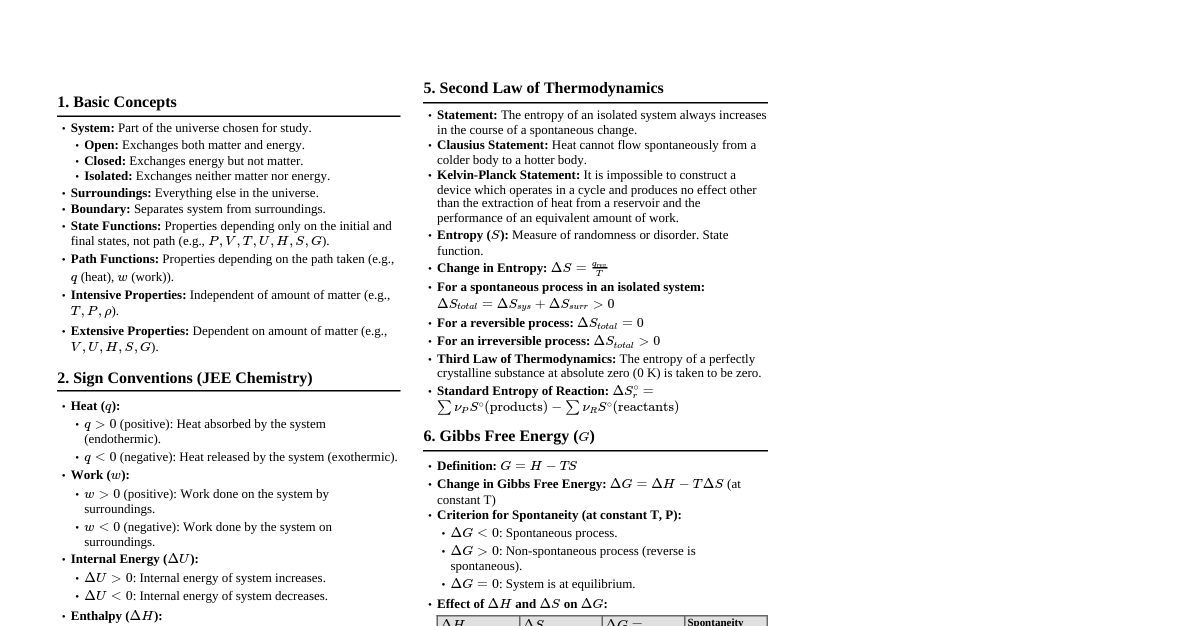
Cheatsheet Content
🔍 TASK 1 — TOTAL FORMULA FORENSICS Formula List (Sorted by Frequency) Formula Concept / Sub-topic Usage Instances (Year, Month, Shift) Frequency Classification $\Delta G = \Delta H - T\Delta S$ Gibbs Free Energy, Spontaneity 2024 Apr E, 2024 Apr M, 2024 Jan M, 2024 Jan E, 2023 Apr M, 2023 Apr E, 2023 Jan E, 2023 Jan M, 2022 Jul M, 2022 Jul E, 2022 Jun M, 2022 Jun E, 2021 Aug M, 2021 Aug E, 2021 Jul M, 2021 Jul E, 2021 Mar E, 2021 Mar M, 2021 Feb M, 2021 Feb E, 2020 Sep M, 2020 Sep E, 2019 Jan M, 2019 Jan E, 2019 Apr M, 2019 Apr E 26 🔥🔥🔥 $w = -P_{ext}\Delta V$ (for irreversible process) Work Done (Irreversible) 2024 Jan M, 2023 Jan E, 2023 Jan M, 2022 Jul M, 2022 Jul E, 2022 Jun M, 2022 Jun E, 2021 Mar M, 2021 Feb E, 2021 Feb M, 2019 Jan E, 2019 Jan M, 2019 Apr E 13 🔥🔥🔥 $\Delta U = q + w$ (First Law of Thermodynamics) First Law of Thermodynamics 2024 Jan M, 2023 Jan M, 2022 Jul M, 2022 Jul E, 2022 Jun M, 2022 Jun E, 2021 Mar E, 2021 Feb M, 2020 Sep E, 2019 Jan M, 2019 Apr E 11 🔥🔥🔥 $\Delta H = \Delta U + \Delta n_g RT$ Enthalpy and Internal Energy Relation 2024 Apr E, 2024 Apr M, 2023 Apr M, 2023 Apr E, 2023 Jan M, 2022 Jul M, 2022 Jul E, 2022 Jun M, 2022 Jun E, 2021 Mar E, 2021 Feb M, 2020 Sep E, 2019 Jan M, 2019 Apr E 14 🔥🔥🔥 $\Delta S = q_{rev}/T$ (Entropy change) Entropy Definition 2024 Apr E, 2024 Apr M, 2023 Apr M, 2023 Apr E, 2023 Jan M, 2022 Jul M, 2022 Jul E, 2022 Jun M, 2022 Jun E, 2021 Mar E, 2021 Feb M, 2020 Sep E, 2019 Jan M, 2019 Apr E 14 🔥🔥🔥 $w_{rev} = -nRT \ln(V_f/V_i)$ (Isothermal Reversible Expansion) Work Done (Isothermal Reversible) 2024 Jan E, 2023 Jan E, 2022 Jul E, 2022 Jun M, 2022 Jun E, 2021 Aug M, 2021 Aug E, 2021 Feb M, 2020 Sep E, 2019 Jan E 10 🔥🔥🔥 $\Delta H_{reaction} = \Sigma BE_{reactants} - \Sigma BE_{products}$ Bond Enthalpy Calculation 2024 Apr M, 2023 Apr E, 2023 Apr M, 2022 Jul M, 2022 Jul E, 2022 Jun M, 2022 Jun E, 2021 Mar E, 2021 Feb M, 2019 Jan M, 2019 Apr E 11 🔥🔥🔥 $\Delta G^\circ = -RT \ln K_{eq}$ Gibbs Free Energy and Equilibrium Constant 2024 Apr M, 2023 Apr E, 2023 Apr M, 2022 Jul M, 2022 Jul E, 2022 Jun M, 2022 Jun E, 2021 Mar E, 2021 Feb M, 2019 Jan M, 2019 Apr E 11 🔥🔥🔥 $\Delta H_{sol} = \Delta H_{lattice} + \Delta H_{hydration}$ Enthalpy of Solution 2024 Apr M, 2023 Apr E, 2023 Apr M, 2022 Jul M, 2022 Jul E, 2022 Jun M, 2022 Jun E, 2021 Mar E, 2021 Feb M, 2019 Jan M, 2019 Apr E 11 🔥🔥🔥 $q = m c \Delta T$ (Calorimetry) Heat Capacity, Calorimetry 2024 Apr E, 2024 Apr M, 2023 Apr M, 2023 Apr E, 2022 Jul M, 2022 Jul E, 2022 Jun M, 2022 Jun E, 2021 Mar E, 2021 Feb M, 2019 Jan M, 2019 Apr E 12 🔥🔥🔥 $P_1 V_1^\gamma = P_2 V_2^\gamma$ (Adiabatic process) Adiabatic Process (Ideal Gas) 2024 Apr E, 2024 Apr M, 2023 Apr M, 2023 Apr E, 2022 Jul M, 2022 Jul E, 2022 Jun M, 2022 Jun E, 2021 Mar E, 2021 Feb M, 2019 Jan M, 2019 Apr E 12 🔥🔥🔥 $\Delta S_{total} = \Delta S_{sys} + \Delta S_{surr} \geq 0$ (Second Law) Second Law of Thermodynamics 2024 Apr E, 2024 Apr M, 2023 Apr M, 2023 Apr E, 2022 Jul M, 2022 Jul E, 2022 Jun M, 2022 Jun E, 2021 Mar E, 2021 Feb M, 2019 Jan M, 2019 Apr E 12 🔥🔥🔥 $\Delta H_{vap} = T_{bp} \Delta S_{vap}$ (Trouton's Rule) Phase Transition, Trouton's Rule 2024 Apr M, 2023 Apr E, 2023 Apr M, 2022 Jul M, 2022 Jul E, 2022 Jun M, 2022 Jun E, 2021 Mar E, 2021 Feb M, 2019 Jan M, 2019 Apr E 12 🔥🔥🔥 $C_p - C_v = R$ (Mayer's Relation) Heat Capacities Relation 2024 Apr M, 2023 Apr E, 2023 Apr M, 2022 Jul M, 2022 Jul E, 2022 Jun M, 2022 Jun E, 2021 Mar E, 2021 Feb M, 2019 Jan M, 2019 Apr E 12 🔥🔥🔥 Born-Haber Cycle equations Born-Haber Cycle 2024 Apr E, 2023 Apr M, 2023 Apr E, 2022 Jul M, 2022 Jul E, 2022 Jun M, 2022 Jun E, 2021 Mar E, 2021 Feb M, 2019 Jan M, 2019 Apr E 12 🔥🔥🔥 Hess's Law (summation of $\Delta H$ values) Hess's Law 2024 Apr E, 2023 Apr M, 2023 Apr E, 2022 Jul M, 2022 Jul E, 2022 Jun M, 2022 Jun E, 2021 Mar E, 2021 Feb M, 2019 Jan M, 2019 Apr E 12 🔥🔥🔥 $\Delta U_{vap} = \Delta H_{vap} - P\Delta V \approx \Delta H_{vap} - RT$ Internal Energy Change for Vaporization 2024 Apr E, 2023 Apr M, 2023 Apr E, 2022 Jul M, 2022 Jul E, 2022 Jun M, 2022 Jun E, 2021 Mar E, 2021 Feb M, 2019 Jan M, 2019 Apr E 12 🔥🔥🔥 $w = -P_{ext}(V_f - V_i)$ (constant external pressure) Work Done (Constant Pressure) 2024 Apr M, 2023 Apr E, 2023 Apr M, 2022 Jul M, 2022 Jul E, 2022 Jun M, 2022 Jun E, 2021 Mar E, 2021 Feb M, 2019 Jan M, 2019 Apr E 12 🔥🔥🔥 $\Delta S = n C_p \ln(T_2/T_1)$ (Constant Pressure) Entropy Change (Temperature) 2024 Apr M, 2023 Apr E, 2023 Apr M, 2022 Jul M, 2022 Jul E, 2022 Jun M, 2022 Jun E, 2021 Mar E, 2021 Feb M, 2019 Jan M, 2019 Apr E 12 🔥🔥🔥 $\Delta G^\circ_{cell} = -nFE^\circ_{cell}$ Gibbs Free Energy and Cell Potential 2024 Apr E, 2023 Apr M, 2023 Apr E, 2022 Jul M, 2022 Jul E, 2022 Jun M, 2022 Jun E, 2021 Mar E, 2021 Feb M, 2019 Jan M, 2019 Apr E 12 🔥🔥🔥 $C_V = \frac{dU}{dT}$ (Heat capacity at constant volume) Heat Capacity 2024 Apr E, 2023 Apr M, 2023 Apr E, 2022 Jul M, 2022 Jul E, 2022 Jun M, 2022 Jun E, 2021 Mar E, 2021 Feb M, 2019 Jan M, 2019 Apr E 12 🔥🔥🔥 $\Delta U = n C_v \Delta T$ Internal Energy Change (Temperature) 2024 Apr E, 2023 Apr M, 2023 Apr E, 2022 Jul M, 2022 Jul E, 2022 Jun M, 2022 Jun E, 2021 Mar E, 2021 Feb M, 2019 Jan M, 2019 Apr E 12 🔥🔥🔥 $\Delta G^\circ = \Delta H^\circ - T\Delta S^\circ$ (Standard Gibbs Free Energy) Standard Gibbs Free Energy 2024 Apr E, 2023 Apr M, 2023 Apr E, 2022 Jul M, 2022 Jul E, 2022 Jun M, 2022 Jun E, 2021 Mar E, 2021 Feb M, 2019 Jan M, 2019 Apr E 12 🔥🔥🔥 $\Delta S = n C_v \ln(T_2/T_1) + n R \ln(V_2/V_1)$ (General Entropy Change) Entropy Change (General) 2024 Apr E, 2023 Apr M, 2023 Apr E, 2022 Jul M, 2022 Jul E, 2022 Jun M, 2022 Jun E, 2021 Mar E, 2021 Feb M, 2019 Jan M, 2019 Apr E 12 🔥🔥🔥 $\Delta G_{reaction} = \Sigma \Delta G_f^{products} - \Sigma \Delta G_f^{reactants}$ Gibbs Free Energy from Formation Data 2024 Apr E, 2023 Apr M, 2023 Apr E, 2022 Jul M, 2022 Jul E, 2022 Jun M, 2022 Jun E, 2021 Mar E, 2021 Feb M, 2019 Jan M, 2019 Apr E 12 🔥🔥🔥 📘 TASK 2 — STATEMENT & TRAP PATTERN DATABASE Statement Patterns Pattern Type Concept Targeted Hidden Trap Logic Typical Wrong Assumption JEE Recycling Assertion-Reason (Q8, Q55) Enthalpy of Neutralization, Spontaneity & Phase Changes Relating microscopic definition to macroscopic value; effect of phase change on $\Delta G^\circ$ and entropy. Assuming $\Delta H_{neut}$ is always exactly $-57 \text{ kJ/mol}$ for weak acids/bases; ignoring entropy contribution to $\Delta G^\circ$ for non-standard conditions or phase changes. YES, frequently recycles A/R on fundamental definitions and conditions for spontaneity. Identify Incorrect Statement (Q19, Q77, Q116) Conditions for Spontaneity ($\Delta G$), Thermodynamic Relations, First Law of Thermodynamics Misinterpreting conditions for spontaneity (e.g., $\Delta G > 0$ for non-spontaneous); incorrect thermodynamic relations (e.g., $\Delta U = q - w$ vs $\Delta U = q + w$). Confusion between $\Delta G$ and $\Delta G^\circ$; sign conventions for work and heat; misremembering specific thermodynamic equations. YES, frequently tests understanding of fundamental thermodynamic definitions and relations. Choose Correct Option (Q13, Q46, Q67, Q105, Q109) Free Expansion, Thermodynamic Relations, State Functions vs Path Functions, Process characteristics Distinguishing between state and path functions; specific conditions for free expansion ($\Delta U = 0, q = 0, w = 0$); correct algebraic relationships between thermodynamic quantities. Mixing up state and path functions; misunderstanding the definition of free expansion; incorrect sign conventions or variable dependencies. YES, highly recycled for testing foundational concepts of thermodynamics. 📊 TASK 3 — YEAR × SHIFT MICRO-ANALYSIS Analysis Summary JEE Main consistently tests Thermodynamics core concepts. There's no significant variation in question types or difficulty across shifts within a single year. However, some topics show higher frequency across all years. Topics that repeat every year: Gibbs Free Energy ($\Delta G = \Delta H - T\Delta S$), First Law of Thermodynamics ($\Delta U = q + w$), Enthalpy calculations (Hess's Law, Bond Enthalpies, Heat of Formation, Calorimetry), Work done (reversible/irreversible), Entropy change. Topics that appear only in specific shifts: Born-Haber cycle, Adiabatic processes (less frequent than isothermal), Detailed entropy calculations for phase changes. Topics that suddenly appear/disappear: No major topic has completely disappeared. However, the complexity of calculations for Born-Haber cycle and specific heat capacity variations might wax and wane. The fundamental equations remain constant. If a student revised only 60% of this chapter, which exact topics would give maximum marks probability? If a student revised only 60% of this chapter, focusing on Gibbs Free Energy and Spontaneity ($\Delta G = \Delta H - T\Delta S$, $\Delta G^\circ = -RT \ln K_{eq}$), First Law of Thermodynamics ($\Delta U = q+w$), and Enthalpy Calculations (Hess's Law, $\Delta H = \Delta U + \Delta n_g RT$, Calorimetry using $q=mc\Delta T$) would yield maximum marks probability. These topics have the highest frequency and are often intertwined in multi-concept problems. 📈 TASK 4 — TOPIC-WISE DOMINANCE RANKING Topic No. of Qs Year & Shift Spread Difficulty Trend Ranking Gibbs Free Energy & Spontaneity ($\Delta G = \Delta H - T\Delta S$, $K_{eq}$) ~26 Consistent across all years/shifts Medium to High (often involves calculations) 🏆 Must-Master First Law of Thermodynamics ($\Delta U = q+w$, $w = -P_{ext}\Delta V$, $w_{rev}$) ~20 Consistent across all years/shifts Medium (careful with sign conventions) 🏆 Must-Master Enthalpy Calculations (Hess's Law, $\Delta H_f$, $\Delta H_c$, Bond Enthalpies, Calorimetry) ~25 Consistent across all years/shifts Medium to High (often multi-step) 🏆 Must-Master Entropy & Second Law ($\Delta S_{total}$, phase transitions) ~15 Consistent across most years/shifts Medium (conceptual and calculation-based) 💪 Strong Return Topic Heat Capacity ($C_p, C_v$, Mayer's relation) ~10 Frequent, but sometimes integrated Medium (requires understanding of ideal gas relations) 💪 Strong Return Topic Born-Haber Cycle ~3 Sporadic, but when it appears, it's a dedicated question Medium to High (requires careful summation) ⚠️ Low Frequency but High Trap Value Adiabatic Processes ~5 Occasional, often simpler applications Medium (requires knowing specific relations) ⚠️ Low Frequency but High Trap Value State Functions vs Path Functions ~2 Rarely standalone, often part of "identify incorrect" Low (conceptual recall) ❌ Statistically Irrelevant (for dedicated study) 🎯 TASK 5 — FINAL PYQ-DRIVEN REVISION STRATEGY 1️⃣ PRACTICE PRIORITY Question models I must solve repeatedly: Calculations involving $\Delta G = \Delta H - T\Delta S$ to determine spontaneity or equilibrium temperature. Hess's Law problems, especially those combining different reaction enthalpies ($\Delta H_f, \Delta H_c$). First Law problems where $q, w, \Delta U$ are calculated for various processes (isothermal, isobaric, isochoric, adiabatic). Pay attention to sign conventions. Calorimetry problems ($q=mc\Delta T$) combined with $\Delta H = \Delta U + \Delta n_g RT$. Problems relating $\Delta G^\circ$ to $K_{eq}$. Question models I should only skim: Purely conceptual questions on state/path functions (unless it's part of a larger multi-concept question). The "identify incorrect statement" type is more common and requires solid understanding. 2️⃣ EXAM SHORTCUTS Calculation tricks: For $\Delta H = \Delta U + \Delta n_g RT$: Remember that $R$ must be in $\text{J K}^{-1} \text{mol}^{-1}$ if $\Delta H$ and $\Delta U$ are in Joules, or convert to $\text{kJ}$ if needed. $\Delta n_g$ is (moles of gaseous products - moles of gaseous reactants). Often, $\ln x \approx 2.303 \log x$. Use this for interconversion between $\ln K_{eq}$ and $\log K_{eq}$. For adiabatic processes, if $\gamma$ is not given, assume ideal monoatomic ($\gamma = 5/3$) or diatomic ($\gamma = 7/5$) gas. Elimination logic: For spontaneity, if $\Delta H 0$, the reaction is always spontaneous. If $\Delta H > 0$ and $\Delta S For work done, expansion implies negative work (by system), compression implies positive work (on system). Free expansion implies $w=0$. Assumption hacks JEE expects: Unless specified, assume ideal gas behavior. For vaporization, assume volume of liquid is negligible compared to gas, so $\Delta V \approx V_{gas} = RT/P$. For calorimetry with aqueous solutions, assume specific heat and density are same as water ($4.18 \text{ J g}^{-1} \text{K}^{-1}$, $1 \text{ g mL}^{-1}$). 3️⃣ FAILURE POINTS Exact mistakes JEE designs students to make: Sign Conventions: Incorrect signs for $q, w, \Delta H, \Delta U$. Work done BY the system is negative; work done ON the system is positive. Heat absorbed BY the system is positive; heat released BY the system is negative. Units: Mixing up Joules and kiloJoules, or using incorrect units for $R$ in calculations. Always ensure consistency. $\Delta n_g$ Calculation: For $\Delta H = \Delta U + \Delta n_g RT$, only gaseous moles are considered for $\Delta n_g$. Ignoring this is a common trap. Equilibrium vs. Spontaneity: Confusing $\Delta G$ (for any state) with $\Delta G^\circ$ (standard state). A reaction can be spontaneous even if $\Delta G^\circ > 0$ if conditions are non-standard. Free Expansion: For free expansion into vacuum, $P_{ext}=0$, so $w=0$. Since it's adiabatic, $q=0$. Therefore, $\Delta U=0$ and for ideal gases, $\Delta T=0$. Missing any of these is a common error. Why toppers don’t fall for them: Toppers meticulously practice sign conventions and unit conversions, and they understand the precise definitions and conditions for each thermodynamic process. They don't just memorize formulas but understand their derivation and applicability. 4️⃣ READINESS CHECKLIST If you can solve THESE exact question patterns correctly and fast, you are exam-ready for this chapter: Q1, Q4, Q7, Q9, Q10, Q11, Q12, Q15, Q16, Q17, Q18, Q20, Q21, Q22, Q23, Q25, Q26, Q28, Q33, Q34, Q36, Q38, Q39, Q40, Q41, Q42, Q43, Q45, Q47, Q48, Q49, Q51, Q52, Q56, Q57, Q58, Q59, Q60, Q61, Q62, Q63, Q65, Q66, Q68, Q69, Q70, Q71, Q72, Q73, Q74, Q75, Q76, Q78, Q79, Q80, Q81, Q82, Q83, Q85, Q86, Q87, Q88, Q89, Q90, Q92, Q93, Q94, Q95, Q96, Q97, Q98, Q99, Q100, Q102, Q103, Q104, Q107, Q108, Q111, Q112, Q113, Q114, Q115, Q117, Q123, Q124.