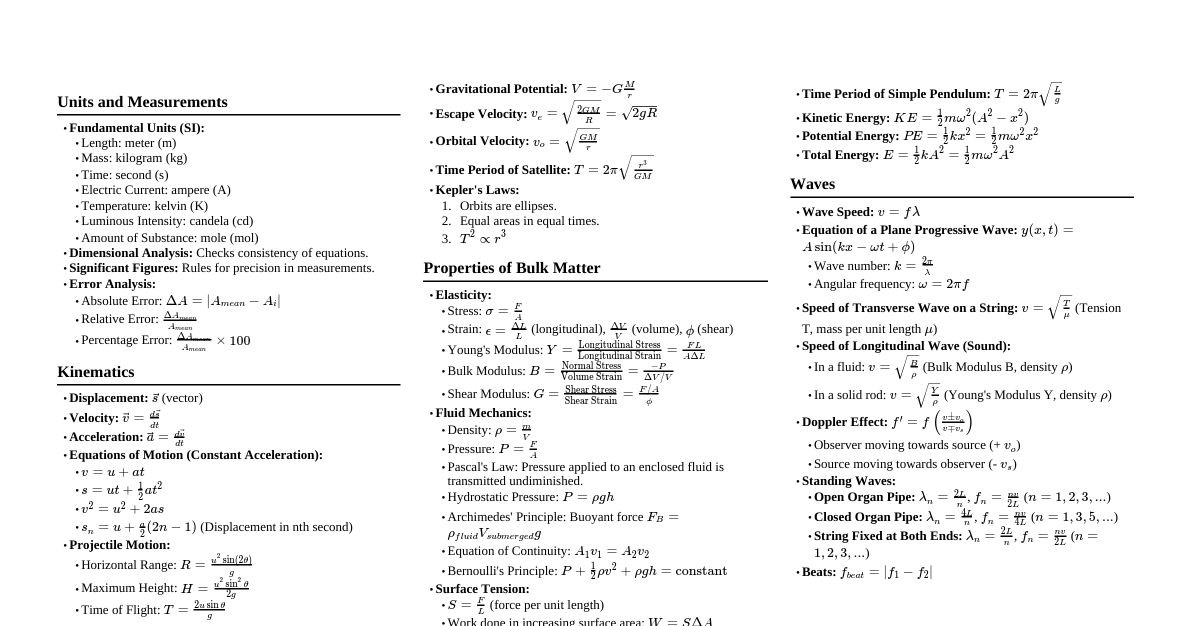
JEE Main Physics Formulas
Cheatsheet Content
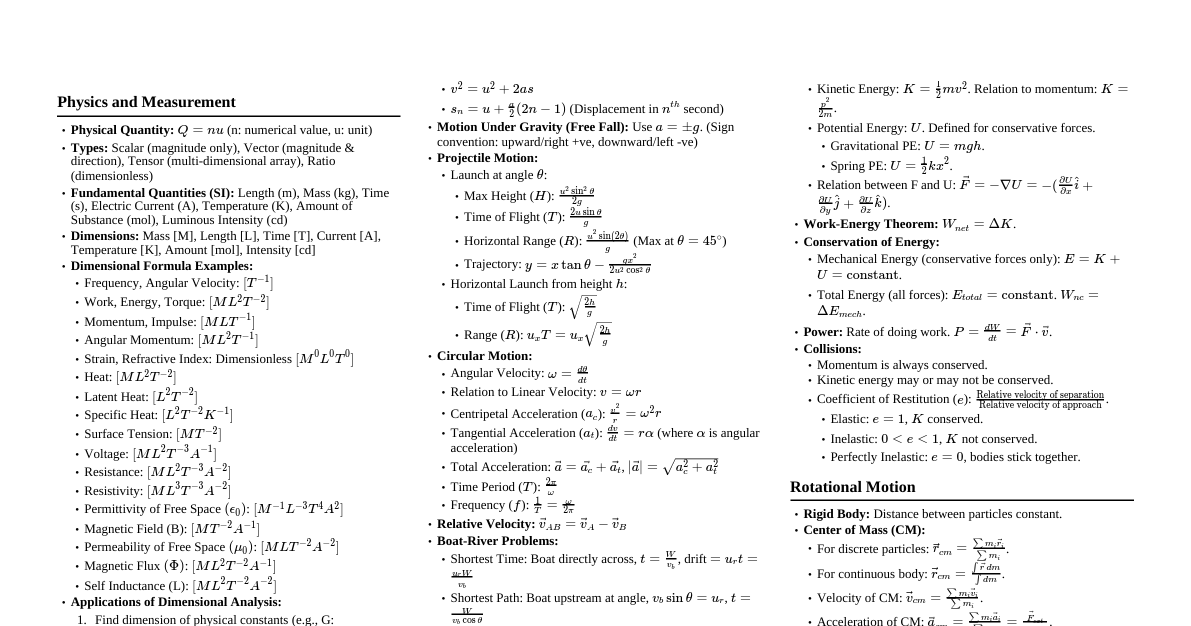
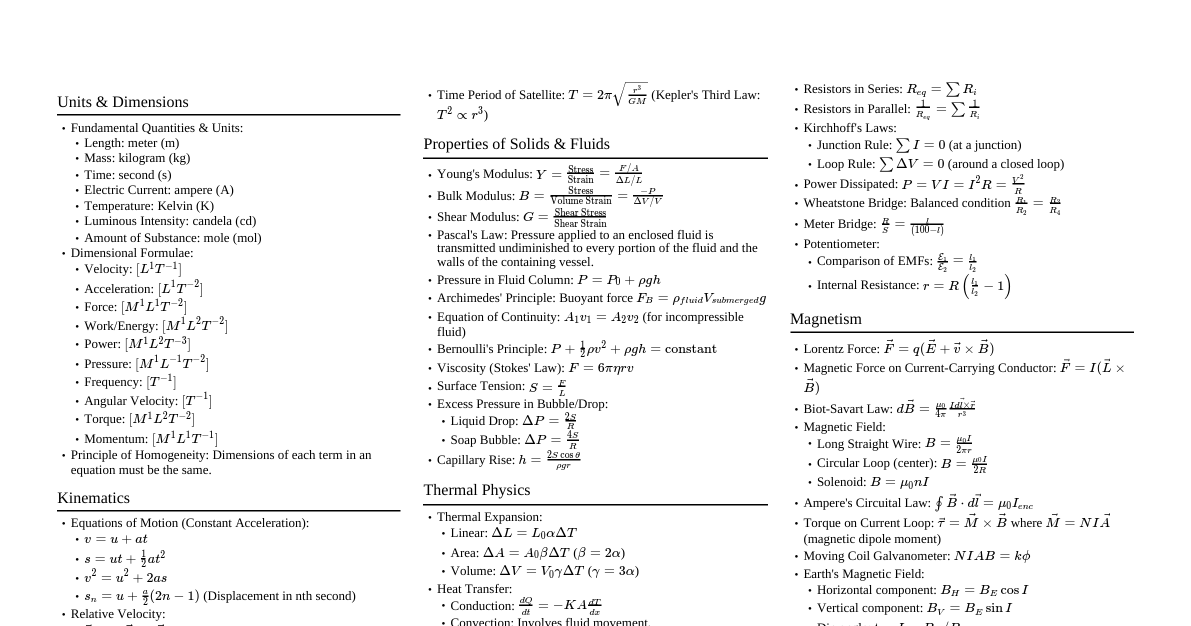
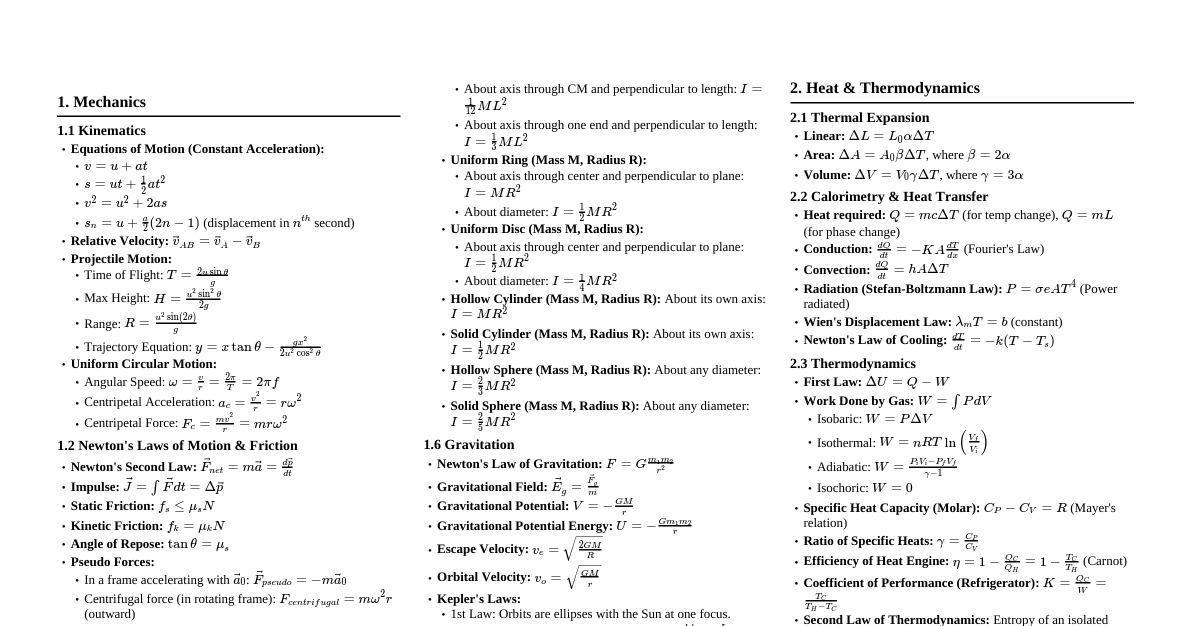
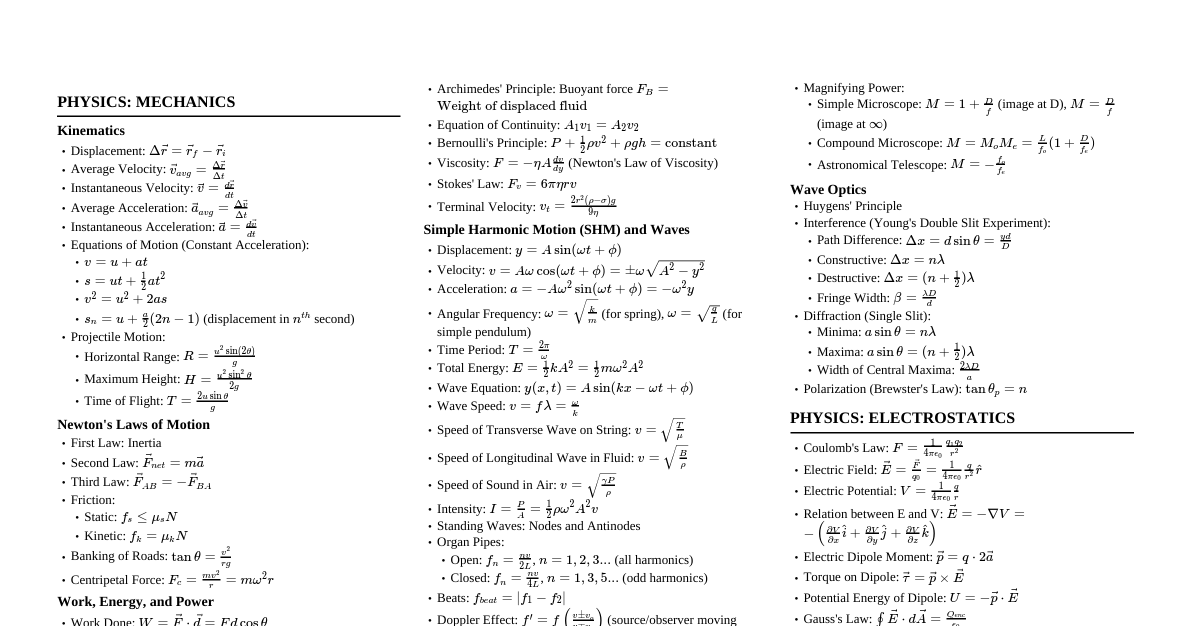
### Kinematics Kinematics is the branch of classical mechanics that describes the motion of points, bodies and systems of bodies without considering the forces that cause them to move. #### 1. Equations of Motion (Constant Acceleration) - **Velocity-Time Relation:** $v = u + at$ - Where: $v$ = final velocity, $u$ = initial velocity, $a$ = acceleration, $t$ = time. - **Example 1 (Easy):** A car starts from rest and accelerates at $2 \text{ m/s}^2$ for $5 \text{ s}$. Find its final velocity. - Solution: $u=0, a=2, t=5$. $v = 0 + (2)(5) = 10 \text{ m/s}$. - **Example 2 (Average):** A ball is thrown vertically upwards with an initial velocity of $20 \text{ m/s}$. How long does it take to reach its highest point? (Take $g = 10 \text{ m/s}^2$) - Solution: At the highest point, $v=0$. $0 = 20 - 10t \Rightarrow t = 2 \text{ s}$. - **Example 3 (Tricky):** A particle starts from rest and moves with acceleration $a = 2t$. Find its velocity after $3 \text{ s}$. - Solution: $a = \frac{dv}{dt} = 2t \Rightarrow \int_0^v dv = \int_0^3 2t dt \Rightarrow v = [t^2]_0^3 = 9 \text{ m/s}$. - **Displacement-Time Relation:** $s = ut + \frac{1}{2}at^2$ - Where: $s$ = displacement. - **Example 1 (Easy):** A bike starts from rest and accelerates at $3 \text{ m/s}^2$ for $4 \text{ s}$. What is the distance covered? - Solution: $u=0, a=3, t=4$. $s = 0 + \frac{1}{2}(3)(4^2) = \frac{1}{2}(3)(16) = 24 \text{ m}$. - **Example 2 (Average):** A stone is dropped from a height of $45 \text{ m}$. How long does it take to reach the ground? (Take $g = 10 \text{ m/s}^2$) - Solution: $u=0, s=45, a=10$. $45 = 0 + \frac{1}{2}(10)t^2 \Rightarrow 45 = 5t^2 \Rightarrow t^2 = 9 \Rightarrow t = 3 \text{ s}$. - **Example 3 (Tricky):** A particle moves in a straight line with initial velocity $u$. Its acceleration is given by $a = -kv$, where $k$ is a positive constant. Find the distance traveled until its velocity becomes $u/2$. - Solution: $a = \frac{dv}{dt} = -kv \Rightarrow \frac{dv}{v} = -k dt \Rightarrow \int_u^{u/2} \frac{dv}{v} = -k \int_0^t dt \Rightarrow [\ln v]_u^{u/2} = -kt \Rightarrow \ln(1/2) = -kt \Rightarrow t = \frac{\ln 2}{k}$. - Also, $a = v\frac{dv}{ds} = -kv \Rightarrow \frac{dv}{ds} = -k \Rightarrow \int_u^{u/2} dv = -k \int_0^s ds \Rightarrow [v]_u^{u/2} = -ks \Rightarrow u/2 - u = -ks \Rightarrow -u/2 = -ks \Rightarrow s = \frac{u}{2k}$. - **Velocity-Displacement Relation:** $v^2 = u^2 + 2as$ - **Example 1 (Easy):** An object moving at $5 \text{ m/s}$ accelerates at $1 \text{ m/s}^2$ over a distance of $12 \text{ m}$. What is its final velocity? - Solution: $u=5, a=1, s=12$. $v^2 = 5^2 + 2(1)(12) = 25 + 24 = 49 \Rightarrow v = 7 \text{ m/s}$. - **Example 2 (Average):** A bullet fired into a block loses half its velocity after penetrating $3 \text{ cm}$. How much further will it penetrate before coming to rest? - Solution: Let initial velocity be $u$. After $3 \text{ cm}$, velocity is $u/2$. $a$ is constant. - For first part: $(u/2)^2 = u^2 + 2a(0.03) \Rightarrow u^2/4 = u^2 + 0.06a \Rightarrow -3u^2/4 = 0.06a \Rightarrow a = -12.5u^2$. - For second part (from $u/2$ to $0$): $0^2 = (u/2)^2 + 2as' \Rightarrow 0 = u^2/4 + 2(-12.5u^2)s' \Rightarrow 0 = u^2/4 - 25u^2s' \Rightarrow u^2/4 = 25u^2s' \Rightarrow s' = \frac{1}{100} \text{ m} = 1 \text{ cm}$. - **Example 3 (Tricky):** A particle starts from rest and moves with acceleration $a = 3s$. Find its velocity when $s = 2 \text{ m}$. - Solution: $a = v\frac{dv}{ds} = 3s \Rightarrow \int_0^v v dv = \int_0^2 3s ds \Rightarrow [\frac{v^2}{2}]_0^v = [\frac{3s^2}{2}]_0^2 \Rightarrow \frac{v^2}{2} = \frac{3(2^2)}{2} = 6 \Rightarrow v^2 = 12 \Rightarrow v = \sqrt{12} = 2\sqrt{3} \text{ m/s}$. #### 2. Relative Velocity - **Relative Velocity of A with respect to B:** $\vec{v}_{AB} = \vec{v}_A - \vec{v}_B$ - **Example 1 (Easy):** Car A moves at $50 \text{ km/h}$ East, Car B moves at $30 \text{ km/h}$ East. Find $\vec{v}_{AB}$. - Solution: $\vec{v}_A = 50 \hat{i}$, $\vec{v}_B = 30 \hat{i}$. $\vec{v}_{AB} = (50-30)\hat{i} = 20 \hat{i} \text{ km/h}$ East. - **Example 2 (Average):** A boat can travel at $10 \text{ m/s}$ in still water. If the river flows at $5 \text{ m/s}$ East, and the boat wants to go directly North, what is its actual speed relative to the ground? - Solution: Let boat velocity relative to water be $\vec{v}_{BW}$. River velocity $\vec{v}_W = 5 \hat{i}$. Boat velocity relative to ground $\vec{v}_B = \vec{v}_{BW} + \vec{v}_W$. - To go directly North, $\vec{v}_B$ must be $v_B \hat{j}$. $\vec{v}_{BW}$ must have a component countering $\vec{v}_W$. - $\vec{v}_{BW} = -5 \hat{i} + v_y \hat{j}$. Magnitude $|\vec{v}_{BW}| = 10$. - $\sqrt{(-5)^2 + v_y^2} = 10 \Rightarrow 25 + v_y^2 = 100 \Rightarrow v_y^2 = 75 \Rightarrow v_y = \sqrt{75} = 5\sqrt{3} \text{ m/s}$. - So, $\vec{v}_B = 5\sqrt{3} \hat{j}$. Actual speed is $5\sqrt{3} \text{ m/s}$. - **Example 3 (Tricky):** Two particles A and B are moving in XY-plane. Their positions are given by $\vec{r}_A = (3t \hat{i} + 4t \hat{j}) \text{ m}$ and $\vec{r}_B = (5 \hat{i} - 2t \hat{j}) \text{ m}$. Find the minimum separation between them. - Solution: $\vec{r}_{AB} = \vec{r}_A - \vec{r}_B = (3t-5)\hat{i} + (4t-(-2t))\hat{j} = (3t-5)\hat{i} + 6t\hat{j}$. - Distance squared $d^2 = (3t-5)^2 + (6t)^2 = 9t^2 - 30t + 25 + 36t^2 = 45t^2 - 30t + 25$. - For minimum distance, $\frac{d(d^2)}{dt} = 0 \Rightarrow 90t - 30 = 0 \Rightarrow t = 30/90 = 1/3 \text{ s}$. - Minimum $d^2 = 45(1/3)^2 - 30(1/3) + 25 = 45/9 - 10 + 25 = 5 - 10 + 25 = 20$. - Minimum separation $d = \sqrt{20} = 2\sqrt{5} \text{ m}$. #### 3. Projectile Motion - **Horizontal Range:** $R = \frac{u^2 \sin(2\theta)}{g}$ - Where: $u$ = initial velocity, $\theta$ = angle of projection. - **Example 1 (Easy):** A projectile is fired with initial velocity $10 \text{ m/s}$ at an angle of $30^\circ$ with the horizontal. Find its range. (Take $g = 10 \text{ m/s}^2$) - Solution: $R = \frac{10^2 \sin(2 \times 30^\circ)}{10} = \frac{100 \sin(60^\circ)}{10} = 10 \times \frac{\sqrt{3}}{2} = 5\sqrt{3} \text{ m}$. - **Example 2 (Average):** For what angle of projection is the range of a projectile equal to its maximum height? - Solution: Max height $H = \frac{u^2 \sin^2\theta}{2g}$. - $R = H \Rightarrow \frac{u^2 \sin(2\theta)}{g} = \frac{u^2 \sin^2\theta}{2g}$ - $2\sin\theta\cos\theta = \frac{\sin^2\theta}{2}$ - As $\sin\theta \ne 0$ (for projectile motion), $4\cos\theta = \sin\theta \Rightarrow \tan\theta = 4$. So $\theta = \arctan(4)$. - **Example 3 (Tricky):** A projectile is thrown with velocity $u$ such that its horizontal range is twice the maximum height attained. Find the range. - Solution: $R = 2H$. From Example 2, this means $\tan\theta = 4$. - We need to find $R = \frac{u^2 \sin(2\theta)}{g} = \frac{u^2 (2\sin\theta\cos\theta)}{g}$. - If $\tan\theta = 4$, then $\sin\theta = 4/\sqrt{17}$ and $\cos\theta = 1/\sqrt{17}$. - $R = \frac{u^2 (2 \times \frac{4}{\sqrt{17}} \times \frac{1}{\sqrt{17}})}{g} = \frac{u^2 \times 8/17}{g} = \frac{8u^2}{17g}$. - **Time of Flight:** $T = \frac{2u \sin\theta}{g}$ - **Example 1 (Easy):** A ball is thrown with initial velocity $20 \text{ m/s}$ at an angle of $30^\circ$. Find the time of flight. (Take $g = 10 \text{ m/s}^2$) - Solution: $T = \frac{2(20)\sin(30^\circ)}{10} = \frac{40 \times (1/2)}{10} = \frac{20}{10} = 2 \text{ s}$. - **Example 2 (Average):** A projectile has a time of flight of $4 \text{ s}$ and a horizontal range of $40 \text{ m}$. Find its initial velocity and angle of projection. (Take $g = 10 \text{ m/s}^2$) - Solution: $T = \frac{2u \sin\theta}{g} \Rightarrow 4 = \frac{2u \sin\theta}{10} \Rightarrow u \sin\theta = 20$. - $R = \frac{u^2 \sin(2\theta)}{g} = \frac{u^2 (2\sin\theta\cos\theta)}{g} = \frac{(u\sin\theta)(2u\cos\theta)}{g}$. This is incorrect. - $R = \frac{u^2 (2\sin\theta\cos\theta)}{g} = \frac{(2u\sin\theta) (u\cos\theta)}{g} = \frac{T (u\cos\theta)g}{g} = T (u\cos\theta)$. - $40 = 4 (u\cos\theta) \Rightarrow u\cos\theta = 10$. - We have $u\sin\theta = 20$ and $u\cos\theta = 10$. - Dividing: $\tan\theta = 20/10 = 2 \Rightarrow \theta = \arctan(2)$. - Squaring and adding: $u^2\sin^2\theta + u^2\cos^2\theta = 20^2 + 10^2 \Rightarrow u^2 = 400 + 100 = 500 \Rightarrow u = \sqrt{500} = 10\sqrt{5} \text{ m/s}$. - **Example 3 (Tricky):** A projectile is launched from ground level with initial velocity $u$ at an angle $\theta$. If at time $t_1$ its height is $h_1$ and at time $t_2$ its height is $h_2$, show that $h_1 = h_2$ if $t_1 + t_2 = T$ (total time of flight). - Solution: Vertical displacement $y = (u\sin\theta)t - \frac{1}{2}gt^2$. - Let $h$ be the height. $h = (u\sin\theta)t - \frac{1}{2}gt^2$. This is a quadratic equation in $t$: $\frac{1}{2}gt^2 - (u\sin\theta)t + h = 0$. - The roots of this equation are $t_1$ and $t_2$, the times at which the projectile is at height $h$. - From Vieta's formulas, sum of roots $t_1 + t_2 = \frac{-(-u\sin\theta)}{g/2} = \frac{2u\sin\theta}{g}$. - This sum is exactly the Time of Flight $T$. Thus, if $t_1+t_2=T$, the projectile is at the same height $h$. - **Maximum Height:** $H = \frac{u^2 \sin^2\theta}{2g}$ - **Example 1 (Easy):** A projectile is launched with vertical component of velocity $15 \text{ m/s}$. Find its maximum height. (Take $g = 10 \text{ m/s}^2$) - Solution: $H = \frac{(u\sin\theta)^2}{2g} = \frac{15^2}{2 \times 10} = \frac{225}{20} = 11.25 \text{ m}$. - **Example 2 (Average):** A projectile is thrown such that its horizontal range is $100 \text{ m}$ and maximum height is $25 \text{ m}$. Find the angle of projection. - Solution: $R = \frac{u^2 \sin(2\theta)}{g} = 100$. $H = \frac{u^2 \sin^2\theta}{2g} = 25$. - Divide $H$ by $R$: $\frac{H}{R} = \frac{u^2 \sin^2\theta / (2g)}{u^2 \sin(2\theta) / g} = \frac{\sin^2\theta}{2\sin(2\theta)} = \frac{\sin^2\theta}{2(2\sin\theta\cos\theta)} = \frac{\sin\theta}{4\cos\theta} = \frac{1}{4}\tan\theta$. - So, $\frac{25}{100} = \frac{1}{4}\tan\theta \Rightarrow \frac{1}{4} = \frac{1}{4}\tan\theta \Rightarrow \tan\theta = 1 \Rightarrow \theta = 45^\circ$. - **Example 3 (Tricky):** A particle is projected from the ground with velocity $u$ at angle $\theta$ with horizontal. What is the radius of curvature of its path at the highest point? - Solution: At the highest point, the vertical velocity is $0$, and the velocity is purely horizontal, $v = u\cos\theta$. The acceleration acting is $g$ downwards. - The formula for radius of curvature $\rho = \frac{v^2}{a_\perp}$, where $a_\perp$ is the component of acceleration perpendicular to velocity. - At the highest point, $v = u\cos\theta$ (horizontal) and $a = g$ (vertical). So $a_\perp = g$. - Therefore, $\rho = \frac{(u\cos\theta)^2}{g} = \frac{u^2\cos^2\theta}{g}$. ### Newton's Laws of Motion Newton's laws of motion are three basic laws of classical mechanics that describe the relationship between the motion of an object and the forces acting on it. #### 1. Newton's First Law (Law of Inertia) - An object at rest stays at rest and an object in motion stays in motion with the same speed and in the same direction unless acted upon by an unbalanced force. - **Example 1 (Easy):** A book is lying on a table. It remains at rest unless you push or pull it. - Solution: This directly illustrates the law of inertia. No net external force, so no change in state of motion. - **Example 2 (Average):** Why does a passenger in a car lurch forward when the car suddenly brakes? - Solution: Due to inertia, the passenger's body tends to continue moving forward at the car's original speed even when the car slows down, causing them to lurch forward. - **Example 3 (Tricky):** A space probe is launched into space. Once it's outside Earth's gravitational influence and its engines are shut off, it continues to move at a constant velocity. Explain. - Solution: In the vacuum of space, far from significant gravitational or atmospheric drag forces, the net external force on the probe is essentially zero. According to Newton's First Law, an object in motion with no net force acting on it will continue to move at a constant velocity. #### 2. Newton's Second Law ($\vec{F} = m\vec{a}$) - The acceleration of an object is directly proportional to the net force acting on it and inversely proportional to its mass. The direction of the acceleration is in the direction of the net force. - Where: $\vec{F}$ = net force, $m$ = mass, $\vec{a}$ = acceleration. - **Example 1 (Easy):** A force of $10 \text{ N}$ is applied to a $2 \text{ kg}$ object. What is its acceleration? - Solution: $F = ma \Rightarrow 10 = 2a \Rightarrow a = 5 \text{ m/s}^2$. - **Example 2 (Average):** Two blocks of masses $m_1 = 2 \text{ kg}$ and $m_2 = 3 \text{ kg}$ are in contact on a frictionless horizontal surface. A horizontal force of $F = 15 \text{ N}$ is applied to $m_1$. Find the acceleration of the system and the contact force between the blocks. - Solution: - System acceleration: $a = \frac{F}{m_1+m_2} = \frac{15}{2+3} = \frac{15}{5} = 3 \text{ m/s}^2$. - Contact force (FBD for $m_2$): Let $N$ be the contact force. $N = m_2 a = 3 \times 3 = 9 \text{ N}$. - **Example 3 (Tricky):** A block of mass $M$ is placed on a rough horizontal surface. The coefficient of friction between the block and the surface is $\mu$. A force $F$ is applied at an angle $\theta$ below the horizontal. Find the acceleration of the block. - Solution: - Vertical forces: $N - Mg - F\sin\theta = 0 \Rightarrow N = Mg + F\sin\theta$. - Friction force: $f_k = \mu N = \mu(Mg + F\sin\theta)$. - Horizontal forces: $F\cos\theta - f_k = Ma$. - $F\cos\theta - \mu(Mg + F\sin\theta) = Ma$. - $a = \frac{F\cos\theta - \mu(Mg + F\sin\theta)}{M}$. - (Note: The block moves only if $F\cos\theta > \mu_s(Mg + F\sin\theta)$). #### 3. Newton's Third Law - For every action, there is an equal and opposite reaction. - **Example 1 (Easy):** When you push a wall, the wall pushes back on you with an equal and opposite force. - Solution: This is a direct application. The force you exert on the wall is the action, and the force the wall exerts on you is the reaction. - **Example 2 (Average):** A rocket moves forward by expelling exhaust gases backward. Explain using Newton's Third Law. - Solution: The rocket exerts a force on the exhaust gases, pushing them backward (action). According to Newton's Third Law, the exhaust gases exert an equal and opposite force on the rocket, pushing it forward (reaction). - **Example 3 (Tricky):** A horse pulls a cart. If the action-reaction forces are equal and opposite, how does the cart move? - Solution: The key is to consider the forces on *different* objects. 1. Horse pulls cart (action) and cart pulls horse (reaction). These are equal and opposite, but act on different bodies. 2. Horse pushes ground backward (action). Ground pushes horse forward (reaction). This forward force on the horse allows it to accelerate. 3. Cart wheels push ground backward (action). Ground pushes cart wheels forward (reaction). This forward force on the cart allows it to accelerate. The cart moves because the net force on the *cart* (forward force from horse minus backward friction/drag) is non-zero, and the net force on the *horse* (forward force from ground minus backward force from cart) is non-zero. The action-reaction pair between horse and cart does not cancel out the motion initiating forces on either body. #### 4. Impulse-Momentum Theorem - **Impulse:** $\vec{J} = \vec{F}_{avg} \Delta t = \Delta \vec{p}$ - Where: $\vec{J}$ = impulse, $\vec{F}_{avg}$ = average force, $\Delta t$ = time interval, $\Delta \vec{p}$ = change in momentum. - **Momentum:** $\vec{p} = m\vec{v}$ - **Example 1 (Easy):** A $0.5 \text{ kg}$ ball moving at $10 \text{ m/s}$ hits a wall and rebounds with a speed of $8 \text{ m/s}$. What is the change in momentum? - Solution: Let initial direction be positive. $\vec{p}_i = (0.5)(10) = 5 \text{ kg m/s}$. $\vec{p}_f = (0.5)(-8) = -4 \text{ kg m/s}$. - $\Delta \vec{p} = \vec{p}_f - \vec{p}_i = -4 - 5 = -9 \text{ kg m/s}$. (Magnitude is $9 \text{ kg m/s}$). - **Example 2 (Average):** A batsman hits a cricket ball of mass $150 \text{ g}$ moving at $40 \text{ m/s}$. The ball leaves the bat at $60 \text{ m/s}$ in the opposite direction. If the contact time is $0.01 \text{ s}$, find the average force exerted by the bat on the ball. - Solution: $m = 0.15 \text{ kg}$. $\vec{v}_i = 40 \text{ m/s}$. $\vec{v}_f = -60 \text{ m/s}$. $\Delta t = 0.01 \text{ s}$. - $\Delta \vec{p} = m(\vec{v}_f - \vec{v}_i) = 0.15(-60 - 40) = 0.15(-100) = -15 \text{ kg m/s}$. - $\vec{F}_{avg} = \frac{\Delta \vec{p}}{\Delta t} = \frac{-15}{0.01} = -1500 \text{ N}$. (Force is $1500 \text{ N}$ in the direction opposite to initial motion). - **Example 3 (Tricky):** A water jet of area $A$ and velocity $v$ hits a wall perpendicularly and comes to rest. If the density of water is $\rho$, find the force exerted by the jet on the wall. - Solution: In time $\Delta t$, the mass of water hitting the wall is $\Delta m = (\text{volume}) \times \rho = (A v \Delta t) \rho$. - Initial momentum of this mass of water: $\Delta p_i = (\Delta m) v = (A v \Delta t \rho) v = A \rho v^2 \Delta t$. - Final momentum of this mass of water: $\Delta p_f = 0$ (comes to rest). - Change in momentum of water: $\Delta p = \Delta p_f - \Delta p_i = -A \rho v^2 \Delta t$. - Force on water by wall: $F_{wall \to water} = \frac{\Delta p}{\Delta t} = -A \rho v^2$. - By Newton's Third Law, force on wall by water: $F_{water \to wall} = -F_{wall \to water} = -(-A \rho v^2) = A \rho v^2$. #### 5. Conservation of Linear Momentum - In the absence of external forces, the total linear momentum of a system remains constant. - $\sum \vec{p}_{initial} = \sum \vec{p}_{final}$ - **Example 1 (Easy):** A $2 \text{ kg}$ mass moving at $5 \text{ m/s}$ collides with a $3 \text{ kg}$ mass at rest. If they stick together, what is their final velocity? - Solution: $m_1 u_1 + m_2 u_2 = (m_1+m_2)V$. - $(2)(5) + (3)(0) = (2+3)V \Rightarrow 10 = 5V \Rightarrow V = 2 \text{ m/s}$. - **Example 2 (Average):** A bullet of mass $m$ is fired from a gun of mass $M$ with velocity $v$. What is the recoil velocity of the gun? - Solution: Initial momentum of gun+bullet system is $0$. - Final momentum: $mv + MV_{recoil}$. - By conservation of momentum: $0 = mv + MV_{recoil} \Rightarrow V_{recoil} = -\frac{mv}{M}$. (Negative sign indicates opposite direction to bullet). - **Example 3 (Tricky):** A block of mass $M$ is suspended by a string. A bullet of mass $m$ moving horizontally with velocity $v$ strikes the block and gets embedded in it. Find the maximum height to which the block-bullet system rises. - Solution: - **Step 1: Collision (Momentum Conservation)** - Initial momentum: $mv$. Final momentum: $(M+m)V_{f}$ (where $V_f$ is velocity just after collision). - $mv = (M+m)V_f \Rightarrow V_f = \frac{mv}{M+m}$. - **Step 2: Rise to maximum height (Energy Conservation)** - Kinetic energy just after collision is converted to potential energy. - $\frac{1}{2}(M+m)V_f^2 = (M+m)gh$. - $\frac{1}{2}\left(\frac{mv}{M+m}\right)^2 = gh$. - $h = \frac{1}{2g}\left(\frac{mv}{M+m}\right)^2$. ### Work, Energy, and Power These concepts are fundamental to understanding how forces affect motion and how energy is transformed. #### 1. Work Done - **Work Done by a Constant Force:** $W = \vec{F} \cdot \vec{s} = Fs \cos\theta$ - Where: $W$ = work done, $\vec{F}$ = force, $\vec{s}$ = displacement, $\theta$ = angle between $\vec{F}$ and $\vec{s}$. - **Example 1 (Easy):** A $5 \text{ N}$ force pushes a box $3 \text{ m}$ in the direction of the force. How much work is done? - Solution: $W = Fs\cos(0^\circ) = (5)(3)(1) = 15 \text{ J}$. - **Example 2 (Average):** A $20 \text{ kg}$ object is pulled $10 \text{ m}$ along a horizontal surface by a force of $50 \text{ N}$ acting at an angle of $30^\circ$ above the horizontal. How much work is done by the pulling force? - Solution: $F=50, s=10, \theta=30^\circ$. $W = 50 \times 10 \times \cos(30^\circ) = 500 \times \frac{\sqrt{3}}{2} = 250\sqrt{3} \text{ J}$. - **Example 3 (Tricky):** A block of mass $m$ is pulled up a rough inclined plane (angle $\alpha$) by a force $F$ parallel to the incline. The coefficient of kinetic friction is $\mu_k$. If the block moves a distance $d$ up the incline, find the work done by all forces. - Solution: - Work by applied force $F$: $W_F = Fd$. - Work by gravity: $W_g = -mgd\sin\alpha$ (or $mg \Delta h$ with appropriate sign). - Normal force: $N = mg\cos\alpha$. - Work by friction: $W_f = -f_k d = -\mu_k N d = -\mu_k mg\cos\alpha d$. - Work by normal force: $W_N = 0$ (perpendicular to displacement). - Total work done: $W_{net} = W_F + W_g + W_f + W_N = Fd - mgd\sin\alpha - \mu_k mg\cos\alpha d$. - **Work Done by a Variable Force:** $W = \int \vec{F} \cdot d\vec{s}$ - **Example 1 (Easy):** A spring is stretched by $0.1 \text{ m}$ from its equilibrium position. If the spring constant is $100 \text{ N/m}$, how much work is done? - Solution: $F = kx$. $W = \int_0^{0.1} kx dx = [\frac{1}{2}kx^2]_0^{0.1} = \frac{1}{2}(100)(0.1)^2 = \frac{1}{2}(100)(0.01) = 0.5 \text{ J}$. - **Example 2 (Average):** A force $\vec{F} = (3x^2 \hat{i} + 2y \hat{j}) \text{ N}$ acts on a particle. Calculate the work done by this force as the particle moves from origin $(0,0)$ to point $(1,2) \text{ m}$. - Solution: $W = \int \vec{F} \cdot d\vec{s} = \int (3x^2 dx + 2y dy)$. - Since the components are independent, we can integrate along any path (e.g., first along x-axis, then along y-axis). - $W = \int_0^1 3x^2 dx + \int_0^2 2y dy = [x^3]_0^1 + [y^2]_0^2 = (1^3 - 0) + (2^2 - 0) = 1 + 4 = 5 \text{ J}$. - **Example 3 (Tricky):** A particle is moved from $(0,0)$ to $(1,1)$ along the path $y=x^2$ by a force $\vec{F} = (x \hat{i} + y \hat{j}) \text{ N}$. Find the work done. - Solution: For path $y=x^2$, we have $dy = 2x dx$. - $W = \int \vec{F} \cdot d\vec{s} = \int (x dx + y dy)$. Substitute $y=x^2$ and $dy=2x dx$: - $W = \int_0^1 (x dx + x^2 (2x dx)) = \int_0^1 (x + 2x^3) dx$. - $W = [\frac{x^2}{2} + \frac{2x^4}{4}]_0^1 = [\frac{x^2}{2} + \frac{x^4}{2}]_0^1 = (\frac{1}{2} + \frac{1}{2}) - 0 = 1 \text{ J}$. #### 2. Kinetic Energy - **Translational Kinetic Energy:** $K = \frac{1}{2}mv^2$ - Where: $K$ = kinetic energy, $m$ = mass, $v$ = speed. - **Example 1 (Easy):** A $2 \text{ kg}$ object is moving at $4 \text{ m/s}$. Find its kinetic energy. - Solution: $K = \frac{1}{2}(2)(4^2) = \frac{1}{2}(2)(16) = 16 \text{ J}$. - **Example 2 (Average):** If the kinetic energy of a body is doubled, by what factor does its linear momentum change? - Solution: $K = \frac{1}{2}mv^2$ and $p = mv$. So $K = \frac{p^2}{2m}$. - If $K' = 2K$, then $\frac{p'^2}{2m} = 2 \frac{p^2}{2m} \Rightarrow p'^2 = 2p^2 \Rightarrow p' = \sqrt{2}p$. - The momentum changes by a factor of $\sqrt{2}$. - **Example 3 (Tricky):** A particle of mass $m$ is projected with velocity $u$ at an angle $\theta$ with the horizontal. Find its kinetic energy at the highest point of its trajectory. - Solution: At the highest point, the vertical component of velocity is $0$. The velocity is purely horizontal, $v_x = u\cos\theta$. - Kinetic energy at highest point: $K_{top} = \frac{1}{2}m(u\cos\theta)^2 = \frac{1}{2}mu^2\cos^2\theta$. #### 3. Potential Energy - **Gravitational Potential Energy:** $U_g = mgh$ - Where: $U_g$ = gravitational potential energy, $m$ = mass, $g$ = acceleration due to gravity, $h$ = height above reference level. - **Example 1 (Easy):** A $0.5 \text{ kg}$ apple is $2 \text{ m}$ above the ground. What is its potential energy? (Take $g = 10 \text{ m/s}^2$) - Solution: $U_g = (0.5)(10)(2) = 10 \text{ J}$. - **Example 2 (Average):** A $10 \text{ kg}$ object is lifted $5 \text{ m}$ vertically. How much work is done against gravity? - Solution: Work done against gravity equals the change in gravitational potential energy. - $W_{against} = \Delta U_g = mg\Delta h = (10)(10)(5) = 500 \text{ J}$. - **Example 3 (Tricky):** A chain of mass $M$ and length $L$ hangs over a table with one-third of its length hanging down. How much work is required to pull the entire chain onto the table? - Solution: Only the hanging part needs to be lifted. - Mass of hanging part: $m' = M/3$. - Length of hanging part: $L' = L/3$. - The center of mass of the hanging part is at a depth of $L'/2 = (L/3)/2 = L/6$ below the table. - Work required = change in potential energy = $m'g \times (\text{height lifted})$. - $W = (M/3)g(L/6) = \frac{MgL}{18}$. - **Elastic Potential Energy:** $U_s = \frac{1}{2}kx^2$ - Where: $U_s$ = elastic potential energy, $k$ = spring constant, $x$ = compression/extension from equilibrium. - **Example 1 (Easy):** A spring with constant $200 \text{ N/m}$ is compressed by $0.05 \text{ m}$. What is the stored potential energy? - Solution: $U_s = \frac{1}{2}(200)(0.05)^2 = 100(0.0025) = 0.25 \text{ J}$. - **Example 2 (Average):** A block of mass $1 \text{ kg}$ is dropped from a height $h$ onto a spring of spring constant $1000 \text{ N/m}$. If the spring is compressed by $0.1 \text{ m}$, find the height $h$. (Take $g = 10 \text{ m/s}^2$) - Solution: Initial potential energy (gravitational) = final potential energy (elastic). - $mg(h+x) = \frac{1}{2}kx^2$. - $(1)(10)(h+0.1) = \frac{1}{2}(1000)(0.1)^2$. - $10(h+0.1) = 500(0.01) = 5$. - $10h + 1 = 5 \Rightarrow 10h = 4 \Rightarrow h = 0.4 \text{ m}$. - **Example 3 (Tricky):** A block of mass $m$ is attached to a spring of spring constant $k$ and is allowed to oscillate on a frictionless horizontal surface. If the amplitude of oscillation is $A$, what is the maximum speed of the block? - Solution: At maximum displacement ($x=A$), all energy is potential: $E_{total} = \frac{1}{2}kA^2$. - At equilibrium position ($x=0$), all energy is kinetic: $E_{total} = \frac{1}{2}mv_{max}^2$. - Equating them: $\frac{1}{2}kA^2 = \frac{1}{2}mv_{max}^2 \Rightarrow v_{max}^2 = \frac{kA^2}{m} \Rightarrow v_{max} = A\sqrt{\frac{k}{m}}$. #### 4. Work-Energy Theorem - The net work done on an object is equal to the change in its kinetic energy. - $W_{net} = \Delta K = K_f - K_i$ - **Example 1 (Easy):** A $2 \text{ kg}$ object speeds up from $2 \text{ m/s}$ to $4 \text{ m/s}$. How much net work was done on it? - Solution: $K_i = \frac{1}{2}(2)(2^2) = 4 \text{ J}$. $K_f = \frac{1}{2}(2)(4^2) = 16 \text{ J}$. - $W_{net} = K_f - K_i = 16 - 4 = 12 \text{ J}$. - **Example 2 (Average):** A $5 \text{ kg}$ block is pushed $10 \text{ m}$ on a rough horizontal surface by a $20 \text{ N}$ horizontal force. If the coefficient of kinetic friction is $0.2$, what is the final speed of the block if it started from rest? (Take $g = 10 \text{ m/s}^2$) - Solution: Applied force $F_p = 20 \text{ N}$. Friction force $f_k = \mu_k N = \mu_k mg = (0.2)(5)(10) = 10 \text{ N}$. - Net force $F_{net} = F_p - f_k = 20 - 10 = 10 \text{ N}$. - Net work $W_{net} = F_{net} \times s = 10 \times 10 = 100 \text{ J}$. - $W_{net} = \Delta K = K_f - K_i$. Since $K_i=0$, $W_{net} = K_f = \frac{1}{2}mv_f^2$. - $100 = \frac{1}{2}(5)v_f^2 \Rightarrow 100 = 2.5v_f^2 \Rightarrow v_f^2 = 40 \Rightarrow v_f = \sqrt{40} = 2\sqrt{10} \text{ m/s}$. - **Example 3 (Tricky):** A particle of mass $m$ moves along the x-axis under the influence of a force $F(x) = -kx + ax^3$. If the particle starts from rest at $x=A$, find its speed when it reaches $x=0$. - Solution: $W_{net} = \Delta K = K_f - K_i$. Here $K_i=0$. - $W_{net} = \int_A^0 F(x) dx = \int_A^0 (-kx + ax^3) dx$. - $W_{net} = [-\frac{1}{2}kx^2 + \frac{1}{4}ax^4]_A^0 = (0) - (-\frac{1}{2}kA^2 + \frac{1}{4}aA^4) = \frac{1}{2}kA^2 - \frac{1}{4}aA^4$. - $K_f = \frac{1}{2}mv_f^2$. - $\frac{1}{2}mv_f^2 = \frac{1}{2}kA^2 - \frac{1}{4}aA^4 \Rightarrow v_f^2 = \frac{kA^2}{m} - \frac{aA^4}{2m}$. - $v_f = \sqrt{\frac{kA^2}{m} - \frac{aA^4}{2m}}$. #### 5. Power - **Average Power:** $P_{avg} = \frac{\Delta W}{\Delta t}$ - **Instantaneous Power:** $P = \frac{dW}{dt} = \vec{F} \cdot \vec{v}$ - Where: $P$ = power, $W$ = work, $t$ = time, $\vec{F}$ = force, $\vec{v}$ = velocity. - **Example 1 (Easy):** A motor does $500 \text{ J}$ of work in $5 \text{ s}$. What is its average power? - Solution: $P_{avg} = \frac{500}{5} = 100 \text{ W}$. - **Example 2 (Average):** A car engine produces $50 \text{ hp}$ (approx. $37.3 \text{ kW}$) when the car is moving at a constant speed of $72 \text{ km/h}$ ($20 \text{ m/s}$). What is the resistive force acting on the car? - Solution: Since speed is constant, the engine's force equals the resistive force. - $P = Fv \Rightarrow F = \frac{P}{v} = \frac{37300 \text{ W}}{20 \text{ m/s}} = 1865 \text{ N}$. - **Example 3 (Tricky):** A particle of mass $m$ is projected vertically upwards with initial velocity $u$. Find the power delivered by gravity just before it hits the ground. - Solution: Power by gravity $P = \vec{F}_g \cdot \vec{v}$. - Force of gravity $\vec{F}_g = -mg \hat{j}$. - Just before hitting the ground, its velocity will be $v = -u \hat{j}$ (same magnitude as initial, opposite direction). - $P = (-mg \hat{j}) \cdot (-u \hat{j}) = mg u$. - (If it returns to the same height, speed is $u$. If it falls from height $H$, $v=\sqrt{2gH}$, so $P = mg\sqrt{2gH}$). ### Rotational Motion Describes the motion of rigid bodies around a fixed axis. #### 1. Angular Kinematics - **Angular Displacement:** $\theta$ (in radians) - **Angular Velocity:** $\omega = \frac{d\theta}{dt}$ (rad/s) - **Angular Acceleration:** $\alpha = \frac{d\omega}{dt} = \frac{d^2\theta}{dt^2}$ (rad/s$^2$) - **Relations between linear and angular quantities:** - $s = r\theta$ - $v = r\omega$ - $a_t = r\alpha$ (tangential acceleration) - $a_c = r\omega^2 = \frac{v^2}{r}$ (centripetal acceleration) - **Equations of Rotational Motion (Constant Angular Acceleration):** - $\omega = \omega_0 + \alpha t$ - $\theta = \omega_0 t + \frac{1}{2}\alpha t^2$ - $\omega^2 = \omega_0^2 + 2\alpha\theta$ - **Example 1 (Easy):** A wheel starts from rest and accelerates at $2 \text{ rad/s}^2$. What is its angular velocity after $4 \text{ s}$? - Solution: $\omega = \omega_0 + \alpha t = 0 + (2)(4) = 8 \text{ rad/s}$. - **Example 2 (Average):** A fan rotating at $90 \text{ rpm}$ slows down uniformly to $30 \text{ rpm}$ in $5 \text{ s}$. How many revolutions does it make during this time? - Solution: Convert rpm to rad/s: $90 \text{ rpm} = 90 \times \frac{2\pi}{60} = 3\pi \text{ rad/s} = \omega_0$. $30 \text{ rpm} = 30 \times \frac{2\pi}{60} = \pi \text{ rad/s} = \omega$. - First find $\alpha$: $\omega = \omega_0 + \alpha t \Rightarrow \pi = 3\pi + \alpha(5) \Rightarrow 5\alpha = -2\pi \Rightarrow \alpha = -0.4\pi \text{ rad/s}^2$. - Then find $\theta$: $\theta = \omega_0 t + \frac{1}{2}\alpha t^2 = (3\pi)(5) + \frac{1}{2}(-0.4\pi)(5^2) = 15\pi - 0.2\pi(25) = 15\pi - 5\pi = 10\pi \text{ rad}$. - Revolutions: $\frac{10\pi}{2\pi} = 5 \text{ revolutions}$. - **Example 3 (Tricky):** A particle moves in a circle of radius $R$. Its speed varies according to $v = at$, where $a$ is a constant. Find the angle between its velocity and acceleration vectors at time $t$. - Solution: - Velocity $\vec{v}$ is tangential. Magnitude $v = at$. - Tangential acceleration $a_t = \frac{dv}{dt} = a$. - Centripetal acceleration $a_c = \frac{v^2}{R} = \frac{(at)^2}{R} = \frac{a^2t^2}{R}$. - Total acceleration $\vec{a} = \vec{a}_t + \vec{a}_c$. $\vec{a}_t$ is along $\vec{v}$, $\vec{a}_c$ is perpendicular to $\vec{v}$. - The angle $\phi$ between $\vec{v}$ (which is along $\vec{a}_t$) and $\vec{a}$ is given by $\tan\phi = \frac{a_c}{a_t}$. - $\tan\phi = \frac{a^2t^2/R}{a} = \frac{at^2}{R}$. So $\phi = \arctan\left(\frac{at^2}{R}\right)$. #### 2. Torque - **Torque:** $\vec{\tau} = \vec{r} \times \vec{F}$ (Magnitude $\tau = rF\sin\theta$) - Where: $\vec{\tau}$ = torque, $\vec{r}$ = position vector from pivot to force application, $\vec{F}$ = force, $\theta$ = angle between $\vec{r}$ and $\vec{F}$. - **Example 1 (Easy):** A force of $10 \text{ N}$ is applied perpendicularly to a lever arm at a distance of $0.5 \text{ m}$ from the pivot. Calculate the torque. - Solution: $\tau = rF\sin(90^\circ) = (0.5)(10)(1) = 5 \text{ Nm}$. - **Example 2 (Average):** A uniform rod of length $L$ and mass $M$ is pivoted at one end. If it is released from rest in a horizontal position, what is the initial angular acceleration? - Solution: - Force causing torque is gravity $Mg$ acting at the center of mass, $L/2$ from the pivot. - Torque $\tau = Mg(L/2)$. - Moment of inertia of a rod about its end: $I = \frac{1}{3}ML^2$. - $\tau = I\alpha \Rightarrow Mg\frac{L}{2} = \frac{1}{3}ML^2 \alpha$. - $\alpha = \frac{MgL/2}{ML^2/3} = \frac{3g}{2L}$. - **Example 3 (Tricky):** A uniform solid cylinder of mass $M$ and radius $R$ is pulled by a force $F$ applied horizontally at its top-most point. If the cylinder rolls without slipping on a horizontal surface, find the acceleration of its center of mass. - Solution: - Translational equation: $F - f = Ma_{cm}$ (where $f$ is friction). - Rotational equation (about CM): $\tau_{net} = I_{cm}\alpha$. - Force $F$ produces torque $F R$. Friction $f$ produces torque $f R$. Both tend to rotate in the same direction. - $\tau_{net} = F R + f R = (F+f)R$. - Moment of inertia for solid cylinder about CM: $I_{cm} = \frac{1}{2}MR^2$. - $(F+f)R = \frac{1}{2}MR^2 \alpha$. - Rolling without slipping condition: $a_{cm} = R\alpha \Rightarrow \alpha = a_{cm}/R$. - Substitute $\alpha$: $(F+f)R = \frac{1}{2}MR^2 \frac{a_{cm}}{R} \Rightarrow F+f = \frac{1}{2}Ma_{cm}$. - Now we have two equations: 1) $F - f = Ma_{cm}$ 2) $F + f = \frac{1}{2}Ma_{cm}$ - Add (1) and (2): $2F = Ma_{cm} + \frac{1}{2}Ma_{cm} = \frac{3}{2}Ma_{cm}$. - $a_{cm} = \frac{4F}{3M}$. #### 3. Moment of Inertia - **Moment of Inertia:** $I = \sum m_i r_i^2$ (for discrete particles) or $I = \int r^2 dm$ (for continuous bodies) - **Common shapes:** - Ring/Hollow Cylinder (about CM, perpendicular axis): $MR^2$ - Solid Cylinder/Disc (about CM, perpendicular axis): $\frac{1}{2}MR^2$ - Solid Sphere (about CM): $\frac{2}{5}MR^2$ - Rod (about CM, perpendicular axis): $\frac{1}{12}ML^2$ - Rod (about end, perpendicular axis): $\frac{1}{3}ML^2$ - **Parallel Axis Theorem:** $I = I_{cm} + Md^2$ - Where: $I$ = moment of inertia about new axis, $I_{cm}$ = moment of inertia about parallel axis through CM, $M$ = total mass, $d$ = distance between the two parallel axes. - **Perpendicular Axis Theorem (for planar bodies):** $I_z = I_x + I_y$ - Where: $I_z$ = moment of inertia about an axis perpendicular to the plane, $I_x, I_y$ = moments of inertia about two perpendicular axes in the plane, all three axes intersecting at a common point. - **Example 1 (Easy):** Find the moment of inertia of a $2 \text{ kg}$ solid disc of radius $0.5 \text{ m}$ about an axis passing through its center and perpendicular to its plane. - Solution: $I = \frac{1}{2}MR^2 = \frac{1}{2}(2)(0.5)^2 = 1(0.25) = 0.25 \text{ kg m}^2$. - **Example 2 (Average):** Calculate the moment of inertia of a thin rod of mass $M$ and length $L$ about an axis perpendicular to the rod and passing through one of its ends. - Solution: Using parallel axis theorem. $I_{cm} = \frac{1}{12}ML^2$. Distance from CM to end is $d = L/2$. - $I_{end} = I_{cm} + Md^2 = \frac{1}{12}ML^2 + M(\frac{L}{2})^2 = \frac{1}{12}ML^2 + \frac{1}{4}ML^2 = (\frac{1}{12} + \frac{3}{12})ML^2 = \frac{4}{12}ML^2 = \frac{1}{3}ML^2$. - **Example 3 (Tricky):** A square lamina of side $a$ and mass $M$ has its center at the origin. Find its moment of inertia about an axis passing through one of its corners and perpendicular to its plane. - Solution: - Moment of inertia about an axis through CM and perpendicular to plane: $I_{cm,z} = I_{cm,x} + I_{cm,y}$. - For a square lamina, $I_{cm,x} = I_{cm,y} = \frac{1}{12}Ma^2$. - So $I_{cm,z} = \frac{1}{12}Ma^2 + \frac{1}{12}Ma^2 = \frac{1}{6}Ma^2$. - Now use parallel axis theorem. Distance from CM to a corner is $d = \sqrt{(\frac{a}{2})^2 + (\frac{a}{2})^2} = \sqrt{\frac{a^2}{4} + \frac{a^2}{4}} = \sqrt{\frac{a^2}{2}} = \frac{a}{\sqrt{2}}$. - $I_{corner,z} = I_{cm,z} + Md^2 = \frac{1}{6}Ma^2 + M\left(\frac{a}{\sqrt{2}}\right)^2 = \frac{1}{6}Ma^2 + \frac{1}{2}Ma^2 = \frac{1}{6}Ma^2 + \frac{3}{6}Ma^2 = \frac{4}{6}Ma^2 = \frac{2}{3}Ma^2$. #### 4. Rotational Kinetic Energy - **Rotational Kinetic Energy:** $K_{rot} = \frac{1}{2}I\omega^2$ - Where: $K_{rot}$ = rotational kinetic energy, $I$ = moment of inertia, $\omega$ = angular velocity. - **Example 1 (Easy):** A flywheel with moment of inertia $0.1 \text{ kg m}^2$ rotates at $10 \text{ rad/s}$. What is its rotational kinetic energy? - Solution: $K_{rot} = \frac{1}{2}(0.1)(10)^2 = \frac{1}{2}(0.1)(100) = 5 \text{ J}$. - **Example 2 (Average):** A solid sphere of mass $M$ and radius $R$ rolls without slipping with a linear speed $v$ of its center of mass. Find its total kinetic energy. - Solution: Total kinetic energy is sum of translational and rotational KE. - $K_{total} = K_{trans} + K_{rot} = \frac{1}{2}Mv^2 + \frac{1}{2}I\omega^2$. - For a solid sphere, $I = \frac{2}{5}MR^2$. For rolling without slipping, $v = R\omega \Rightarrow \omega = v/R$. - $K_{total} = \frac{1}{2}Mv^2 + \frac{1}{2}(\frac{2}{5}MR^2)(\frac{v}{R})^2 = \frac{1}{2}Mv^2 + \frac{1}{2}(\frac{2}{5}MR^2)(\frac{v^2}{R^2})$. - $K_{total} = \frac{1}{2}Mv^2 + \frac{1}{5}Mv^2 = (\frac{1}{2} + \frac{1}{5})Mv^2 = (\frac{5+2}{10})Mv^2 = \frac{7}{10}Mv^2$. - **Example 3 (Tricky):** A solid cylinder and a hollow cylinder of the same mass $M$ and radius $R$ are released from rest at the top of an inclined plane. Which one reaches the bottom first? Assume rolling without slipping. - Solution: - Initial potential energy $Mgh$ is converted to total kinetic energy $\frac{1}{2}Mv^2 + \frac{1}{2}I\omega^2$. - $Mgh = \frac{1}{2}Mv^2 + \frac{1}{2}I(v/R)^2 = \frac{1}{2}Mv^2 + \frac{1}{2}\frac{I}{R^2}v^2 = \frac{1}{2}v^2(M + \frac{I}{R^2})$. - $v^2 = \frac{2Mgh}{M + I/R^2} = \frac{2gh}{1 + I/(MR^2)}$. Let $K_{inertia} = I/(MR^2)$. - $v = \sqrt{\frac{2gh}{1 + K_{inertia}}}$. - For solid cylinder: $I = \frac{1}{2}MR^2 \Rightarrow K_{inertia} = \frac{1}{2}$. $v_{solid} = \sqrt{\frac{2gh}{1 + 1/2}} = \sqrt{\frac{2gh}{3/2}} = \sqrt{\frac{4gh}{3}}$. - For hollow cylinder (ring): $I = MR^2 \Rightarrow K_{inertia} = 1$. $v_{hollow} = \sqrt{\frac{2gh}{1 + 1}} = \sqrt{\frac{2gh}{2}} = \sqrt{gh}$. - Since $v_{solid} = \sqrt{\frac{4}{3}gh}$ and $v_{hollow} = \sqrt{gh}$, $v_{solid} > v_{hollow}$. - The cylinder with higher final velocity will reach the bottom first. So, the **solid cylinder** reaches first. #### 5. Angular Momentum - **Angular Momentum:** $\vec{L} = \vec{r} \times \vec{p} = \vec{r} \times (m\vec{v})$ (for a particle) - For a rigid body: $L = I\omega$ - **Conservation of Angular Momentum:** If net external torque on a system is zero, its total angular momentum remains constant. - $I_1\omega_1 = I_2\omega_2$ - **Example 1 (Easy):** A particle of mass $0.2 \text{ kg}$ moves in a circle of radius $0.5 \text{ m}$ with a linear speed of $2 \text{ m/s}$. Find its angular momentum. - Solution: $L = mvr = (0.2)(2)(0.5) = 0.2 \text{ kg m}^2\text{/s}$. (Alternatively, $\omega = v/r = 2/0.5 = 4 \text{ rad/s}$. $I = mr^2 = 0.2(0.5)^2 = 0.05 \text{ kg m}^2$. $L = I\omega = 0.05(4) = 0.2 \text{ kg m}^2\text{/s}$). - **Example 2 (Average):** A merry-go-round of radius $2 \text{ m}$ and moment of inertia $200 \text{ kg m}^2$ is rotating at $10 \text{ rad/s}$. A child of mass $30 \text{ kg}$ jumps onto its edge. What is the new angular velocity of the merry-go-round? - Solution: Initial angular momentum $L_i = I_{mgr} \omega_i = (200)(10) = 2000 \text{ kg m}^2\text{/s}$. - After child jumps, new moment of inertia $I_f = I_{mgr} + I_{child} = I_{mgr} + mr^2 = 200 + 30(2^2) = 200 + 30(4) = 200 + 120 = 320 \text{ kg m}^2$. - By conservation of angular momentum: $L_i = L_f \Rightarrow I_i\omega_i = I_f\omega_f$. - $2000 = 320 \omega_f \Rightarrow \omega_f = \frac{2000}{320} = \frac{200}{32} = \frac{25}{4} = 6.25 \text{ rad/s}$. - **Example 3 (Tricky):** A uniform rod of mass $M$ and length $L$ is pivoted at its center. A bullet of mass $m$ moving with velocity $v$ perpendicular to the rod strikes one end of the rod and sticks to it. Find the angular velocity of the rod-bullet system just after the collision. - Solution: - Initial angular momentum (bullet only, about pivot): $L_i = (mv) (L/2)$. - Final moment of inertia of rod+bullet system (about center pivot): - $I_{rod} = \frac{1}{12}ML^2$. - $I_{bullet} = m(L/2)^2 = \frac{1}{4}mL^2$. - $I_f = I_{rod} + I_{bullet} = \frac{1}{12}ML^2 + \frac{1}{4}mL^2 = (\frac{M}{12} + \frac{m}{4})L^2 = \frac{M+3m}{12}L^2$. - By conservation of angular momentum: $L_i = L_f = I_f \omega_f$. - $mv\frac{L}{2} = \frac{M+3m}{12}L^2 \omega_f$. - $mv\frac{1}{2} = \frac{M+3m}{12}L \omega_f$. - $\omega_f = \frac{6mv}{(M+3m)L}$. ### Gravitation Deals with the force of attraction between any two objects having mass. #### 1. Newton's Law of Universal Gravitation - **Gravitational Force:** $F = G\frac{m_1 m_2}{r^2}$ - Where: $G$ = universal gravitational constant ($6.67 \times 10^{-11} \text{ Nm}^2\text{/kg}^2$), $m_1, m_2$ = masses, $r$ = distance between their centers. - **Acceleration due to gravity:** $g = G\frac{M}{R^2}$ (on the surface of Earth/planet) - **Example 1 (Easy):** Calculate the gravitational force between two point masses of $1 \text{ kg}$ each, separated by $1 \text{ m}$. - Solution: $F = G\frac{(1)(1)}{1^2} = G \approx 6.67 \times 10^{-11} \text{ N}$. - **Example 2 (Average):** At what height above Earth's surface does the acceleration due to gravity become $1/4$th of its value on the surface? (Radius of Earth = $R_E$) - Solution: $g_h = g(1 + h/R_E)^{-2}$. We want $g_h = g/4$. - $g/4 = g(1 + h/R_E)^{-2} \Rightarrow (1 + h/R_E)^{-2} = 1/4$. - $1 + h/R_E = 2 \Rightarrow h/R_E = 1 \Rightarrow h = R_E$. - So, at a height equal to Earth's radius. - **Example 3 (Tricky):** Two particles of mass $m$ are placed at two vertices of an equilateral triangle of side $a$. A third particle of mass $m$ is placed at the third vertex. Find the gravitational force on one of the particles. - Solution: Consider the force on the top mass. - Force from bottom-left mass: $F_1 = G\frac{m \cdot m}{a^2} = \frac{Gm^2}{a^2}$. Direction is along the line connecting them, $30^\circ$ to the vertical. - Force from bottom-right mass: $F_2 = G\frac{m \cdot m}{a^2} = \frac{Gm^2}{a^2}$. Direction is along the line connecting them, $30^\circ$ to the vertical. - The angle between $F_1$ and $F_2$ is $60^\circ$. - Resultant force $F_{net} = \sqrt{F_1^2 + F_2^2 + 2F_1F_2\cos(60^\circ)}$. - Since $F_1=F_2=F_0 = Gm^2/a^2$: - $F_{net} = \sqrt{F_0^2 + F_0^2 + 2F_0^2(1/2)} = \sqrt{3F_0^2} = F_0\sqrt{3} = \frac{\sqrt{3}Gm^2}{a^2}$. #### 2. Gravitational Potential Energy - **Gravitational Potential Energy:** $U = -G\frac{m_1 m_2}{r}$ - Where: $U$ = potential energy (negative because it's an attractive force, reference is $U=0$ at $r=\infty$). - **Gravitational Potential:** $V = -G\frac{M}{r}$ - **Example 1 (Easy):** Calculate the gravitational potential energy of a $1 \text{ kg}$ mass on Earth's surface. (Mass of Earth $M_E$, Radius $R_E$) - Solution: $U = -G\frac{M_E m}{R_E}$. - **Example 2 (Average):** How much work is required to move a mass $m$ from Earth's surface to a height $R_E$ above the surface? - Solution: Work done = Change in potential energy. - $W = U_f - U_i = \left(-G\frac{M_E m}{R_E+R_E}\right) - \left(-G\frac{M_E m}{R_E}\right)$. - $W = -G\frac{M_E m}{2R_E} + G\frac{M_E m}{R_E} = G\frac{M_E m}{2R_E}$. - Since $g = G\frac{M_E}{R_E^2}$, we can write $G\frac{M_E}{R_E} = gR_E$. - So $W = \frac{1}{2}mgR_E$. - **Example 3 (Tricky):** Four point masses, each of mass $m$, are placed at the corners of a square of side $a$. Find the gravitational potential energy of the system. - Solution: The total potential energy is the sum of potential energies of all unique pairs of masses. - There are 4 pairs separated by distance $a$. - There are 2 pairs separated by distance $\sqrt{2}a$ (diagonals). - $U_{total} = 4 \times \left(-G\frac{m \cdot m}{a}\right) + 2 \times \left(-G\frac{m \cdot m}{\sqrt{2}a}\right)$. - $U_{total} = -G\frac{m^2}{a}\left(4 + \frac{2}{\sqrt{2}}\right) = -G\frac{m^2}{a}(4 + \sqrt{2})$. #### 3. Escape Velocity - **Escape Velocity:** $v_e = \sqrt{\frac{2GM}{R}} = \sqrt{2gR}$ - Where: $v_e$ = escape velocity, $G$ = gravitational constant, $M$ = mass of planet, $R$ = radius of planet, $g$ = acceleration due to gravity on planet's surface. - **Example 1 (Easy):** Calculate the escape velocity from Earth's surface. (Given $g = 9.8 \text{ m/s}^2$, $R_E = 6.4 \times 10^6 \text{ m}$) - Solution: $v_e = \sqrt{2 \times 9.8 \times 6.4 \times 10^6} \approx 11.2 \times 10^3 \text{ m/s} = 11.2 \text{ km/s}$. - **Example 2 (Average):** If a planet has twice the mass of Earth and half its radius, what would be its escape velocity compared to Earth's? - Solution: $v_e = \sqrt{\frac{2GM}{R}}$. - For Earth: $v_e = \sqrt{\frac{2GM_E}{R_E}}$. - For new planet: $M' = 2M_E$, $R' = R_E/2$. - $v_e' = \sqrt{\frac{2G(2M_E)}{R_E/2}} = \sqrt{\frac{8GM_E}{R_E}} = \sqrt{4 \times \frac{2GM_E}{R_E}} = 2\sqrt{\frac{2GM_E}{R_E}} = 2v_e$. - The escape velocity would be twice that of Earth. - **Example 3 (Tricky):** A particle is projected from Earth's surface with speed $v_0$. What is its speed at a height $h = R_E$ (Earth's radius) from the surface? (Assume no atmosphere) - Solution: Use conservation of mechanical energy: $E_i = E_f$. - $K_i + U_i = K_f + U_f$. - $\frac{1}{2}mv_0^2 - G\frac{M_E m}{R_E} = \frac{1}{2}mv_f^2 - G\frac{M_E m}{R_E+h}$. - Since $h=R_E$, $R_E+h = 2R_E$. - $\frac{1}{2}v_0^2 - G\frac{M_E}{R_E} = \frac{1}{2}v_f^2 - G\frac{M_E}{2R_E}$. - Multiply by $2/m$: $v_0^2 - \frac{2GM_E}{R_E} = v_f^2 - \frac{GM_E}{R_E}$. - We know $v_e^2 = \frac{2GM_E}{R_E}$. - So, $v_0^2 - v_e^2 = v_f^2 - \frac{1}{2}v_e^2$. - $v_f^2 = v_0^2 - v_e^2 + \frac{1}{2}v_e^2 = v_0^2 - \frac{1}{2}v_e^2$. - $v_f = \sqrt{v_0^2 - \frac{GM_E}{R_E}}$. (Or $v_f = \sqrt{v_0^2 - gR_E}$). #### 4. Orbital Velocity and Time Period - **Orbital Velocity (for circular orbit):** $v_o = \sqrt{\frac{GM}{r}}$ - Where: $r$ = orbital radius (distance from center of planet). - **Time Period of Orbit:** $T = \frac{2\pi r}{v_o} = 2\pi\sqrt{\frac{r^3}{GM}}$ (Kepler's Third Law) - **Example 1 (Easy):** A satellite orbits Earth at a height of $600 \text{ km}$ above the surface. If Earth's radius is $6400 \text{ km}$, find the orbital radius. - Solution: Orbital radius $r = R_E + h = 6400 \text{ km} + 600 \text{ km} = 7000 \text{ km} = 7 \times 10^6 \text{ m}$. - **Example 2 (Average):** Calculate the orbital speed of a satellite orbiting Earth in a circular orbit at a height of $3600 \text{ km}$ above the surface. ($M_E = 6 \times 10^{24} \text{ kg}$, $R_E = 6.4 \times 10^6 \text{ m}$, $G = 6.67 \times 10^{-11} \text{ Nm}^2\text{/kg}^2$) - Solution: $r = R_E + h = 6.4 \times 10^6 + 3.6 \times 10^6 = 10 \times 10^6 \text{ m} = 10^7 \text{ m}$. - $v_o = \sqrt{\frac{GM_E}{r}} = \sqrt{\frac{(6.67 \times 10^{-11})(6 \times 10^{24})}{10^7}} = \sqrt{40.02 \times 10^6} \approx \sqrt{40 \times 10^6} = 2\sqrt{10} \times 10^3 \approx 6.32 \times 10^3 \text{ m/s} = 6.32 \text{ km/s}$. - **Example 3 (Tricky):** A satellite is in a circular orbit around Earth at a height $h$. If its total energy is $E$, show that its potential energy is $2E$ and kinetic energy is $-E$. - Solution: - For circular orbit, gravitational force provides centripetal force: $G\frac{M_E m}{r^2} = \frac{mv_o^2}{r} \Rightarrow mv_o^2 = G\frac{M_E m}{r}$. - Kinetic Energy: $K = \frac{1}{2}mv_o^2 = \frac{1}{2}G\frac{M_E m}{r}$. - Potential Energy: $U = -G\frac{M_E m}{r}$. - Total Energy: $E = K + U = \frac{1}{2}G\frac{M_E m}{r} - G\frac{M_E m}{r} = -\frac{1}{2}G\frac{M_E m}{r}$. - From this, we can see: - $U = -G\frac{M_E m}{r} = 2 \left(-\frac{1}{2}G\frac{M_E m}{r}\right) = 2E$. - $K = \frac{1}{2}G\frac{M_E m}{r} = -\left(-\frac{1}{2}G\frac{M_E m}{r}\right) = -E$. ### Oscillations and Waves Deals with periodic motion and the propagation of disturbances through a medium. #### 1. Simple Harmonic Motion (SHM) - **Displacement:** $x(t) = A \sin(\omega t + \phi)$ or $A \cos(\omega t + \phi)$ - Where: $A$ = amplitude, $\omega$ = angular frequency, $\phi$ = phase constant. - **Velocity:** $v(t) = A\omega \cos(\omega t + \phi)$ or $-A\omega \sin(\omega t + \phi)$ - $v = \omega\sqrt{A^2 - x^2}$ - **Acceleration:** $a(t) = -A\omega^2 \sin(\omega t + \phi) = -\omega^2 x$ - **Condition for SHM:** $F = -kx$ or $a = -\omega^2 x$ - **Angular Frequency:** $\omega = \sqrt{\frac{k}{m}}$ (for mass-spring system) - **Time Period:** $T = \frac{2\pi}{\omega} = 2\pi\sqrt{\frac{m}{k}}$ - **Time Period of Simple Pendulum:** $T = 2\pi\sqrt{\frac{L}{g}}$ (for small angles) - **Example 1 (Easy):** A mass-spring system has a spring constant of $50 \text{ N/m}$ and a mass of $0.5 \text{ kg}$. Calculate its angular frequency and time period. - Solution: $\omega = \sqrt{\frac{k}{m}} = \sqrt{\frac{50}{0.5}} = \sqrt{100} = 10 \text{ rad/s}$. - $T = \frac{2\pi}{\omega} = \frac{2\pi}{10} = \frac{\pi}{5} \text{ s}$. - **Example 2 (Average):** A particle executing SHM has an amplitude of $10 \text{ cm}$ and a maximum velocity of $20 \text{ cm/s}$. Find its angular frequency and acceleration at $x = 5 \text{ cm}$. - Solution: $A = 0.1 \text{ m}$, $v_{max} = 0.2 \text{ m/s}$. - $v_{max} = A\omega \Rightarrow 0.2 = 0.1\omega \Rightarrow \omega = 2 \text{ rad/s}$. - Acceleration at $x = 5 \text{ cm} = 0.05 \text{ m}$: $a = -\omega^2 x = -(2)^2(0.05) = -4(0.05) = -0.2 \text{ m/s}^2$. - **Example 3 (Tricky):** A block of mass $m$ is attached to a spring of force constant $k$. The block is given a velocity $v_0$ when it is at $x=0$. Find the amplitude of oscillation. - Solution: Use conservation of energy. At $x=0$, energy is purely kinetic: $E = \frac{1}{2}mv_0^2$. - At maximum displacement ($x=A$), energy is purely potential: $E = \frac{1}{2}kA^2$. - Equating: $\frac{1}{2}mv_0^2 = \frac{1}{2}kA^2 \Rightarrow A^2 = \frac{mv_0^2}{k} \Rightarrow A = v_0\sqrt{\frac{m}{k}}$. #### 2. Wave Equation - **General Wave Equation:** $y(x,t) = A \sin(kx - \omega t + \phi)$ or $A \cos(kx - \omega t + \phi)$ - Where: $A$ = amplitude, $k = \frac{2\pi}{\lambda}$ = wave number, $\omega = \frac{2\pi}{T}$ = angular frequency, $\lambda$ = wavelength, $T$ = time period. - **Wave Speed:** $v = f\lambda = \frac{\omega}{k}$ - **Speed of transverse wave on a string:** $v = \sqrt{\frac{Tension}{\mu}}$ (where $\mu$ = mass per unit length) - **Speed of sound in a fluid:** $v = \sqrt{\frac{B}{\rho}}$ (where $B$ = Bulk modulus, $\rho$ = density) - **Speed of sound in a solid rod:** $v = \sqrt{\frac{Y}{\rho}}$ (where $Y$ = Young's modulus, $\rho$ = density) - **Example 1 (Easy):** A wave has a frequency of $5 \text{ Hz}$ and a wavelength of $2 \text{ m}$. What is its speed? - Solution: $v = f\lambda = (5)(2) = 10 \text{ m/s}$. - **Example 2 (Average):** A string has a mass of $10 \text{ g}$ and length $2 \text{ m}$. It is under a tension of $40 \text{ N}$. Find the speed of transverse waves on the string. - Solution: $\mu = \frac{m}{L} = \frac{0.01 \text{ kg}}{2 \text{ m}} = 0.005 \text{ kg/m}$. - $v = \sqrt{\frac{T}{\mu}} = \sqrt{\frac{40}{0.005}} = \sqrt{8000} = \sqrt{1600 \times 5} = 40\sqrt{5} \text{ m/s}$. - **Example 3 (Tricky):** The equation of a transverse wave is given by $y(x,t) = 0.05 \sin(2\pi x - 4\pi t)$ (in SI units). Find the wavelength, frequency, and wave speed. - Solution: Compare with $y(x,t) = A \sin(kx - \omega t)$. - $k = 2\pi \Rightarrow \frac{2\pi}{\lambda} = 2\pi \Rightarrow \lambda = 1 \text{ m}$. - $\omega = 4\pi \Rightarrow \frac{2\pi}{T} = 4\pi \Rightarrow T = 0.5 \text{ s}$. - Frequency $f = 1/T = 1/0.5 = 2 \text{ Hz}$. - Wave speed $v = f\lambda = (2)(1) = 2 \text{ m/s}$. (Alternatively, $v = \omega/k = 4\pi / 2\pi = 2 \text{ m/s}$). #### 3. Standing Waves (on String and in Pipes) - **String fixed at both ends:** - Wavelengths: $\lambda_n = \frac{2L}{n}$, where $n=1,2,3,...$ (n is harmonic number) - Frequencies: $f_n = \frac{nv}{2L} = n f_1$ - $f_1 = \frac{1}{2L}\sqrt{\frac{T}{\mu}}$ (fundamental frequency) - **Open organ pipe (open at both ends):** - Wavelengths: $\lambda_n = \frac{2L}{n}$, where $n=1,2,3,...$ - Frequencies: $f_n = \frac{nv}{2L} = n f_1$ - **Closed organ pipe (closed at one end):** - Wavelengths: $\lambda_n = \frac{4L}{n}$, where $n=1,3,5,...$ (only odd harmonics) - Frequencies: $f_n = \frac{nv}{4L} = n f_1$ - **Example 1 (Easy):** A string fixed at both ends has a fundamental frequency of $100 \text{ Hz}$. What are the frequencies of its first two overtones? - Solution: Overtones are $2f_1, 3f_1, ...$. So first overtone is $2f_1 = 2(100) = 200 \text{ Hz}$. Second overtone is $3f_1 = 3(100) = 300 \text{ Hz}$. - **Example 2 (Average):** A $1 \text{ m}$ long pipe is open at both ends. If the speed of sound is $340 \text{ m/s}$, what is the frequency of its third harmonic? - Solution: For an open pipe, $f_n = \frac{nv}{2L}$. Third harmonic means $n=3$. - $f_3 = \frac{3 \times 340}{2 \times 1} = \frac{1020}{2} = 510 \text{ Hz}$. - **Example 3 (Tricky):** A closed organ pipe has a fundamental frequency of $200 \text{ Hz}$. If one end of the pipe is now opened, what will be the new fundamental frequency? - Solution: - For closed pipe, $f_1 = \frac{v}{4L}$. So $200 = \frac{v}{4L}$. - When opened, it becomes an open pipe. New fundamental frequency $f_1' = \frac{v}{2L}$. - We need to find $\frac{v}{2L}$. From the closed pipe equation, $\frac{v}{L} = 800$. - So $f_1' = \frac{1}{2} \left(\frac{v}{L}\right) = \frac{1}{2}(800) = 400 \text{ Hz}$. #### 4. Doppler Effect - **Apparent Frequency:** $f' = f \left(\frac{v \pm v_o}{v \mp v_s}\right)$ - Where: $f'$ = apparent frequency, $f$ = actual frequency, $v$ = speed of sound, $v_o$ = speed of observer, $v_s$ = speed of source. - **Sign convention:** - Numerator: `+` if observer moves towards source, `-` if observer moves away. - Denominator: `-` if source moves towards observer, `+` if source moves away. - **Example 1 (Easy):** A car horn emits a sound of $500 \text{ Hz}$. If the car is approaching a stationary observer at $30 \text{ m/s}$, what frequency does the observer hear? (Speed of sound = $340 \text{ m/s}$) - Solution: $f = 500 \text{ Hz}$, $v = 340 \text{ m/s}$, $v_o = 0$, $v_s = 30 \text{ m/s}$ (source approaching). - $f' = f \left(\frac{v}{v - v_s}\right) = 500 \left(\frac{340}{340 - 30}\right) = 500 \left(\frac{340}{310}\right) = 500 \times \frac{34}{31} \approx 548.39 \text{ Hz}$. - **Example 2 (Average):** A train approaching a station at $20 \text{ m/s}$ blows a whistle of frequency $400 \text{ Hz}$. What is the frequency heard by a person standing on the platform when the train is approaching and when it is receding? (Speed of sound = $340 \text{ m/s}$) - Solution: - **Approaching:** $v_s = 20 \text{ m/s}$, $v_o = 0$. - $f'_{app} = f \left(\frac{v}{v - v_s}\right) = 400 \left(\frac{340}{340 - 20}\right) = 400 \left(\frac{340}{320}\right) = 400 \times \frac{34}{32} = 400 \times \frac{17}{16} = 25 \times 17 = 425 \text{ Hz}$. - **Receding:** $v_s = 20 \text{ m/s}$ (source receding). - $f'_{rec} = f \left(\frac{v}{v + v_s}\right) = 400 \left(\frac{340}{340 + 20}\right) = 400 \left(\frac{340}{360}\right) = 400 \times \frac{34}{36} = 400 \times \frac{17}{18} \approx 377.78 \text{ Hz}$. - **Example 3 (Tricky):** A source of sound of frequency $f$ and an observer are moving towards each other with speeds $v_s$ and $v_o$ respectively. If the speed of sound is $v$, what is the apparent frequency? What happens if the observer is moving towards the source but the source is moving away from the observer? - Solution: - **Towards each other:** Observer approaches (+vo), Source approaches (-vs). - $f' = f \left(\frac{v + v_o}{v - v_s}\right)$. - **Observer towards source, source away from observer:** Observer approaches (+vo), Source recedes (+vs). - $f'' = f \left(\frac{v + v_o}{v + v_s}\right)$. ### Thermodynamics Studies the relationship between heat, work, and energy, and how these affect systems. #### 1. Thermal Expansion - **Linear Expansion:** $\Delta L = L_0 \alpha \Delta T$ - **Area Expansion:** $\Delta A = A_0 \beta \Delta T = A_0 (2\alpha) \Delta T$ - **Volume Expansion:** $\Delta V = V_0 \gamma \Delta T = V_0 (3\alpha) \Delta T$ - Where: $\Delta L, \Delta A, \Delta V$ = change in length, area, volume; $L_0, A_0, V_0$ = initial values; $\alpha, \beta, \gamma$ = coefficients of linear, area, volume expansion; $\Delta T$ = change in temperature. - **Example 1 (Easy):** A $1 \text{ m}$ long metal rod is heated from $20^\circ\text{C}$ to $120^\circ\text{C}$. If its coefficient of linear expansion is $10^{-5} /^\circ\text{C}$, what is the increase in its length? - Solution: $\Delta L = L_0 \alpha \Delta T = (1)(10^{-5})(120-20) = 10^{-5}(100) = 10^{-3} \text{ m} = 1 \text{ mm}$. - **Example 2 (Average):** A metal plate has an area of $1 \text{ m}^2$ at $0^\circ\text{C}$. If its coefficient of linear expansion is $2 \times 10^{-5} /^\circ\text{C}$, what is its area at $100^\circ\text{C}$? - Solution: $\beta = 2\alpha = 2(2 \times 10^{-5}) = 4 \times 10^{-5} /^\circ\text{C}$. - $\Delta A = A_0 \beta \Delta T = (1)(4 \times 10^{-5})(100 - 0) = 4 \times 10^{-3} \text{ m}^2$. - Final Area $A = A_0 + \Delta A = 1 + 0.004 = 1.004 \text{ m}^2$. - **Example 3 (Tricky):** A bimetallic strip is made of two different metals with coefficients of linear expansion $\alpha_1$ and $\alpha_2$ ($\alpha_1 > \alpha_2$). When heated, which way will it bend? - Solution: The metal with the larger coefficient of linear expansion ($\alpha_1$) will expand more for the same temperature change. To maintain contact, this metal will be on the outer (longer) curve of the bend. Therefore, the strip will bend such that the metal with $\alpha_1$ is on the convex side. (It bends towards the side with smaller expansion). #### 2. Calorimetry & Heat Transfer - **Heat absorbed/released:** $Q = mc\Delta T$ - Where: $Q$ = heat, $m$ = mass, $c$ = specific heat capacity, $\Delta T$ = change in temperature. - **Latent Heat (phase change):** $Q = mL$ - Where: $L$ = latent heat of fusion or vaporization. - **Example 1 (Easy):** How much heat is required to raise the temperature of $0.5 \text{ kg}$ of water from $20^\circ\text{C}$ to $100^\circ\text{C}$? (Specific heat of water = $4200 \text{ J/kg}^\circ\text{C}$) - Solution: $Q = mc\Delta T = (0.5)(4200)(100-20) = (0.5)(4200)(80) = 2100 \times 80 = 168000 \text{ J} = 168 \text{ kJ}$. - **Example 2 (Average):** $10 \text{ g}$ of ice at $0^\circ\text{C}$ is mixed with $20 \text{ g}$ of water at $40^\circ\text{C}$. Find the final temperature of the mixture. (Latent heat of fusion of ice = $336 \text{ J/g}$, specific heat of water = $4.2 \text{ J/g}^\circ\text{C}$) - Solution: - Heat absorbed by ice to melt: $Q_{ice} = mL_f = (10)(336) = 3360 \text{ J}$. - Heat released by water to cool to $0^\circ\text{C}$: $Q_{water} = mc\Delta T = (20)(4.2)(40-0) = (20)(4.2)(40) = 3360 \text{ J}$. - Since $Q_{ice} = Q_{water}$, all the ice melts, and the water cools to $0^\circ\text{C}$. The final temperature is $0^\circ\text{C}$. - **Example 3 (Tricky):** A $100 \text{ g}$ block of copper at $100^\circ\text{C}$ is dropped into $100 \text{ g}$ of water at $0^\circ\text{C}$. If the final temperature is $T_f$, and the specific heat of copper is $c_{Cu} = 390 \text{ J/kg}^\circ\text{C}$, specific heat of water $c_w = 4200 \text{ J/kg}^\circ\text{C}$, find $T_f$. - Solution: Heat lost by copper = Heat gained by water. - $m_{Cu} c_{Cu} (T_{initial,Cu} - T_f) = m_w c_w (T_f - T_{initial,w})$. - $(0.1)(390)(100 - T_f) = (0.1)(4200)(T_f - 0)$. - $390(100 - T_f) = 4200 T_f$. - $39000 - 390 T_f = 4200 T_f$. - $39000 = 4590 T_f$. - $T_f = \frac{39000}{4590} \approx 8.5^\circ\text{C}$. #### 3. First Law of Thermodynamics - **First Law:** $\Delta U = Q - W$ - Where: $\Delta U$ = change in internal energy, $Q$ = heat added to the system, $W$ = work done *by* the system. - **Work done by gas (variable volume):** $W = \int P dV$ - **Work done in Isothermal process:** $W = nRT \ln\left(\frac{V_f}{V_i}\right)$ - **Work done in Adiabatic process:** $W = \frac{P_iV_i - P_fV_f}{\gamma - 1}$ or $W = \frac{nR(T_i - T_f)}{\gamma - 1}$ - **Example 1 (Easy):** A system absorbs $100 \text{ J}$ of heat and does $30 \text{ J}$ of work. What is the change in its internal energy? - Solution: $\Delta U = Q - W = 100 - 30 = 70 \text{ J}$. - **Example 2 (Average):** $2 \text{ moles}$ of an ideal gas are expanded isothermally from $1 \text{ L}$ to $10 \text{ L}$ at $300 \text{ K}$. Calculate the work done by the gas. ($R = 8.314 \text{ J/mol K}$) - Solution: $W = nRT \ln\left(\frac{V_f}{V_i}\right) = (2)(8.314)(300) \ln\left(\frac{10}{1}\right) = 4988.4 \ln(10) \approx 4988.4 \times 2.303 \approx 11488 \text{ J} \approx 11.5 \text{ kJ}$. - **Example 3 (Tricky):** An ideal gas is taken around a cycle $A \to B \to C \to A$ as shown in the P-V diagram. Calculate the net work done by the gas in one complete cycle. - Solution: The net work done in a cyclic process is the area enclosed by the cycle on the P-V diagram. - In this case, it's a triangle. - Base length = $(V_2 - V_1)$. Height = $(P_2 - P_1)$. - $W_{net} = \frac{1}{2} \times \text{base} \times \text{height} = \frac{1}{2}(V_2-V_1)(P_2-P_1)$. - If the cycle is clockwise, work is positive (net work done by gas). If counter-clockwise, work is negative (net work done on gas). #### 4. Specific Heat Capacities of Gases - **Molar specific heat at constant volume ($C_V$):** - Monatomic gas: $C_V = \frac{3}{2}R$ - Diatomic gas: $C_V = \frac{5}{2}R$ - **Molar specific heat at constant pressure ($C_P$):** - $C_P = C_V + R$ (Mayer's Relation) - **Ratio of specific heats:** $\gamma = \frac{C_P}{C_V}$ - Monatomic gas: $\gamma = \frac{5/2 R}{3/2 R} = 5/3 \approx 1.67$ - Diatomic gas: $\gamma = \frac{7/2 R}{5/2 R} = 7/5 = 1.4$ - **Example 1 (Easy):** For a monatomic gas, what is the value of $C_P$? - Solution: $C_V = \frac{3}{2}R$. $C_P = C_V + R = \frac{3}{2}R + R = \frac{5}{2}R$. - **Example 2 (Average):** A diatomic gas is heated at constant pressure. What fraction of the heat supplied is used to increase its internal energy? - Solution: Heat supplied at constant pressure $Q_P = nC_P\Delta T$. - Change in internal energy $\Delta U = nC_V\Delta T$. - Fraction = $\frac{\Delta U}{Q_P} = \frac{nC_V\Delta T}{nC_P\Delta T} = \frac{C_V}{C_P} = \frac{1}{\gamma}$. - For diatomic gas, $\gamma = 7/5$. So fraction = $5/7$. - **Example 3 (Tricky):** Two moles of an ideal monatomic gas are mixed with one mole of an ideal diatomic gas. Find the equivalent molar specific heat at constant volume for the mixture. - Solution: For a mixture, the total internal energy is the sum of internal energies of components. - $\Delta U_{mix} = \Delta U_1 + \Delta U_2$. - $n_{mix} (C_V)_{mix} \Delta T = n_1 (C_V)_1 \Delta T + n_2 (C_V)_2 \Delta T$. - $(n_1+n_2)(C_V)_{mix} = n_1 (C_V)_1 + n_2 (C_V)_2$. - $(2+1)(C_V)_{mix} = 2(\frac{3}{2}R) + 1(\frac{5}{2}R)$. - $3(C_V)_{mix} = 3R + \frac{5}{2}R = \frac{6R+5R}{2} = \frac{11R}{2}$. - $(C_V)_{mix} = \frac{11R}{6}$. #### 5. Heat Engines & Refrigerators - **Efficiency of Heat Engine:** $\eta = \frac{W}{Q_H} = 1 - \frac{Q_C}{Q_H}$ - Carnot Engine Efficiency: $\eta_{Carnot} = 1 - \frac{T_C}{T_H}$ - Where: $W$ = work done, $Q_H$ = heat absorbed from hot reservoir, $Q_C$ = heat rejected to cold reservoir, $T_H, T_C$ = temperatures of hot and cold reservoirs (in Kelvin). - **Coefficient of Performance (COP) of Refrigerator:** $COP_{ref} = \frac{Q_C}{W} = \frac{Q_C}{Q_H - Q_C}$ - Carnot Refrigerator COP: $COP_{Carnot,ref} = \frac{T_C}{T_H - T_C}$ - **Example 1 (Easy):** A heat engine absorbs $500 \text{ J}$ from a hot reservoir and rejects $300 \text{ J}$ to a cold reservoir. What is its efficiency? - Solution: $W = Q_H - Q_C = 500 - 300 = 200 \text{ J}$. - $\eta = \frac{W}{Q_H} = \frac{200}{500} = 0.4 = 40\%$. - **Example 2 (Average):** A Carnot engine operates between $400 \text{ K}$ and $300 \text{ K}$. What is its efficiency? If it does $1200 \text{ J}$ of work, how much heat is rejected to the cold reservoir? - Solution: - $\eta = 1 - \frac{T_C}{T_H} = 1 - \frac{300}{400} = 1 - \frac{3}{4} = \frac{1}{4} = 0.25 = 25\%$. - We know $\eta = \frac{W}{Q_H} \Rightarrow Q_H = \frac{W}{\eta} = \frac{1200}{0.25} = 4800 \text{ J}$. - Also, $W = Q_H - Q_C \Rightarrow Q_C = Q_H - W = 4800 - 1200 = 3600 \text{ J}$. - Alternatively, for Carnot engine, $\frac{Q_C}{Q_H} = \frac{T_C}{T_H} \Rightarrow Q_C = Q_H \frac{T_C}{T_H} = 4800 \times \frac{300}{400} = 4800 \times \frac{3}{4} = 3600 \text{ J}$. - **Example 3 (Tricky):** A refrigerator has a coefficient of performance of $4$. It extracts $200 \text{ J}$ of heat from the cold reservoir in each cycle. How much work is done on the refrigerator, and how much heat is rejected to the hot reservoir? - Solution: - $COP_{ref} = \frac{Q_C}{W} \Rightarrow W = \frac{Q_C}{COP_{ref}} = \frac{200}{4} = 50 \text{ J}$. - Heat rejected to hot reservoir $Q_H = W + Q_C = 50 + 200 = 250 \text{ J}$.