JEE Main & Advanced Physics Cheatsheet
Cheatsheet Content
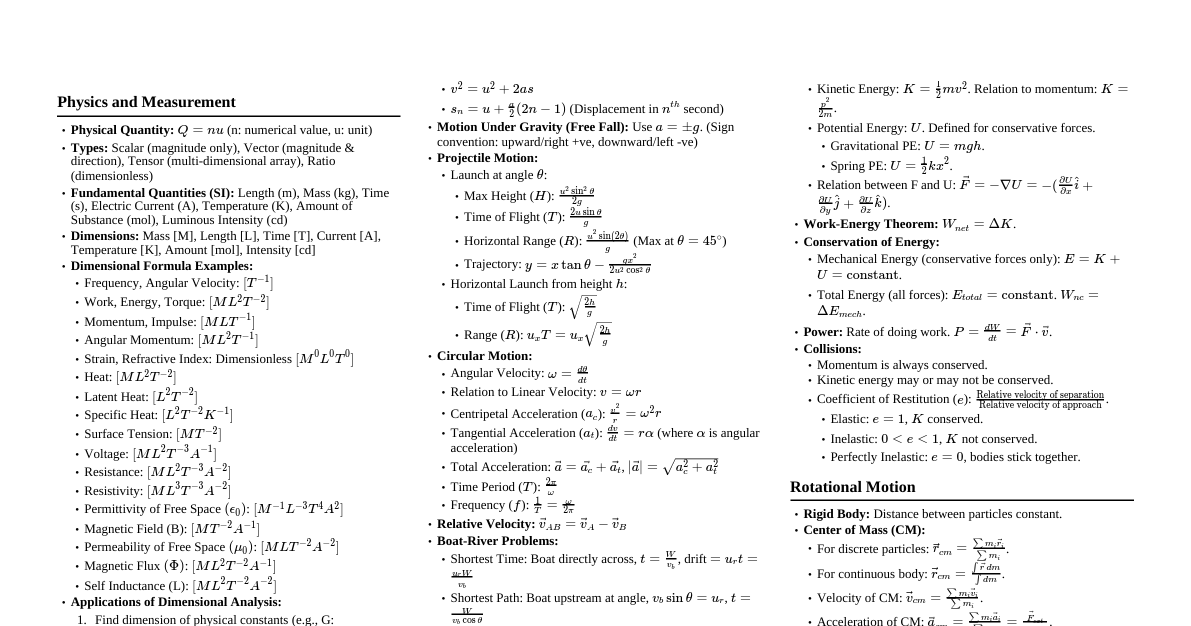
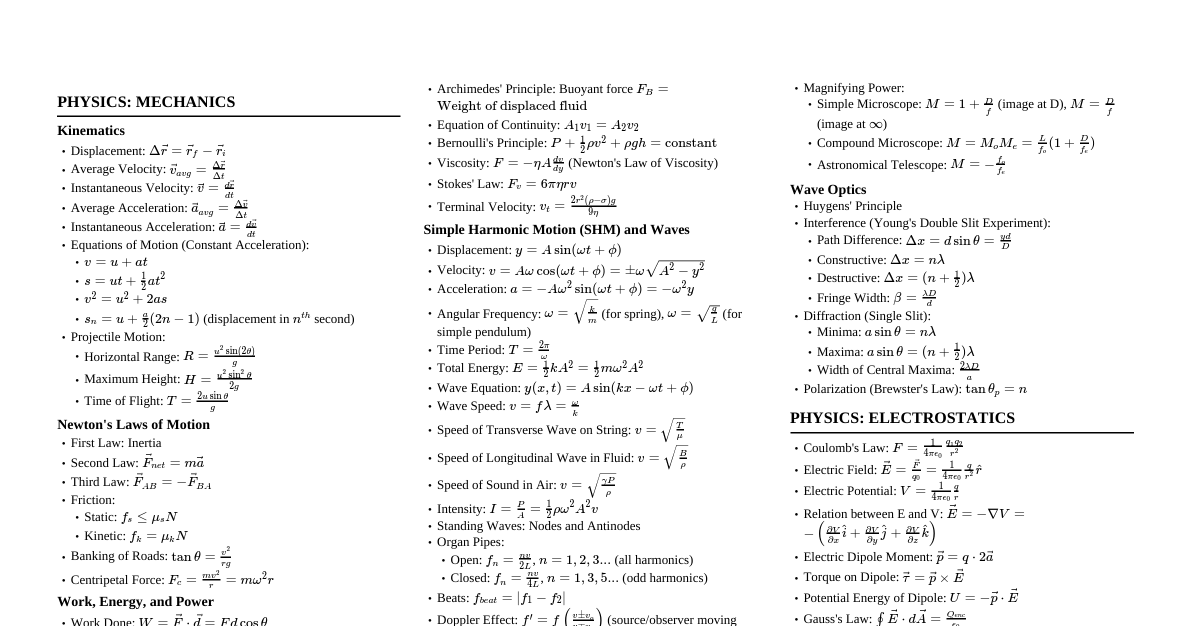
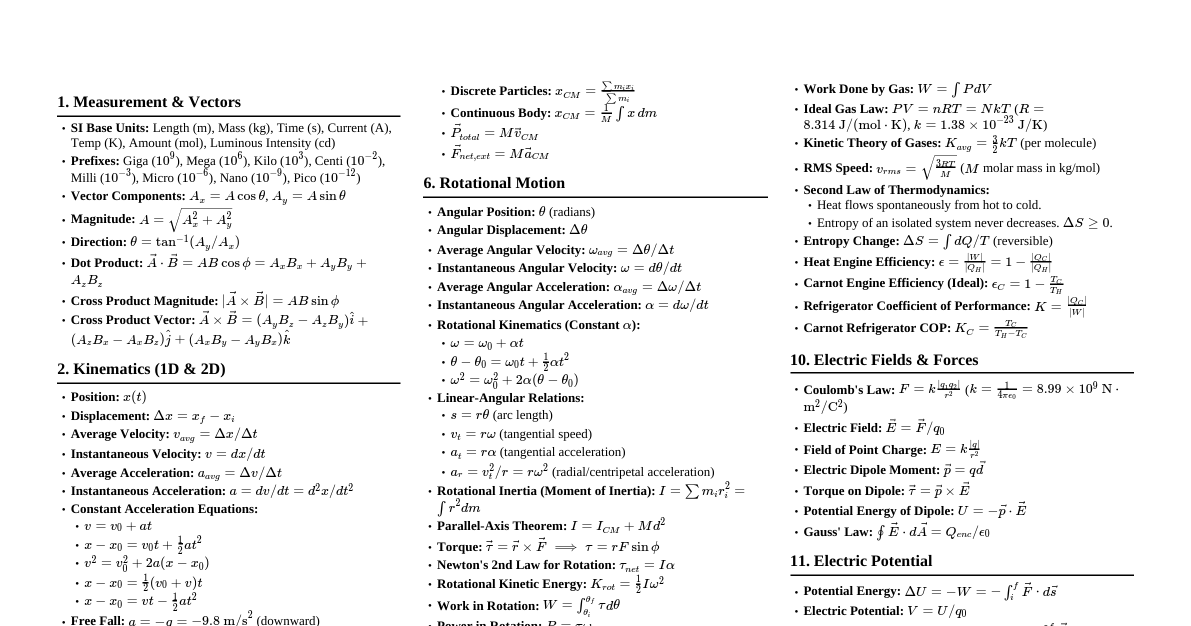
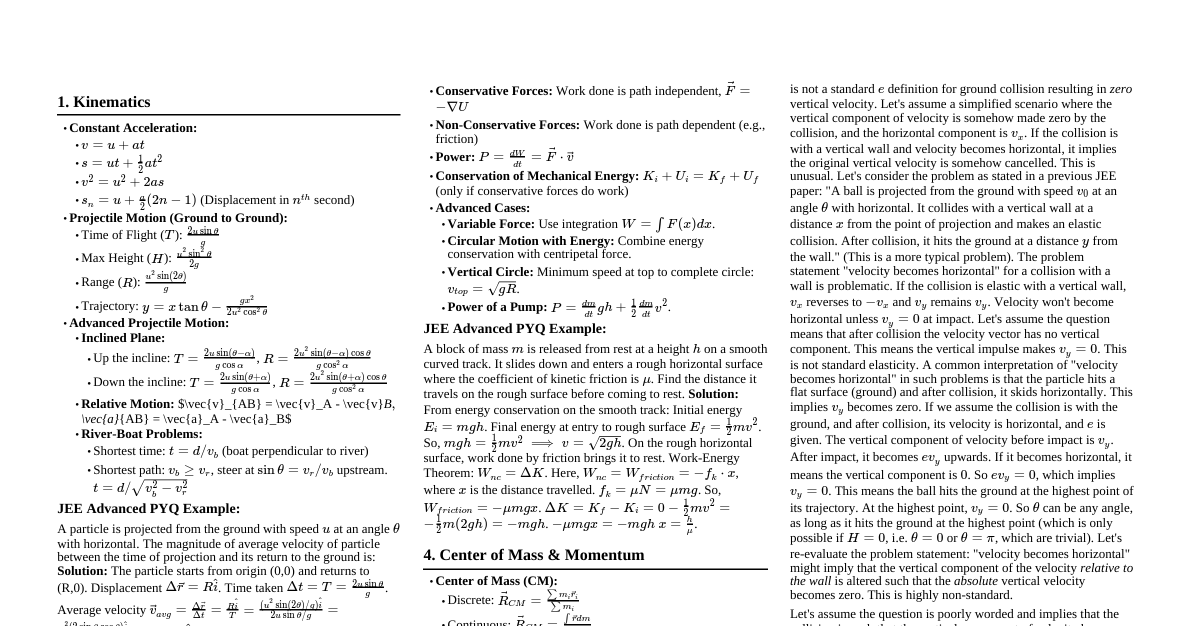
1. Mechanics 1.1 Kinematics Equations of Motion (Constant Acceleration): $v = u + at$ $s = ut + \frac{1}{2}at^2$ $v^2 = u^2 + 2as$ $s_n = u + \frac{a}{2}(2n-1)$ (displacement in $n^{th}$ second) Relative Velocity: $\vec{v}_{AB} = \vec{v}_A - \vec{v}_B$ Projectile Motion: Time of Flight: $T = \frac{2u \sin\theta}{g}$ Max Height: $H = \frac{u^2 \sin^2\theta}{2g}$ Range: $R = \frac{u^2 \sin(2\theta)}{g}$ Trajectory Equation: $y = x \tan\theta - \frac{gx^2}{2u^2 \cos^2\theta}$ Uniform Circular Motion: Angular Speed: $\omega = \frac{v}{r} = \frac{2\pi}{T} = 2\pi f$ Centripetal Acceleration: $a_c = \frac{v^2}{r} = r\omega^2$ Centripetal Force: $F_c = \frac{mv^2}{r} = mr\omega^2$ 1.2 Newton's Laws of Motion & Friction Newton's Second Law: $\vec{F}_{net} = m\vec{a} = \frac{d\vec{p}}{dt}$ Impulse: $\vec{J} = \int \vec{F} dt = \Delta \vec{p}$ Static Friction: $f_s \le \mu_s N$ Kinetic Friction: $f_k = \mu_k N$ Angle of Repose: $\tan\theta = \mu_s$ Pseudo Forces: In a frame accelerating with $\vec{a}_0$: $\vec{F}_{pseudo} = -m\vec{a}_0$ Centrifugal force (in rotating frame): $F_{centrifugal} = m\omega^2 r$ (outward) 1.3 Work, Energy & Power Work Done: $W = \vec{F} \cdot \vec{d} = Fd \cos\theta$ (constant force), $W = \int \vec{F} \cdot d\vec{r}$ (variable force) Kinetic Energy: $K = \frac{1}{2}mv^2$ Potential Energy: Gravitational: $U_g = mgh$ (near Earth), $U_g = -\frac{GMm}{r}$ (general) Spring: $U_s = \frac{1}{2}kx^2$ Conservative Force: $\vec{F} = -\nabla U$ Work-Energy Theorem: $W_{net} = \Delta K$ Conservation of Mechanical Energy: $K_i + U_i = K_f + U_f$ (for conservative forces) Power: $P = \frac{dW}{dt} = \vec{F} \cdot \vec{v}$ 1.4 Centre of Mass & Collisions CM Position: $\vec{r}_{CM} = \frac{\sum m_i \vec{r}_i}{\sum m_i} = \frac{\int \vec{r} dm}{\int dm}$ CM Velocity: $\vec{v}_{CM} = \frac{\sum m_i \vec{v}_i}{\sum m_i}$ Conservation of Momentum: $\sum \vec{p}_i = \sum \vec{p}_f$ (if $F_{ext}=0$) Coefficient of Restitution (e): $e = \frac{\text{relative velocity after collision}}{\text{relative velocity before collision}}$ Elastic: $e=1$ Inelastic: $0 Perfectly Inelastic: $e=0$ Rocket Propulsion: $v_f - v_i = v_e \ln\left(\frac{m_i}{m_f}\right)$ Centre of Mass for Specific Geometries: Uniform Rod (Length L): At $L/2$ from one end. Uniform Circular Ring/Disc (Radius R): At its geometric center. Uniform Hemisphere (Radius R): At $3R/8$ from the center of the flat base (solid), $R/2$ (hollow). Uniform Solid Cone (Height H): At $H/4$ from the base. Uniform Hollow Cone (Height H): At $H/3$ from the base. Uniform Solid/Hollow Sphere (Radius R): At its geometric center. Triangular Lamina (Height H): At $H/3$ from the base. 1.5 Rotational Motion Angular Kinematics: $\omega = \omega_0 + \alpha t$ $\theta = \omega_0 t + \frac{1}{2}\alpha t^2$ $\omega^2 = \omega_0^2 + 2\alpha\theta$ Relation between Linear & Angular: $\vec{v} = \vec{\omega} \times \vec{r}$, $\vec{a} = \vec{\alpha} \times \vec{r} + \vec{\omega} \times (\vec{\omega} \times \vec{r})$ ($a_t = r\alpha$, $a_c = r\omega^2$) Moment of Inertia: $I = \sum m_i r_i^2$, $I = \int r^2 dm$ Parallel Axis Theorem: $I = I_{CM} + Md^2$ Perpendicular Axis Theorem (for planar objects): $I_z = I_x + I_y$ Torque: $\vec{\tau} = \vec{r} \times \vec{F}$, $\tau = I\alpha$ Angular Momentum: $\vec{L} = \vec{r} \times \vec{p} = I\vec{\omega}$ (for rigid body), $\vec{L} = \sum (\vec{r}_i \times \vec{p}_i)$ Conservation of Angular Momentum: $\vec{L}_{initial} = \vec{L}_{final}$ (if $\tau_{ext}=0$) Rotational Kinetic Energy: $K_{rot} = \frac{1}{2}I\omega^2$ Rolling Motion: Pure rolling: $v_{CM} = R\omega$ Total Kinetic Energy: $K_{total} = \frac{1}{2}mv_{CM}^2 + \frac{1}{2}I_{CM}\omega^2$ Moments of Inertia for Specific Geometries: Uniform Rod (Mass M, Length L): About axis through CM and perpendicular to length: $I = \frac{1}{12}ML^2$ About axis through one end and perpendicular to length: $I = \frac{1}{3}ML^2$ Uniform Ring (Mass M, Radius R): About axis through center and perpendicular to plane: $I = MR^2$ About diameter: $I = \frac{1}{2}MR^2$ Uniform Disc (Mass M, Radius R): About axis through center and perpendicular to plane: $I = \frac{1}{2}MR^2$ About diameter: $I = \frac{1}{4}MR^2$ Hollow Cylinder (Mass M, Radius R): About its own axis: $I = MR^2$ Solid Cylinder (Mass M, Radius R): About its own axis: $I = \frac{1}{2}MR^2$ Hollow Sphere (Mass M, Radius R): About any diameter: $I = \frac{2}{3}MR^2$ Solid Sphere (Mass M, Radius R): About any diameter: $I = \frac{2}{5}MR^2$ 1.6 Gravitation Newton's Law of Gravitation: $F = G \frac{m_1 m_2}{r^2}$ Gravitational Field: $\vec{E}_g = \frac{\vec{F}_g}{m}$ Gravitational Potential: $V = -\frac{GM}{r}$ Gravitational Potential Energy: $U = -\frac{Gm_1 m_2}{r}$ Escape Velocity: $v_e = \sqrt{\frac{2GM}{R}}$ Orbital Velocity: $v_o = \sqrt{\frac{GM}{r}}$ Kepler's Laws: 1st Law: Orbits are ellipses with the Sun at one focus. 2nd Law: Equal areas swept in equal times ($\frac{dA}{dt} = \frac{L}{2m}$). 3rd Law: $T^2 \propto r^3$ or $T^2 = \left(\frac{4\pi^2}{GM}\right)r^3$. Gravitational Field/Potential for Specific Geometries: Uniform Solid Sphere (Mass M, Radius R): Outside ($r \ge R$): $E_g = \frac{GM}{r^2}$, $V = -\frac{GM}{r}$ Inside ($r Uniform Spherical Shell (Mass M, Radius R): Outside ($r \ge R$): $E_g = \frac{GM}{r^2}$, $V = -\frac{GM}{r}$ Inside ($r Uniform Thin Circular Ring (Mass M, Radius R): At axial point (distance $x$ from center): $E_g = \frac{GMx}{(R^2+x^2)^{3/2}}$, $V = -\frac{GM}{\sqrt{R^2+x^2}}$ At center ($x=0$): $E_g=0$, $V = -\frac{GM}{R}$ 1.7 Simple Harmonic Motion (SHM) Differential Equation: $\frac{d^2x}{dt^2} + \omega^2 x = 0$ Displacement: $x(t) = A \sin(\omega t + \phi)$ or $A \cos(\omega t + \phi)$ Velocity: $v(t) = A\omega \cos(\omega t + \phi) = \pm \omega \sqrt{A^2 - x^2}$ Acceleration: $a(t) = -A\omega^2 \sin(\omega t + \phi) = -\omega^2 x$ Angular Frequency: $\omega = \sqrt{\frac{k}{m}}$ (spring-mass), $\omega = \sqrt{\frac{g}{L_{eff}}}$ (pendulum) Time Period: $T = \frac{2\pi}{\omega}$ Energy in SHM: $E = \frac{1}{2}kA^2 = \frac{1}{2}m\omega^2 A^2$ Damped Oscillations: $x(t) = A_0 e^{-bt/2m} \cos(\omega' t + \phi)$ where $\omega' = \sqrt{\omega_0^2 - (b/2m)^2}$ Forced Oscillations & Resonance: Amplitude maximum when driving frequency equals natural frequency. 1.8 Fluid Mechanics Pressure: $P = \frac{F}{A}$ Pressure in Fluid: $P = P_0 + \rho gh$ Pascal's Law: Pressure applied to an enclosed fluid is transmitted undiminished. Archimedes' Principle: Buoyant force $F_B = \rho_{fluid} V_{submerged} g$ Equation of Continuity: $A_1 v_1 = A_2 v_2$ (for incompressible fluid) Bernoulli's Equation: $P + \frac{1}{2}\rho v^2 + \rho gh = \text{constant}$ Viscosity: $F = -\eta A \frac{dv}{dy}$ (Newton's Law of Viscosity) Stokes' Law: $F_v = 6\pi\eta rv$ (for spherical body) Terminal Velocity: $v_t = \frac{2r^2(\rho_p - \rho_f)g}{9\eta}$ Surface Tension: $S = \frac{F}{L}$ Excess Pressure in Bubble/Drop: Liquid drop: $\Delta P = \frac{2S}{R}$ Soap bubble: $\Delta P = \frac{4S}{R}$ Capillary Rise: $h = \frac{2S \cos\theta}{\rho rg}$ 1.9 Properties of Matter Stress: $\sigma = F/A$ Strain: Longitudinal ($\Delta L/L$), Volumetric ($\Delta V/V$), Shear ($\phi$) Young's Modulus: $Y = \frac{\text{Tensile Stress}}{\text{Tensile Strain}} = \frac{F/A}{\Delta L/L}$ Bulk Modulus: $B = \frac{\text{Volumetric Stress}}{\text{Volumetric Strain}} = \frac{-\Delta P}{\Delta V/V}$ Shear Modulus: $G = \frac{\text{Shear Stress}}{\text{Shear Strain}} = \frac{F/A}{\phi}$ Poisson's Ratio: $\sigma = -\frac{\text{lateral strain}}{\text{longitudinal strain}}$ 2. Heat & Thermodynamics 2.1 Thermal Expansion Linear: $\Delta L = L_0 \alpha \Delta T$ Area: $\Delta A = A_0 \beta \Delta T$, where $\beta = 2\alpha$ Volume: $\Delta V = V_0 \gamma \Delta T$, where $\gamma = 3\alpha$ 2.2 Calorimetry & Heat Transfer Heat required: $Q = mc\Delta T$ (for temp change), $Q = mL$ (for phase change) Conduction: $\frac{dQ}{dt} = -KA\frac{dT}{dx}$ (Fourier's Law) Convection: $\frac{dQ}{dt} = hA\Delta T$ Radiation (Stefan-Boltzmann Law): $P = \sigma e A T^4$ (Power radiated) Wien's Displacement Law: $\lambda_m T = b$ (constant) Newton's Law of Cooling: $\frac{dT}{dt} = -k(T - T_s)$ 2.3 Thermodynamics First Law: $\Delta U = Q - W$ Work Done by Gas: $W = \int P dV$ Isobaric: $W = P\Delta V$ Isothermal: $W = nRT \ln\left(\frac{V_f}{V_i}\right)$ Adiabatic: $W = \frac{P_i V_i - P_f V_f}{\gamma - 1}$ Isochoric: $W = 0$ Specific Heat Capacity (Molar): $C_P - C_V = R$ (Mayer's relation) Ratio of Specific Heats: $\gamma = \frac{C_P}{C_V}$ Efficiency of Heat Engine: $\eta = 1 - \frac{Q_C}{Q_H} = 1 - \frac{T_C}{T_H}$ (Carnot) Coefficient of Performance (Refrigerator): $K = \frac{Q_C}{W} = \frac{T_C}{T_H - T_C}$ Second Law of Thermodynamics: Entropy of an isolated system never decreases. $\Delta S \ge 0$. 2.4 Kinetic Theory of Gases Ideal Gas Equation: $PV = nRT = NkT$ Average Kinetic Energy per molecule: $\langle K \rangle = \frac{3}{2}kT$ RMS Speed: $v_{rms} = \sqrt{\frac{3RT}{M}} = \sqrt{\frac{3kT}{m}}$ Most Probable Speed: $v_{mp} = \sqrt{\frac{2RT}{M}}$ Average Speed: $v_{avg} = \sqrt{\frac{8RT}{\pi M}}$ Degrees of Freedom ($f$): Monatomic (3), Diatomic (5), Polyatomic (6) Internal Energy: $U = \frac{f}{2}nRT$ Specific Heats: $C_V = \frac{f}{2}R$, $C_P = \left(1 + \frac{f}{2}\right)R$ 3. Waves 3.1 Transverse & Longitudinal Waves Wave Equation: $y(x,t) = A \sin(kx - \omega t + \phi)$ Wave Speed: $v = f\lambda = \frac{\omega}{k}$ Speed of Transverse wave on string: $v = \sqrt{\frac{T}{\mu}}$ Speed of Sound: $v = \sqrt{\frac{B}{\rho}}$ (liquid), $v = \sqrt{\frac{\gamma P}{\rho}}$ (gas) Energy Density of a Wave: $u = \frac{1}{2}\rho \omega^2 A^2$ Intensity: $I = \frac{P}{A} = \frac{1}{2}\rho v \omega^2 A^2$ 3.2 Sound Waves Intensity Level: $\beta = 10 \log_{10}\left(\frac{I}{I_0}\right)$ dB Doppler Effect: $f' = f \left(\frac{v \pm v_O}{v \mp v_S}\right)$ (Upper signs for approach, lower for recession) Standing Waves in Organ Pipes: Open pipe: $f_n = \frac{nv}{2L}$, $n=1,2,3...$ (all harmonics) Closed pipe: $f_n = \frac{nv}{4L}$, $n=1,3,5...$ (odd harmonics) Standing Waves in Strings: $f_n = \frac{nv}{2L}\sqrt{\frac{T}{\mu}}$, $n=1,2,3...$ Beats: $f_{beat} = |f_1 - f_2|$ 4. Optics 4.1 Ray Optics Mirror Formula: $\frac{1}{f} = \frac{1}{v} + \frac{1}{u}$ (concave $f 0$) Magnification: $m = -\frac{v}{u} = \frac{h_i}{h_o}$ Refraction (Snell's Law): $n_1 \sin\theta_1 = n_2 \sin\theta_2$ Critical Angle: $\sin\theta_c = \frac{n_2}{n_1}$ (for $n_1 > n_2$) Real Depth / Apparent Depth: $n = \frac{\text{real depth}}{\text{apparent depth}}$ Refraction at Spherical Surface: $\frac{n_2}{v} - \frac{n_1}{u} = \frac{n_2 - n_1}{R}$ Lens Formula: $\frac{1}{f} = \frac{1}{v} - \frac{1}{u}$ (converging $f>0$, diverging $f Lens Maker's Formula: $\frac{1}{f} = (n-1)\left(\frac{1}{R_1} - \frac{1}{R_2}\right)$ Power of Lens: $P = \frac{1}{f}$ (in diopters, $f$ in meters) Combination of Lenses: $P_{eq} = P_1 + P_2$, $\frac{1}{f_{eq}} = \frac{1}{f_1} + \frac{1}{f_2}$ (when in contact) Prism: $\delta = (n-1)A$ (for small angle prism), $A = r_1 + r_2$, $\delta = i_1 + i_2 - A$ Optical Instruments: Simple Microscope: $M = 1 + \frac{D}{f}$ (image at D), $M = \frac{D}{f}$ (image at $\infty$) Compound Microscope: $M = \frac{L}{f_o} \left(1 + \frac{D}{f_e}\right)$ Astronomical Telescope: $M = -\frac{f_o}{f_e}$ (normal adjustment), $L = f_o + f_e$ 4.2 Wave Optics Huygens' Principle: Every point on a wavefront is a source of secondary wavelets. Interference (Young's Double Slit): Path difference: $\Delta x = d \sin\theta = \frac{yd}{D}$ Bright Fringes: $\Delta x = n\lambda$ Dark Fringes: $\Delta x = (n + \frac{1}{2})\lambda$ Fringe Width: $\beta = \frac{\lambda D}{d}$ Intensity distribution: $I = I_0 \cos^2\left(\frac{\pi d \sin\theta}{\lambda}\right)$ Diffraction (Single Slit): Minima: $a \sin\theta = n\lambda$ Central Maxima Angular Width: $2\theta = \frac{2\lambda}{a}$ Central Maxima Linear Width: $\frac{2\lambda D}{a}$ Polarization (Brewster's Law): $\tan\theta_p = n$ Malus's Law: $I = I_0 \cos^2\theta$ Resolving Power: Microscope: $RP = \frac{2n \sin\theta}{1.22\lambda}$ Telescope: $RP = \frac{D}{1.22\lambda}$ 5. Electrostatics & Current Electricity 5.1 Electrostatics Coulomb's Law: $F = \frac{1}{4\pi\epsilon_0} \frac{q_1 q_2}{r^2}$ Electric Field: $\vec{E} = \frac{\vec{F}}{q_0} = \frac{1}{4\pi\epsilon_0} \frac{q}{r^2}\hat{r}$, $\vec{E} = -\nabla V$ Electric Potential: $V = \frac{1}{4\pi\epsilon_0} \frac{q}{r}$ Potential Energy: $U = qV = \frac{1}{4\pi\epsilon_0} \frac{q_1 q_2}{r}$ Electric Dipole Moment: $\vec{p} = q(2\vec{a})$ (from -q to +q) Electric Field of an Electric Dipole: Axial Point (at distance $r \gg a$ from center): $E = \frac{1}{4\pi\epsilon_0} \frac{2p}{r^3}$ Equatorial Point (at distance $r \gg a$ from center): $E = \frac{1}{4\pi\epsilon_0} \frac{p}{r^3}$ General Point (at $r, \theta$): $E_r = \frac{1}{4\pi\epsilon_0} \frac{2p \cos\theta}{r^3}$, $E_\theta = \frac{1}{4\pi\epsilon_0} \frac{p \sin\theta}{r^3}$ Potential of an Electric Dipole: $V = \frac{1}{4\pi\epsilon_0} \frac{p \cos\theta}{r^2}$ Torque on Dipole: $\vec{\tau} = \vec{p} \times \vec{E}$ Potential Energy of Dipole: $U = -\vec{p} \cdot \vec{E}$ Gauss's Law: $\oint \vec{E} \cdot d\vec{A} = \frac{Q_{enc}}{\epsilon_0}$ Capacitance: $C = \frac{Q}{V}$ Parallel Plate Capacitor: $C = \frac{\epsilon_0 A}{d}$ (with dielectric $C = \frac{K\epsilon_0 A}{d}$) Energy Stored in Capacitor: $U = \frac{1}{2}CV^2 = \frac{Q^2}{2C} = \frac{1}{2}QV$ Energy Density in Electric Field: $u_E = \frac{1}{2}\epsilon_0 E^2$ Capacitors in Series: $\frac{1}{C_{eq}} = \sum \frac{1}{C_i}$ Capacitors in Parallel: $C_{eq} = \sum C_i$ Electric Field/Potential for Specific Geometries (derived using Gauss's Law or integration): Uniformly Charged Ring (Charge Q, Radius R): At axial point (distance $x$ from center): $E = \frac{1}{4\pi\epsilon_0} \frac{Qx}{(R^2+x^2)^{3/2}}$, $V = \frac{1}{4\pi\epsilon_0} \frac{Q}{\sqrt{R^2+x^2}}$ At center ($x=0$): $E=0$, $V = \frac{1}{4\pi\epsilon_0} \frac{Q}{R}$ Uniformly Charged Disc (Charge Q, Radius R): At axial point (distance $x$ from center): $E = \frac{\sigma}{2\epsilon_0} \left(1 - \frac{x}{\sqrt{R^2+x^2}}\right)$, where $\sigma = Q/(\pi R^2)$ Infinite Line Charge (Linear charge density $\lambda$): $E = \frac{\lambda}{2\pi\epsilon_0 r}$ Infinite Plane Sheet (Surface charge density $\sigma$): $E = \frac{\sigma}{2\epsilon_0}$ Uniformly Charged Spherical Shell (Charge Q, Radius R): Outside ($r \ge R$): $E = \frac{1}{4\pi\epsilon_0} \frac{Q}{r^2}$, $V = \frac{1}{4\pi\epsilon_0} \frac{Q}{r}$ Inside ($r Uniformly Charged Solid Sphere (Charge Q, Radius R): Outside ($r \ge R$): $E = \frac{1}{4\pi\epsilon_0} \frac{Q}{r^2}$, $V = \frac{1}{4\pi\epsilon_0} \frac{Q}{r}$ Inside ($r 5.2 Current Electricity Current: $I = \frac{dQ}{dt} = nAve_d$ (Drift Velocity $v_d = \frac{eE\tau}{m}$) Ohm's Law: $V = IR$ Resistance: $R = \rho \frac{L}{A}$ Conductivity: $\sigma = \frac{1}{\rho}$ Resistivity Temperature Dependence: $\rho_T = \rho_0 [1 + \alpha(T - T_0)]$ Resistors in Series: $R_{eq} = \sum R_i$ Resistors in Parallel: $\frac{1}{R_{eq}} = \sum \frac{1}{R_i}$ Kirchhoff's Laws: Junction Rule ($\Sigma I = 0$, conservation of charge) Loop Rule ($\Sigma V = 0$, conservation of energy) Electrical Power: $P = VI = I^2 R = \frac{V^2}{R}$ Cells in Series: $E_{eq} = \sum E_i$, $r_{eq} = \sum r_i$ Cells in Parallel: $\frac{1}{r_{eq}} = \sum \frac{1}{r_i}$, $\frac{E_{eq}}{r_{eq}} = \sum \frac{E_i}{r_i}$ Wheatstone Bridge: $\frac{P}{Q} = \frac{R}{S}$ (balanced condition) Meter Bridge: $\frac{R}{S} = \frac{L_1}{100-L_1}$ Potentiometer: Comparison of EMFs: $\frac{E_1}{E_2} = \frac{L_1}{L_2}$ Internal Resistance: $r = R\left(\frac{L_1}{L_2} - 1\right)$ 6. Magnetism & Electromagnetic Induction (EMI) 6.1 Magnetic Effects of Current & Magnetism Biot-Savart Law: $d\vec{B} = \frac{\mu_0}{4\pi} \frac{I d\vec{l} \times \vec{r}}{r^3}$ Magnetic Field due to Long Straight Wire: $B = \frac{\mu_0 I}{2\pi r}$ Magnetic Field at Center of Circular Loop: $B = \frac{\mu_0 I}{2R}$ Magnetic Field on Axis of Circular Loop (distance $x$ from center): $B = \frac{\mu_0 I R^2}{2(R^2+x^2)^{3/2}}$ Magnetic Field inside Solenoid: $B = \mu_0 nI$ Magnetic Field inside Toroid: $B = \frac{\mu_0 NI}{2\pi r}$ Ampere's Circuital Law: $\oint \vec{B} \cdot d\vec{l} = \mu_0 I_{enc}$ Lorentz Force: $\vec{F} = q(\vec{E} + \vec{v} \times \vec{B})$ Force on Current Carrying Wire: $\vec{F} = I(\vec{L} \times \vec{B})$ Force between two parallel current-carrying wires: $F = \frac{\mu_0 I_1 I_2 L}{2\pi d}$ (attractive if currents are same direction) Magnetic Dipole Moment: $\vec{M} = I\vec{A}$ (for a current loop), or $\vec{M} = N I \vec{A}$ (for a coil) Torque on Current Loop/Magnetic Dipole: $\vec{\tau} = \vec{M} \times \vec{B}$ Potential Energy of Magnetic Dipole: $U = -\vec{M} \cdot \vec{B}$ Cyclotron Frequency: $f = \frac{qB}{2\pi m}$ Hall Effect: $V_H = \frac{IB}{net}$ Moving Coil Galvanometer: $\tau = NIAB \sin\theta$ (usually $\sin\theta \approx 1$ for radial field) Conversion of Galvanometer: To Ammeter: Shunt Resistance $R_s = \frac{I_g G}{I - I_g}$ To Voltmeter: Series Resistance $R_{series} = \frac{V}{I_g} - G$ Magnetic Properties of Materials: Intensity of Magnetisation: $I_m = M/V$ Magnetic Intensity: $H = B/\mu_0 - I_m$ Magnetic Susceptibility: $\chi_m = I_m/H$ Relative Permeability: $\mu_r = 1 + \chi_m$ Permeability: $\mu = \mu_0 \mu_r$ Diamagnetic, Paramagnetic, Ferromagnetic materials characteristics. Earth's Magnetism: Angle of dip, angle of declination, horizontal component. 6.2 EMI & AC Magnetic Flux: $\Phi_B = \int \vec{B} \cdot d\vec{A}$ Faraday's Law of EMI: $\mathcal{E} = -\frac{d\Phi_B}{dt}$ Lenz's Law: Induced current opposes the change in magnetic flux that produced it. Motional EMF: $\mathcal{E} = Blv$ (conductor moving in uniform B-field) Self-Inductance: $\Phi_B = LI$, $\mathcal{E} = -L\frac{dI}{dt}$ Mutual Inductance: $\Phi_{21} = M_{21}I_1$, $\mathcal{E}_2 = -M_{21}\frac{dI_1}{dt}$ Energy Stored in Inductor: $U = \frac{1}{2}LI^2$ Energy Density in Magnetic Field: $u_B = \frac{B^2}{2\mu_0}$ AC Circuit (RMS values): $V_{rms} = \frac{V_0}{\sqrt{2}}$, $I_{rms} = \frac{I_0}{\sqrt{2}}$ Reactance: Inductive: $X_L = \omega L = 2\pi f L$ Capacitive: $X_C = \frac{1}{\omega C} = \frac{1}{2\pi f C}$ Impedance (Z): $Z = \sqrt{R^2 + (X_L - X_C)^2}$ Phase Angle: $\tan\phi = \frac{X_L - X_C}{R}$ Power in AC Circuit: $P = V_{rms} I_{rms} \cos\phi$ (Power Factor: $\cos\phi = \frac{R}{Z}$) Resonance (Series LCR): $X_L = X_C \implies \omega_0 = \frac{1}{\sqrt{LC}}$, $Z_{min}=R$ Quality Factor (Q-factor): $Q = \frac{\omega_0 L}{R} = \frac{1}{\omega_0 C R}$ Transformer: $\frac{V_s}{V_p} = \frac{N_s}{N_p} = \frac{I_p}{I_s}$ (ideal) LC Oscillations: $\omega = \frac{1}{\sqrt{LC}}$ 6.3 Electromagnetic Waves Speed of EM waves in vacuum: $c = \frac{1}{\sqrt{\mu_0 \epsilon_0}}$ Speed of EM waves in medium: $v = \frac{1}{\sqrt{\mu \epsilon}}$ Relationship between E and B: $E = cB$ Poynting Vector (Intensity): $\vec{S} = \frac{1}{\mu_0}(\vec{E} \times \vec{B})$, $I_{avg} = \frac{1}{2} c \epsilon_0 E_0^2 = \frac{E_0 B_0}{2\mu_0}$ Momentum carried by EM waves: $p = \frac{U}{c}$ EM Spectrum: Radio, Microwave, IR, Visible, UV, X-ray, Gamma ray. 7. Modern Physics 7.1 Dual Nature of Matter & Radiation Photon Energy: $E = hf = \frac{hc}{\lambda}$ Momentum of Photon: $p = \frac{h}{\lambda} = \frac{E}{c}$ Photoelectric Effect: $K_{max} = hf - \phi_0$ (Work Function $\phi_0 = hf_0$) de Broglie Wavelength: $\lambda = \frac{h}{p} = \frac{h}{mv}$ de Broglie for accelerated electron: $\lambda = \frac{h}{\sqrt{2meV}}$ Heisenberg's Uncertainty Principle: $\Delta x \Delta p_x \ge \frac{\hbar}{2}$, $\Delta E \Delta t \ge \frac{\hbar}{2}$ 7.2 Atoms & Nuclei Bohr's Model for Hydrogen-like atoms: Radius of $n^{th}$ orbit: $r_n = 0.529 \frac{n^2}{Z}$ Å Velocity of electron in $n^{th}$ orbit: $v_n = 2.18 \times 10^6 \frac{Z}{n}$ m/s Energy of $n^{th}$ orbit: $E_n = -13.6 \frac{Z^2}{n^2}$ eV Rydberg Formula: $\frac{1}{\lambda} = RZ^2 \left(\frac{1}{n_1^2} - \frac{1}{n_2^2}\right)$ X-rays (Moseley's Law): $\sqrt{f} = a(Z-b)$ Mass Defect: $\Delta m = (Zm_p + Nm_n) - M_{nucleus}$ Binding Energy: $BE = \Delta m c^2$ Radioactivity (Decay Law): $N = N_0 e^{-\lambda t}$ Half-life: $T_{1/2} = \frac{\ln 2}{\lambda} = \frac{0.693}{\lambda}$ Mean Life: $\tau = \frac{1}{\lambda}$ Activity: $A = \lambda N$ Nuclear Fission & Fusion: Basic understanding of processes. 7.3 Semiconductors & Communication Systems PN Junction Diode: Forward bias (low resistance), Reverse bias (high resistance) Rectifiers: Half-wave, Full-wave (conversion of AC to DC) Zener Diode: Voltage regulator. Transistors (BJT): $I_E = I_B + I_C$ Current gain $\alpha = \frac{I_C}{I_E}$, $\beta = \frac{I_C}{I_B}$ Relation: $\beta = \frac{\alpha}{1-\alpha}$ Logic Gates: AND, OR, NOT, NAND, NOR, XOR, XNOR (Truth tables and symbols) Communication Systems: Modulation: Amplitude Modulation (AM), Frequency Modulation (FM) Bandwidth: Range of frequencies occupied by a signal. Propagation: Ground wave, Sky wave, Space wave. Antenna length: $\lambda/4$ for efficient radiation. 8. Experimental Physics Concepts & Errors Vernier Calipers: LC = 1 MSD - 1 VSD Screw Gauge: LC = Pitch / No. of divisions on circular scale Errors: Absolute error: $|\Delta A|$ Relative error: $\frac{\Delta A}{A}$ Percentage error: $\frac{\Delta A}{A} \times 100\%$ Propagation of errors: Addition/Subtraction: $\Delta Z = \Delta A + \Delta B$ (for $Z=A \pm B$) Multiplication/Division: $\frac{\Delta Z}{Z} = \frac{\Delta A}{A} + \frac{\Delta B}{B}$ (for $Z=AB$ or $Z=A/B$) Powers: $\frac{\Delta Z}{Z} = n \frac{\Delta A}{A}$ (for $Z=A^n$) Least Count: Smallest measurement that can be made accurately with an instrument. Significant Figures: Rules for counting and performing operations.