Electrostatics JEE Mains
Shared 3/21/2026•51 views
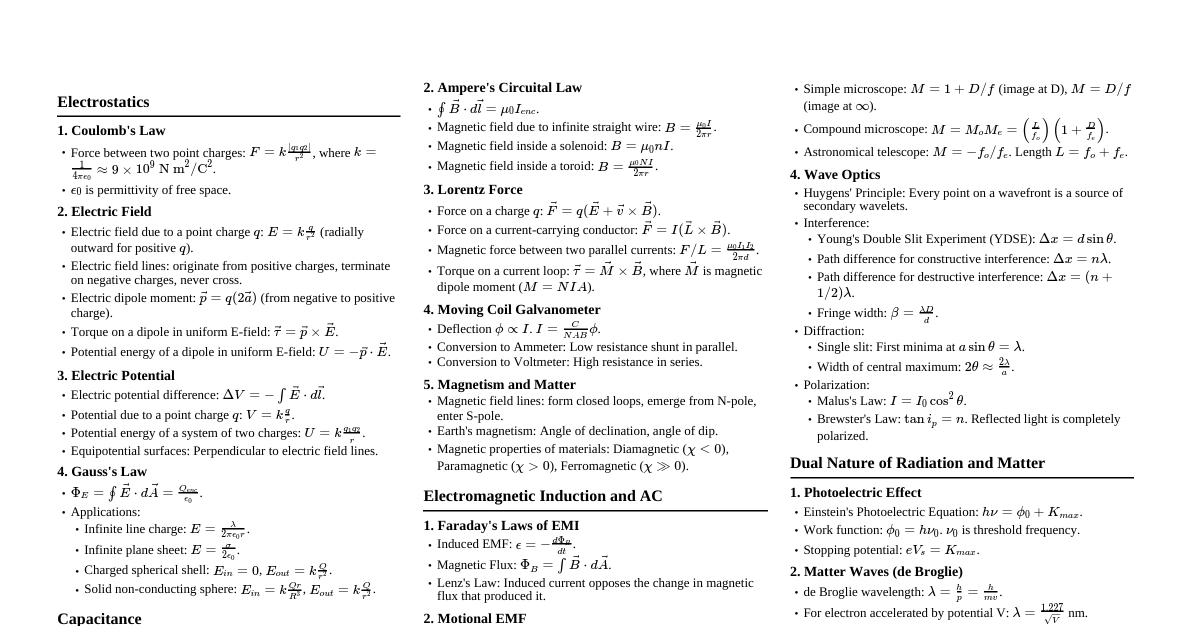
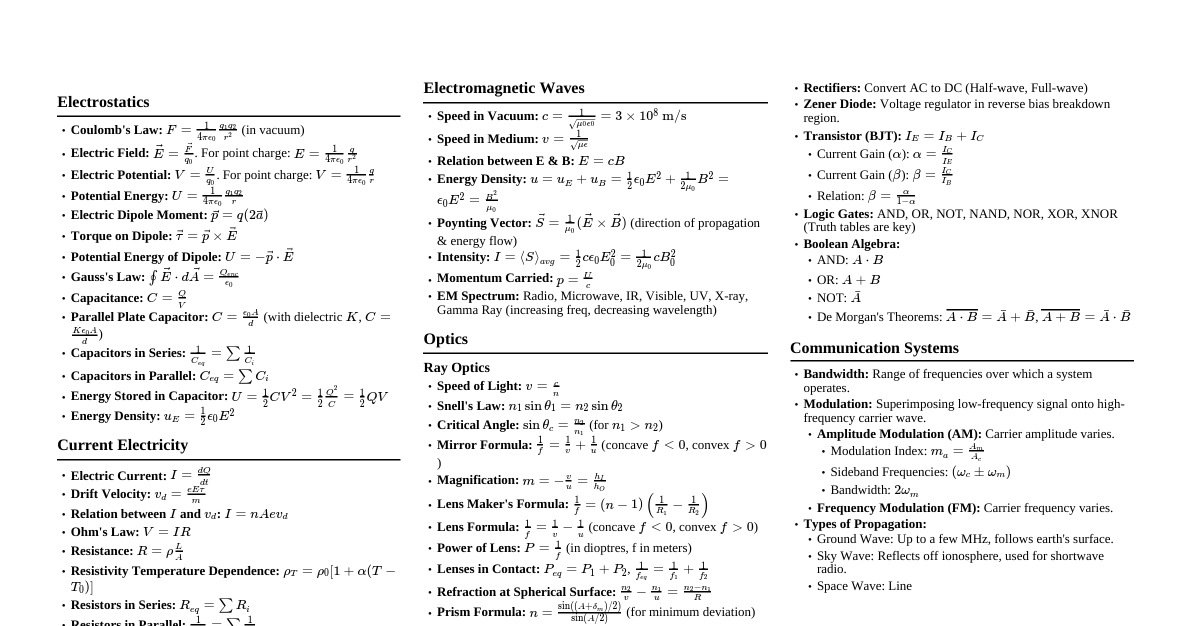
### Coulomb's Law - **Force between two point charges:** $$F = k \frac{|q_1 q_2|}{r^2}$$ where $k = \frac{1}{4\pi\epsilon_0} = 9 \times 10^9 \text{ Nm}^2/\text{C}^2$ $\epsilon_0 = 8.85 \times 10^{-12} \text{ C}^2/\text{Nm}^2$ (permittivity of free space) - **Vector form:** $\vec{F}_{12} = k \frac{q_1 q_2}{r^3} \vec{r}_{12}$ or $\vec{F}_{12} = k \frac{q_1 q_2}{|\vec{r}_{12}|^2} \hat{r}_{12}$ - **Principle of Superposition:** The total force on a charge is the vector sum of forces due to all other charges. $\vec{F}_{total} = \sum_{i} \vec{F}_i$ ### Electric Field ($\vec{E}$) - **Definition:** Force experienced by a unit positive test charge. $\vec{E} = \frac{\vec{F}}{q_0}$ - **Due to a point charge Q:** $$E = k \frac{|Q|}{r^2}$$ Direction is radially outward for positive Q, inward for negative Q. - **Due to a system of charges:** $\vec{E}_{total} = \sum_{i} \vec{E}_i$ (Superposition Principle) - **Electric field lines:** - Originate from positive charges, terminate on negative charges. - Never intersect. - Tangent at any point gives direction of $\vec{E}$. - Density of lines proportional to field strength. - No electric field lines inside a conductor. #### Common Electric Field Configurations: - **Infinite line charge (linear charge density $\lambda$):** $E = \frac{\lambda}{2\pi\epsilon_0 r}$ (radially outward) - **Infinite plane sheet (surface charge density $\sigma$):** $E = \frac{\sigma}{2\epsilon_0}$ (perpendicular to plane) - **Uniformly charged spherical shell:** - Inside ($r ### Electric Potential (V) - **Definition:** Work done by external force to bring a unit positive test charge from infinity to a point without acceleration. $V = \frac{W}{q_0}$ (Scalar quantity, SI unit: Volt (V) = J/C) - **Potential difference:** $V_B - V_A = -\int_A^B \vec{E} \cdot d\vec{l}$ - **Relation between E and V:** $\vec{E} = -\nabla V = -\left(\frac{\partial V}{\partial x}\hat{i} + \frac{\partial V}{\partial y}\hat{j} + \frac{\partial V}{\partial z}\hat{k}\right)$ For 1D, $E = -\frac{dV}{dr}$ - **Due to a point charge Q:** $V = k \frac{Q}{r}$ - **Due to a system of charges:** $V_{total} = \sum_{i} V_i$ - **Equipotential surfaces:** - Surfaces where potential is constant. - Electric field lines are always perpendicular to equipotential surfaces. - No work is done in moving a charge along an equipotential surface. #### Common Electric Potential Configurations: - **Infinite line charge:** $V = \frac{\lambda}{2\pi\epsilon_0} \ln\left(\frac{r_0}{r}\right)$ (reference $r_0$) - **Infinite plane sheet:** $V = -\frac{\sigma}{2\epsilon_0} x + C$ - **Uniformly charged spherical shell:** - Inside ($r ### Electric Dipole - **Definition:** Two equal and opposite charges (+q and -q) separated by a small distance 2a. - **Dipole moment:** $\vec{p} = q(2\vec{a})$ (direction from -q to +q) - **Electric field due to a short dipole (2a ### Gauss's Law - **Electric flux ($\Phi_E$):** $\Phi_E = \int \vec{E} \cdot d\vec{A}$ - **Gauss's Law:** The total electric flux through any closed surface (Gaussian surface) is $1/\epsilon_0$ times the net charge enclosed by the surface. $$\oint \vec{E} \cdot d\vec{A} = \frac{Q_{enc}}{\epsilon_0}$$ - **Applications:** - **Infinite line charge:** $E = \frac{\lambda}{2\pi\epsilon_0 r}$ - **Infinite plane sheet:** $E = \frac{\sigma}{2\epsilon_0}$ - **Charged spherical shell/solid sphere:** Used to derive E field expressions. ### Conductors in Electrostatic Equilibrium - Net electric field inside a conductor is zero. - Any net charge resides on the surface of the conductor. - Electric potential is constant throughout the volume of the conductor and equal to its surface potential. - Electric field at the surface of a charged conductor is perpendicular to the surface: $E = \frac{\sigma}{\epsilon_0}$ - For a conductor with a cavity, if no charge is inside the cavity, the field in the cavity is zero (Faraday cage effect). ### Electrostatic Potential Energy - **Of a system of two point charges:** $U = k \frac{q_1 q_2}{r}$ - **Of a system of N point charges:** $U = \sum_{all pairs} k \frac{q_i q_j}{r_{ij}}$ - **In an external electric field:** - For a single charge q: $U = qV(\vec{r})$ - For an electric dipole: $U = -\vec{p} \cdot \vec{E}$ - **Energy density in electric field:** $u_E = \frac{1}{2}\epsilon_0 E^2$ (Energy per unit volume) ### Capacitance (C) - **Definition:** Ability of a conductor to store electric charge. $C = \frac{Q}{V}$ (SI unit: Farad (F) = C/V) - **Parallel Plate Capacitor:** $C = \frac{\epsilon_0 A}{d}$ - **Spherical Capacitor:** $C = 4\pi\epsilon_0 \frac{R_1 R_2}{R_2 - R_1}$ (for isolated sphere, $C = 4\pi\epsilon_0 R$) - **Cylindrical Capacitor:** $C = \frac{2\pi\epsilon_0 L}{\ln(R_2/R_1)}$ - **Effect of Dielectric:** - When dielectric (dielectric constant K) fills space between plates: $C' = KC = K \frac{\epsilon_0 A}{d}$ - Electric field inside dielectric: $E_d = \frac{E_0}{K}$ ($E_0$ is field without dielectric) - Potential difference: $V_d = \frac{V_0}{K}$ #### Combination of Capacitors: - **Series:** $\frac{1}{C_{eq}} = \frac{1}{C_1} + \frac{1}{C_2} + ...$ (Charge is same, Voltage divides) - **Parallel:** $C_{eq} = C_1 + C_2 + ...$ (Voltage is same, Charge divides) #### Energy Stored in a Capacitor: $$U = \frac{1}{2}CV^2 = \frac{1}{2}\frac{Q^2}{C} = \frac{1}{2}QV$$ - **Energy density:** $u_E = \frac{1}{2}\epsilon_0 E^2$ ### Dielectrics and Polarization - **Dielectric:** Non-conducting material that can be polarized by an external electric field. - **Polarization (P):** Dipole moment per unit volume. $\vec{P} = \chi_e \epsilon_0 \vec{E}_{ext}$ $\chi_e$ is electric susceptibility. - **Displacement vector (D):** $\vec{D} = \epsilon_0 \vec{E} + \vec{P} = \epsilon_0 (1 + \chi_e) \vec{E} = \epsilon_0 K \vec{E} = \epsilon \vec{E}$ where $K = 1 + \chi_e$ is the dielectric constant, $\epsilon = K\epsilon_0$ is the permittivity of the medium. - **Gauss's law in dielectrics:** $\oint \vec{D} \cdot d\vec{A} = Q_{free,enc}$