Electrochemistry JEE Cheatsheet
Cheatsheet Content
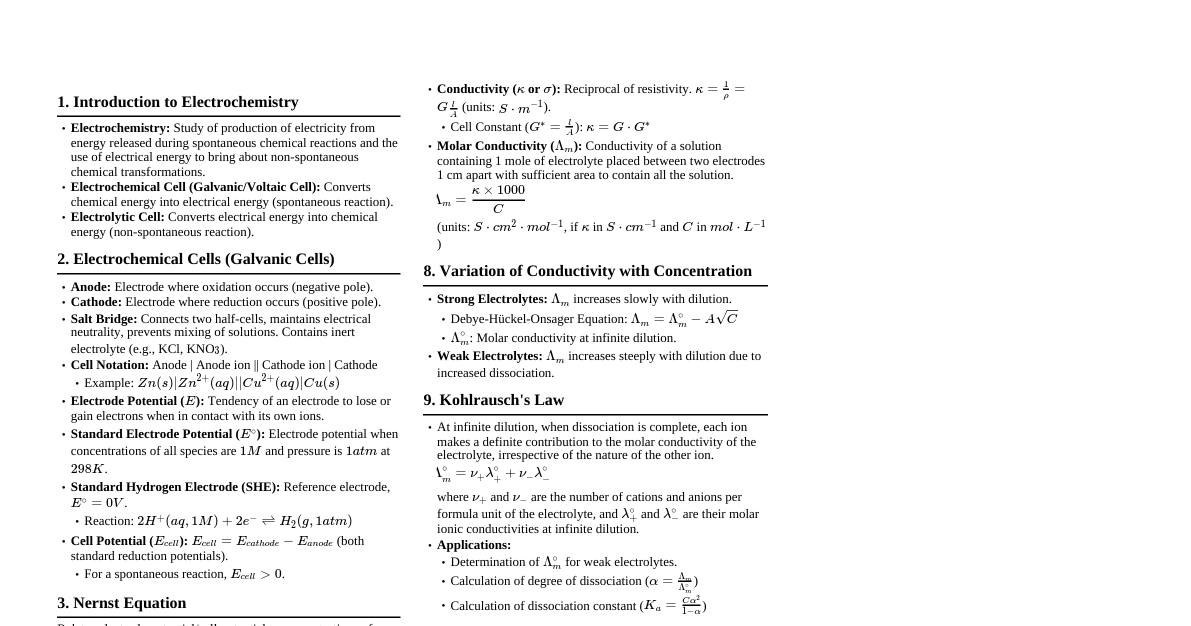
1. Basic Concepts Electrochemistry: Study of production of electricity from energy released during spontaneous chemical reactions and use of electrical energy to bring about non-spontaneous chemical transformations. Electrochemical Cell: Device that converts chemical energy into electrical energy (Galvanic/Voltaic cell) or electrical energy into chemical energy (Electrolytic cell). Oxidation: Loss of electrons, increase in oxidation state. Occurs at anode . Reduction: Gain of electrons, decrease in oxidation state. Occurs at cathode . 2. Galvanic / Voltaic Cells Spontaneous Redox Reaction: Converts chemical energy to electrical energy. Salt Bridge: Connects two half-cells, maintains electrical neutrality. Contains inert electrolyte (e.g., KCl, KNO$_3$). Cell Representation (Daniell Cell): Zn(s) | Zn²⁺(aq, 1M) || Cu²⁺(aq, 1M) | Cu(s) Left side: Anode (Oxidation) Right side: Cathode (Reduction) Single line: Phase boundary Double line: Salt bridge Electrode Potential ($E$): Tendency of an electrode to lose or gain electrons. Standard Electrode Potential ($E^\circ$): Electrode potential when all species are at unit concentration (1M for solutions, 1 atm for gases) at 298 K. Standard Hydrogen Electrode (SHE): Reference electrode, $E^\circ = 0.00$ V. Pt(s) | H₂(g, 1 atm) | H⁺(aq, 1M) Standard Cell Potential ($E^\circ_{cell}$): $E^\circ_{cell} = E^\circ_{cathode} - E^\circ_{anode}$ (both standard reduction potentials) or $E^\circ_{cell} = E^\circ_{reduction} + E^\circ_{oxidation}$ 3. Nernst Equation Relates cell potential to concentrations/pressures of reactants and products. For a general reaction: $aA + bB \rightleftharpoons cC + dD$ $E_{cell} = E^\circ_{cell} - \frac{RT}{nF} \ln Q$ or $E_{cell} = E^\circ_{cell} - \frac{0.0592}{n} \log Q$ (at 298 K) where $Q = \frac{[C]^c[D]^d}{[A]^a[B]^b}$ (reaction quotient) $n$: number of electrons transferred $F$: Faraday's constant ($96485 \text{ C/mol e}^-$) $R$: Gas constant ($8.314 \text{ J K}^{-1}\text{ mol}^{-1}$) At Equilibrium: $E_{cell} = 0$ and $Q = K_c$ (equilibrium constant) $E^\circ_{cell} = \frac{RT}{nF} \ln K_c$ or $E^\circ_{cell} = \frac{0.0592}{n} \log K_c$ (at 298 K) 4. Gibbs Free Energy and Cell Potential $\Delta G = -nFE_{cell}$ $\Delta G^\circ = -nFE^\circ_{cell}$ For a spontaneous reaction, $\Delta G 0$. Relationship with equilibrium constant: $\Delta G^\circ = -RT \ln K_c$ 5. Electrolytic Cells Non-spontaneous Redox Reaction: Requires external electrical energy. Anode: Oxidation occurs (positive terminal). Cathode: Reduction occurs (negative terminal). Electrolysis: Process of using electrical energy to drive non-spontaneous reactions. Electrolysis of NaCl(aq): At Cathode (reduction): $2\text{H}_2\text{O}(l) + 2\text{e}^- \to \text{H}_2(g) + 2\text{OH}^-(aq)$ ($E^\circ = -0.83 \text{ V}$) or $\text{Na}^+(aq) + \text{e}^- \to \text{Na}(s)$ ($E^\circ = -2.71 \text{ V}$) H$_2$O is reduced preferentially due to lower (less negative) reduction potential. At Anode (oxidation): $2\text{Cl}^-(aq) \to \text{Cl}_2(g) + 2\text{e}^-$ ($E^\circ = -1.36 \text{ V}$) or $2\text{H}_2\text{O}(l) \to \text{O}_2(g) + 4\text{H}^+(aq) + 4\text{e}^-$ ($E^\circ = -1.23 \text{ V}$) Cl$^-$ is oxidized preferentially due to overpotential of O$_2$ evolution. 6. Faraday's Laws of Electrolysis First Law: The mass of a substance deposited or liberated at an electrode is directly proportional to the quantity of electricity passed through the electrolyte. $m \propto Q \implies m = ZQ = ZIt$ where $Z$ is electrochemical equivalent ($Z = \frac{\text{Molar Mass}}{nF}$), $Q$ is charge in Coulombs, $I$ is current in Amperes, $t$ is time in seconds. Second Law: When the same quantity of electricity is passed through different electrolytes, the masses of the substances deposited or liberated are directly proportional to their chemical equivalents (equivalent weights). $\frac{m_1}{m_2} = \frac{E_1}{E_2}$ where $E$ is equivalent weight ($E = \frac{\text{Molar Mass}}{n}$). 1 Faraday (1F): Charge of 1 mole of electrons = $96485 \text{ C}$. 7. Conductance of Electrolytic Solutions Resistance ($R$): $R = \rho \frac{l}{A}$ (units: Ohm, $\Omega$) Resistivity ($\rho$): Resistance of a conductor of unit length and unit area of cross-section (units: $\Omega \text{ cm}$). Conductance ($G$): Reciprocal of resistance. $G = \frac{1}{R}$ (units: Siemens, S or $\Omega^{-1}$). Conductivity ($\kappa$ or specific conductance): Reciprocal of resistivity. $\kappa = \frac{1}{\rho} = G \frac{l}{A}$ (units: $\text{S cm}^{-1}$). Cell constant $G^* = \frac{l}{A}$ (units: $\text{cm}^{-1}$). So, $\kappa = G \times G^*$. Molar Conductivity ($\Lambda_m$): Conductivity of a solution containing 1 mole of electrolyte when placed between two electrodes 1 cm apart with area large enough to contain all the solution. $\Lambda_m = \frac{\kappa \times 1000}{C}$ (units: $\text{S cm}^2 \text{ mol}^{-1}$) where $C$ is molar concentration in mol/L. Equivalent Conductivity ($\Lambda_{eq}$): $\Lambda_{eq} = \frac{\kappa \times 1000}{N}$ (units: $\text{S cm}^2 \text{ eq}^{-1}$) where $N$ is normality. 8. Kohlrausch's Law At infinite dilution, the molar conductivity of an electrolyte is the sum of the individual contributions of the anion and cation of the electrolyte. $\Lambda^\circ_m = \nu_+ \lambda^\circ_+ + \nu_- \lambda^\circ_-$ where $\nu_+$ and $\nu_-$ are the number of cations and anions per formula unit of the electrolyte, and $\lambda^\circ_+$ and $\lambda^\circ_-$ are the limiting molar conductivities of the individual ions. Applications: Calculation of $\Lambda^\circ_m$ for weak electrolytes. Calculation of degree of dissociation ($\alpha$): $\alpha = \frac{\Lambda_m}{\Lambda^\circ_m}$. Calculation of dissociation constant ($K_a$ or $K_b$) for weak electrolytes. 9. Batteries and Fuel Cells Primary Batteries: Non-rechargeable (e.g., Dry cell, Mercury cell). Dry Cell (Leclanché cell): Anode: Zn, Cathode: Carbon rod surrounded by MnO$_2$ and carbon powder. Electrolyte: Paste of NH$_4$Cl and ZnCl$_2$. Mercury Cell: Anode: Zn-Hg amalgam, Cathode: HgO and carbon. Electrolyte: Paste of KOH and ZnO. Secondary Batteries: Rechargeable (e.g., Lead-acid battery, Ni-Cd battery, Lithium-ion battery). Lead-Acid Battery: Anode: Lead, Cathode: Lead dioxide. Electrolyte: H$_2$SO$_4$. Discharge: $\text{Pb}(s) + \text{PbO}_2(s) + 2\text{H}_2\text{SO}_4(aq) \to 2\text{PbSO}_4(s) + 2\text{H}_2\text{O}(l)$ Recharge: Reverse reaction. Ni-Cd Cell: Anode: Cadmium, Cathode: Nickel dioxide. Electrolyte: KOH. Fuel Cells: Galvanic cells that convert energy from combustion of fuels (H$_2$, CH$_4$, CH$_3$OH) directly into electrical energy. High efficiency, pollution-free. H$_2$-O$_2$ Fuel Cell: Anode: H$_2(g)$, Cathode: O$_2(g)$. Electrolyte: Aqueous KOH or NaOH. Overall reaction: $2\text{H}_2(g) + \text{O}_2(g) \to 2\text{H}_2\text{O}(l)$ 10. Corrosion Electrochemical phenomenon where metals are attacked by the environment. Rusting of Iron: An electrochemical process. At Anode: $\text{Fe}(s) \to \text{Fe}^{2+}(aq) + 2\text{e}^-$ ($E^\circ = -0.44 \text{ V}$) At Cathode: $\text{O}_2(g) + 4\text{H}^+(aq) + 4\text{e}^- \to 2\text{H}_2\text{O}(l)$ ($E^\circ = 1.23 \text{ V}$) Overall: $2\text{Fe}(s) + \text{O}_2(g) + 4\text{H}^+(aq) \to 2\text{Fe}^{2+}(aq) + 2\text{H}_2\text{O}(l)$ $\text{Fe}^{2+}$ is further oxidized to $\text{Fe}^{3+}$ which forms hydrated ferric oxide (rust), $\text{Fe}_2\text{O}_3 \cdot x\text{H}_2\text{O}$. Protection Methods: Barrier protection (paint, grease). Galvanization (coating with Zn). Sacrificial protection (more active metal connected to protect less active metal). Electrochemical protection (connecting to external power source).